

No. 37 · Drafting (English edition first) · Marketing & trust · CITATION
The Findability Engine
How to Be Cited, Trusted, and Discovered in the Age of AI Search
The Findability Engine: How to Be Cited, Trusted, and Discovered in the Age of AI Search.
Search is becoming answer-first: systems retrieve, synthesize, and cite before a reader sees a list of links. CITATION connects identity, evidence, retrieval-ready content, and proof assets so serious work stays easy to find, judge, and credit. How to Be Cited, Trusted, and Discovered in the Age of AI Search. The framework: CITATION.
- pages
- 130
- chapters
- 12
- hours of reading
- ± 2
- editions
- EN · NL
- Design
- Drafting
- Manuscript
- Production
- Launched
The editions
Kindle and Paperback
Production shots of the editions. Not for sale yet — this page is the public working version.
-
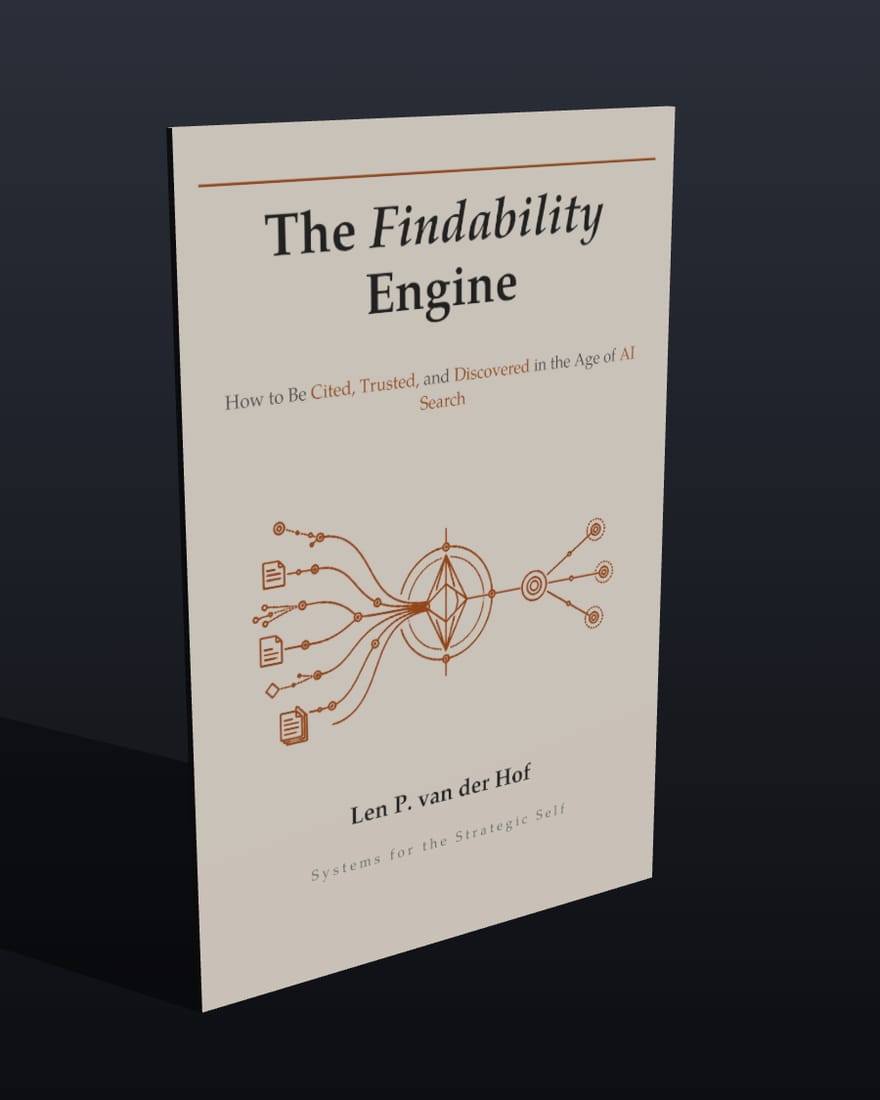
Kindle
The digital edition, ready in any Kindle app.
-
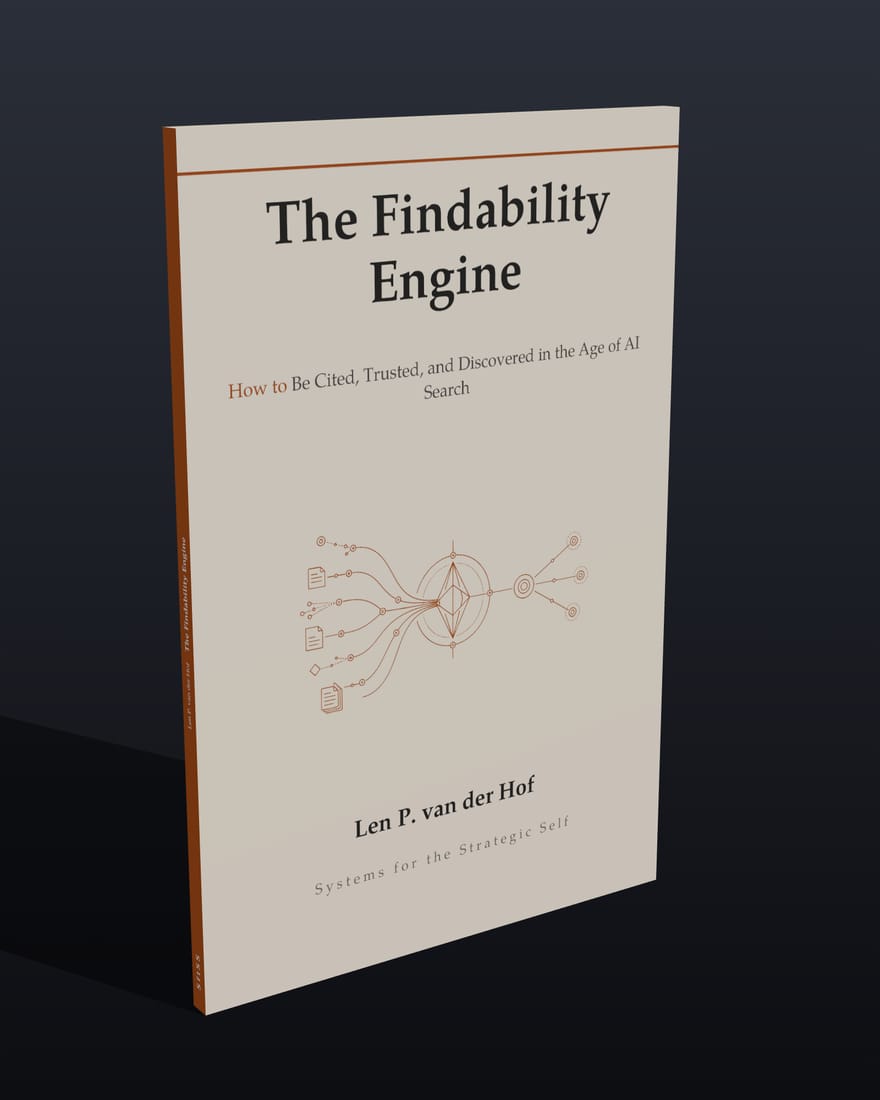
Paperback
The working copy. Mark it up. Take it into the meeting.


The book
How to Be Cited, Trusted, and Discovered in the Age of AI Search
The open web still contains your work. That no longer guarantees that anyone, human or machine, will find it. Search is becoming answer-first: systems retrieve, synthesize, and cite before a reader ever sees a list of links. A body of expertise can be useful, credible, and almost invisible at the moment an answer is assembled.
The Findability Engine turns discoverability into an operating system. Its CITATION framework connects identity, evidence, retrieval-ready content, and proof assets so that a serious body of work becomes easier to retrieve, evaluate, and credit.
What you learn
What this book puts in your hands
- Map the questions for which you intend to become a citable source.
- Build a citation stack around clear identity, primary evidence, and inspectable claims.
- Structure definitions, comparisons, frameworks, and source notes for reliable retrieval.
- Strengthen authority without manufacturing consensus or publishing synthetic filler.
- Test how answer engines represent your work and where attribution breaks down.
- Replace click-only reporting with a practical citation log and review cadence.
The framework
CITATION, step by step
-
Cite
-
Identify
-
Triangulate
-
Anchor
-
Track
-
Iterate
-
Optimize
-
Normalize
The contents
Chapter by chapter
Every chapter of The Findability Engine with its printed epigraph, what you can do afterwards, and the moment it is built for.
Introduction
The click economy is thinning
Your best work is still your best work. The channel that used to carry it to the people looking for it is quietly closing, and your dashboard has not mentioned it.
What you can do afterwards
You will be able to name what changed in the channel that carries your work, and read tonight's three-engine query as evidence instead of a mood.
Use this chapter when
Your traffic line has flattened for several quarters while the work behind it kept getting better, and no number on the dashboard explains the gap.
Chapter 1
The answer-first web
The channel that replaced the click already has a name, a scale, and a set of rules. Learn the name first; the rules come after.
What you can do afterwards
You will be able to name the channel that replaced the click, tell its four surfaces apart, and measure your place in it with citation presence instead of rank.
Use this chapter when
You can feel the shift but keep meeting it as separate emergencies, one flat quarter and one missing byline at a time.
Chapter 2
Why the link graph is no longer enough
The web of links did not die when the answers arrived. It was demoted to one input among several, and the signals that outrank it now are the ones it could never measure.
What you can do afterwards
You will know what your backlink work still buys you, what it quietly stopped buying, and which three signals now carry the weight the link graph lost.
Use this chapter when
The answer keeps skipping you and your first instinct is to go and earn more links.
Chapter 3
The CITATION framework
Three worries managed by hand are not a system. Name the eight moves that connect them, and the same work becomes an engine you can run on purpose.
What you can do afterwards
You will be able to name the eight moves that make a body of work citable, and mark your own position on each.
Use this chapter when
You are carrying source trust, citation presence, and retrieval-ready content as three separate worries with no system holding them together.
Chapter 4
Cite and Identify
Two moves come before the machine ever reads you: make a claim worth crediting, and know exactly where you need the credit to land. Skip them, and everything you build downstream rests on a claim that was never clearly yours and a map you never drew.
What you can do afterwards
You will state your best claim once, plainly, as yours, and leave holding a citation log that names the questions you should own and whoever is being credited in your place.
Use this chapter when
Your strongest idea is argued everywhere in your work and stated cleanly nowhere a machine could quote it.
Chapter 5
Triangulate and Anchor
A claim you can point to is not yet a claim a machine will trust. Two more moves stand between appearing and being believed: corroborate the claim past your own pages, and fasten it to an identity a machine can read without guessing. Do both, and the credit stops slipping to someone else.
What you can do afterwards
You will be able to explain why the machine credited someone else, and leave with the weakest link named for each of the three claims you most want cited.
Use this chapter when
The citation log came back uncredited: the thinking in the answer was yours and the name on it was not.
Chapter 6
Track and Iterate
A snapshot tells you where you stand. It cannot tell you which way you are moving. The last two moves turn one afternoon's audit into a moving picture: watch the few signals that reveal whether the machine is citing you more, then change the work on what those signals show. A measurement that ends in nothing changed was theater all along.
What you can do afterwards
You will run a short review on four readings, on a cadence you keep, and close each pass with one committed move routed back to the upstream fix.
Use this chapter when
You have audited your foundations once and have no way to tell whether they are getting stronger or quietly eroding.
Chapter 7
Optimize and Normalize
What you can do afterwards
You will re-render one piece so a machine can lift its claim whole, and set the single standard you will hold the rest of your work to.
Use this chapter when
Your claims are citable, corroborated and anchored, and the machine still has to fight the page they live on.
Chapter 8
The citation stack
What you can do afterwards
You will draw your body of work as four layers and give the fault a location, so you can see which layer is thin and what is resting on it.
Use this chapter when
You have run all eight moves at least once and still hold them as eight separate disciplines instead of one structure.
Chapter 9
Proof assets and the citability surface
What you can do afterwards
You will build one proof asset all the way, for the claim you would least like to see credited to someone else.
Use this chapter when
The stack diagram came back with the top layer empty, which is where it comes back for almost everyone who draws it.
Chapter 10
The book-as-engine flywheel
What you can do afterwards
You will score the eight moves across your whole body of work and name the one turn of the flywheel that is slipping.
Use this chapter when
You are holding a body of work large enough to bind, and treating it as the record of what you did rather than the asset that carries it.
Conclusion
The floor you stand on
What you can do afterwards
You will measure the distance between the line you wrote on the first night and tonight's reading, and see plainly what being the source bought you.
Use this chapter when
The engineering is done, the flywheel turns, and you are deciding what to point it at.
Who it is for
Who this book was written for
The result is more than a content plan. It is a working system: a source-trust audit, a claim architecture, a retrieval-ready publishing pattern, a citation log, and a ninety-day installation sequence.
This is not an SEO obituary and not a collection of weekly platform tricks. It is for authors, founders, consultants, and experts whose authority depends on being found accurately. Rankings still matter. The deeper question is whether the systems answering on your behalf can identify what you know, verify why it is credible, and name you as the source.
The reader it was written for
Authors, consultants, and experts whose authority depends on being discovered and cited. Mid-career; ships a body of work (book, research, practice, framework, newsletter, podcast) that the open web is supposed to surface. Technical founder-turned-author, or independent researcher, or thought leader with a real practice. Age 32–55. Already has a working professional brand;
What you will use it on
- Diagnose why organic traffic is flat or declining even when the work is good.
- Audit their own citation presence across AI Overviews, AI Mode, Perplexity, and ChatGPT-browse.
- Build (or rebuild) a citation stack: identity, evidence, retrieval-ready content, proof assets.
- Engineer their next book, framework, or research practice to be citable.
- Measure what the old dashboard missed (citation presence, answer-box presence, branded search, referral shift).
- Brief their team or their editor in language that survives a board meeting.
Probably not for you if
- **Pure technical SEOs** who want a schema-and-sitemap tutorial. Not a how-to on JSON-LD or sitemap.xml.
- **Enterprise brand teams** with established paid acquisition who do not depend on organic citation.
- **Readers who want a generic "use AI to write content" book.** This is the opposite.
- **Clickbait operators, affiliate marketers, link schemes.** Engineered against that mode.
Editions
Editions and specifications
| Edition | Formats | Chapters | Pages | Reading time | ISBN (paperback) |
|---|---|---|---|---|---|
| English The Findability Engine | In production | 12 | 130 | ± 2 hours | — |
| Dutch The findability engine | In production | — | — | — | — |
Both editions are written natively. The Dutch text is not a machine translation of the English. · Trim size: 6x9″
Frequently asked
What readers usually want to know
What is The Findability Engine about?
Search is becoming answer-first: systems retrieve, synthesize, and cite before a reader sees a list of links. CITATION connects identity, evidence, retrieval-ready content, and proof assets so serious work stays easy to find, judge, and credit. The subtitle is: How to Be Cited, Trusted, and Discovered in the Age of AI Search.
What is the CITATION framework?
CITATION: Cite, Identify, Triangulate, Anchor, Track, Iterate, Optimize and Normalize.
Is there a Dutch edition?
Yes. The Dutch edition is The findability engine, written as a native edition rather than a machine translation. It moves through the same production line.
How long is The Findability Engine?
This edition runs 12 chapters, 130 pages in print and roughly 2 hours of reading.
Who is The Findability Engine for?
This is not an SEO obituary and not a collection of weekly platform tricks. It is for authors, founders, consultants, and experts whose authority depends on being found accurately. Rankings still matter. The deeper question is whether the systems answering on your behalf can identify what you know, verify why it is credible, and name you as the source.
The production system
How this book was made
Every title moves through the same gated production line: sourced research, a claim-level evidence ledger, structural review, fact-checking, red-team critique, and a bilingual final edit. AI agents do specialist work inside those gates; judgment, voice, and accountability stay human.
- Claims enter an evidence ledger with a source and a confidence grade before they reach the page
- English and Dutch are two native editions, not a translation of one another
- Every chapter clears readability, rhythm, and style gates before it is typeset


