

No. 23 · In design · Marketing & trust · TRUST
Marketing Without Manipulation
How to Sell with Integrity in a World of Persuasion Tactics
Win the customers that dark patterns drive away.
Manipulative marketing works once, then poisons the well. This book gives founders a trust-first operating system — five pillars that turn honesty into a durable growth engine. For operators who would rather earn attention than trick it.
- pages
- 292
- chapters
- 12
- hours of reading
- ± 4
- editions
- EN · NL
- Design
- Drafting
- Manuscript
- Production
- Launched
The editions
Kindle, Paperback and Hardcover
Production shots of the editions. Not for sale yet — this page is the public working version.
-
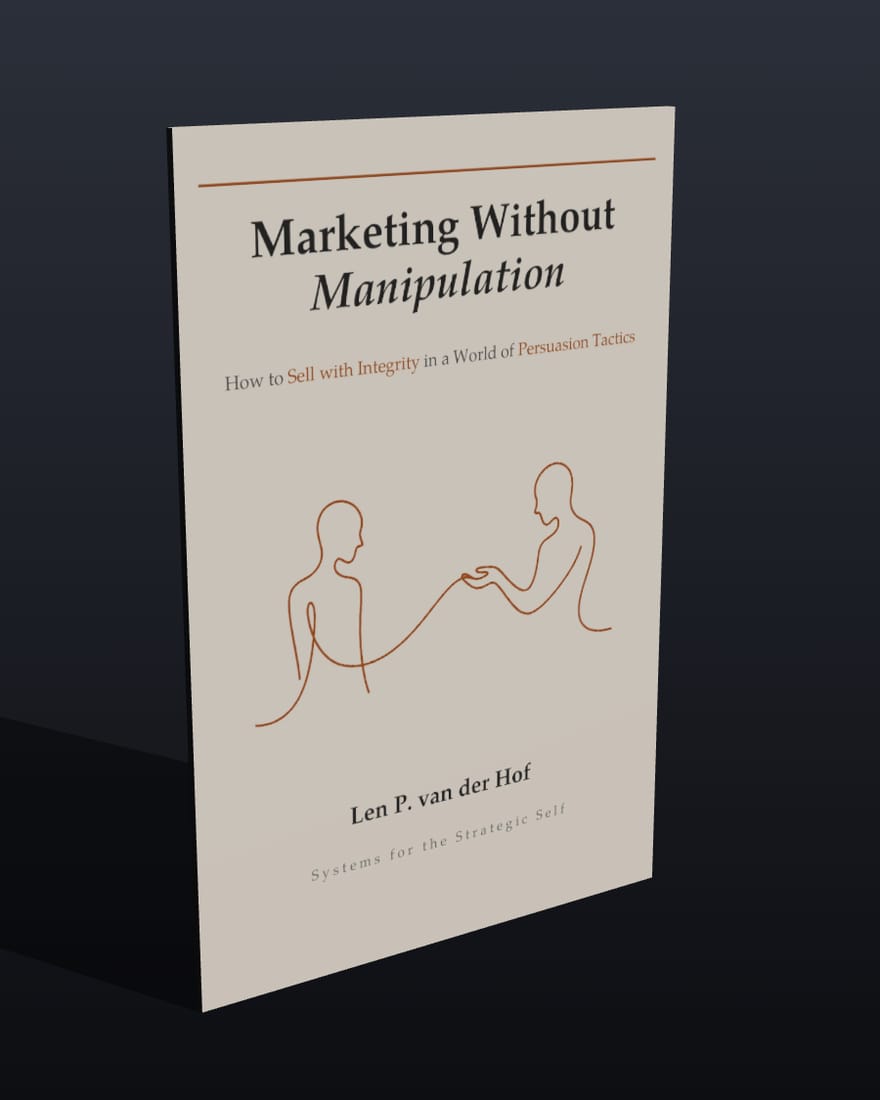
Kindle
The digital edition, ready in any Kindle app.
-
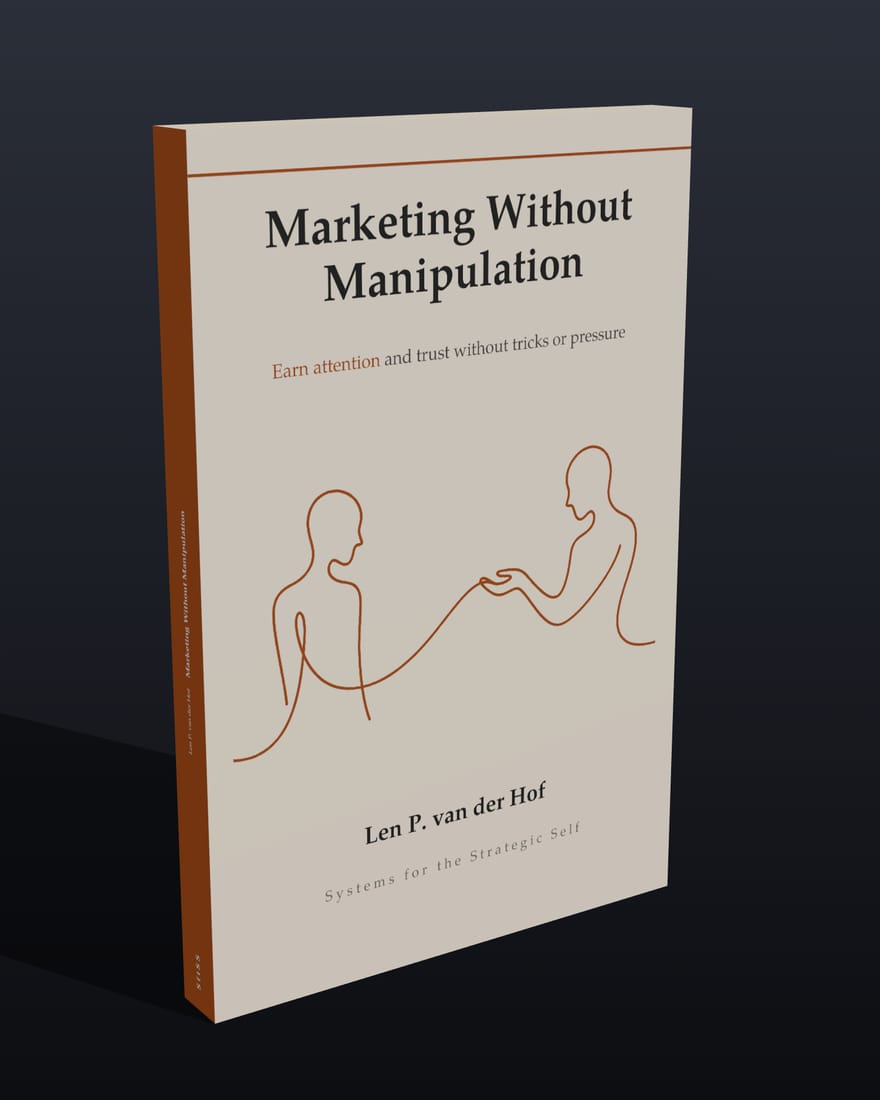
Paperback
The working copy. Mark it up. Take it into the meeting.
-
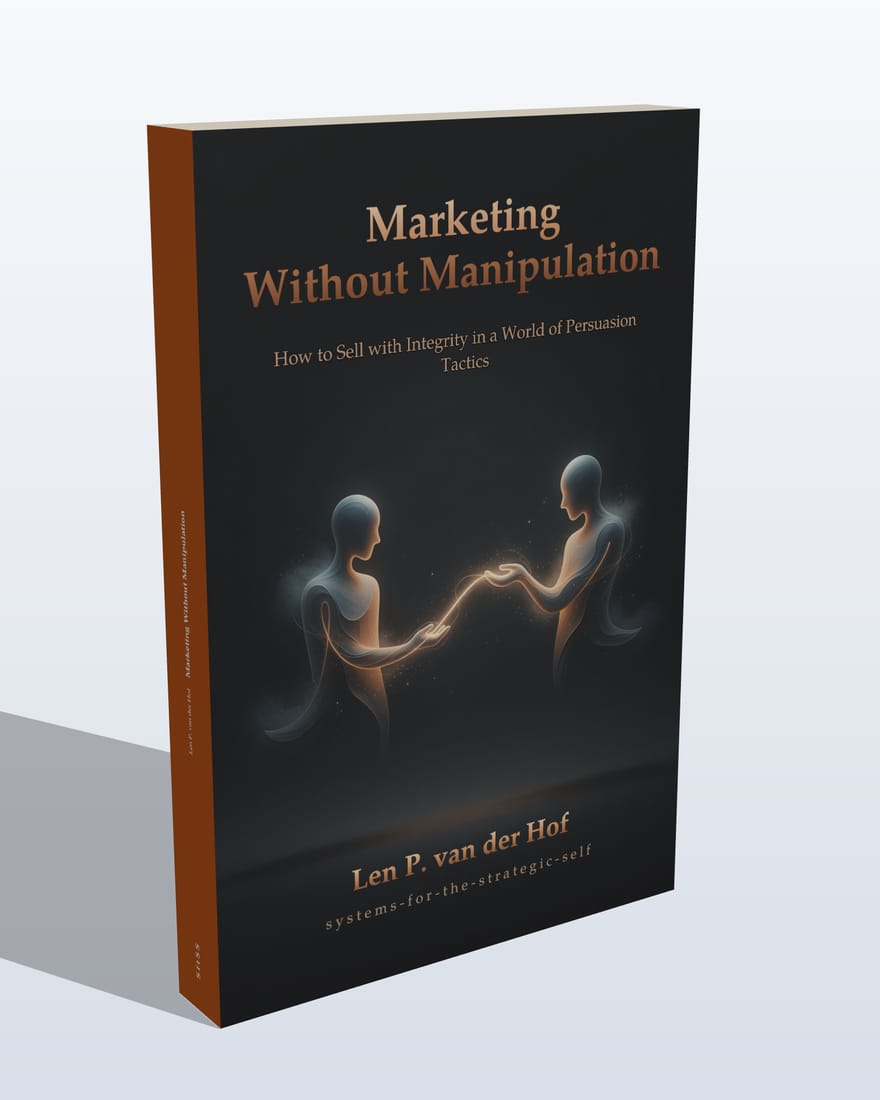
Hardcover
The shelf edition. Dark full-art jacket, built to stay in the room.


The book
How to Sell with Integrity in a World of Persuasion Tactics
You launch the thing you spent months building, open the doc to write the sales page, and freeze. Every move that supposedly works (the fake countdown timer, the "only 3 spots left," the shame-tinted subject line) feels like something done to a person you respect. So you soften it, or skip it, and the launch lands quietly. You are stuck choosing between marketing that works and marketing you can live with.
The usual fix is to "be authentic" and trust that good work finds its audience. It rarely does, because authenticity without architecture is just noise in a loud market.
This book offers the third path: a marketing system built on the TRUST framework: Transparency, Respect, Utility, Selectivity, and Time. It treats the customer as an intelligent decision-maker rather than a stimulus to be triggered, and it shows why trust-based positioning outperforms manipulation over any horizon longer than a quarter.
You will learn to: - State what you offer, what you don't, and what it costs with zero ambiguity - Write copy that persuades without false urgency, manufactured scarcity, or shame - Choose which customers to serve and which to decline, and why declining is leverage - Build content that educates instead of extracts, and referrals that compound - Measure marketing by trust earned, not just conversions captured
The result is durable: aligned customers who stay longer, refer more often, and defend your reputation when you are not in the room. Not a spike that decays: an asset that compounds.
If you have ever written a sentence to sell something and felt the need to wash your hands afterward, this book was written for the operator you are when integrity and growth stop being a trade-off.
What you learn
What this book puts in your hands
- The TRUST framework: Transparency, Respect, Utility, Selectivity, Time
- Growth tactics that compound trust instead of burning it
- Win the buyers fake urgency and dark patterns repel
The framework
TRUST, step by step
Transparency, Respect, Utility, Selectivity, Time
-
T=Transparency
-
R=Respect
-
U=Utility
-
S=Selectivity
-
T=Time
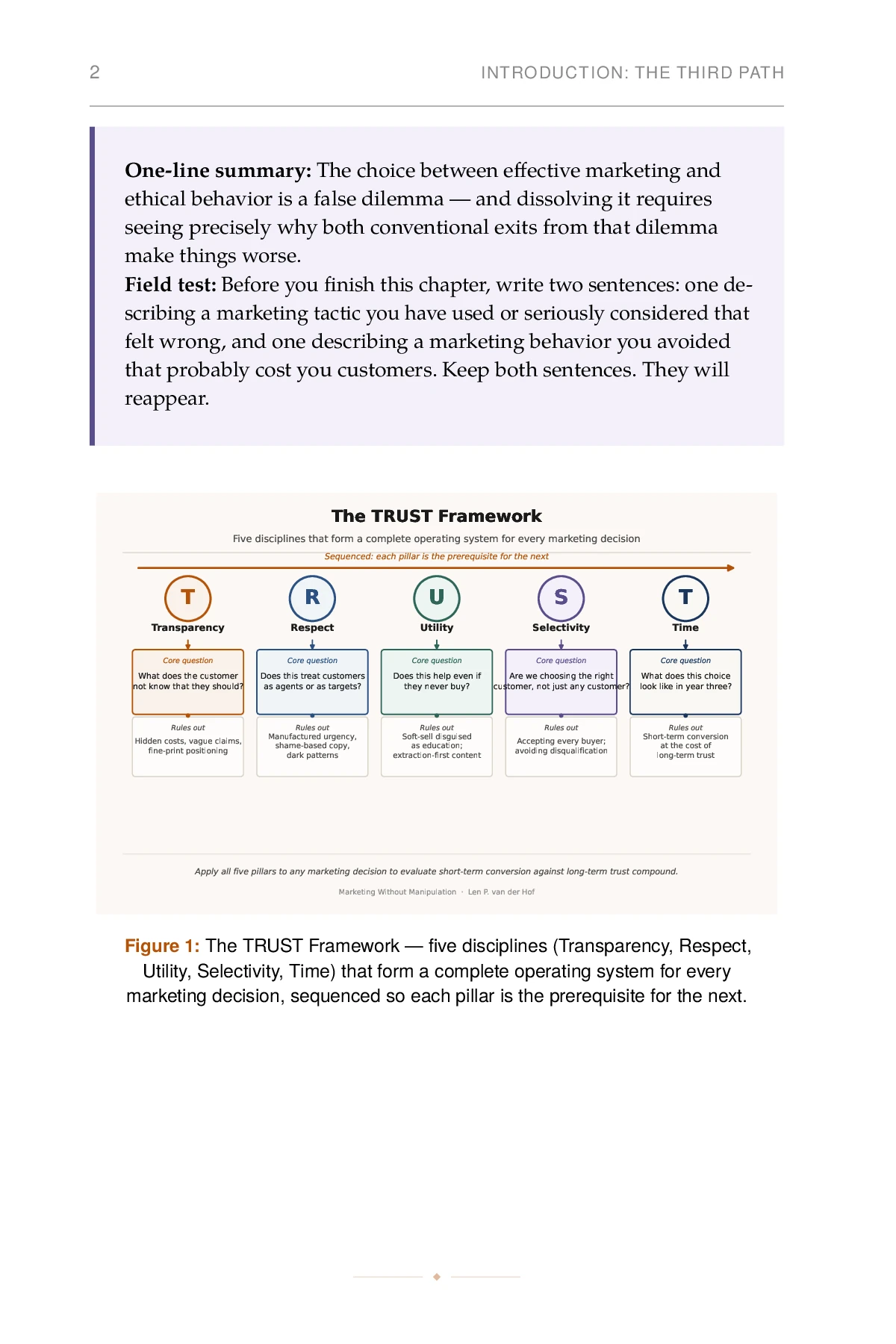
From the book
The TRUST Framework — five disciplines (Transparency, Respect, Utility, Selectivity, Time) that form a complete operating system for every
Marketing Without Manipulation, printed page: The TRUST Framework — five disciplines (Transparency, Respect, Utility, Selectivity, Time) that form a complete operating system for every
Inspect more pagesLook inside
Pages from the print edition.
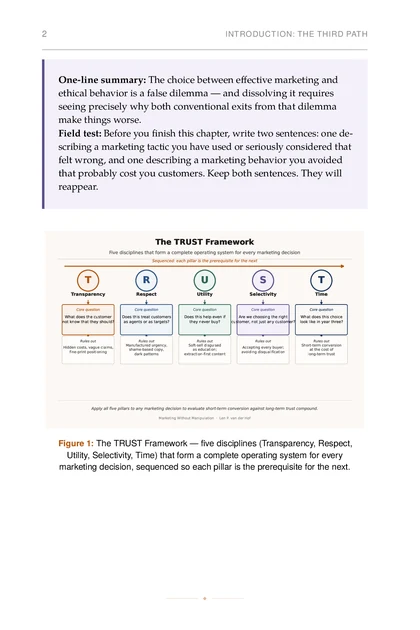 The TRUST Framework — five disciplines (Transparency, Respect, Utility, Selectivity, Time) that form a complete operating system for every
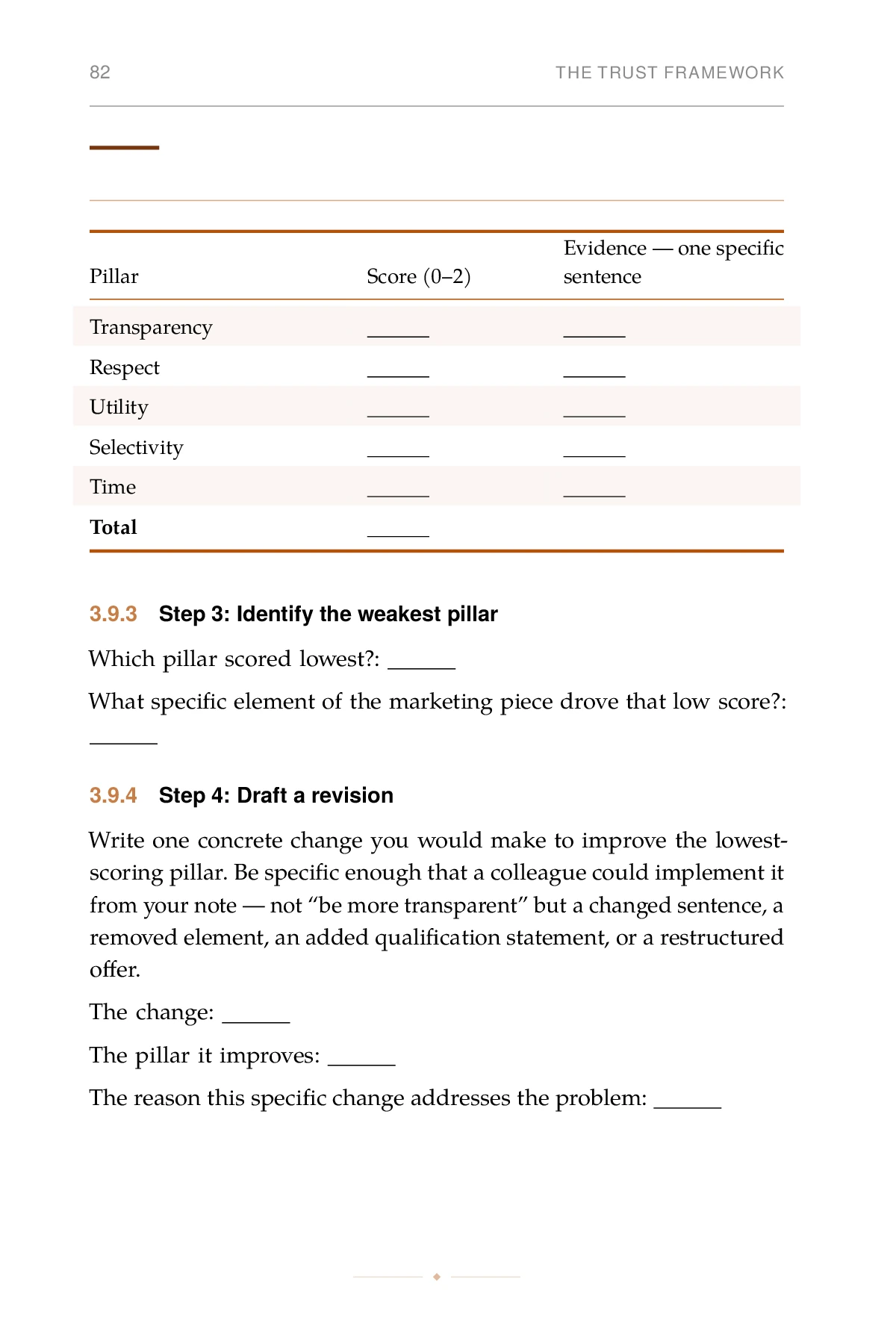
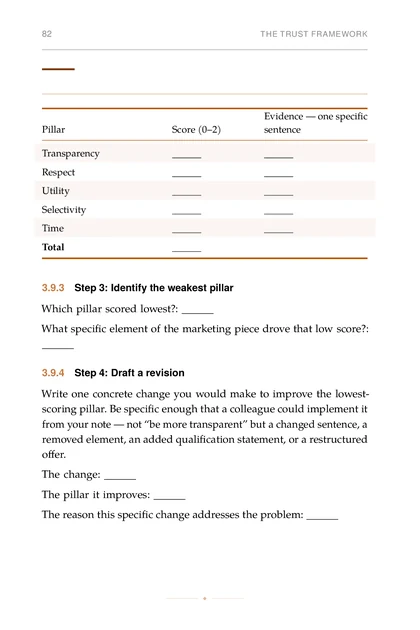 Evidence — one specific
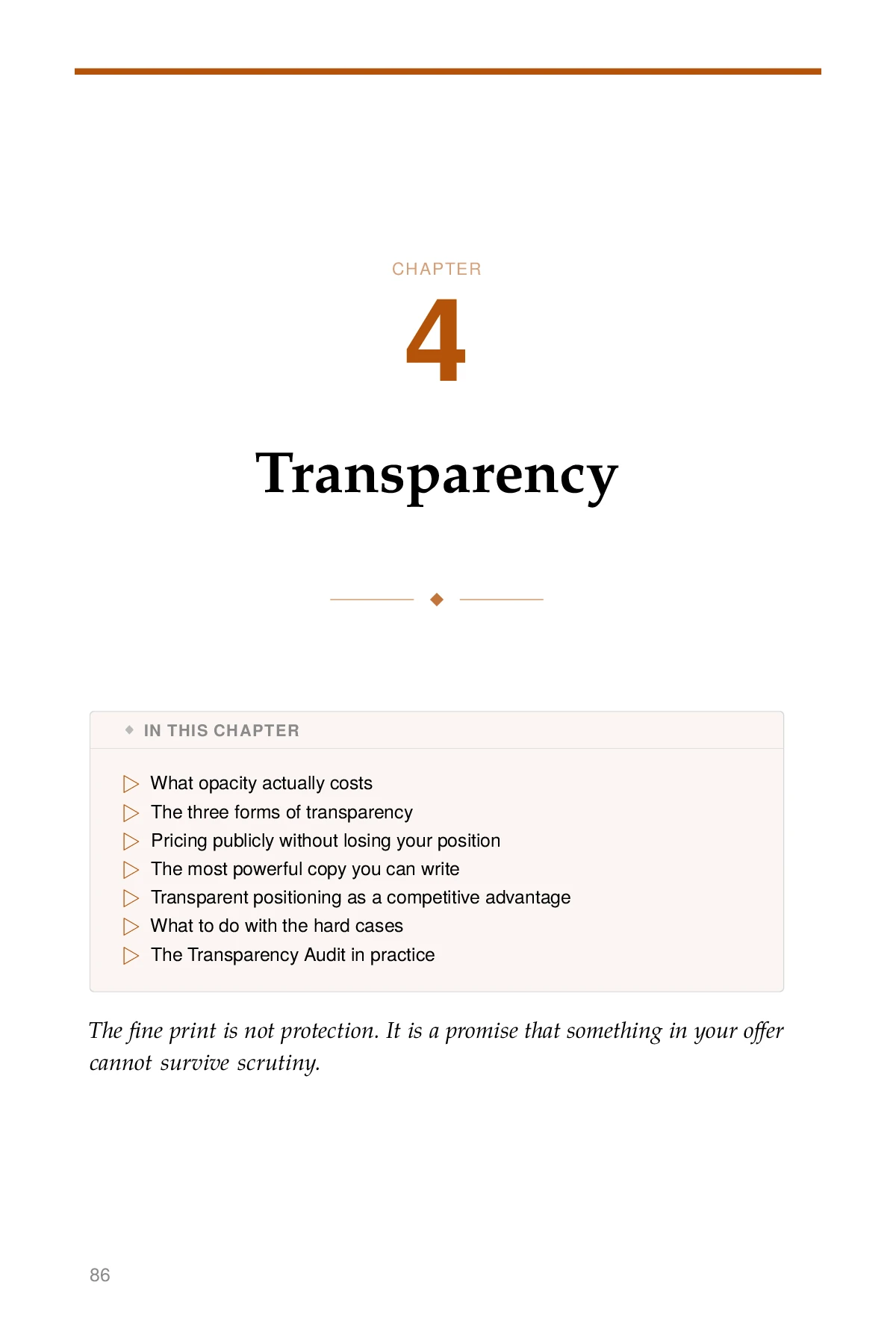
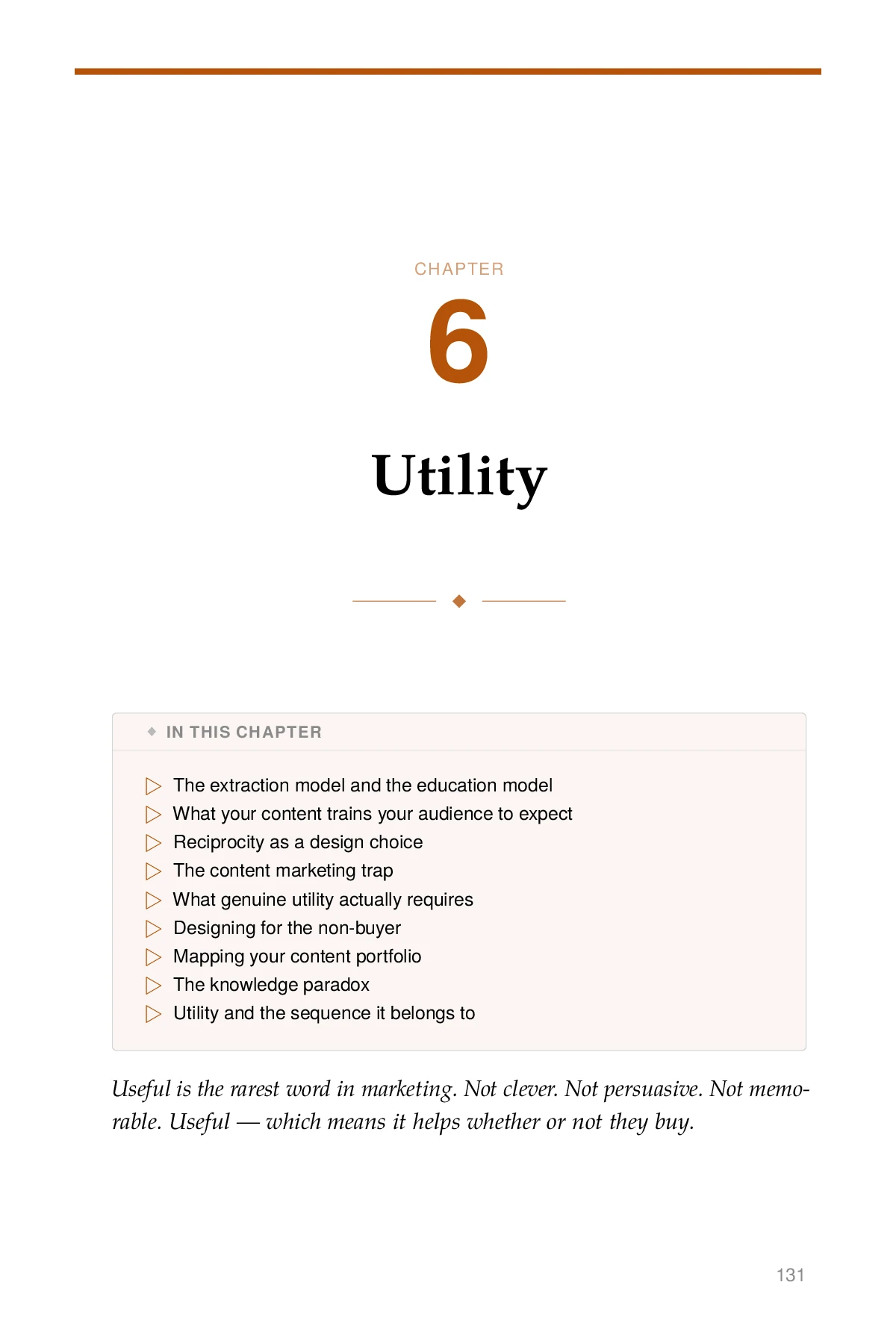
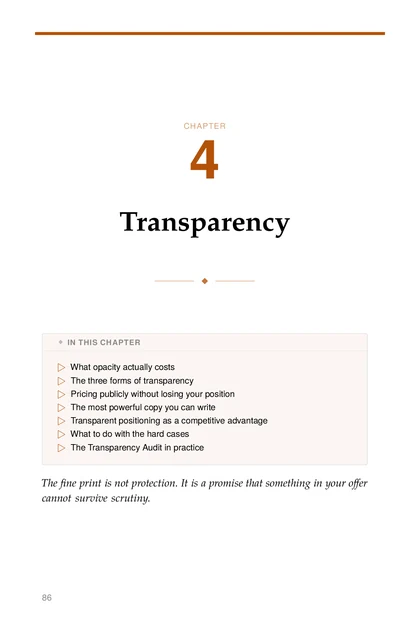 CHAPTER
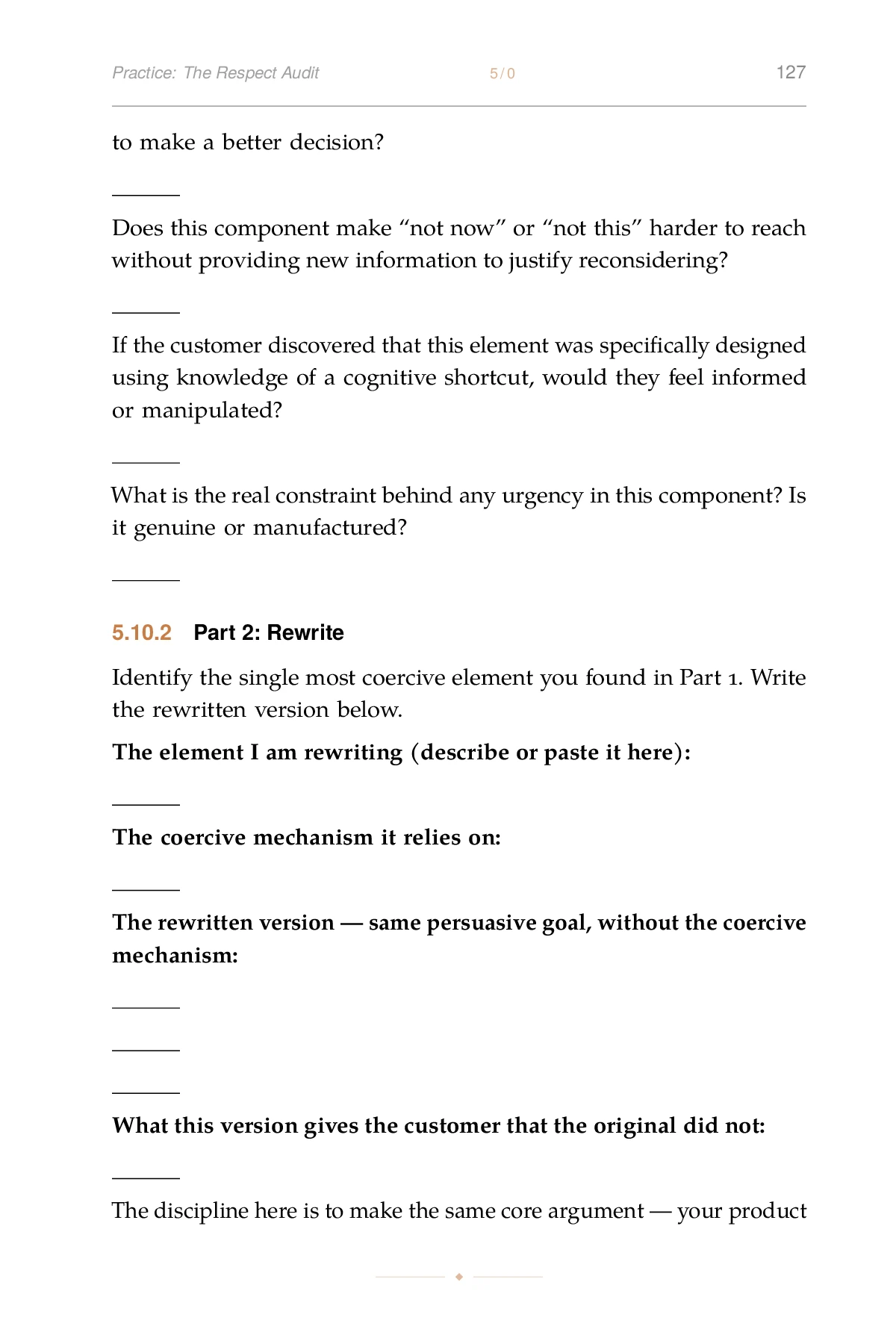
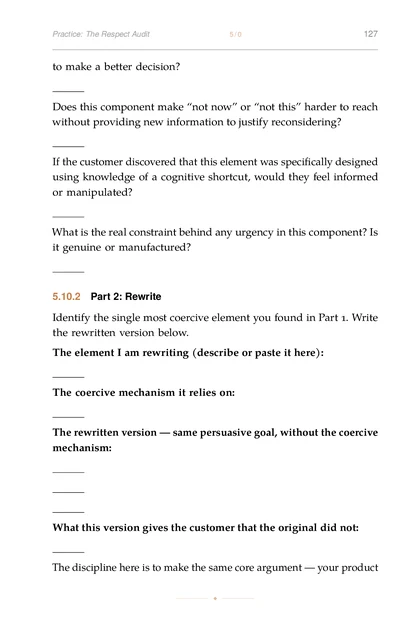 to make a better decision?
 CHAPTER
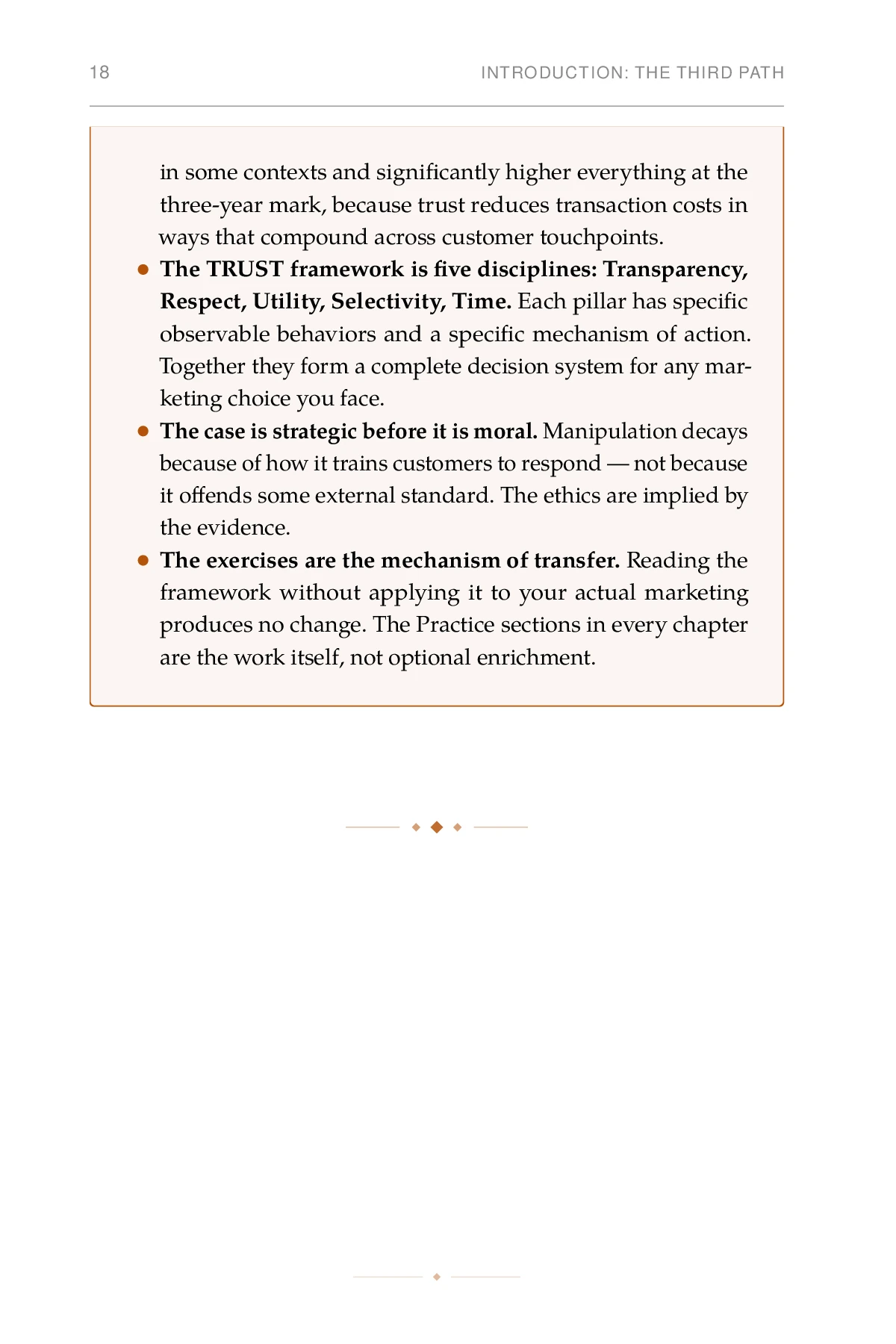
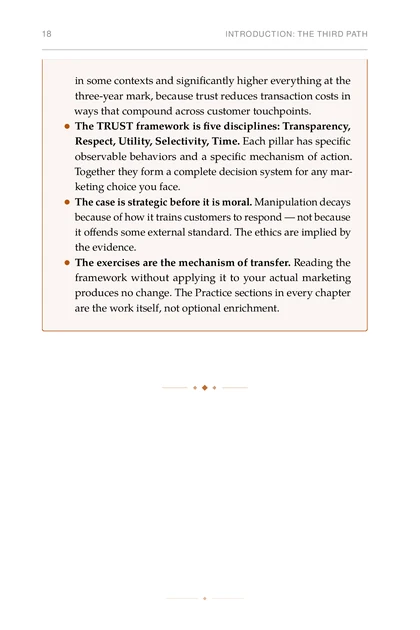 in some contexts and significantly higher everything at the
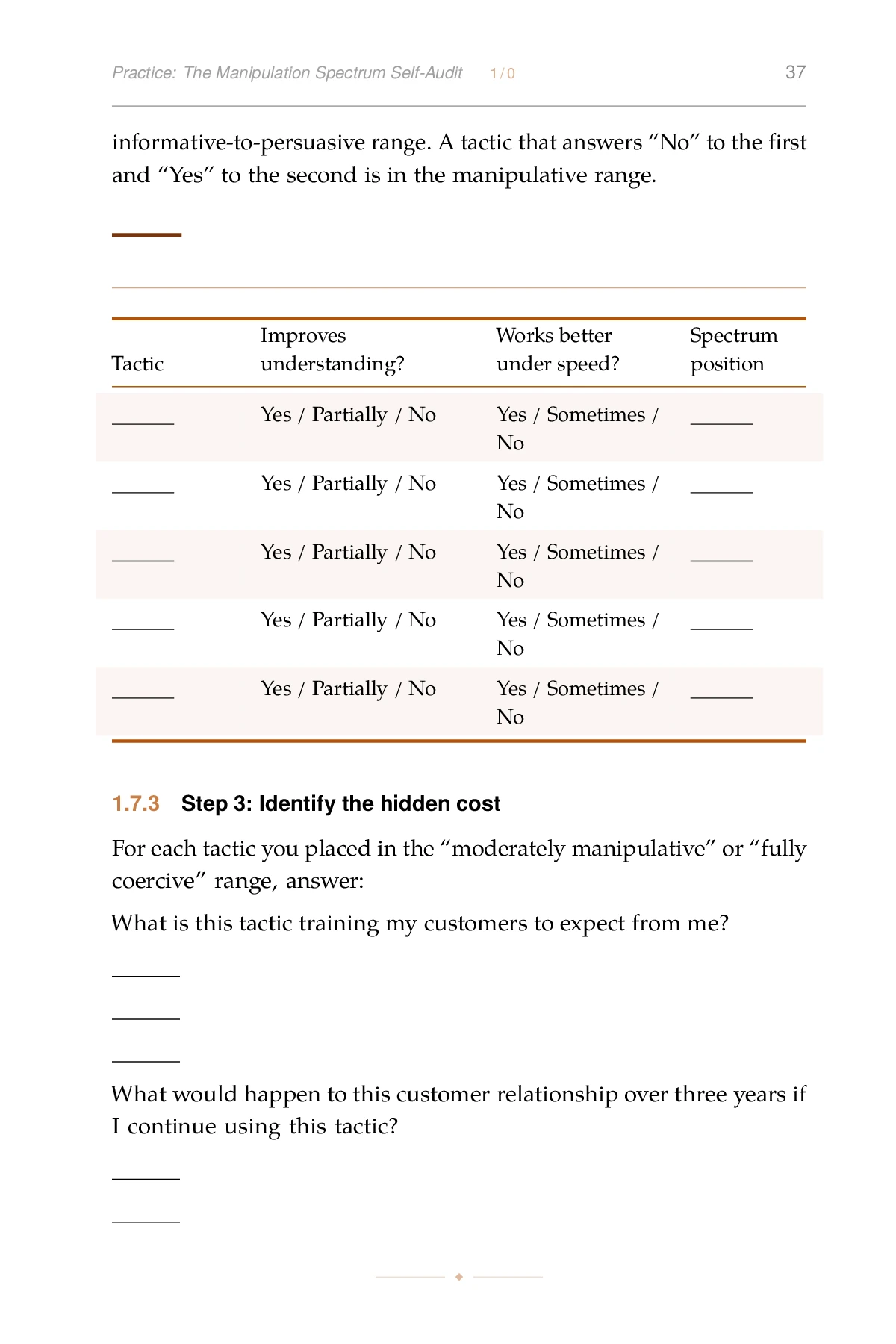
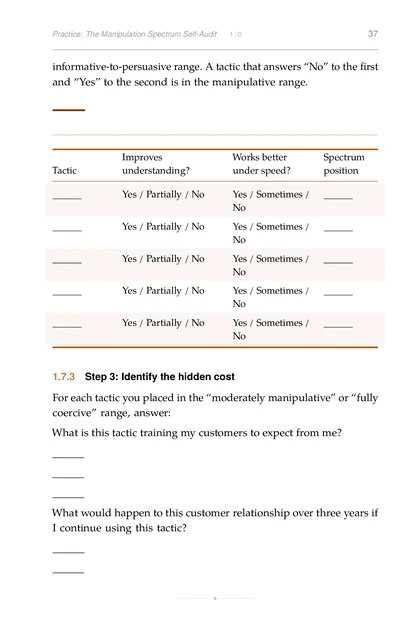 informative-to-persuasive range. A tactic that answers “No” to the first
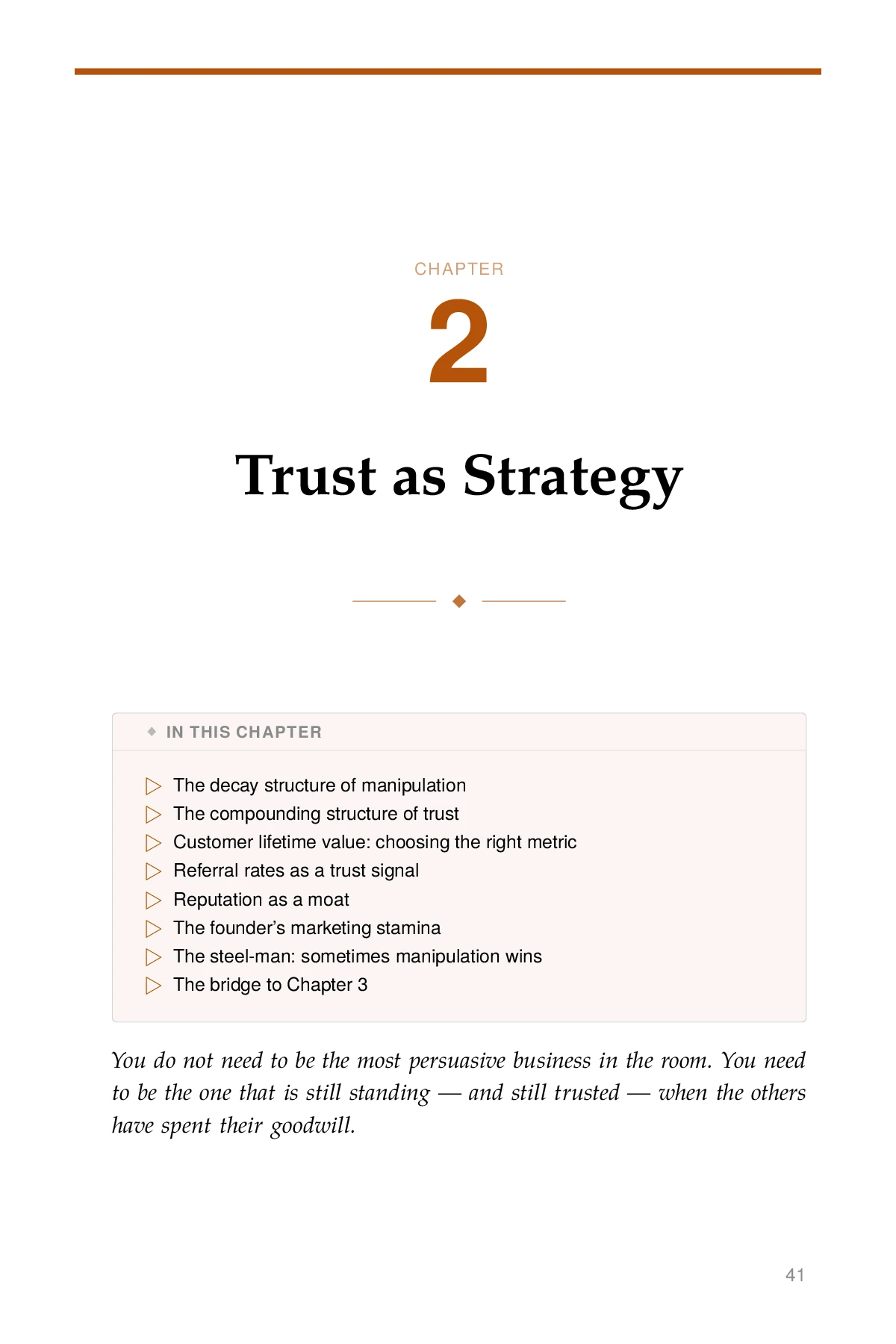
 CHAPTER
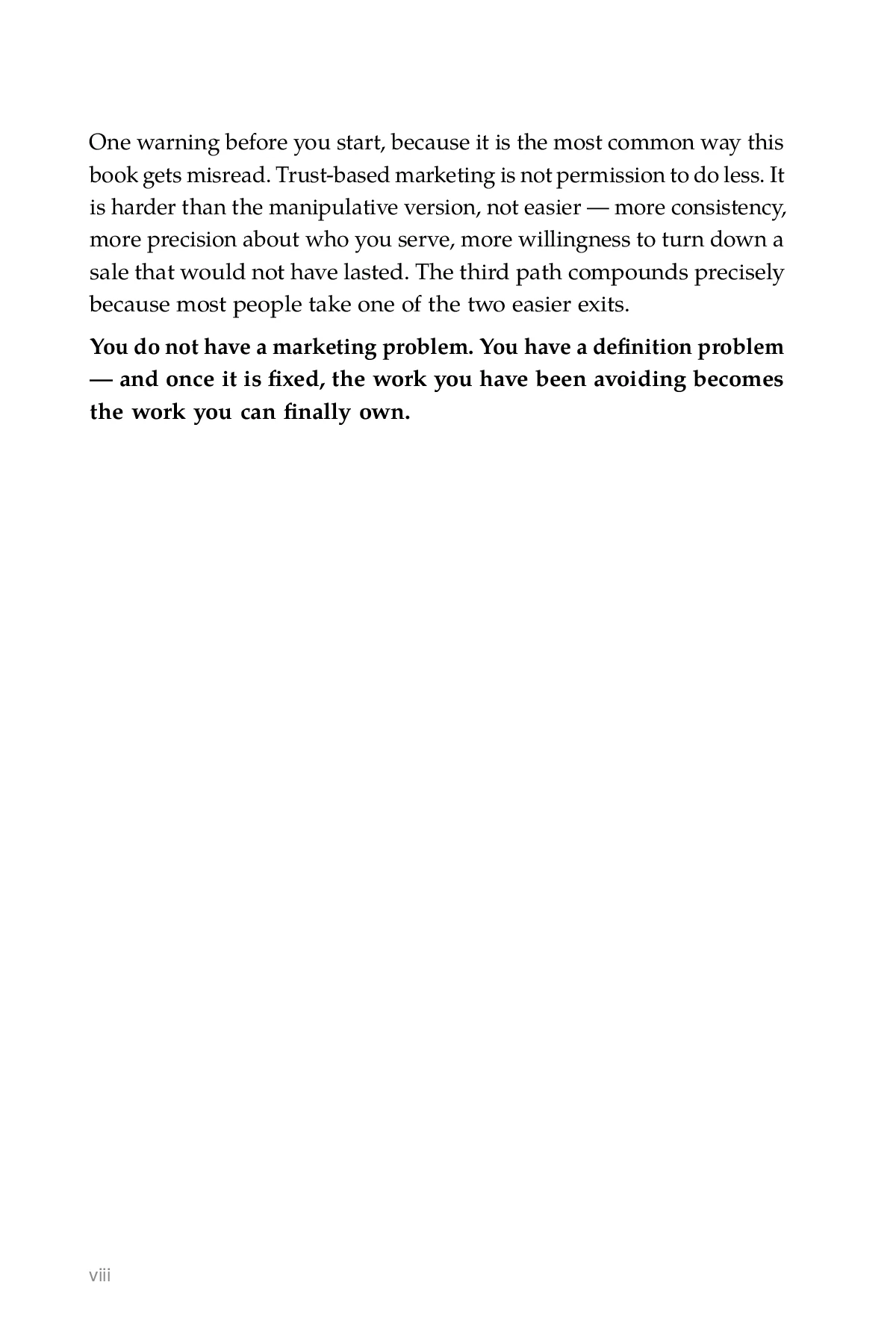
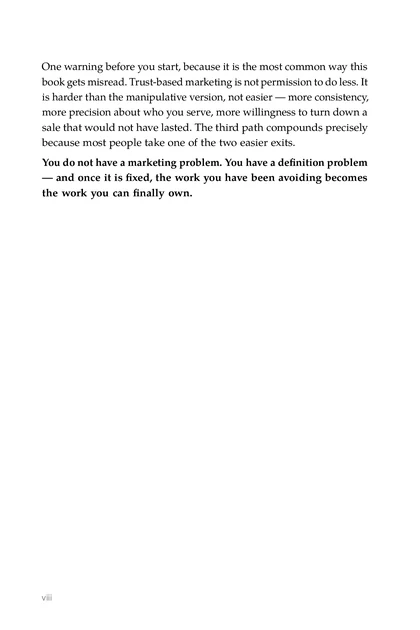 book gets misread. Trust-based marketing is not permission to do less. It
The contents
Chapter by chapter
Every chapter of Marketing Without Manipulation with its printed epigraph, what you can do afterwards, and the moment it is built for.
Introduction
Introduction: The Third Path
There is a reason you picked up this book instead of a conversion-rate playbook. You already sense that something is wrong with conventional marketing. The harder question is what to do instead.
What you can do afterwards
You will leave this chapter with a precise name for the discomfort you have been carrying, a clear view of the two false exits, and a working description of the alternative — trust-based marketing as deliberate architecture, not a moral posture.
Use this chapter when
You are beginning the book, or returning to it after feeling that "ethical marketing" still sounds like a compromise or a soft constraint on real growth.
Chapter 1
The Manipulation Trap
Most of what the industry calls "best practice" is optimized for the next click, not the next year. The gap between those two time horizons is where your reputation lives.
What you can do afterwards
You will be able to name the specific marketing patterns that erode customer trust, understand precisely why they work in the short run and fail in the long run, and place your own current practice honestly on the manipulation spectrum.
Use this chapter when
You feel a nagging discomfort about a tactic you have deployed or are about to deploy — and you cannot quite articulate why it bothers you.
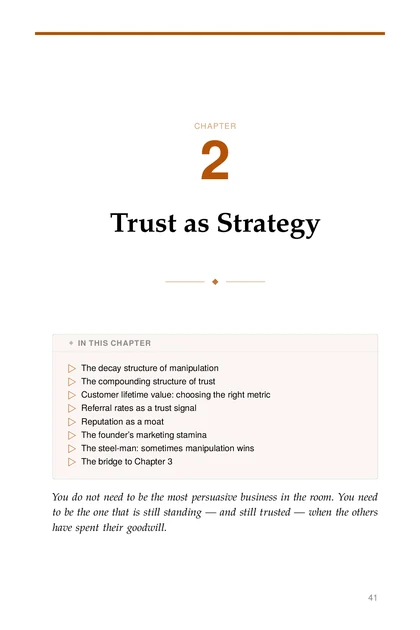
Chapter 2
Trust as Strategy
You do not need to be the most persuasive business in the room. You need to be the one that is still standing — and still trusted — when the others have spent their goodwill.
What you can do afterwards
You leave this chapter with a strategic, not moral, case for trust-based marketing — one that uses customer lifetime value, referral rates, and reputation as the measuring sticks, not virtue.
Use this chapter when
You are tempted to adopt a manipulation tactic because the short-term conversion looks worth the cost — or when someone tells you that trust-based marketing is a luxury you cannot afford right now.
Chapter 3
The TRUST Framework
A framework without teeth is a slogan. What follows is not a slogan — it is a decision procedure you can run in under two minutes on any marketing choice you face.
What you can do afterwards
You leave this chapter with a five-pillar operating system you can apply to any marketing decision before you publish it, send it, or launch it — not to feel virtuous, but to catch the specific choices that will cost you in year two.
Use this chapter when
You are staring at a piece of marketing — a sales page, an email sequence, a pricing structure, an offer — and cannot tell whether it crosses a line. Or when you want a fast, repeatable test for any decision, not just the obvious ones.
Chapter 4
Transparency
The fine print is not protection. It is a promise that something in your offer cannot survive scrutiny.
What you can do afterwards
You will understand why opacity is a liability rather than a shield, and you will have the tools to make your pricing, scope, and limits so clear that customers self-select before they ever speak to you.
Use this chapter when
You are about to write a pricing page, a sales email, a homepage, or any copy that currently contains hedges, qualifiers, or deliberate vagueness — or any time you are tempted to leave a question unanswered because you fear the honest answer will cost you the sale.
Chapter 5
Respect
The moment you decide that your customer is an intelligent adult who can handle the truth, your marketing gets easier to write, easier to live with, and — over time — easier to sell.
What you can do afterwards
You will be able to draw a principled line between persuasion and coercion, name the specific tactics that cross it, and rewrite your most pressure-heavy marketing without losing its persuasive force.
Use this chapter when
You are about to send a follow-up sequence, draft a scarcity-based offer, or write any copy that uses emotional pressure — and you want a test for whether you are informing a decision or manufacturing one.
Chapter 6
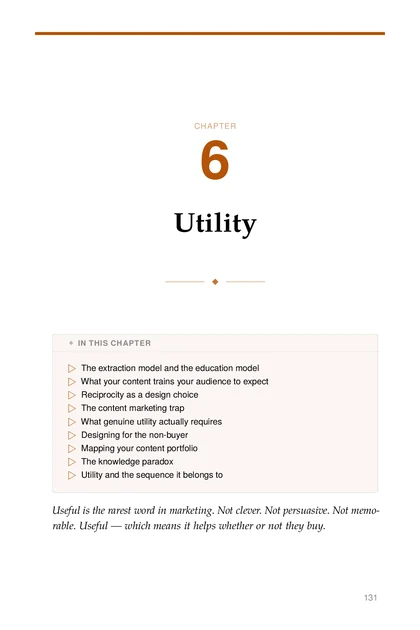
Utility
Useful is the rarest word in marketing. Not clever. Not persuasive. Not memorable. Useful — which means it helps whether or not they buy.
What you can do afterwards
You will understand why most "educational" content fails the test it claims to pass, what genuine utility actually requires, and how to design marketing that holds up even for people who will never become customers.
Use this chapter when
You are building a content strategy, planning a newsletter, creating a free resource, or producing anything you would describe as "giving value." Apply this chapter as a diagnostic before you publish.
Chapter 7
Selectivity
The clearest signal you can send to the market is not the list of customers you have served. It is the list of customers you turned away.
What you can do afterwards
You will understand why turning away customers is not a narrowing of your market but a sharpening of it — and you will draft the customer-selection statement your sales page has been missing.
Use this chapter when
You are reviewing your positioning, writing a sales page, refining your offer, or recovering from a run of wrong-fit customers who drained your energy, generated complaints, and left without renewing.
Chapter 8
Time
The most powerful force in marketing is not creativity, reach, or budget. It is the accumulation of kept promises.
What you can do afterwards
You will understand why the TRUST system's returns are non-linear — why the compounding logic means that month one and month thirty-six are not different in degree, but different in kind — and you will leave with a concrete picture of what that thirty-six-month arc looks like for your business specifically.
Use this chapter when
You are feeling the pressure to take a shortcut that would produce results faster but at the cost of something — a relationship, a standard, a piece of your integrity — that you know matters. Or when you are comparing your current traction against a competitor's and wondering whether you are playing the right game.
Chapter 9
The Trust-Based Marketing System
A principle that lives only in your mind is not a principle — it is a preference. Systems convert preferences into behavior.
What you can do afterwards
You will leave this chapter with a one-page operating rhythm — weekly decisions, monthly measurements, quarterly review — that converts the TRUST framework from something you believe into something you actually do, beginning the Monday after you finish reading.
Use this chapter when
You have absorbed the five pillars and find yourself agreeing with all of them in theory while noticing, week by week, that your marketing practice has not actually changed. Or when you are starting fresh and want to wire the principles into a calendar before old habits fill the space.
Chapter 10
When Trust Breaks
The founder who handles failure honestly will outlast the one who handles success brilliantly.
What you can do afterwards
You will understand exactly what damages trust when something goes wrong — and what repairs it — and you will leave with a five-step protocol you can execute the next time a customer is let down, whether the failure was yours, your product's, or simply the gap between what they expected and what arrived.
Use this chapter when
A customer complains publicly or privately; a shipment, delivery, or result falls short of what you promised; your team makes a mistake that reflects on you; or you realize, reading a negative review, that the failure described is accurate.
Conclusion
Conclusion: Your Marketing Is a Mirror
Every marketing decision is a revealed preference. Not about your product — about what you believe other people are worth.
What you can do afterwards
You will leave with a clear account of what the TRUST system actually is beneath the framework language — a philosophy about how you want to relate to other people — and with one concrete, immediately executable commitment that carries that philosophy forward.
Use this chapter when
You have finished the book and feel the pull of two simultaneous things: the relief of having a system, and the vague suspicion that systems are only ever as principled as the person running them.
Who it is for
Who this book was written for
The reader it was written for
The values-driven founder/creator. Solo founders, indie hackers, consultants, coaches, and creative professionals who have built something they believe in but struggle to market it without feeling manipulative. They are typically 25–45, digitally native, have read some business/marketing books, and have tried (and abandoned) several marketing approaches.
What you will use it on
- [ ] Write marketing copy that feels honest and compelling
- [ ] Design a pricing and packaging structure without false urgency
- [ ] Build a content strategy that educates rather than extracts
- [ ] Choose which customers to serve and which to decline
- [ ] Measure marketing success in ways that align with long-term values
- [ ] Handle the moral discomfort of selling and self-promotion
Probably not for you if
- Growth hackers looking for conversion-maximizing dark patterns
- Readers seeking NLP, covert hypnosis, or manipulation techniques
- People who believe marketing is inherently evil and cannot be redeemed
- Large enterprise marketing teams with dedicated budgets and departments
Editions
Editions and specifications
| Edition | Formats | Chapters | Pages | Reading time | ISBN (paperback) |
|---|---|---|---|---|---|
| English Marketing Without Manipulation | In production | 12 | 292 | ± 4 hours | — |
| Dutch Marketing zonder manipulatie | In production | 12 | 308 | ± 4 hours | — |
Both editions are written natively. The Dutch text is not a machine translation of the English. · Trim size: 6x9″
Frequently asked
What readers usually want to know
What is Marketing Without Manipulation about?
TRUST is a marketing operating system for founders who want demand without fake urgency, dark patterns, or borrowed authority. The subtitle is: How to Sell with Integrity in a World of Persuasion Tactics.
What is the TRUST framework?
TRUST: T=Transparency, R=Respect, U=Utility, S=Selectivity and T=Time. Transparency, Respect, Utility, Selectivity, Time
Is there a Dutch edition?
Yes. The Dutch edition is Marketing zonder manipulatie, written as a native edition rather than a machine translation. It moves through the same production line.
How long is Marketing Without Manipulation?
This edition runs 12 chapters, 292 pages in print and roughly 4 hours of reading.
The production system
How this book was made
Every title moves through the same gated production line: sourced research, a claim-level evidence ledger, structural review, fact-checking, red-team critique, and a bilingual final edit. AI agents do specialist work inside those gates; judgment, voice, and accountability stay human.
- Claims enter an evidence ledger with a source and a confidence grade before they reach the page
- English and Dutch are two native editions, not a translation of one another
- Every chapter clears readability, rhythm, and style gates before it is typeset
The series
More in this theme


