

No. 44 · Early draft · Marketing & trust · PROVE
Proof in Public
Trust Velocity for Evidence-First Founders
Buyers don't trust claims. They trust proof you can hand them.
Early-stage founders confuse activity with evidence: more posts, louder claims, another landing page. The Proof Engine treats trust as an evidence supply chain and gives you the PROVE system to build it: pilot the smallest proof that moves a buyer, record outcomes at the moment of truth, organize a searchable asset library, validate before publication, and exhibit signals that compound. For founders who refuse to manipulate and want to outrun hype with evidence.
- pages
- 208
- chapters
- 13
- hours of reading
- ± 3
- editions
- EN · NL
- Design
- Drafting
- Manuscript
- Production
- Launched
The editions
Kindle and Paperback
Production shots of the editions. Not for sale yet — this page is the public working version.
-
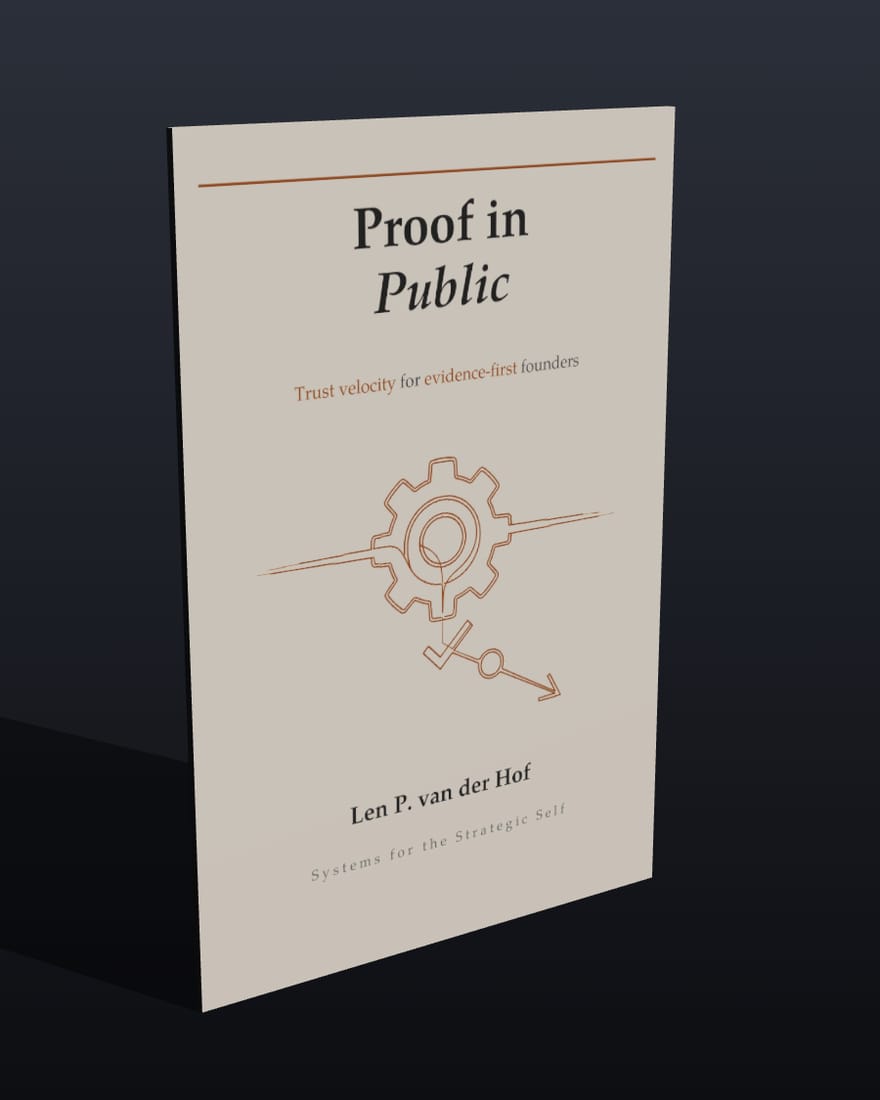
Kindle
The digital edition, ready in any Kindle app.
-

Paperback
The working copy. Mark it up. Take it into the meeting.


The book
Trust Velocity for Evidence-First Founders
The buyer nods through your pitch, says it sounds great, and asks you to "send something over." Then the thread goes quiet. You did not lose to a better offer; you lost to doubt you never saw, because the prospect could not tell (fast enough) whether you were the real thing or a confident stranger. In a crowded market, the deal does not go to the best work. It goes to the work the buyer can trust before the money moves.
The usual instruction is to network harder and let your reputation precede you. But reputation is slow, and "trust me" is the one claim a skeptical buyer is trained to discount.
Proof in Public treats credibility as something you manufacture on purpose, not something you wait to accumulate. It introduces the PROVE framework (Positioning, Receipts, Origination, Verification, and Endorsement), five sources of evidence that move a buyer from "who is this?" to "this is the one" before a single sales call. It builds proof the way you build a product: deliberately, in components, and measured by what it converts.
You will learn to: - Position so the buyer knows in one line what you do and who you are not for. - Turn delivered results into receipts: specific, dated, and verifiable, not vague praise. - Originate proof of your own: the demonstration, audit, or teardown that shows competence instead of claiming it. - Make every claim independently checkable, so trust survives contact with a careful buyer. - Earn endorsement that travels: references and signals that vouch for you when you are not in the room.
The result is a shorter path to yes. Buyers arrive already convinced, price resistance softens, and the sale becomes confirmation of a decision the proof already made.
If you sell real competence and are tired of watching louder, lesser operators close the deals you earned, this was written for you.
What you learn
What this book puts in your hands
- The PROVE framework: Pilot, Record, Organize, Validate, Exhibit proof end to end
- Five proof types mapped: usage, outcome, process, third-party, comparative
- A repeatable pipeline from customer reality to forward-able trust assets
- Validation gates so claims ship only after structured verification
- Trust velocity as a measurable signal: time to credible proof
The framework
PROVE, step by step
Pilot, Record, Organize, Validate, Exhibit proof end to end
-
Pilot
-
Record
-
Organize
-
Validate
-
Exhibit proof end to end
The contents
Chapter by chapter
Every chapter of Proof in Public with its printed epigraph, what you can do afterwards, and the moment it is built for.
Introduction
Introduction: The Trust Stall
You did not lose the deal because your product was weak. You lost it because your buyer could not defend the purchase internally, and you had nothing durable to hand them.
What you can do afterwards
You will see stalled GTM as an evidence-supply problem, not a messaging problem, and you will know where PROVE fits.
Use this chapter when
Prospects go quiet after a strong demo, or your team keeps rewriting copy instead of producing proof.
Chapter 1
The Evidence Gap
What you can say will always outrun what you can prove. The gap between them is where deals go quiet.
What you can do afterwards
You will measure the distance between what you claim and what you can prove, surface by surface, and read that distance as a supply imbalance you can correct.
Use this chapter when
Prospects ask "who else like us uses this?" and then go quiet, or your team keeps sharpening copy instead of producing evidence.
Chapter 2
Proof Taxonomy
A benchmark, a login count, and a measured result all get filed under proof. Your buyer does not weigh them the same, and neither should you.
What you can do afterwards
You will sort any piece of evidence into one of five proof types, know what each type can and cannot carry, and weight it before you spend it.
Use this chapter when
You hold a drawer of testimonials, screenshots, ratings, and logos and cannot tell which one to put in front of a buyer who just went quiet.
Chapter 3
Pilot Proof
The case study you are waiting for starts as an experiment you could run this week. Stop waiting for proof to arrive; design the smallest version and go produce it.
What you can do afterwards
You will design a proof pilot: the smallest experiment that yields one outcome asset strong enough to move a skeptical buyer, and you will know what to do when it misses.
Use this chapter when
A deal has stalled on a claim you believe but cannot show, and you have no case study for a buyer who looks like this one.
Chapter 4
Record Evidence
An outcome lives for a few weeks at full strength, then fades: the number gets overwritten, the memory drifts, the champion moves on. Catch it while it is still true.
What you can do afterwards
You will install a habit that records a customer outcome the moment it lands, with the baseline, date, attribution, and consent that let it survive a buyer's audit months later.
Use this chapter when
A customer just hit a result worth showing, or your check-in calls stay warm and friendly and leave you with nothing you could forward.
Chapter 5
Organize Proof Assets
The strongest evidence in your company is whatever a teammate can find the minute a buyer asks. Organize so the rest can be found just as fast.
What you can do afterwards
You will build a proof library: a single, claim-tagged repository where anyone on your team can find the strongest relevant proof for a given buyer in under a minute, and trust that it is current and cleared to send.
Use this chapter when
Your recorded proof is real but scattered across chat threads, drives, decks, and people's memories, and the right asset never surfaces at the moment a deal needs it.
Chapter 6
Validate Claims
Every claim you publish is a promise a stranger will test without you in the room. Build the checkpoint that decides which promises you can keep before you make them.
What you can do afterwards
You will build a validation gate: a checkpoint every public claim must pass before it ships, backed by a claim ledger that records each claim's proof, its review level, and the date it was last cleared.
Use this chapter when
Your marketing says more than your proof library can defend, or a buyer has called out a claim you could not back on the spot and you never want that to happen again.
Chapter 7
Exhibit Trust Signals
Validated proof sitting in a folder persuades no one. The only proof that moves a decision is the proof that reaches the buyer at the moment they decide.
What you can do afterwards
You will map the decision points where your buyers decide, and redesign each touchpoint so the strongest relevant proof lands there — not buried under filler, not saved for a follow-up that never comes.
Use this chapter when
Your proof library is stocked and your claims are validated, yet deals still stall, buyers still ask for references you never had to give before, and your best evidence never seems to reach the person who needed it.
Chapter 8
Trust Velocity
Volume of proof is not the metric. Speed of credible proof — the rate at which a skeptical stranger moves to a yes they can defend — is the one worth managing.
What you can do afterwards
You will define trust velocity for your own GTM motion, measure a baseline, locate the bottleneck that is slowing it, and leave with one lever to move first.
Use this chapter when
Proof in Public is running — claims are piloted, recorded, organized, validated, and exhibited — but you cannot tell whether it is working fast enough, or where the remaining friction lives.
Chapter 9
Proof-Led GTM Motions
Proof in Public is not a support function. It is the GTM motion. PROVE runs through every channel you use to grow — not after you have refined the pitch, but instead of it.
What you can do afterwards
You will walk one complete PROVE motion through each of the main GTM patterns — founder-led sales, product-led growth, content-led, and fundraise — and leave with a 30-day motion plan you can start this week.
Use this chapter when
PROVE is installed in each component — you can pilot, record, organize, validate, and exhibit — but the five steps are running as separate habits instead of as one continuous motion.
Chapter 10
Agents and Proof
An agent can search your proof library faster than you can, summarize a call transcript in seconds, and flag a claim that has aged past its freshness limit. It cannot manufacture an outcome that did not happen. That boundary is the only rule this chapter teaches.
What you can do afterwards
You will draw a clean line between the agent tasks that accelerate your proof operations and the uses that undermine the integrity your entire engine depends on — and you will leave with a practical configuration for each legitimate use case.
Use this chapter when
You are running PROVE at enough volume that manual search, summarization, and freshness monitoring are slowing the engine, and you want to know precisely where agent assistance starts and where it must stop.
Chapter 11
The Proof Moat
A competitor can match your features in a quarter. They cannot match an evidence archive that took you two years to earn.
What you can do afterwards
You will understand why proof compounds as a competitive advantage, design a 90-day PROVE roadmap for your team, assign the roles that keep the engine running, and leave with one sentence that explains the strategic value of your proof system to an investor, a co-founder, or a new hire.
Use this chapter when
PROVE is running as a motion — pilots feed records, records feed the library, claims clear the gate, and proof reaches decision points — and you are ready to think about what that motion builds over time, not just in this quarter.
Conclusion
Evidence-First Growth
The engine does not require belief. It requires execution.
What you can do afterwards
You will leave with one sentence, one protocol, and one immediate action — the distillation of every chapter into something you can carry without the book.
Use this chapter when
You have finished the book and need to convert understanding into a standing operating procedure, or you have returned here from a stalled deal and need to reorient fast.
Who it is for
Who this book was written for
The reader it was written for
The proof-starved founder. Seed to Series A, 1–15 employees, selling a real product but losing deals to "we need to see more proof." Technically literate, allergic to sleazy marketing, already reading series books on evidence and ethics. They can get meetings but not conviction.
Also a fit for
The founder-led seller. Solo consultant, agency owner, or technical founder who is still the closer. Needs proof assets for decks, emails, and demos — not a marketing team.
What you will use it on
- Close deals stalled on "sounds good but who else uses this?
- Build a proof library before the next fundraise
- Stop rewriting the pitch deck with stronger adjectives
- Use AI to **organize** proof, not invent it
- Align marketing with evidence policy from *Evidence-Aware Life*
Probably not for you if
- Growth hackers optimizing CAC without caring about claim integrity
- Founders pre-product / pre-customer
- Enterprise marketing ops with mature proof libraries
Editions
Editions and specifications
| Edition | Formats | Chapters | Pages | Reading time | ISBN (paperback) |
|---|---|---|---|---|---|
| English Proof in Public | In production | 13 | 208 | ± 3 hours | — |
| Dutch Proof in public | In production | — | — | — | — |
Both editions are written natively. The Dutch text is not a machine translation of the English. · Trim size: 6x9″
Frequently asked
What readers usually want to know
What is Proof in Public about?
PROVE helps founders turn claims into artifacts: pilots, records, organized proof, validation, and public evidence buyers can inspect. The subtitle is: Trust Velocity for Evidence-First Founders.
What is the PROVE framework?
PROVE: Pilot, Record, Organize, Validate and Exhibit proof end to end. Pilot, Record, Organize, Validate, Exhibit proof end to end
Is there a Dutch edition?
Yes. The Dutch edition is Proof in public, written as a native edition rather than a machine translation. It moves through the same production line.
How long is Proof in Public?
This edition runs 13 chapters, 208 pages in print and roughly 3 hours of reading.
The production system
How this book was made
Every title moves through the same gated production line: sourced research, a claim-level evidence ledger, structural review, fact-checking, red-team critique, and a bilingual final edit. AI agents do specialist work inside those gates; judgment, voice, and accountability stay human.
- Claims enter an evidence ledger with a source and a confidence grade before they reach the page
- English and Dutch are two native editions, not a translation of one another
- Every chapter clears readability, rhythm, and style gates before it is typeset


