Available now · worldwide on Amazon
The Agentic Author
The BooksOS Method for Writing Serious Nonfiction with AI Agents
AI makes writing faster and worse. A system is what raises the ceiling instead.
A quality-gated production system for serious nonfiction: research agents, evidence ledgers, structural review, fact checks, red-team critique, and bilingual publishing discipline.
Get the book
Reading from another country?Pick your own Amazon marketplace — same edition, your store.
Amazon links may include affiliate tags. That does not change the price you pay. Bol.com listings are third-party.
English & Dutch editions · Kindle, Paperback, Hardcover · free on Kindle Unlimited · Nederlandse editie →
- pages
- 320
- chapters
- 12
- hours of reading
- ± 5
- editions
- EN · NL


The editions
Choose your format
Same book, your format. You buy on Amazon, not on this site.
-
Kindle
Read now. Kindle Unlimited members get it at no extra cost.
Buy on Amazon -
Paperback
The working copy. Mark it up. Take it into the meeting.
Buy on Amazon -
Hardcover
The shelf edition. Dark full-art jacket, built to stay in the room.
Buy on Amazon


Available now
The BooksOS Method for Writing Serious Nonfiction with AI Agents
You sit down to write the book, and the tools are finally fast enough. The draft pours out. Then the doubt arrives: a claim you can no longer source, a chapter that re-argues the last one, a voice that stopped sounding like yours somewhere around thirty thousand words. You are producing more, and trusting it less.
The advice is to prompt harder and ship faster. That is how you mass-produce the flaw, because speed does not repair a method: it amplifies one.
This book offers the opposite of a productivity hack: a quality-gated production system. The Agentic Author introduces BooksOS (Brief, Bible, Map, Draft, Edit, Package, Launch): a books operating system of seven quality-gated stages that decompose authorship into parts you can run, check, and hand off one at a time. Each stage owns one decision and ends at a gate where your judgment, written once, does its checking a hundred times.
What you can do
What this book puts in your hands
You will learn to:
- Treat agents as specialists (a research engine, a structural critic, a fact-checker, a red-teamer, a bilingual editor), never as a ghostwriter.
- Separate judgment from execution so a stage can be delegated without surrendering the book.
- Run an evidence ledger and a hallucination check that catch the confident sentence that is merely fluent.
- Hold one voice across a draft, and across two languages, by writing the standard down before you write the prose.
The framework
BooksOS: the system behind the book
seven quality-gated stages from Brief to Launch
-
Brief
The promise: who the book is for, what changes for them, and what it refuses to be.
-
Bible
The memory: terms, voice, cast, and standards written down once so they hold for 300 pages.
-
Map
The order: a chapter map with dependencies, so structure fails on paper instead of at 30,000 words.
-
Draft
The pages: drafting as manufacturing, against an evidence ledger rather than memory.
-
Edit
The finish: structural, line, and proof passes plus red-team review and claim verification.
-
Package
The formats: one manuscript rendered into ebook, print, and web, never hand-formatted twice.
-
Launch
The campaign: positioning, assets, channels, and a measurement loop, not one announcement.
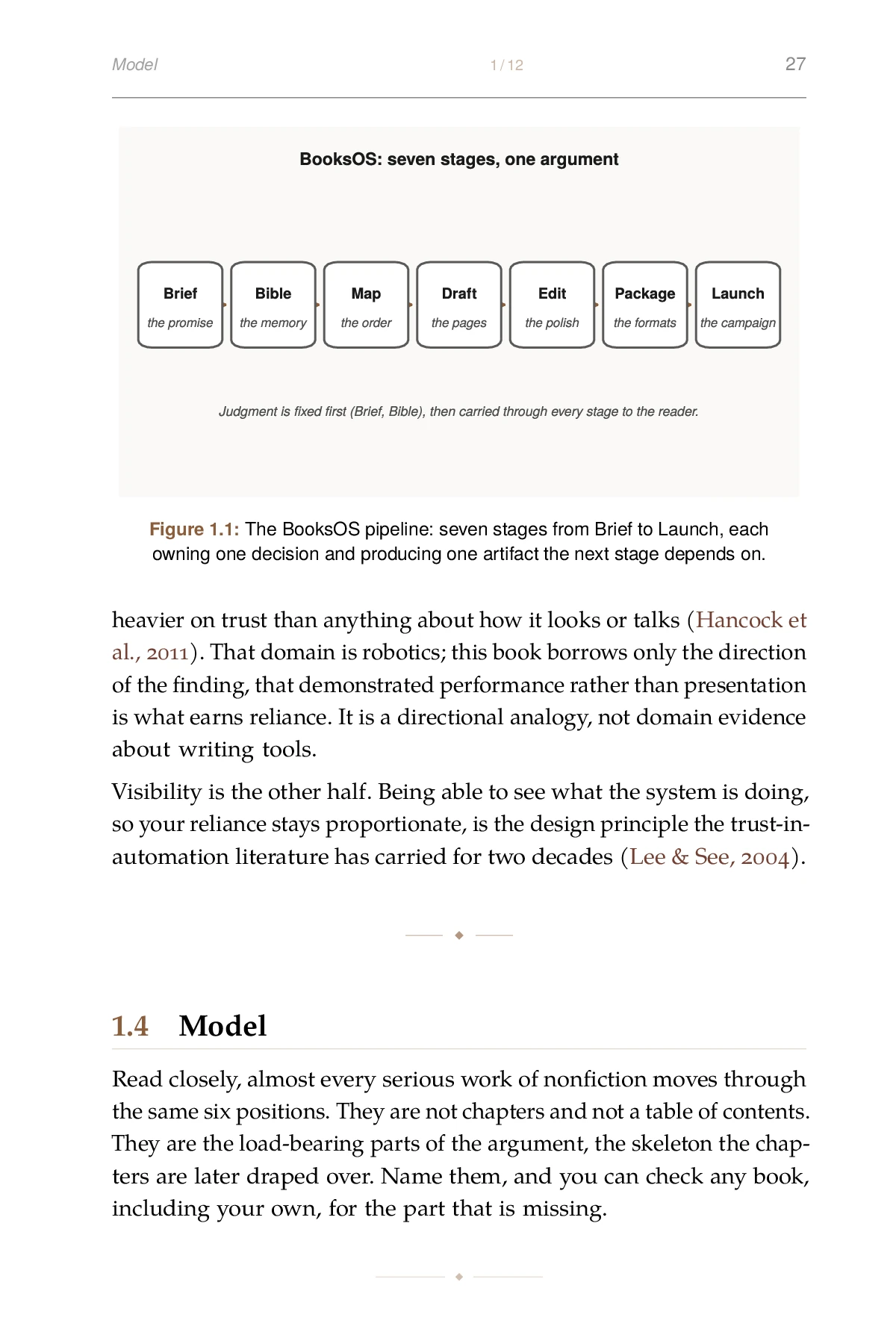
From the book
The BooksOS pipeline: seven stages from Brief to Launch, each
The Agentic Author, printed page: The BooksOS pipeline: seven stages from Brief to Launch, each
Inspect more pagesLook inside
Pages from the print edition.
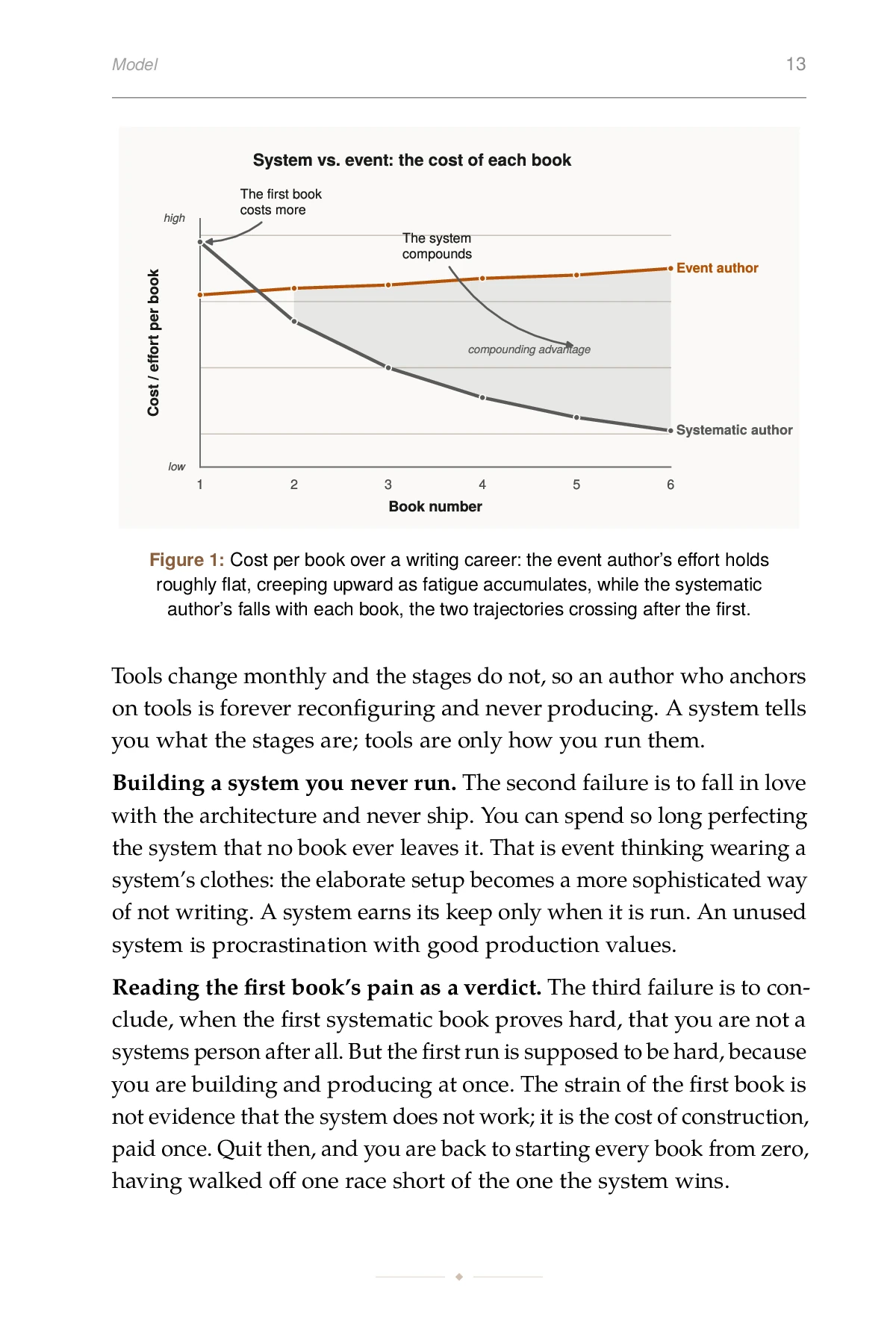
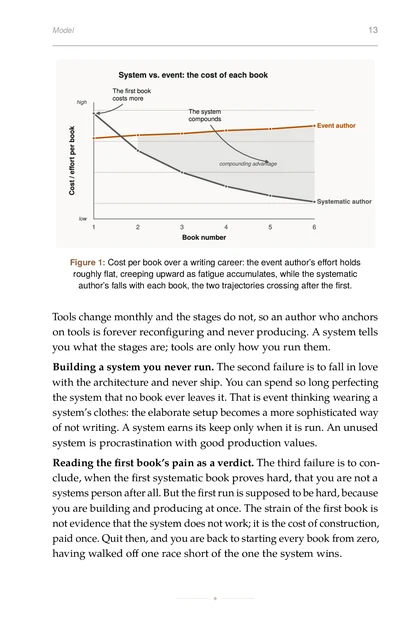 Cost per book over a writing career: the event author’s effort holds roughly flat, creeping upward as fatigue accumulates, while the systematic
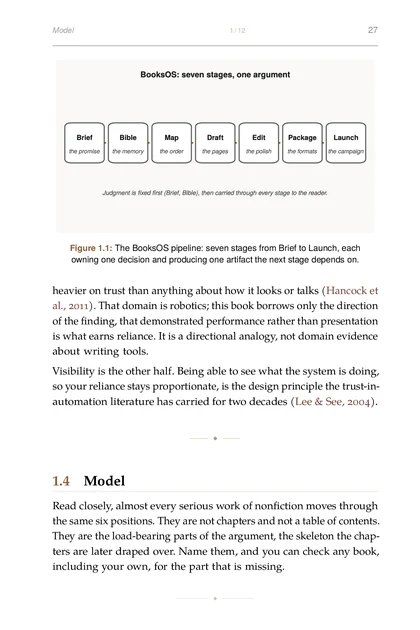 The BooksOS pipeline: seven stages from Brief to Launch, each
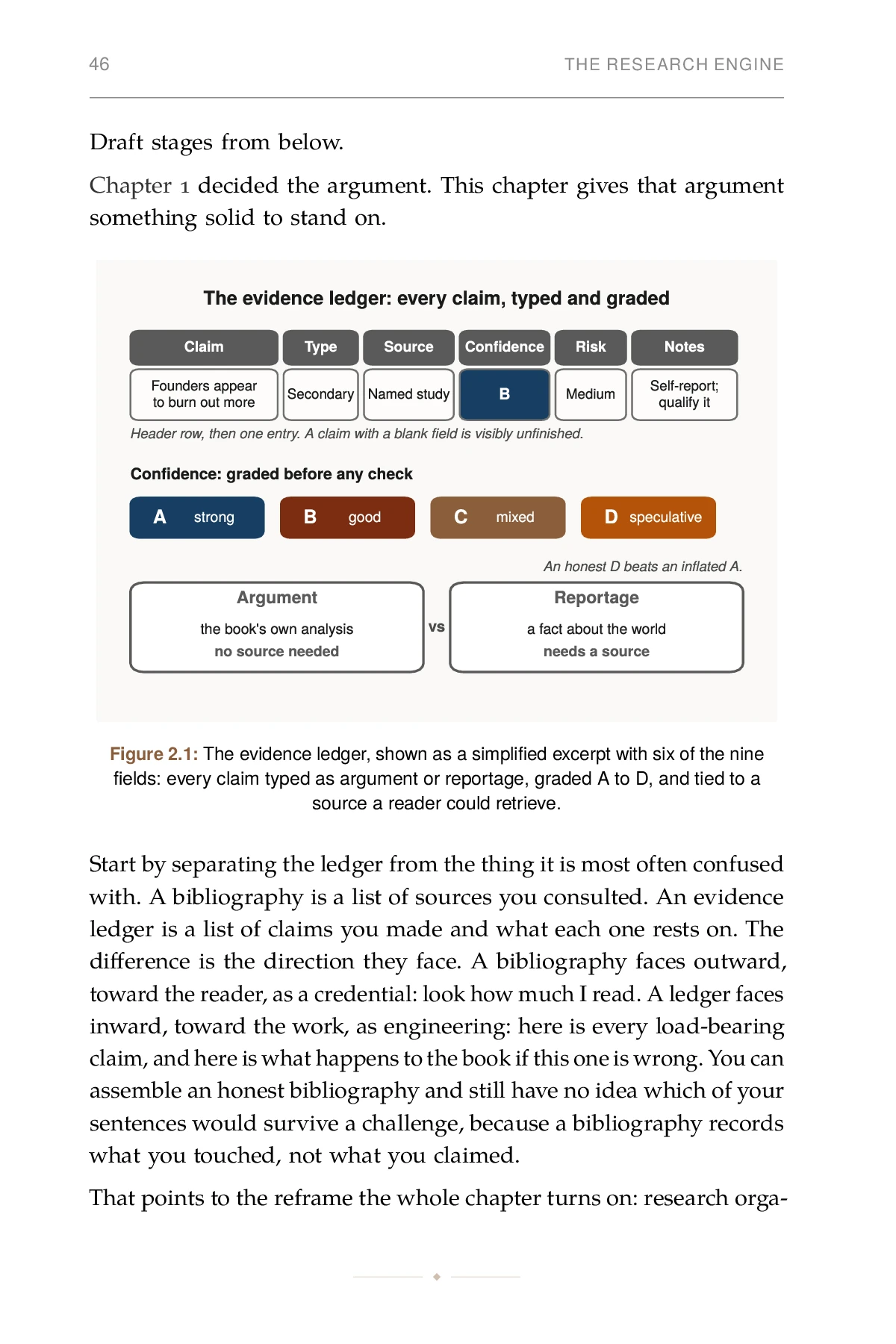
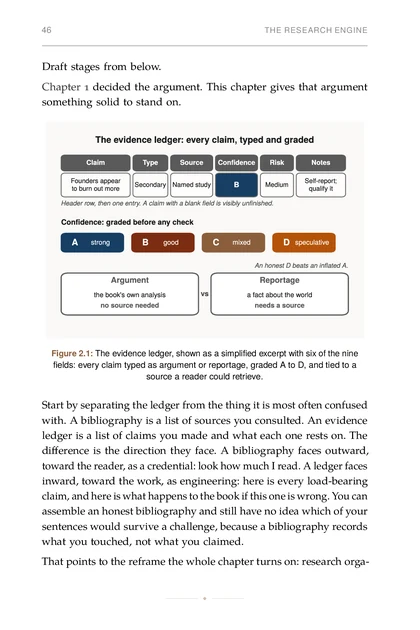 The evidence ledger, shown as a simplified excerpt with six of the nine fields: every claim typed as argument or reportage, graded A to D, and ti…
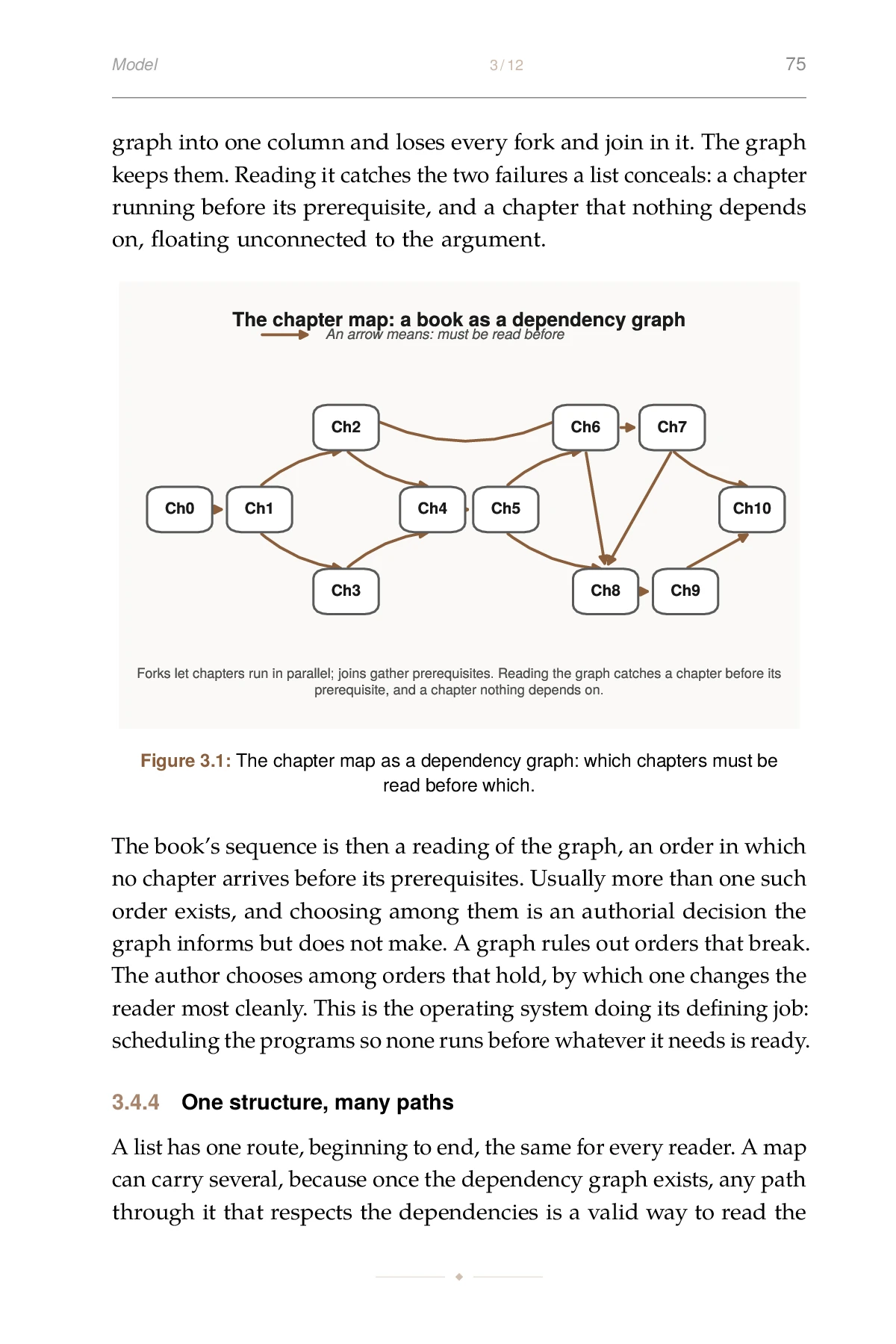
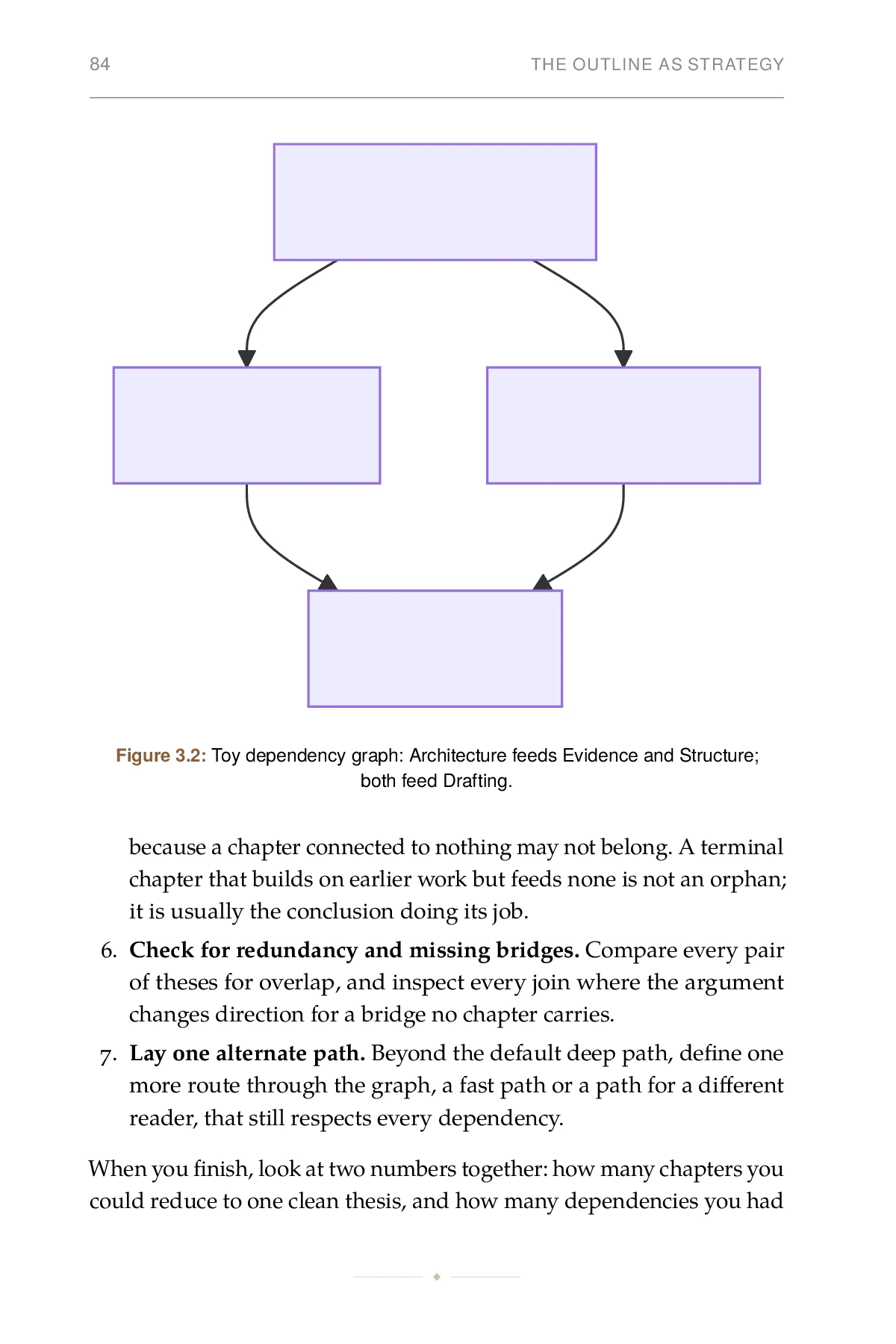
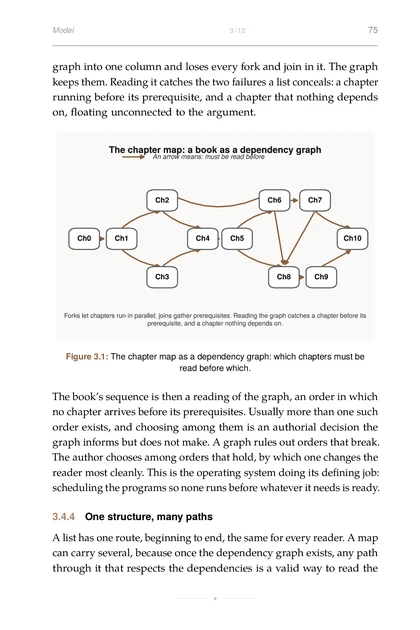 The chapter map as a dependency graph: which chapters must be
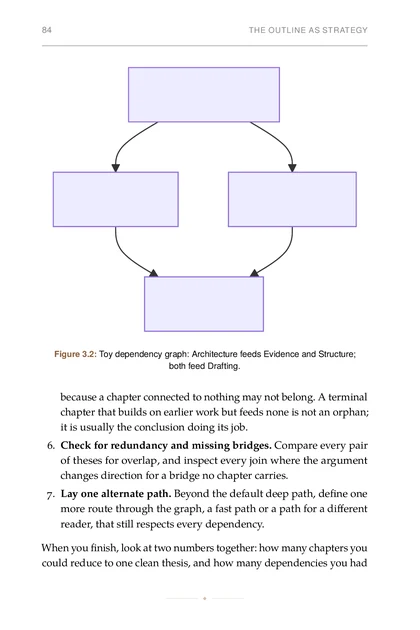 Toy dependency graph: Architecture feeds Evidence and Structure;
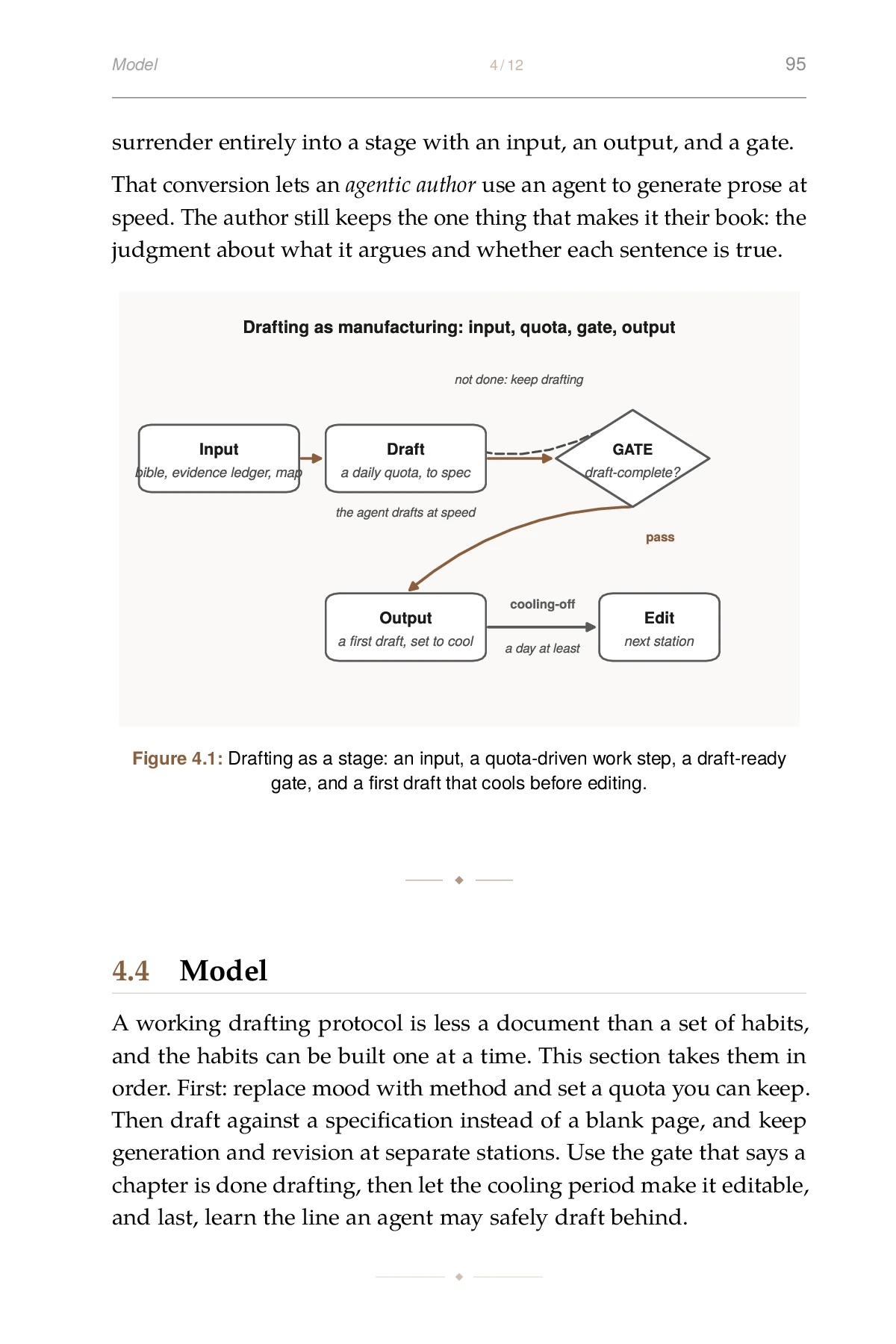
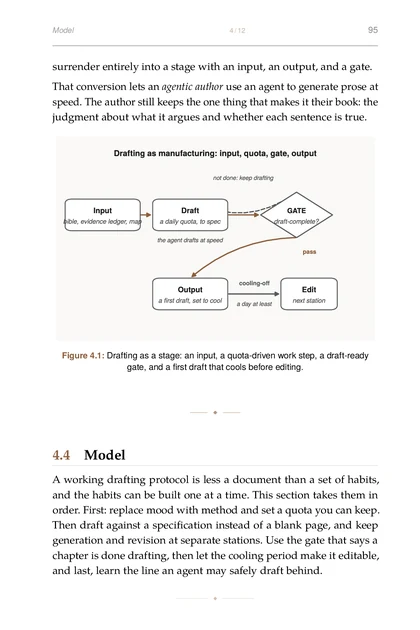 Drafting as a stage: an input, a quota-driven work step, a draft-ready
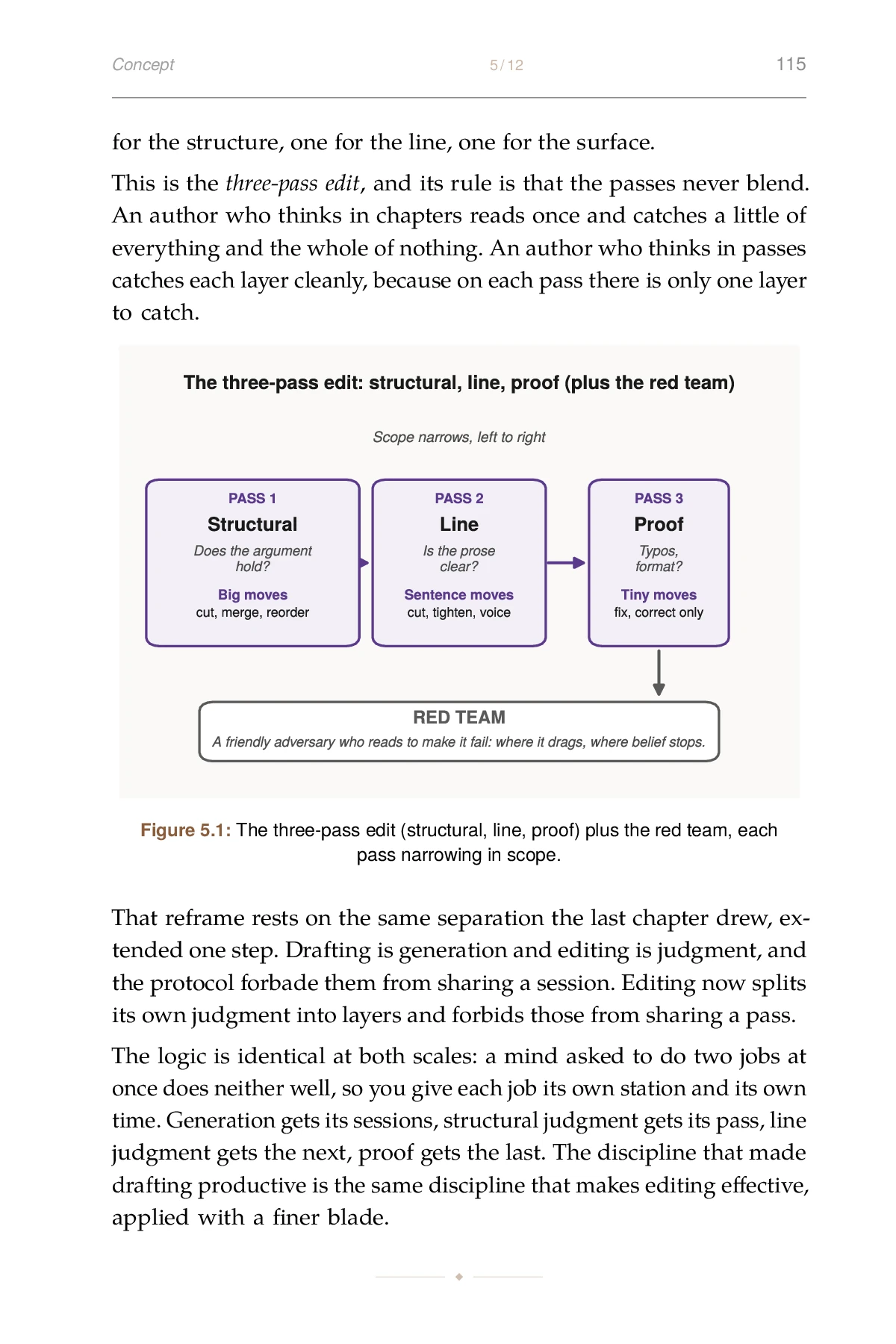
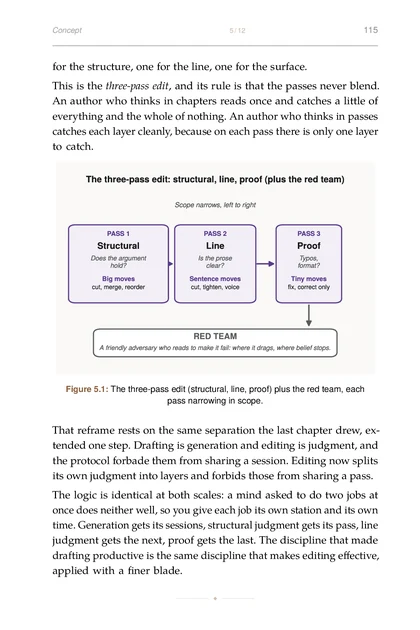 The three-pass edit (structural, line, proof) plus the red team, each
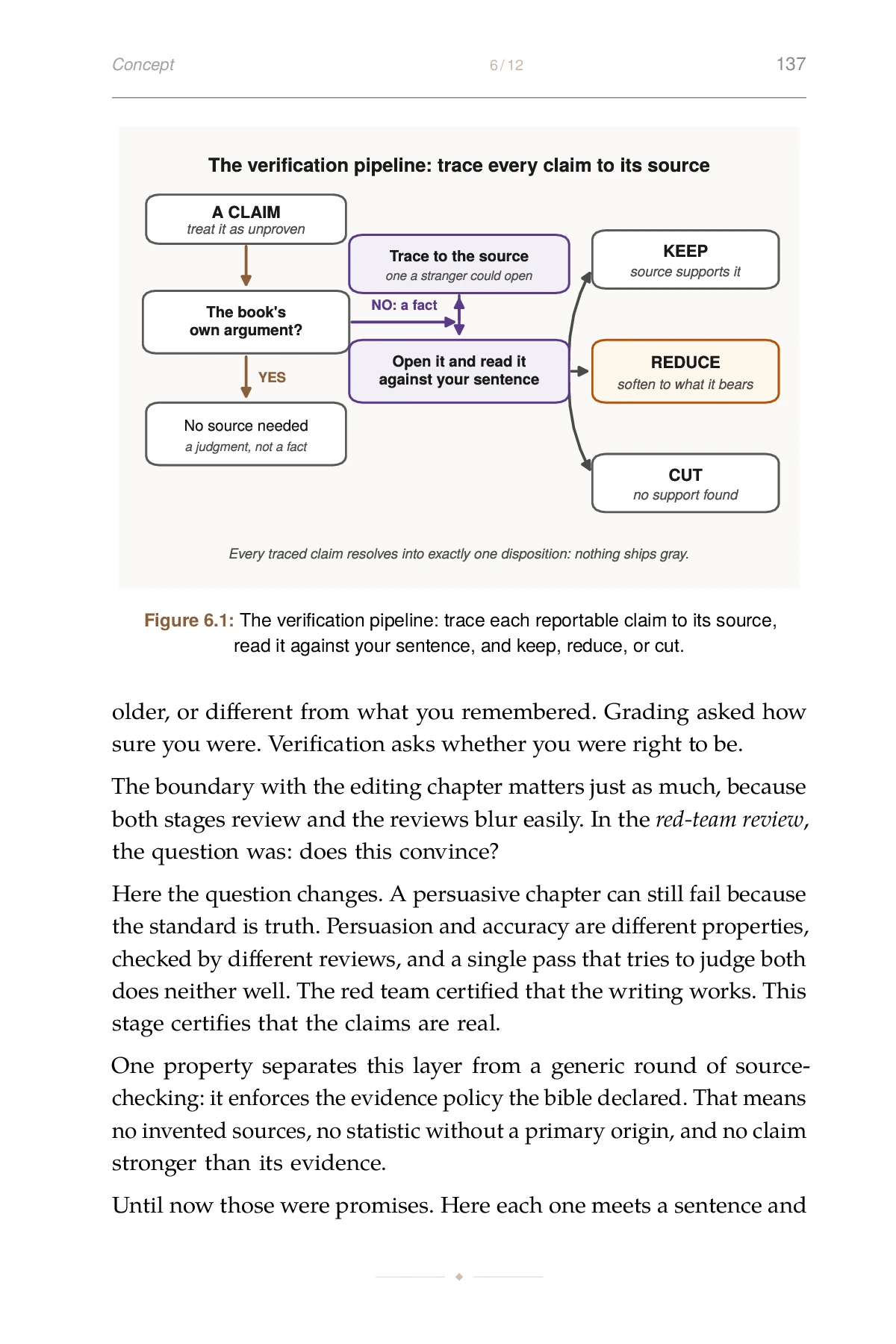
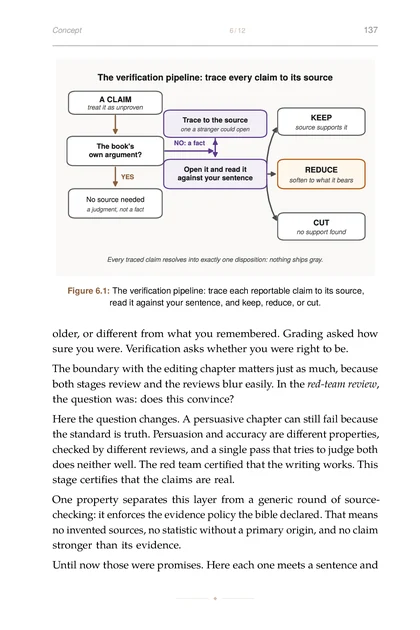 The verification pipeline: trace each reportable claim to its source,
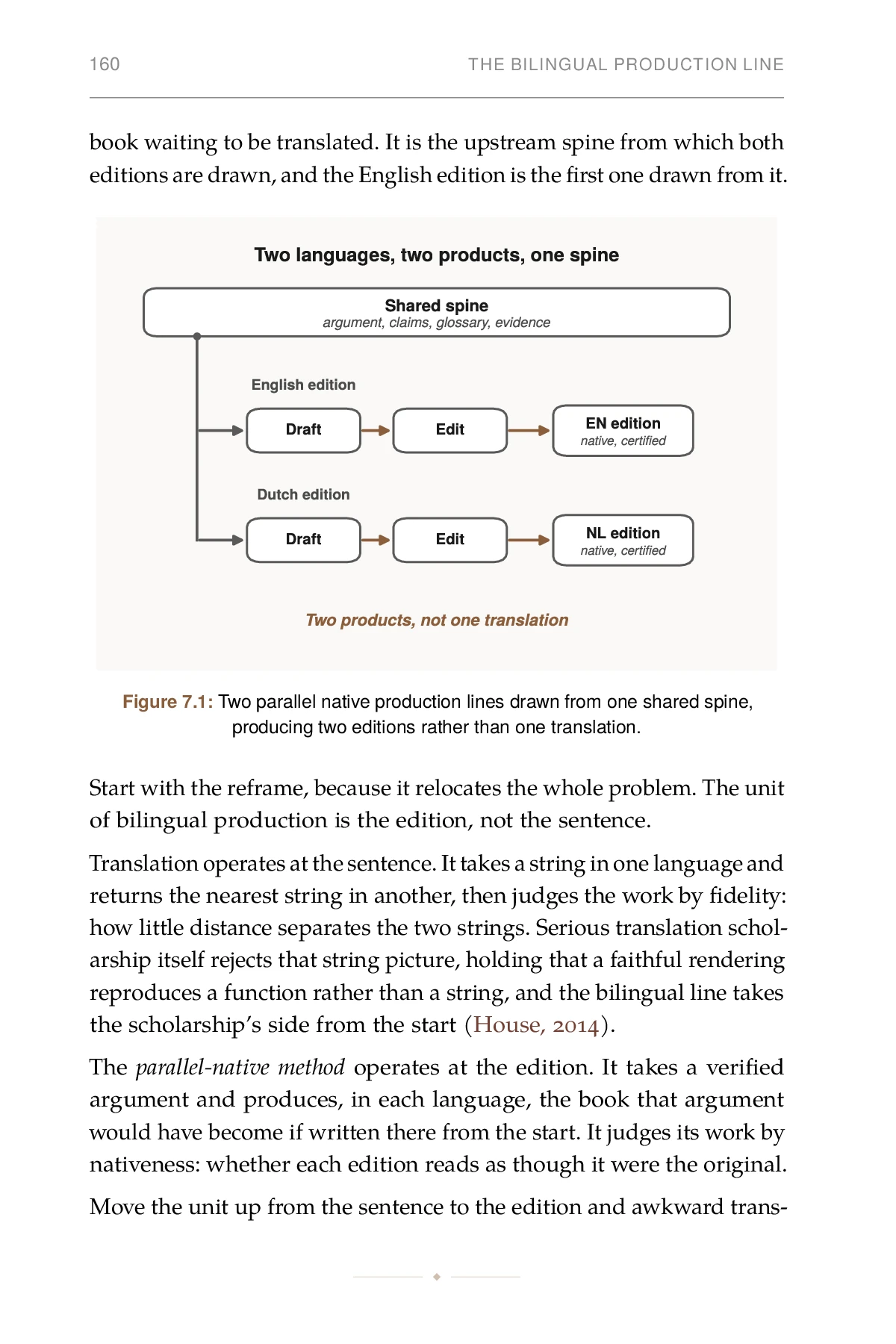
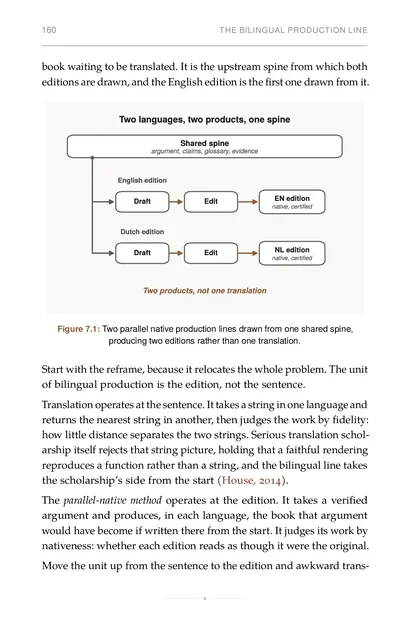 Two parallel native production lines drawn from one shared spine,
Purchase takes place on Amazon, not on this website.
Buy the paperback on AmazonFrom the book
Read a page
Introduction
The Author as System
What you can do afterwards
You leave this chapter with a mental model that makes every subsequent stage of this book actionable: authorship as a system, not a heroic event.
Use this chapter when
You are starting a new writing project and feel the pull to simply begin drafting without planning the process around it.
What you get
What you get
- The BooksOS production system: seven quality-gated stages from Brief to Launch
- AI agents as specialists: research engine, structural critic, fact-checker, red-teamer, editor
- An evidence ledger and quality gates that catch hallucinations before they ship
- A bilingual production line that treats two languages as two products, not a translation
- Written using the exact system it documents, across a full nonfiction series
Who it's for
- Design a book that is worth writing before the draft starts
- Research without drowning, against an evidence ledger
- Draft faster without surrendering voice
- Catch confident hallucinations before they ship
- Produce English and Dutch as two products, not a translation
Who it's for
Who this book was written for
The result is not a faster way to write a book. It is a system that compounds: the second book begins where the first stopped, and the tenth begins with a decade of decisions already made.
If you intend to publish more than once, and refuse to let speed lower your standard, this book was built for the author you are when the draft is long and the deadline is close.
The reader it was written for
Serious nonfiction authors who want more rigor, not just more speed, and who will not hand the book to a ghostwriter.
Also a fit for
Consultants, researchers, and operators writing a book of record who need evidence gates and a bilingual production line.
What you will use it on
- Design a book that is worth writing before the draft starts
- Research without drowning, against an evidence ledger
- Draft faster without surrendering voice
- Catch confident hallucinations before they ship
- Produce English and Dutch as two products, not a translation
Probably not for you if
- Fiction writers; the evidence contract is different
- Anyone looking for a book-in-a-weekend shortcut
- Readers who want AI to write the book without human judgment
The contents
Chapter by chapter
Every chapter of The Agentic Author with its printed epigraph, what you can do afterwards, and the moment it is built for.
Introduction
The Author as System
What you can do afterwards
You leave this chapter with a mental model that makes every subsequent stage of this book actionable: authorship as a system, not a heroic event.
Use this chapter when
You are starting a new writing project and feel the pull to simply begin drafting without planning the process around it.
Chapter 1
The Architecture of Authorship
What you can do afterwards
You leave this chapter with a one-page book brief: the architecture of your argument fixed before a word of any chapter is written.
Use this chapter when
You have a topic and things to say about it, but no single sentence that states what the book argues and why a reader should care.
Chapter 2
The Research Engine
What you can do afterwards
You leave this chapter with the habit of filing claims before you polish sentences, and an evidence ledger structure you can run on your next writing session.
Use this chapter when
You have research notes scattered across folders and browser tabs, and no systematic way to know which of your claims can be defended if challenged.
Chapter 3
The Outline as Strategy
What you can do afterwards
You leave this chapter with a chapter map that shows which chapters depend on which, so you can catch structural failures in a table before they cost you thirty thousand words.
Use this chapter when
You have a list of chapter titles and the urge to start writing, but no record of what each chapter proves or which ones must come before others.
Chapter 4
The Drafting Protocol
What you can do afterwards
You leave this chapter with a calibrated daily quota and a no-edit rule that carry a chapter to completion on a cadence you can keep, instead of perpetually re-polishing its opening.
Use this chapter when
Your manuscript is a collection of brilliant first pages with no middles, or you have been stalled for weeks because no writing day feels good enough to begin.
Chapter 5
The Editorial Machine
What you can do afterwards
You leave this chapter with a concrete three-pass editing sequence that catches what single-pass editing misses, and a clear definition of when a chapter is done being edited.
Use this chapter when
You have been editing the same chapter for weeks, each pass turning up something new to adjust, with no sense of when to stop or what "good enough" means.
Chapter 6
The Fact-Checking Layer
What you can do afterwards
You leave this chapter with a verification discipline. Every load-bearing claim stays a liability until a primary source clears it. You also get a hallucination-check protocol for agent-supplied content. Low-risk asides may clear against a reliable secondary source with a note, but they never carry argument weight.
Use this chapter when
You have a finished, polished chapter and you feel confident in your sources. That is the dangerous moment. Confidence can feel like verification.
Chapter 7
The Bilingual Production Line
What you can do afterwards
You leave this chapter with a method for producing a second-language edition that reads native. Not translated. Written for that language's readers from the start.
Use this chapter when
You have finished a first-language edition and are about to hand it to a translator or an agent. The danger is treating the second language as a conversion of the first.
Chapter 8
The Packaging System
What you can do afterwards
You leave this chapter with a single-source publishing discipline. Correct a typo once, rebuild, and every format receives the fix. That is how you end the drift between e-book, print file, and web edition.
Use this chapter when
You have a finished manuscript and are about to open a word processor to "format it." Also use it if you are already maintaining several files that used to be one text.
Chapter 9
The Launch as System
What you can do afterwards
You leave this chapter with a launch brief (a single document holding positioning, copy, email sequence, social content, channels, and metrics), so the launch week is execution rather than improvisation.
Use this chapter when
You are approaching a book's release date and your launch plan is "post that the book is out and share the link."
Chapter 10
The Compound Author
What you can do afterwards
You leave this chapter with the concept of the reusable-asset system and the habit of harvesting, so that each book you finish makes the next one cheaper to produce and better made.
Use this chapter when
You have just shipped a book, or are planning a second one, and your instinct is to close the project and start fresh.
Conclusion
Conclusion: The Judgment You Keep
What you can do afterwards
You leave this chapter with the single distinction that holds the whole book together, and a ninety-day plan that turns that distinction into daily work.
Use this chapter when
You have finished reading and are deciding what to actually do on Monday.
Editions
Editions and specifications
| Edition | Formats | Chapters | Pages | Reading time | ISBN (paperback) |
|---|---|---|---|---|---|
| English The Agentic Author | Kindle, Paperback, Hardcover | 12 | 320 | ± 5 hours | 9798187632381 |
| Dutch De agentische auteur | Kindle, Paperback, Hardcover | 12 | 346 | ± 5 hours | 9798187633487 |
Both editions are written natively. The Dutch text is not a machine translation of the English. · Trim size: 6x9″
Get the book
One title, every Amazon marketplace. Pick your format and your store.
Get the book
Reading from another country?Pick your own Amazon marketplace — same edition, your store.
Amazon links may include affiliate tags. That does not change the price you pay. Bol.com listings are third-party.
Frequently asked
What readers usually want to know
What is The Agentic Author about?
A quality-gated production system for serious nonfiction: research agents, evidence ledgers, structural review, fact checks, red-team critique, and bilingual publishing discipline. The subtitle is: The BooksOS Method for Writing Serious Nonfiction with AI Agents.
What is the BooksOS framework?
BooksOS: Brief, Bible, Map, Draft, Edit, Package and Launch. seven quality-gated stages from Brief to Launch
In which formats is The Agentic Author available?
The Agentic Author ships as Kindle, Paperback and Hardcover, on every Amazon marketplace worldwide. The Kindle edition is enrolled in Kindle Unlimited, so KU members read it free.
Is there a Dutch edition?
Yes. The Dutch edition is De agentische auteur, written as a native edition rather than a machine translation. It is available on Amazon too.
How long is The Agentic Author?
This edition runs 12 chapters, 320 pages in print and roughly 5 hours of reading.
Who is The Agentic Author for?
If you intend to publish more than once, and refuse to let speed lower your standard, this book was built for the author you are when the draft is long and the deadline is close.
This sounds like a technical manual, not a book.
It is the production system used to write this series, told as an operator manual. You see the gates because they are the product.
I do not want my book to sound like AI wrote it.
Voice and judgment stay human. Agents do specialist work behind ledgers and red-team review. The point of the system is to raise the ceiling, not to flatten the prose.
I do not have time to learn a complex system.
BooksOS is seven named stages from Brief to Launch. You run the stage you are in. You do not install a platform first.
My topic is too niche for agents to help.
Niche is where evidence discipline pays. Agents collect and pressure-test; you decide what the book is allowed to claim.
Is this just prompt engineering dressed up?
Prompts are not the system. The system is an evidence ledger, quality gates, specialist roles, and a bilingual line that treats two languages as two products.
The production system
How this book was made
Every title moves through the same gated production line: sourced research, a claim-level evidence ledger, structural review, fact-checking, red-team critique, and a bilingual final edit. AI agents do specialist work inside those gates; judgment, voice, and accountability stay human.
- Claims enter an evidence ledger with a source and a confidence grade before they reach the page
- English and Dutch are two native editions, not a translation of one another
- Every chapter clears readability, rhythm, and style gates before it is typeset


