

No. 32 · In design · Marketing & trust · VOICE
The Authentic Operator
Voice, Identity, and Trust When AI Writes With You
When AI drafts your words, authenticity stops being a mood and becomes architecture
Your emails, posts, proposals, and books are increasingly drafted by AI, and the worry underneath is real: sounding generic, getting exposed as not really writing, losing the trust your voice built. The Authentic Operator answers with the VOICE system — five skills that turn authenticity into infrastructure. You verify before you ship, own decisions explicitly, anchor identity in non-negotiables, constrain templates, and exhibit selectively. AI becomes amplification, not replacement.
- pages
- 222
- chapters
- 12
- hours of reading
- ± 3
- editions
- EN · NL
- Design
- Drafting
- Manuscript
- Production
- Launched
The editions
Kindle and Paperback
Production shots of the editions. Not for sale yet — this page is the public working version.
-
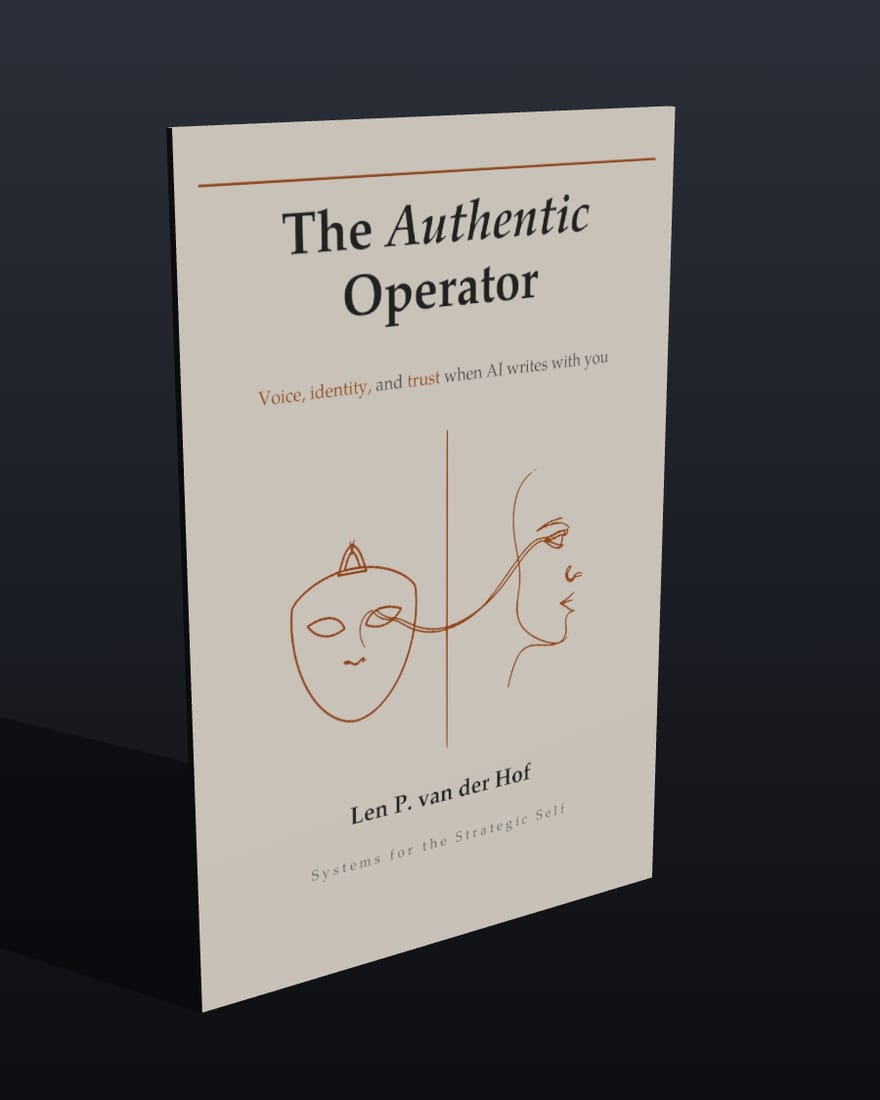
Kindle
The digital edition, ready in any Kindle app.
-
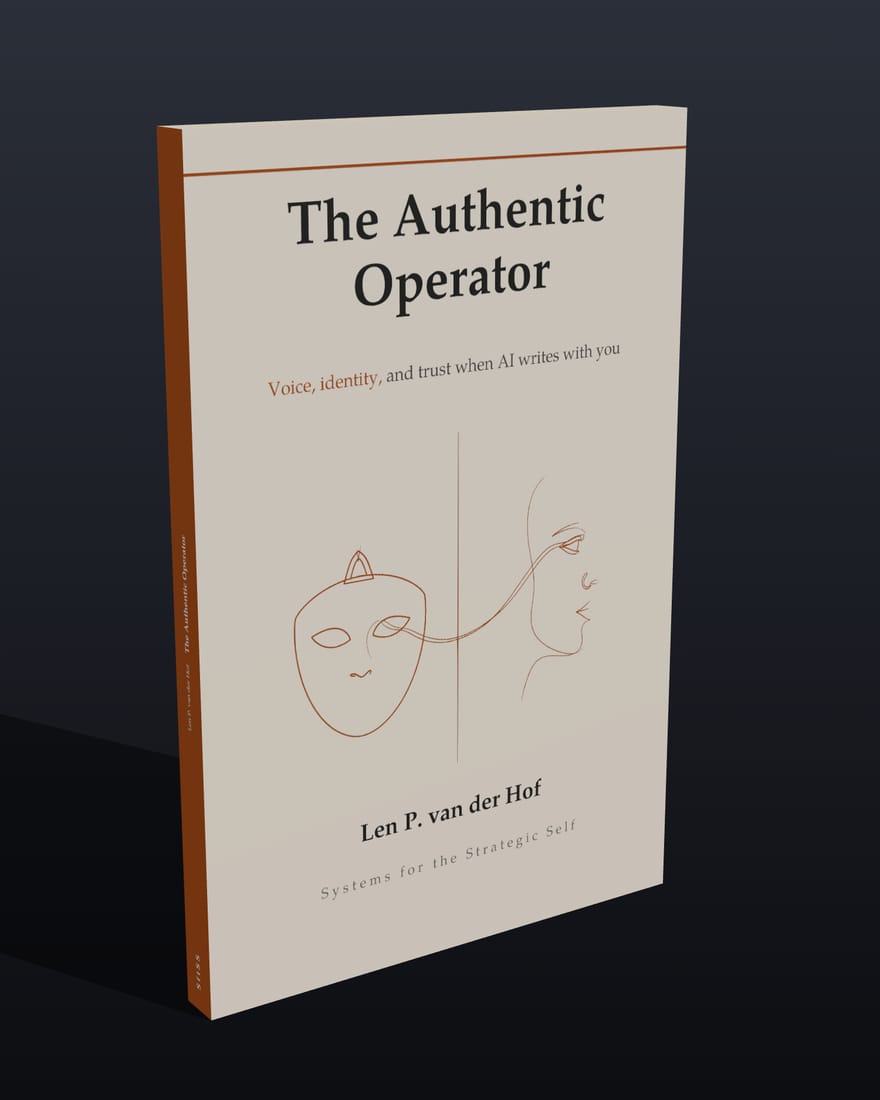
Paperback
The working copy. Mark it up. Take it into the meeting.


The book
Voice, Identity, and Trust When AI Writes With You
You have a voice for the pitch, a voice for the all-hands, a voice for LinkedIn, and somewhere underneath them a person you no longer fully recognize. You rehearse the founder you think investors want and post in the tone the algorithm rewards. The performance works well enough to keep going, and costs more every quarter, because maintaining a self you have to fake is the most expensive overhead you carry.
The standard advice is to "build your personal brand": pick a persona, stay on message, perform until it sticks. That advice manufactures the problem it promises to solve: a polished surface your audience learns to distrust, and a widening gap between who you are and who you sell as.
The Authentic Operator rejects performance as a growth strategy and gives you something you can run. It introduces the REAL framework (Reveal, Embody, Align, Lead), four disciplines that turn authenticity from a personality trait into an operating system, and treat your character the way you treat your company: auditable, structured, deployable under pressure.
What you learn
What this book puts in your hands
- The VOICE system: Verify, Own, Identity, Constrain, Exhibit — five skills, one operating layer
- Verification gates that catch synthetic polish before anything ships under your name
- Identity anchors AI cannot invent: your values, your stories, your non-negotiables
- Template constraints that stop sameness from spreading across every channel
- Separate voice lanes for LinkedIn, board memos, and customer email — without losing yourself
The framework
VOICE, step by step
Verify, Own, Identity, Constrain, Exhibit — five skills, one operating layer
-
Verify
-
Own
-
Identity
-
Constrain
-
Exhibit — five skills
-
one operating layer

From the book
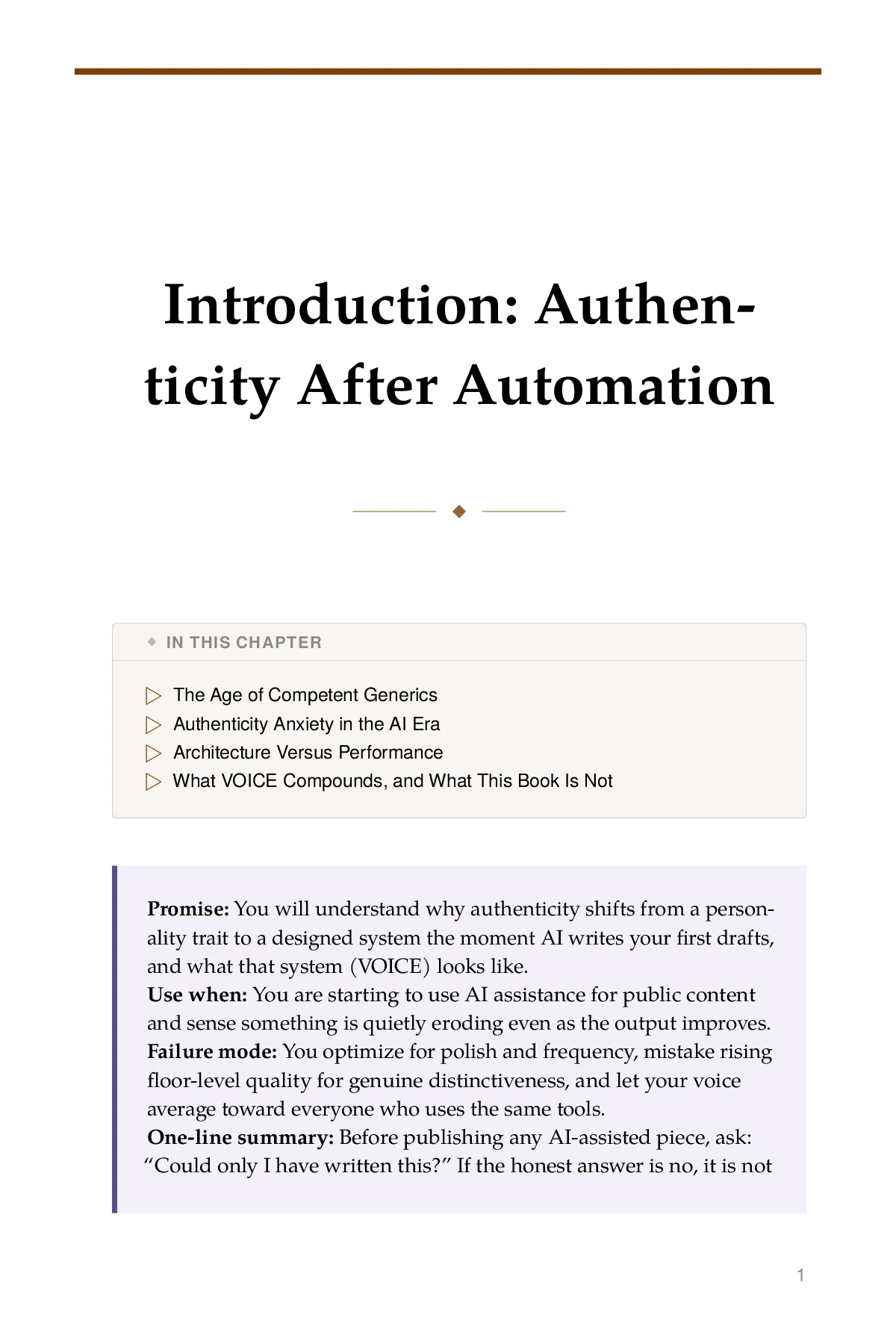
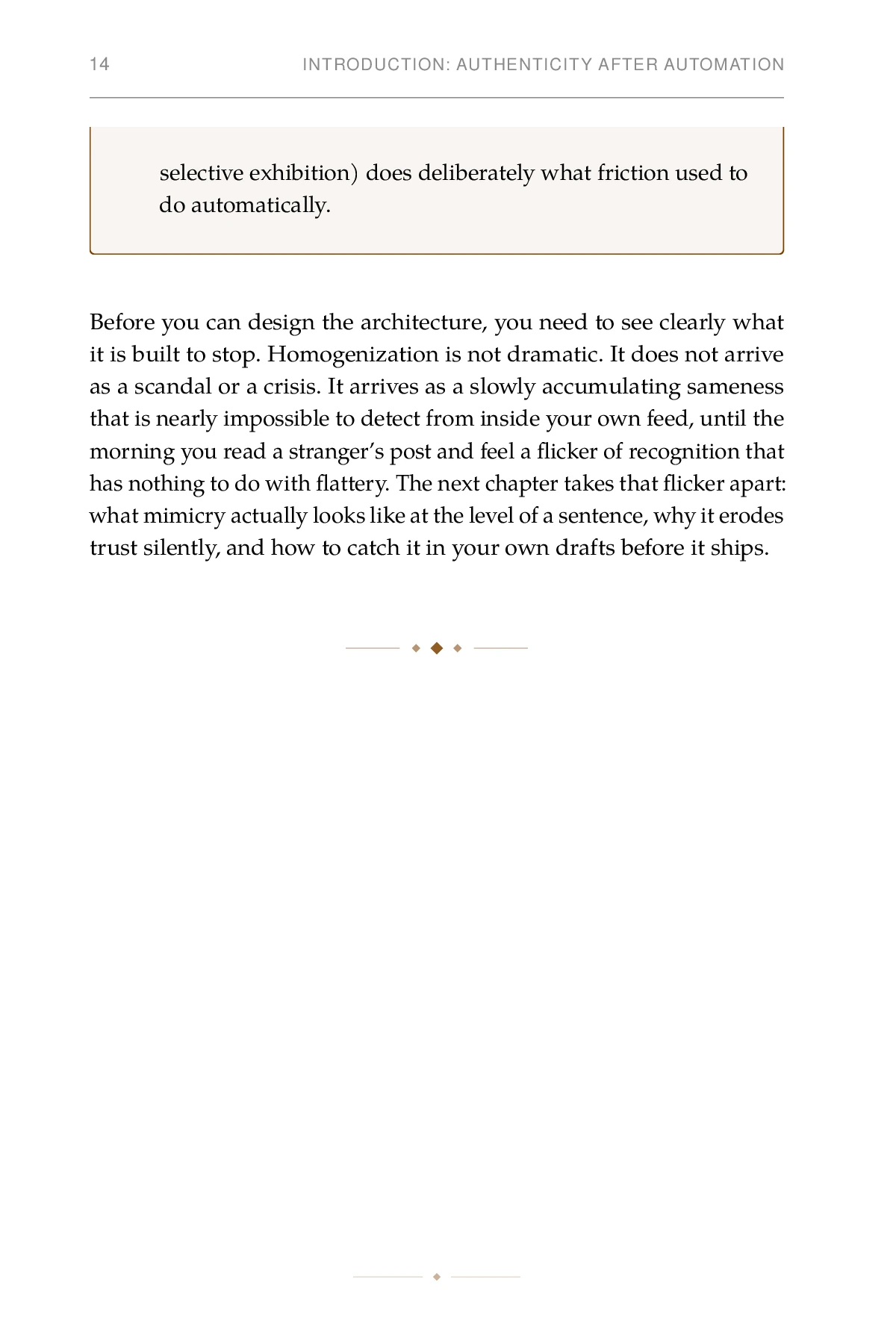
on ninety minutes a quarter beats sincerity you have to summon
The Authentic Operator, printed page: on ninety minutes a quarter beats sincerity you have to summon
Inspect more pages
The contents
Chapter by chapter
Every chapter of The Authentic Operator with its printed epigraph, what you can do afterwards, and the moment it is built for.
Introduction
Introduction: Authenticity After Automation
What you can do afterwards
You will understand why authenticity shifts from a personality trait to a designed system the moment AI writes your first drafts, and what that system (VOICE) looks like.
Use this chapter when
You are starting to use AI assistance for public content and sense something is quietly eroding even as the output improves.
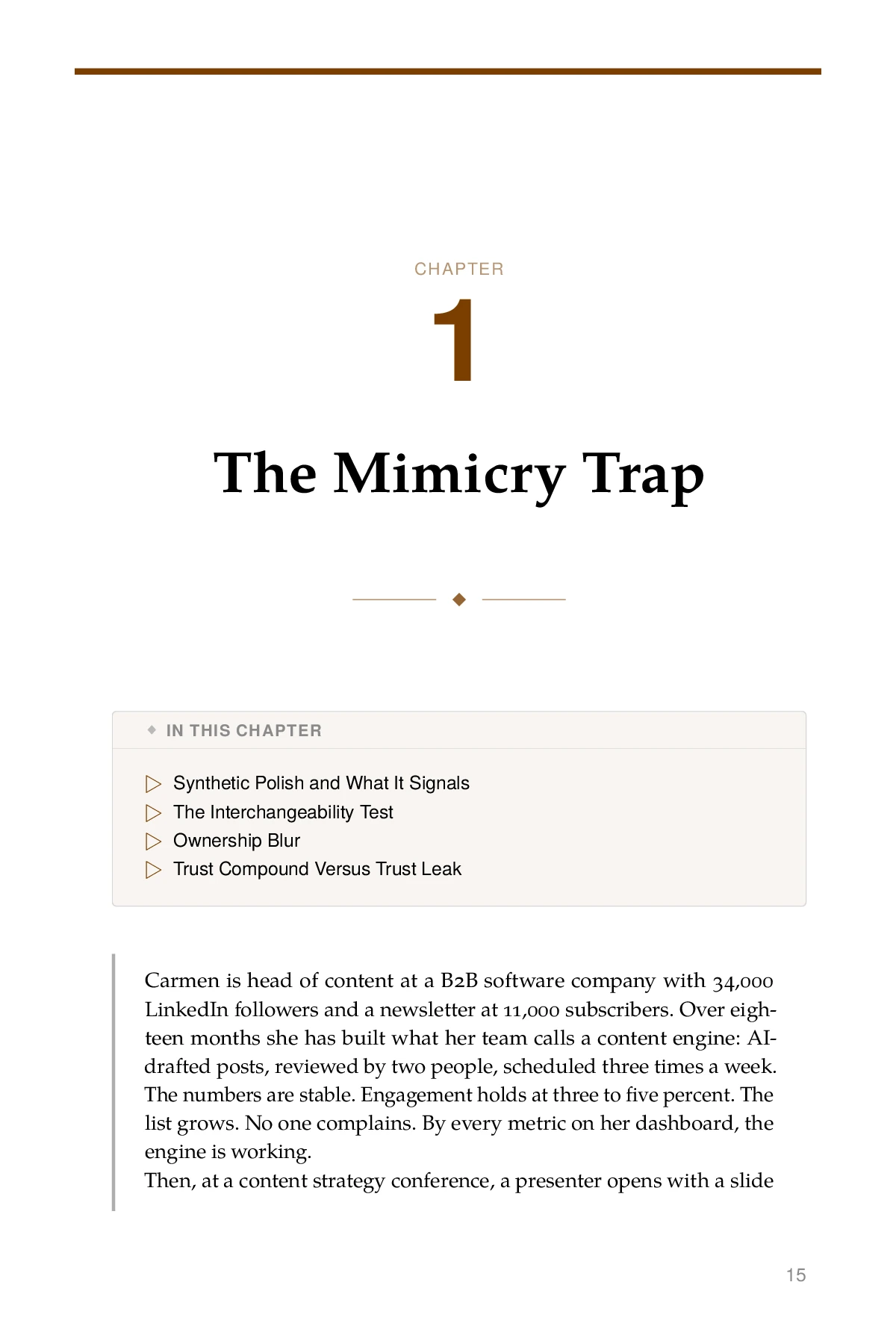
Chapter 1
The Mimicry Trap
What you can do afterwards
You will be able to name the three specific ways your voice flattens under AI assistance (synthetic polish, interchangeability, and ownership blur) and run a three-minute diagnostic that detects them in your own output.
Use this chapter when
You are publishing AI-assisted content at volume and the numbers look fine, but something feels slightly off and you cannot say what.
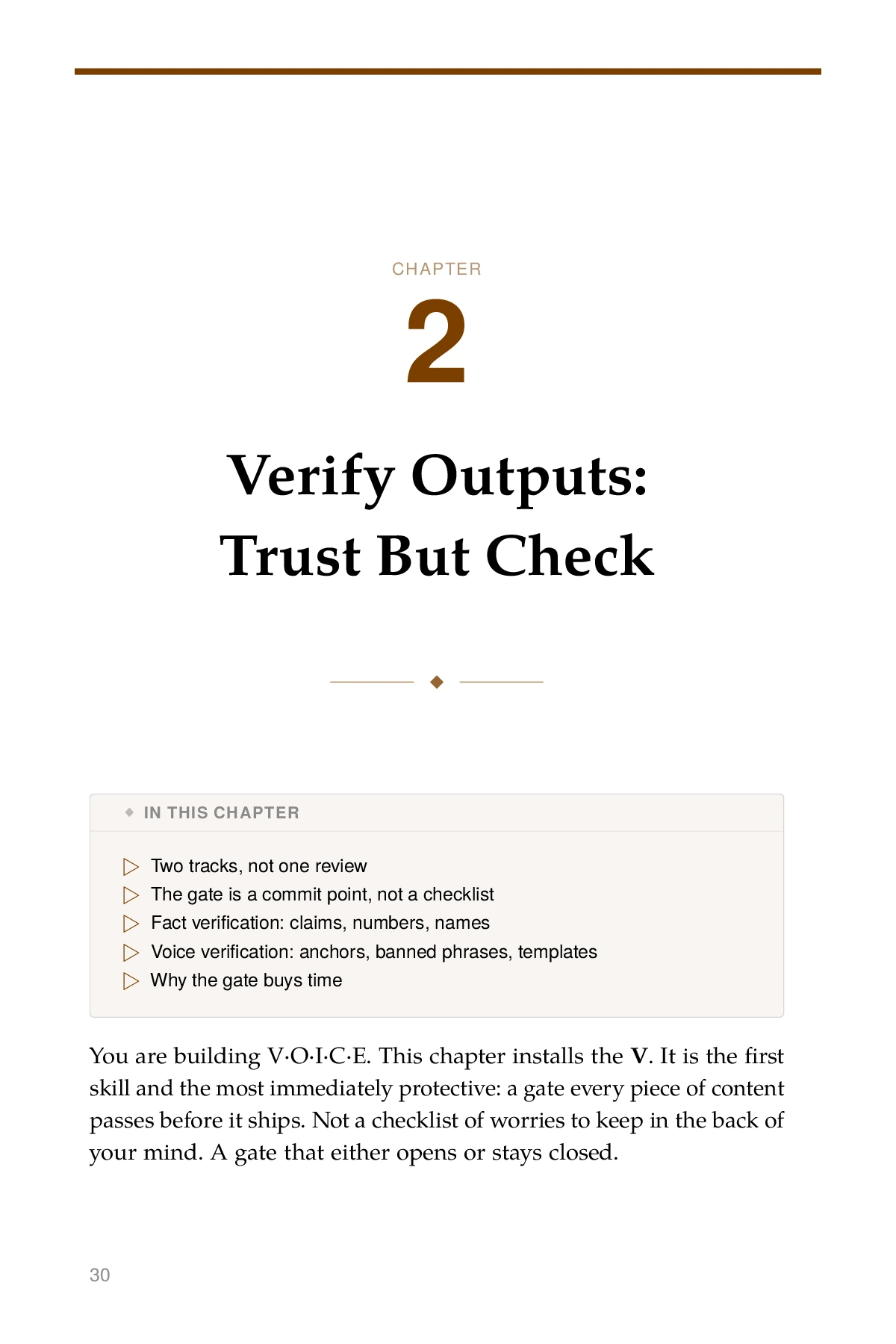
Chapter 2
Verify Outputs: Trust But Check
What you can do afterwards
A two-track verification gate (facts and voice) that every output passes before it ships, in under fifteen minutes.
Use this chapter when
You are about to publish anything under your name that an AI helped draft.
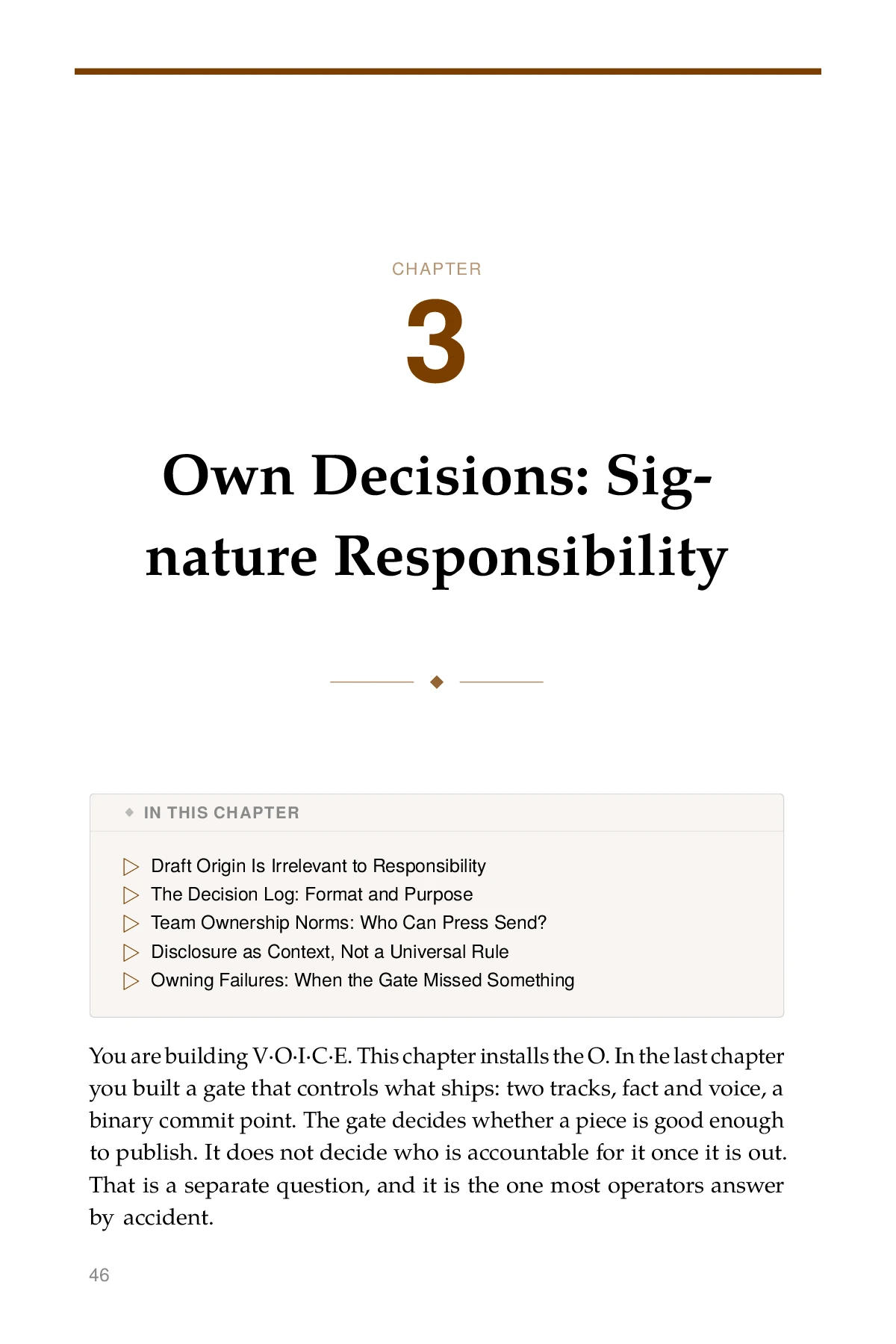
Chapter 3
Own Decisions: Signature Responsibility
What you can do afterwards
A lightweight decision log and a set of ownership norms that let you publish AI-assisted content without ever again hesitating over the question "did you write this?"
Use this chapter when
You publish under your name, your team can draft in your voice, or anyone might ask you to stand behind a specific claim you only approved.
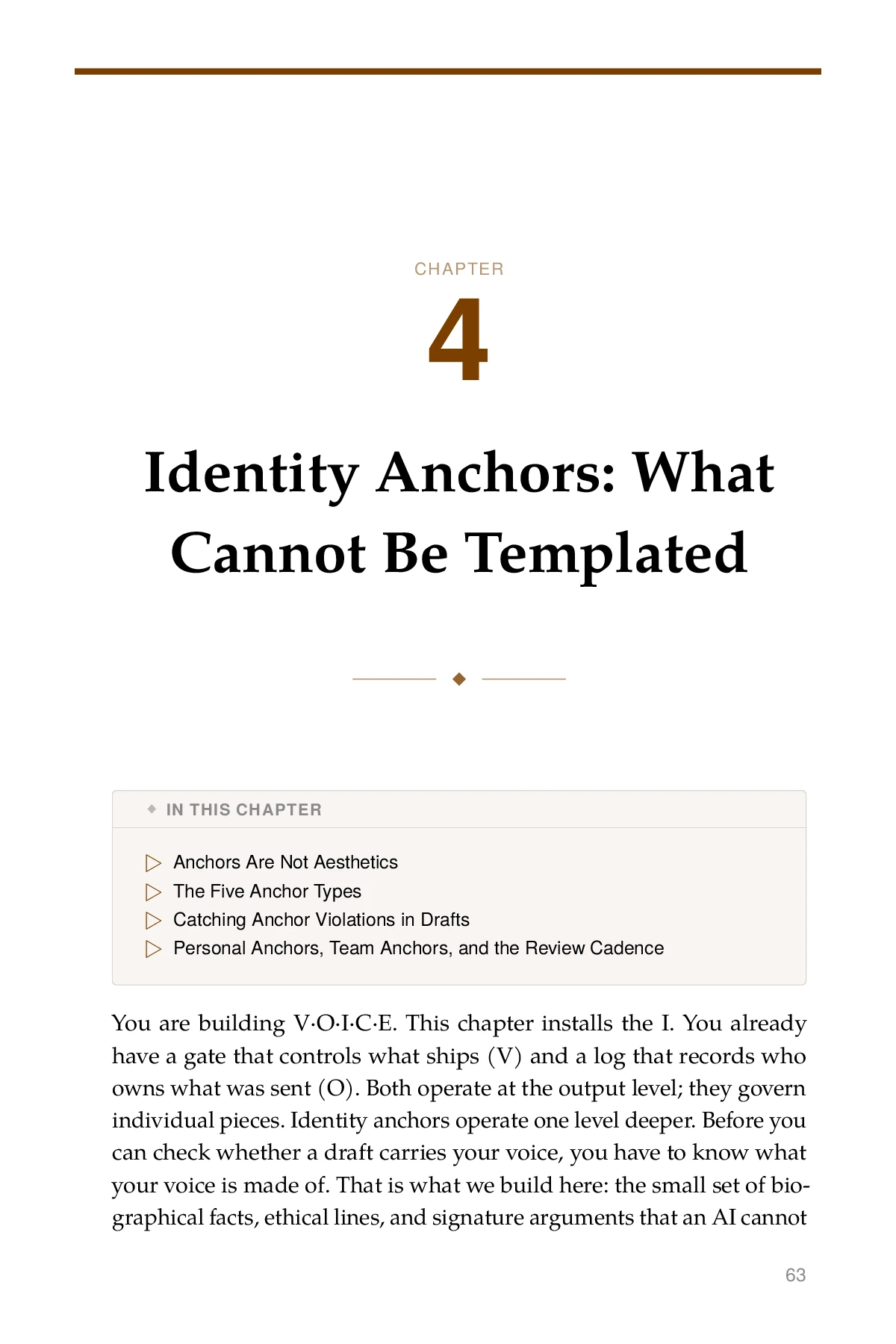
Chapter 4
Identity Anchors: What Cannot Be Templated
What you can do afterwards
A documented anchor set (five concrete identity elements an AI cannot invent) plus a method for catching the moment a draft overwrites one.
Use this chapter when
Before voice verification on any output where your name implies your judgment; quarterly, when you review whether your anchors still hold.
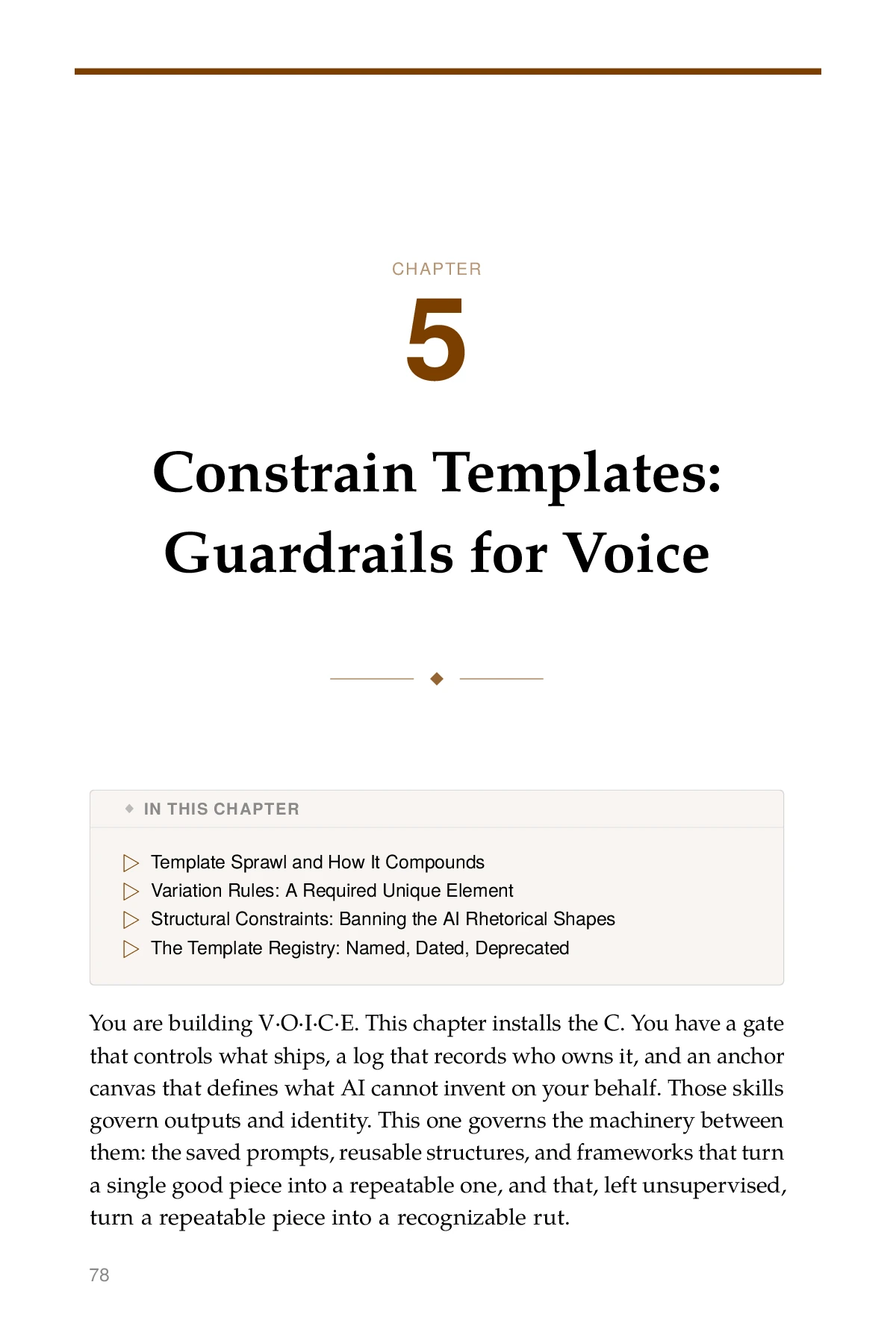
Chapter 5
Constrain Templates: Guardrails for Voice
What you can do afterwards
A governed template library (capped, dated, and varied) that gives you AI's speed without surrendering your structural fingerprint.
Use this chapter when
You reuse saved prompts or content structures and cannot remember the last time you retired one.
Chapter 6
Exhibit Selectively: Strategic Authenticity
What you can do afterwards
A working map that assigns every kind of content you produce to a voice lane, so you stop spending maximum effort on outputs that do not need it and stop under-investing in the ones that do.
Use this chapter when
You feel the pressure to publish constantly, or you suspect your highest-effort content is disappearing into the same feed as your lowest-effort content.
Chapter 7
Voice in Public: Marketing Without Mimicry
What you can do afterwards
A protocol for applying the full VOICE stack to your highest-stakes public surface (launch copy, posts, landing pages) so marketing compounds trust instead of diluting it.
Use this chapter when
You are about to ship a campaign, a product launch, or any public asset that carries your name to the audience that decides whether to hire, buy from, or refer you.
Chapter 8
Voice in Private: Internal Comms Carry Identity
What you can do afterwards
A lane system for internal communication that puts full voice where relationships are deepest and silent delegation where voice is neither claimed nor needed, plus a one-page team charter that stops the drift before it leaves the building.
Use this chapter when
You delegate internal communication (team updates, client reports, board memos, Slack) to AI and have never decided which of those genuinely require your judgment to be visible.
Chapter 9
Voice Across Languages: Bilingual Authenticity
What you can do afterwards
A working distinction between translation and native voicing, and a protocol for producing genuinely native-voiced content in a second language without diluting the voice you built in the first.
Use this chapter when
You publish (or are about to publish) the same ideas to audiences in two languages and one edition reads like a translation of the other.
Chapter 10
The Authentic Operator System
What you can do afterwards
A single integrated view of how the five VOICE skills compose into one maintainable system, plus a quarterly audit you can run in ninety minutes that keeps the architecture functional as your practice evolves.
Use this chapter when
You have installed the individual skills and need them to work together as a system rather than as five separate habits you maintain by willpower.
Conclusion
Conclusion: Architecture, Not Performance
What you can do afterwards
You will see the VOICE system working as a whole — and understand why architecture, not intention, is what keeps your voice from being averaged away.
Use this chapter when
You have finished building the system and need to understand how its parts compose and compound into a trust asset that survives your attention lapses.
Who it is for
Who this book was written for
The result is not a better brand. It is the end of needing one. You stop performing a founder and start operating on the only identity that compounds: yours.
If you build under pressure and refuse to confuse a performance with a position, this was written for the operator you already are when no one is watching.
The reader it was written for
The visible operator-creator. Founder, consultant, marketer, or subject-matter expert aged 28–50 who publishes regularly — LinkedIn, newsletters, books, proposals — and increasingly uses AI to draft. Their reputation is their revenue. They fear sounding like everyone else.
Also a fit for
The ethical marketer. Growth lead or comms director who wants AI leverage without trust erosion. They need guardrails their team can follow.
What you will use it on
- Help me define what must stay human in my content
- Give me a verification checklist before I post or send
- Design public vs private voice rules for my team
- Navigate bilingual voice without sounding translated
- Use AI without becoming a generic 'AI founder' archetype
Probably not for you if
- Anonymous meme accounts optimizing for engagement only
- Professional ghostwriters (different ethics of invisible authorship)
- Readers seeking viral hacks without substance
- AI voice-cloning enthusiasts optimizing similarity
Editions
Editions and specifications
| Edition | Formats | Chapters | Pages | Reading time | ISBN (paperback) |
|---|---|---|---|---|---|
| English The Authentic Operator | In production | 12 | 222 | ± 3 hours | — |
| Dutch De authentieke operator | In production | 12 | 244 | ± 3 hours | — |
Both editions are written natively. The Dutch text is not a machine translation of the English.
Frequently asked
What readers usually want to know
What is The Authentic Operator about?
VOICE turns authenticity into infrastructure: verify, own, identify, constrain, and exhibit the words AI helps produce in your name. The subtitle is: Voice, Identity, and Trust When AI Writes With You.
What is the VOICE framework?
VOICE: Verify, Own, Identity, Constrain, Exhibit — five skills and one operating layer. Verify, Own, Identity, Constrain, Exhibit — five skills, one operating layer
Is there a Dutch edition?
Yes. The Dutch edition is De authentieke operator, written as a native edition rather than a machine translation. It moves through the same production line.
How long is The Authentic Operator?
This edition runs 12 chapters, 222 pages in print and roughly 3 hours of reading.
Who is The Authentic Operator for?
If you build under pressure and refuse to confuse a performance with a position, this was written for the operator you already are when no one is watching.
The production system
How this book was made
Every title moves through the same gated production line: sourced research, a claim-level evidence ledger, structural review, fact-checking, red-team critique, and a bilingual final edit. AI agents do specialist work inside those gates; judgment, voice, and accountability stay human.
- Claims enter an evidence ledger with a source and a confidence grade before they reach the page
- English and Dutch are two native editions, not a translation of one another
- Every chapter clears readability, rhythm, and style gates before it is typeset


