

No. 35 · Drafting (English edition first) · Marketing & trust · SALES
The Founder Sales System
Pipeline, Discovery, and Deals Before You Have a Sales Team
The Founder Sales System: Pipeline, Discovery, and Deals Before You Have a Sales Team.
The five-part SALES motion (Story, Ask, Listen, Evaluate, Sustain) turns founder-led selling into a process you can run, inspect, and improve long before you hire anyone to do it for you. Pipeline, Discovery, and Deals Before You Have a Sales Team. The framework: SALES.
- pages
- 122
- chapters
- 10
- hours of reading
- ± 2
- editions
- EN · NL
- Design
- Drafting
- Manuscript
- Production
- Launched
The editions
Kindle and Paperback
Production shots of the editions. Not for sale yet — this page is the public working version.
-
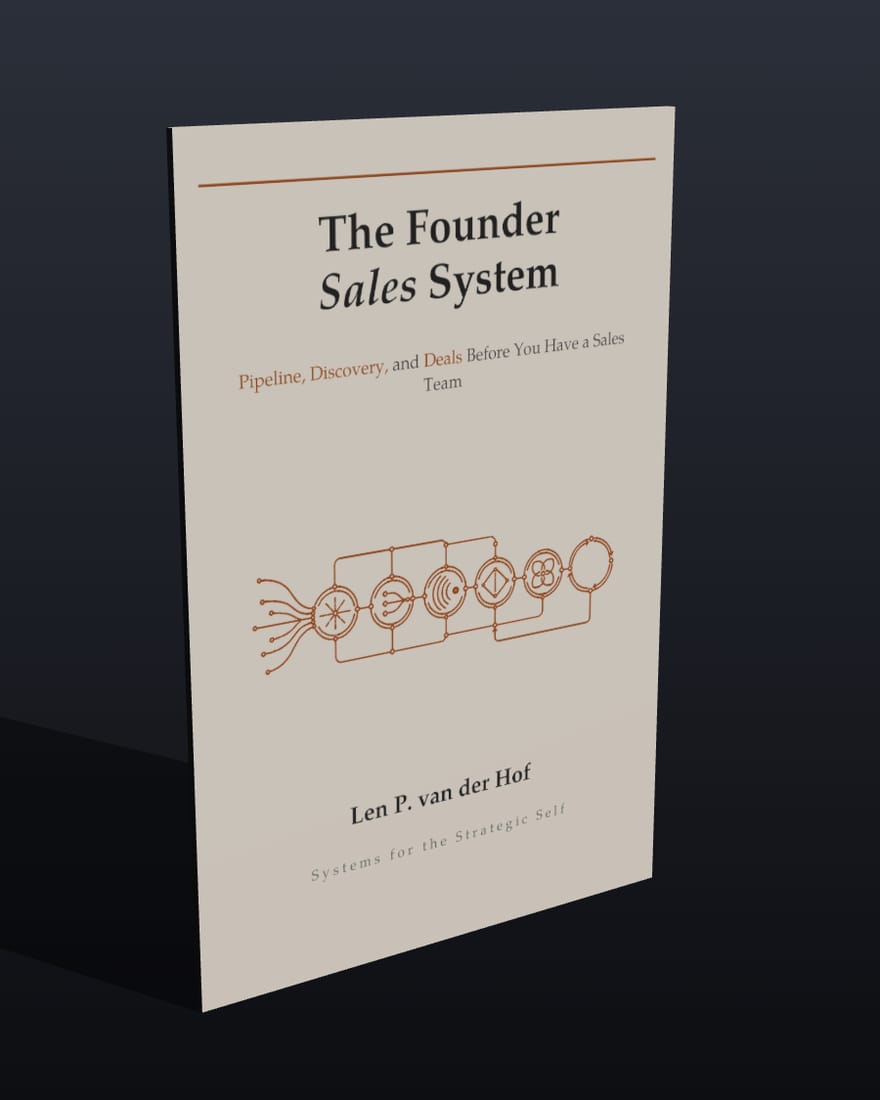
Kindle
The digital edition, ready in any Kindle app.
-
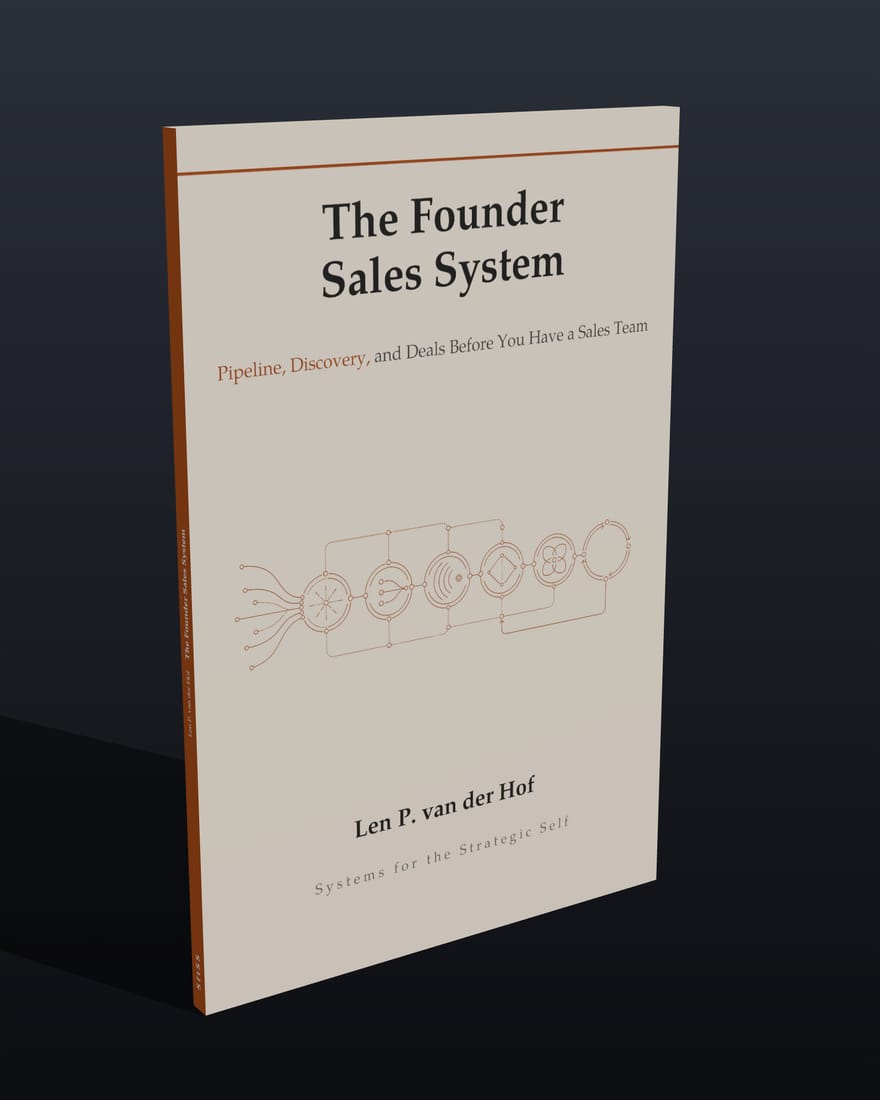
Paperback
The working copy. Mark it up. Take it into the meeting.


The book
Pipeline, Discovery, and Deals Before You Have a Sales Team
Your first deals arrived through conviction, warm introductions, and the founder's direct access to the product. That may get you to ten customers. It will not tell you which opportunity deserves time, why a discovery call worked, or what next quarter is likely to produce.
The Founder Sales System turns founder-led selling into a process you can run, inspect, and improve before you have a sales team. Its five-part SALES motion connects Story, Ask, Listen, Evaluate, and Sustain, from the first signal of interest through qualification, proposal, forecast, and follow-through.
What you learn
What this book puts in your hands
- Define pipeline stages by observable buyer progress instead of optimism.
- Run discovery that surfaces the problem, stakes, constraints, and decision path.
- Disqualify weak opportunities early without treating every no as failure.
- Build proposals and mutual action plans that make the next step explicit.
- Maintain a forecast with clear evidence for commit, upside, and uncertainty.
- Install a weekly review that turns lost deals and stalled deals into system learning.
The framework
SALES, step by step
-
Story
-
Ask
-
Listen
-
Evaluate
-
Sustain
The contents
Chapter by chapter
Every chapter of The Founder Sales System with its printed epigraph, what you can do afterwards, and the moment it is built for.
Introduction
The Improvisation Tax
Every deal you win by instinct is a deal you cannot repeat. This is the cost of selling without a system, and the first step toward building one.
What you can do afterwards
You will leave this chapter able to name the hidden cost of improvised selling, see the four gaps every founder-led sales effort has, and recognize the six-part system the rest of the book installs.
Use this chapter when
You are starting the book, or you have just finished a quarter where the number came in but you could not say how, and you want that to stop being luck.
Chapter 1
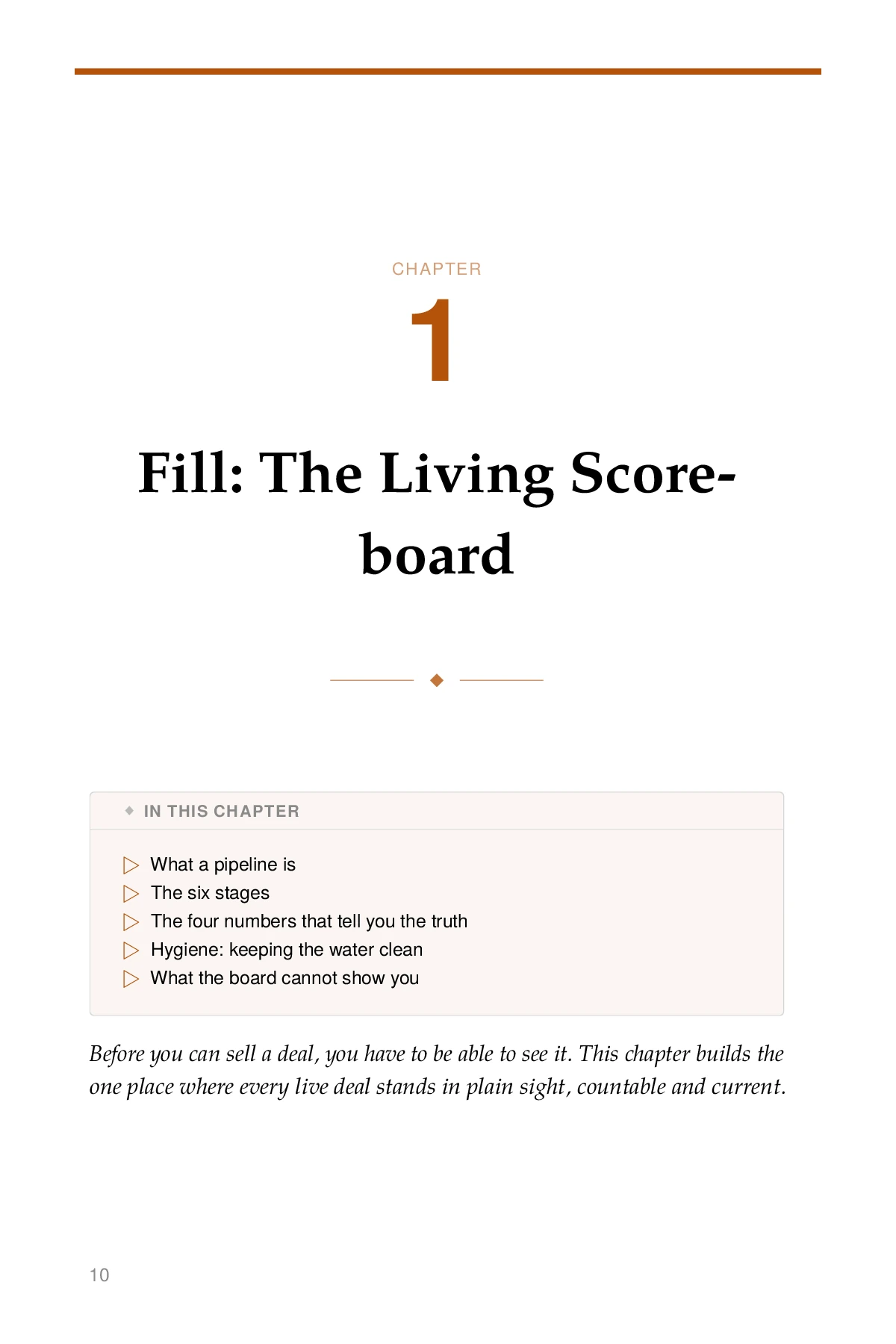
Fill: The Living Scoreboard
Before you can sell a deal, you have to be able to see it. This chapter builds the one place where every live deal stands in plain sight, countable and current.
What you can do afterwards
You will leave this chapter with a working pipeline: a set of named stages, a clear condition for entering each one, and a single board where the true state of every open deal is visible at a glance.
Use this chapter when
You cannot say, without digging, how many real deals you have or what stage each is in, and you want the pipeline to stop being a feeling and start being a number.
Chapter 2
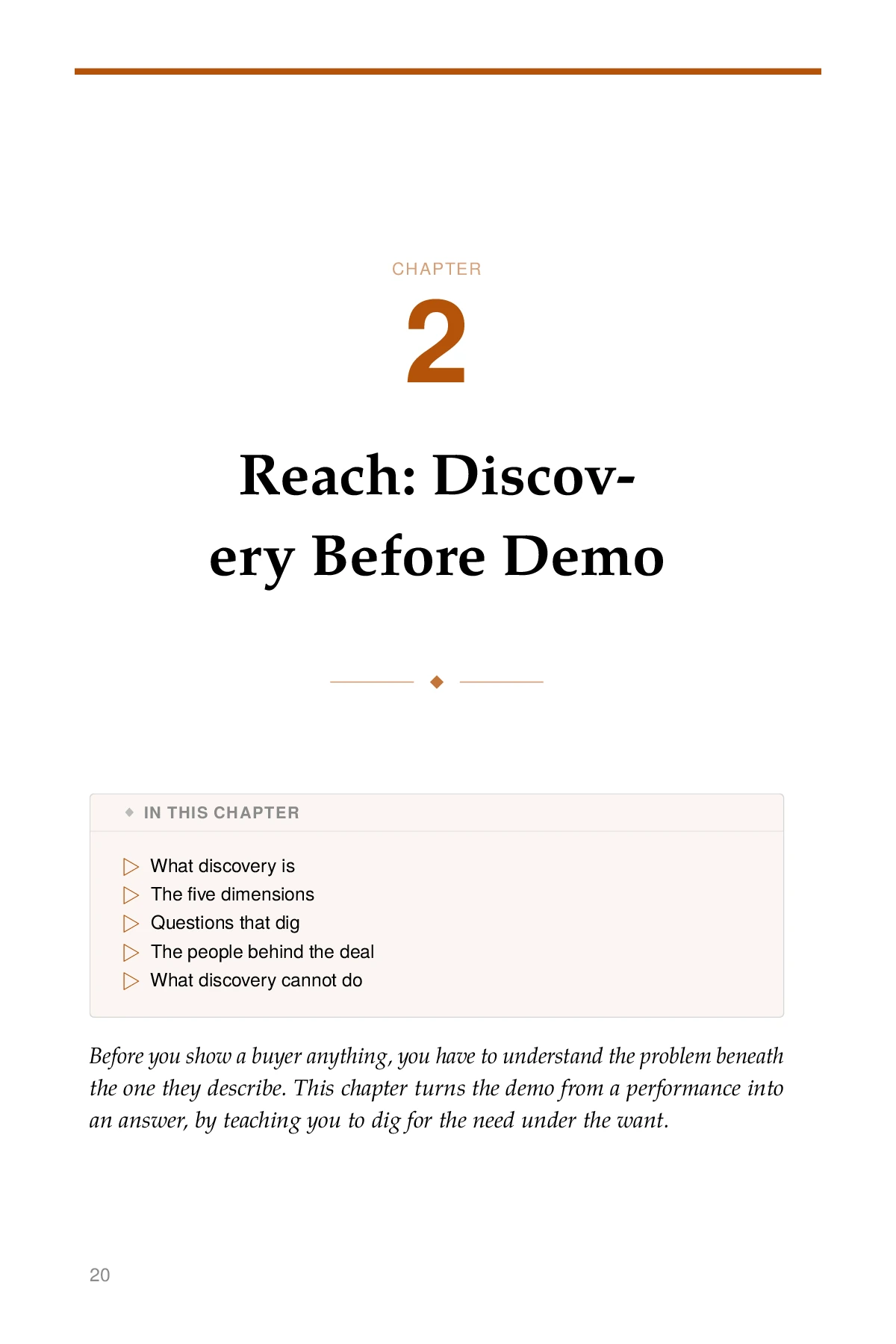
Reach: Discovery Before Demo
Before you show a buyer anything, you have to understand the problem beneath the one they describe. This chapter turns the demo from a performance into an answer, by teaching you to dig for the need under the want.
What you can do afterwards
You will leave this chapter able to run a discovery conversation that surfaces what a buyer truly needs, who decides, what they can spend, when they will move, and who else they are considering, before you demo anything.
Use this chapter when
You have a qualified opportunity on your board and you feel the pull to show the product. Stop, and run discovery first.
Chapter 3
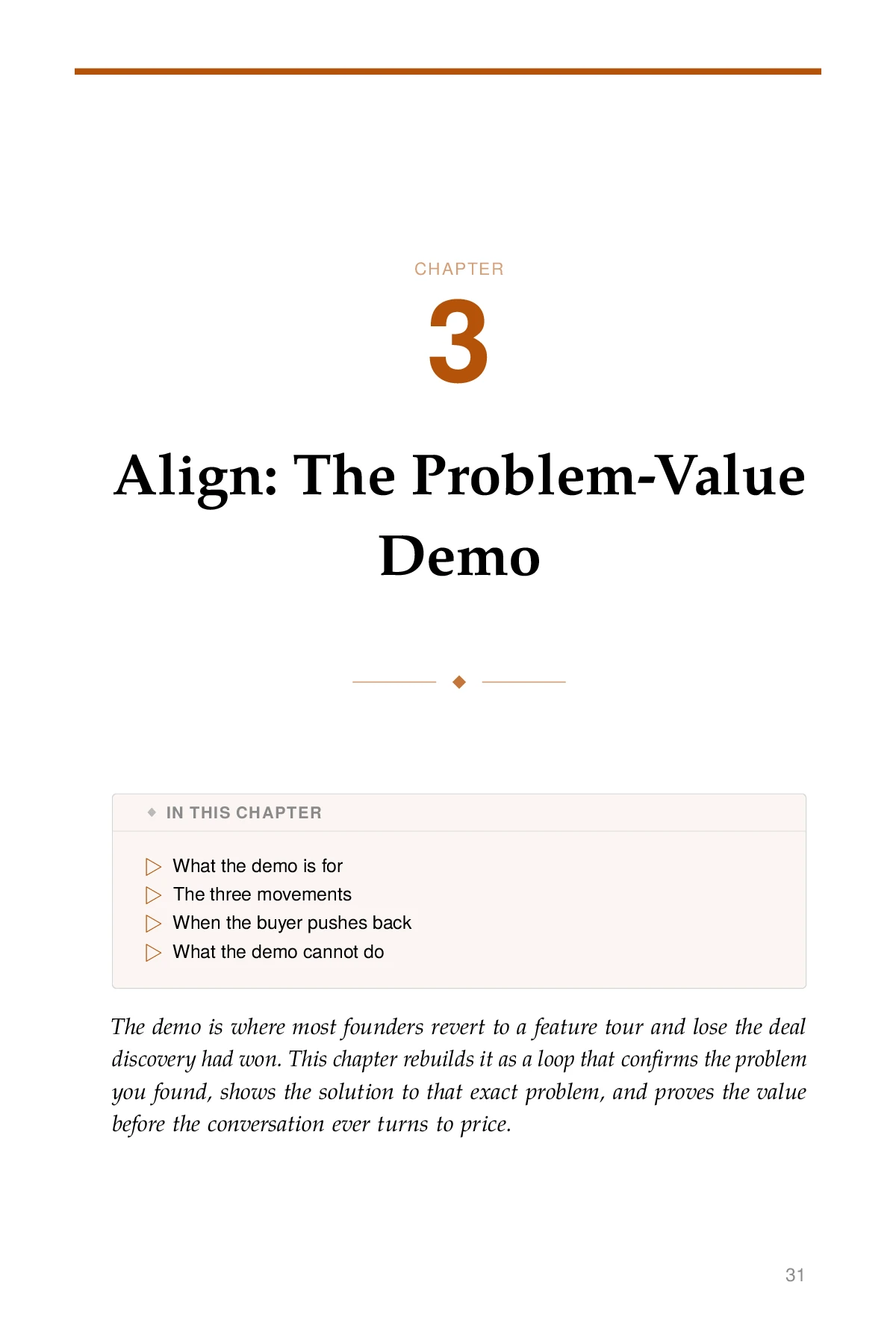
Align: The Problem-Value Demo
The demo is where most founders revert to a feature tour and lose the deal discovery had won. This chapter rebuilds it as a loop that confirms the problem you found, shows the solution to that exact problem, and proves the value before the conversation ever turns to price.
What you can do afterwards
You will leave this chapter able to run a demo as a three-part loop: confirm the problem you found in discovery, demonstrate your solution to that exact problem, and validate that the buyer sees the value, surfacing the real objections before you write a proposal.
Use this chapter when
You have run discovery, you know the buyer's problem, and you are about to show them the product. Before you open the screen, build the demo around their problem instead of your feature list.
Chapter 4
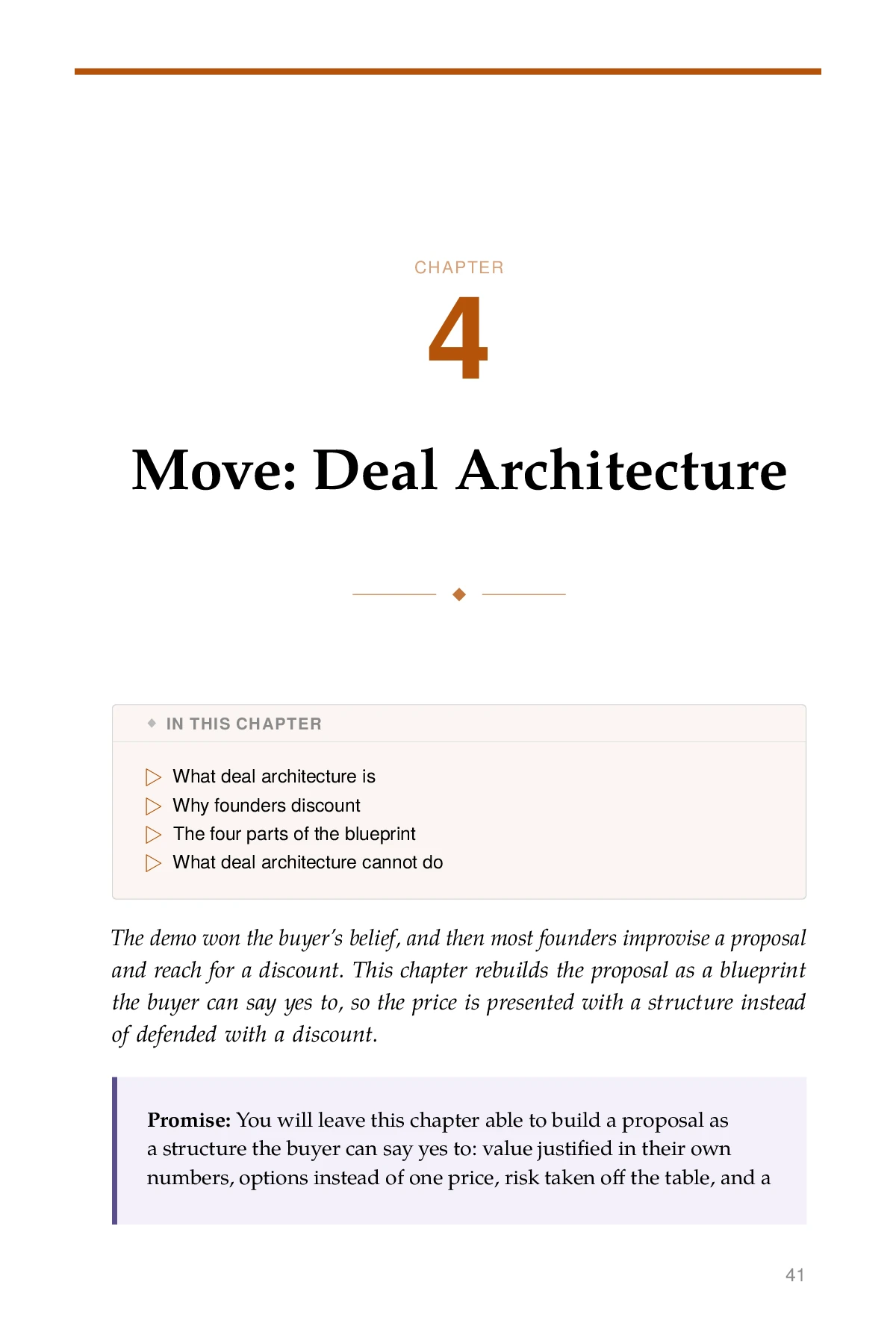
Move: Deal Architecture
The demo won the buyer's belief, and then most founders improvise a proposal and reach for a discount. This chapter rebuilds the proposal as a blueprint the buyer can say yes to, so the price is presented with a structure instead of defended with a discount.
What you can do afterwards
You will leave this chapter able to build a proposal as a structure the buyer can say yes to: value justified in their own numbers, options instead of one price, risk taken off the table, and a plan that names every step to signature.
Use this chapter when
The demo has landed and the buyer sees the value. Before you open a blank document and improvise a proposal, design its structure.
Chapter 5
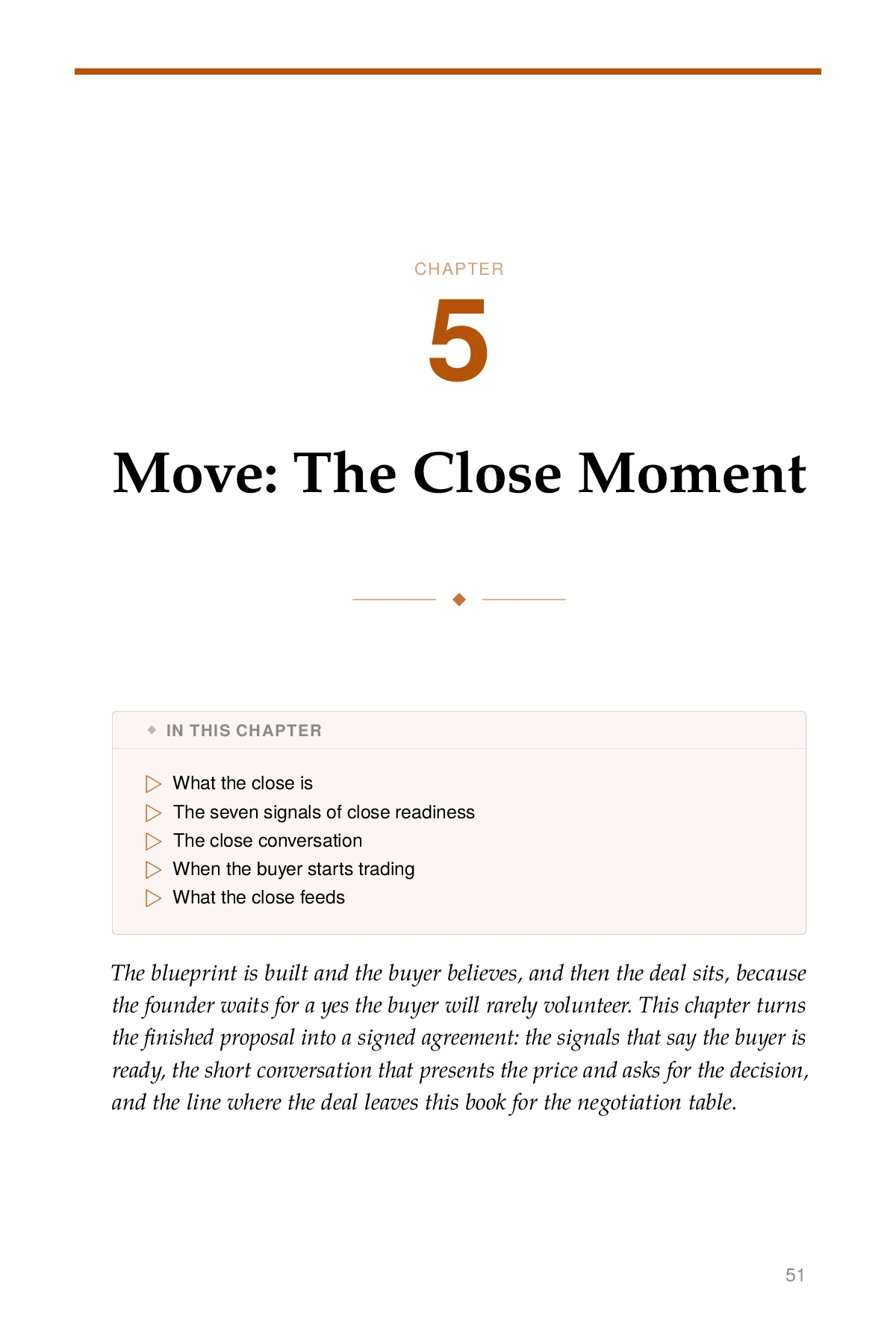
Move: The Close Moment
The blueprint is built and the buyer believes, and then the deal sits, because the founder waits for a yes the buyer will rarely volunteer. This chapter turns the finished proposal into a signed agreement: the signals that say the buyer is ready, the short conversation that presents the price and asks for the decision, and the line where the deal leaves this book for the negotiation table.
What you can do afterwards
You will leave this chapter able to read the seven signals that tell you a buyer is ready to decide, run a four-move close conversation that presents the price inside the value the buyer named, and recognize the moment the conversation crosses into negotiation and stop.
Use this chapter when
The proposal is built and delivered, the buyer has seen it, and you are waiting. Before you send another proof point, check whether the buyer is ready and ask for the decision.
Chapter 6
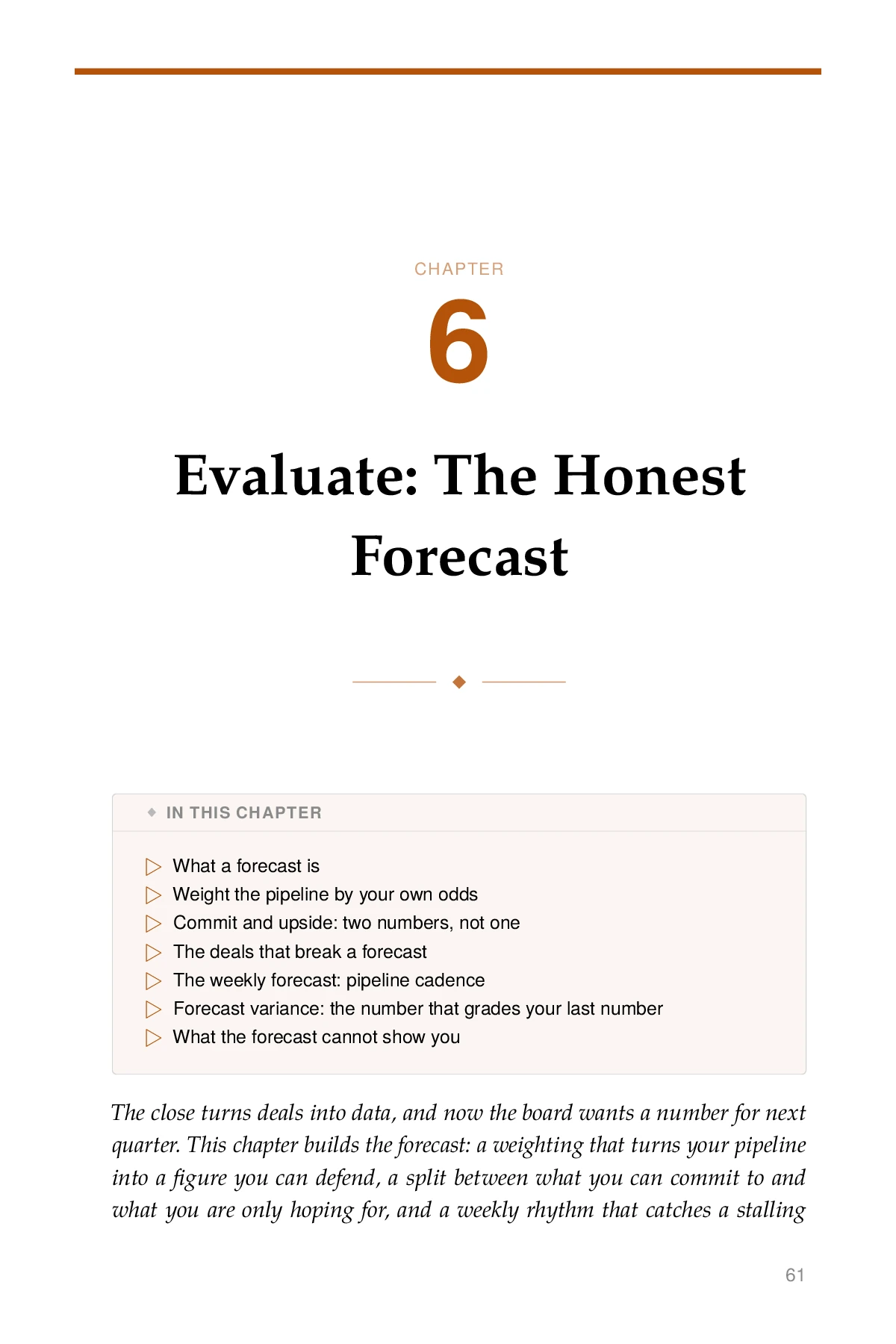
Evaluate: The Honest Forecast
The close turns deals into data, and now the board wants a number for next quarter. This chapter builds the forecast: a weighting that turns your pipeline into a figure you can defend, a split between what you can commit to and what you are only hoping for, and a weekly rhythm that catches a stalling deal before it rots.
What you can do afterwards
You will leave this chapter able to weight your pipeline by your own conversion history, split it into a commit number you can stand behind and an upside number you cannot, and run a weekly review that finds a dying deal while there is still time to save it.
Use this chapter when
Someone asks what you will close next quarter and your honest answer is a guess, or your pipeline total and your gut disagree and you cannot say which one is lying.
Chapter 7
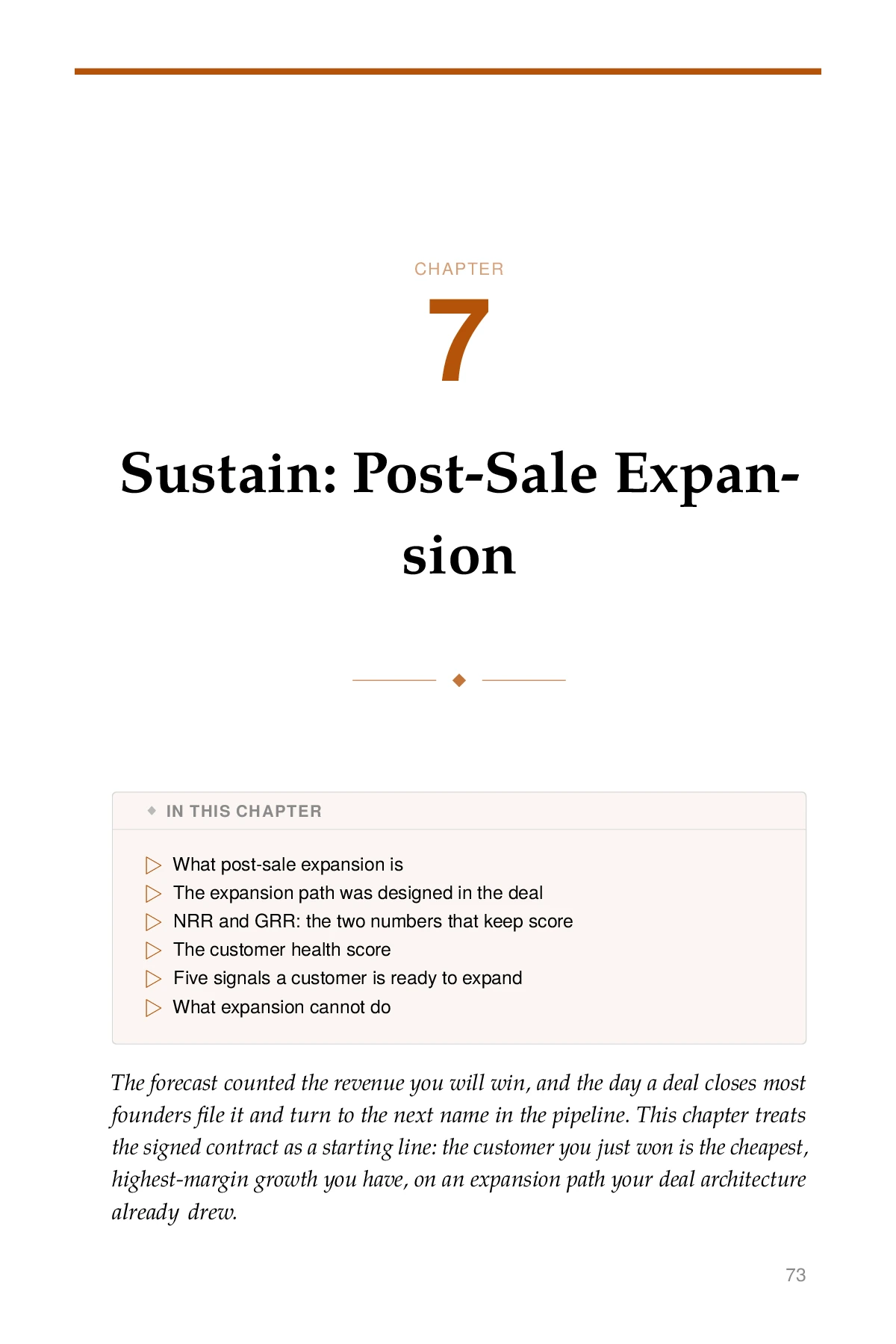
Sustain: Post-Sale Expansion
The forecast counted the revenue you will win, and the day a deal closes most founders file it and turn to the next name in the pipeline. This chapter treats the signed contract as a starting line: the customer you just won is the cheapest, highest-margin growth you have, on an expansion path your deal architecture already drew.
What you can do afterwards
You will leave this chapter able to treat a closed deal as the start of an expansion relationship: hand it off cleanly, score customer health on leading signals instead of waiting for the renewal, and read the five signs that a customer is ready to grow.
Use this chapter when
A deal just closed and your instinct is to file it and open the next one, or a customer you thought was safe gives notice and you never saw it coming.
Chapter 8
Sustain: The Personal Sales OS
You have learned six domains. This chapter builds the weekly system that runs all of them, so your sales function stops living in your head and starts living in a record, a rhythm, and a loop you could hand to someone else.
What you can do afterwards
You will leave this chapter able to run your whole sales system on a weekly cadence: a CRM disciplined enough to trust, a thirty-minute review that inspects all six domains, and a won-and-lost post-mortem that turns every closed deal into a sharper method.
Use this chapter when
You have learned the six domains but still run them from memory, or you reach the end of a week and cannot say what the deals you worked taught you.
Conclusion
Before You Hire
Conclusion: what to have in place before you bring in sales help, and why a system, not a personality, is the one version of your sales function you can hand to someone else.
What you can do afterwards
You will leave this chapter able to see the six FRAMES domains as one operating system, audit all eight domains and pick the next one to improve, and name the four things to have in place before you hire your first salesperson.
Use this chapter when
You have built the system and are wondering whether you are ready to bring in help, or you have finished the book and want the single-page version you can run the whole motion from.
Who it is for
Who this book was written for
The result is a practical operating layer: stage definitions, a discovery structure, pipeline hygiene rules, opportunity notes, a forecast, and a ninety-day practice for making the motion less dependent on the founder's memory or mood.
This is not a charisma manual and not an enterprise sales methodology compressed for startups. It is for technical and first-time founders who need a sales system before they need a sales department: rigorous enough to forecast, humane enough to preserve trust, and simple enough to run every week.
The reader it was written for
Technical founders and small-team sales leads at companies of 2-30 people who need a sales motion that does not depend on a dedicated sales hire. The reader is the founder who has closed the first 10 deals by instinct and needs a system to scale from 10 to 100.
What you will use it on
- Document the founder's story.
- Design the ask and the listen.
- Build the discovery call.
- Build the demo.
- Build the proposal.
- Hire the first sales person.
Probably not for you if
- Enterprise sales leaders with established sales functions (the book is for the underbuilt case).
- Pure marketing / positioning readers (the book is sales, not marketing).
- Hobbyist founders (the book assumes operational context).
- Series-B-and-beyond founders (the book is for the early stage).
Editions
Editions and specifications
| Edition | Formats | Chapters | Pages | Reading time | ISBN (paperback) |
|---|---|---|---|---|---|
| English The Founder Sales System | In production | 10 | 122 | ± 2 hours | — |
| Dutch The founder sales system | In production | — | — | ± 1 hours | — |
Both editions are written natively. The Dutch text is not a machine translation of the English. · Trim size: 6x9″
Frequently asked
What readers usually want to know
What is The Founder Sales System about?
The five-part SALES motion (Story, Ask, Listen, Evaluate, Sustain) turns founder-led selling into a process you can run, inspect, and improve long before you hire anyone to do it for you. The subtitle is: Pipeline, Discovery, and Deals Before You Have a Sales Team.
What is the SALES framework?
SALES: Story, Ask, Listen, Evaluate and Sustain.
Is there a Dutch edition?
Yes. The Dutch edition is The founder sales system, written as a native edition rather than a machine translation. It moves through the same production line.
How long is The Founder Sales System?
This edition runs 10 chapters, 122 pages in print and roughly 2 hours of reading.
Who is The Founder Sales System for?
This is not a charisma manual and not an enterprise sales methodology compressed for startups. It is for technical and first-time founders who need a sales system before they need a sales department: rigorous enough to forecast, humane enough to preserve trust, and simple enough to run every week.
The production system
How this book was made
Every title moves through the same gated production line: sourced research, a claim-level evidence ledger, structural review, fact-checking, red-team critique, and a bilingual final edit. AI agents do specialist work inside those gates; judgment, voice, and accountability stay human.
- Claims enter an evidence ledger with a source and a confidence grade before they reach the page
- English and Dutch are two native editions, not a translation of one another
- Every chapter clears readability, rhythm, and style gates before it is typeset


