

No. 48 · Drafting (English edition first) · Marketing & trust · PRICE
The Pricing Mind
Behavioral Economics of Price: How Buyers Experience Value and How to Design That Experience
The Pricing Mind: Behavioral Economics of Price: How Buyers Experience Value and How to Design That Experience.
A price is never experienced as a naked number. The five-part PRICE framework explains how perception, reference points, systematic biases, context, and anticipated ownership decide whether an offer feels expensive, fair, confusing, or easy to choose. Behavioral Economics of Price: How Buyers Experience Value and How to Design That Experience. The framework: PRICE.
- pages
- 128
- chapters
- 12
- hours of reading
- ± 2
- editions
- EN · NL
- Design
- Drafting
- Manuscript
- Production
- Launched
The editions
Kindle and Paperback
Production shots of the editions. Not for sale yet — this page is the public working version.
-
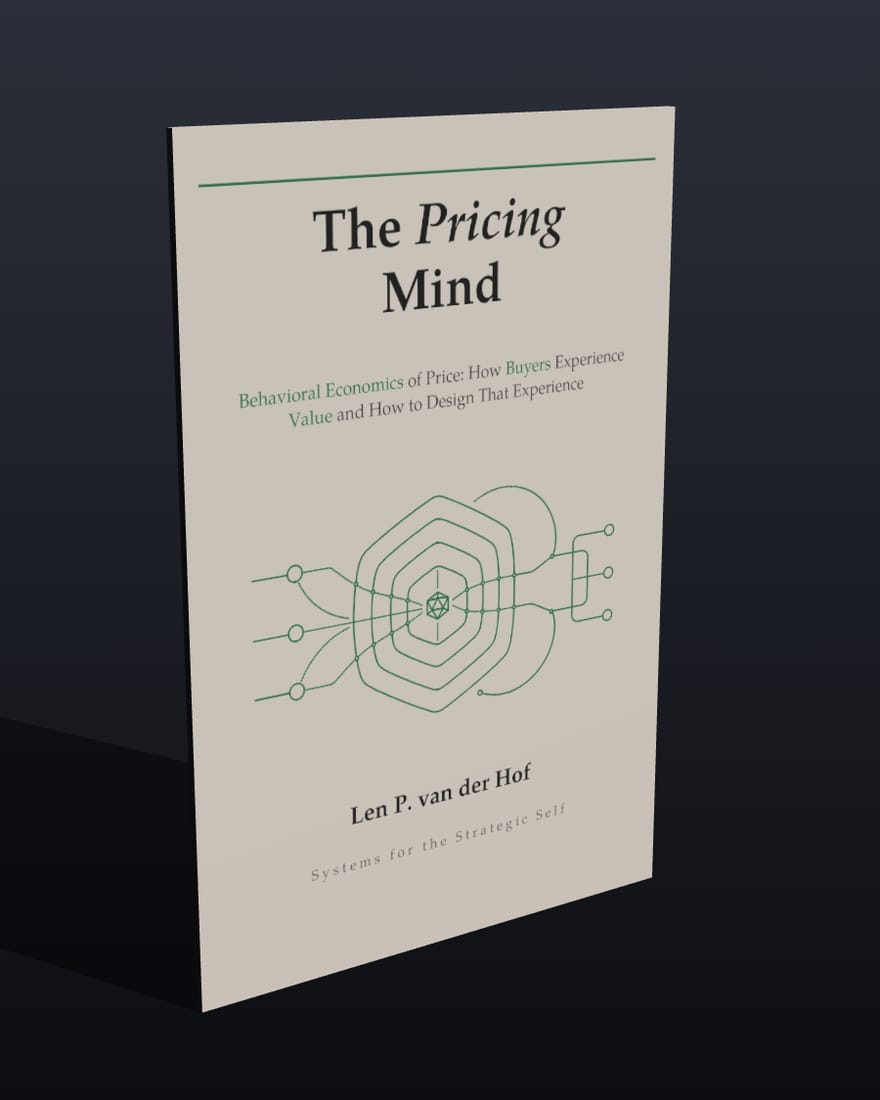
Kindle
The digital edition, ready in any Kindle app.
-
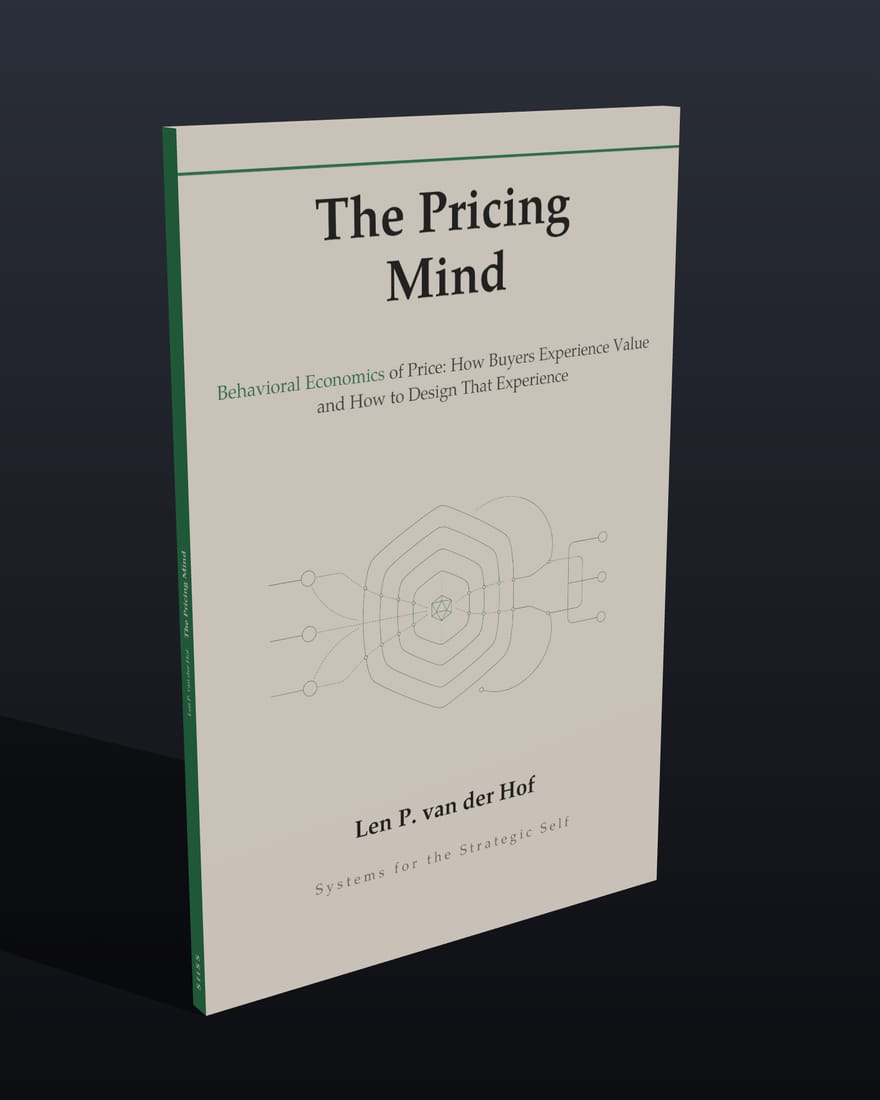
Paperback
The working copy. Mark it up. Take it into the meeting.


The book
Behavioral Economics of Price: How Buyers Experience Value and How to Design That Experience
Your price is never experienced as a naked number. Buyers compare it with what came before, what sits beside it, what they expect to gain, and what they fear losing. Founders do the same, often bringing guilt, anxiety, and borrowed competitor logic into the moment they name a price.
The Pricing Mind turns behavioral economics into an ethical pricing-design practice. Its five-part PRICE framework explains how perception, reference points, systematic biases, context, and anticipated ownership shape whether an offer feels expensive, fair, confusing, or easy to choose.
What you learn
What this book puts in your hands
- Separate the economic price from the experience the buyer is actually evaluating.
- Identify anchors and reference frames before they silently set the comparison.
- Design tiers that clarify trade-offs instead of manufacturing a decoy.
- Use context, sequencing, and packaging without hiding material information.
- Recognize when discounts train buyers to wait or weaken the value story.
- Test pricing architecture with evidence rather than copying a competitor's page.
The framework
PRICE, step by step
-
Perceive
-
Reference
-
Irrational
-
Context
-
Endow
The contents
Chapter by chapter
Every chapter of The Pricing Mind with its printed epigraph, what you can do afterwards, and the moment it is built for.
Introduction
Price Is Not a Number
You did not choose your price so much as arrive at it, and it slips a little lower each time a buyer pauses. The number the buyer weighs is never only the number you wrote down. What they weigh is an experience assembled in the mind, and an experience can be designed.
What you can do afterwards
Understand that pricing is a cognitive design problem with a map.
Use this chapter when
Beginning any engagement with this book, or returning to it when a pricing decision leaves you stuck.
Chapter 1
The Anxiety Problem
The pricing page has been open in a browser tab for twenty minutes. You know the number is too low. You knew it last quarter, and the quarter before that. Your hand rests on the mouse, the number does not change, and the thing stopping you is not a fact you are missing but a feeling you have never quite named. Until you name it, it will go on setting your prices for you.
What you can do afterwards
Name the cognitive source of pricing anxiety and establish that it is addressable by model, not by mindset.
Use this chapter when
Before any pricing decision that is producing avoidance or dread.
Chapter 2
What Buyers Actually Do
You watch a buyer read your price. Their eyes reach the number, and something happens in the half second before they answer, something you cannot see and have never quite named. You have treated that moment as a black box. It is not one, and this chapter opens it.
What you can do afterwards
Establish the cognitive model that all five PRICE mechanisms rest on.
Use this chapter when
Any time you need to return to first principles about how a price is experienced.
Chapter 3
The Anchor Effect
The buyer's eye lands on one number before it lands on any other. That first number does not sit quietly and wait to be compared against the rest. It reaches forward and bends every figure that follows toward itself. You can choose which number arrives first, or you can let whatever the buyer saw this morning choose it for you.
What you can do afterwards
Understand anchoring as a cognitive mechanism and set your anchor deliberately rather than by accident.
Use this chapter when
Designing a pricing page, preparing a proposal, or opening a pricing conversation.
Chapter 4
What You Are Compared To
Your buyer has never seen your price, and already they know what it should be. Before you say a number, another one is waiting in the room, assembled out of every invoice they have paid and every quote they have been handed. Your figure does not get judged on its own. It gets judged against the one already there, and most sellers never learn what it was.
What you can do afterwards
Understand how a buyer's reference point forms, and learn to participate honestly in setting the frame your price is compared against.
Use this chapter when
Preparing a proposal, redesigning a pricing page, or opening any conversation where your price will meet an expectation the buyer already holds.
Chapter 5
What Free Really Does
The buyer who will not pay a single cent for a thing will often take it gladly for nothing, and the whole distance between those two prices is one penny. Something happens at zero that happens nowhere else on the scale. A price of zero stops being a small number and becomes a different kind of number, one that rearranges the choice around it.
What you can do afterwards
Understand the zero-price effect and what it means for your freemium, free-trial, and loss-leader decisions.
Use this chapter when
Designing or reconsidering any pricing architecture that includes a free element.
Chapter 6
The Architecture of Choice
A price is never read by itself. The buyer reads it in the company it keeps, against the other numbers on the page, and that company decides what the price means. Set a third price beside two and you have done more than lengthen a list. You have reached in and changed how the first two are seen. The set is the design, and most sellers leave it to chance.
What you can do afterwards
Understand the decoy and compromise effects, and design your option set instead of only your prices.
Use this chapter when
Building or revising a multi-tier pricing page, a bundle, or a proposal that offers a buyer more than one choice.
Chapter 7
Context Is the Price
The same price can feel like a gift or an insult, and the number decides neither. What decides is the frame: the words set around the price, the thing it is compared to, the unit it is quoted in. Change the frame and you change the price, though the figure on the page never moves.
What you can do afterwards
Understand the framing effect, and set the words, comparisons, and units around your price on purpose instead of leaving them to chance.
Use this chapter when
Writing the copy that surrounds a price you have already decided, a product page, a proposal, a rate card, where the number is fixed but its presentation is still open.
Chapter 8
The Ownership Premium
What you can do afterwards
Understand the endowment effect and mental accounting, and see why the price an existing customer already pays is defended like something they own instead of weighed like something they are buying.
Use this chapter when
Thinking about a price increase for long-standing customers, designing a free trial, or deciding the billing cycle and the category your price is filed under in the buyer's mind.
Chapter 9
The Price Increase Problem
What you can do afterwards
Understand why price increases fail even when the new price is right, and learn a three-step protocol that manages the increase as a reference-point reset instead of a number change.
Use this chapter when
You are about to raise prices on existing customers, especially long-standing ones on a price you have not changed in a year or more.
Chapter 10
The Ethics of Pricing Design
What you can do afterwards
See the line between pricing design and manipulation clearly enough to find it under pressure, and understand why the commercial case and the ethical case point the same way.
Use this chapter when
You are about to deploy any mechanism from this book and some part of you is unsure whether it is fair, or you are up against a competitor who has no such hesitation.
Conclusion
Your PRICE Audit
What you can do afterwards
A completed PRICE audit that tells you what to change, why, and by when, not a summary to file.
Use this chapter when
You have finished the book and want to convert it into a decision. Return here quarterly, not once.
Who it is for
Who this book was written for
The result is a practical operating layer: a perception map, reference-frame audit, tier architecture, discount policy, buyer-language test, and pricing decision record.
This is not a formula for discovering one objectively correct number. It is not a catalogue of dark patterns. It is for founders, product leaders, and independent operators who want to understand how buyers experience price, design that experience honestly, and make commercial decisions they can explain without apology.
The reader it was written for
The undercharging founder. Typically 30–45 years old. They have a product or service that works — customers tell them so, NPS is good, churn is low — but they have not raised prices since launch, or since a very early arbitrary decision. They know their pricing is too low. Their accountant knows it. Their investors hint at it.
Also a fit for
The tier-design paralytic. Product manager or product-led growth lead at a 15–80 person startup, preparing a pricing page redesign or the launch of a second or third tier. They are not the founder but they own this decision and they feel its weight. They have run surveys, read blog posts about decoy pricing, and stared at the competitor's pricing page until the numbers swim.
What you will use it on
- **Understand** the specific cognitive mechanisms — anchoring, reference points, the zero-price effect, mental accounting, the endowment effect — that shape how buyers experience price
- **Diagnose** what is wrong with their current pricing design: missing anchors, absent reference frames, misused free tiers, discount structures that train price sensitivity
- **Redesign** their pricing page, tier structure, or proposal framing using the PRICE framework
- **Communicate** price increases to existing customers in a way that manages the endowment effect and loss aversion without deception
- **Hold** prices under pressure — develop the internal model and language to resist discount requests without anxiety
- **Evaluate** prestige and Veblen pricing in their own context: when higher price signals quality vs. when it merely excludes
Probably not for you if
- Readers seeking a shortcut compendium of psychological pricing "tricks" (dark patterns, artificial scarcity, fake crossed-out prices) — the book explicitly refuses to serve this request and explains why in the introduction
- Revenue operations managers at enterprise companies running fully instrumented pricing experiments with dedicated analyst teams — this book is for operators who set prices without that infrastructure
- Academic economists or behavioural scientists seeking a literature review — the evidence base is real and cited, but the frame is practitioner application, not academic contribution
- Readers who believe "ethical pricing" is a naive concept and that all commercial persuasion is inherently manipulative — this book's anti-manipulation ethic is load-bearing, not decorative; dismissing it means dismissing the book's core argument
Editions
Editions and specifications
| Edition | Formats | Chapters | Pages | Reading time | ISBN (paperback) |
|---|---|---|---|---|---|
| English The Pricing Mind | In production | 12 | 128 | ± 2 hours | — |
| Dutch De prijspsychologie | In production | — | — | — | — |
Both editions are written natively. The Dutch text is not a machine translation of the English. · Trim size: 6x9″
Frequently asked
What readers usually want to know
What is The Pricing Mind about?
A price is never experienced as a naked number. The five-part PRICE framework explains how perception, reference points, systematic biases, context, and anticipated ownership decide whether an offer feels expensive, fair, confusing, or easy to choose. The subtitle is: Behavioral Economics of Price: How Buyers Experience Value and How to Design That Experience.
What is the PRICE framework?
PRICE: Perceive, Reference, Irrational, Context and Endow.
Is there a Dutch edition?
Yes. The Dutch edition is De prijspsychologie, written as a native edition rather than a machine translation. It moves through the same production line.
How long is The Pricing Mind?
This edition runs 12 chapters, 128 pages in print and roughly 2 hours of reading.
Who is The Pricing Mind for?
This is not a formula for discovering one objectively correct number. It is not a catalogue of dark patterns. It is for founders, product leaders, and independent operators who want to understand how buyers experience price, design that experience honestly, and make commercial decisions they can explain without apology.
The production system
How this book was made
Every title moves through the same gated production line: sourced research, a claim-level evidence ledger, structural review, fact-checking, red-team critique, and a bilingual final edit. AI agents do specialist work inside those gates; judgment, voice, and accountability stay human.
- Claims enter an evidence ledger with a source and a confidence grade before they reach the page
- English and Dutch are two native editions, not a translation of one another
- Every chapter clears readability, rhythm, and style gates before it is typeset


