Available now · worldwide on Amazon
The Psychology of Founder Resilience
How High-Stakes Leaders Stay Grounded, Clear, and Effective Under Pressure
Resilience is not what you are. It is what you run.
The RESILIENT framework treats founder resilience as trainable infrastructure: stress recognition, emotional precision, attention protection, decision architecture, recovery, and support before pressure turns into isolation.
Get the book
Also on Bol.com → Third-party listing (not our storefront). Amazon remains the primary buy path.
Reading from another country?Pick your own Amazon marketplace — same edition, your store.
Amazon links may include affiliate tags. That does not change the price you pay. Bol.com listings are third-party.
English & Dutch editions · Kindle, Paperback, Hardcover · free on Kindle Unlimited · Nederlandse editie →
- pages
- 276
- chapters
- 12
- hours of reading
- ± 3
- editions
- EN · NL


The editions
Choose your format
Same book, your format. You buy on Amazon, not on this site.
-
Kindle
Read now. Kindle Unlimited members get it at no extra cost.
Buy on Amazon -
Paperback
The working copy. Mark it up. Take it into the meeting.
Buy on Amazon -
Hardcover
The shelf edition. Dark full-art jacket, built to stay in the room.
Buy on Amazon


Available now
How High-Stakes Leaders Stay Grounded, Clear, and Effective Under Pressure
Your psychology is infrastructure. Most founders treat it as a luxury. The ones who last do not.
Built on cognitive psychology, affective science, and decision research, this book introduces the RESILIENT framework: nine trainable capacities that separate founders who merely survive from founders who stay clear under load. Your psychology, treated like a system: observed, trained, repaired, improved.
What you can do
What this book puts in your hands
Inside, you will learn to:
- Map your stress signature and decode identity fusion before it costs you.
- Reappraise setbacks before they compound into catastrophes in your head.
- Name emotions precisely enough to choose the right response, not the loudest one.
- Protect attention as the currency every other skill spends.
- Architect decisions so the irreversible calls get the judgment they deserve.
- Build recovery as infrastructure, and organise support before isolation turns expensive.
The framework
RESILIENT: the system behind the book
nine trainable capacities, not nine personality traits
-
Reappraisal
Interpreting a setback in a way that does not amplify the threat.
-
Emotional granularity
Telling similar feelings apart and responding to each precisely.
-
Somatic regulation
Managing the body's stress signals through sleep, movement, and breath.
-
Identity flexibility
Maintaining more than one room of the self, so a setback cannot collapse the whole person.
-
Learning orientation
Treating failure as information, feeding the next decision instead of self-doubt.
-
Interpersonal support
Building relationships that supply support without demanding performance.
-
Executive function
Guarding attention and decision-making clarity from exhaustion.
-
Narrative integration
Holding a coherent story of challenge and growth, so hard stretches compound rather than deplete.
-
Titrated exposure
Deliberately meeting manageable stressors to build strength, in measured doses.
From the book
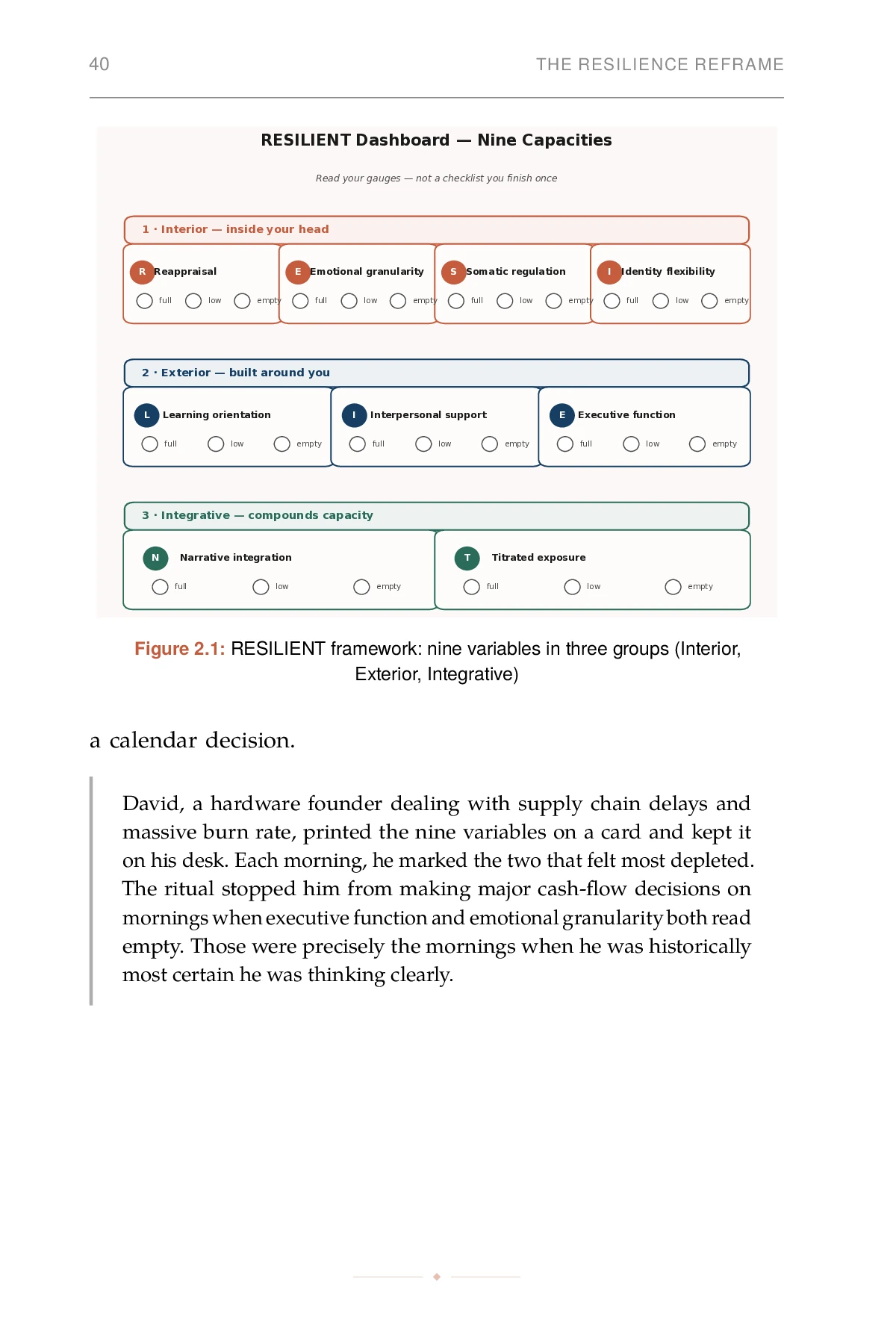
RESILIENT framework: nine variables in three groups (Interior, Exterior, Integrative)
The Psychology of Founder Resilience, printed page: RESILIENT framework: nine variables in three groups (Interior, Exterior, Integrative)
Inspect more pagesLook inside
Pages from the print edition.
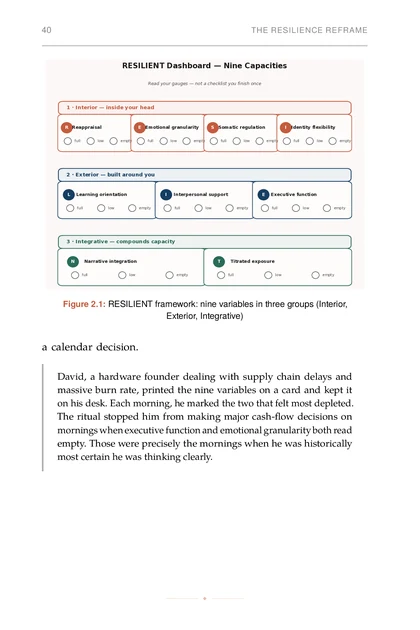 RESILIENT framework: nine variables in three groups (Interior, Exterior, Integrative)
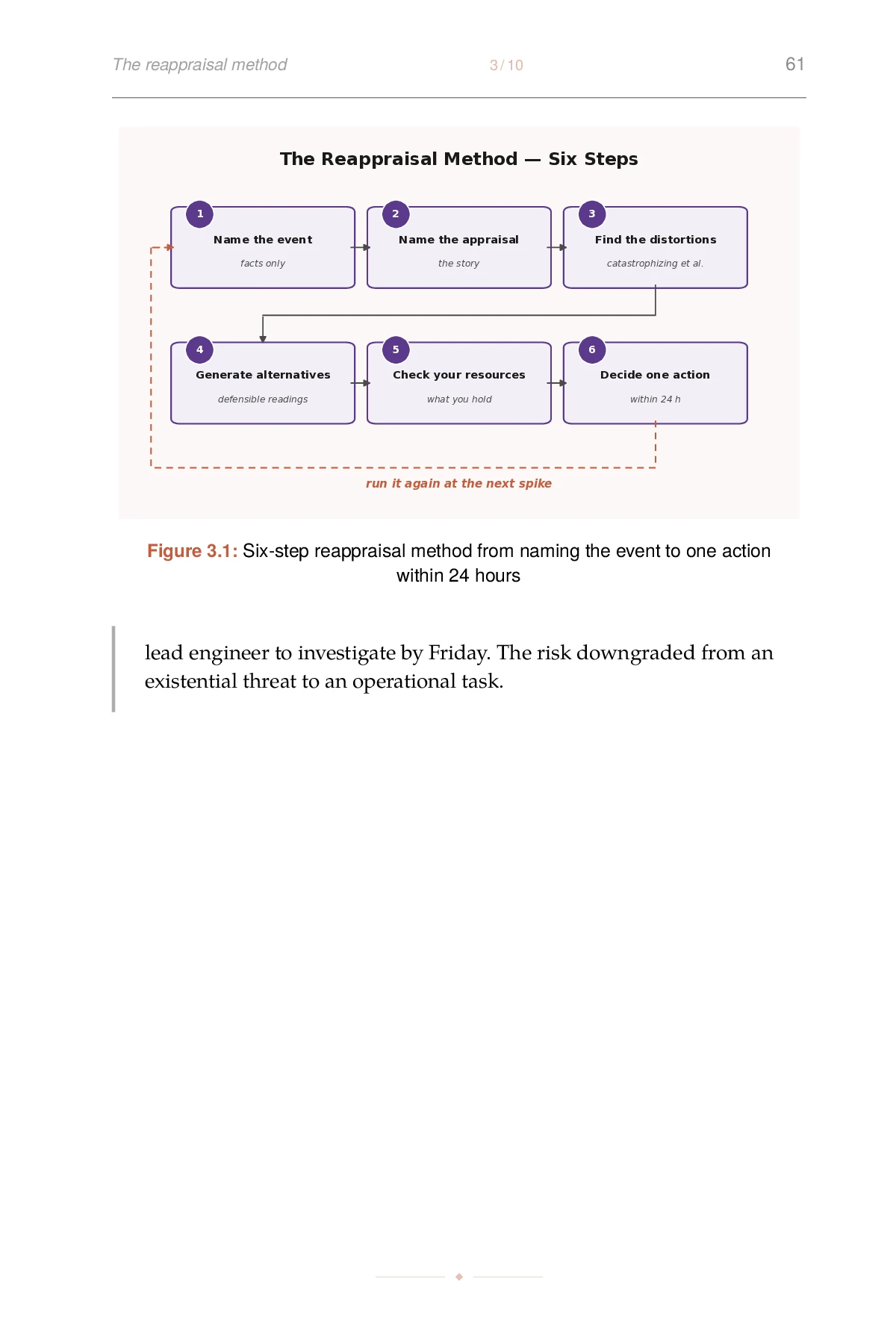
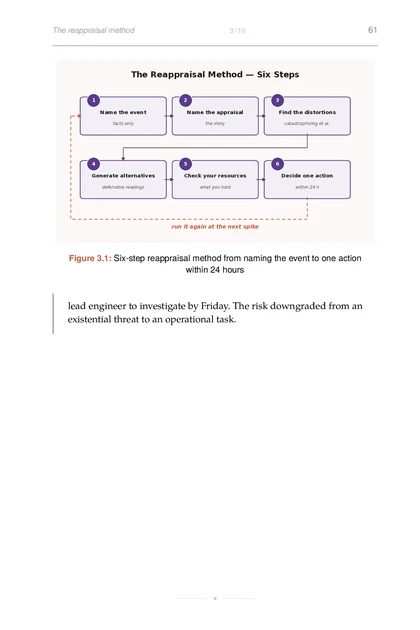 Six-step reappraisal method from naming the event to one action within 24 hours
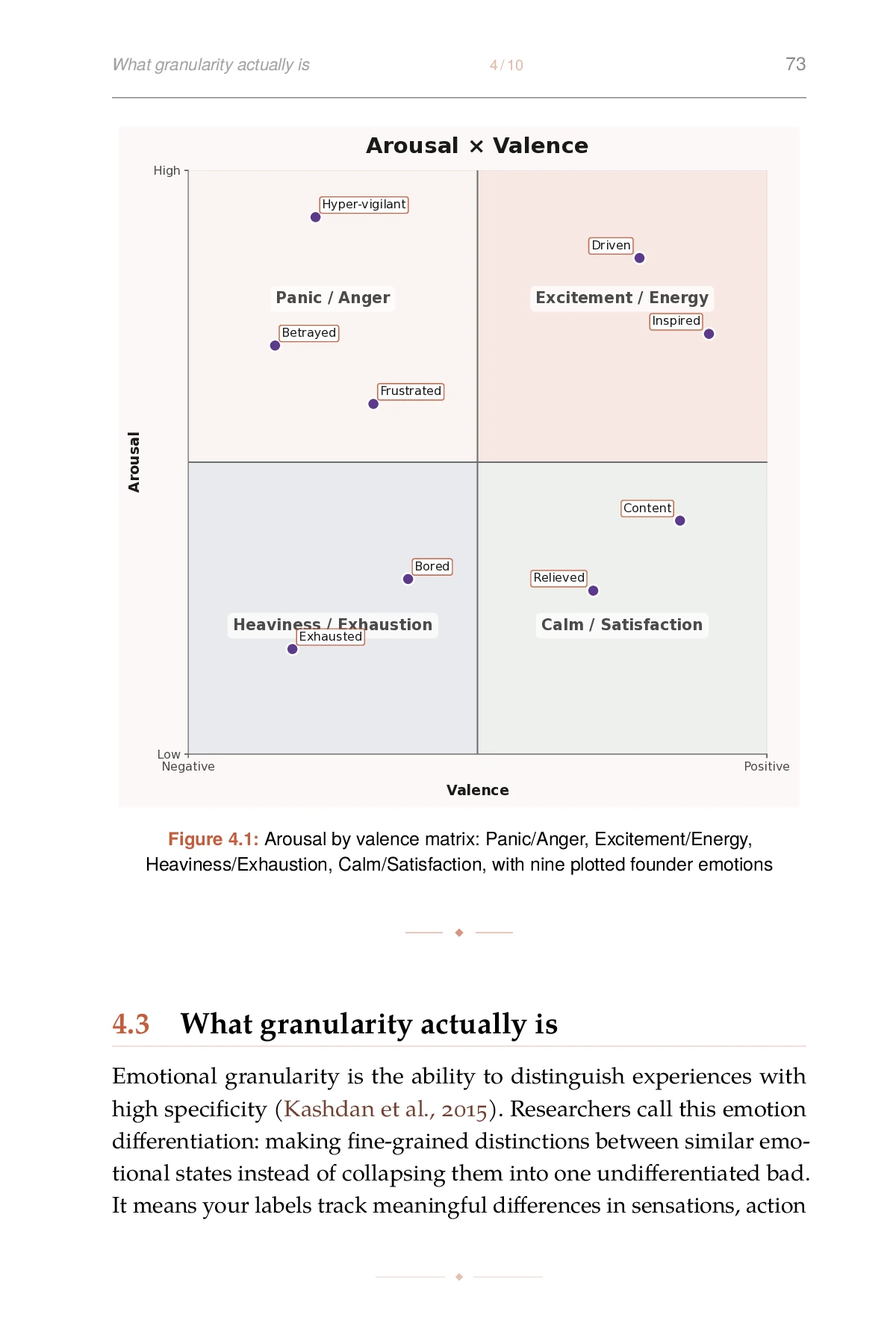
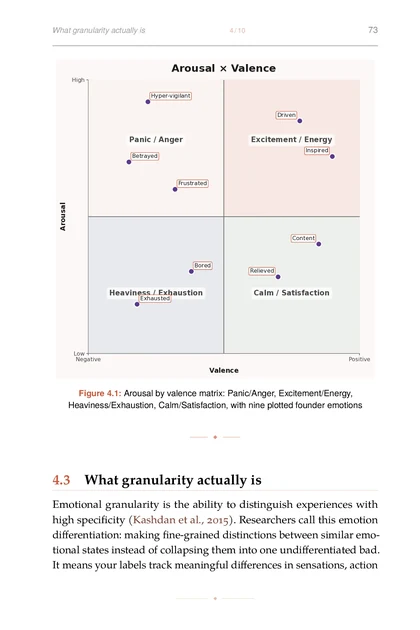 Arousal by valence matrix: Panic/Anger, Excitement/Energy, Heaviness/Exhaustion, Calm/Satisfaction, with nine plotted founder emotions
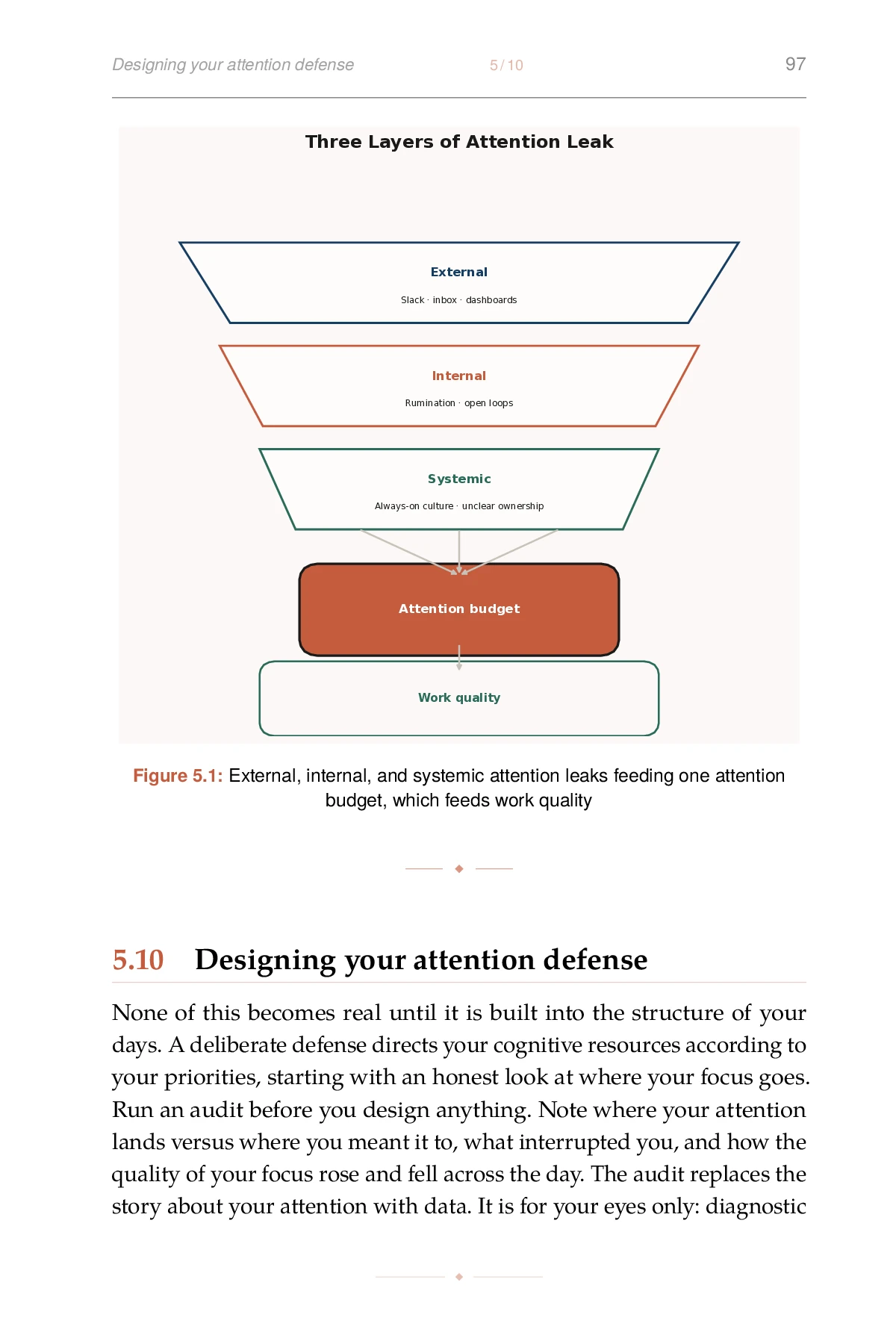
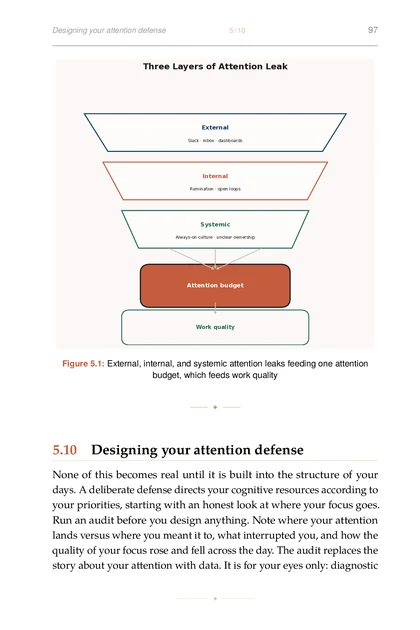 External, internal, and systemic attention leaks feeding one attention budget, which feeds work quality
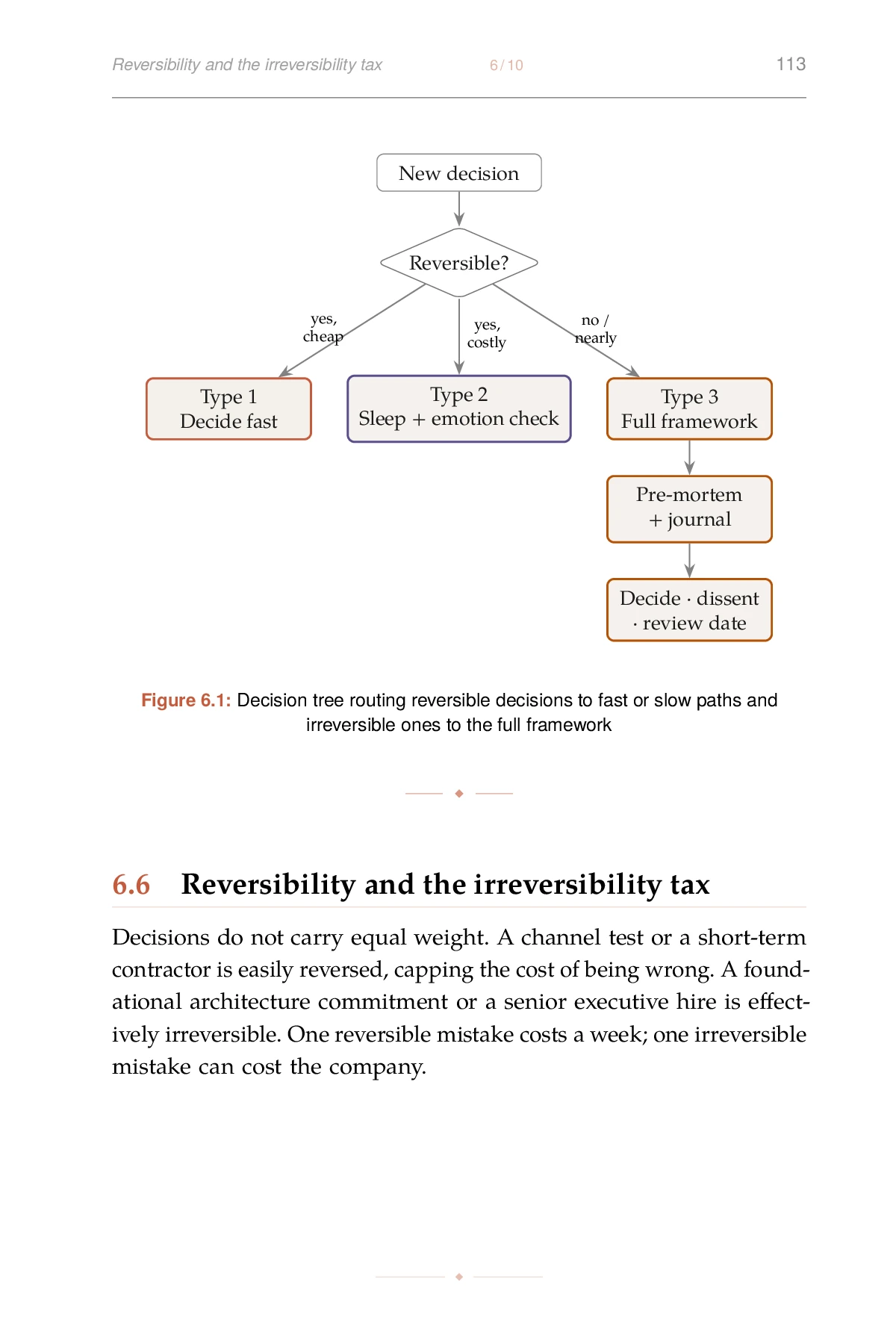
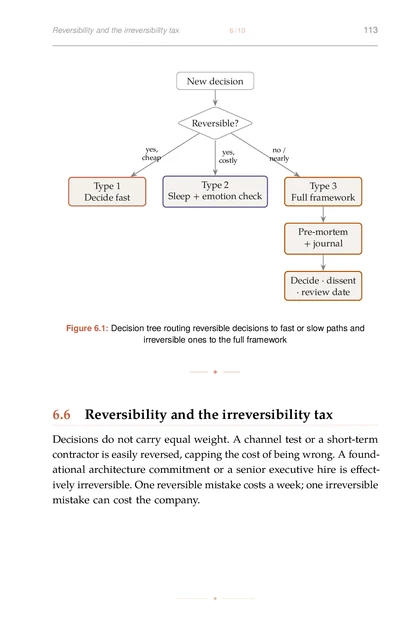 Decision tree routing reversible decisions to fast or slow paths and irreversible ones to the full framework
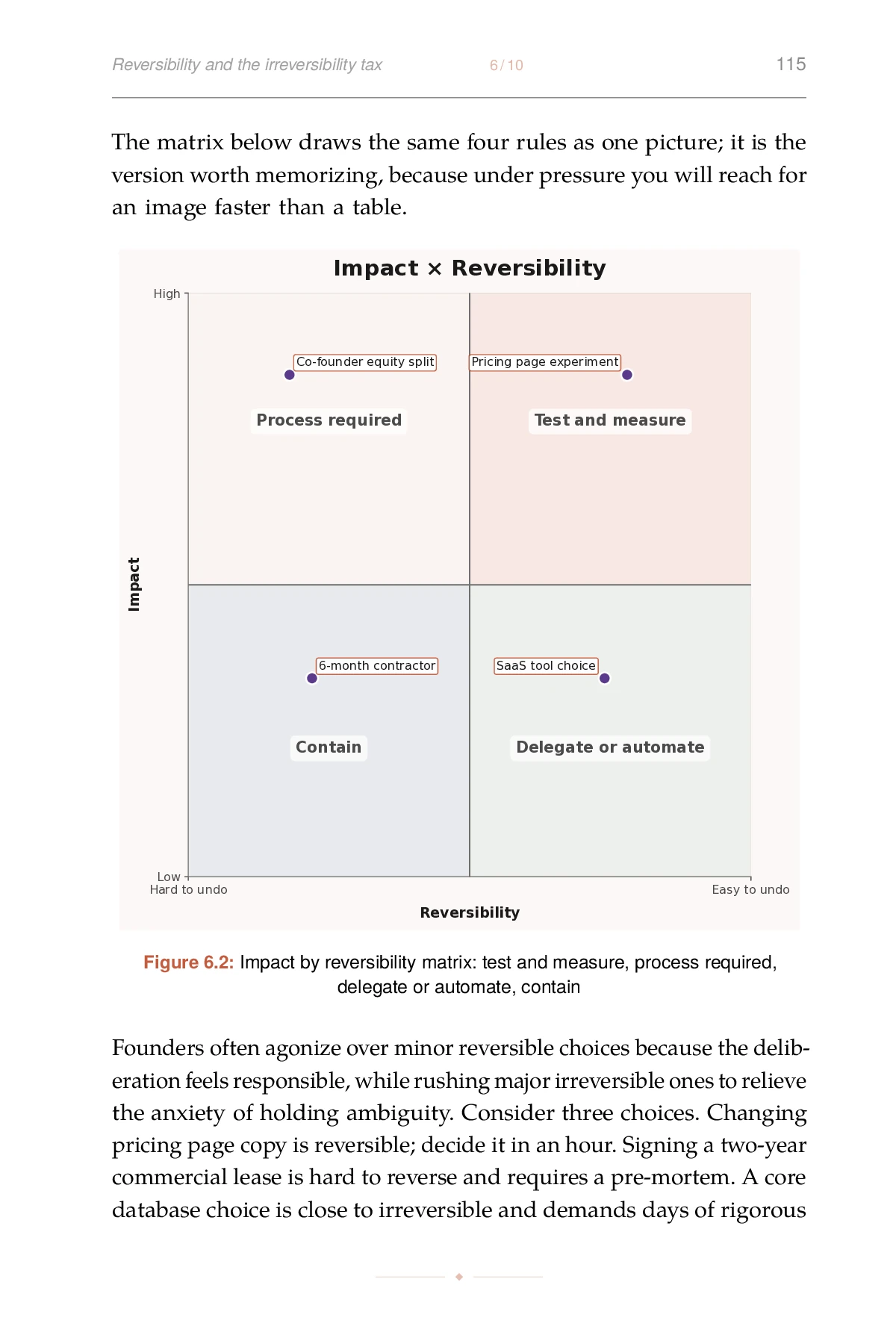
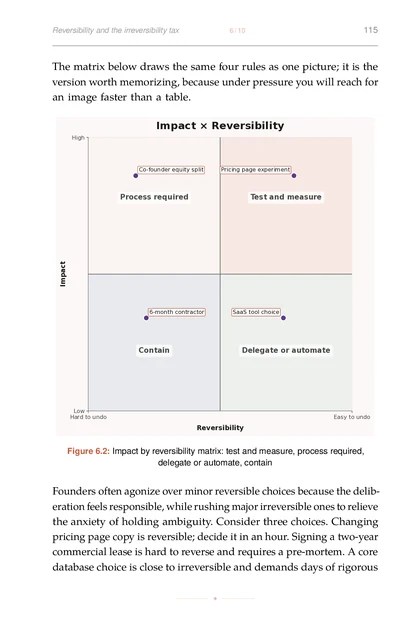 Impact by reversibility matrix: test and measure, process required, delegate or automate, contain
 CHAPTER
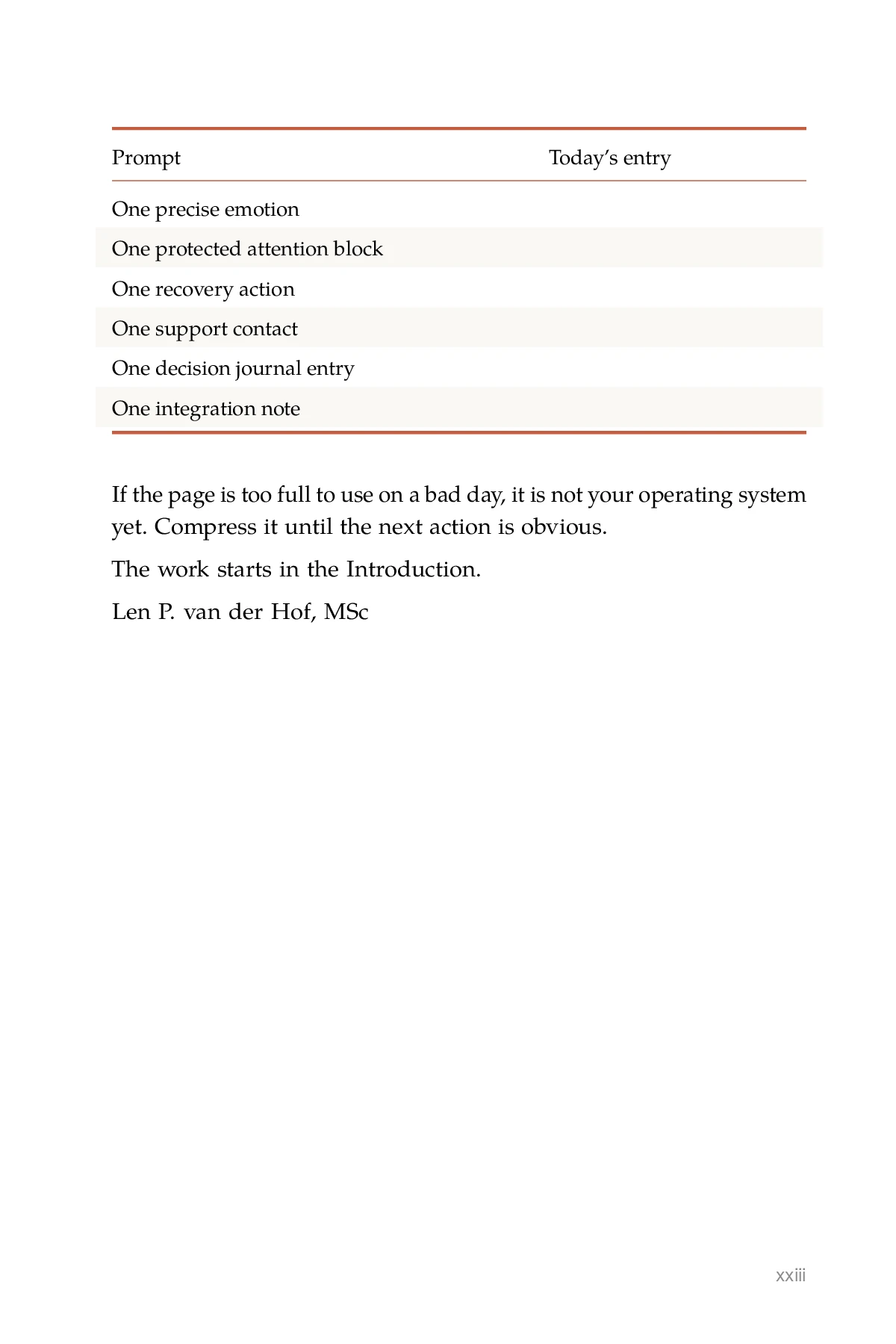
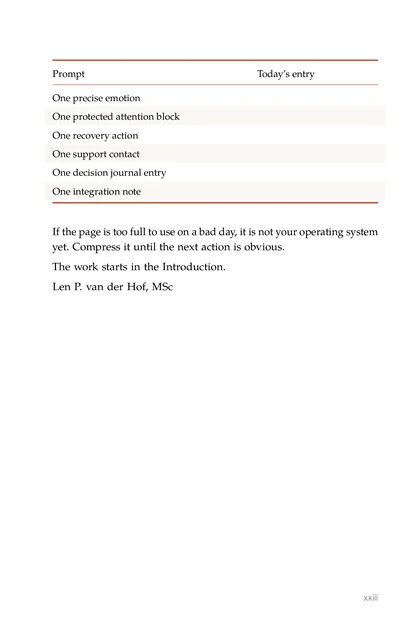 One precise emotion
 CHAPTER
Purchase takes place on Amazon, not on this website.
Buy the paperback on AmazonFrom the book
Read a page
Introduction
The founder's dilemma
Some of the load you carry is built into the role. This book is about catching that load early and building the defenses that keep it from eroding your judgment, your health, and your life.
What you can do afterwards
You will treat founder stress as structural data and start your stress signature tonight.
Use this chapter when
Generic stress advice misses how the role actually works.
What you get
What you get
- The RESILIENT model: nine trainable capacities, not nine personality traits
- Protocols you can run on a bad Tuesday when the runway is short and the inbox is loud
- Decision architecture so irreversible calls get the judgment they deserve
- Weekly rhythms, decision audits, crisis modes, and a two-minute personal dashboard
- Companion workbook with fillable worksheets; native EN and NL editions
Who it's for
- Map your stress signature before it starts writing your decisions
- Keep irreversible calls from landing on a depleted brain
- Build recovery and support as infrastructure, not as a reward
- Treat resilience as nine trainable capacities, not a personality trait
Who it's for
Who this book was written for
This is not meditation rebranded for LinkedIn. It is operator-grade psychology: protocols you can run on a bad Tuesday when the runway is short, the inbox is loud, and the part of you that would remember to pause is already offline.
Operator-grade psychology for founders who refuse to confuse suffering with strategy.
The reader it was written for
Solo and co-founders from seed to Series A who are still functional under chronic stress, and who need a trainable system rather than a pep talk.
Also a fit for
Executive coaches, accelerator operators, and operators who want an evidence-based resilience protocol they can run on a bad Tuesday.
What you will use it on
- Map your stress signature before it starts writing your decisions
- Keep irreversible calls from landing on a depleted brain
- Build recovery and support as infrastructure, not as a reward
- Treat resilience as nine trainable capacities, not a personality trait
Probably not for you if
- Corporate managers looking for generic leadership resilience
- Clinicians looking for treatment protocols
- Readers with no startup context
- Founders in acute crisis; this book is preventive skill-building, not intervention
The contents
Chapter by chapter
Every chapter of The Psychology of Founder Resilience with its printed epigraph, what you can do afterwards, and the moment it is built for.
Introduction
The founder's dilemma
Some of the load you carry is built into the role. This book is about catching that load early and building the defenses that keep it from eroding your judgment, your health, and your life.
What you can do afterwards
You will treat founder stress as structural data and start your stress signature tonight.
Use this chapter when
Generic stress advice misses how the role actually works.
Chapter 1
The founder mind
Before you build resilience, you have to know who it is protecting. For many founders, that person has quietly taken the same shape as the company, and that is exactly where the trouble starts.
What you can do afterwards
You will see identity fusion as a structure you can widen, allowing you to sustain commitment without losing yourself.
Use this chapter when
Business setbacks feel like personal verdicts, or your self-description collapses to simply "founder."
Chapter 2
The resilience reframe
You have been told resilience is a trait you either possess or lack. That misconception prevents founders from building the one mechanism that actually sustains them.
What you can do afterwards
Replace the toughness myth with a process model and the RESILIENT dashboard: nine variables you can read, train, and manage.
Use this chapter when
Strain feels like a character verdict, or you default to pushing harder instead of restoring.
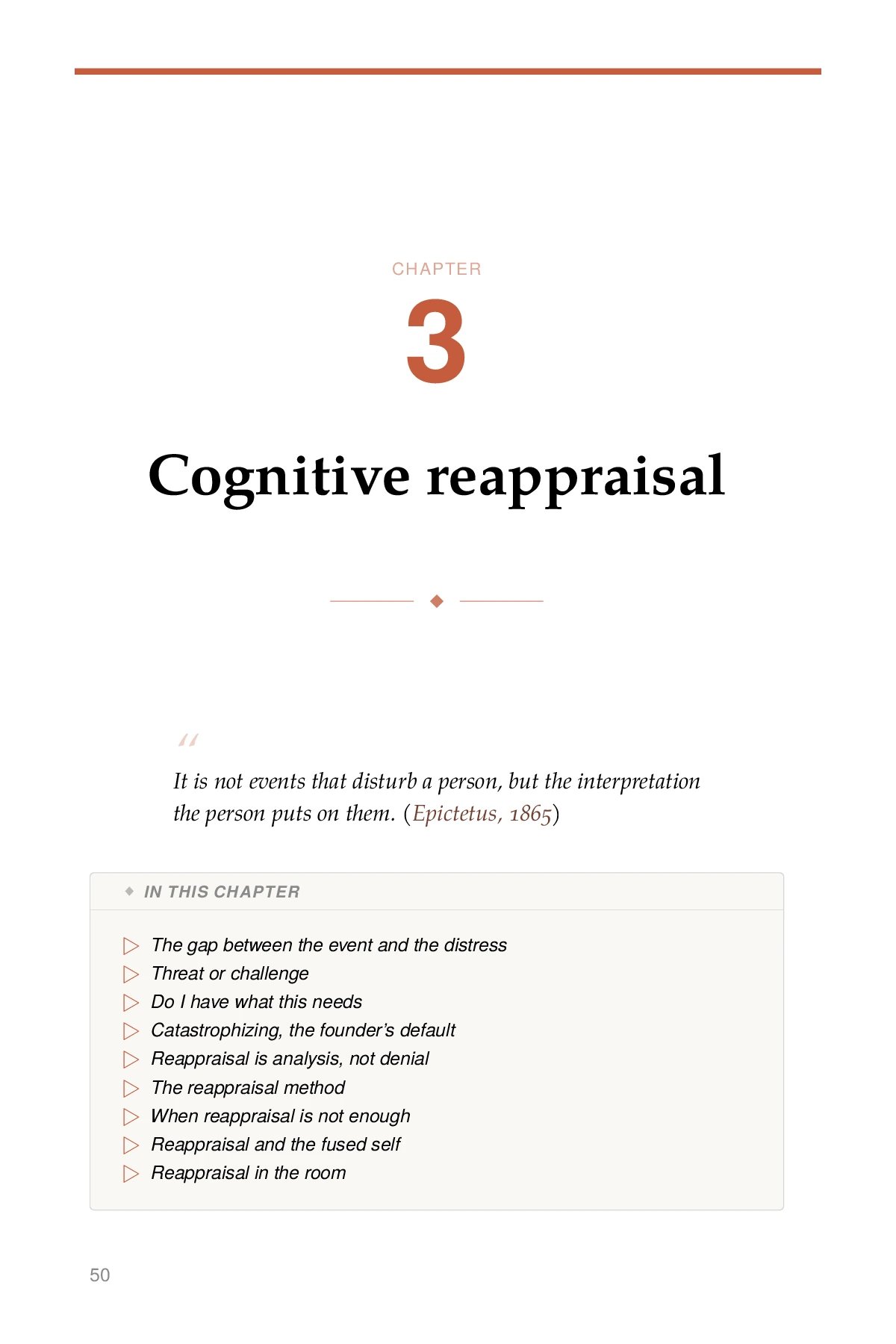
Chapter 3
Cognitive reappraisal
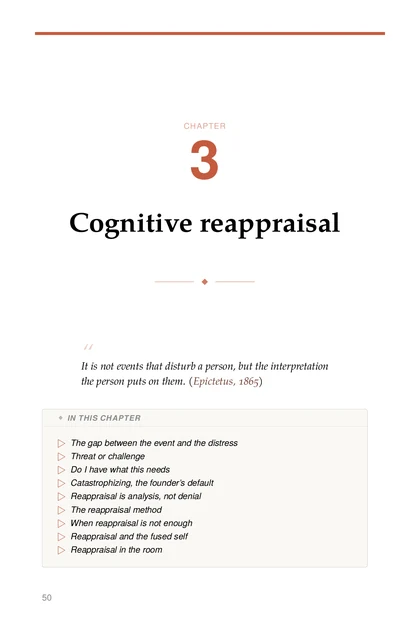
Part of the stress you feel can arise in the rapid interpretation following an event: the story you tell yourself about what the data means. This chapter trains that appraisal window.
What you can do afterwards
You will separate event from appraisal and run a six-step process after any spike.
Use this chapter when
Your body is still in a meeting that ended hours ago, or catastrophe math runs on a loop.
Chapter 4
Emotional granularity
Most founders run their inner life on a vocabulary of about four words: good, bad, fine, stressed. That is a dashboard with a single warning light. This chapter installs better instruments. A feeling you can name precisely is a feeling you can act on precisely.
What you can do afterwards
You will push every emotional label one degree finer and act on the need underneath it.
Use this chapter when
"Stressed" or "bad" is your only vocabulary, or arousal sends you down the wrong script.
Chapter 5
Attentional control
Attention is the currency every other skill in this book spends. You cannot reappraise an event you never fully registered, or name a feeling you never paused to feel. This chapter is about protecting the one resource that makes all the others possible, and about reading its depletion as the early warning it is.
What you can do afterwards
You will defend attention with friction and geography, and read its collapse as a recovery signal.
Use this chapter when
You re-read the same paragraph four times, or "focus time" has become micro-review chains.
Chapter 6
Decision architecture
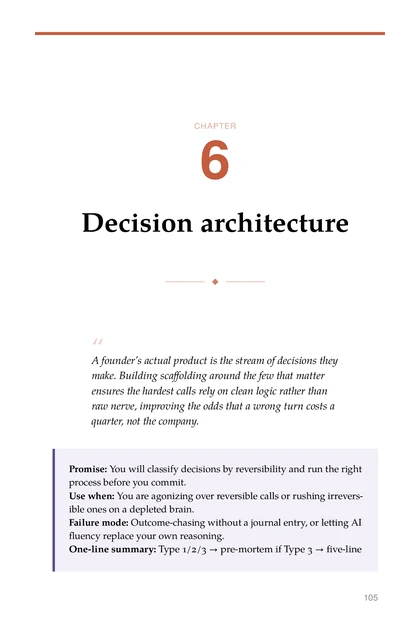
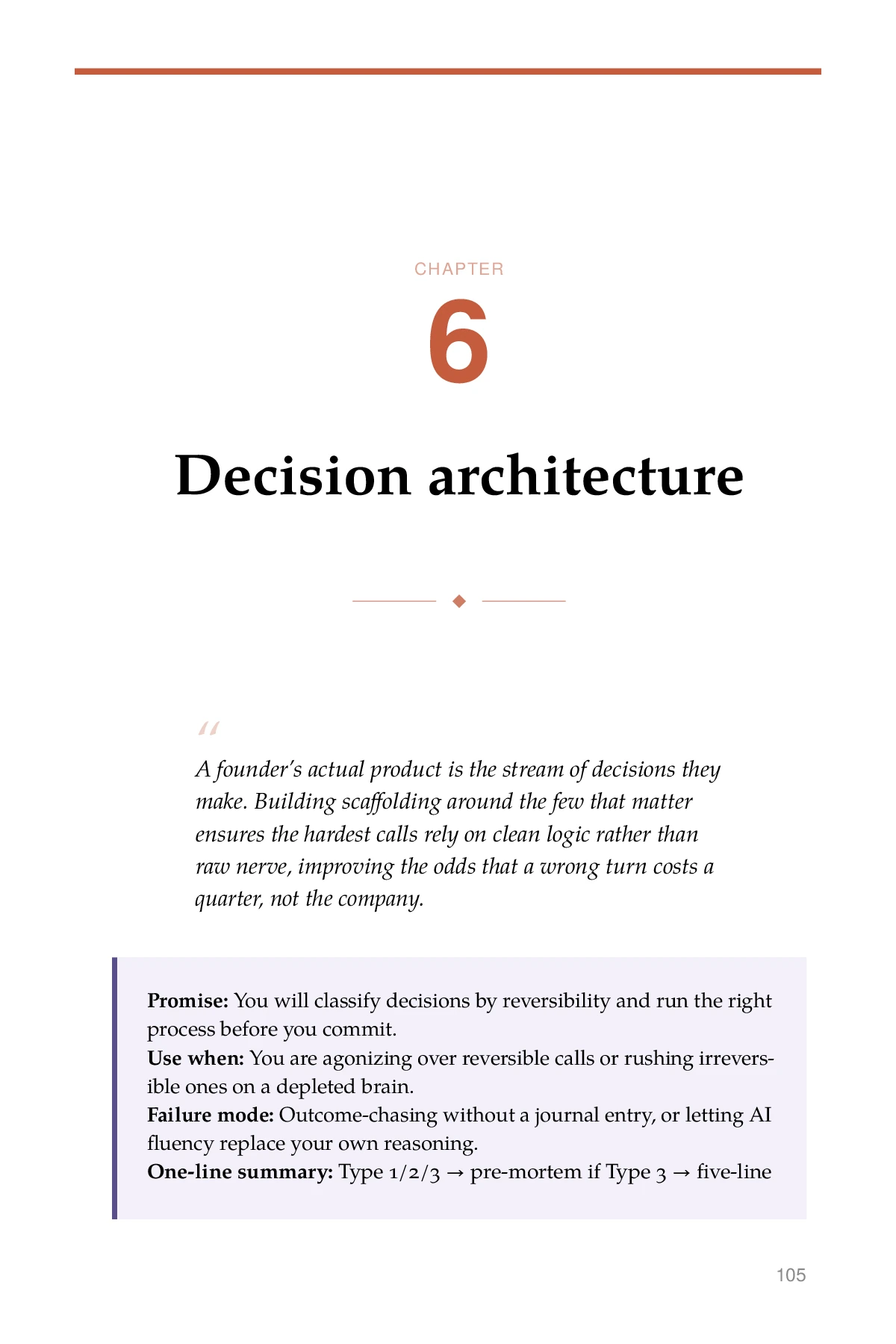
A founder's actual product is the stream of decisions they make. Building scaffolding around the few that matter ensures the hardest calls rely on clean logic rather than raw nerve, improving the odds that a wrong turn costs a quarter, not the company.
What you can do afterwards
You will classify decisions by reversibility and run the right process before you commit.
Use this chapter when
You are agonizing over reversible calls or rushing irreversible ones on a depleted brain.
Chapter 7
Recovery discipline
Every skill in this book runs on a recovered brain. Reappraisal, granularity, attention, judgment: all of them degrade in a depleted operator. None can be willed back online. Recovery is the power supply, and this chapter turns it into a discipline.
What you can do afterwards
Build recovery as infrastructure: sleep, movement, cognitive rest, and boundaries that keep judgment online.
Use this chapter when
Focus collapses, "rest" feels unrestful, or you feel guilt about stopping.
Chapter 8
Social resilience
You can sleep well, move regularly, protect your attention, and still remain depleted by a need those practices do not meet. The founder role can be structurally lonely. Social isolation is an operational risk.
What you can do afterwards
Map social support as infrastructure: four functions, clear containers, and precise disclosure rules.
Use this chapter when
You are surrounded by people but remain fundamentally isolated, or one relationship carries every emotional load.
Chapter 9
The antifragile founder
Recovery restores what stress took. Social resilience holds you while it restores. But the stress keeps coming. The question eventually stops being how to survive each blow and becomes whether a blow can leave you more capable than it found you.
What you can do afterwards
You will distinguish training stress from damaging overload and run dose → recover → integrate on unavoidable difficulty.
Use this chapter when
Recovery and social support are in place and recurring stressors keep arriving.
Chapter 10
Building your resilience protocol
What you can do afterwards
You will run a one-page operating rhythm with triggers, measurement, and season variants, rather than another wellness aspiration list.
Use this chapter when
You know the skills but nothing fires on your worst Tuesday without heroic recall.
Conclusion
Conclusion, resilience as competitive advantage
What you can do afterwards
You will close with stewardship logic: resilience as an operator advantage, not self-help garnish.
Use this chapter when
You need the final argument for why this practice is a fundamental operator advantage.
Editions
Editions and specifications
| Edition | Formats | Chapters | Pages | Reading time | ISBN (paperback) |
|---|---|---|---|---|---|
| English The Psychology of Founder Resilience | Kindle, Paperback, Hardcover | 12 | 276 | ± 3 hours | 9798183948950 |
| Dutch De psychologie van oprichtersveerkracht | Kindle, Paperback, Hardcover | 12 | 280 | ± 3 hours | — |
Both editions are written natively. The Dutch text is not a machine translation of the English. · Trim size: 6x9″
Get the book
One title, every Amazon marketplace. Pick your format and your store.
Get the book
Also on Bol.com → Third-party listing (not our storefront). Amazon remains the primary buy path.
Reading from another country?Pick your own Amazon marketplace — same edition, your store.
Amazon links may include affiliate tags. That does not change the price you pay. Bol.com listings are third-party.
Frequently asked
What readers usually want to know
What is The Psychology of Founder Resilience about?
The RESILIENT framework treats founder resilience as trainable infrastructure: stress recognition, emotional precision, attention protection, decision architecture, recovery, and support before pressure turns into isolation. The subtitle is: How High-Stakes Leaders Stay Grounded, Clear, and Effective Under Pressure.
What is the RESILIENT framework?
RESILIENT: Reappraisal, Emotional granularity, Somatic regulation, Identity flexibility, Learning orientation, Interpersonal support, Executive function, Narrative integration and Titrated exposure. nine trainable capacities, not nine personality traits
In which formats is The Psychology of Founder Resilience available?
The Psychology of Founder Resilience ships as Kindle, Paperback and Hardcover, on every Amazon marketplace worldwide. The Kindle edition is enrolled in Kindle Unlimited, so KU members read it free.
Is there a Dutch edition?
Yes. The Dutch edition is De psychologie van oprichtersveerkracht, written as a native edition rather than a machine translation. It is available on Amazon too.
How long is The Psychology of Founder Resilience?
This edition runs 12 chapters, 276 pages in print and roughly 3 hours of reading.
Who is The Psychology of Founder Resilience for?
Operator-grade psychology for founders who refuse to confuse suffering with strategy.
Does The Psychology of Founder Resilience come with worksheets?
Yes. Fillable worksheets live on this site, alongside the print edition. They are operating instruments, not one-off exercises.
I do not have time to read a book.
This is a high-density operator manual. Chapters are skimmable, and the worksheets are extractable so you can run the system without finishing every page first.
This sounds like therapy. I do not need therapy.
It is an operator-grade performance framework, not a clinical treatment. Resilience is treated as capacity architecture you train and restore.
My situation is unique.
The load is unique. The structure is not. The book works from common founder failure modes, then gives you instruments to measure your own.
The evidence is probably thin.
Claims sit in an evidence ledger with sources and limits. The book is explicit about what the research supports and where it does not.
This is just common sense.
Common sense is not common practice under pressure. The book gives you worksheets, a dashboard, and a weekly review so the practice actually runs.
The production system
How this book was made
Every title moves through the same gated production line: sourced research, a claim-level evidence ledger, structural review, fact-checking, red-team critique, and a bilingual final edit. AI agents do specialist work inside those gates; judgment, voice, and accountability stay human.
- Claims enter an evidence ledger with a source and a confidence grade before they reach the page
- English and Dutch are two native editions, not a translation of one another
- Every chapter clears readability, rhythm, and style gates before it is typeset
Terminology
The production system


