

No. 21 · Manuscript complete · Founder psychology · DOWNSTREAM
The Downstream Effects
Trace the Delayed Consequences of Your Decisions Before They Cost You
The Downstream Effects: Trace the Delayed Consequences of Your Decisions Before They Cost You.
DOWNSTREAM trains operators to map delayed consequences, second-order effects, dependency chains, and hidden costs before a decision compounds. Trace the Delayed Consequences of Your Decisions Before They Cost You. The framework: DOWNSTREAM.
- pages
- 208
- chapters
- 14
- hours of reading
- ± 3
- editions
- EN · NL
- Design
- Drafting
- Manuscript
- Production
- Launched
The editions
Kindle and Paperback
Production shots of the editions. Not for sale yet — this page is the public working version.
-
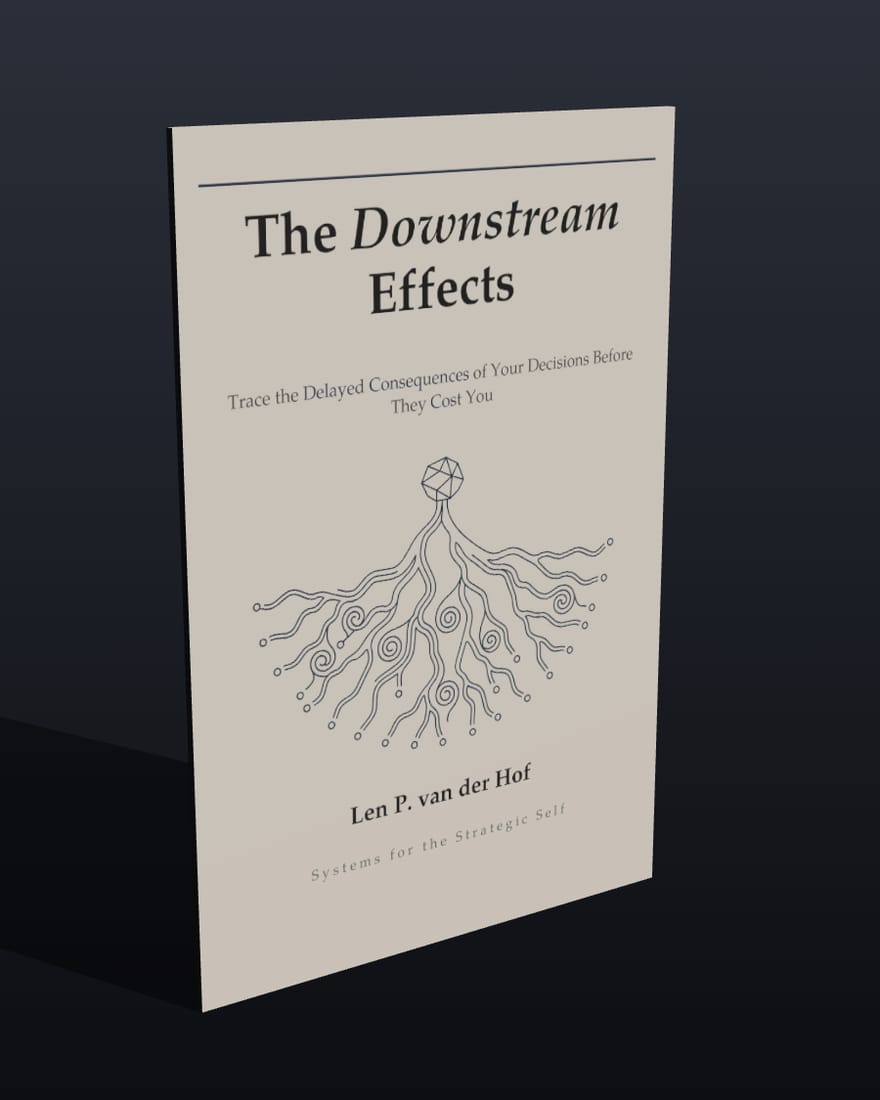
Kindle
The digital edition, ready in any Kindle app.
-
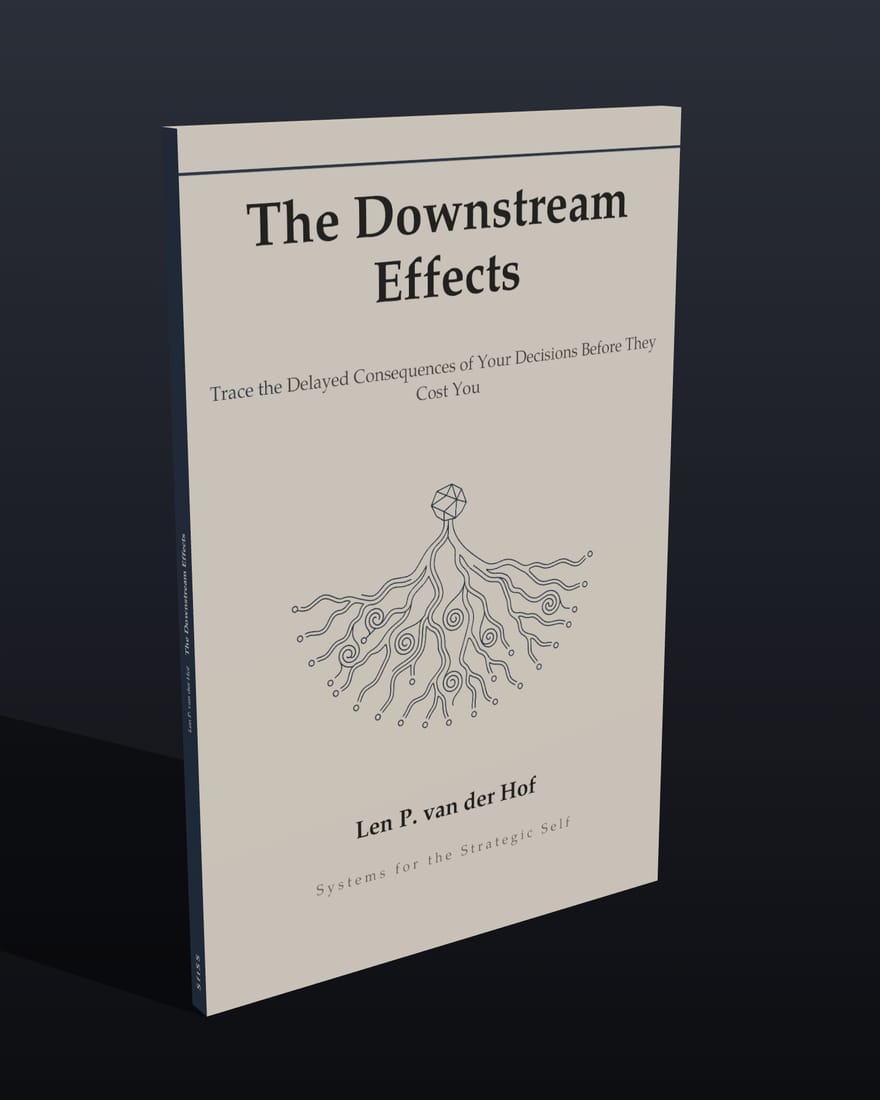
Paperback
The working copy. Mark it up. Take it into the meeting.


The book
Trace the Delayed Consequences of Your Decisions Before They Cost You
The decision looked like a win. The metric improved, the dashboard turned green, the room felt competent. Then the cost arrived somewhere you were not looking: a partner's margin collapsed, a regulator opened an inquiry, a segment churned. The win you celebrated in month one became the surprise you explained to the board in month four.
Tightening the metric does not help, because the problem is not the decision. It is the architecture that lets a decision get made without anyone asking where its effects flow. Every choice starts a river, and most teams only watch the first bend.
The Downstream Effects is the engineering work of tracing that river before you commit. It introduces the DOWNSTREAM framework: eleven moves that turn a local win into a visible, weighable consequence tree, so the delayed, distant, and emergent effects land on the table before you lock the decision in.
What you learn
What this book puts in your hands
- Audit your last five material decisions and name the second-order effect already forming.
- Build a pre-commit checklist that asks the people who will carry the cost, not those who built the model.
- Weigh the full tree of effects across product, partner, regulatory, and legacy horizons.
- Trace the causal chain, spot when downstream risk crosses a threshold, and mitigate it with an owner, a trigger, and a test.
- Install a living protocol so the river is visible on every decision, not just the one that hurt.
The framework
DOWNSTREAM, step by step
-
Detect
Surface potential downstream before the organization commits.
-
Observe
Watch what actually happens on the surfaces the decision will touch.
-
Weigh
Compare material later costs against the first-order win, not against a wish.
-
Navigate
Mark every high-weight branch accept, mitigate, or avoid, each with an owner.
-
Stream effects
Push every effect across four horizons (30, 90, and 365 days, and three years) so the far horizon is not discounted to zero.
-
Trace
Draw the causal chain the system actually ran, and mark the link the original model missed.
-
Review
Re-open the map after the decision ships, on a named rhythm.
-
Effects on stakeholders
Name who actually pays: partner, regulator, agent network, or user.
-
Assess systemic risk
Find the threshold where a local drag becomes a contagion.
-
Mitigate
Install the smallest control that changes the later landing, not a new committee.
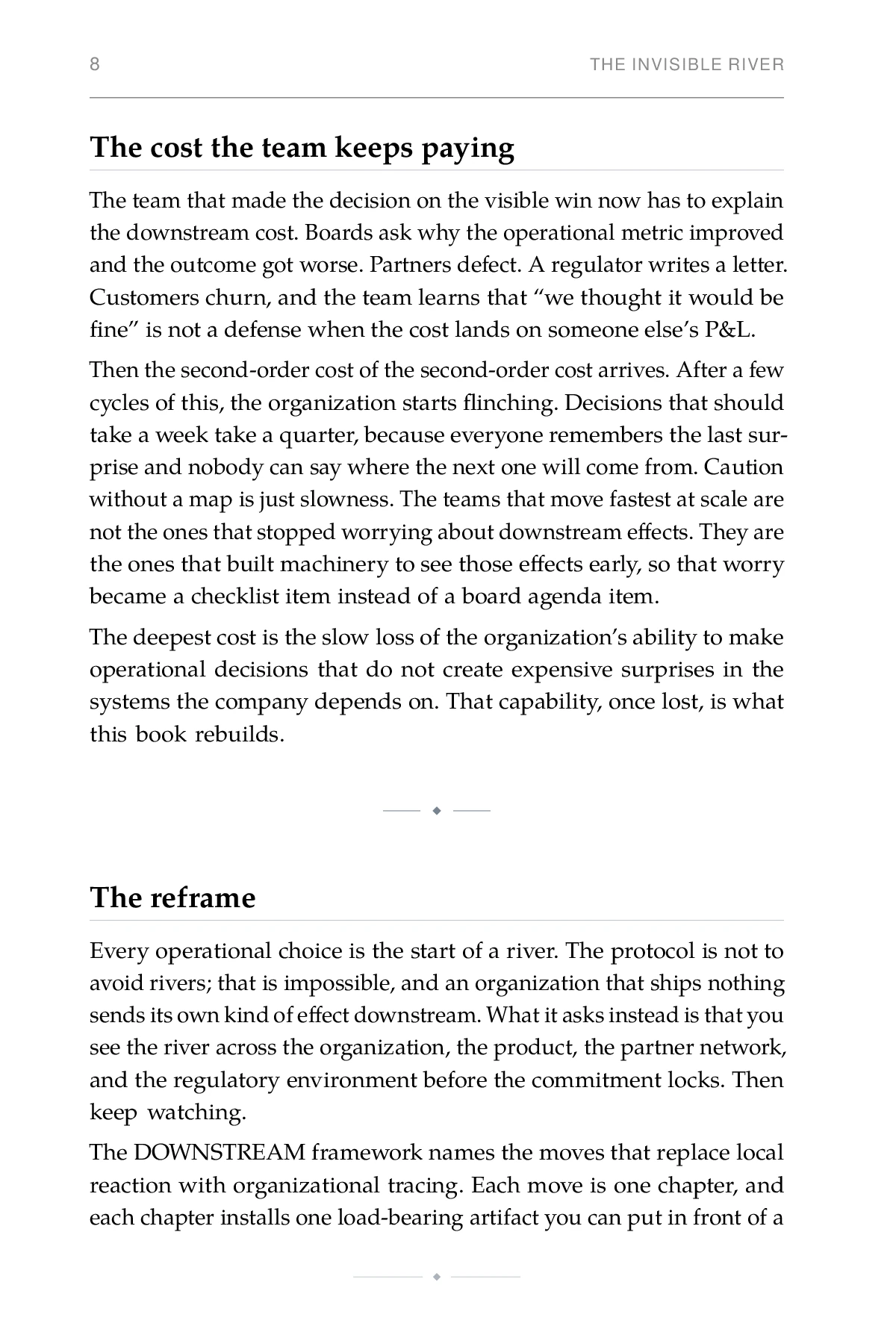
From the book
The cost the team keeps paying
The Downstream Effects, printed page: The cost the team keeps paying
Inspect more pagesLook inside
Pages from the print edition.
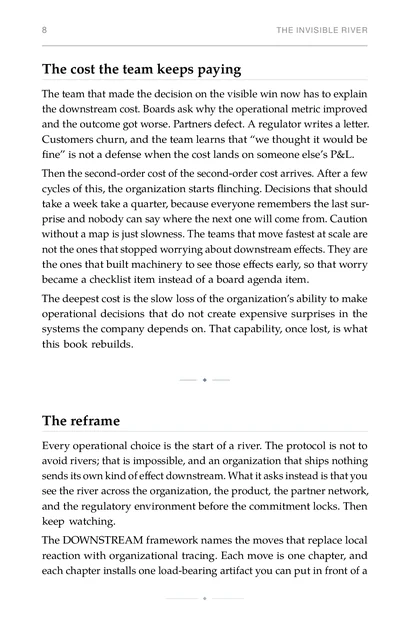 The cost the team keeps paying
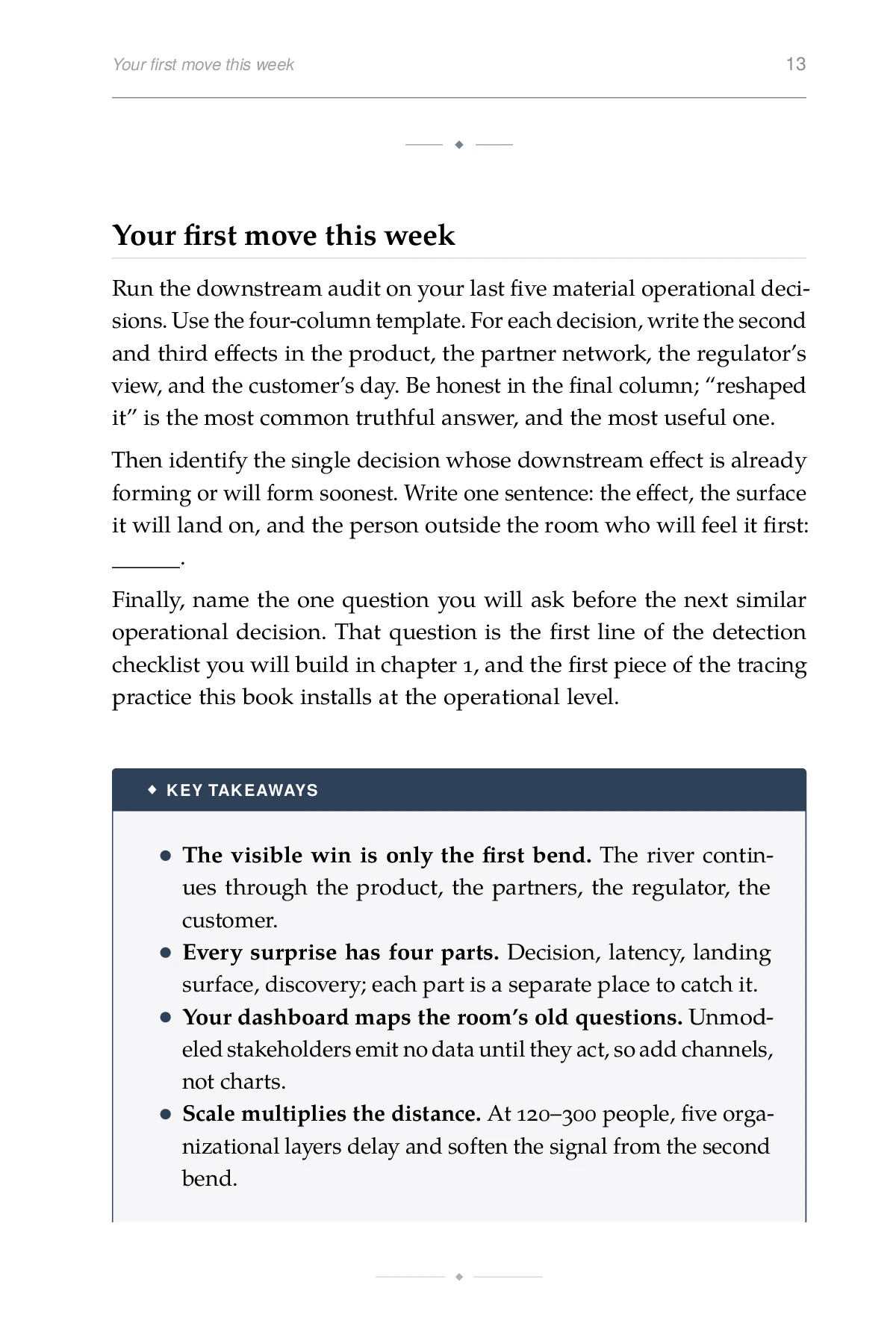
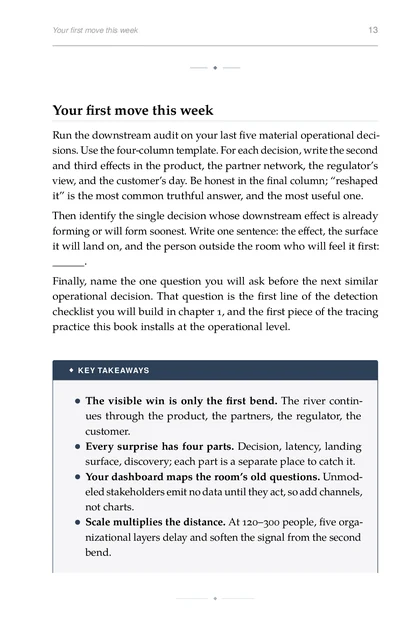 practice this book installs at the operational level
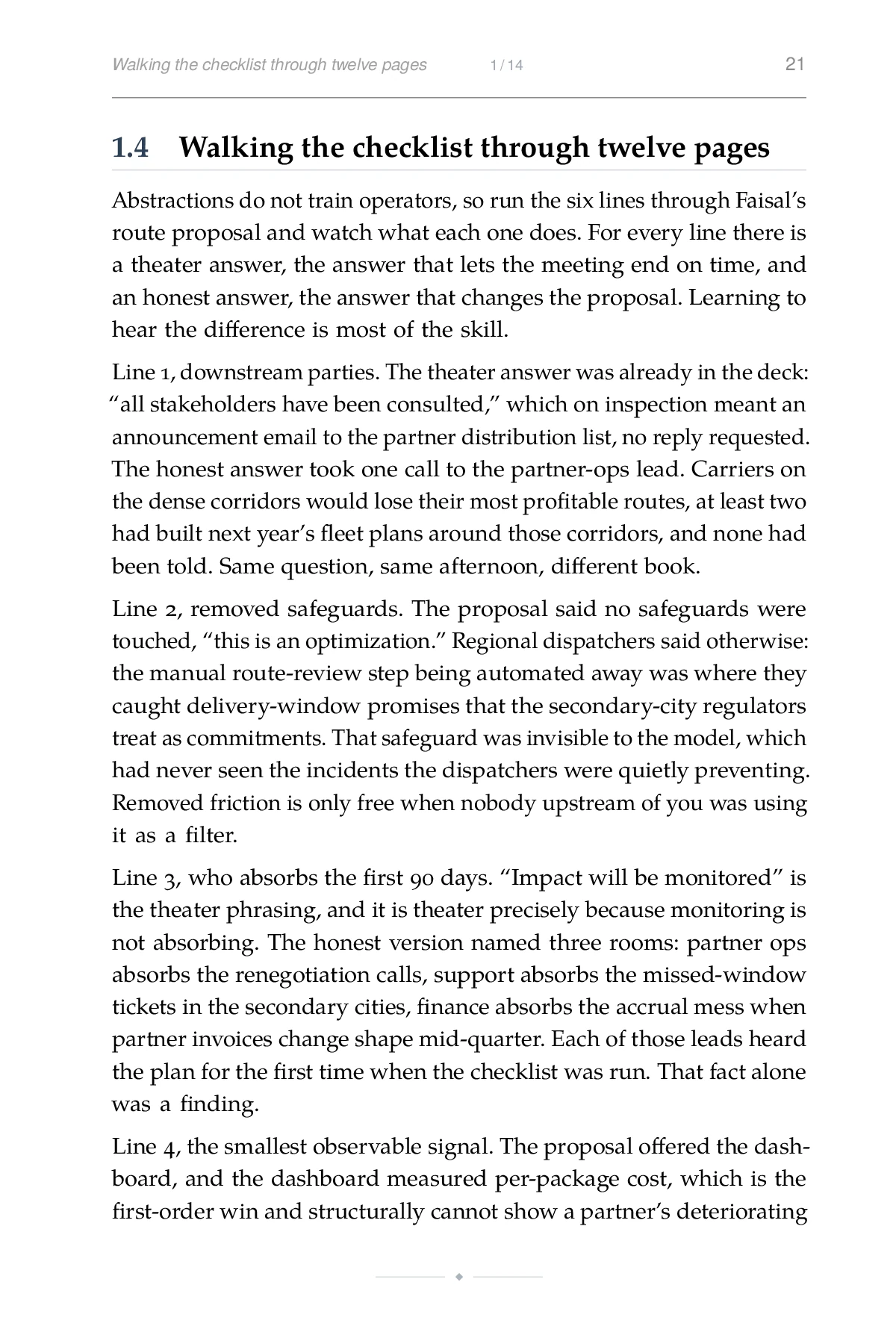
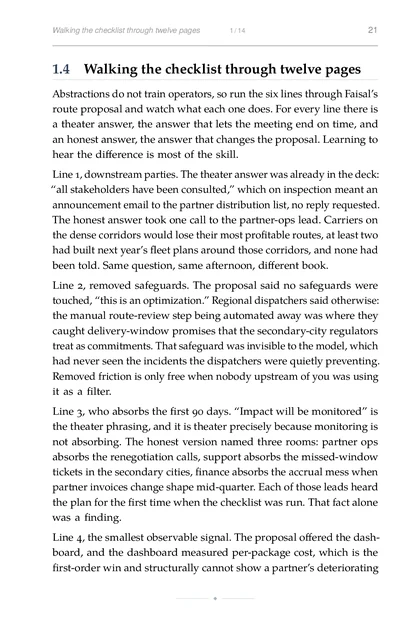 Line 2, removed safeguards. The proposal said no safeguards were
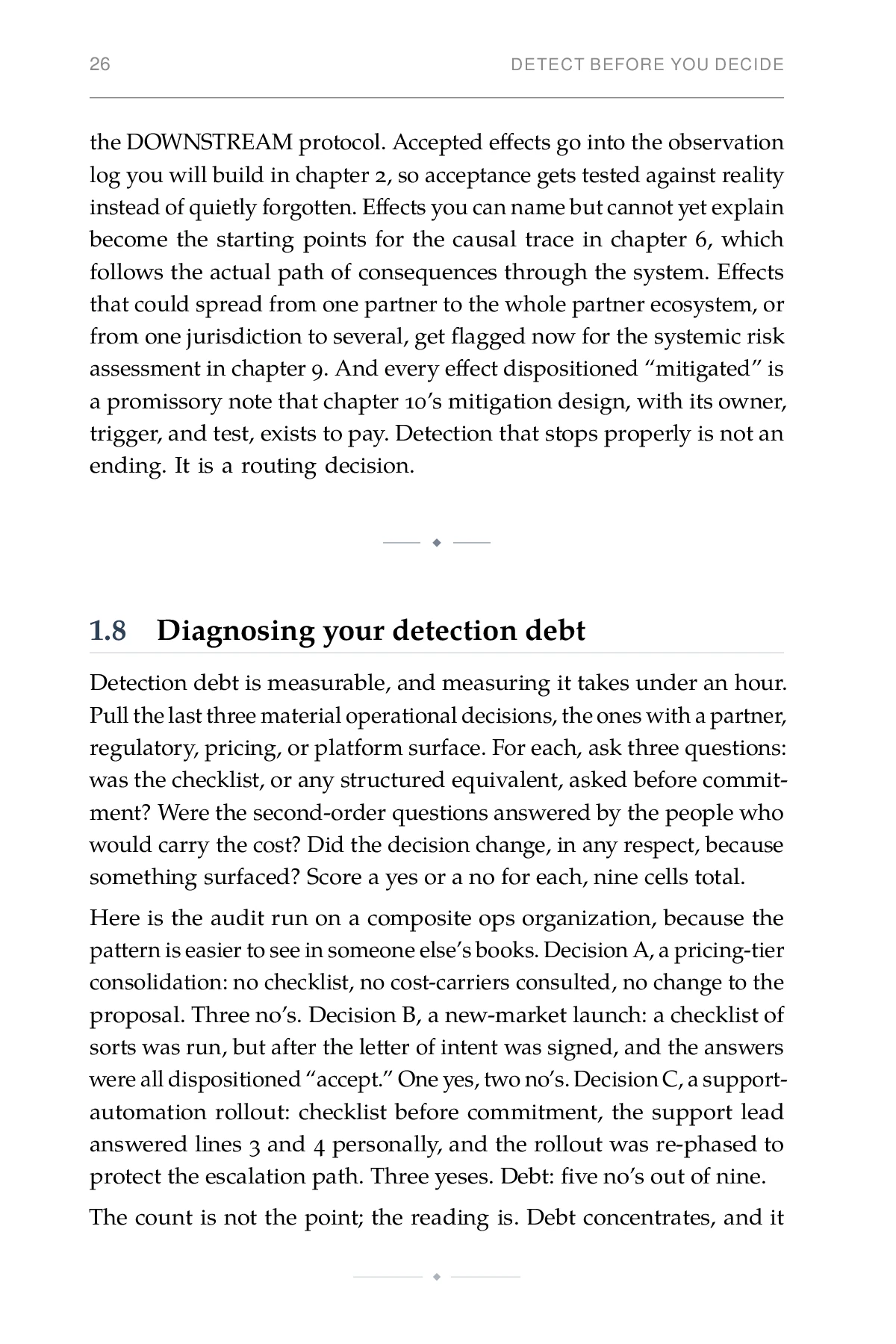
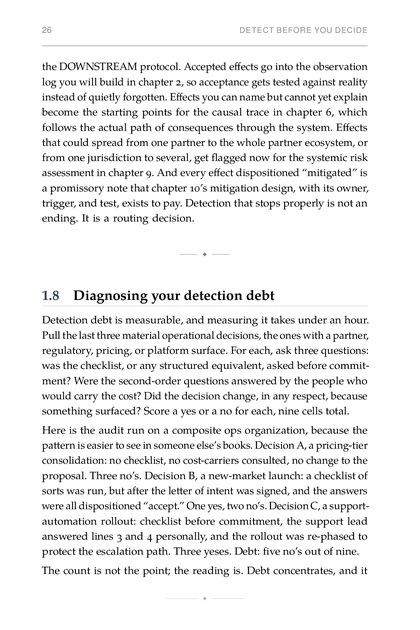 Here is the audit run on a composite ops organization, because
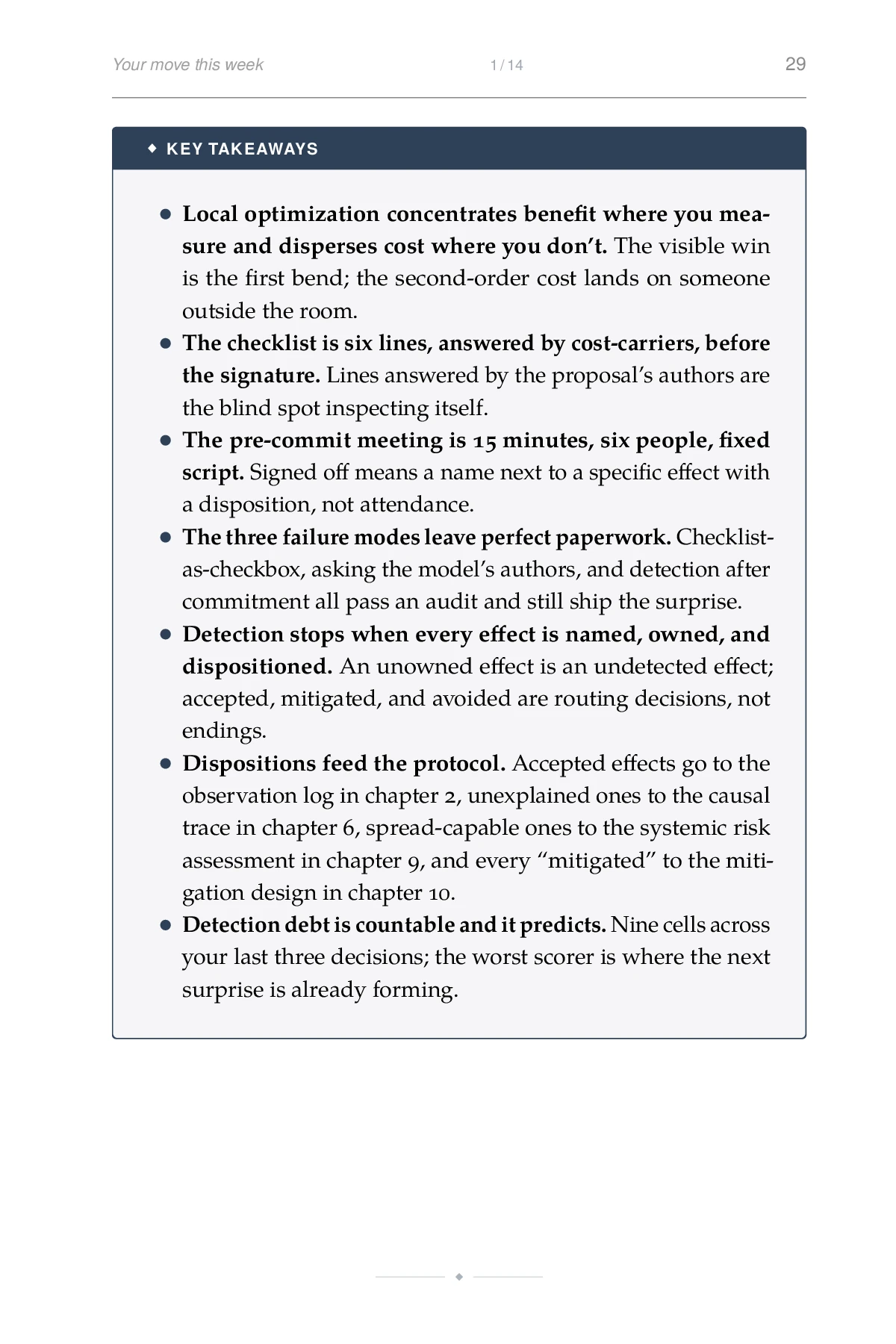
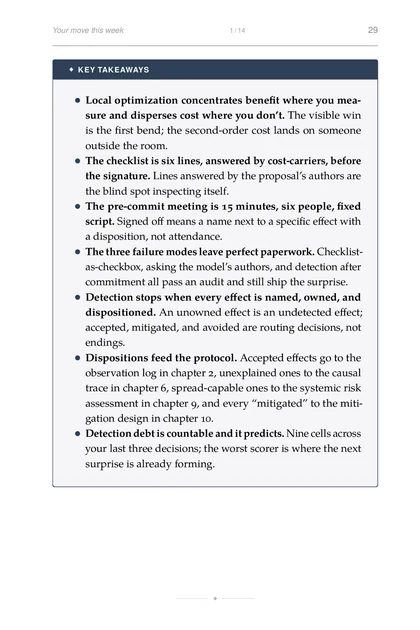 Your move this week 1 14 29
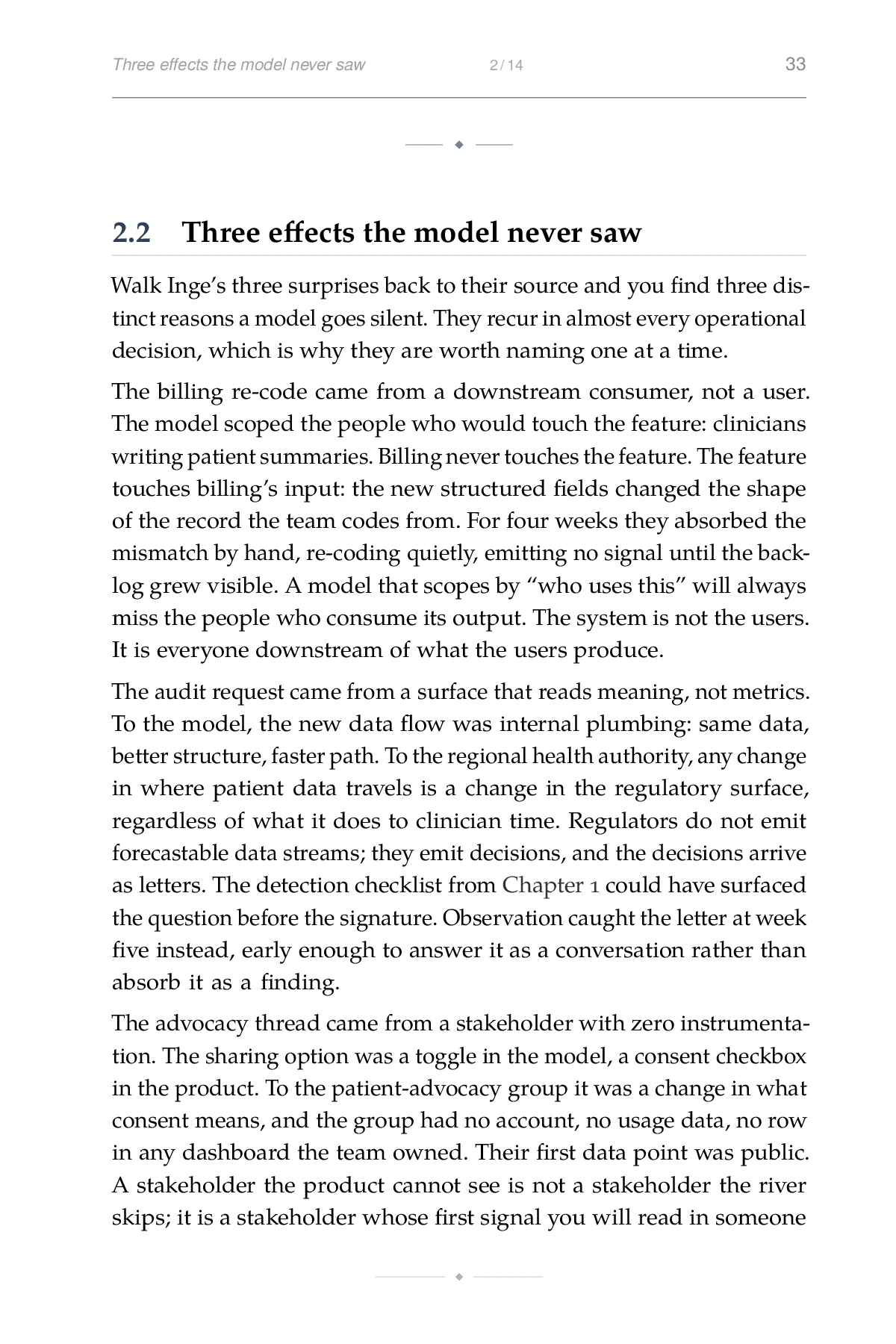
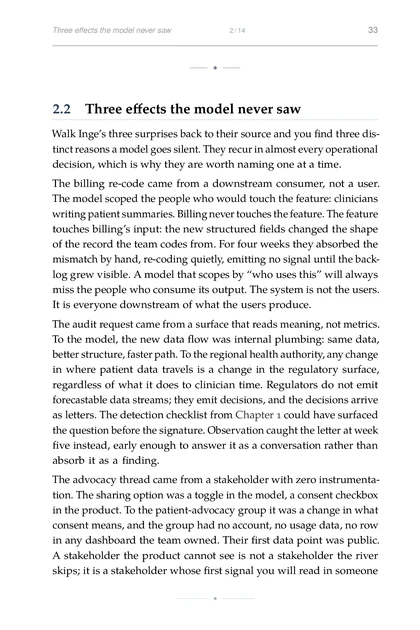 The advocacy thread came from a stakeholder with zero instrumenta-
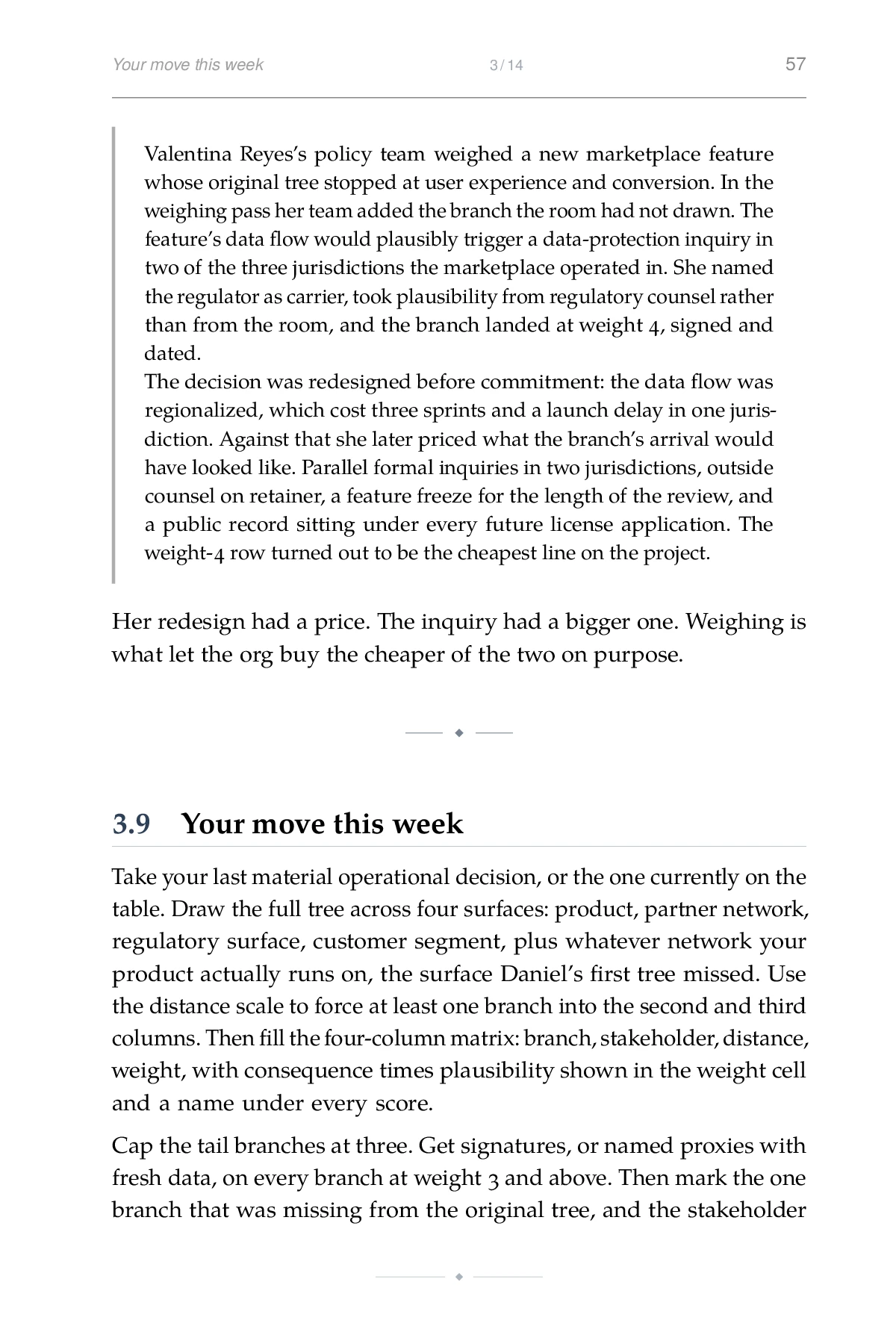
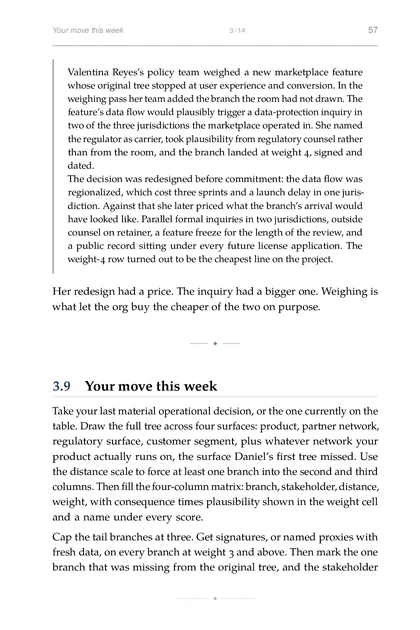 Your move this week 3 14 57
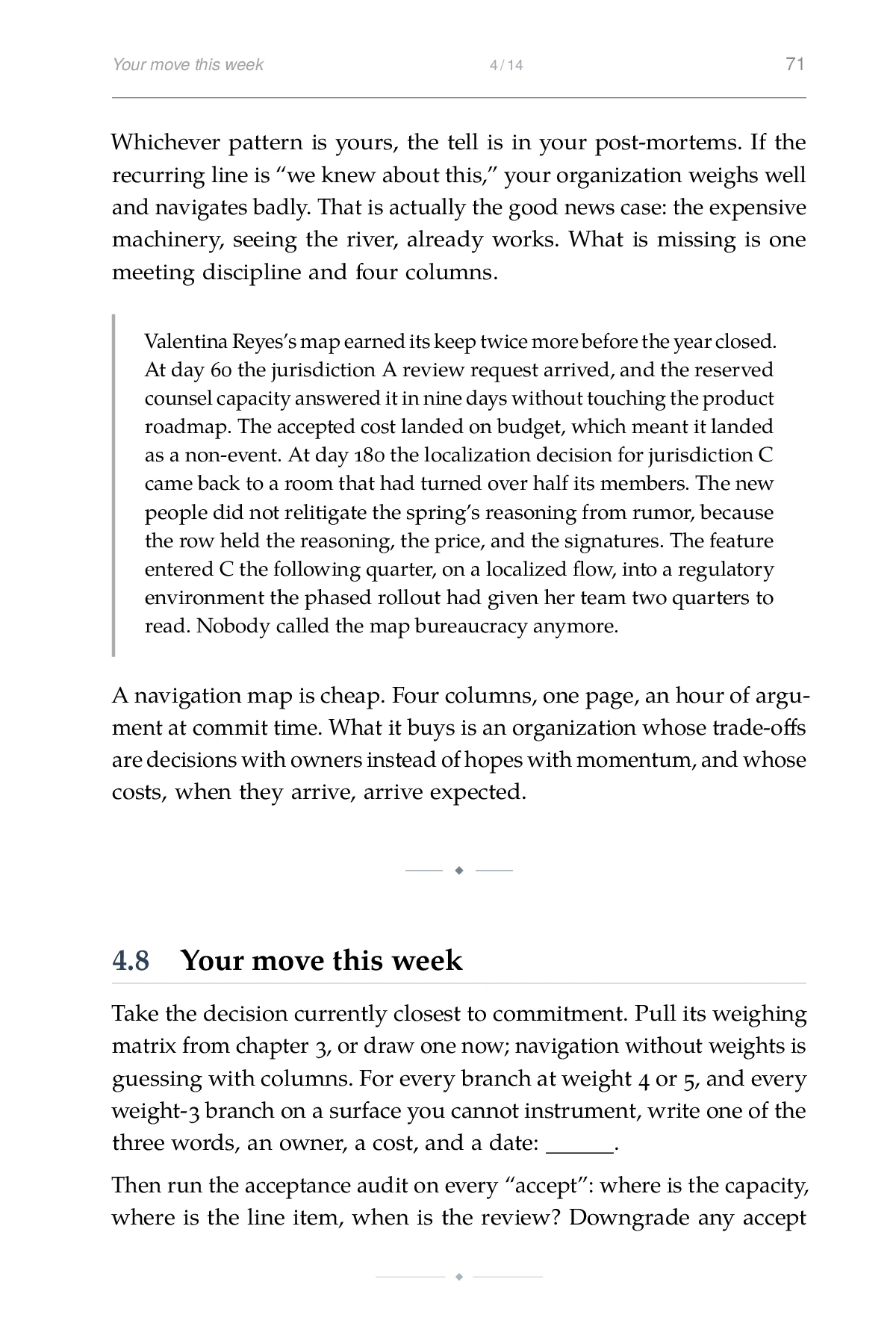
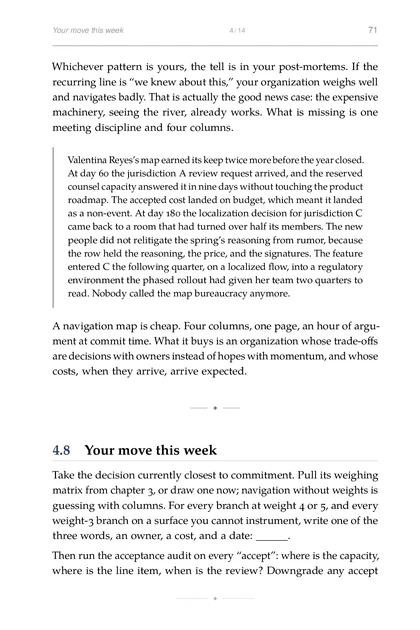 Your move this week 4 14 71
The contents
Chapter by chapter
Every chapter of The Downstream Effects with its printed epigraph, what you can do afterwards, and the moment it is built for.
Introduction
The Invisible River
Every operational choice sends effects downstream, through the product, the team, the partner network, the regulator's inbox, and the user's day, and most teams only watch the first bend. The first move is to see the river at the level of the organization, not just the meeting.
What you can do afterwards
You will run a downstream audit on your last five material operational decisions and name the second-order effect already forming across product flows, partner economics, or regulatory contact.
Use this chapter when
A "win" on the visible operational metric is starting to create downstream drag somewhere outside the room where the decision was made.
Chapter 1
Detect Before You Decide
Surfacing downstream effects before organizational commitment is the smallest unit of river-aware operational decision-making. Without detection, every product, partner, or pricing change is a bet on what the room can see, and the room is never the whole system.
What you can do afterwards
You will leave with the six-line detection checklist, the 15-minute pre-commit meeting, a stop rule for detection, and a debt audit of where your organization still decides blind.
Use this chapter when
A "simpler" flow, a "faster" rule, a "cleaner" pricing model, or a "smarter" feature is being proposed and the visible metric is improving in the room.
Chapter 2
Observe the Actual Flow
Prediction without observation is not learning. Watching the actual flow of consequences through the product, the partner network, the regulatory surface, and the customer's day is the only way to make the river visible in real time.
What you can do afterwards
You will start an observation log for one decision from the last 90 days. Four columns, named owners, thresholds set before the next number arrives, and a 30/60/90 cadence that tests the model against the system.
Use this chapter when
The team has predicted the operational outcome of a decision and the prediction is being trusted before the river has actually moved through the system.
Chapter 3
Weigh the Full Tree
The tree that only shows the branches the room likes is not weighing. An honest operational decision assigns weight to near and far effects, including the ones that feel unlikely in the partner network, the regulatory surface, and the technical network the product runs on.
What you can do afterwards
You will draw the full tree of an operational decision and fill the four-column weighing matrix (branch, stakeholder, distance, weight). Every weight is consequence times plausibility, every tail branch has a named carrier, and every high weight carries the signature of the stakeholder who would live with it.
Use this chapter when
A visible operational win is on the table and the team is being asked to commit on the upside branch alone.
Chapter 4
Navigate Trade-offs
Implicit acceptance of all downstream effects is how operational rivers become floods. Explicit navigation of trade-offs, in the product, the partner network, the regulatory surface, and the customer's day, is what makes the operational decision a choice rather than a hope.
What you can do afterwards
You will draw a navigation map for your next material decision: every high-weight branch assigned accept, mitigate, or avoid. Each choice carries an owner, a named cost, a date, and a rule you can defend.
Use this chapter when
A visible win is on the table and the team is about to commit without naming which downstream effects the org will accept, mitigate, or avoid.
Chapter 5
Stream Effects Across Time
Operational effects arrive at different horizons (product, partner, regulatory, legacy) and the room and the P&L always discount the far horizon; a deliberate temporal stream is required to keep the 90-day, 365-day, and 3-year effects in the operational decision.
What you can do afterwards
You will draw a temporal stream for your next material operational decision, with explicit weights at the 30/90/365-day and 3-year horizons in the product, the partner network, and the regulatory surface.
Use this chapter when
A visible operational win is on the table and the team is about to commit on the 30-day metric alone.
Chapter 6
Trace the Causal Chain
Linear thinking misses the actual operational path; tracing the causal chain from choice to effect to next effect through the product, the partner network, the technical network, and the regulatory surface is required to understand what the operational river is actually doing.
What you can do afterwards
You will trace the actual causal chain of an operational decision through the product, the partner network, the technical network, and the regulatory surface, and you will mark the one link that was not in the original model.
Use this chapter when
The team's mental model of the operational decision is still linear ("if we do A, then B, then C") and the system is not linear.
Chapter 7
Review and Update
A prediction that is never compared to what the river actually did is not a prediction. It is a decoration. Review is the four-step comparison that turns one decision's surprises into the next decision's criteria.
What you can do afterwards
You will run the four-step review protocol on one decision from 90 days ago. Pull the predicted river, pull the actual log, write the delta rows, and change one criterion the following decision of that type will inherit.
Use this chapter when
A decision you mapped has been live for 30, 90, or 365 days, and a later decision of the same type is being scoped.
Chapter 8
Effects on Stakeholders
The room decides. The system pays. A stakeholder map is how the people who will carry the cost get named, weighted, and signed before the commitment, instead of discovered at the inquiry.
What you can do afterwards
You will draw a five-class stakeholder map for your last material decision. Each class gets named in its own terms, placed on its surface, and weighted with a signature from the stakeholder or a qualified proxy.
Use this chapter when
A decision is being scoped and the only stakeholders named so far are the people in the room.
Chapter 9
Assess Systemic Risk
A river can absorb almost anything one bend at a time. The question this chapter adds is different in kind, not degree: at what water level does the river stop carrying effects downstream and start moving the banks.
What you can do afterwards
You will run the three-part systemic risk assessment on one live decision: local effect, spread condition, system threshold, with the threshold signed by the executive who owns the property at risk.
Use this chapter when
A downstream effect that started local, at one partner, in one jurisdiction, on one network surface, is showing patterns that could cross into the system the company depends on.
Chapter 10
Mitigate What Can Be Mitigated
Choosing "mitigate" on the navigation map is a decision. Designing the mitigation is work. The gap between the two is where most systemic thresholds get crossed by organizations that sincerely decided not to cross them.
What you can do afterwards
You will design one complete mitigation for the highest systemic effect your assessment has named: effect, intervention, owner, trigger, test, all five written before launch, on the surface where the effect lives.
Use this chapter when
Navigation chose "mitigate" for a branch, or the systemic assessment named a threshold, and the intervention exists so far only as a verb in a meeting.
Chapter 11
The Cost of Ignoring the River
Every organization already pays for downstream effects. The only choice is whether the payment has a name. This chapter builds the number that turns "we should think about the river" into a budget line nobody wants to delete.
What you can do afterwards
You will price three recent untraced downstream effects with the six-line cost calculator, each line signed by its surface owner, and present the total where the operational calendar gets set.
Use this chapter when
A visible win is still being celebrated while its surprises are being paid for as unlabeled overhead, partner friction, compliance time, and quiet departures.
Chapter 12
Building Your Downstream Protocol
Every decision feels new and every surprise feels original until the organization has a living protocol: the moves, the artifacts, the owners, and the rituals that see the river whether or not the person with good instincts is in the room.
What you can do afterwards
You will write version one of your downstream protocol as a one-pager, install the minimum viable core in the first 90 days, and put the weekly and monthly rituals on the calendar with named owners.
Use this chapter when
The moves have been run on enough real decisions that the next surprise would feel like a system failure, not weather.
Conclusion
Decisions That Survive Their Consequences
What you can do afterwards
You will write your personal operational commitment (one sentence) and schedule the first 90-day review of the protocol with the executive owners of each system surface.
Use this chapter when
You have run the protocol on enough operational decisions that the next surprise would feel like a failure of the system, not the cost of doing business.
Who it is for
Who this book was written for
The result is not caution for its own sake. It is decisions built to survive their own consequences: fewer expensive surprises, fewer "we didn't see that coming" post-mortems, and an organization that moves fast because it can see where its choices flow.
Start with the audit. Take your last five material decisions, ask "and then what?" three times, and mark the effect that would have changed the call.
The reader it was written for
Founders, product leaders, and operators at 15–100 person companies who are exhausted by the recurring "we didn't see that coming" tax. They have shipped features or signed deals that produced expensive, delayed, or systemic consequences that eclipsed the initial win.
Probably not for you if
- Pure theorists.
- Readers who never make material decisions.
- Those seeking only bias checklists.
Editions
Editions and specifications
| Edition | Formats | Chapters | Pages | Reading time | ISBN (paperback) |
|---|---|---|---|---|---|
| English The Downstream Effects | In production | 14 | 208 | ± 3 hours | — |
| Dutch De stroomafwaartse effecten | In production | 14 | 122 | ± 3 hours | — |
Both editions are written natively. The Dutch text is not a machine translation of the English. · Trim size: 6x9″
Frequently asked
What readers usually want to know
What is The Downstream Effects about?
DOWNSTREAM trains operators to map delayed consequences, second-order effects, dependency chains, and hidden costs before a decision compounds. The subtitle is: Trace the Delayed Consequences of Your Decisions Before They Cost You.
What is the DOWNSTREAM framework?
DOWNSTREAM: Detect, Observe, Weigh, Navigate, Stream effects, Trace, Review, Effects on stakeholders, Assess systemic risk and Mitigate.
Is there a Dutch edition?
Yes. The Dutch edition is De stroomafwaartse effecten, written as a native edition rather than a machine translation. It moves through the same production line.
How long is The Downstream Effects?
This edition runs 14 chapters, 208 pages in print and roughly 3 hours of reading.
Who is The Downstream Effects for?
Start with the audit. Take your last five material decisions, ask "and then what?" three times, and mark the effect that would have changed the call.
The production system
How this book was made
Every title moves through the same gated production line: sourced research, a claim-level evidence ledger, structural review, fact-checking, red-team critique, and a bilingual final edit. AI agents do specialist work inside those gates; judgment, voice, and accountability stay human.
- Claims enter an evidence ledger with a source and a confidence grade before they reach the page
- English and Dutch are two native editions, not a translation of one another
- Every chapter clears readability, rhythm, and style gates before it is typeset
Terminology
The series
More in this theme


