

No. 49 · Active development · Founder psychology · RESCUE
The Turnaround Protocol
RESCUE: Diagnose, Stabilize, Cut, Unify, Execute or Exit with Dignity
The Turnaround Protocol: RESCUE: Diagnose, Stabilize, Cut, Unify, Execute or Exit with Dignity.
Heroic effort can postpone the moment of clarity; it cannot make an unsavable company viable. RESCUE moves from recognition and stabilisation through cuts and unification to the decision that matters: execute a viable plan, or exit with dignity. RESCUE: Diagnose, Stabilize, Cut, Unify, Execute or Exit with Dignity. The framework: RESCUE.
- pages
- 198
- chapters
- 14
- hours of reading
- ± 3
- editions
- EN · NL
- Design
- Drafting
- Manuscript
- Production
- Launched
The editions
Kindle and Paperback
Production shots of the editions. Not for sale yet — this page is the public working version.
-
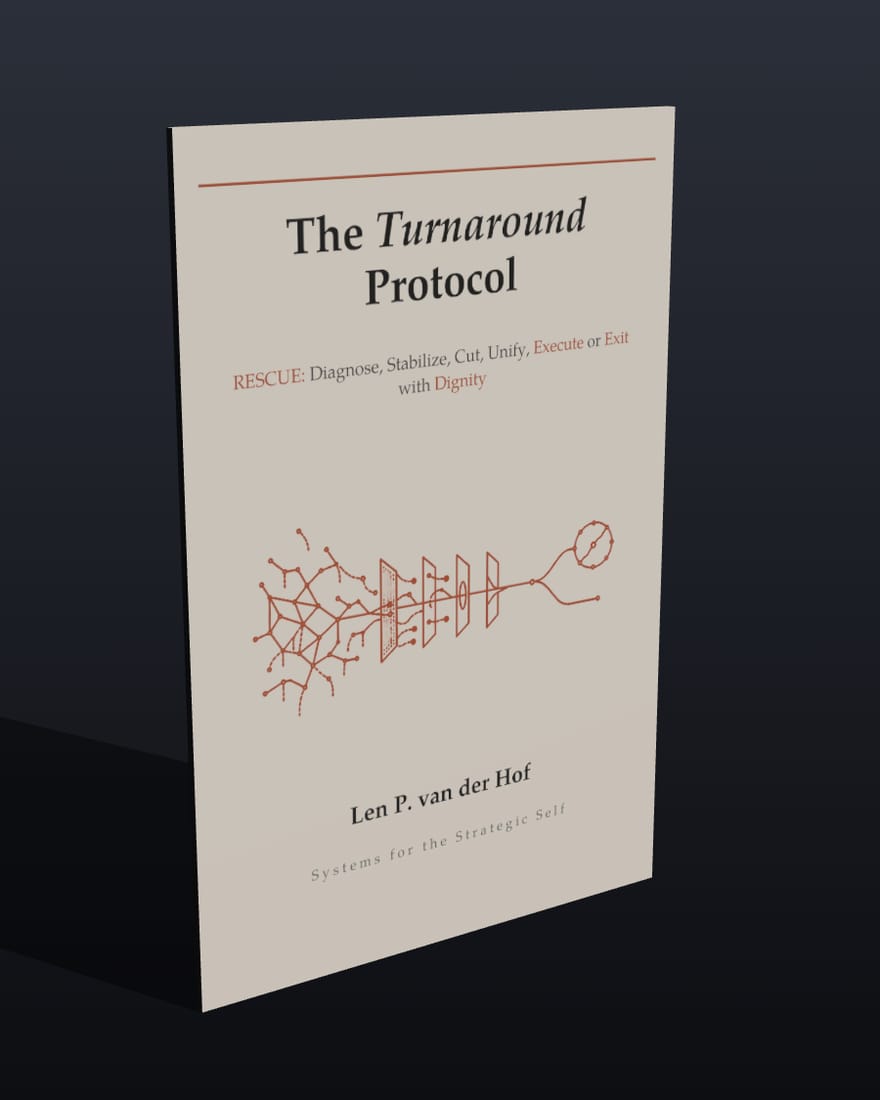
Kindle
The digital edition, ready in any Kindle app.
-
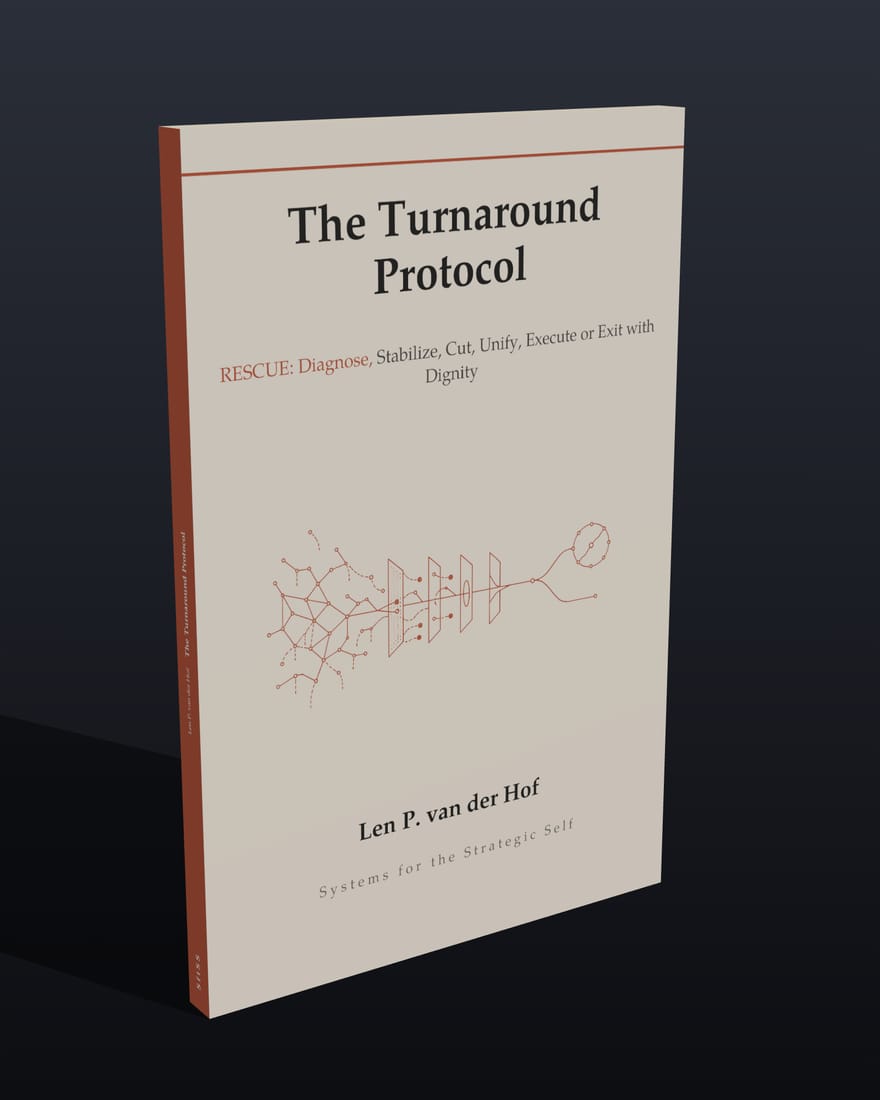
Paperback
The working copy. Mark it up. Take it into the meeting.


The book
RESCUE: Diagnose, Stabilize, Cut, Unify, Execute or Exit with Dignity
The numbers are getting worse while the story gets louder. More hours, another bridge, another launch, one more quarter: heroic effort can postpone the moment of clarity, but it cannot make an unsavable company viable.
The Turnaround Protocol is a structured operating system for founders facing acute business distress. RESCUE moves from recognition and stabilization through cuts and unification to the decision that matters: execute a viable plan or exit with dignity.
What you learn
What this book puts in your hands
- Replace the recovery story with a brutal, reviewable audit of cash, product, customers, and team.
- Stabilize the immediate operating environment before designing the rescue.
- Separate the viable core from work the company can no longer afford to carry.
- Make cuts against explicit principles instead of fear, favoritism, or delay.
- Build a savability scorecard and expose the assumptions behind the verdict.
- Unify the remaining team around one operating truth and a ninety-day plan.
The framework
RESCUE, step by step
-
Recognize
-
Stabilize
-
Cut
-
Unify
-
Execute or Exit
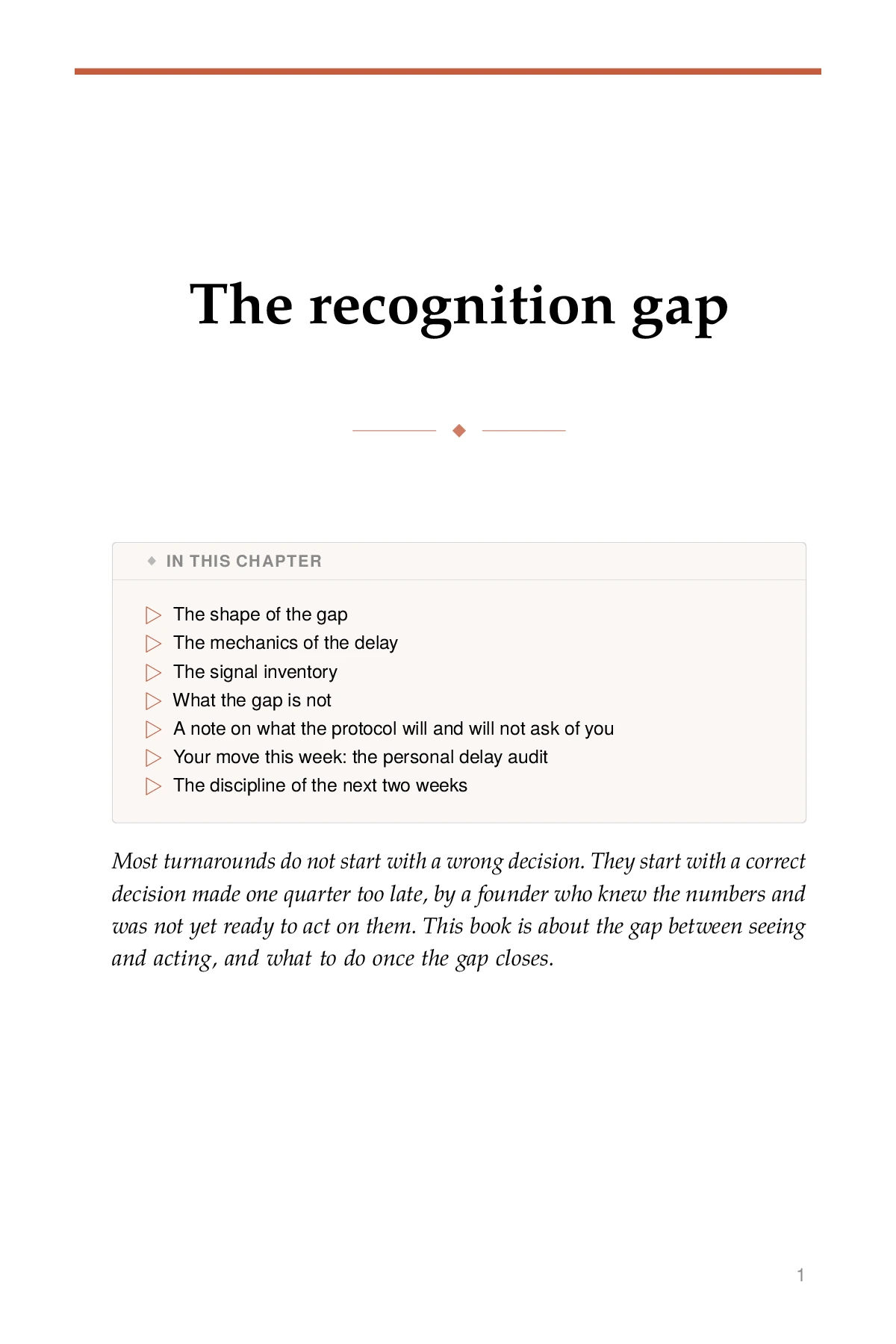
From the book
IN THIS CHAPTER
The Turnaround Protocol, printed page: IN THIS CHAPTER
Inspect more pages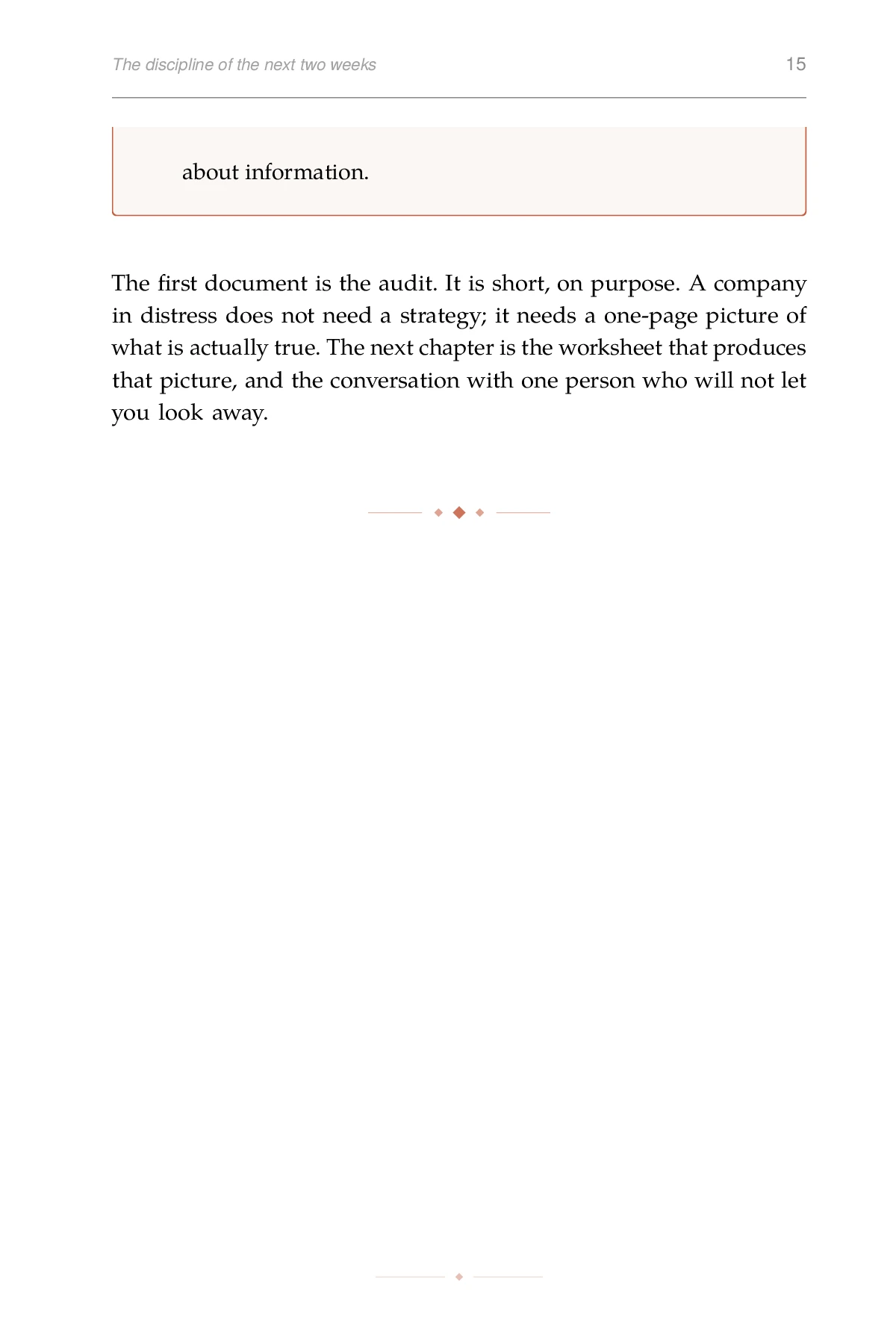
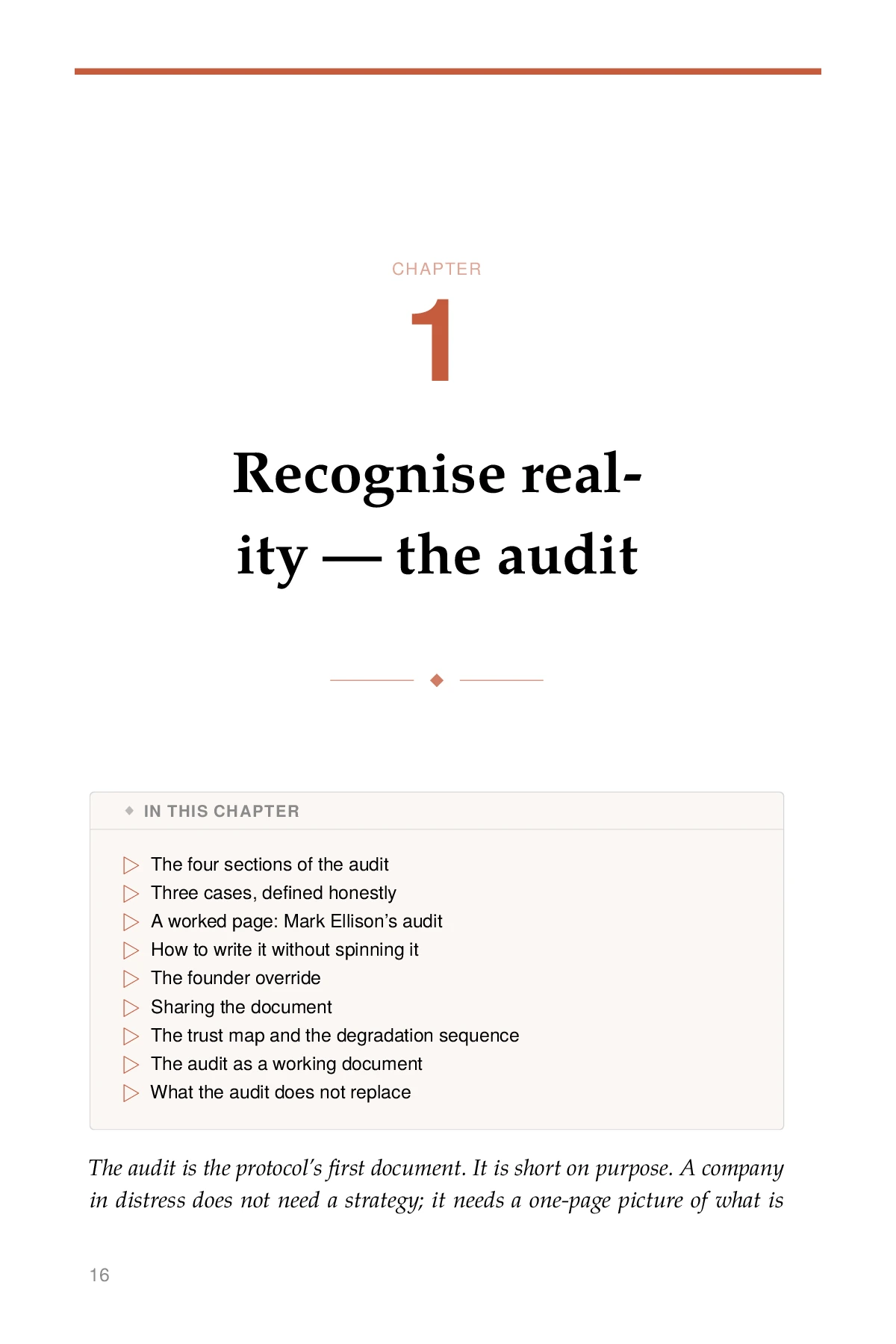
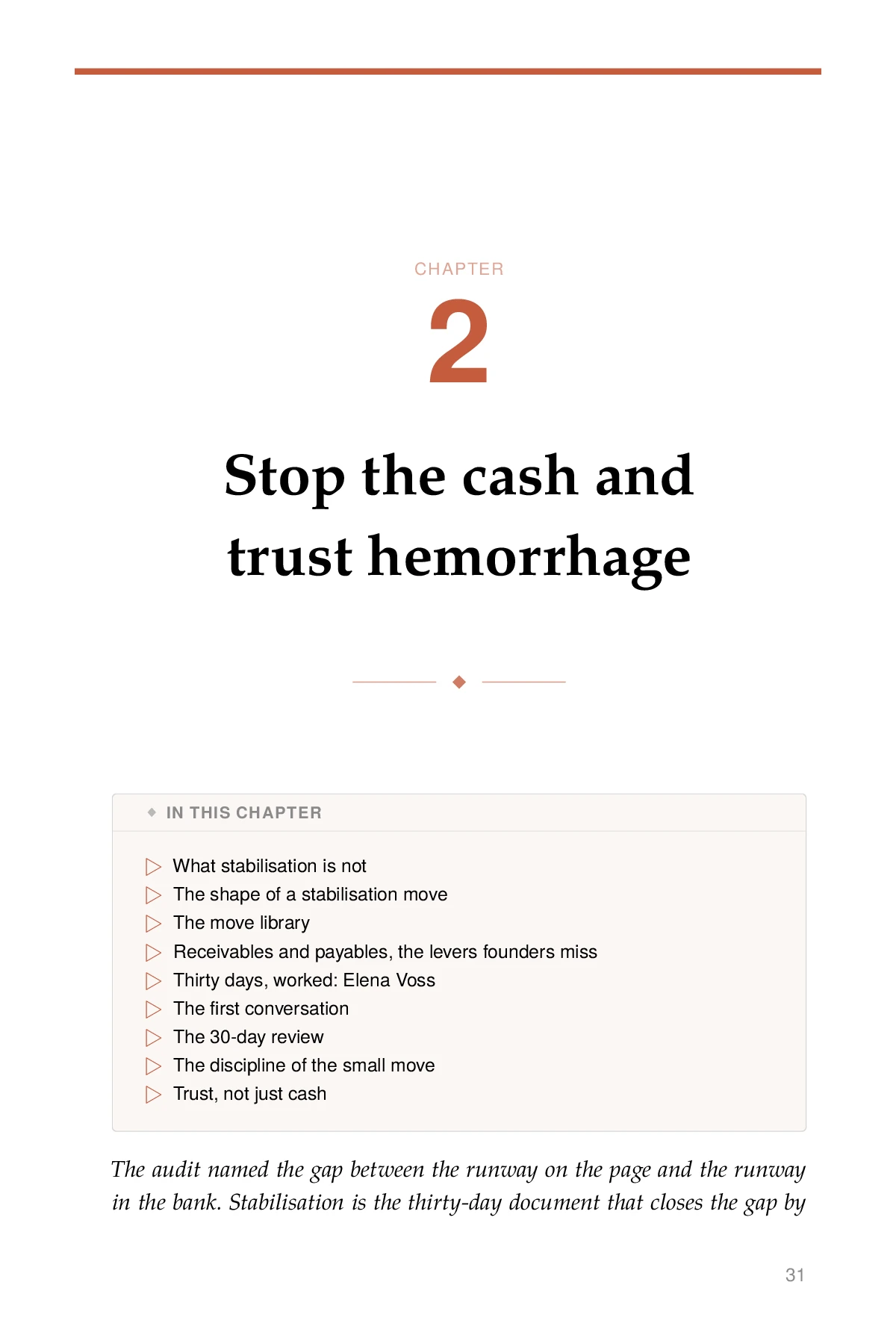
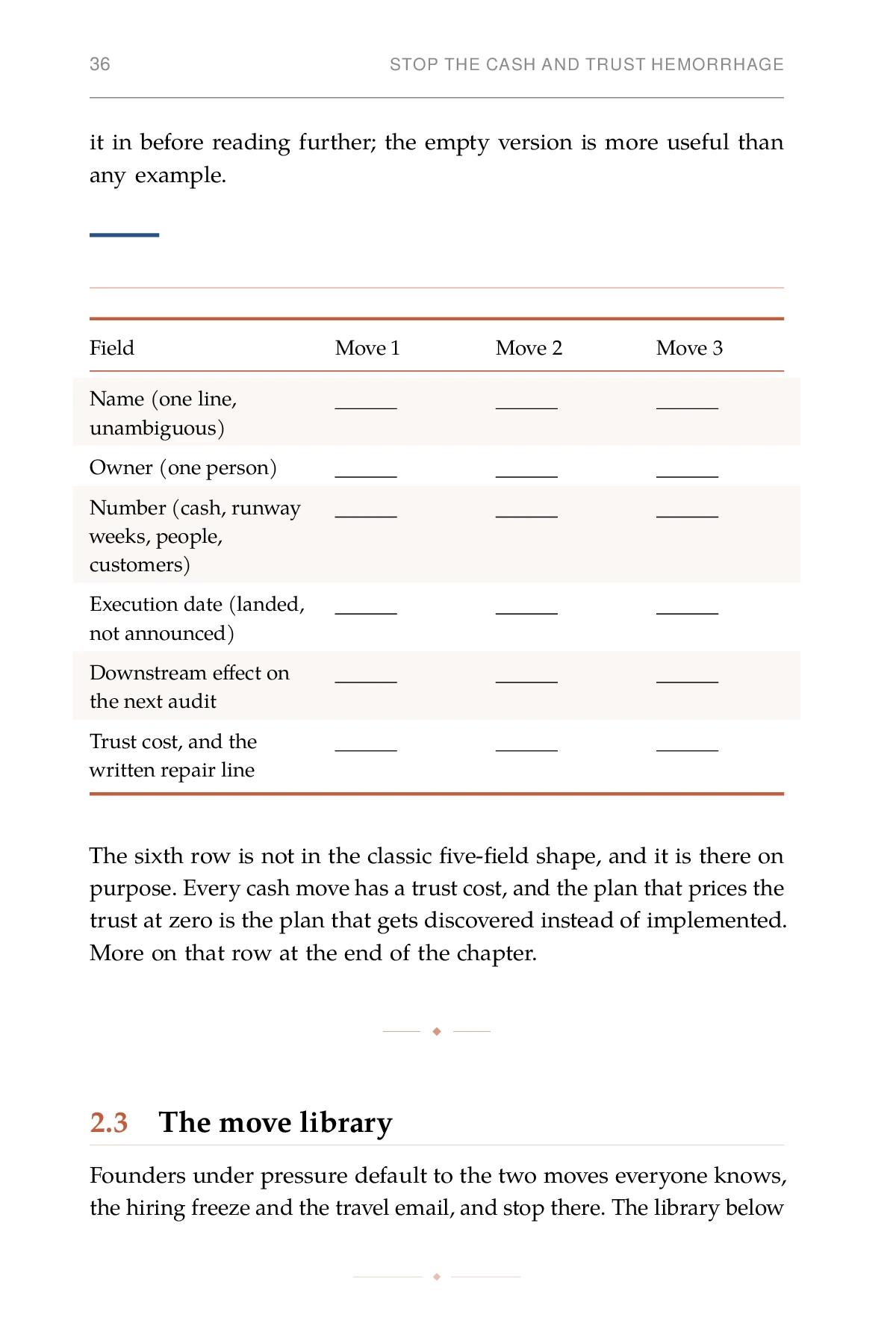
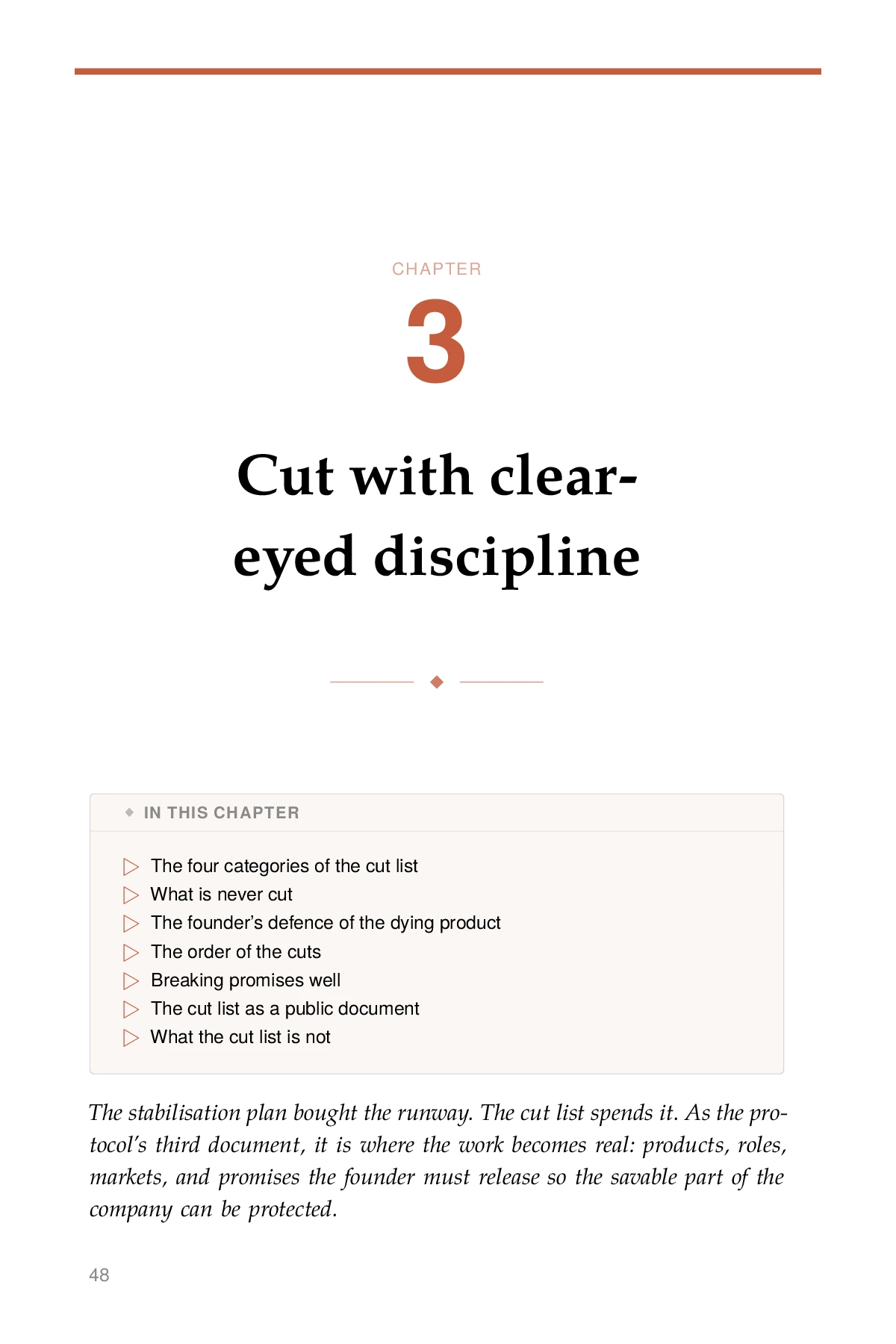
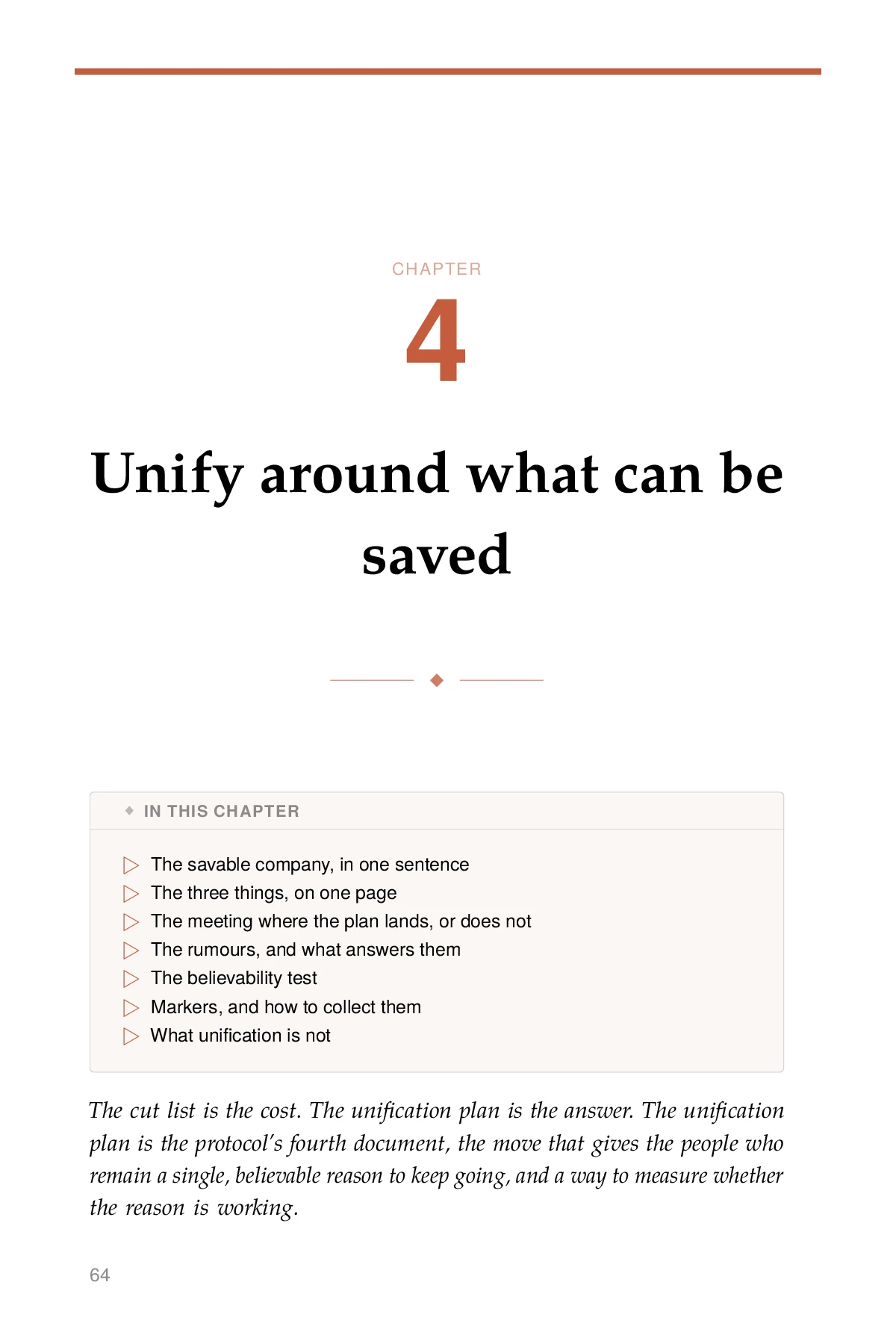
The contents
Chapter by chapter
Every chapter of The Turnaround Protocol with its printed epigraph, what you can do afterwards, and the moment it is built for.
Introduction
The recognition gap
Most turnarounds do not start with a wrong decision. They start with a correct decision made one quarter too late, by a founder who knew the numbers and was not yet ready to act on them. This book is about the gap between seeing and acting, and what to do once the gap closes.
What you can do afterwards
You will see the recognition gap as a measurable delay between signal and action, not a moral failure, and run your first personal delay audit today.
Use this chapter when
You suspect your company is in distress but find yourself deferring the audit, the call, or the conversation.
Chapter 1
Recognise reality — the audit
The audit is the protocol's first document. It is short on purpose. A company in distress does not need a strategy; it needs a one-page picture of what is actually true. The page is signed by the founder and read by one person who will not let them look away.
What you can do afterwards
You will leave with a one-page audit template, a fully worked example, and a shared, signed page of your own.
Use this chapter when
You suspect the numbers have changed but you have not written them down in a way that forces honesty.
Chapter 2
Stop the cash and trust hemorrhage
The audit named the gap between the runway on the page and the runway in the bank. Stabilisation is the thirty-day document that closes the gap by stopping what is draining the company faster than the protocol can refill it. The discipline is to choose a small number of moves, execute them visibly, and use the breathing room to make the next call.
What you can do afterwards
You will leave with a 30-day stabilisation plan built from a move library: moves named, owned, numbered, dated, with the trust repair written next to each.
Use this chapter when
The audit shows a runway of less than twelve months, customer concentration above 40 per cent, or visible loss of key people.
Chapter 3
Cut with clear-eyed discipline
The stabilisation plan bought the runway. The cut list spends it. As the protocol's third document, it is where the work becomes real: products, roles, markets, and promises the founder must release so the savable part of the company can be protected.
What you can do afterwards
You will leave with a one-page cut list built on written criteria: what is released, what is never cut, in what order, at what cost, with scripts for the promises being broken.
Use this chapter when
The stabilisation plan landed, the runway is still tight, and the savability scorecard is two weeks away.
Chapter 4
Unify around what can be saved
The cut list is the cost. The unification plan is the answer. The unification plan is the protocol's fourth document, the move that gives the people who remain a single, believable reason to keep going, and a way to measure whether the reason is working.
What you can do afterwards
You will leave with a one-page unification plan: the savable company in one sentence, three priorities with leaders, numbers, and markers, and an answer to every rumour class running through the smaller team.
Use this chapter when
The cut list has landed, the team is smaller, and the founder can feel the room waiting to hear what comes next.
Chapter 5
Execute or exit — the savability scorecard
Every document the protocol has produced so far has been preparing the founder for a single binary question: is the company savable on the runway we have, with the team we have, for the customers we have? The savability scorecard is the document that asks the question honestly, scores the answer, and turns the answer into a call.
What you can do afterwards
You will leave with a savability scorecard that scores the company across six dimensions, gives a binary recommendation, and produces the call.
Use this chapter when
The cut list has landed, the unification plan is in place, and the founder can feel the room waiting to hear the call.
Chapter 6
The 90-day rescue plan
The scorecard produced the call. The 90-day plan is the work that follows. The plan is the protocol's sixth document, a one-page, time-boxed, measurable sequence of actions that turns the execute call into a run the leadership team can run, with a review at day 30, day 60, and day 90.
What you can do afterwards
You will leave with a 90-day plan that names the milestones, the dates, the owners, the cash effects, and the day-30, day-60, and day-90 review cadence.
Use this chapter when
The scorecard produced an execute call, the cut list is in place, and the leadership team is ready for a sequence of dated actions.
Chapter 7
Cash as the oxygen
Every other document in the protocol assumes a number. The cash model is the document that produces the number. It is the protocol's seventh artefact, the spreadsheet the founder updates weekly, the board chair sees weekly, and the leadership team runs against. Cash is the frame, not a step.
What you can do afterwards
You will leave with a cash model that produces a weekly runway number under three cases, plus a written trigger ladder that pre-commits your responses before you need them.
Use this chapter when
The 90-day plan is in motion, the runway is quoted in meetings, and the founder needs one document the team can trust more than the founder's mood.
Chapter 8
Talent triage and trust repair
The cut list named the products, markets, and promises. The talent triage names the people. It is the protocol's eighth artefact, the document that says who the company is committed to retaining, who the company is committed to releasing, and how both are handled so that the people affected leave with their names intact.
What you can do afterwards
You will leave with a triage matrix that scores every role on four criteria, two named lists with rationales, a one-page transition plan per release, and a script skeleton for the hardest conversation of the turnaround.
Use this chapter when
The cut list has landed, the runway is still tight, and the founder is ready to be honest about the people.
Chapter 9
The planned wind-down
If the savability scorecard recommended exit, the protocol's next move is the planned wind-down. The planned wind-down is the protocol's ninth artefact, the document the company uses to bring the company to a close in a way that is honest, that is legal, and that treats the people affected with the care the protocol cannot promise but can still try to honour.
What you can do afterwards
You will leave with a wind-down plan that names the legal path, the questions counsel must answer first, the five-conversation communications sequence, the customer and team transitions, and the timeline, with the founder still in the room.
Use this chapter when
The savability scorecard recommended exit, the cut list is in motion, and the founder is ready to plan the close.
Chapter 10
Rebuilding after the cut
If the savability scorecard recommended execute, and the 90-day plan produced a savable company, the protocol's next move is the rebuild. The rebuild is the protocol's tenth artefact, the document the founder writes to describe the new operating system for the smaller, focused company the cut list and the unification plan made possible.
What you can do afterwards
You will leave with a rebuild plan on one operating-cadence table, a named counter-move for each of the three ways the old company creeps back, and the commitments the founder is willing to be measured by in public.
Use this chapter when
The 90-day plan has produced a savable company, the scorecard has been re-run above the threshold, and the relief has started to argue for relaxing.
Chapter 11
Protecting your capacity to decide (aspirational; no guarantees)
What you can do afterwards
You will leave with a one-page personal protocol you can fill in this week: your runway in months under the downside case, a four-line health floor, a peer reader chosen by explicit rules, and a next chapter with a date on it.
Use this chapter when
The company is closing or rebuilding, the scorecard has produced a call, and the founder is ready to apply the book's discipline to the one person it has not yet covered.
Chapter 12
Your RESCUE protocol — the operating system
The protocol's twelve artefacts, taken together, are an operating system. The operating system is the document the founder writes for the rest of the founder's career, the one the founder runs when the next crisis arrives, and the one the founder shares with the next leadership team when the founder hands the company to a successor.
What you can do afterwards
You will leave with the whole protocol on one page: twelve artefacts with healthy and distressed cadences, escalation triggers, owners, and readers, plus a 30-day path for anyone who arrived mid-crisis.
Use this chapter when
The eleven previous artefacts are in place, the company is stable or closing, and the founder is ready to make the discipline permanent.
Conclusion
Leaving with your judgment and relationships intact (aspirational framing only)
What you can do afterwards
You will close with the protocol's only unqualified promise: the founder has a next chapter, and the founder can begin it in 30 days.
Use this chapter when
The twelve artefacts are in place, the company is closing or rebuilding, and the founder is ready to plan the next chapter.
Who it is for
Who this book was written for
The result is a practical set of artifacts: a turnaround audit, stabilization plan, cut list, viable-core map, savability decision, ninety-day plan, exit design, and personal protocol.
No framework guarantees company survival, reputation, dignity, or protection from psychological or financial harm. This book is educational, not medical, psychological, legal, financial, or clinical advice. Acute distress, suicidal thoughts, severe burnout, or impaired judgment require immediate qualified support; material company decisions require jurisdiction-specific legal and financial counsel.
The reader it was written for
Founders and operator-CEOs at 15–100 person companies in acute distress (runway <9 months, major revenue loss, product or market failure, or cultural implosion). They have tried "more hours" and are now at the point where denial is no longer working. Psychographics:
Probably not for you if
- Companies still in growth mode (wrong stage).
- Purely financial or legal turnaround professionals (different book).
- Readers seeking only "how to raise a bridge round.
Editions
Editions and specifications
| Edition | Formats | Chapters | Pages | Reading time | ISBN (paperback) |
|---|---|---|---|---|---|
| English The Turnaround Protocol | In production | 14 | 198 | ± 3 hours | — |
| Dutch Het turnaroundprotocol | In production | 14 | 158 | ± 2 hours | — |
Both editions are written natively. The Dutch text is not a machine translation of the English. · Trim size: 6x9″
Frequently asked
What readers usually want to know
What is The Turnaround Protocol about?
Heroic effort can postpone the moment of clarity; it cannot make an unsavable company viable. RESCUE moves from recognition and stabilisation through cuts and unification to the decision that matters: execute a viable plan, or exit with dignity. The subtitle is: RESCUE: Diagnose, Stabilize, Cut, Unify, Execute or Exit with Dignity.
What is the RESCUE framework?
RESCUE: Recognize, Stabilize, Cut, Unify and Execute or Exit.
Is there a Dutch edition?
Yes. The Dutch edition is Het turnaroundprotocol, written as a native edition rather than a machine translation. It moves through the same production line.
How long is The Turnaround Protocol?
This edition runs 14 chapters, 198 pages in print and roughly 3 hours of reading.
Who is The Turnaround Protocol for?
No framework guarantees company survival, reputation, dignity, or protection from psychological or financial harm. This book is educational, not medical, psychological, legal, financial, or clinical advice. Acute distress, suicidal thoughts, severe burnout, or impaired judgment require immediate qualified support; material company decisions require jurisdiction-specific legal and financial counsel.
The production system
How this book was made
Every title moves through the same gated production line: sourced research, a claim-level evidence ledger, structural review, fact-checking, red-team critique, and a bilingual final edit. AI agents do specialist work inside those gates; judgment, voice, and accountability stay human.
- Claims enter an evidence ledger with a source and a confidence grade before they reach the page
- English and Dutch are two native editions, not a translation of one another
- Every chapter clears readability, rhythm, and style gates before it is typeset
The series
More in this theme


