

No. 40 · Drafting (English edition first) · Founder psychology · NEGOTIATE
The Negotiation Operator
Evidence-Based Deal-Making for Founders
The Negotiation Operator: Evidence-Based Deal-Making for Founders.
NEGOTIATE turns behavioral evidence into a repeatable preparation-and-exchange system for the three deal types that shape a founder’s trajectory: investor terms, team offers, and customer agreements. Evidence-Based Deal-Making for Founders. The framework: NEGOTIATE.
- pages
- 146
- chapters
- 12
- hours of reading
- ± 2
- editions
- EN · NL
- Design
- Drafting
- Manuscript
- Production
- Launched
The editions
Kindle and Paperback
Production shots of the editions. Not for sale yet — this page is the public working version.
-
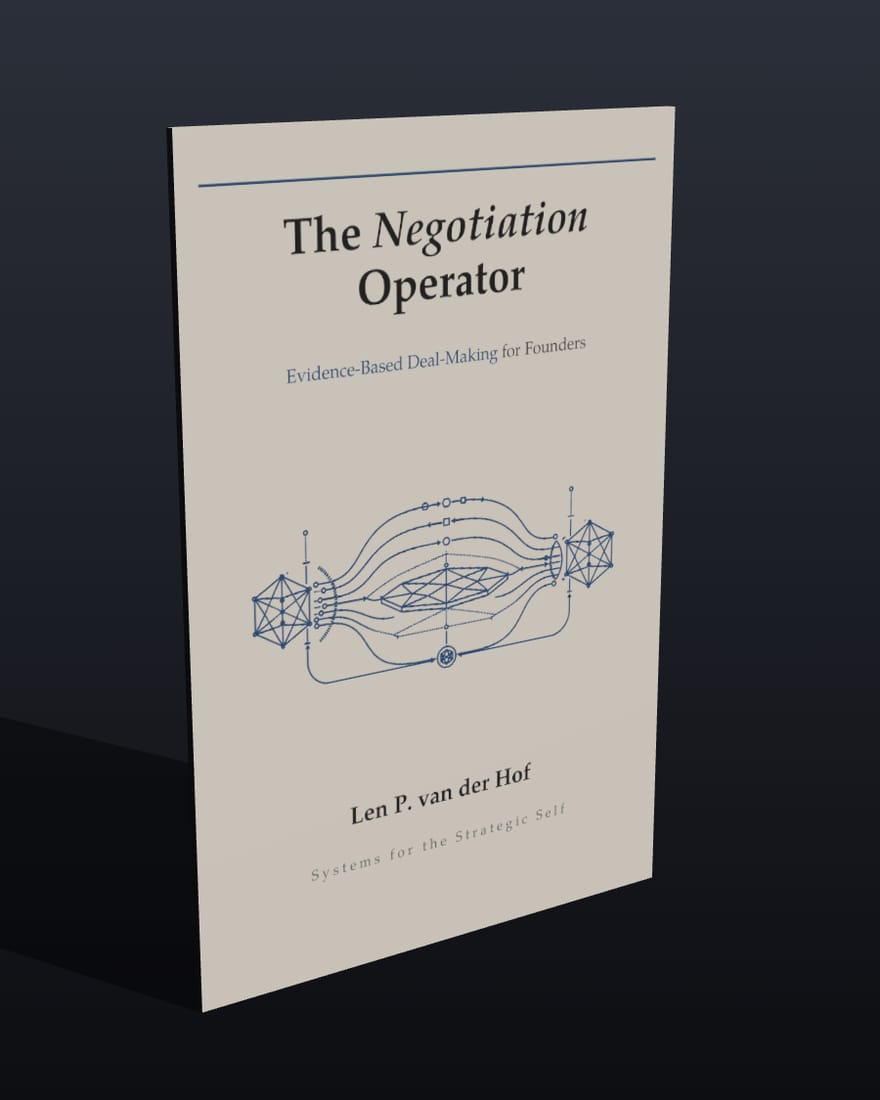
Kindle
The digital edition, ready in any Kindle app.
-
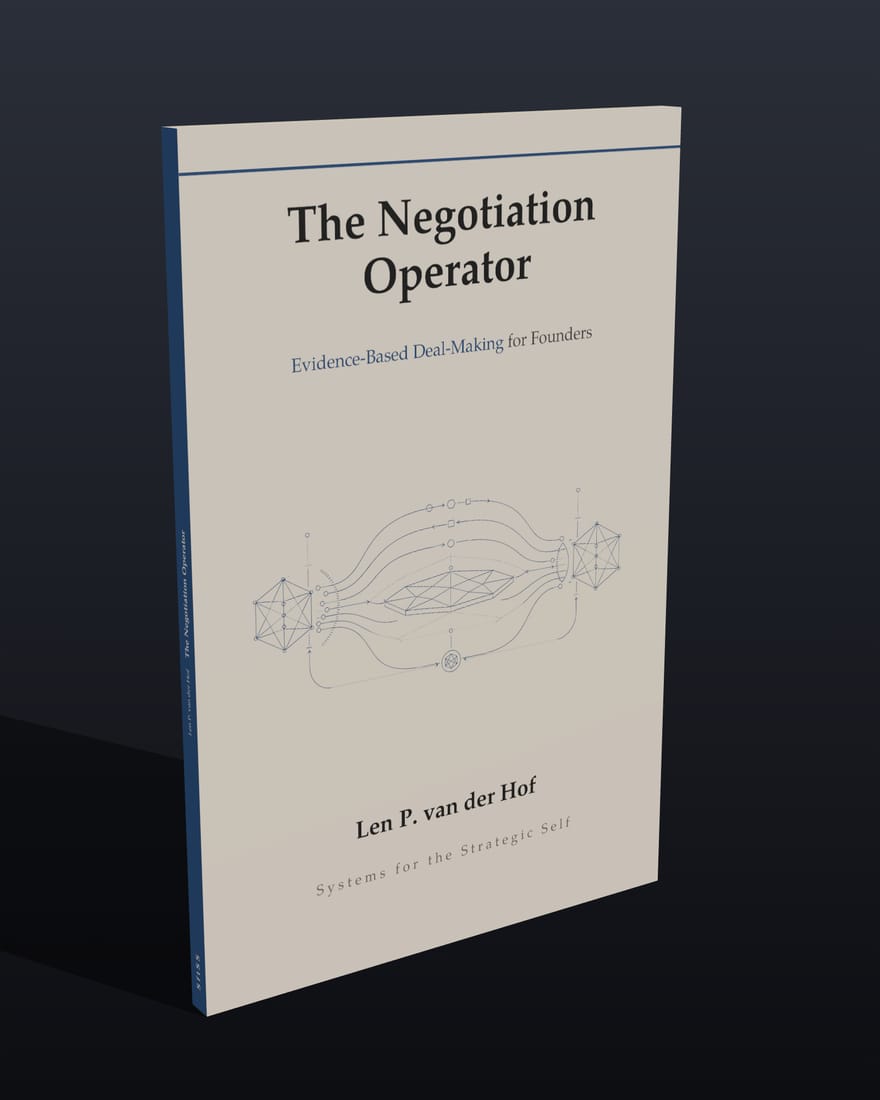
Paperback
The working copy. Mark it up. Take it into the meeting.


The book
Evidence-Based Deal-Making for Founders
The term sheet arrives late on Friday. A key hire wants an answer by Monday. Procurement says the pilot only works if you cut the price. Across the table sits someone who has negotiated this kind of deal many times before. You have not.
The Negotiation Operator replaces improvisation with a disciplined preparation and exchange system. Its NEGOTIATE framework turns behavioral evidence into a repeatable practice for the three deal types that shape a founder's trajectory: investor terms, team offers, and customer agreements.
What you learn
What this book puts in your hands
- Separate positions from interests before the conversation becomes a contest.
- Prepare alternatives, goals, variables, and walk-away points without false certainty.
- Recognize anchors, loss framing, reactive devaluation, and pressure deadlines.
- Expand the deal space before dividing value or conceding price.
- Trade across differences instead of giving unilateral concessions.
- Use calibrated questions and summaries to surface real constraints.
The framework
NEGOTIATE, step by step
-
Notice
-
Expand
-
Goals
-
Offer
-
Trade
-
Integrate
-
Anchor
-
Take
The contents
Chapter by chapter
Every chapter of The Negotiation Operator with its printed epigraph, what you can do afterwards, and the moment it is built for.
Introduction
The Negotiation You Were Never Taught
What you can do afterwards
You will stop misattributing negotiation difficulty to your personality and start treating it as a preparation problem you can solve.
Use this chapter when
You are opening this book for the first time, or you need to reorient after a negotiation that went badly and left you blaming yourself.
Chapter 1
The Science Beneath the Deal
What you can do afterwards
You will understand why effective negotiation looks nothing like the cultural stereotype, and you will hold the specific research findings that explain why.
Use this chapter when
You feel the pull of the dominant myth, that confidence and aggression decide outcomes, and you need to reset before a deal.
Chapter 2
The NEGOTIATE Framework
What you can do afterwards
You will hold the full NEGOTIATE framework, a preparation architecture that turns any negotiation into a structured eight-phase problem you can work through before you enter the room.
Use this chapter when
You have a deal on the calendar and the anxiety that comes with it, and you want to convert that anxiety into a checklist you can complete.
Chapter 3
Reading a Term Sheet Like a Negotiator
What you can do afterwards
You will read a term sheet as a negotiation document, not a legal one, sorting its clauses by negotiability and by economic effect before your first call.
Use this chapter when
A term sheet has arrived, or one is coming and you want to prepare before it does.
Chapter 4
Anchoring the Investor Conversation
What you can do afterwards
You will walk into the first investor call with three things prepared in advance: an alternative you can act on, a valuation number you state on purpose, and a concession sequence you decided before anyone picked up the phone.
Use this chapter when
The term sheet has arrived, your clause audit is done, and the first live conversation is on the calendar.
Chapter 5
The Equity Conversation
What you can do afterwards
You will walk into the co-founder equity conversation with the surface expanded past the single percentage, both partners' real interests mapped, and at least one structure that leaves each of you better off than the number-swap you were dreading.
Use this chapter when
The equity split no longer matches contribution, a co-founder's role is changing, or you are setting terms with a partner for the first time and want to do it once, well.
Chapter 6
Closing the Key Hire
What you can do afterwards
You will walk into the offer conversation with the job expanded past salary into its full set of issues, a structured choice of equivalent packages ready to present, and a method for reading the candidate's priorities from the offer she reaches for first.
Use this chapter when
You are recruiting a senior hire you cannot outbid on cash, a candidate is weighing a competing offer, or you need to learn what the other party values before you can meet it.
Chapter 7
Holding Your Price
What you can do afterwards
You will answer a procurement counter by holding your price and moving the terms, having found the interest under the demand before you concede anything.
Use this chapter when
A customer or procurement officer counters with a deep discount, hard payment terms, or a risk-shifting clause, often under a deadline.
Chapter 8
Vendor and Partner Deals
What you can do afterwards
You will answer a sole-supplier renewal by building a real alternative first, then converting terms the vendor called fixed, without pretending the dependency away.
Use this chapter when
A vendor or partner you depend on raises price or hardens terms and presents them as non-negotiable, often near their quarter- or year-end.
Chapter 9
Reading the Room
What you can do afterwards
You will recognize the standard pressure tactics a counterpart runs, name each one as it happens, and answer it by returning to your prepared floor and trading instead of conceding.
Use this chapter when
A counterpart applies deadline pressure, a receding authority, an extreme number, a staged concession, or a good-cop routine, and presents the pressure as a fact about the deal.
Chapter 10
The Ethics of Negotiation
What you can do afterwards
You will leave this chapter with a clear line between ethical and unethical negotiation, and you will hold that line as a commercial strategy, because your reputation is the asset it protects.
Use this chapter when
You are tempted to use a pressure tactic you have learned to counter, or you feel that your restraint is putting you at a disadvantage against a counterpart who shows none.
Conclusion
Your Personal Negotiation System
What you can do afterwards
You will leave with a personal negotiation system, three standing artifacts that turn every deal you do into preparation for the next one.
Use this chapter when
You have finished the book and want the durable version, the part you keep after the specific tactics have faded from memory.
Who it is for
Who this book was written for
The result is a practical operating layer: a preparation sheet, an issue map, a trade matrix, an ethical boundary, a decision log, and a review cadence that improves the next negotiation.
This is not a book about dominance, tricks, or becoming harder to deal with. It is for founders who want better agreements without manufacturing pressure or performing confidence. Negotiation is not a personality trait. It is a structured skill, and the structure can be learned.
This book is educational and does not provide legal, tax, or investment advice. Verify material terms with qualified professionals who understand the deal and jurisdiction.
What you will use it on
- Prepare for a specific imminent negotiation (term sheet, offer, renewal, co-founder talk) with a structured protocol
- Understand the cognitive biases that make founders their own worst negotiators and how to neutralize them
- Recognize the standard pressure tactics used by investors, enterprise procurement, and competing employers — and respond strategically
- Conduct multi-issue negotiations that create value before distributing it
- Hold their price or terms without damaging the relationship
- Build a personal negotiation system they can apply repeatedly, not just once
Editions
Editions and specifications
| Edition | Formats | Chapters | Pages | Reading time | ISBN (paperback) |
|---|---|---|---|---|---|
| English The Negotiation Operator | In production | 12 | 146 | ± 2 hours | — |
| Dutch De onderhandelende ondernemer | In production | — | — | — | — |
Both editions are written natively. The Dutch text is not a machine translation of the English. · Trim size: 6x9″
Frequently asked
What readers usually want to know
What is The Negotiation Operator about?
NEGOTIATE turns behavioral evidence into a repeatable preparation-and-exchange system for the three deal types that shape a founder’s trajectory: investor terms, team offers, and customer agreements. The subtitle is: Evidence-Based Deal-Making for Founders.
What is the NEGOTIATE framework?
NEGOTIATE: Notice, Expand, Goals, Offer, Trade, Integrate, Anchor and Take.
Is there a Dutch edition?
Yes. The Dutch edition is De onderhandelende ondernemer, written as a native edition rather than a machine translation. It moves through the same production line.
How long is The Negotiation Operator?
This edition runs 12 chapters, 146 pages in print and roughly 2 hours of reading.
Who is The Negotiation Operator for?
This book is educational and does not provide legal, tax, or investment advice. Verify material terms with qualified professionals who understand the deal and jurisdiction.
The production system
How this book was made
Every title moves through the same gated production line: sourced research, a claim-level evidence ledger, structural review, fact-checking, red-team critique, and a bilingual final edit. AI agents do specialist work inside those gates; judgment, voice, and accountability stay human.
- Claims enter an evidence ledger with a source and a confidence grade before they reach the page
- English and Dutch are two native editions, not a translation of one another
- Every chapter clears readability, rhythm, and style gates before it is typeset
The series
More in this theme


