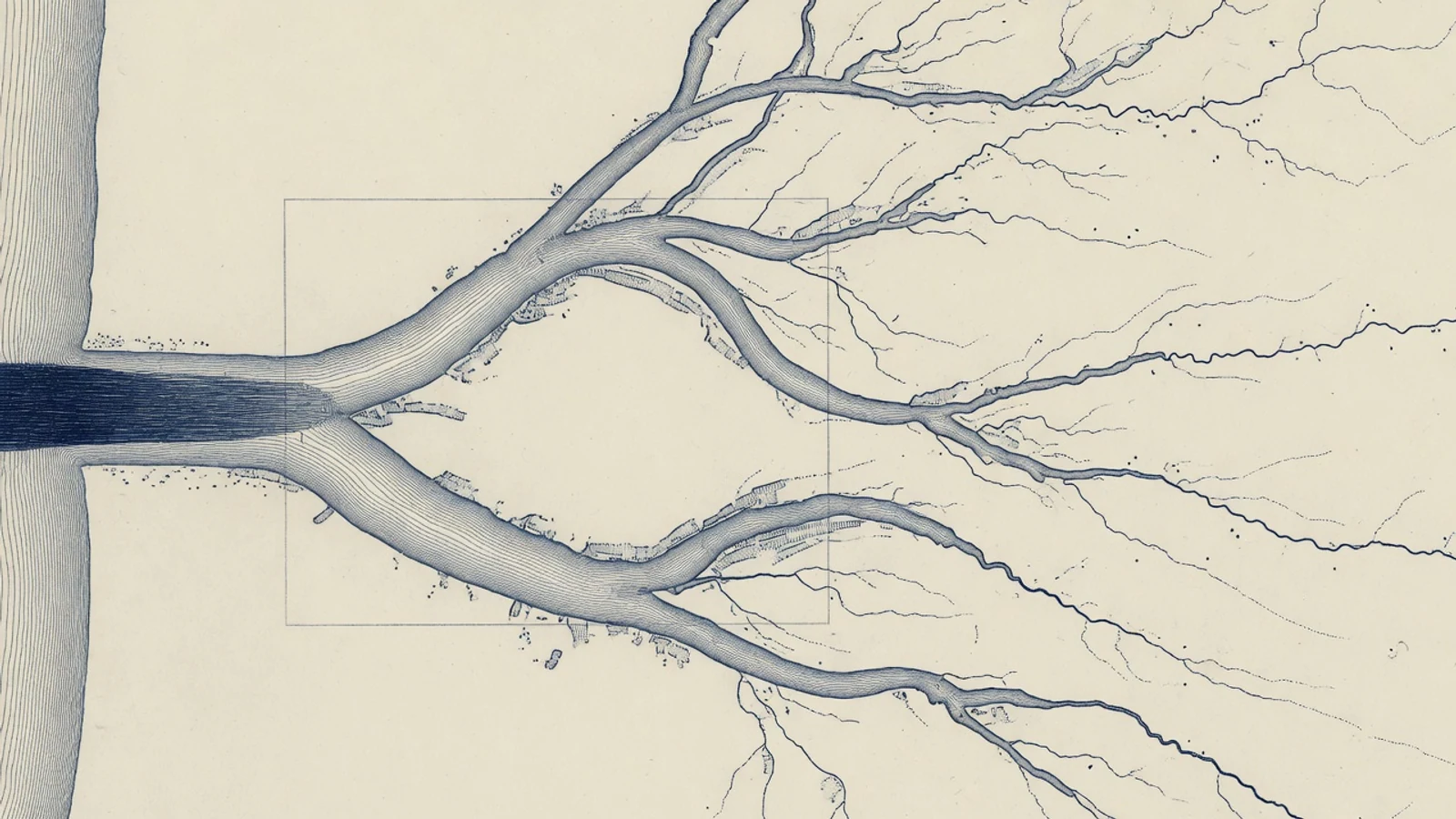
The meeting stopped at the first bend.
A mid-size company moves supplier payment terms from 30 days to 60.
Cash improves within a quarter. Finance books the win. The working-capital number the room came to move turns green. Nobody in that meeting is lying. The decision did what it was designed to do.
Then suppliers adjust.
Large ones absorb the change and reprice it into the next renewal. Small ones, who live month to month, start protecting themselves. They deprioritize your orders when capacity is tight. They ask for deposits on custom work. A couple start talking to a competitor who still pays in 30.
None of that shows up in your warehouse. Supplier behavior was never instrumented. What shows up is lead times drifting out by a week, which operations files under “market conditions.”
Eighteen months later, effective input costs are higher than before the change. Procurement is running a dual-sourcing project because the suppliers who used to pick up the phone first no longer do. The cash you gained in quarter one now sits against a slower, costlier, more brittle supply base.
That later, elsewhere, unowned cost is a downstream effect.
People also search for it as a downstream consequence, or type downstream affects when they mean the noun. Same river. Different words.
What a downstream effect actually is
A downstream effect is a consequence of a decision that is:
- Delayed. It travels at the speed of someone else’s accounting cycle, complaint, or renewal, not at the speed of your dashboard refresh.
- Displaced. It lands on a different surface than the metric you optimized: a partner’s margin, a regulator’s queue, an agent network’s cash float, a customer’s renewal.
- Unowned at decision time. The people who will carry the cost were not in the room, and nothing in the room was pointed at them.
It is not “something unexpected.” Unexpected is the story the organization tells after the cheap responses have expired.
The first-order effect can be real. Payment terms really did free cash. A route rule really can cut delivery time. A feature really can get adopted in the pilot. That is what makes these surprises durable. The post-mortem keeps finding a good decision at the origin and stalls there.
Downstream consequences is the same object with slightly wider language. Use whichever phrase your team will actually say out loud. The unit that matters is singular: one decision, one later bend, one landing surface.
Affect is the verb. A pricing change affects partner margins. Effect is the noun: the downstream effect is the margin collapse. If you typed “downstream affects” into a search box, you almost certainly wanted the noun cluster. You are in the right place.
Four parts of a surprise
Every expensive downstream surprise that lands on an operator’s desk has the same four-part structure. Naming the parts matters, because each part is a separate place where the surprise could have been caught.
Decision. A small group commits, optimized against the variables that group chose to model. The decision is often locally correct.
Latency. Downstream effects travel at the speed of other people’s month-end, not your standup. During the latency window the decision looks like a pure win, which is exactly when the organization stops watching.
Landing surface. The effect does not return to the metric you moved. It arrives on a partner P&L, an inquiry queue, a support load, a works-council agenda, a cash-float reconciliation. The owners of that surface usually hear about the decision as a consequence, not as a proposal.
Discovery. It is almost never gentle. A termination notice. A letter. A churn spike. A resignation. By the time the room recognizes the form, the affected party has already acted.
Decision, latency, landing surface, discovery. Hold that sequence. Detection shortens the list of unmodeled surfaces. Observation collapses the latency. Weighing changes the decision itself. Review turns each discovery into cheaper detection next time.
Why another dashboard will not save you
Most teams respond to a downstream surprise by buying more charts.
Instrumentation follows the room’s old questions. Every chart in your stack exists because someone once asked a question and paid an engineer to answer it continuously. Your telemetry is a map of what the organization has already thought to worry about.
The stakeholders who carry your second-order effects emit no data into your systems until they act. A partner absorbing margin damage generates zero warehouse events. A regulator forming a view of your data flows generates zero events. An agent network quietly routing customers to a competitor generates a slow drift that looks like seasonality until it does not.
If a stakeholder can appear in your data only by leaving, your dashboard is a lagging indicator of the second bend. You need a human channel to that stakeholder before the next material decision, not after. More resolution on the first bend will never substitute.
The fix is coverage of the surfaces you do not watch.
The office stops being the protocol
At thirty people, downstream effects are still felt in the body. The person who changes pricing also answers the partner’s angry email. The engineer who ships the feature sits within earshot of support. The signal arrives raw, in the injured party’s own words, usually within days.
At two hundred people the same decision crosses five layers. Each layer delays it by a reporting cycle and translates it into softer language. “They are furious and losing money” becomes “some pushback on the new terms,” which becomes “partner sentiment is mixed.” By the time the committee that could act hears it, the calendar has moved two quarters.
Decision quality often improves with scale. There are more models, more review, more expertise in the room. What degrades is transmission. Somewhere between 25 and 70 people, the office stops being the protocol. By 120 to 300, the second-order effect is routinely felt by a person, a company, or an agency the decision-maker has never met.
Caution without a map is just slowness. The teams that still move at scale are not the ones that stopped worrying. They built machinery to see the river early, so worry became a checklist item instead of a board agenda item.
A twenty-minute audit
Take the last five material operational decisions. For each one, ask “and then what?” three times. Write what you can now see. Mark whether seeing the later bend would have changed the original call.
The payment-terms case, filled in:
| Decision | First-order effect (seen) | Second-order (round 2) | Third-order (round 3) | Would it have changed the call? |
|---|---|---|---|---|
| Extend supplier terms 30 → 60 days | Cash and working capital improve in-quarter | Small suppliers deprioritize you; large ones reprice at renewal; lead times drift | 18 months later: higher input costs, dual-sourcing project, spent relationship capital | Reshaped it: staged rollout, small suppliers exempted, named owner on lead times |
Blank table for you:
| Decision | First-order effect (seen) | Second-order (round 2) | Third-order (round 3) | Would it have changed the call? |
|---|---|---|---|---|
| ____ | ____ | ____ | ____ | yes / no / reshaped it |
Be honest in the last column. Reshaped it is the most common truthful answer, and the most useful one. Seeing round three would probably not have killed the payment-terms change. It would have changed its shape.
Then write one sentence for the decision whose next bend is already forming: the effect, the surface it will land on, and the person outside the room who will feel it first.
Name one question you will ask before the next similar decision. That question is the first line of a detection checklist.
Operators who run this honestly usually find one decision in five whose later bend would have changed the call. Treat that as a working observation, not a benchmark.
What this is not
This is not a request to predict every consequence. Material effects, not all effects.
This is not “think more.” Thinking more without a landing surface, an owner, and a time horizon is how rooms perform seriousness.
This is not a recap of Thinking in Systems, useful as Meadows is. Operators do not fail because they have never heard of feedback loops. They fail because the loop lives in a partner contract, a regulator’s inbox, or an agent network, and the protocol for seeing it was never installed.
This is not generic risk management. Risk registers catch named, owned, already-imagined threats. Downstream work is about the surfaces nobody put on the register because they were not in the room.
It is also not the same as second-order thinking in your own head. That cognitive layer is the companion book, The Second-Order Thinker. Downstream work lives in the product, the org chart, the partner contracts, and the regulator’s inbox. The two are companions, not duplicates.
The book, still in production
I am writing The Downstream Effects as the operational protocol behind this diagnostic. The memorable name is DOWNSTREAM. You do not need the full acronym to start. Three moves are enough to preview:
- Detect before the organization commits. Ask who is not in the room and which surface they own.
- Trace the actual chain after the fact, through product, partner, technical network, and regulator, and mark the one link that was not in the original model.
- Mitigate with five elements, all required: effect, action, owner, trigger, test. “We’ll watch it” is not a mitigation.
DOWNSTREAM is an operating heuristic, not a validated risk instrument. Use it as a lens. Keep what survives contact with your own operations.
The book is still in production and not published yet. The chapter map, the notify-me list, and the longer protocol live on the book page:
Dutch edition page: De stroomafwaartse effecten.
If you only do one thing this week, run the audit. The river is already moving. The question is whether anyone in the building is pointed at the next bend.
Cite this:Downstream effects: why the real cost of a decision lands later, and somewhere else.Len P. van der Hof. https://lenvanderhof.com/en/blog/downstream-effects/ ·