

No. 45 · Manuscript complete · Founder psychology · CLAUSE
The Fundraising Operator
Term Sheets, Power, and Calm Under Dilution
Win the term sheet you'll still respect in five years.
Founders over-optimize the pitch and panic on the paperwork that actually shapes their company. The Fundraising Operator is a calm, clause-by-clause protocol (cap-table clarity, leverage mapping, and emotional regulation) for raising on terms you will still respect years later.
- pages
- 302
- chapters
- 13
- hours of reading
- ± 4
- editions
- EN · NL
- Design
- Drafting
- Manuscript
- Production
- Launched
The editions
Kindle and Paperback
Production shots of the editions. Not for sale yet — this page is the public working version.
-
Kindle
The digital edition, ready in any Kindle app.
-
Paperback
The working copy. Mark it up. Take it into the meeting.


The book
Term Sheets, Power, and Calm Under Dilution
You rehearse the pitch in the shower and still walk in hoping more than asking. You soften the ask, laugh at the term sheet you should question, and take the lead investor's framing because the runway clock is louder than your judgment. You run the company like an operator and the raise like a supplicant, and the round you close on those terms is the cap table you live inside for the next decade.
The usual answer is to network harder, perfect the deck, and project confidence you do not feel. Confidence theater works right up to diligence, where a desperate founder negotiates against himself and signs away control he can never cleanly buy back.
The Fundraising Operator treats raising capital as what it is: a structured operation with a counterparty, not a personality test you pass by being likable. It introduces the RAISE framework (Readiness, Architecture, Investor fit, Story, Execution): five moves that convert a nerve-wracking pitch into a process you run on your terms, from a position of leverage you built before the first meeting.
What you learn
What this book puts in your hands
- The CLAUSE protocol: cap table, leverage, anti-dilution, pacing, evidence
- Optimize power and pacing, not just the pitch
- Stay calm and clear under term-sheet pressure
The framework
CLAUSE, step by step
cap table, leverage, anti-dilution, pacing, evidence
-
cap table
-
leverage
-
anti-dilution
-
pacing
-
evidence
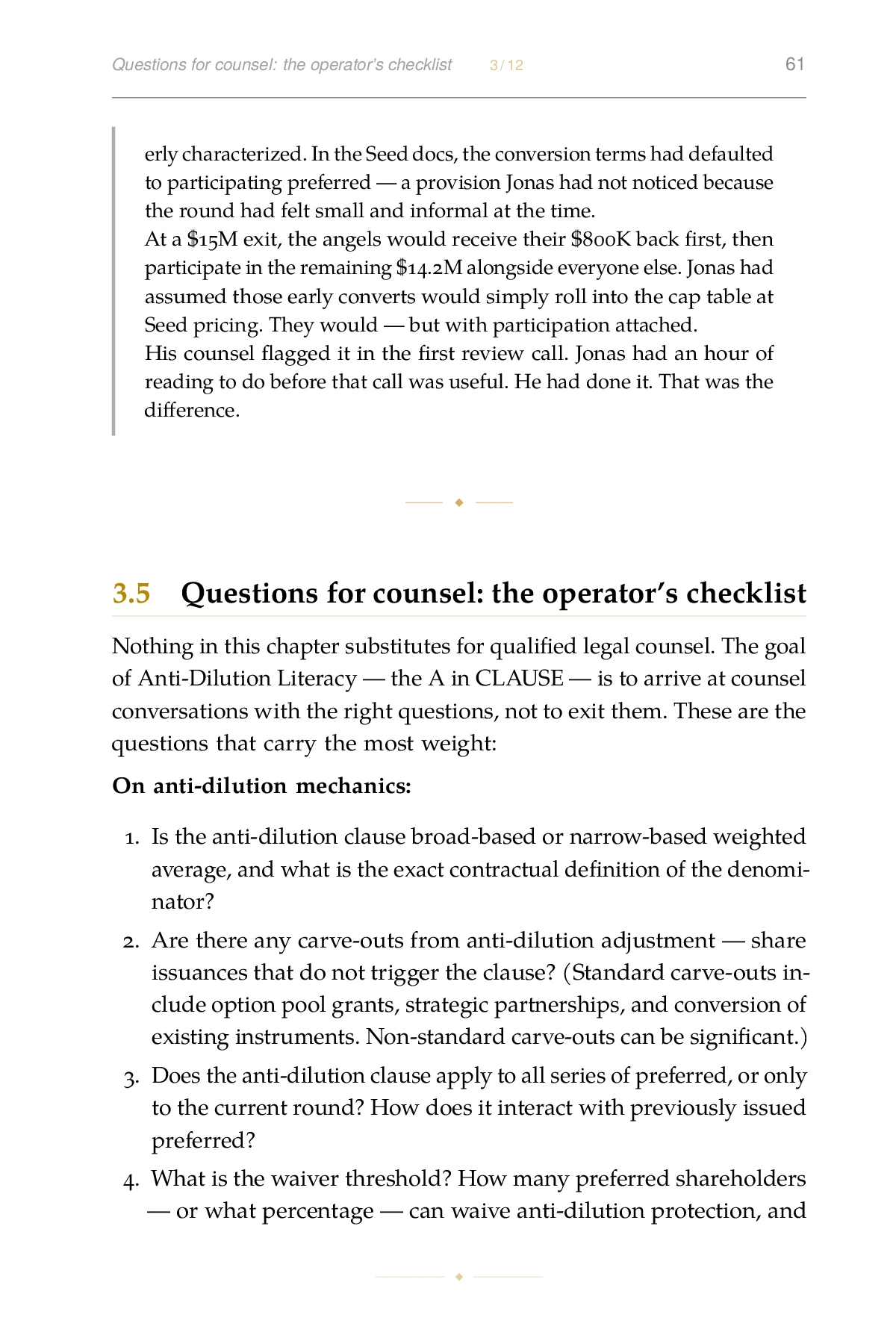
From the book
At a $15M exit, the angels would receive their $800K back first, then
The Fundraising Operator, printed page: At a $15M exit, the angels would receive their $800K back first, then
Inspect more pagesLook inside
Pages from the print edition.
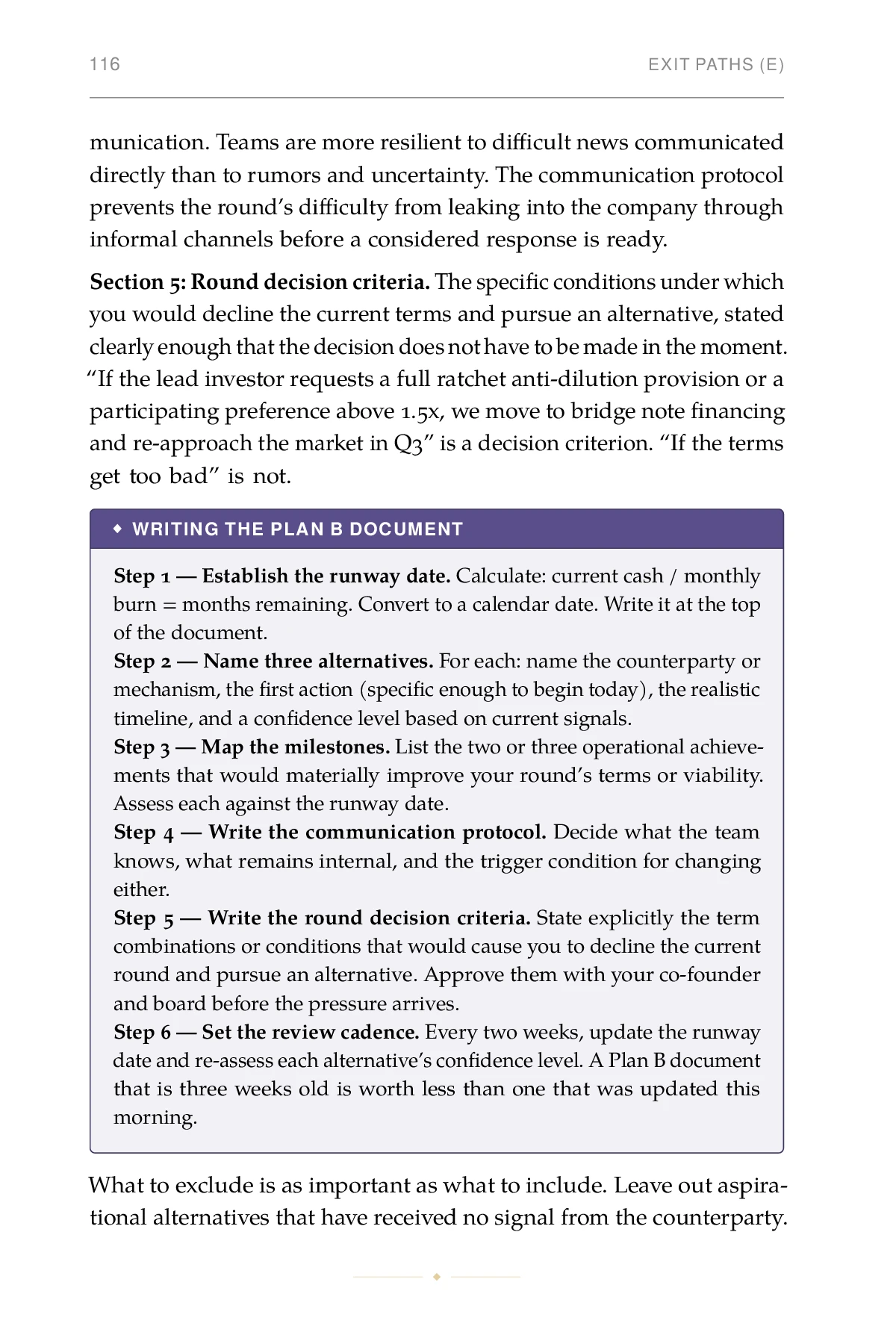
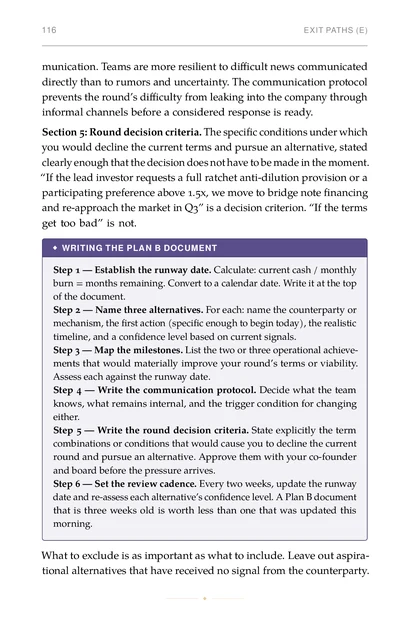 Step 1 — Establish the runway date. Calculate: current cash monthly
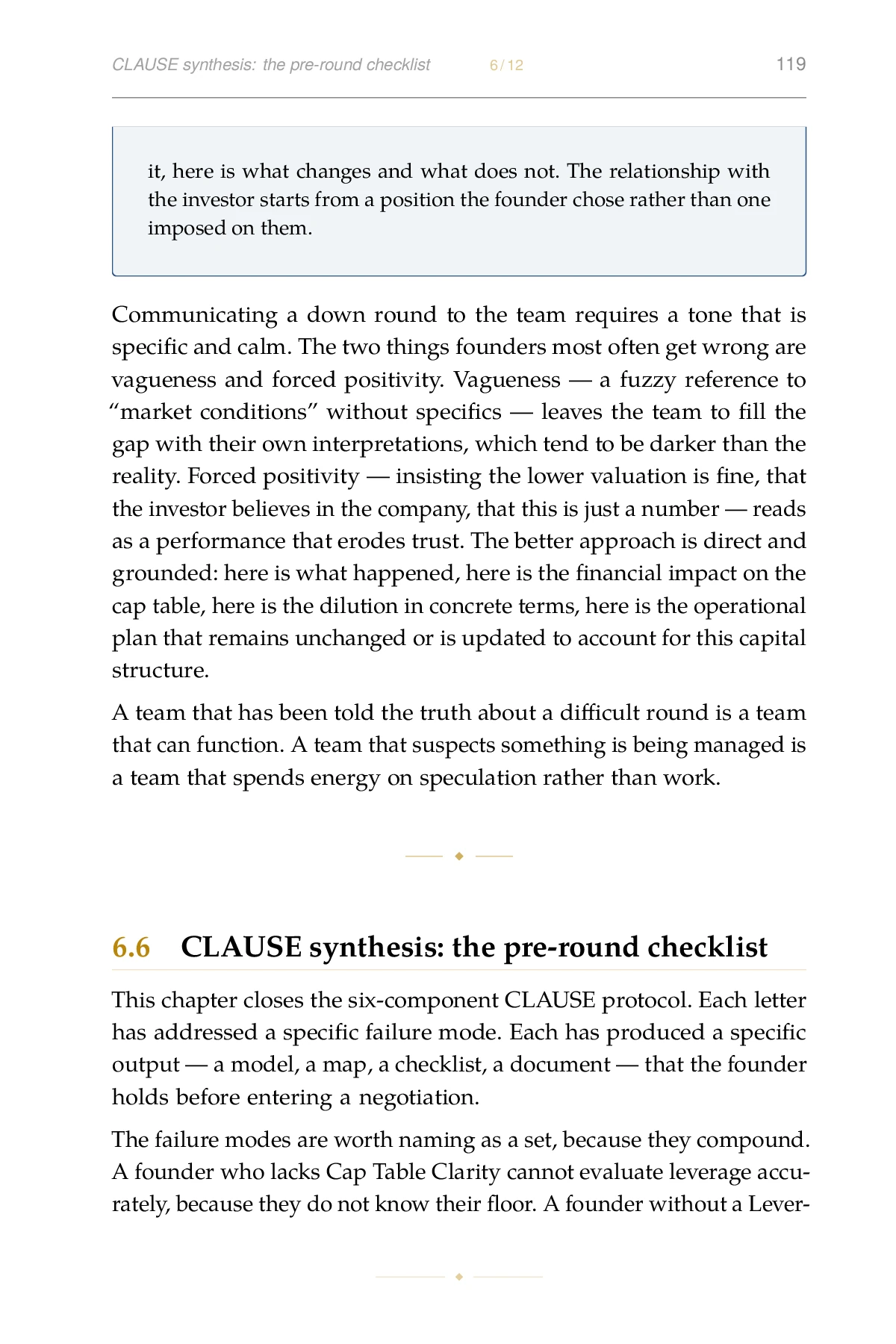
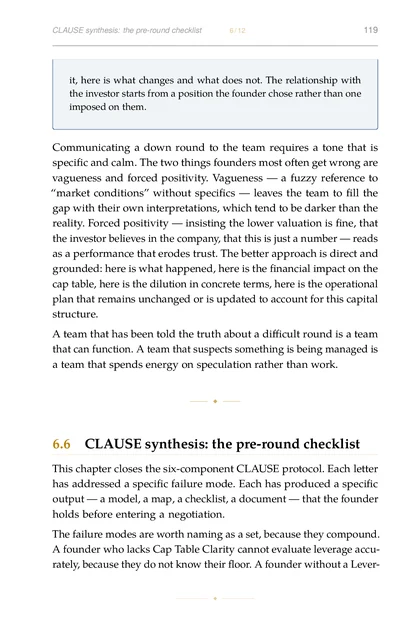 Communicating a down round to the team requires a tone that is
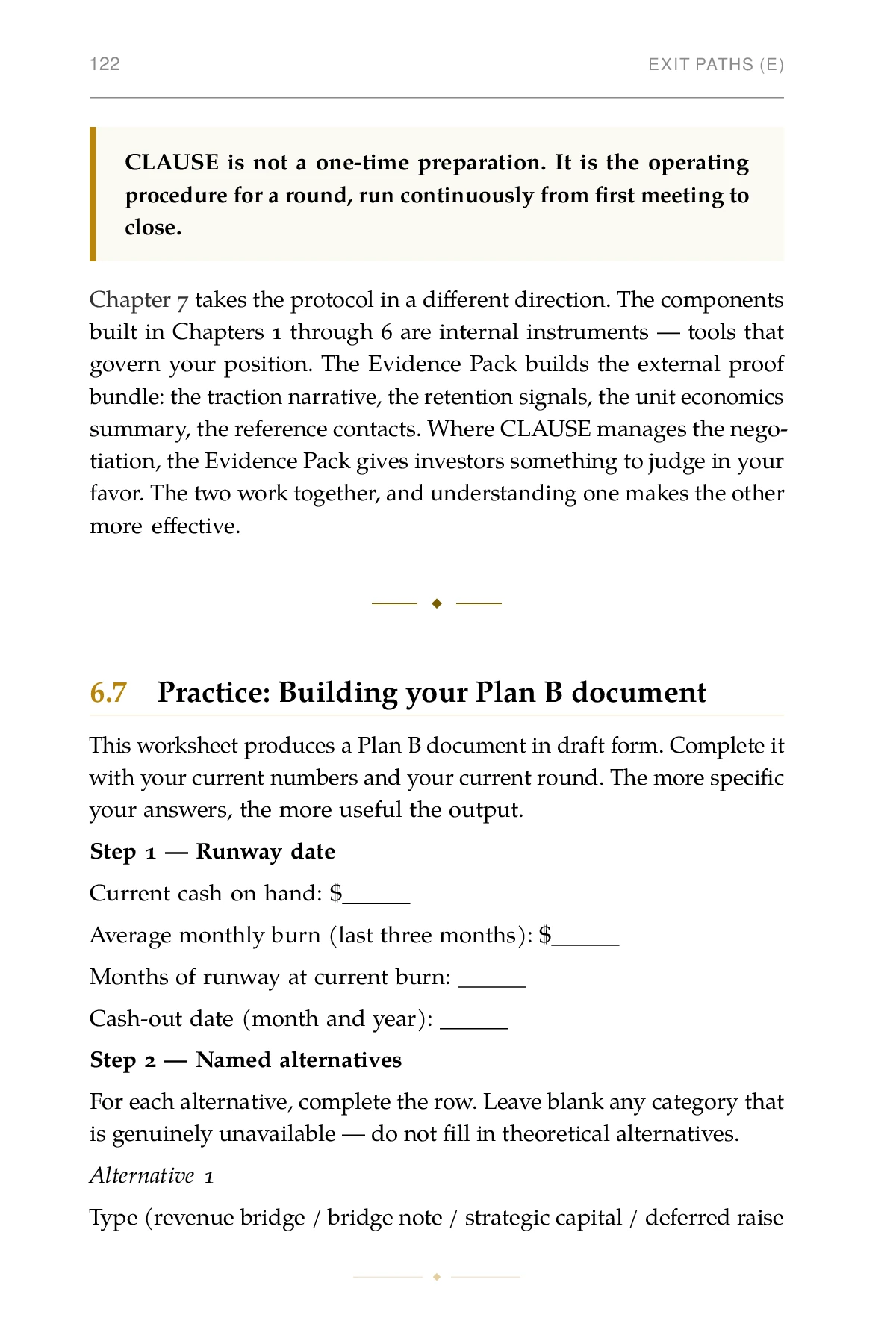
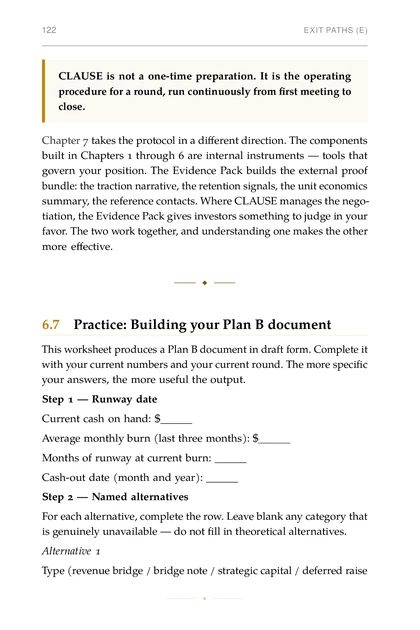 Step 1 — Runway date
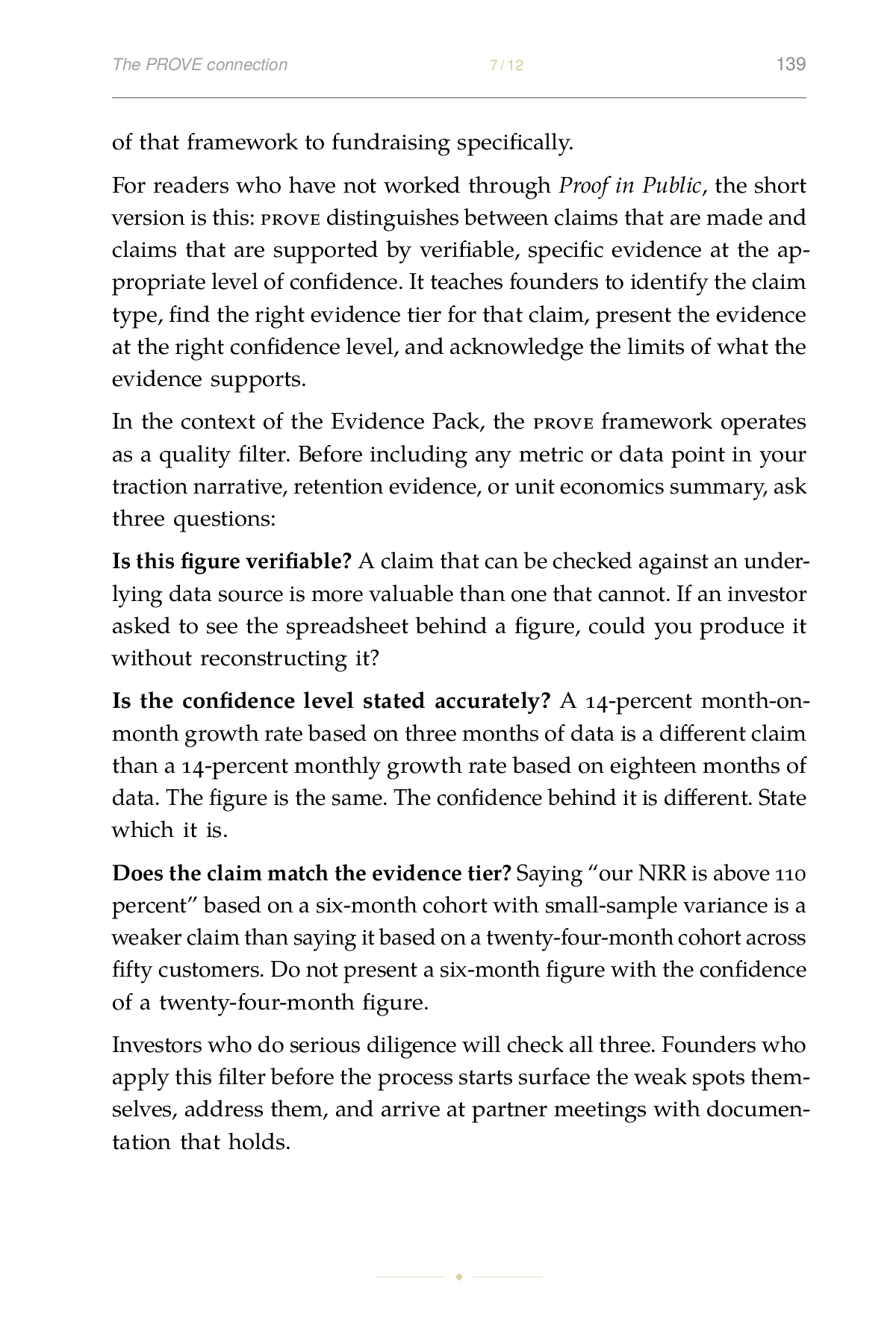
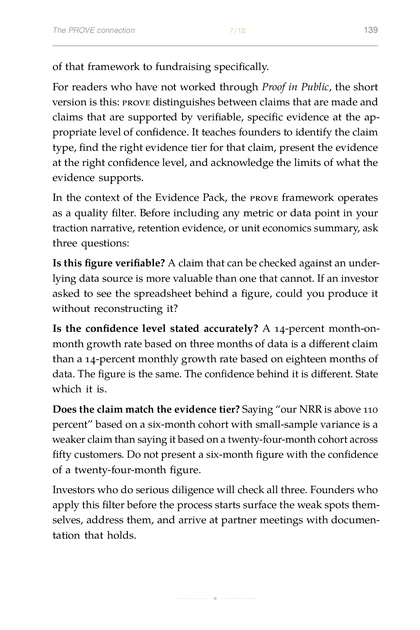 In the context of the Evidence Pack, the prove framework operates
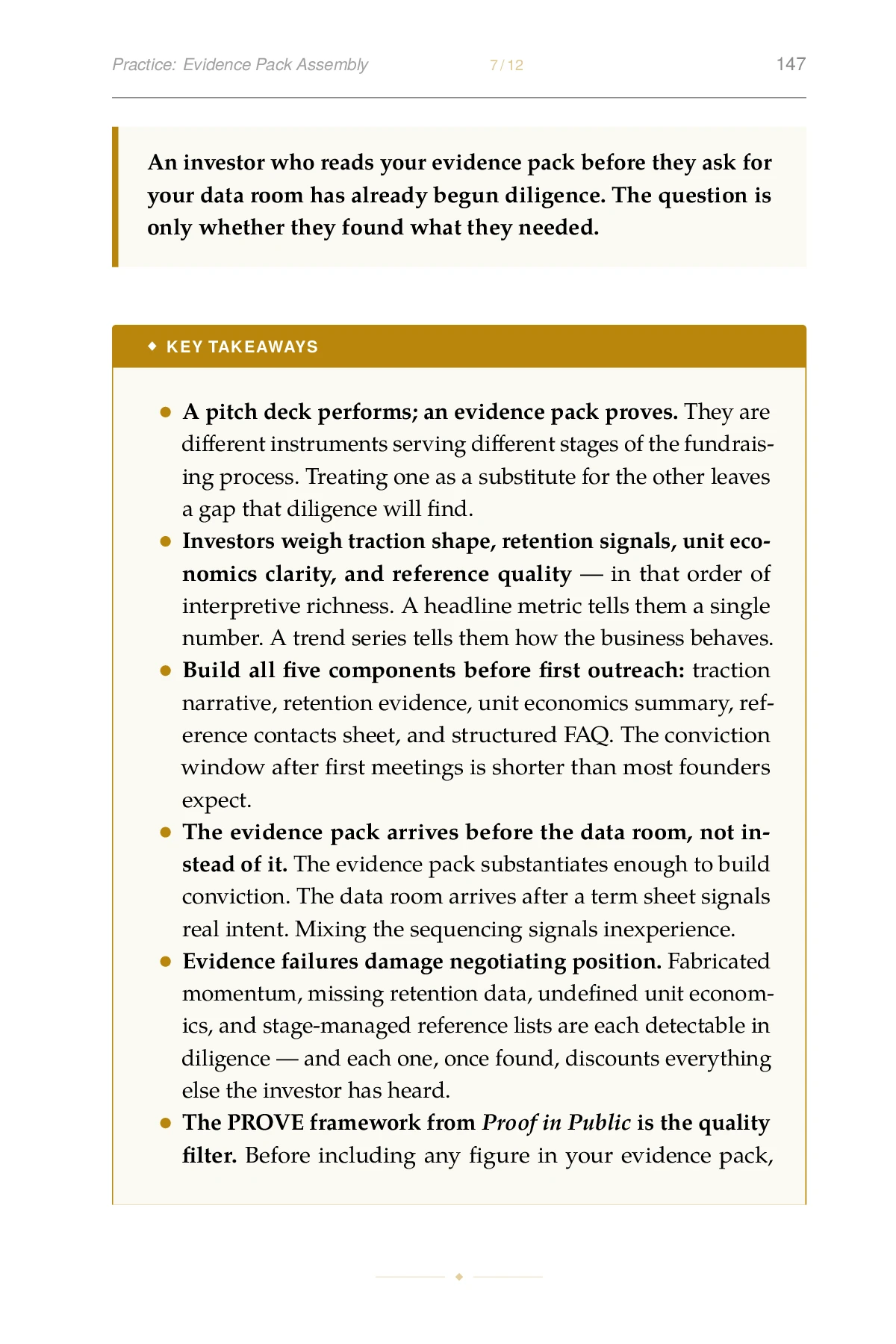
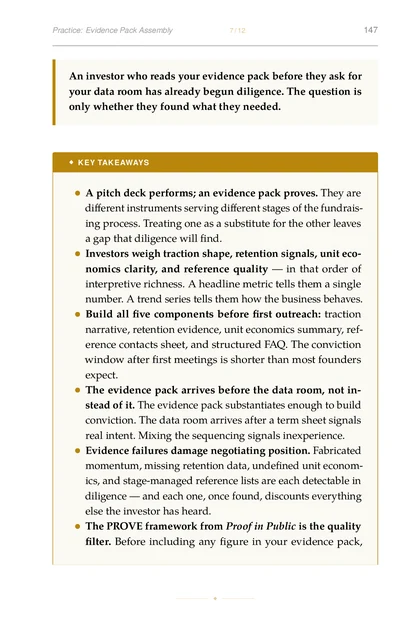 Practice: Evidence Pack Assembly 7 12 147
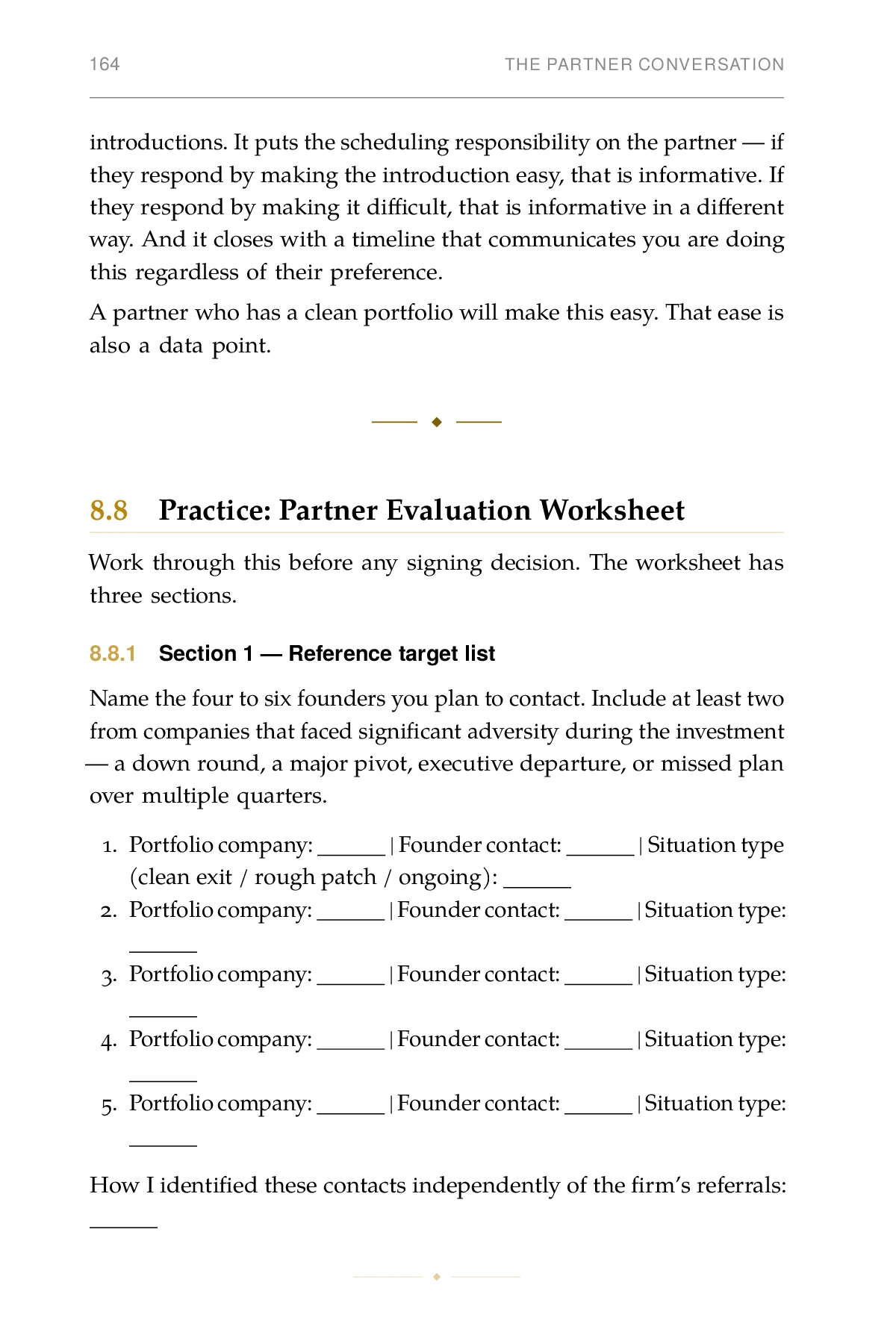
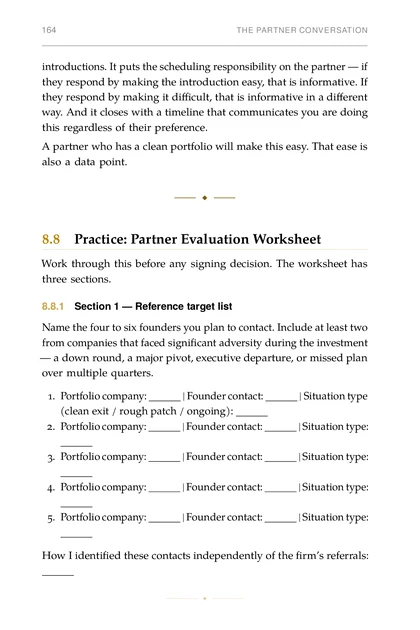 Work through this before any signing decision. The worksheet has
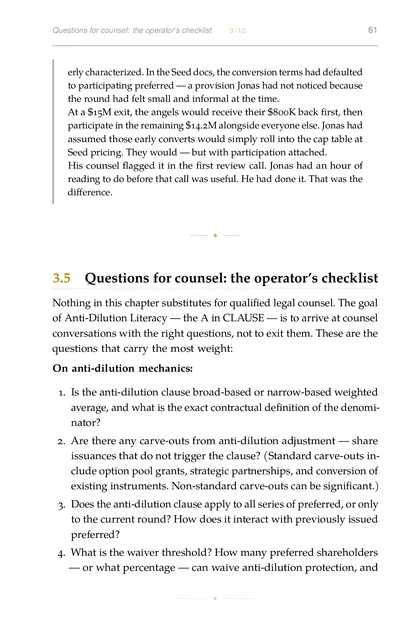 At a $15M exit, the angels would receive their $800K back first, then
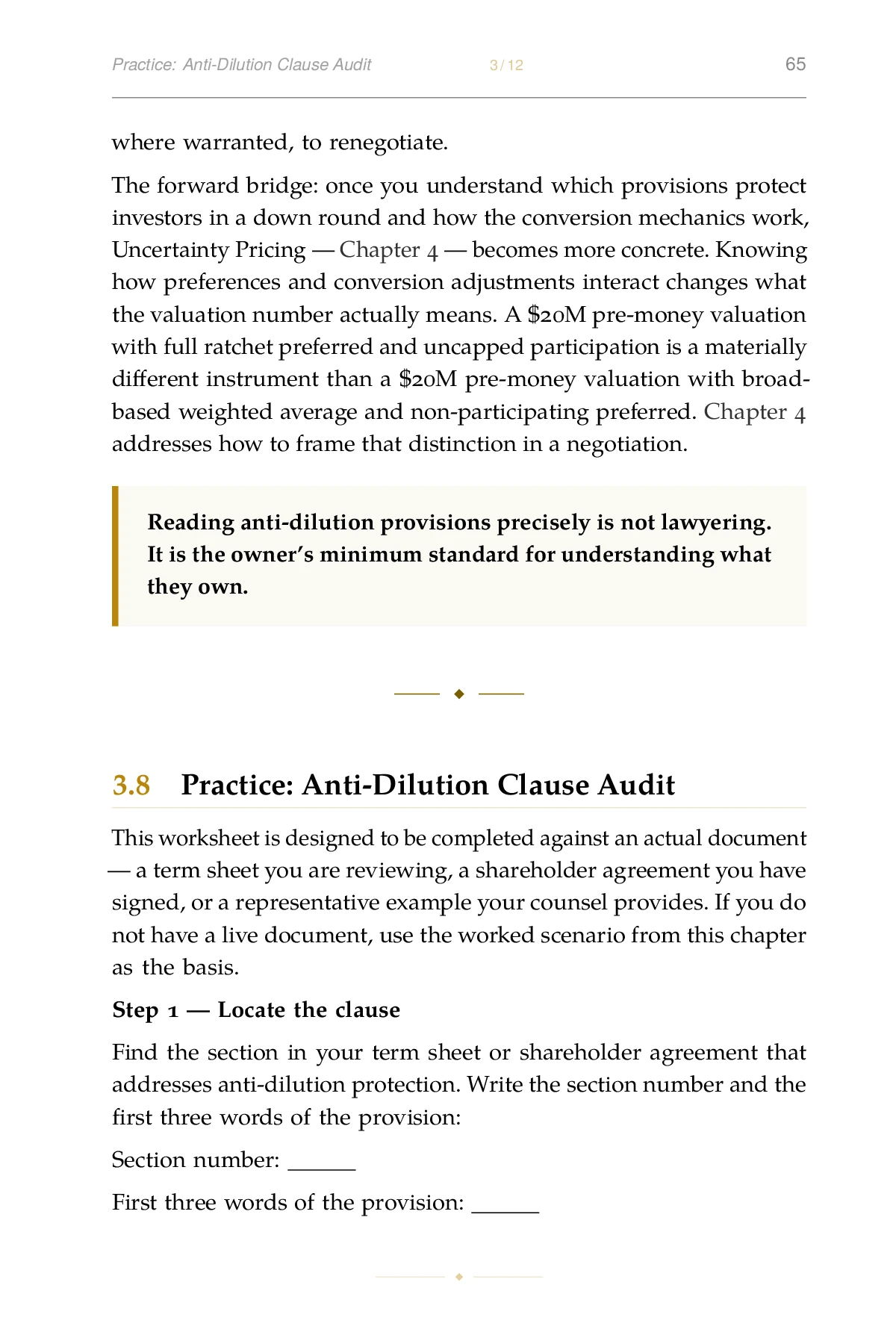
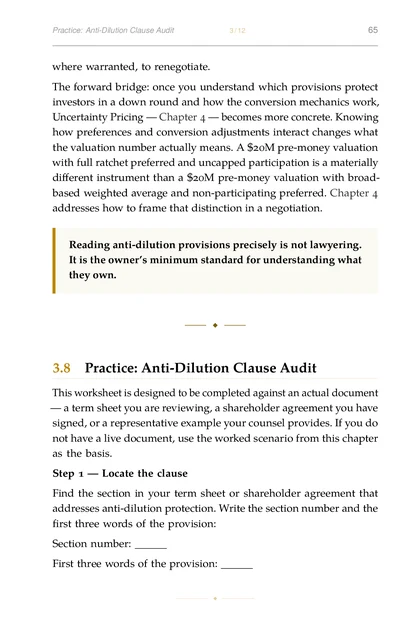 Practice: Anti-Dilution Clause Audit 3 12 65
The contents
Chapter by chapter
Every chapter of The Fundraising Operator with its printed epigraph, what you can do afterwards, and the moment it is built for.
Introduction
The Other Game
Most of the damage happens after the meeting ends. The pitch gets you in the room. Those terms determine what you own when you leave it.
What you can do afterwards
You will understand why operator judgment (not storytelling polish) determines the quality of your terms, and you will have a first map of the six-component protocol that structures everything that follows.
Use this chapter when
You have received or are about to receive a term sheet and you feel the ground shift under you, either elated and about to say yes too fast, or frozen and not sure which word to look up first.
Chapter 1
Cap Table Clarity
The ownership conversation has already begun. You are either running it or letting someone else run it for you.
What you can do afterwards
You will be able to model your own dilution across realistic seed-to-Series A scenarios (including the option pool shuffle and a convertible note conversion) before any term sheet lands on your desk.
Use this chapter when
You are approaching a fundraising conversation and have not yet built a working dilution model for your specific cap table. Also use when a term sheet arrives and something in the math does not feel right but you cannot name what.
Chapter 2
Leverage Map
The negotiator who cannot walk away is not negotiating, they are auditioning.
What you can do afterwards
You will leave this chapter with a written inventory of real alternatives (investors, revenue bridges, strategic capital, deferred raises) that transform "no" from a capitulation into a credible position.
Use this chapter when
You are entering a term-sheet conversation without a named Plan B, or you sense that an investor's term feels wrong but you feel unable to push back.
Chapter 3
Anti-Dilution Literacy (A)
A provision you cannot read is a provision you have already agreed to. The question is only whether you agreed to it deliberately.
What you can do afterwards
You will be able to read an anti-dilution clause, distinguish the two main mechanisms from each other and from the extreme case, understand how participation rights interact with them, and arrive at your next counsel conversation with the specific questions that move the conversation forward.
Use this chapter when
You have a term sheet in hand that specifies anti-dilution protection and you do not yet know what it will do to your ownership in a down round, or when you are negotiating a seed round and the participation language looks more complicated than you expected.
Chapter 4
Uncertainty Pricing (U)
A number that cannot move is not a position. It is a target.
What you can do afterwards
You will learn to frame valuation as a confidence interval anchored to your operational assumptions (not a single number you are emotionally obligated to defend) so that anchoring tactics fall short and the negotiation stays on ground you control.
Use this chapter when
You are approaching a valuation conversation and you notice the instinct to pick a number and hold it as if the number were a judgment on the company's worth.
Chapter 5
Stoic Pause (S)
The fastest way to give away a negotiation is to answer before the question has finished arriving.
What you can do afterwards
You will have a named, rehearsed pause protocol (the Stoic Pause) that you can deploy the next time a term-sheet conversation accelerates past the speed of your judgment. You will recognize the four pressure patterns before they work on you, and you will know exactly what to say when you need thirty seconds and the room is not offering any.
Use this chapter when
An investor has just said something in the meeting that you feel compelled to respond to immediately, a deadline, a compliment, a reference to another interested party, or the simple weight of sitting across from someone whose approval you want. The urge to answer quickly is the signal.
Chapter 6
Exit Paths (E)
A founder who has no named Plan B when a round stalls is not negotiating, they are hoping. Investors know the difference. The contingency itself is the walk-away power.
What you can do afterwards
You will have a written, realistic Plan B before the next investor conversation, not as a fallback you dread, but as the operational asset that gives every term-sheet exchange its real weight.
Use this chapter when
Your round has slowed, stalled, or produced terms worse than expected; or you are preparing a round and want to enter with genuine walk-away power rather than performed confidence.
Chapter 7
Evidence Pack
A pitch deck tells a story. An evidence pack makes the story checkable. Investors fund what they can verify, not what they can only admire.
What you can do afterwards
You will understand the structural difference between a pitch deck and an evidence pack, learn what experienced investors actually weigh in the weeks before a term sheet, and leave with a five-component evidence bundle assembled from your own operating data, ready before first partner meetings begin.
Use this chapter when
You are in the weeks before entering your formal fundraising process and you want to ensure that every investor conversation is substantiated by verified operational data rather than projected narrative.
Chapter 8
The Partner Conversation
The term sheet has a term sheet. The partner has a history. Only one of those can be read in a document.
What you can do afterwards
You will have a structured framework for evaluating the human being on the other side of your term sheet (their board style, conflict resolution patterns, and the gap between their portfolio support promises and their actual behavior) before you sign. You will know how to run investor reference calls, what questions to ask, and how to interpret the answers.
Use this chapter when
You have received one or more term sheets and you are trying to choose between investors, or when something in a partner conversation has produced a signal you cannot name but cannot dismiss. The chapter applies equally if you are still deep in the process and have not yet met with a partner meeting at all.
Chapter 9
Agent-Assisted Red Team
A tool that models consequences is not the same as a tool that understands them. Know which one you are holding.
What you can do afterwards
You will have a structured, repeatable protocol for running an AI-assisted red team on term-sheet language before counsel review, knowing exactly which outputs to act on, which to bring to your lawyer, and which to set aside.
Use this chapter when
You have received a term sheet and you have a day or less before your first substantive response is expected. You want a rapid first-pass analysis that stress-tests the language you do not fully understand without waiting for a scheduled counsel call.
Chapter 10
After the Term Sheet
A signed term sheet is not a closed round. It is a starting gun for a different kind of work, and founders who confuse the two spend the next six weeks making avoidable mistakes.
What you can do afterwards
You will have a concrete checklist for the period between signed term sheet and funded close, know exactly what to tell your team and when, and understand how to begin the governance relationship on terms you set rather than inherited.
Use this chapter when
You have just signed a term sheet (or expect to within the next two weeks) and you are not entirely sure what happens next, what to say to the company, or how to manage the transition from fundraising mode to operating-with-investors mode.
Chapter 11
The Bootstrapped Fork
The default is not neutral. Every founder who assumes raising is the serious choice has already made a decision, they have just made it without running the numbers.
What you can do afterwards
You will know how to run CLAUSE against the bootstrapped alternative. Not as a sanity check on a decision already made. As a genuine decision filter that surfaces what the raise costs and what the alternative offers.
Use this chapter when
You are considering a first institutional round while the business already generates revenue. Or you have a term sheet and are unsure the terms justify what you give up. Or you have been bootstrapped and a customer or advisor has asked whether now is the time to raise.
Conclusion
Calm Ownership
A round closes. The number on the cap table is what it is. That question that remains (the one that will follow you into the next round, and the one after that) is whether you chose it or whether it happened to you.
What you can do afterwards
You will leave this chapter with a consolidated view of the CLAUSE protocol as a permanent operating habit, and a clearer sense of what calm ownership means as a negotiating posture rather than a personality claim.
Use this chapter when
You have finished the round (or you are preparing to) and you want to consolidate what the process taught you before the next one begins.
Who it is for
Who this book was written for
The result is not a founder who got funded. It is an operator who raised on terms he chose, kept the company he was building, and left diligence with his integrity and his cap table intact.
If you would rather negotiate from leverage you built than from a runway clock you are watching, this is the operation you have been improvising.
The reader it was written for
The first-time or second-time institutional raiser. A founder from pre-seed through Series B who has enough traction to enter investor conversations, can engage qualified counsel, and needs an operator-side process between legal calls. The reader wants to understand ownership math, alternatives, uncertainty, and decision timing without mistaking a book for transaction advice.
What you will use it on
- Reproduce the ownership math for the actual instrument and sequence under review.
- Prepare a written list of genuine alternatives and the conditions that make each executable.
- Mark every legal, tax, accounting, and jurisdiction-specific question for qualified review.
- Distinguish a pitch deck, evidence pack, data room, form document, and negotiated agreement.
- Document assumptions behind valuation and dilution scenarios.
- Use a deliberate pause before any binding or consequential commitment.
Probably not for you if
- Readers seeking legal, tax, accounting, securities, or individualized investment advice.
- Founders who cannot engage qualified counsel for binding documents.
- Readers seeking a guaranteed valuation, close, investor response, or negotiation tactic.
- Investors looking for a diligence or portfolio-management manual.
Editions
Editions and specifications
| Edition | Formats | Chapters | Pages | Reading time | ISBN (paperback) |
|---|---|---|---|---|---|
| English The Fundraising Operator | In production | 13 | 302 | ± 4 hours | — |
| Dutch De fundraising-operator | In production | 13 | 324 | ± 4 hours | — |
Both editions are written natively. The Dutch text is not a machine translation of the English. · Trim size: 6x9″
Frequently asked
What readers usually want to know
What is The Fundraising Operator about?
CLAUSE gives founders the operating discipline to read term sheets, protect optionality, understand power, and stay calm when dilution pressure rises. The subtitle is: Term Sheets, Power, and Calm Under Dilution.
What is the CLAUSE framework?
CLAUSE: cap table, leverage, anti-dilution, pacing and evidence. cap table, leverage, anti-dilution, pacing, evidence
Is there a Dutch edition?
Yes. The Dutch edition is De fundraising-operator, written as a native edition rather than a machine translation. It moves through the same production line.
How long is The Fundraising Operator?
This edition runs 13 chapters, 302 pages in print and roughly 4 hours of reading.
Who is The Fundraising Operator for?
If you would rather negotiate from leverage you built than from a runway clock you are watching, this is the operation you have been improvising.
The production system
How this book was made
Every title moves through the same gated production line: sourced research, a claim-level evidence ledger, structural review, fact-checking, red-team critique, and a bilingual final edit. AI agents do specialist work inside those gates; judgment, voice, and accountability stay human.
- Claims enter an evidence ledger with a source and a confidence grade before they reach the page
- English and Dutch are two native editions, not a translation of one another
- Every chapter clears readability, rhythm, and style gates before it is typeset
The series
More in this theme


