

No. 20 · Active development · Founder psychology · FORGE
The Identity Forge
The Operating System for Identity That Survives Growth
The Identity Forge: The Operating System for Identity That Survives Growth.
FORGE is one operating system for the transition a new stage demands: frame the current identity, own the evolution, reassess at thresholds, grow through visible practice, and exit identities that no longer serve the company or the person leading it. The Operating System for Identity That Survives Growth. The framework: FORGE.
- pages
- 188
- chapters
- 14
- hours of reading
- ± 3
- editions
- EN · NL
- Design
- Drafting
- Manuscript
- Production
- Launched
The editions
Kindle and Paperback
Production shots of the editions. Not for sale yet — this page is the public working version.
-
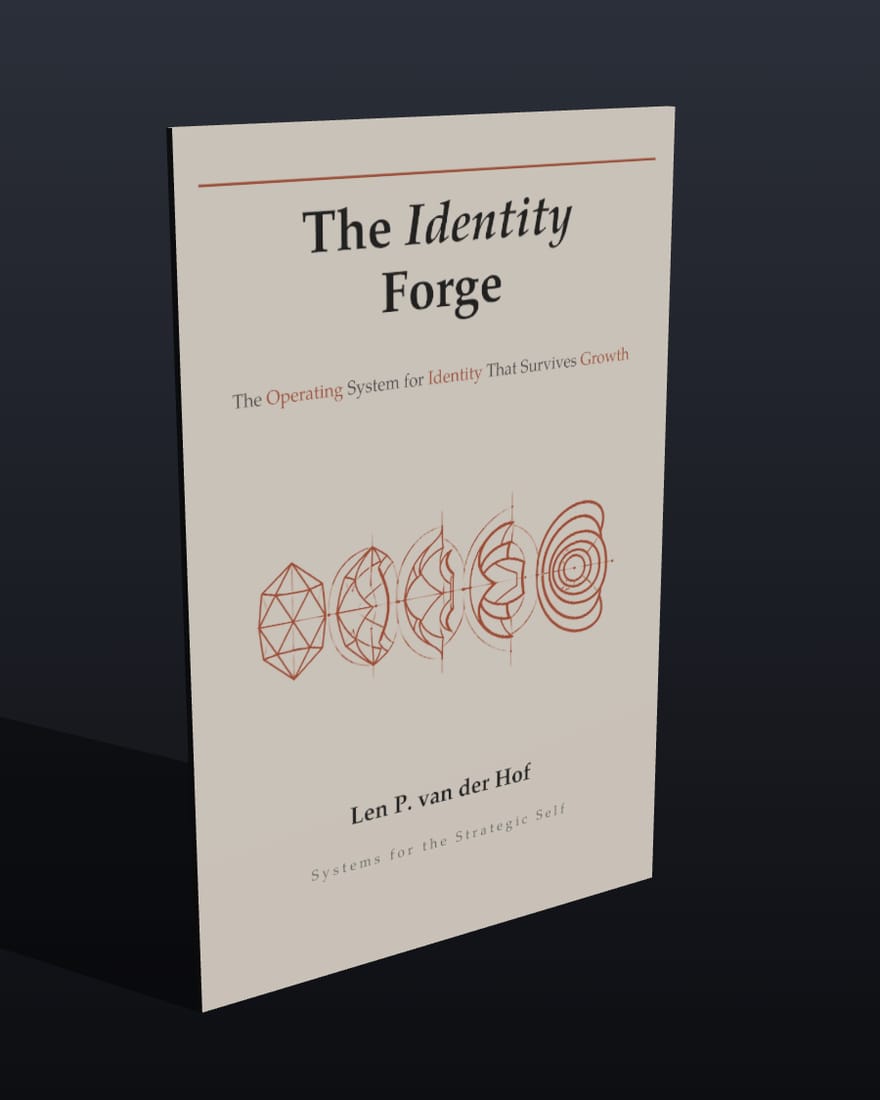
Kindle
The digital edition, ready in any Kindle app.
-
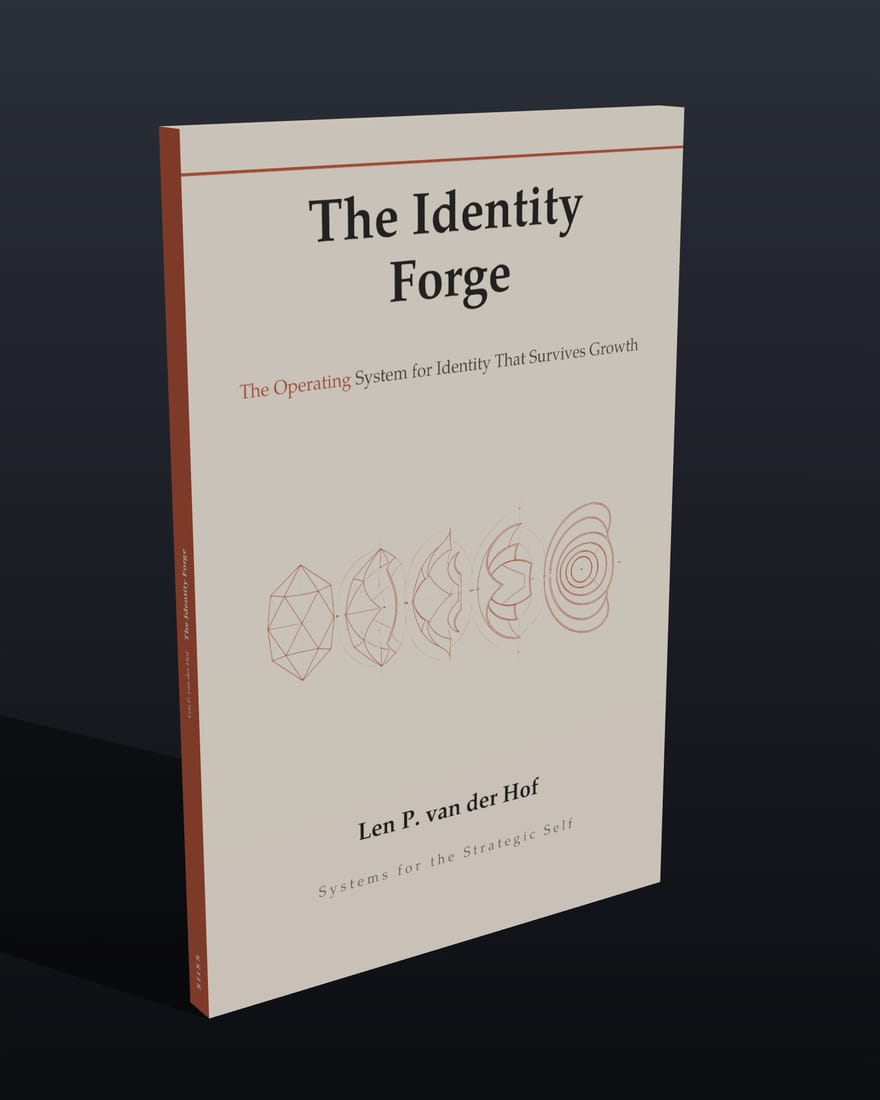
Paperback
The working copy. Mark it up. Take it into the meeting.


The book
The Operating System for Identity That Survives Growth
You built the company as an extension of yourself. Now it needs a different version of you. A new stage asks you to delegate work you still experience as identity, leave roles that once made you valuable, and lead without treating every company result as a verdict on who you are.
The Identity Forge gives you one operating system for that transition: FORGE. Frame your current identity. Own the evolution the next stage requires. Reassess at thresholds. Grow into the new role through visible practice. Exit identities that no longer serve the company or the person leading it.
This is identity work made operational. You will learn to:
What you learn
What this book puts in your hands
- Map where role, status, company, and self have fused.
- Define the next identity without denying what the current one built.
- Turn a growth threshold into specific practices, decisions, and conversations.
- Delegate responsibility without quietly reclaiming the identity attached to it.
- Leave an outgrown role deliberately, publicly, and with clean boundaries.
- Use your calendar as evidence of the identity you are actually living.
The framework
FORGE, step by step
-
Frame
-
Own
-
Reassess
-
Grow
-
Exit
The contents
Chapter by chapter
Every chapter of The Identity Forge with its printed epigraph, what you can do afterwards, and the moment it is built for.
Introduction
Fusion as structural feature
Before you can forge a self that survives growth, you have to see the one you have built, and the way you have built it, clearly. This book begins there: not with a fix, but with a name.
What you can do afterwards
You will see identity fusion as a structural feature of how many founders start, not a flaw, and you will leave with the book's frame plus a first artifact: the Fusion Audit.
Use this chapter when
"I am the company" is your first thought in the morning and your last at night, and a growth threshold is starting to cost more than it returns.
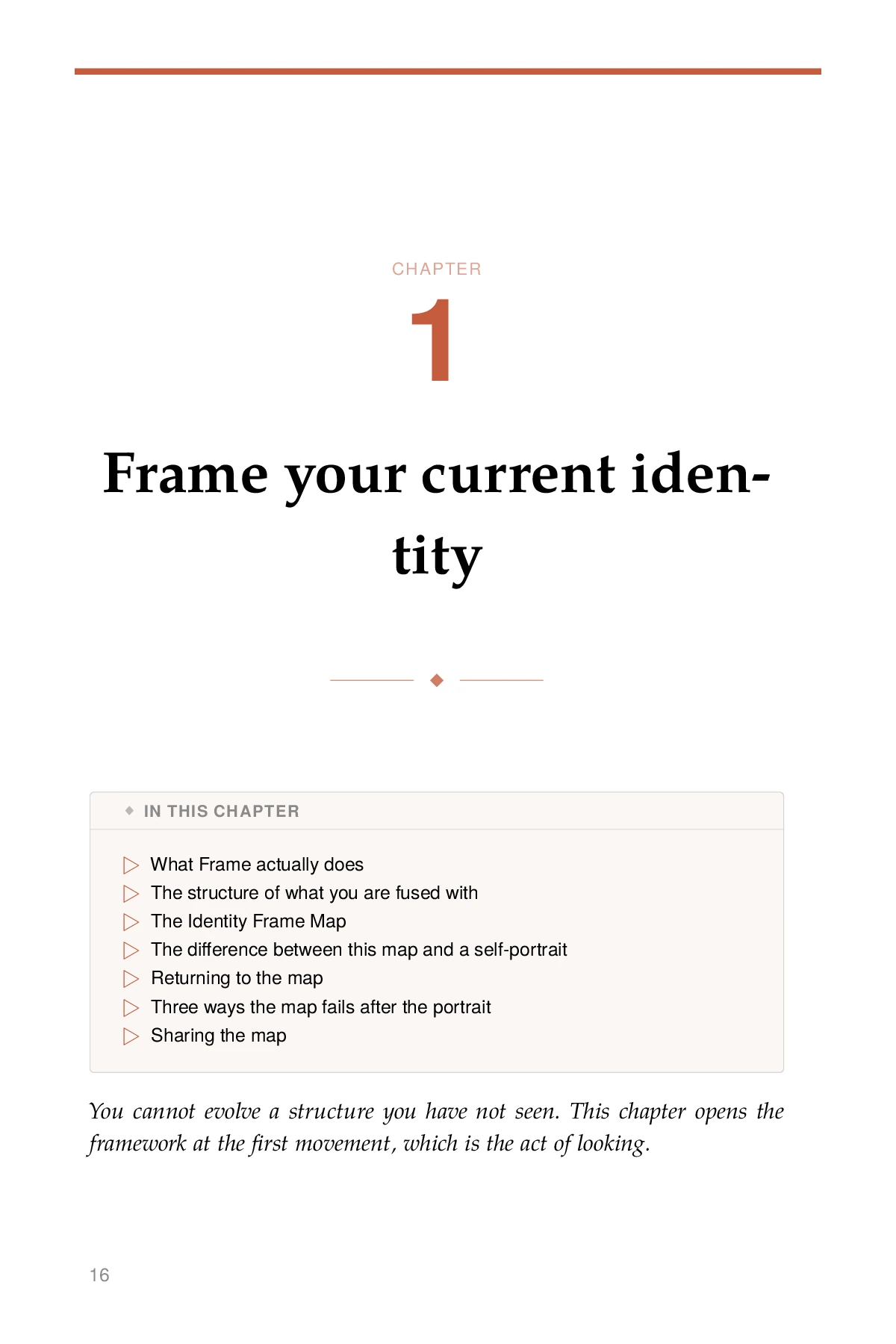
Chapter 1
Frame your current identity
You cannot evolve a structure you have not seen. This chapter opens the framework at the first movement, which is the act of looking.
What you can do afterwards
You will leave with a one-page map of what you are currently fused with, worked examples of what honest entries look like, and a vocabulary for the rest of the book.
Use this chapter when
"I am the company" is your first morning thought, and you want a structural way to see it before you change it.
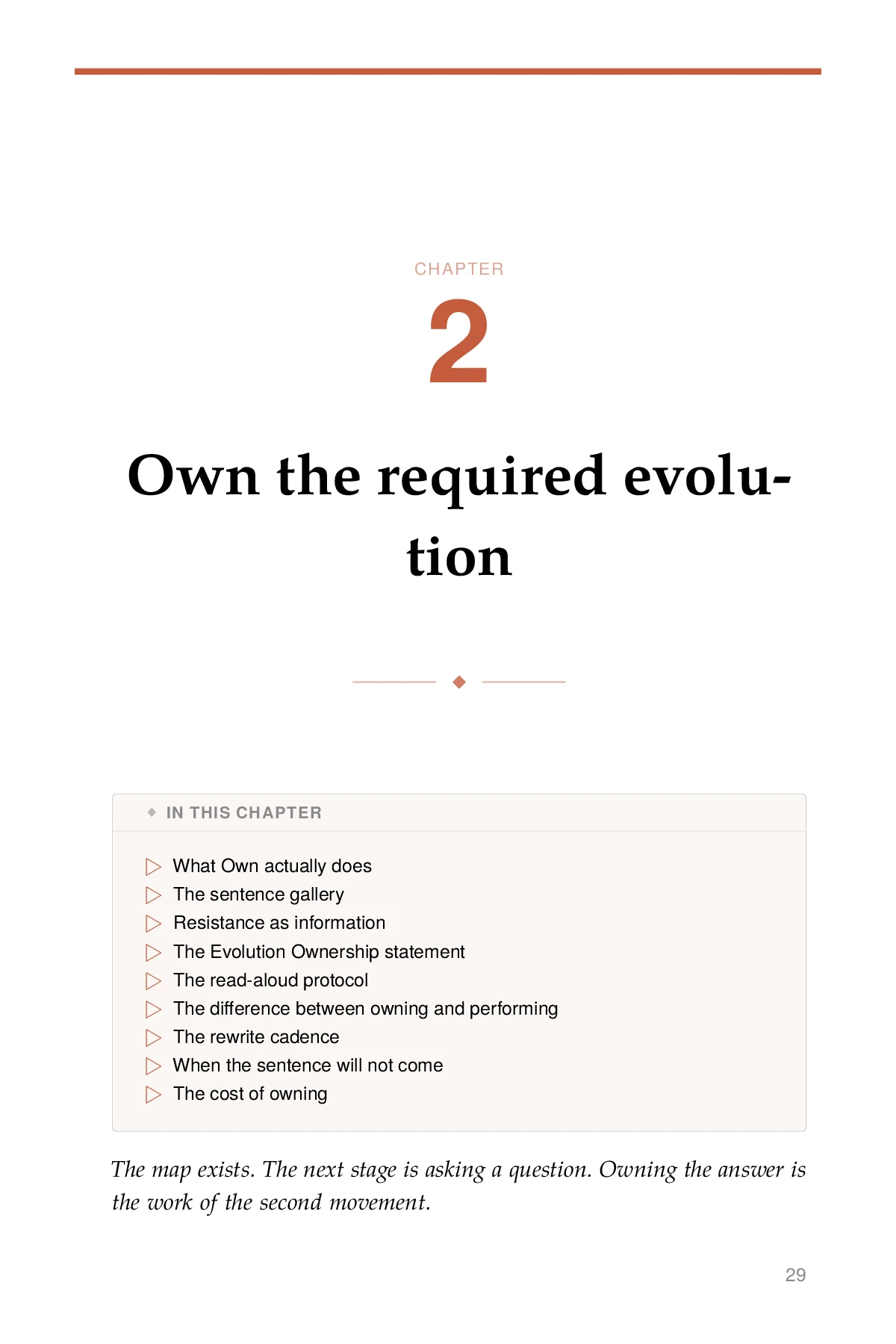
Chapter 2
Own the required evolution
The map exists. The next stage is asking a question. Owning the answer is the work of the second movement.
What you can do afterwards
You will leave with a written commitment to a specific next-stage identity, a gallery of weak sentences and their fixes, and the owning-versus-waiting distinction.
Use this chapter when
The next stage is visible on the horizon and the company is starting to ask a different question of you than the one you have been answering.
Chapter 3
Reassess at thresholds
Growth happens in steps. The structure that worked at the previous step rarely works at the next one. Reassess is the practice of catching the moment the company has changed shape, before the structure starts to cost more than it returns.
What you can do afterwards
You will leave with a Threshold Audit for every time the company changes shape, a taxonomy of five threshold types, a worked audit page, and the 30-minute block agenda.
Use this chapter when
The company is about to add ten people, raise a round, enter a new market, lose a key customer, or change the founder's day-to-day role.
Chapter 4
Grow into the new role
Owning the next identity is the sentence. Growing into it is the practice. The fourth movement is where the sentence becomes a person.
What you can do afterwards
You will leave with a written Growth Plan naming the smallest next-identity version you can practice in public this week, plus a pattern catalog and a worked month.
Use this chapter when
The next stage is visible, the sentence is written, and the company is starting to ask for the change in language.
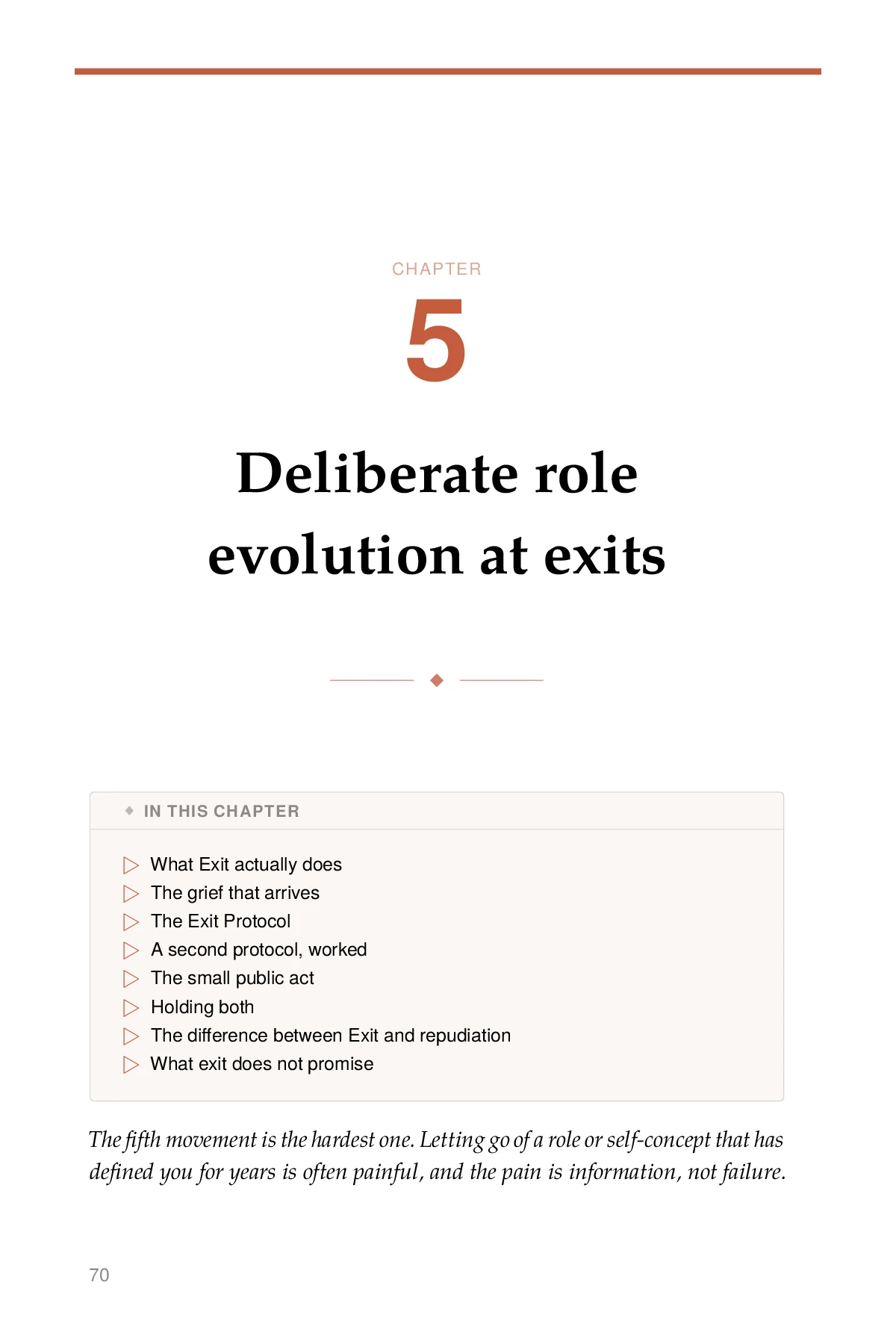
Chapter 5
Deliberate role evolution at exits
The fifth movement is the hardest one. Letting go of a role or self-concept that has defined you for years is often painful, and the pain is information, not failure.
What you can do afterwards
You will leave with a written Exit Protocol for the next role the company no longer requires, two fully worked examples, a catalog of small public acts, and a way to hold the grief the work can surface.
Use this chapter when
The next stage has arrived and the role or self-concept that got you here is no longer the one the company needs.
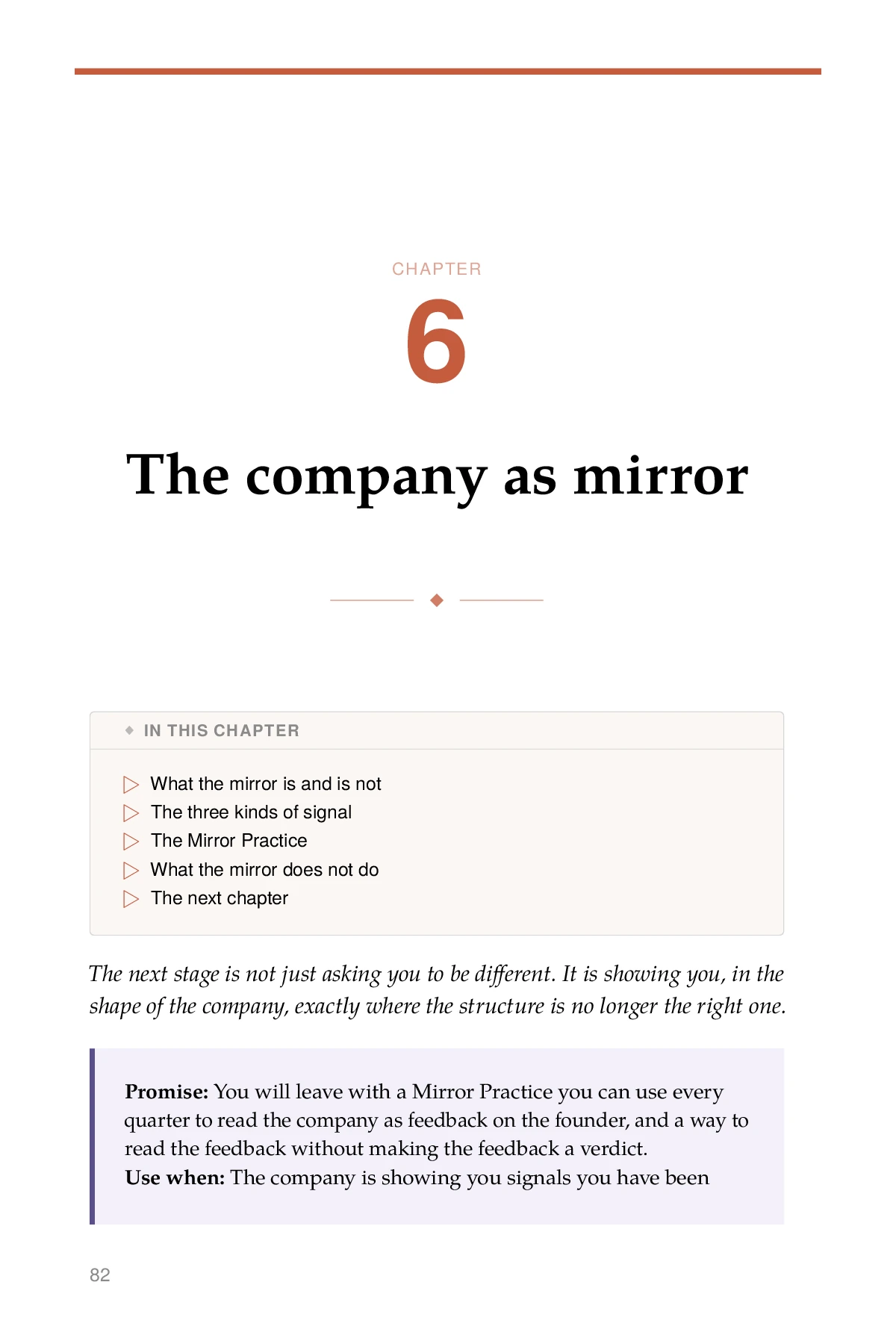
Chapter 6
The company as mirror
The next stage is not just asking you to be different. It is showing you, in the shape of the company, exactly where the structure is no longer the right one.
What you can do afterwards
You will leave with a Mirror Practice you can use every quarter to read the company as feedback on the founder, and a way to read the feedback without making the feedback a verdict.
Use this chapter when
The company is showing you signals you have been avoiding, or the signals are getting louder.
Chapter 7
Public versus private self
The founder persona is a structure. So is the private self. What sits between them is design work, not a default.
What you can do afterwards
You will leave with a Boundary Map: your domains sorted into public, private, and negotiable columns, the rooms where the boundary is most at risk, and a redesign rule for every threshold.
Use this chapter when
The founder persona is starting to crowd the private self, or the private self is starting to leak into the public role in a form the company cannot use.
Chapter 8
Identity and delegation
You cannot delegate what you are fused with. The sentence is an operational truth, not a slogan. Everything that follows is the form the delegation takes when the founder is ready.
What you can do afterwards
You will leave with a Delegation Identity Audit that names what you are fused with, what you can hand over this quarter, and what you cannot yet. Alongside it: a boomerang diagnostic that tells a skill gap from a fusion, and a room contract that makes the handover survivable.
Use this chapter when
The company has grown past your capacity to be in every room, and work you handed over keeps coming back.
Chapter 9
Identity at the end of founder-led control
The company will, at some point, no longer be the founder's to run. The self has to be ready for that day, and the work of being ready is structural, not motivational.
What you can do afterwards
You will leave with an Exit Identity Plan naming what the self looks like when the company is no longer yours to run. With it: a first-thirty-days practice catalog and a lane map separating self-work from legal work.
Use this chapter when
An exit, an acquisition, a generational transition, a structural change you did not choose, or a serious conversation about any of these is on the horizon.
Chapter 10
The forged self as adaptive capacity (aspirational; outcomes vary)
The forged self is a structural outcome, not a personality trait. It is what the work produces when the work is done in the form the framework names, and it is not a guarantee.
What you can do afterwards
You will leave with the forged self decomposed into four observable components and a decision rule for when not to evolve. The Asset Audit then names what the work has built, what is load-bearing, and what needs maintenance.
Use this chapter when
The framework has been run for at least one full threshold, and the question is what the self looks like now.
Chapter 11
Your calendar as identity signal
The calendar is the most honest document in the founder's week. It shows what the identity actually is, hour by allocated hour, regardless of what the founder says the identity is.
What you can do afterwards
You will leave with a Calendar Identity Audit that exposes the gap between the identity you say you are living and the identity your calendar shows. With it: the count mechanics, decision rules for reading the gap, and a smallest-change catalog with second-order effects.
Use this chapter when
The framework has been run for at least one threshold, and the question is what the calendar is actually saying.
Chapter 12
Building your identity protocol
The framework is finished. Now the protocol is the founder's. What remains is to make the framework yours, in a form you will actually run.
What you can do afterwards
You will leave with a personal FORGE protocol that binds the twelve documents, from the Fusion Audit through the Calendar Identity Audit, into a single page. Each gets a trigger, a cadence, and a person, pruned to what you will actually run.
Use this chapter when
The framework has been run for at least one full threshold, and you are ready to make the work a protocol.
Conclusion
A self capable of leading at multiple scales (aspirational; outcomes vary)
The book began with a name. It ends with a self the name was trying to protect. The forged self is the structural outcome of the work, and the work is not finished at the close of the book.
What you can do afterwards
You will close with the long view: the forged self as a structural outcome, the operating baseline the book has produced, and the discipline the book expects the founder to keep.
Use this chapter when
You have run the framework for at least one threshold, and you are ready to hold the long view.
Who it is for
Who this book was written for
Each chapter produces a working artifact: a fusion audit, identity frame map, threshold audit, growth plan, exit protocol, boundary map, delegation audit, calendar audit, and finally a personal FORGE protocol you can run at future transitions.
The aim is not reinvention for its own sake. It is a coherent self that can change scale without becoming rigid, performative, or trapped by its own history.
This book addresses ordinary founder experiences of role and identity change. It is not medical, psychological, clinical, or therapeutic advice. If identity loss, severe distress, or burnout symptoms are present, seek support from a qualified professional.
The reader it was written for
Technical or operator founders 3–7 years in, 15–100 people, who have achieved some success and are now at a growth threshold (Series A/B, first major team expansion, first "I am not the product" moment) where their fused identity is becoming visible as a constraint or a personal crisis. Psychographics:
Probably not for you if
- Very early founders (no fusion yet).
- Corporate managers.
- Readers seeking only therapy or mindset.
Editions
Editions and specifications
| Edition | Formats | Chapters | Pages | Reading time | ISBN (paperback) |
|---|---|---|---|---|---|
| English The Identity Forge | In production | 14 | 188 | ± 3 hours | — |
| Dutch De identiteitssmidse | In production | 14 | 136 | ± 2 hours | — |
Both editions are written natively. The Dutch text is not a machine translation of the English. · Trim size: 6x9″
Frequently asked
What readers usually want to know
What is The Identity Forge about?
FORGE is one operating system for the transition a new stage demands: frame the current identity, own the evolution, reassess at thresholds, grow through visible practice, and exit identities that no longer serve the company or the person leading it. The subtitle is: The Operating System for Identity That Survives Growth.
What is the FORGE framework?
FORGE: Frame, Own, Reassess, Grow and Exit.
Is there a Dutch edition?
Yes. The Dutch edition is De identiteitssmidse, written as a native edition rather than a machine translation. It moves through the same production line.
How long is The Identity Forge?
This edition runs 14 chapters, 188 pages in print and roughly 3 hours of reading.
Who is The Identity Forge for?
This book addresses ordinary founder experiences of role and identity change. It is not medical, psychological, clinical, or therapeutic advice. If identity loss, severe distress, or burnout symptoms are present, seek support from a qualified professional.
The production system
How this book was made
Every title moves through the same gated production line: sourced research, a claim-level evidence ledger, structural review, fact-checking, red-team critique, and a bilingual final edit. AI agents do specialist work inside those gates; judgment, voice, and accountability stay human.
- Claims enter an evidence ledger with a source and a confidence grade before they reach the page
- English and Dutch are two native editions, not a translation of one another
- Every chapter clears readability, rhythm, and style gates before it is typeset


