

No. 34 · Drafting (English edition first) · Founder psychology
The Founder CFO
Cash, Metrics, and Calm Between Rounds
The Founder CFO: Cash, Metrics, and Calm Between Rounds.
A financial operating system for the non-finance founder between rounds: the metrics you track, the rhythm in which you review them, and the decisions those numbers have to inform, instead of reactive bank-balance checking. Cash, Metrics, and Calm Between Rounds.
- pages
- 158
- chapters
- 11
- hours of reading
- ± 3
- editions
- EN · NL
- Design
- Drafting
- Manuscript
- Production
- Launched
The editions
Kindle and Paperback
Production shots of the editions. Not for sale yet — this page is the public working version.
-
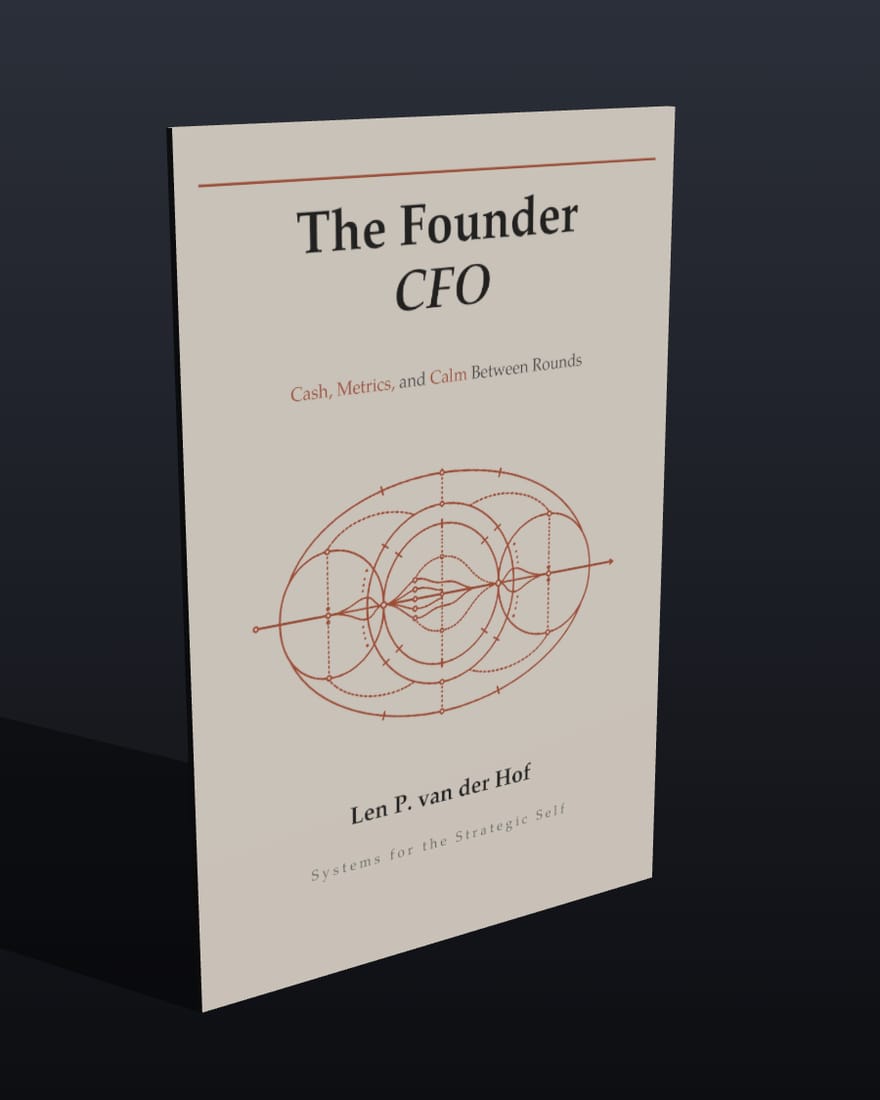
Kindle
The digital edition, ready in any Kindle app.
-
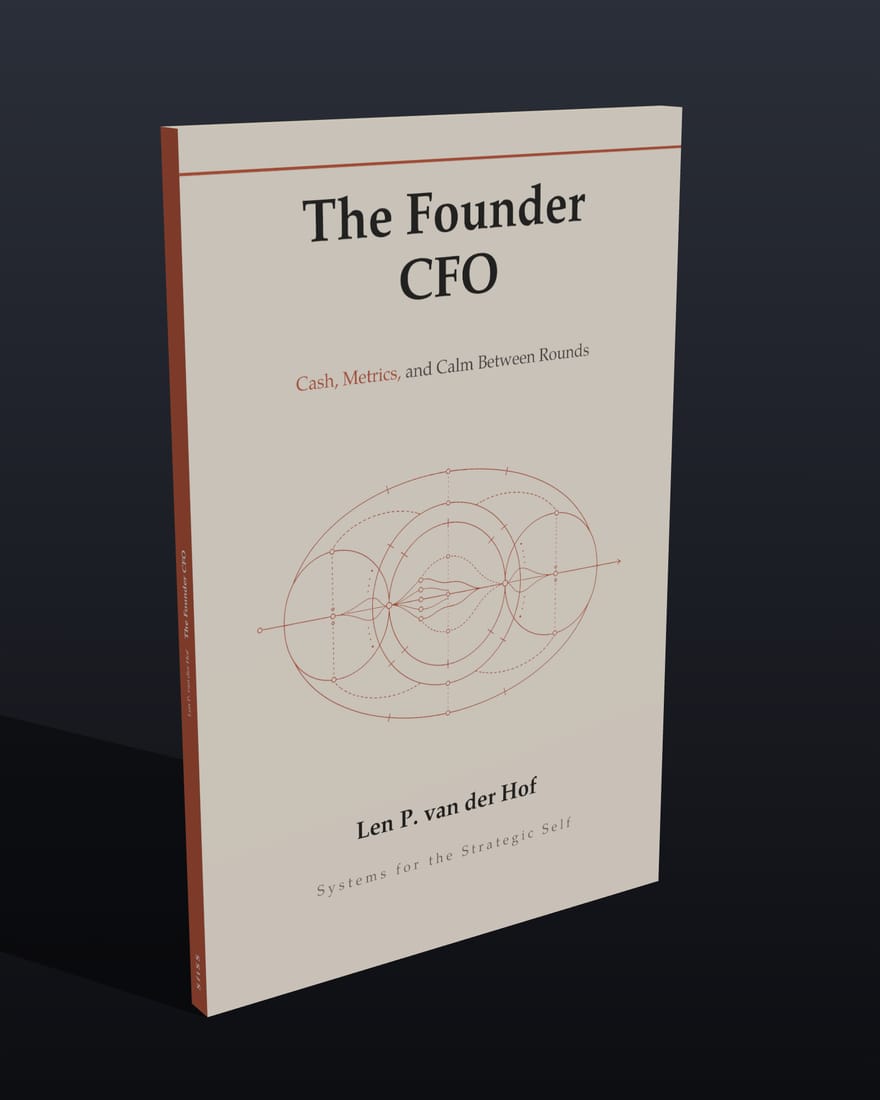
Paperback
The working copy. Mark it up. Take it into the meeting.


The book
Cash, Metrics, and Calm Between Rounds
You raised the round. The money reached the account. Now every hiring plan, product bet, and board meeting asks a question your pitch deck cannot answer: what can this company responsibly afford to do next?
The Founder CFO is a financial operating system for the non-finance founder between rounds. It replaces reactive bank-balance checking with three connected disciplines: the metrics you track, the rhythm in which you review them, and the decisions those numbers must inform.
What you learn
What this book puts in your hands
- Separate cash, revenue, and profit before they distort a decision.
- Build a small dashboard around runway, burn, unit economics, and the drivers that matter for your model.
- Install weekly, monthly, and quarterly review rhythms that surface variance early.
- Turn the board pack into a decision document instead of a retrospective performance.
- Use scenarios to test hiring, pricing, and growth choices before cash makes the choice for you.
- Recognize when bookkeeping support is no longer enough and hand the founder-CFO role to the right finance partner.
The framework
Founders', step by step
-
Metrics
-
Rhythm
-
Decisions
The contents
Chapter by chapter
Every chapter of The Founder CFO with its printed epigraph, what you can do afterwards, and the moment it is built for.
Introduction
The Financial Operating System
You did not start a company to manage its money. But the money now decides whether the company survives, and managing it well is a system you can build rather than a talent you were born with.
What you can do afterwards
You will leave this chapter able to name the difference between accounting and financial operations, hold the three layers of the Financial Operating System in your head, and pick the exact path through this book that fits your situation.
Use this chapter when
You have raised at least one round, you check your bank balance more often than you would admit, and you have no reliable way to say whether the number you see is healthy.
Chapter 1
Cash Flow: The First and Last Metric
Profit is an opinion formed on paper. Cash is a fact in the bank. Founders who confuse the two turn a survivable mistake into a fatal one.
What you can do afterwards
You will leave this chapter able to say the difference between profit and cash out loud, read the three sections of a cash flow statement without an accountant, and build a rolling 13-week cash forecast that tells you, week by week, when money arrives and when it leaves.
Use this chapter when
You have signed revenue you cannot yet spend, you fund the cost of growth before customers pay, or you check the bank balance and cannot explain why it is lower than your revenue says it should be.
Chapter 2
The Dashboard: What to Track, What to Ignore
Your company throws off hundreds of numbers, and almost none of them change what you do on Monday. A founder dashboard is the opposite: one page, five pockets, five to seven numbers that each carry a decision. This chapter builds that page and tells you what to leave off it.
What you can do afterwards
You will leave this chapter able to build a one-page dashboard of five to seven numbers, name what belongs in each of the five pockets, and tell a signal from a vanity metric.
Use this chapter when
You track dozens of numbers and still cannot say in one sentence whether the company is healthy, or you track almost nothing and check the bank balance instead.
Chapter 3
The Operating Rhythm: Weekly, Monthly, Quarterly
A dashboard you read once is a photograph. A dashboard you read on a schedule is an instrument, and the schedule matters more than any single number on the page. This chapter sets the three intervals that turn your metrics into decisions: a short weekly cash check, a longer monthly review, and a quarterly step back.
What you can do afterwards
You will leave this chapter with three review intervals on your calendar, a checklist for each, and a protocol for getting back on cadence when you fall off it.
Use this chapter when
You built a dashboard and stopped looking at it, or you check your bank balance at random and call it a financial process, or the board meeting is the first time each quarter you see your whole company at once.
Chapter 4
Unit Economics: CAC, LTV, and the Math of One
Growth answers many questions and hides one. Do you make money on a single customer, or do you lose money on each and make it up in volume? A company that never runs the second calculation can scale for years and call the scaling success, right up until the moment the math catches it.
What you can do afterwards
You will leave this chapter able to compute the four numbers that decide whether a customer pays off, your CAC, your LTV, the ratio between them, and your payback period, and to read a cohort table that shows whether your economics are improving or eroding as you grow.
Use this chapter when
You are growing and cannot say whether each new customer makes the company stronger or weaker, or your dashboard carries an honest blank where the unit economics belong.
Chapter 5
Burn and Runway: Managing the Clock
Every founder can name the number in the bank. Fewer can name the date it reaches zero, and fewer still treat that date as something they build toward instead of something that happens to them. What separates those two founders is a habit, not luck. The habit is managing the clock.
What you can do afterwards
You will leave this chapter able to compute your burn multiple, the single measure of how efficiently you turn cash into growth, and to pull the three levers that extend your runway in the order that works, so that you can time a raise from strength instead of scrambling for one from fear.
Use this chapter when
Your runway has dropped inside eighteen months, you are spending to grow and cannot say how efficiently, or you feel the burn as dread instead of as a dial you control.
Chapter 6
The Board Pack: Reporting with Clarity
A board pack is the one document where founders reliably undo their own good work. They track the right numbers all quarter, then bury the two that matter under the dozens that do not, and hand a skimming director a reason to worry. Reporting is a skill, and it is not the same skill as knowing.
What you can do afterwards
You will leave this chapter able to build a board pack that a director reads in 15 minutes and acts on, structured around the few decisions you need instead of the many numbers you have, so that a board meeting builds your credibility instead of spending it.
Use this chapter when
You have a board meeting coming, you tend to send a long deck the night before, or the meeting is where problems surface for the first time instead of where they get resolved.
Chapter 7
The Driver-Based Model: Forecasting Without Accounting
Every founder builds a model to raise money, then closes the spreadsheet and does not open it again until the next round. That model recorded a future you promised. The one you need lets you change a single assumption and watch the whole company answer.
What you can do afterwards
You will leave this chapter able to build a driver-based model of your company from four inputs you already understand, test a real decision like a hire or a price change before you make it, and see three versions of the year ahead instead of the single hopeful line your fundraise deck contained.
Use this chapter when
You are weighing a decision that changes your cost or revenue in a durable way, a hire, a price move, a marketing bet, and you want to see its effect on runway before you commit, not after.
Chapter 8
Build vs. Delegate: When to Hire a Finance Person
The founder-CFO job is temporary by design. The work that made you fluent in your own company was never meant to be yours forever. The skill this chapter teaches is the timing of the handoff: when to give away the counting, what to keep in your own hands, and how to stay the decision-maker after you stop being the one at the spreadsheet past midnight.
What you can do afterwards
You will leave this chapter able to tell which stage of financial maturity your company is in, name the specific strain that signals it is time to hire, decide what to hand off first and what to keep no matter how large you grow, and evaluate a finance hire with the same rigor you would bring to choosing an investor.
Use this chapter when
The finance work is eating hours you owe the business, or someone is telling you to hire a finance person and you cannot tell whether it is the right moment or the wrong one.
Chapter 9
The Financial Operator: Consolidating the System
The tools are built; the last thing to consolidate is you. This is the chapter where the three layers stop being separate skills and become one way of working, and where the founder who operated the system becomes the operator who embodies it. The shift is quiet, a practice and not a personality: the difference between running your numbers and being run by them.
What you can do afterwards
You will leave this chapter able to run the three layers of the Financial OS as a single instrument, recognize the identity shift from reactive checking to calm operating, maintain the system as your company grows, teach it to your leadership team, and diagnose the seven ways it fails.
Use this chapter when
You have built the tools across the previous chapters but still feel like you are performing financial competence rather than possessing it.
Conclusion
Calm Between Rounds
The system works. What remains is to say what it was for. Financial calm was never the end of pressure, which no round removes, but the presence of a way of working that runs through it. This is the promise of the title, defined at last and handed back to you as a habit you own.
What you can do afterwards
You will leave this chapter able to state what "calm between rounds" means in one sentence, see the three layers of the Financial OS as a single loop instead of a stack of tools, and measure the distance you have traveled since the first page.
Use this chapter when
You have built the system across the previous chapters and want to consolidate it into a stance you keep, instead of a set of tasks you might let lapse.
Who it is for
Who this book was written for
The result is not an accounting education. It is a working system: a cash view you trust, a driver-based model you can update, a board narrative you can explain, and a ninety-day installation plan that fits the cadence of a real startup.
This is for seed-to-Series-A founders who want to understand the financial story without pretending to be accountants. Calm does not come from a reassuring number. It comes from a reviewable model, a disciplined rhythm, and decisions that show their assumptions.
This book is educational and does not provide accounting, tax, legal, or investment advice. Verify material decisions with qualified professionals who understand your company and jurisdiction.
The reader it was written for
The seed-to-Series-A non-finance founder who has raised at least one institutional round and now faces the reality of managing company money without a finance background. Who they are: Day in the life: One-sentence archetype: A founder who can debug a distributed system but freezes when asked about gross margin. ---
Also a fit for
1. Pre-seed founder who wants to build financial literacy before they raise — reading this proactively while still building the product. Part 1 and the dashboard chapters apply directly; Ch 08 (delegation) and Ch 09 (consolidation) are future-oriented. 2. Bootstrapped founder managing cash with similar anxiety — no investor pressure but real cash constraints.
Probably not for you if
- Professional finance people (accountants, CFOs, investment bankers) — this book teaches the literacy they already have. They are not the reader; the prose should not try to impress them.
- Late-stage or public-company executives — SOX compliance, complex cap structures, M&A integration are out of scope. Do not write for this reader.
- Pre-revenue idea-stage founders who have not yet raised — the book assumes you have money in the bank and employees to pay. The opening chapters may overwhelm them; the book does not try to serve them but also does not exclude them if they are willing to extrapolate.
- Readers looking for accounting instruction (debits, credits, ledger entries) — bookkeeping is explicitly scoped out. If the reader needs this, they should hire a bookkeeper, not read this book.
Editions
Editions and specifications
| Edition | Formats | Chapters | Pages | Reading time | ISBN (paperback) |
|---|---|---|---|---|---|
| English The Founder CFO | In production | 11 | 158 | ± 3 hours | — |
| Dutch The founder CFO | In production | — | — | — | — |
Both editions are written natively. The Dutch text is not a machine translation of the English. · Trim size: 6x9″
Frequently asked
What readers usually want to know
What is The Founder CFO about?
A financial operating system for the non-finance founder between rounds: the metrics you track, the rhythm in which you review them, and the decisions those numbers have to inform, instead of reactive bank-balance checking. The subtitle is: Cash, Metrics, and Calm Between Rounds.
What is the Founders' framework?
Founders': Metrics, Rhythm and Decisions.
Is there a Dutch edition?
Yes. The Dutch edition is The founder CFO, written as a native edition rather than a machine translation. It moves through the same production line.
How long is The Founder CFO?
This edition runs 11 chapters, 158 pages in print and roughly 3 hours of reading.
Who is The Founder CFO for?
This book is educational and does not provide accounting, tax, legal, or investment advice. Verify material decisions with qualified professionals who understand your company and jurisdiction.
The production system
How this book was made
Every title moves through the same gated production line: sourced research, a claim-level evidence ledger, structural review, fact-checking, red-team critique, and a bilingual final edit. AI agents do specialist work inside those gates; judgment, voice, and accountability stay human.
- Claims enter an evidence ledger with a source and a confidence grade before they reach the page
- English and Dutch are two native editions, not a translation of one another
- Every chapter clears readability, rhythm, and style gates before it is typeset


