

No. 53 · Manuscript complete · Health & performance · INTEGRATE
The Performance Integrator
One Integrated Protocol for the Body, Mind, Energy, and Team That Runs Your Company
The Performance Integrator: One Integrated Protocol for the Body, Mind, Energy, and Team That Runs Your Company.
INTEGRATE connects body, cognition, energy, and team operating rhythms into one performance system instead of isolated optimization rituals. One Integrated Protocol for the Body, Mind, Energy, and Team That Runs Your Company. The framework: INTEGRATE.
- pages
- 250
- chapters
- 14
- hours of reading
- ± 3
- editions
- EN · NL
- Design
- Drafting
- Manuscript
- Production
- Launched
The editions
Kindle and Paperback
Production shots of the editions. Not for sale yet — this page is the public working version.
-
Kindle
The digital edition, ready in any Kindle app.
-
Paperback
The working copy. Mark it up. Take it into the meeting.


The book
One Integrated Protocol for the Body, Mind, Energy, and Team That Runs Your Company
The sleep score is green, the training is on plan, the nootropics are taken, the meditation is done. Energy still collapses at three in the afternoon, and judgment slips on the calls that matter most. Every dial reads green on its own dashboard. The system does not.
The reflex is to add another dial: a new ring, protocol, or metric. That scales the problem, not the work. Each optimization quietly taxes another, and the cross-domain cost shows up on no single dashboard until the whole system plateaus or crashes.
This book offers the opposite: one integrated operating system for the founder who runs the company. The Performance Integrator introduces the INTEGRATE protocol, a single stage-aware system across body, mind, energy, and team. It treats recovery as training, attention as the scarce resource, the calendar as performance architecture, and the founder's energy as the master variable.
What you learn
What this book puts in your hands
- Run a base-layer audit of sleep, light, movement, and nutrition, then defend the one input taxing every downstream dial.
- Dose training as adaptation and treat recovery as training, so effort compounds instead of depleting its own base.
- Protect attention as the scarcest resource and rebuild the calendar as performance architecture, not a list of other people's demands.
- Run the team as a performance multiplier, because the founder's energy allocation is the company's visible operating system.
- Make the protocol stage-aware and measure it as one system, so what worked at ten people is rebuilt for forty before it cracks.
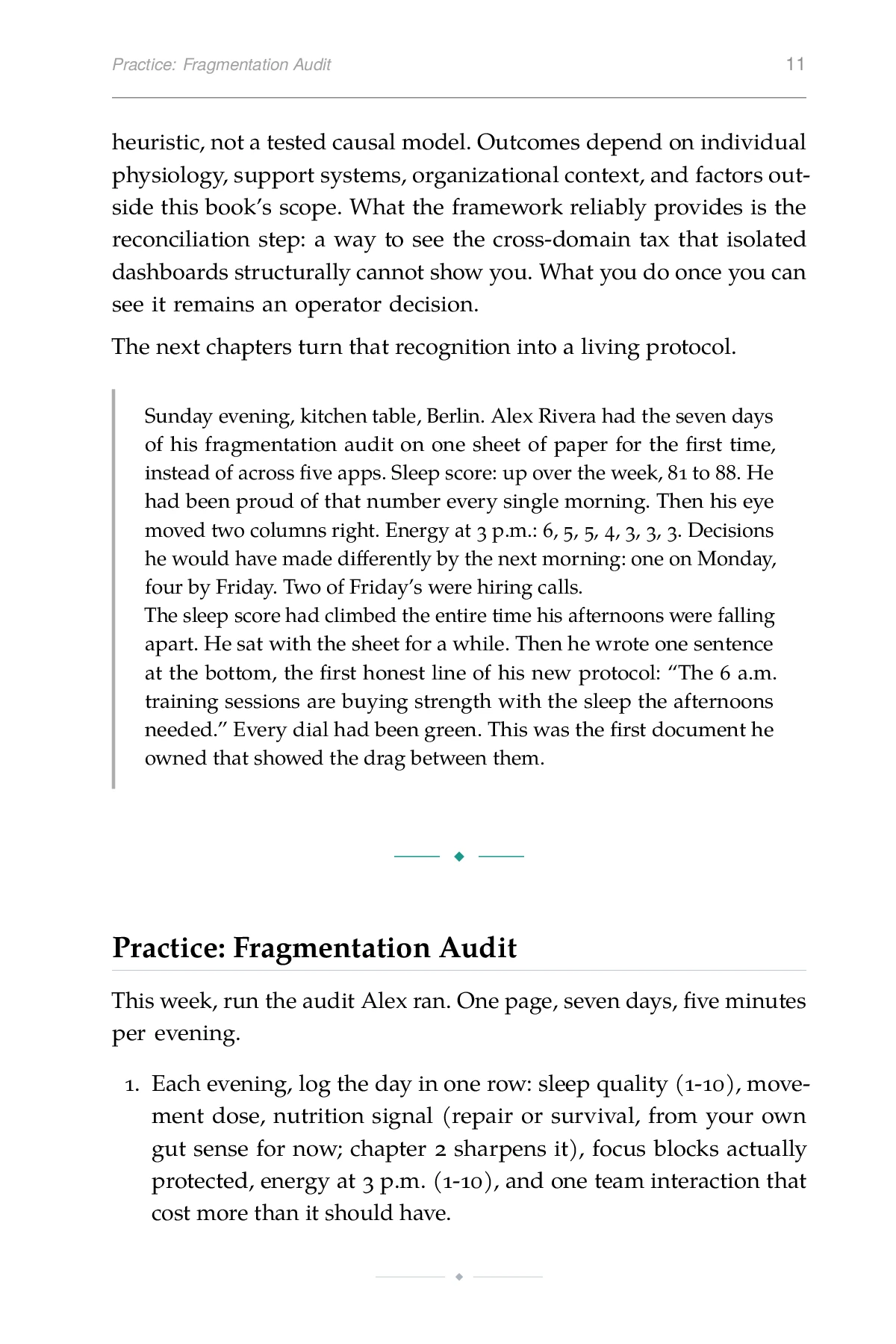
From the book
Practice: Fragmentation Audit 11
The Performance Integrator, printed page: Practice: Fragmentation Audit 11
Inspect more pagesLook inside
Pages from the print edition.
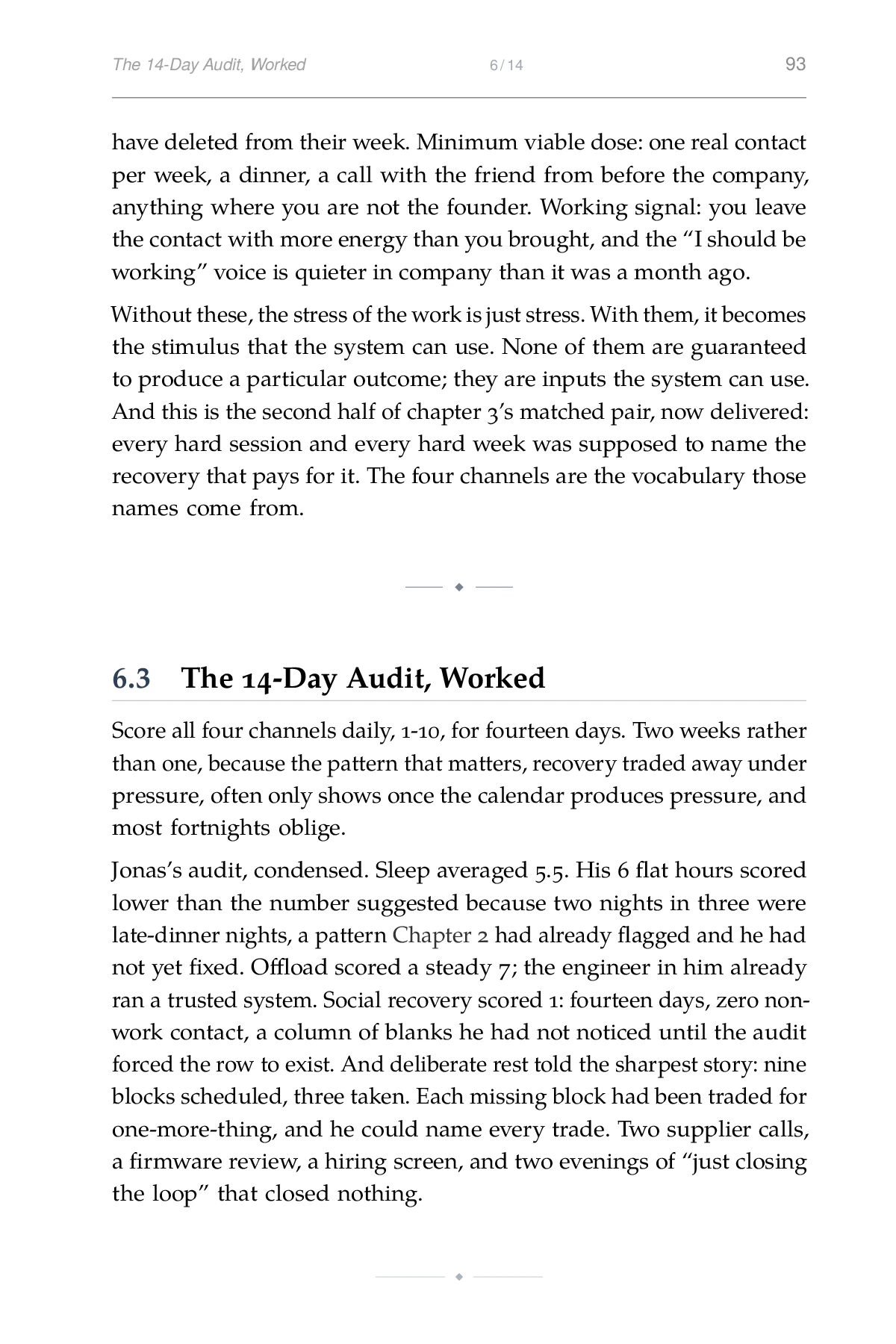
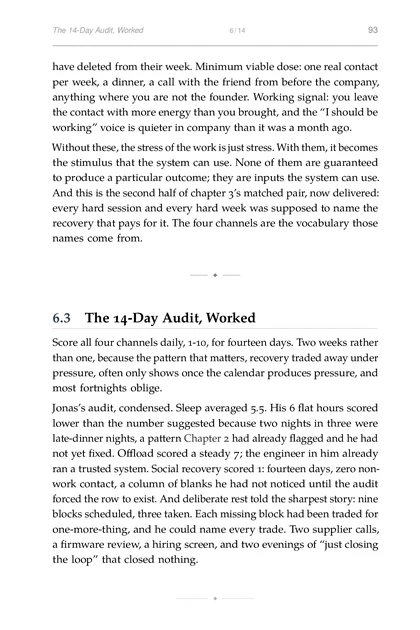 Jonas’s audit, condensed. Sleep averaged 5.5. His 6 flat hours scored
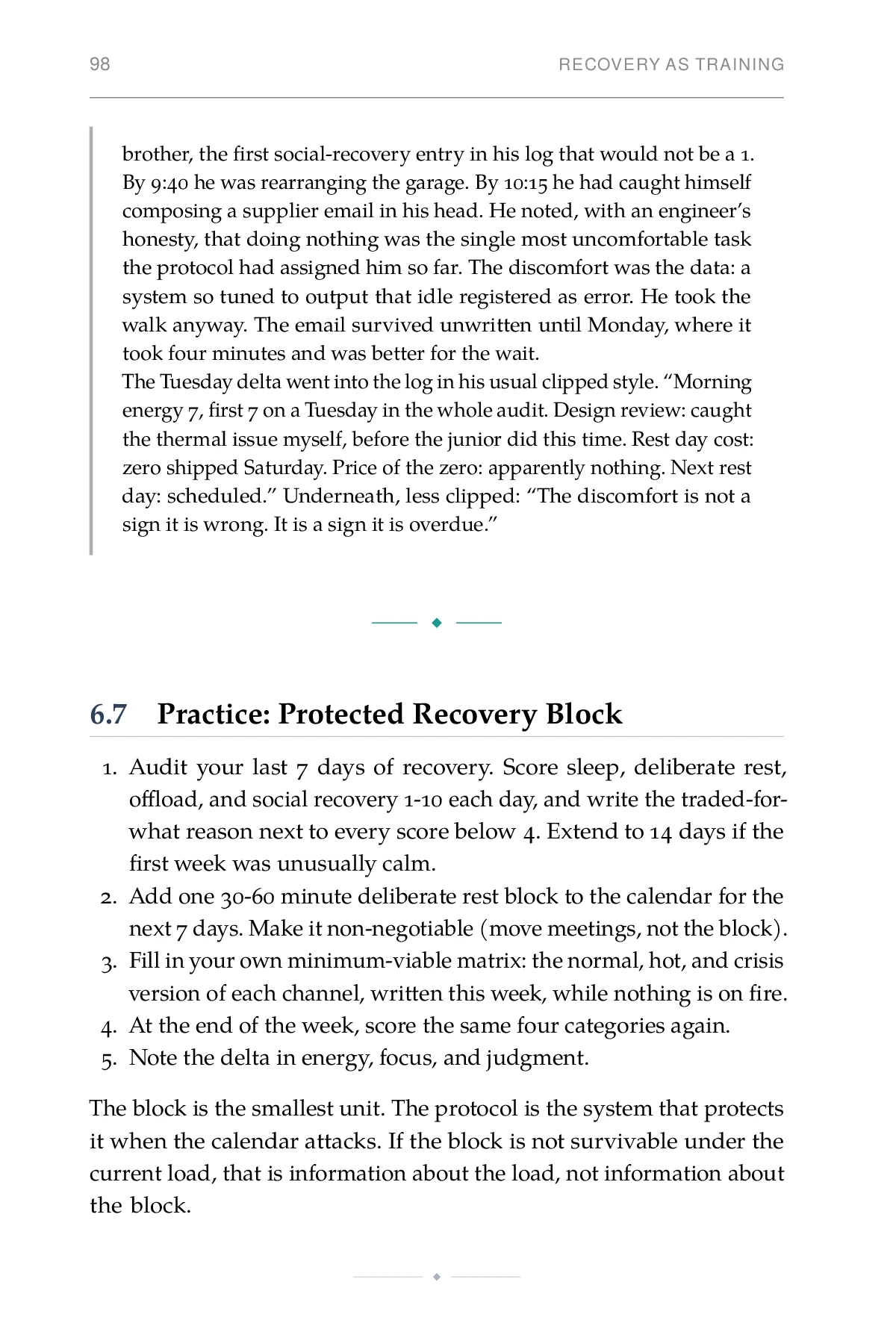
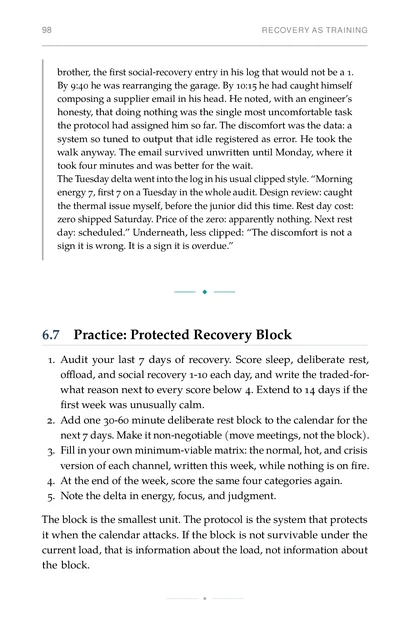 By 9:40 he was rearranging the garage. By 10:15 he had caught himself
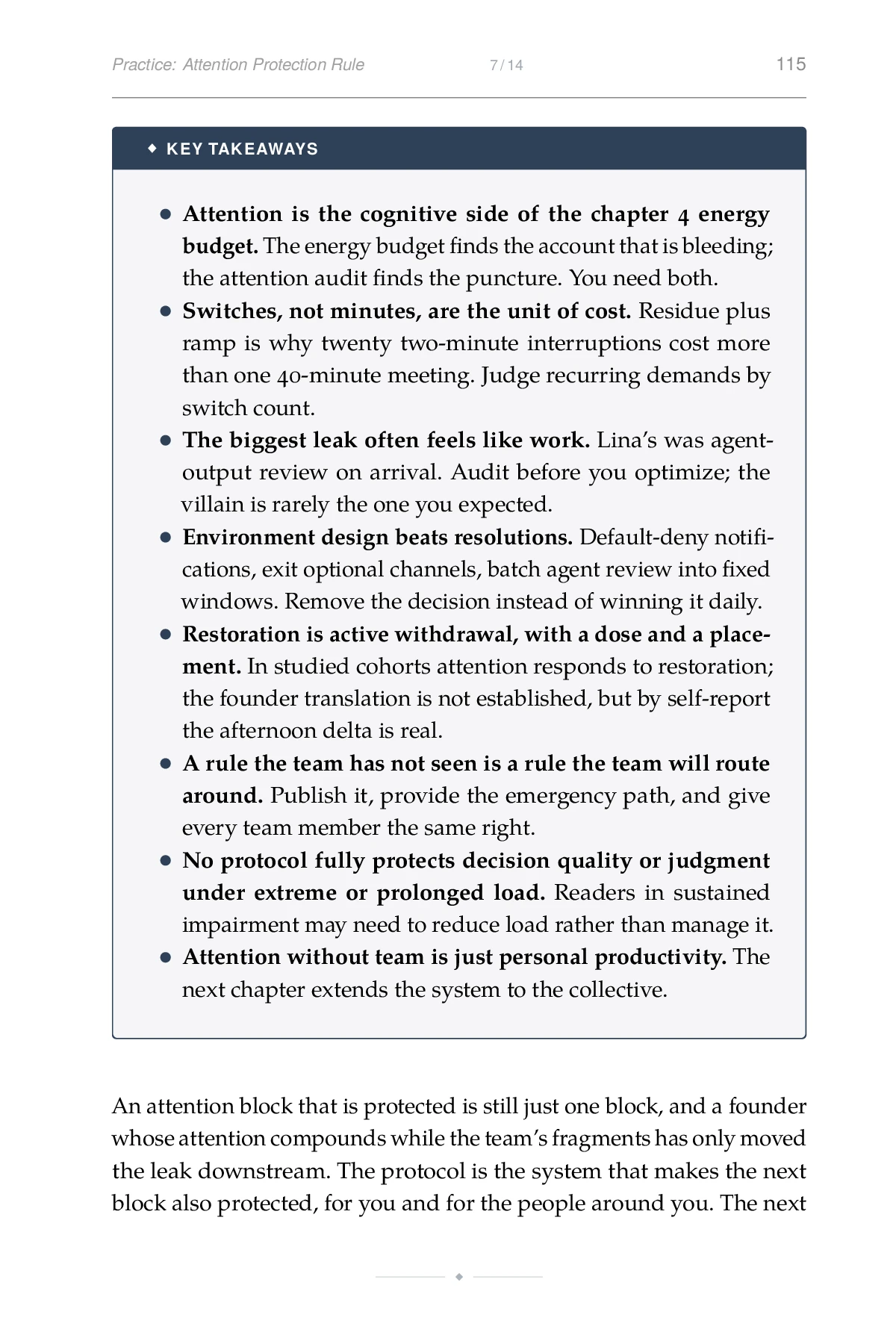
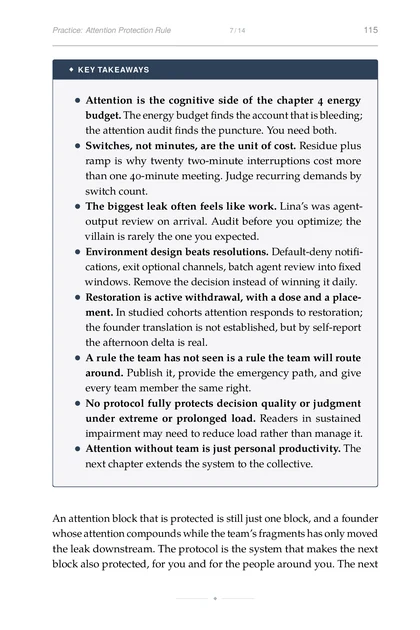 Practice: Attention Protection Rule 7 14 115
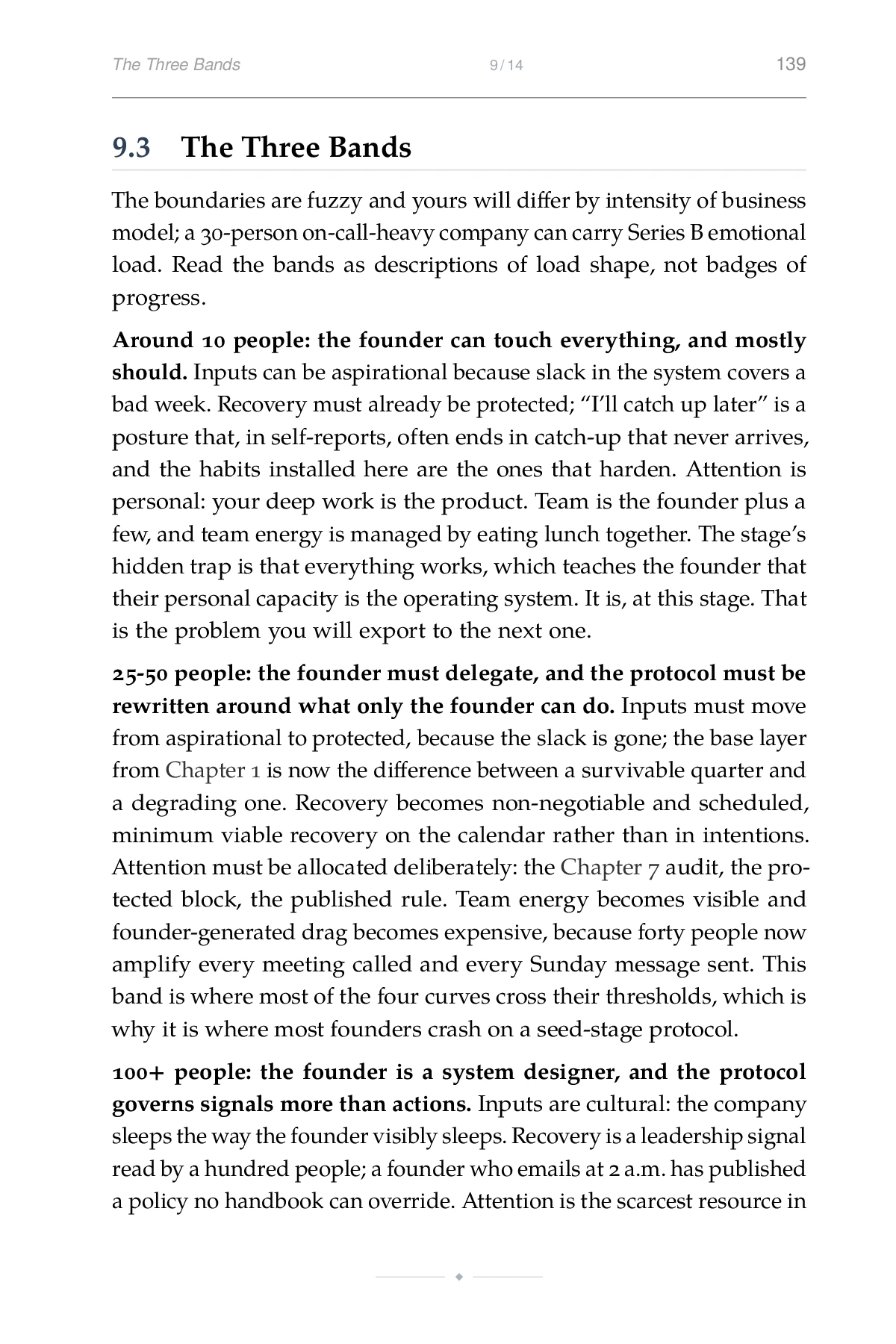
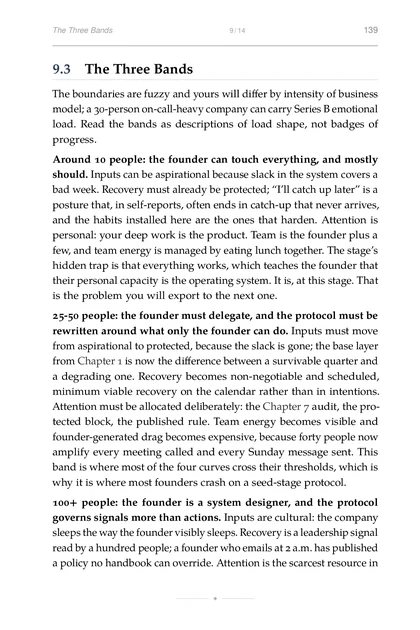 Around 10 people: the founder can touch everything, and mostly
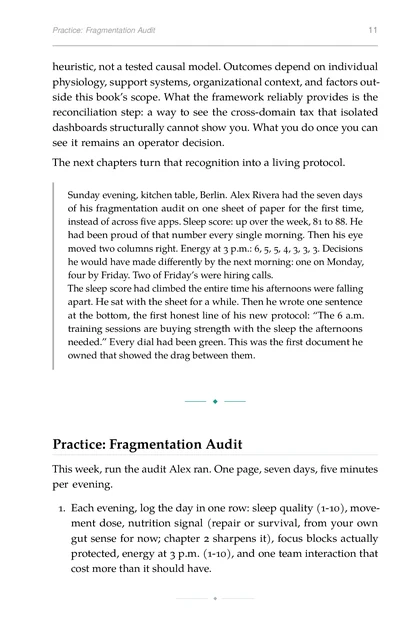 Practice: Fragmentation Audit 11
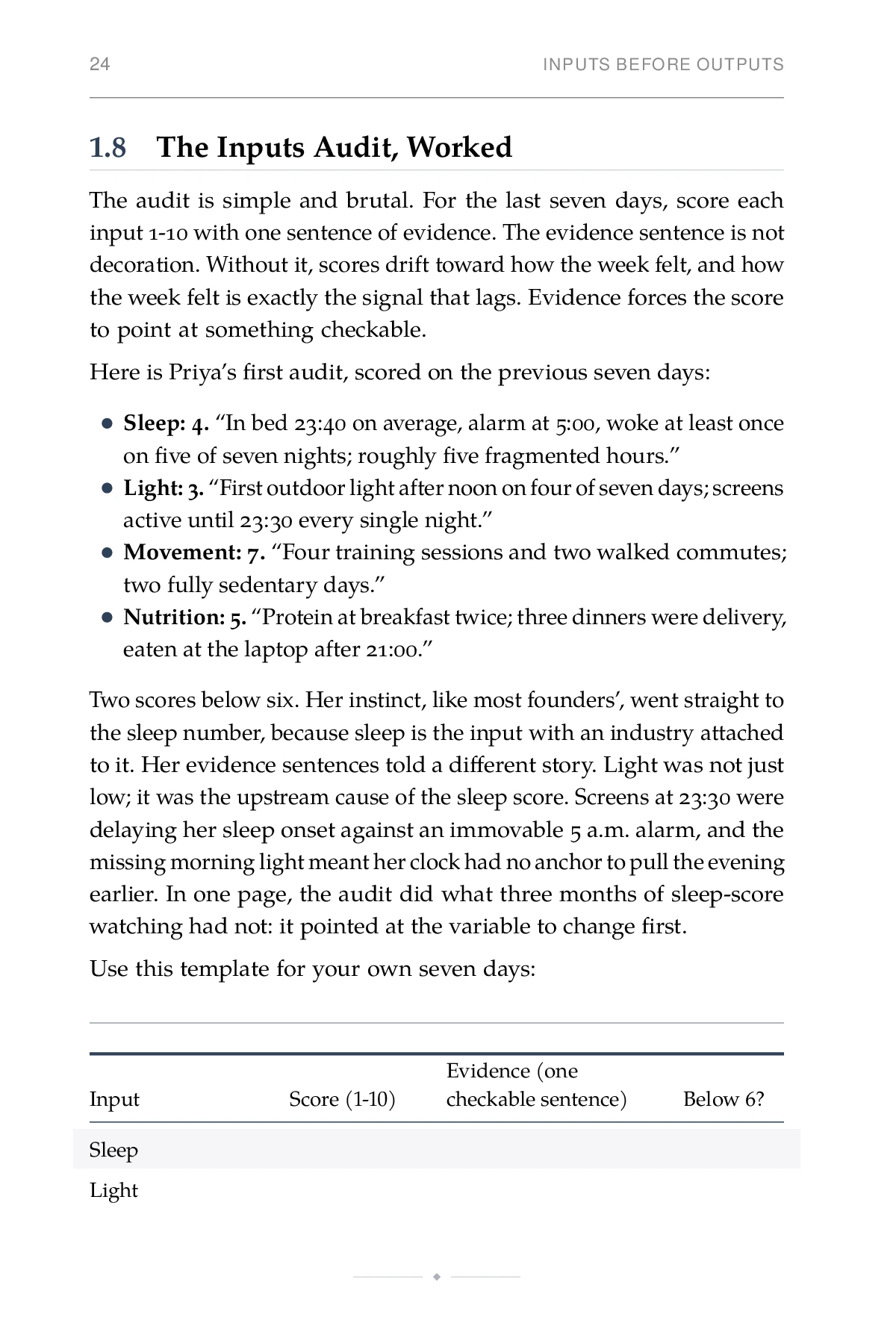
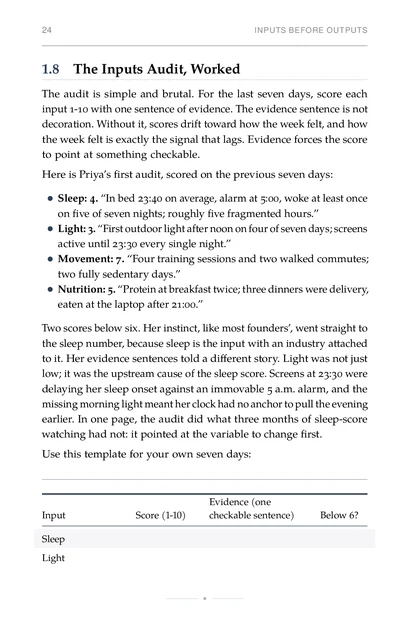 The audit is simple and brutal. For the last seven days, score each
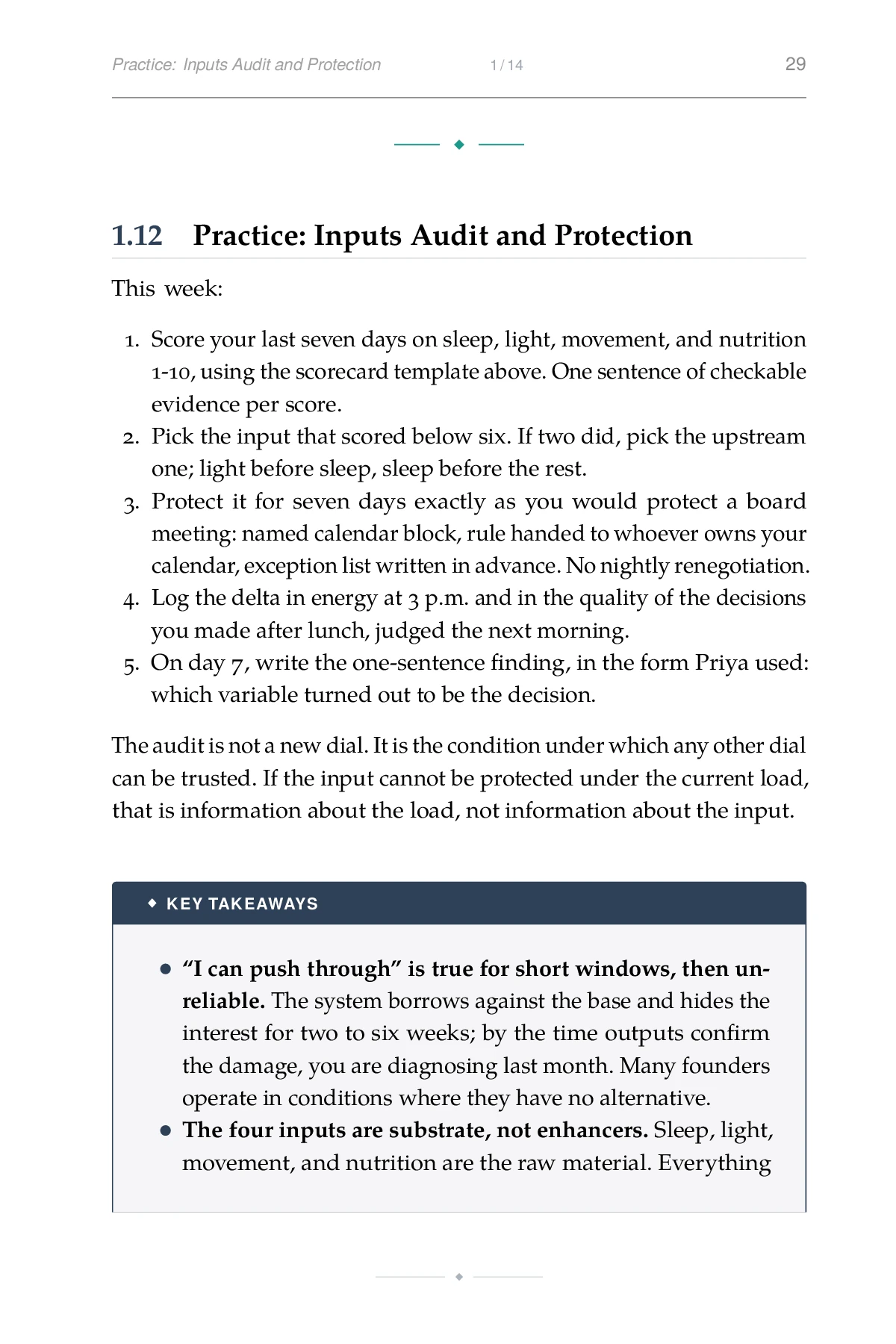
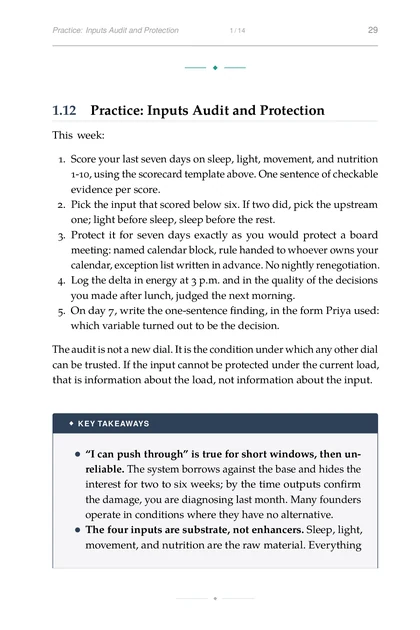 Practice: Inputs Audit and Protection 1 14 29
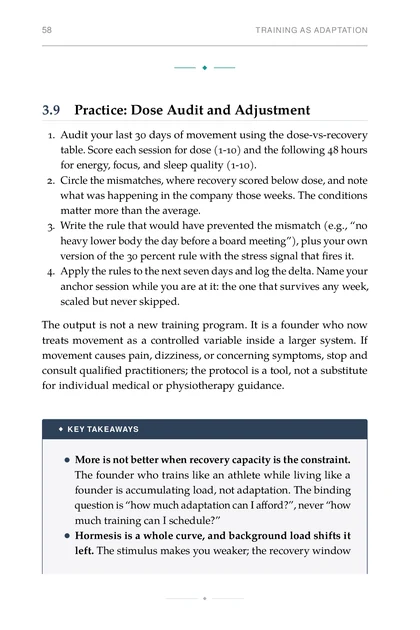 Hormesis is a whole curve, and background load shifts it
The contents
Chapter by chapter
Every chapter of The Performance Integrator with its printed epigraph, what you can do afterwards, and the moment it is built for.
Introduction
The Fragmented Optimizer
Optimizing sleep, training, focus, or nutrition in isolation feels like progress until the system quietly loses coherence. The first move is to see the system, not to add another dial.
What you can do afterwards
You will see why adding another optimization dial while the base is broken creates hidden trade-offs and eventual plateaus or crashes. You will also meet INTEGRATE, the nine-component protocol the rest of this book builds one chapter at a time.
Use this chapter when
You track multiple metrics (sleep score, training volume, focus hours, macros) and still feel the energy or judgment slipping despite "doing all the things."
Chapter 1
Inputs Before Outputs
Sleep, light, movement, and nutrition are the non-negotiable base layer. Optimizing outputs on a broken base is the fastest way to plateau or crash. The system is the only thing that can be optimized, not the willpower on top of it.
What you can do afterwards
You will run a base-layer audit that makes the next decision about training, focus work, or calendar start with what the body and brain actually have available. You will also leave with protection rules for each input that survive a normal week, a travel week, and a crisis week.
Use this chapter when
You are pushing outputs (training volume, deep work hours, decision load) while the inputs that make those outputs sustainable remain unexamined.
Chapter 2
Nutrition as Fuel and Signal
Food is not just calories; it is the substrate that builds the body and the signal that tells the brain and hormones what to do; treating it as fuel-only is how founders create inflammation, energy crashes, and cognitive fog.
What you can do afterwards
You will leave with a nutrition protocol that treats every meal as a deliberate signal for the energy and recovery the founder actually needs. Four rules with rationale, travel and crisis adaptations, and a symptom-to-test decision table for diagnosing your own patterns.
Use this chapter when
"I eat clean" or "I eat whatever is fast" both leave you inflamed, foggy, or crashing by 3pm.
Chapter 3
Training as Adaptation
Movement is not "exercise" or "more is better"; it is a deliberate hormetic stress that tells the body to adapt, but only if the dose and the recovery are matched to the founder's actual load.
What you can do afterwards
You will leave with a training + recovery plan that doses movement as controlled stress matched to your real load, not an athlete's program. Included: a session architecture for the 2-4x/week operator, a dose audit that shows your own mismatches, and an adjustment rule for hot weeks.
Use this chapter when
You train hard (or "should" train) yet sleep worse, focus flatter, and decision quality slips.
Chapter 4
Energy as the Master Variable
All performance (cognitive, physical, emotional, social) flows through energy availability and allocation; treating energy as willpower or "just push through" is the fastest way to operate beyond the system's capacity. The "master variable" framing is an operator heuristic, not a clinical claim.
What you can do afterwards
You will leave with an energy budget that shows where the good energy is going and where it is leaking. Also included: a taxonomy of the three big leaks with countermeasures, and a protection rule for high-quality energy that survives a real Tuesday.
Use this chapter when
You are sleeping, eating, and training "right" yet still running out of steam by 2pm and making worse decisions in the afternoon.
Chapter 5
Goals That Compound
Goals that are siloed by domain or by time create exactly the trade-offs that fragment the system; integrated goals that compound across domains and time are required.
What you can do afterwards
You will leave with an integrated goals map that makes your top targets reinforce rather than compete for the same limited energy. Included: a pairwise interaction method, a three-question compounding test, and a worked rewrite showing a hostile goal restructured without lowering its ambition.
Use this chapter when
You have a revenue goal, a body goal, a family goal, and a meditation streak, and they are all losing.
Chapter 6
Recovery as Training
Recovery is not the absence of work; it is the adaptation signal. Without it the system degrades even if the inputs look good. No protocol fully protects against the documented effects of extreme or prolonged load.
What you can do afterwards
You will leave with a recovery protocol that treats deliberate rest as the training that turns stress into capability, protected on the calendar like any other non-negotiable. Included: four channels with minimum viable doses, a 14-day audit, and a crisis-week version that shrinks but never hits zero.
Use this chapter when
You are sleeping 6 hours and calling it recovery while decision quality and energy continue to slide.
Chapter 7
Attention as the Scarce Resource
Cognitive performance is gated by attention allocation and restoration; treating attention as unlimited or as a willpower issue is how founders operate beyond the system's capacity while believing they are working harder. No protocol fully protects decision quality under extreme or prolonged load.
What you can do afterwards
You will leave with a 3-day attention audit that shows where the high-quality attention is actually going, a ranked list of your leaks, one written protection rule, and an environment design that stops the leaks at the source instead of asking you to resist them.
Use this chapter when
You are sleeping, eating, training, and recovering "right" yet still making shallower decisions by mid-afternoon.
Chapter 8
Team as Performance Multiplier
Your team's energy, recovery, and attention are part of your performance protocol, and ignoring them is how you create a system that looks productive while the collective capability degrades. The team's welfare is the system, not an input to the founder's output.
What you can do afterwards
You will leave with a one-week team energy map built from your own observable behavior, a taxonomy of the four drags founders generate for their teams, a selection rule for the one change that pays back fastest, and the deposit that reverses it.
Use this chapter when
Your personal protocol is improving but the team's output, energy, or decision quality is quietly sliding.
Chapter 9
Stage-Aware Protocols
A performance protocol that does not change with the company's stage, the founder's load, and the team's maturity is a protocol that will eventually work against the very performance it was designed to create. Stages compound; protocols that do not evolve with them break quietly.
What you can do afterwards
You will leave with a stage map of what mechanically breaks at each headcount band, a worked rewrite showing one founder retiring her seed-stage rules at 70 people, detection methods for the four transition signals, and a pre-written trigger for the next stage.
Use this chapter when
The protocol that got you to 20 people is the one that is breaking you at 60.
Chapter 10
Measurement That Matters
Vanity metrics and lagging indicators hide the loss of coherence until it is expensive; leading indicators across inputs, energy, attention, recovery, and team are required to make the protocol adjustable in real time.
What you can do afterwards
You will leave with a five-indicator dashboard fully specified down to the instrumentation, numeric thresholds, and the protocol element each number controls, plus the two-trigger rule that turns a bad trend into a 48-hour adjustment instead of a bad quarter.
Use this chapter when
Your Oura score is 85 but decision quality is collapsing and the team is quietly burning out.
Chapter 11
Your Calendar as Performance Architecture
The calendar is not a to-do list; it is the visible architecture of the performance protocol, and the founder who does not treat it as such is building a system that looks busy while the actual capability erodes.
What you can do afterwards
You will leave with a 30-day architecture audit method, a worked redesign showing one founder moving from 4/2/0 to a calendar that resources the whole protocol, implementation scripts for each redesign move, and the re-audit cadence that stops week-three decay.
Use this chapter when
Your calendar is full of "performance" activities but the base layer, recovery, and deep work are squeezed into the scraps.
Chapter 12
Building Your Performance Protocol
Every founder has pieces of a performance system; the protocol is what turns the pieces into one living, integrated, stage-aware operating system that compounds across body, mind, energy, and social system.
What you can do afterwards
You will leave with version 1.0 of your INTEGRATE protocol, real rules per section drawn from the artifacts of chapters 1 through 11, three rituals with line-by-line agendas, the versioning mechanics that keep the document alive, and a 30-day install plan.
Use this chapter when
You have excellent pieces (sleep tracking, training, nutrition, meditation, team 1:1s) but they do not talk to each other and crash when the load rises.
Conclusion
The Compounding Self
Integrated performance is one possible pattern, observed in some operators under some conditions, that may help maintain capacity over years when the protocol is run as default. No protocol guarantees long-term health or cognitive outcomes. The scope qualifier in POFR Chapter 99 governs this chapter.
What you can do afterwards
You will write a personal commitment that the INTEGRATE protocol will be the default operating system for the body, mind, energy, and social system, even when the pressure is to sacrifice the base layer for the visible win. The commitment accepts that the protocol is a tool, not a virtue, and that you may need to reduce load rather than manage it.
Use this chapter when
You have run the protocol for 90 days and notice that the system is, in your judgment, more often supporting capacity than fragmenting when the load rises.
Who it is for
Who this book was written for
The result is a performance system that compounds: each input you make legible and defend is capacity the rest of the system inherits, growing more durable as the company scales.
If you track everything and still feel your energy and judgment slipping, this was written for you: the operator running green dials over a system that is not.
The reader it was written for
Founders and operator-leaders at 15–100 people who have experienced the limits of fragmented optimization or heroic depletion. They track some metrics but the system is not compounding, and decision quality or energy is visibly declining. Psychographics:
Probably not for you if
- Pure biohackers or athletes.
- Corporate wellness.
- Readers seeking only sleep or only training.
Editions
Editions and specifications
| Edition | Formats | Chapters | Pages | Reading time | ISBN (paperback) |
|---|---|---|---|---|---|
| English The Performance Integrator | In production | 14 | 250 | ± 3 hours | — |
| Dutch De prestatie-integrator | In production | 14 | 120 | ± 3 hours | — |
Both editions are written natively. The Dutch text is not a machine translation of the English.
Frequently asked
What readers usually want to know
What is The Performance Integrator about?
INTEGRATE connects body, cognition, energy, and team operating rhythms into one performance system instead of isolated optimization rituals. The subtitle is: One Integrated Protocol for the Body, Mind, Energy, and Team That Runs Your Company.
Is there a Dutch edition?
Yes. The Dutch edition is De prestatie-integrator, written as a native edition rather than a machine translation. It moves through the same production line.
How long is The Performance Integrator?
This edition runs 14 chapters, 250 pages in print and roughly 3 hours of reading.
Who is The Performance Integrator for?
If you track everything and still feel your energy and judgment slipping, this was written for you: the operator running green dials over a system that is not.
The production system
How this book was made
Every title moves through the same gated production line: sourced research, a claim-level evidence ledger, structural review, fact-checking, red-team critique, and a bilingual final edit. AI agents do specialist work inside those gates; judgment, voice, and accountability stay human.
- Claims enter an evidence ledger with a source and a confidence grade before they reach the page
- English and Dutch are two native editions, not a translation of one another
- Every chapter clears readability, rhythm, and style gates before it is typeset


