

No. 47 · Active development · Health & performance · UNDERLOAD
Leadership Under Load
Awareness-Based Practice for Founders and Operators Under Sustained Pressure
Leadership Under Load: Awareness-Based Practice for Founders and Operators Under Sustained Pressure.
UNDERLOAD treats prolonged pressure as a design condition, not a character test: observe the load, protect decision quality, redistribute responsibility, and recognise when the only responsible move is to reduce or leave it. Awareness-Based Practice for Founders and Operators Under Sustained Pressure. The framework: UNDERLOAD.
- pages
- 156
- chapters
- 14
- hours of reading
- ± 2
- editions
- EN · NL
- Design
- Drafting
- Manuscript
- Production
- Launched
The editions
Kindle and Paperback
Production shots of the editions. Not for sale yet — this page is the public working version.
-
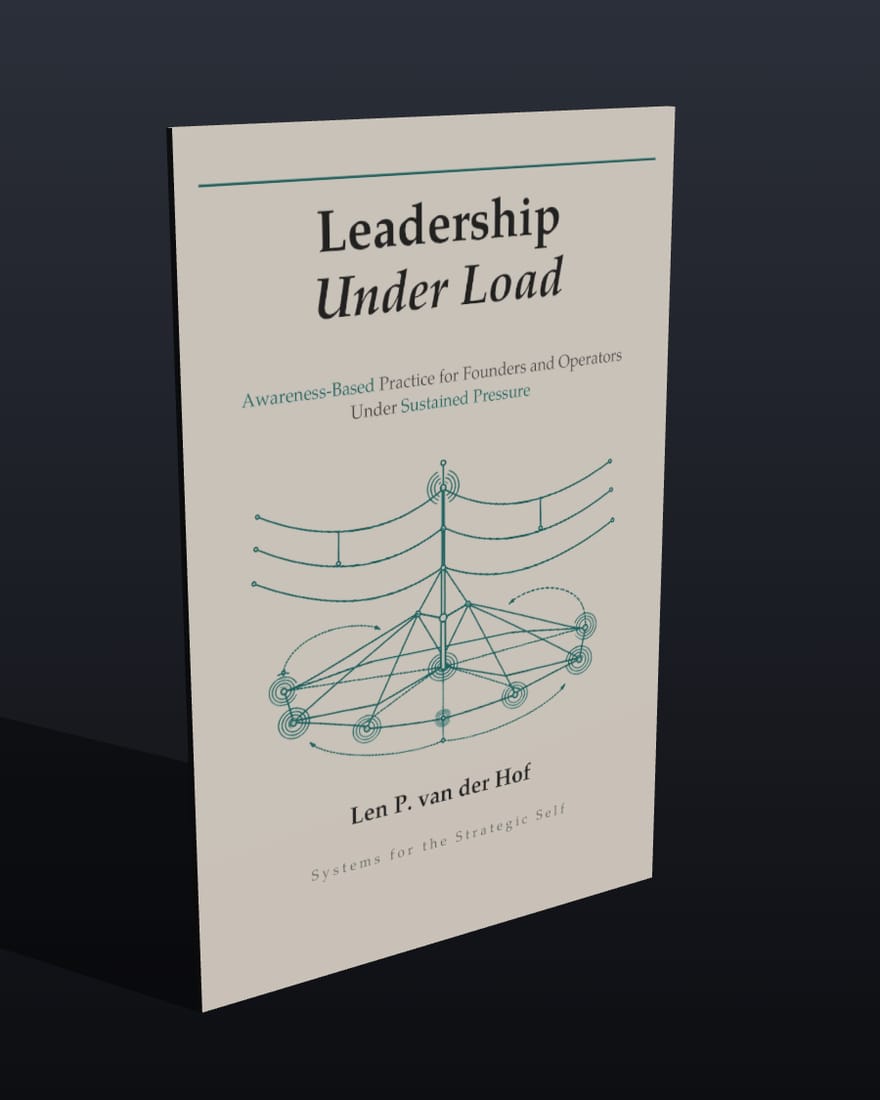
Kindle
The digital edition, ready in any Kindle app.
-
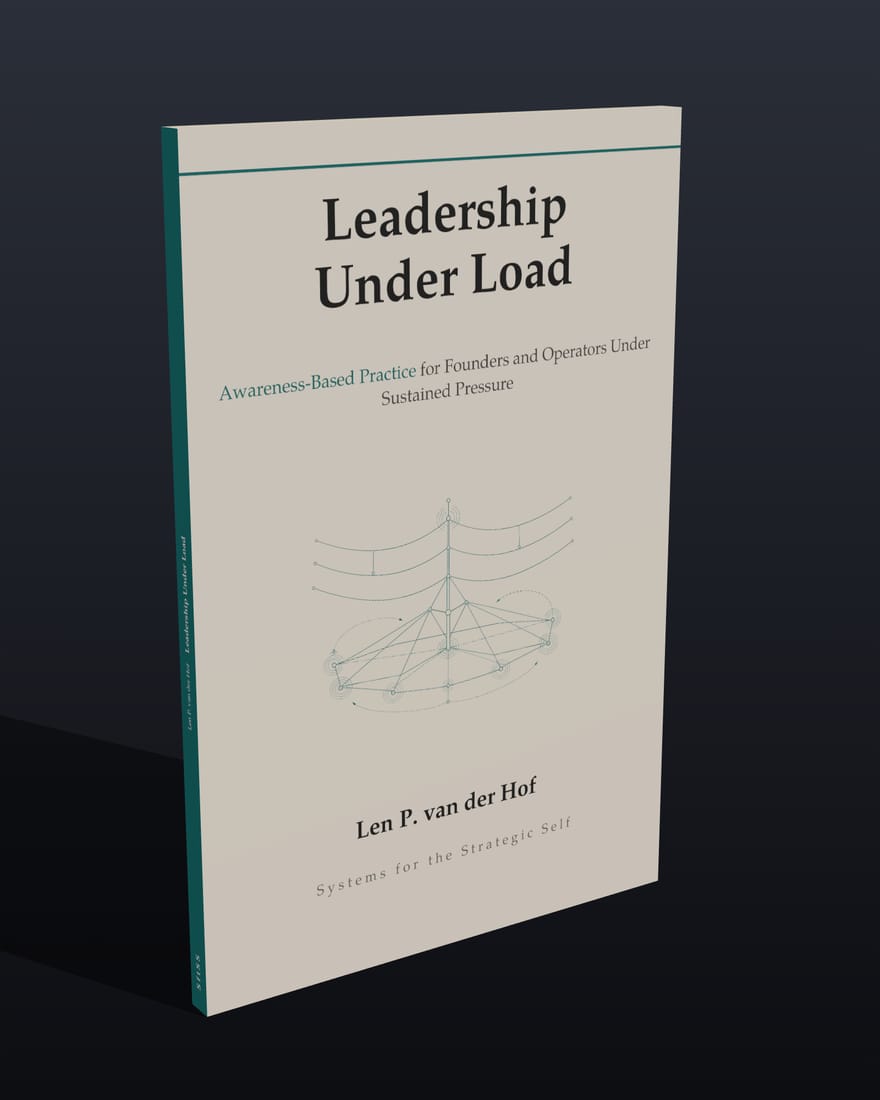
Paperback
The working copy. Mark it up. Take it into the meeting.


The book
Awareness-Based Practice for Founders and Operators Under Sustained Pressure
Sustained pressure rarely announces the moment it begins to change a leader. The calendar tightens. Sleep becomes negotiable. Decisions take longer, ethical edges blur, and the team starts carrying the cost of a system built around one person's endurance.
Leadership Under Load treats prolonged pressure as a design condition, not a character test. The UNDERLOAD framework gives founders and operator-leaders an awareness-based practice for observing load, protecting decision quality, redistributing responsibility, and recognizing when the only responsible move is to reduce or leave the load.
What you learn
What this book puts in your hands
- Audit where sustained pressure is already altering attention, judgment, and behavior.
- Rebuild presence as a practiced operating condition rather than a performance.
- Navigate uncertainty without converting urgency into avoidable damage.
- Use decision records and evaluation loops when memory and confidence become unreliable.
- Treat the calendar, delegation, and team capacity as load architecture.
- Observe early signals in yourself and the organization without turning them into diagnoses.
The framework
UNDERLOAD, step by step
-
Unflappable presence
-
Navigate
-
Decide
-
Evaluate
-
Review
-
Load
-
Observe
-
Adapt
-
Delegate
The contents
Chapter by chapter
Every chapter of Leadership Under Load with its printed epigraph, what you can do afterwards, and the moment it is built for.
Introduction
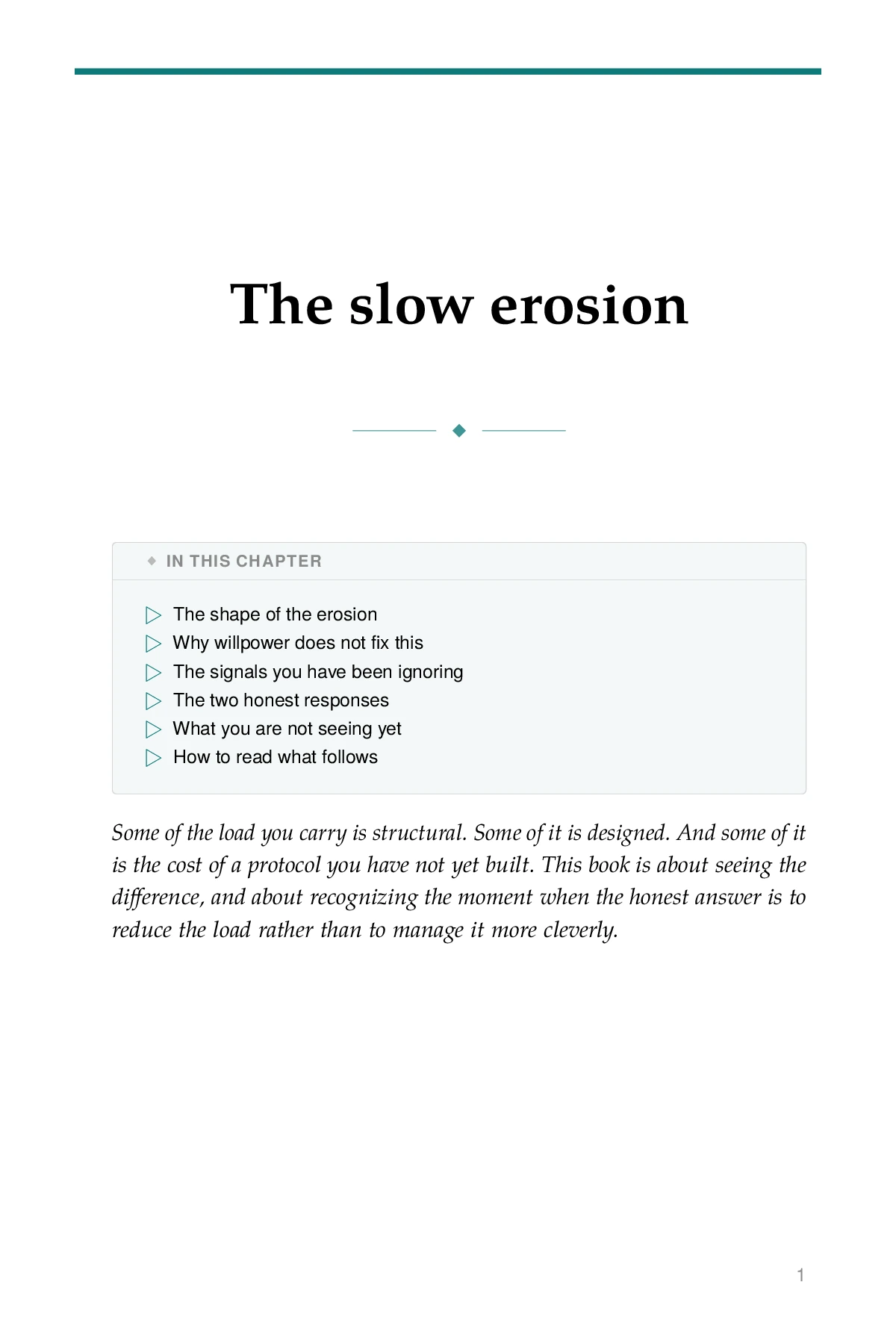
The slow erosion
Some of the load you carry is structural. Some of it is designed. And some of it is the cost of a protocol you have not yet built. This book is about seeing the difference, and about recognizing the moment when the honest answer is to reduce the load rather than to manage it more cleverly.
What you can do afterwards
You will see the structural shape of the erosion and start reading your own signals before the cost is paid in full.
Use this chapter when
You suspect load is changing you but cannot name how.
Chapter 1
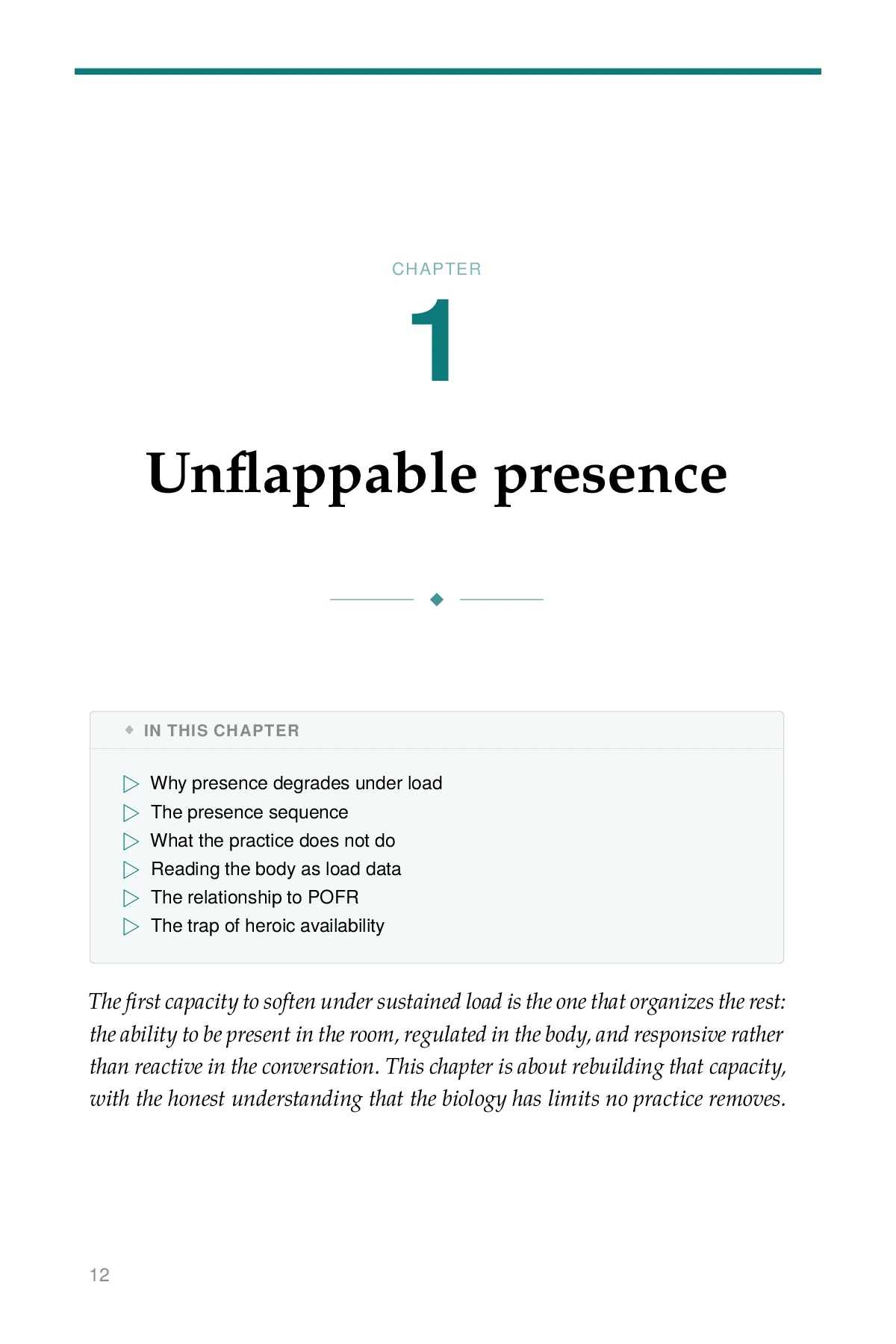
Unflappable presence
The first capacity to soften under sustained load is the one that organizes the rest: the ability to be present in the room, regulated in the body, and responsive rather than reactive in the conversation. This chapter is about rebuilding that capacity, with the honest understanding that the biology has limits no practice removes.
What you can do afterwards
You will build a presence protocol that survives a hard day, and you will learn to read the body's signals as load data.
Use this chapter when
You find yourself reactive in meetings you used to navigate, or your body is in the room while your mind is elsewhere.
Chapter 2
Navigate uncertainty
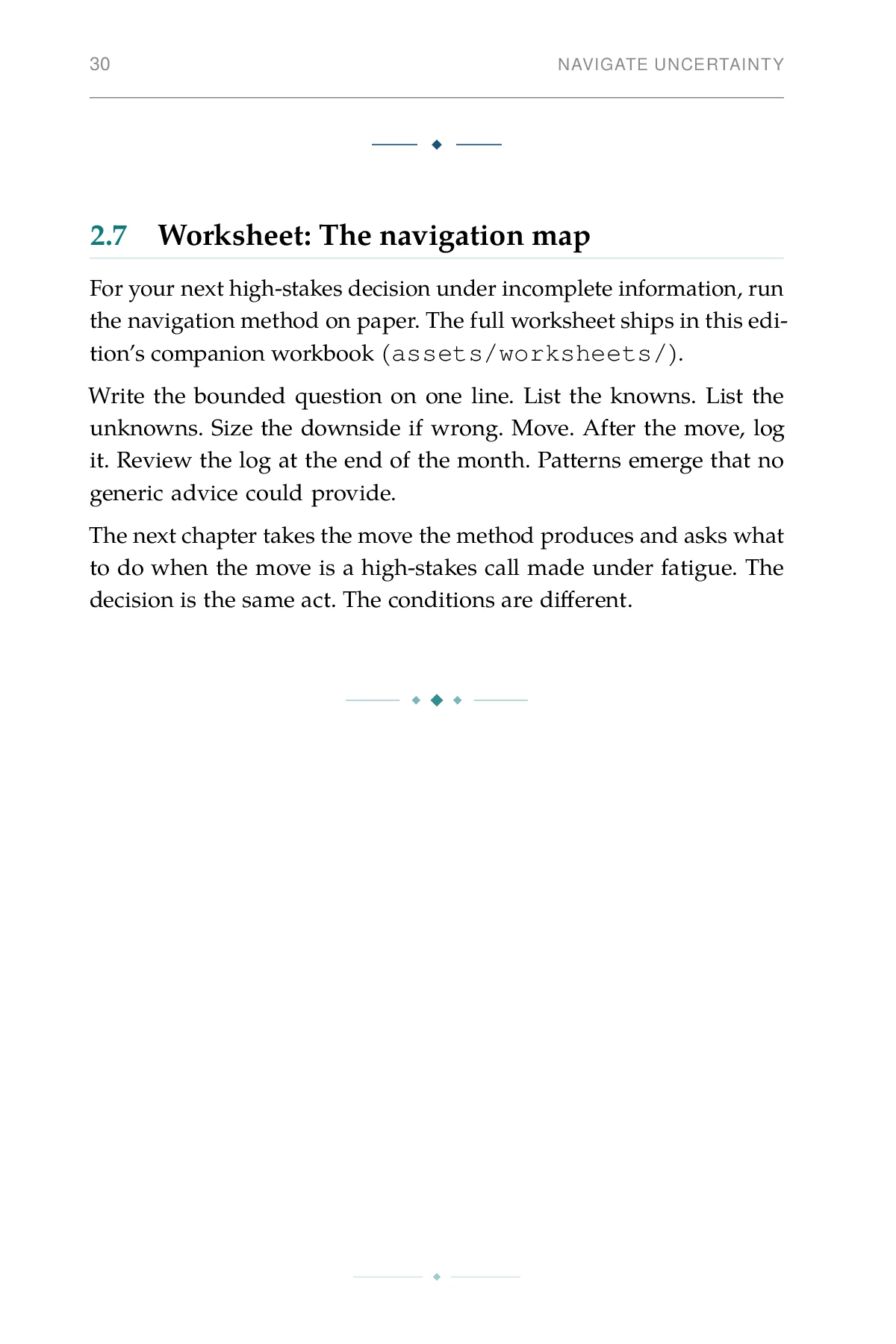
Presence is the foundation. Presence without a method for moving forward under incomplete information is calm confusion. This chapter is about navigation as a structured practice: act on what you know, name what you do not, and do not pretend the gaps away.
What you can do afterwards
You will replace decision paralysis and reactive instinct with a structured navigation method that acts on what you know, names what you do not, and protects the options you still have.
Use this chapter when
Information is incomplete, the stakes are real, and the cost of waiting is now higher than the cost of moving.
Chapter 3
Decide under load
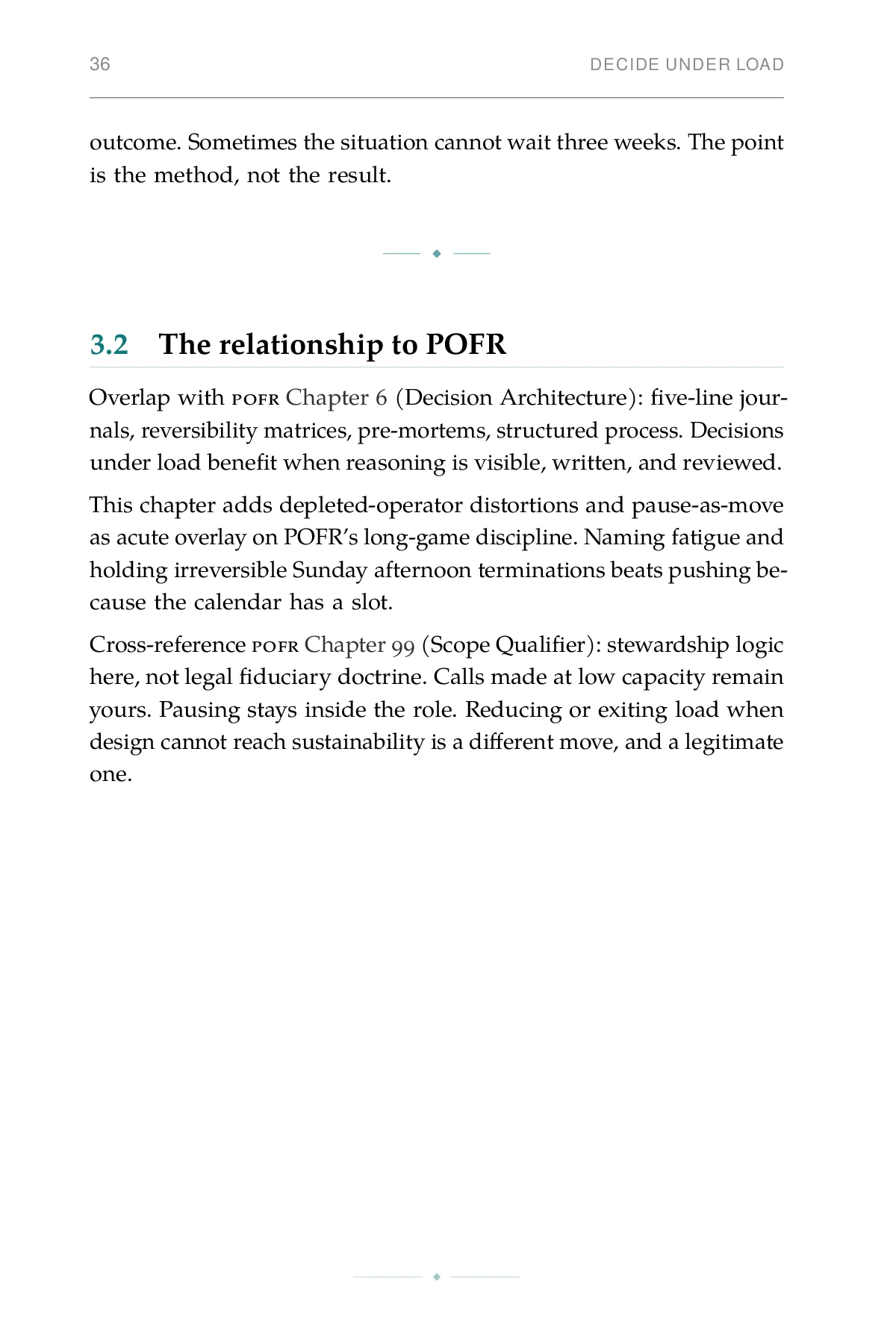
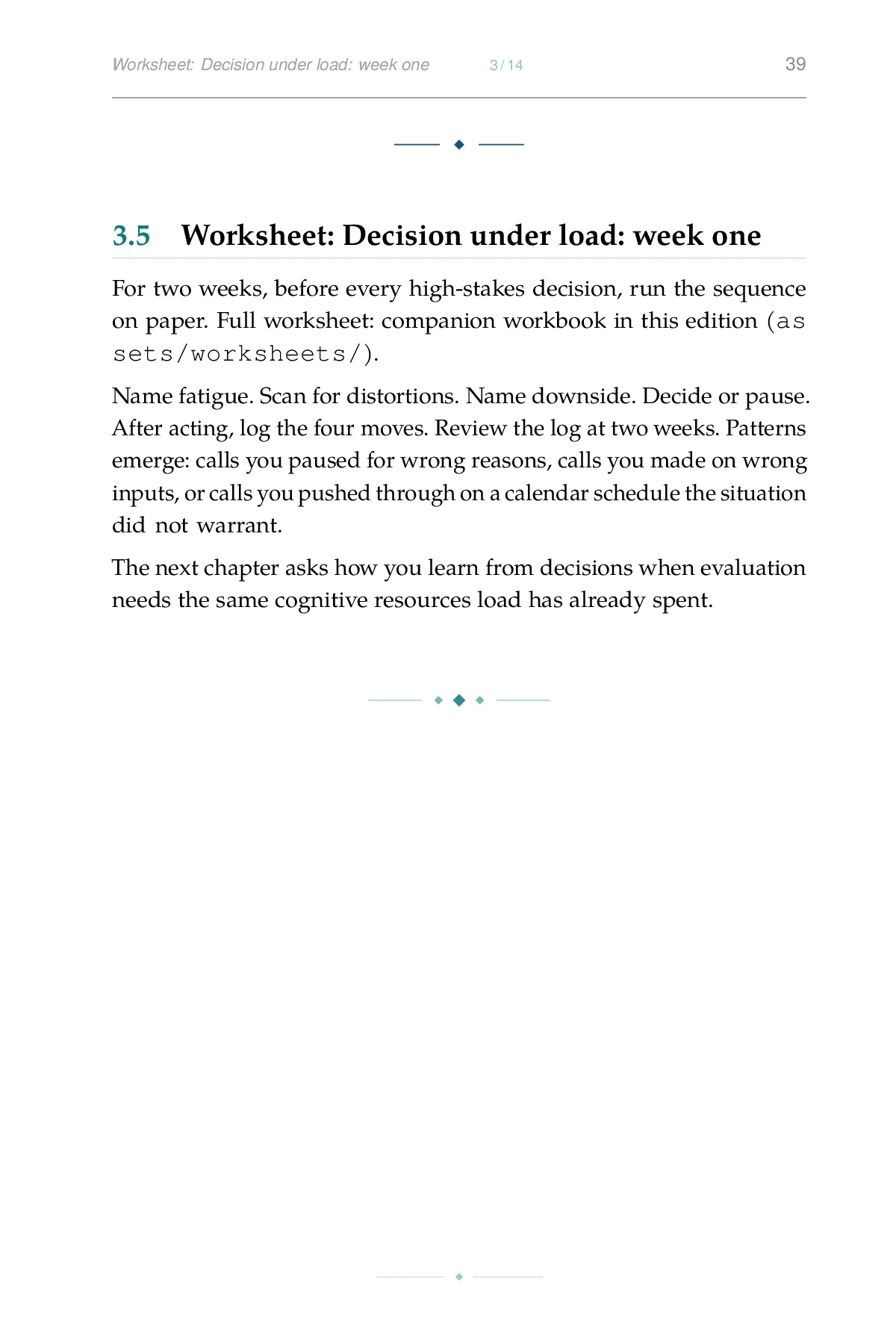
Navigation produces options. The next move is choosing between them when the stakes are high and you are worn down. This chapter is about decision habits under fatigue: the failure modes the load produces, the checklist that addresses them, and the honest fact that no checklist removes body limits when sleep is gone.
What you can do afterwards
You will run a decision checklist that accounts for the specific failure modes the load produces, and you will recognize the move of deferring a high-stakes decision to a recovered state when the defer is the responsible move.
Use this chapter when
A high-stakes call is in front of you and you know you are not at full capacity.
Chapter 4
Evaluate and review
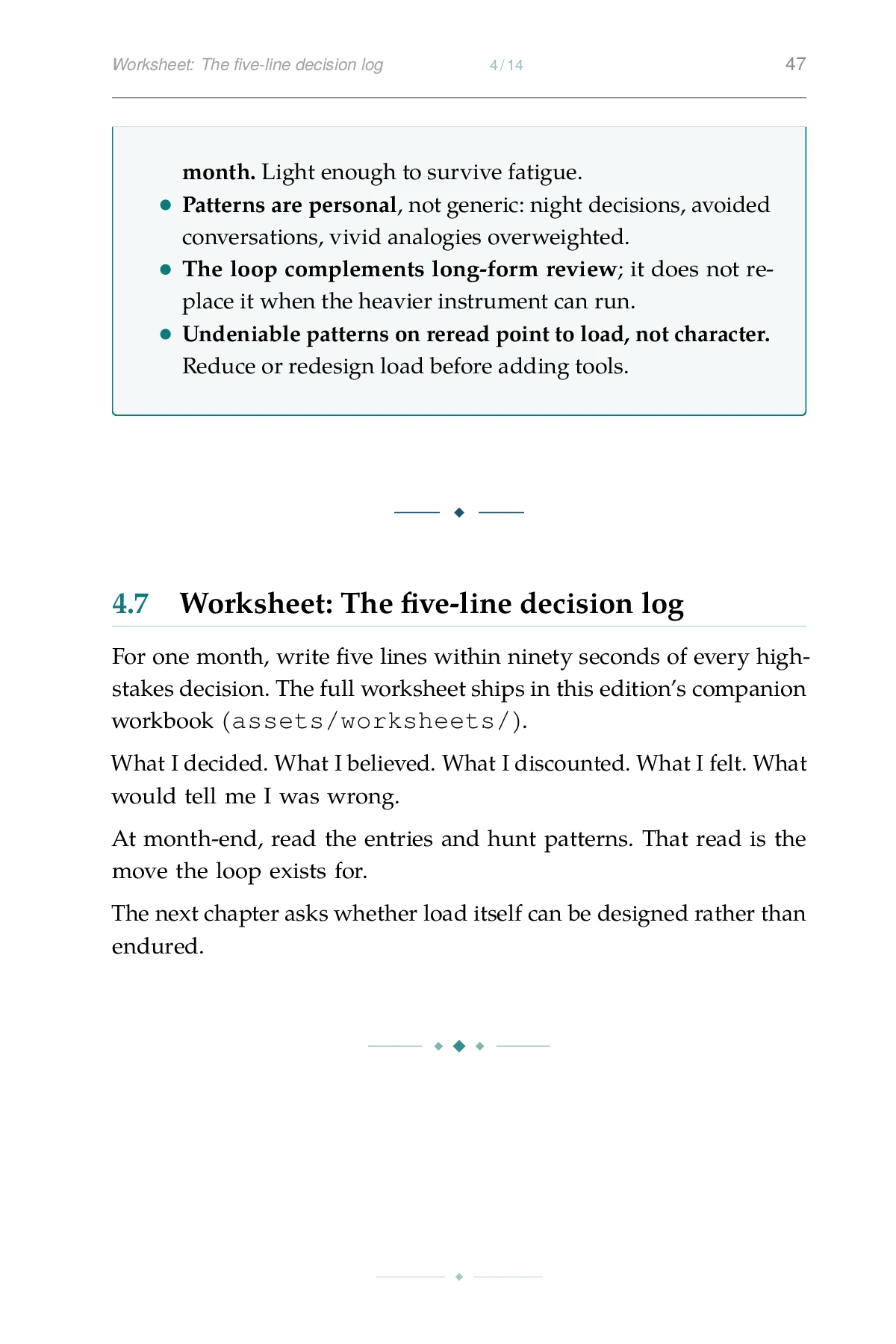
A decision made under load is only useful if the system learns from it. The problem is that evaluation requires cognitive resources that depletion has already consumed. This chapter is about designing evaluation loops that survive fatigue, and about recognizing the moment when the failure to learn is a signal about the load, not about the operator.
What you can do afterwards
You will build a lightweight evaluation loop that produces learning from decisions made under load, without requiring the cognitive resources the load has already spent.
Use this chapter when
You are making decisions but not learning from them, or the retrospective analysis is heavier than the system can carry.
Chapter 5
Load management, load as a design variable
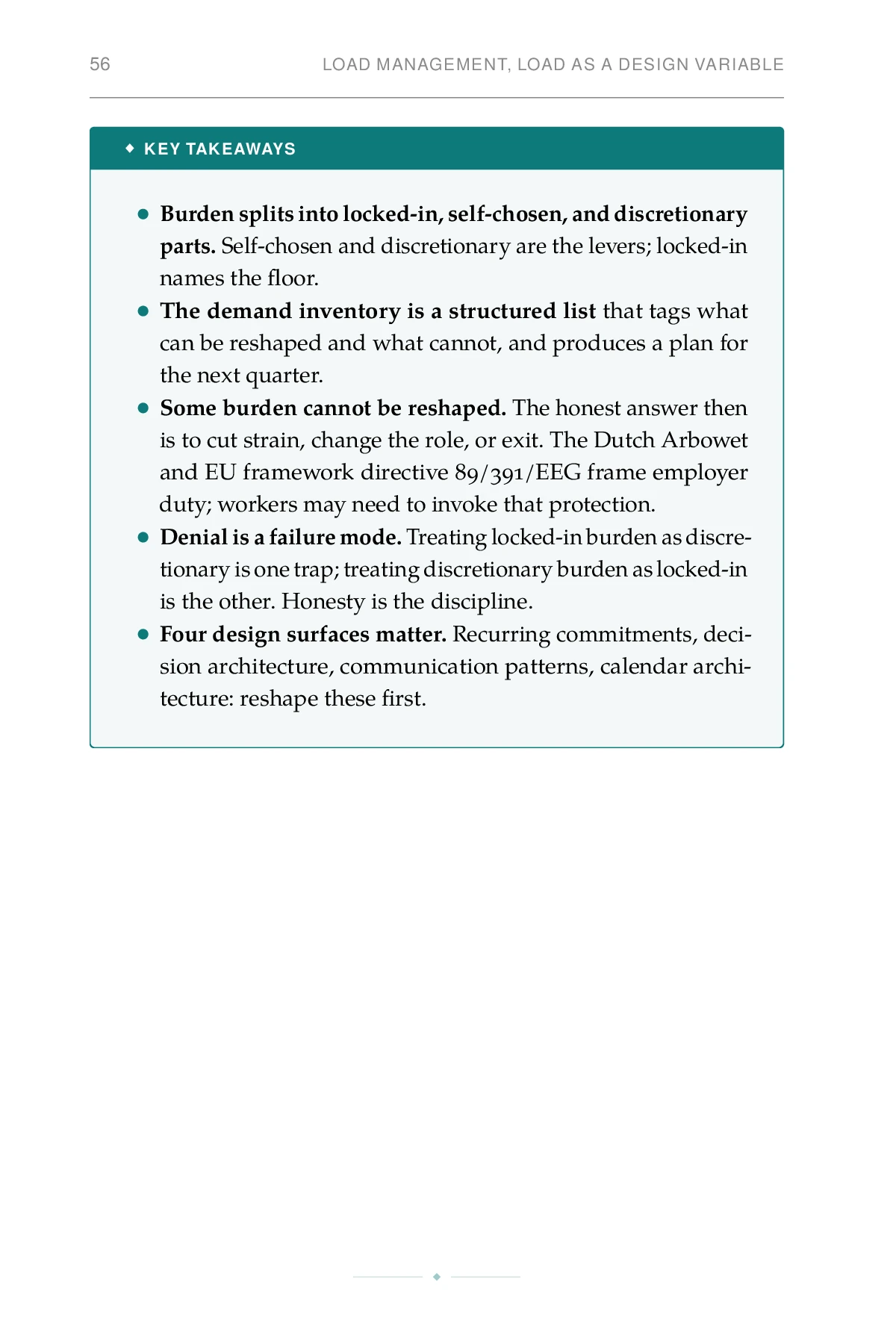
Presence, navigation, decision, and review are interior skills. The rest of the book asks whether strain itself can be shaped rather than endured. This chapter is the pivot. It treats demand as a variable you can design, and names the parts of demand that cannot be shaped around.
What you can do afterwards
You will run a demand inventory that splits fixed from chosen strain, find design levers, and produce a reshape plan for the next quarter.
Use this chapter when
You have been wearing strain as a badge and treating it as an immutable fact of the role.
Chapter 6
Observe the signals
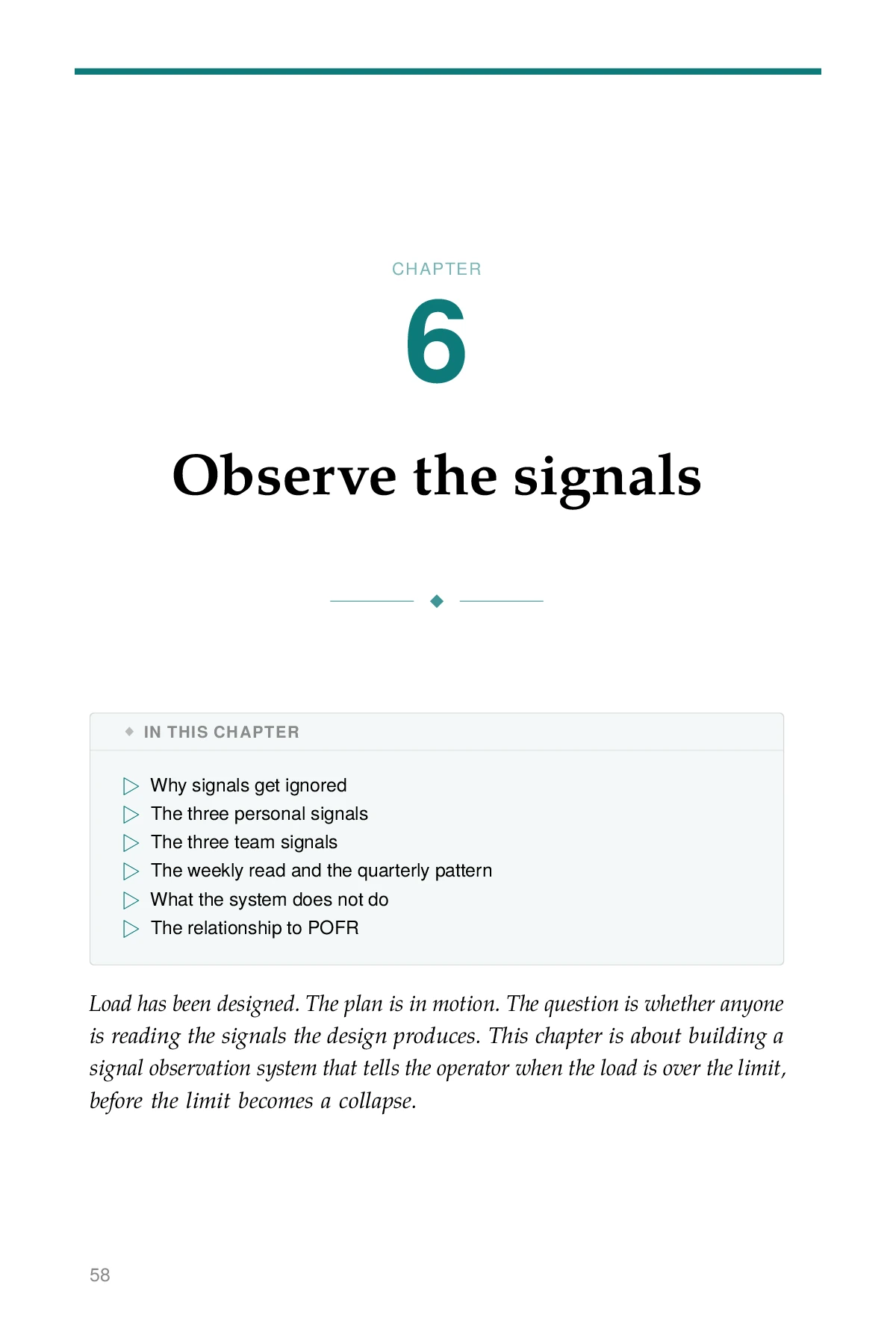
Load has been designed. The plan is in motion. The question is whether anyone is reading the signals the design produces. This chapter is about building a signal observation system that tells the operator when the load is over the limit, before the limit becomes a collapse.
What you can do afterwards
You will build a lightweight signal observation system that detects personal and team erosion before it becomes a collapse, and you will read the signals as data the system produces.
Use this chapter when
You suspect the load is over your limit but cannot name how, or the team's mood has shifted in ways that worry you.
Chapter 7
Adapt the system
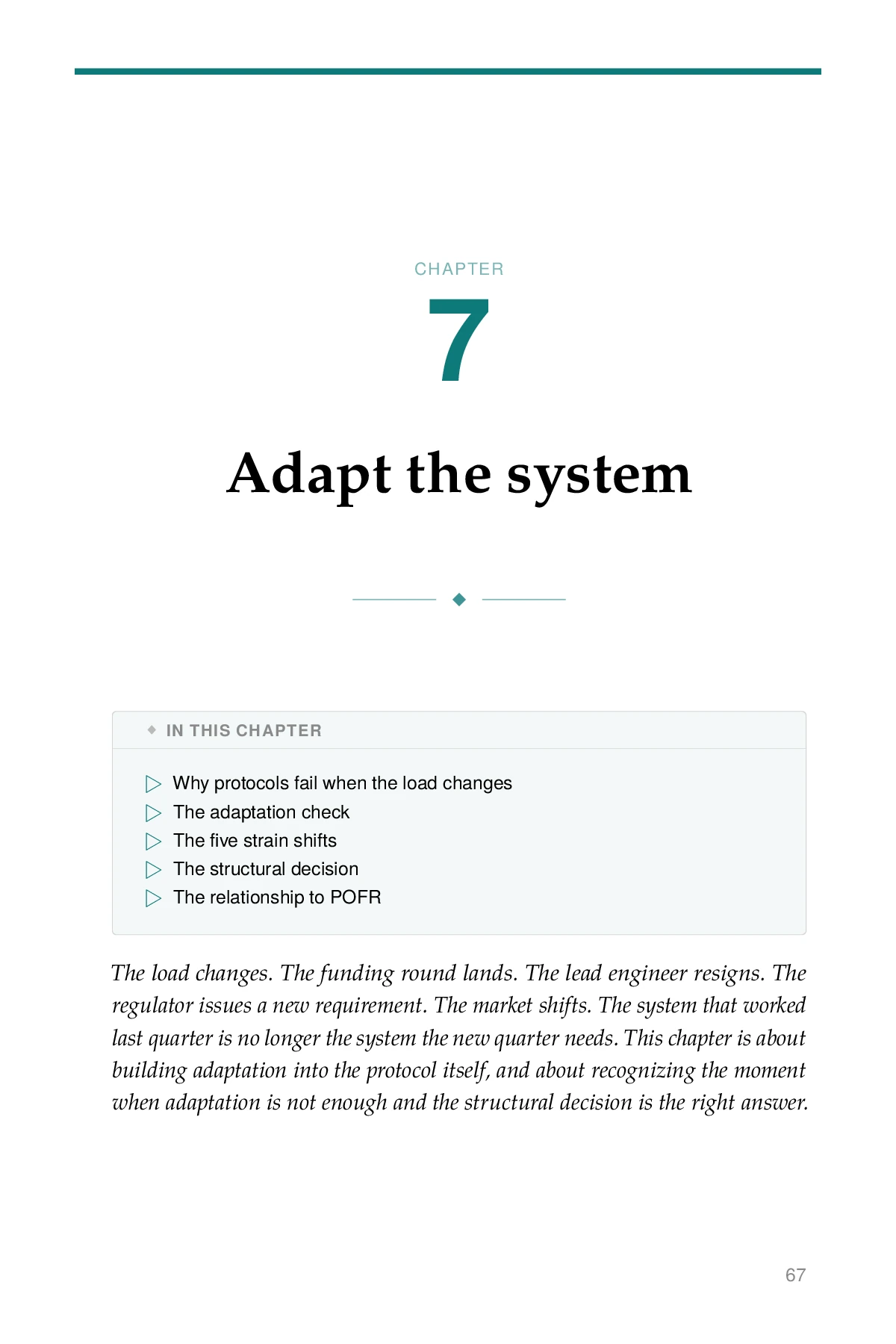
The load changes. The funding round lands. The lead engineer resigns. The regulator issues a new requirement. The market shifts. The system that worked last quarter is no longer the system the new quarter needs. This chapter is about building adaptation into the protocol itself, and about recognizing the moment when adaptation is not enough and the structural decision is the right answer.
What you can do afterwards
You will run an adaptation check on the protocol when the load changes, and you will distinguish between adaptations that preserve the system and adaptations that require the structural decision.
Use this chapter when
The protocol that worked last quarter is no longer working, or you are about to enter a known load change.
Chapter 8
Delegate as survival
The adaptation plan surfaces a hard truth: the operator is carrying more than one person can carry. The next move is structural. The next move is to delegate, not as a management technique, but as the survival skill the load is making it impossible to refuse.
What you can do afterwards
You will run a handoff audit that splits what you can pass from what only you can do, and you will design a pass plan that hands off without abdicating.
Use this chapter when
You are a bottleneck, or strain is producing calls only you can make that you are not making well.
Chapter 9
The long game
Prior chapters built a system: interior skills, exterior systems, signal reads, adaptation, and delegation. The system has been tested against the load. The system is running. The long game asks what changes when the load is not a sprint but a multi-year condition.
What you can do afterwards
You will adopt a long-game temporal frame for endurance, measured in years, not quarters, and you will design the system to run across the long game, not just across the next funding round.
Use this chapter when
You have been thinking in quarters and funding rounds, treating the load as temporary.
Chapter 10
Team under load
The long game is not played alone. Team load mirrors and amplifies founder load. Designing for collective endurance is not a management technique. It is the discipline the long game requires, and the only way a multi-year frame stays honest.
What you can do afterwards
You will map the team's load, recognize the amplification relationship between founder load and team load, and design a team-load architecture that centers team welfare and agency.
Use this chapter when
You have been treating the load as personal, or the team has been mirroring the founder's load without anyone naming it.
Chapter 11
Your calendar as load architecture
What you can do afterwards
You will read your calendar as load architecture and redesign it as infrastructure for presence, recovery, and decision quality.
Use this chapter when
Your days feel reactive even when the calendar looks full of important things, or you cannot remember the last morning you were not interrupted.
Chapter 12
Building your Underload protocol
Previous chapters introduced the parts of the UNDERLOAD protocol. It is not a checklist but a living system. You design it, run it, and hand it off when you are no longer the right person to run it. Integration means joining those parts into something that survives a hard day, a hard quarter, and a hard year, and that can transfer without losing what it was built to protect.
What you can do afterwards
You will integrate the UNDERLOAD parts into a personal protocol that runs on a hard day, and you will design the handoff so the system outlives the operator's tenure in the role.
Use this chapter when
The individual practices are in place but feel disconnected, or the next role change is on the horizon and the protocol needs to survive the transition.
Conclusion
Leadership under sustained load: aspirational, with no protection from limits
What you can do afterwards
You will close the book with a clear-eyed view of what the protocol can and cannot do, and a commitment to the escalation paths the protocol cannot replace.
Use this chapter when
You have built the protocol and are now deciding how to live inside it, or you are weighing whether the role is one you can continue in safely.
Who it is for
Who this book was written for
The result is a practical set of artifacts: an erosion audit, a load map, a decision-under-load checklist, a signal observation system, a delegation protocol, and a long-game review cadence.
This book is educational. It does not provide medical, psychological, clinical, or therapeutic advice, and no framework can fully protect judgment or health under extreme or prolonged load. Significant distress, impaired judgment, burnout symptoms, or unsafe conditions call for qualified professional support and, where necessary, a reduction or removal of the load.
The reader it was written for
Founders and operator-leaders 2–5 years into sustained high load (runway pressure, regulatory, growth, team, personal health signals). They have "toughed it out" and are now seeing the cost in judgment, ethics, energy, or team. Psychographics:
Probably not for you if
- Acute crisis only.
- Pre-load founders.
- Readers seeking only mindset or therapy.
Editions
Editions and specifications
| Edition | Formats | Chapters | Pages | Reading time | ISBN (paperback) |
|---|---|---|---|---|---|
| English Leadership Under Load | In production | 14 | 156 | ± 2 hours | — |
| Dutch Leiderschap Onder Belasting | In production | 14 | 196 | ± 2 hours | — |
Both editions are written natively. The Dutch text is not a machine translation of the English. · Trim size: 6x9″
Frequently asked
What readers usually want to know
What is Leadership Under Load about?
UNDERLOAD treats prolonged pressure as a design condition, not a character test: observe the load, protect decision quality, redistribute responsibility, and recognise when the only responsible move is to reduce or leave it. The subtitle is: Awareness-Based Practice for Founders and Operators Under Sustained Pressure.
What is the UNDERLOAD framework?
UNDERLOAD: Unflappable presence, Navigate, Decide, Evaluate, Review, Load, Observe, Adapt and Delegate.
Is there a Dutch edition?
Yes. The Dutch edition is Leiderschap Onder Belasting, written as a native edition rather than a machine translation. It moves through the same production line.
How long is Leadership Under Load?
This edition runs 14 chapters, 156 pages in print and roughly 2 hours of reading.
Who is Leadership Under Load for?
This book is educational. It does not provide medical, psychological, clinical, or therapeutic advice, and no framework can fully protect judgment or health under extreme or prolonged load. Significant distress, impaired judgment, burnout symptoms, or unsafe conditions call for qualified professional support and, where necessary, a reduction or removal of the load.
The production system
How this book was made
Every title moves through the same gated production line: sourced research, a claim-level evidence ledger, structural review, fact-checking, red-team critique, and a bilingual final edit. AI agents do specialist work inside those gates; judgment, voice, and accountability stay human.
- Claims enter an evidence ledger with a source and a confidence grade before they reach the page
- English and Dutch are two native editions, not a translation of one another
- Every chapter clears readability, rhythm, and style gates before it is typeset


