

No. 26 · Active development · Health & performance · PACE
The Attention Architect
Reclaiming Cognitive Sovereignty by Delegating Distraction to AI
Every focus method assumes you can disconnect. Founders cannot.
A founder cannot quit Slack, ignore email, or vanish for four hours without consequence. Deep Work, Indistractable, and Digital Minimalism all assume you can disconnect. This is the first attention book for founders who cannot. The PACE framework treats distraction as an architecture problem solved by AI delegation, not a willpower problem solved by discipline. You delegate the noise to AI so you can focus on what only you can decide.
- pages
- 208
- chapters
- 13
- hours of reading
- ± 3
- editions
- EN · NL
- Design
- Drafting
- Manuscript
- Production
- Launched
The editions
Kindle and Paperback
Production shots of the editions. Not for sale yet — this page is the public working version.
-
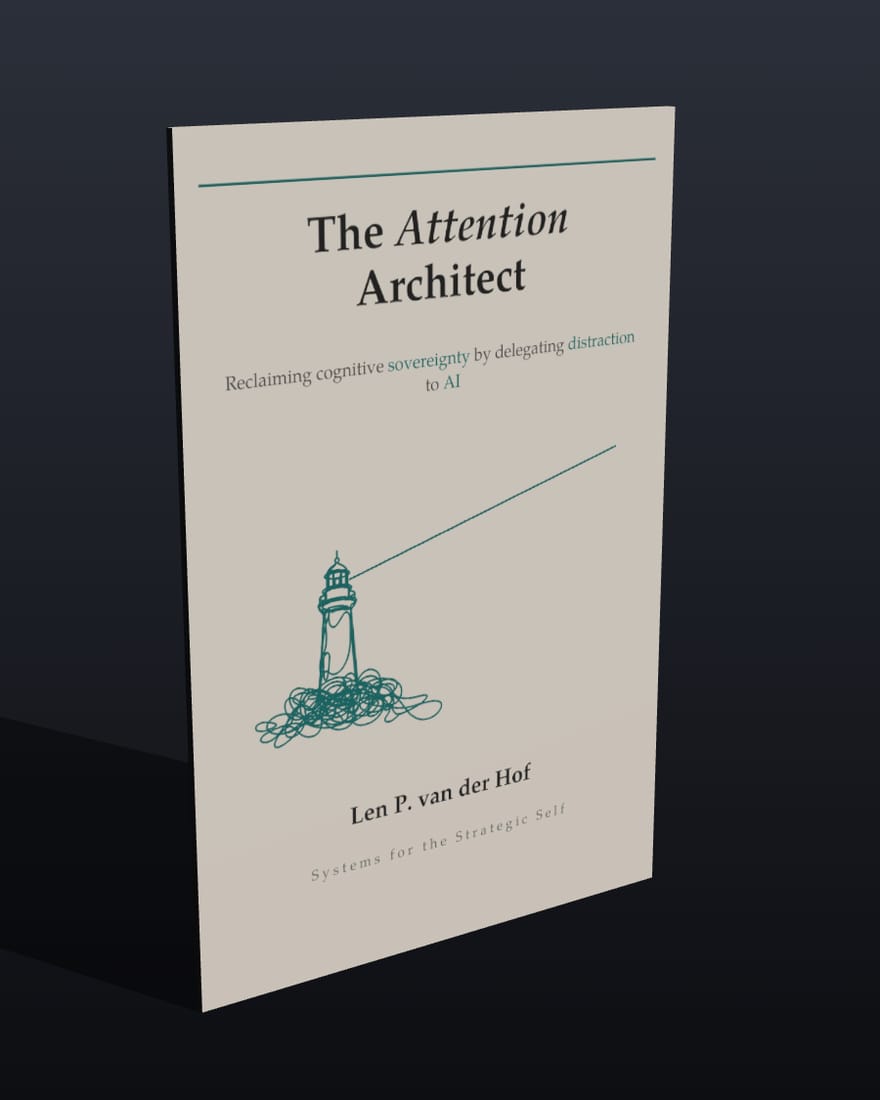
Kindle
The digital edition, ready in any Kindle app.
-
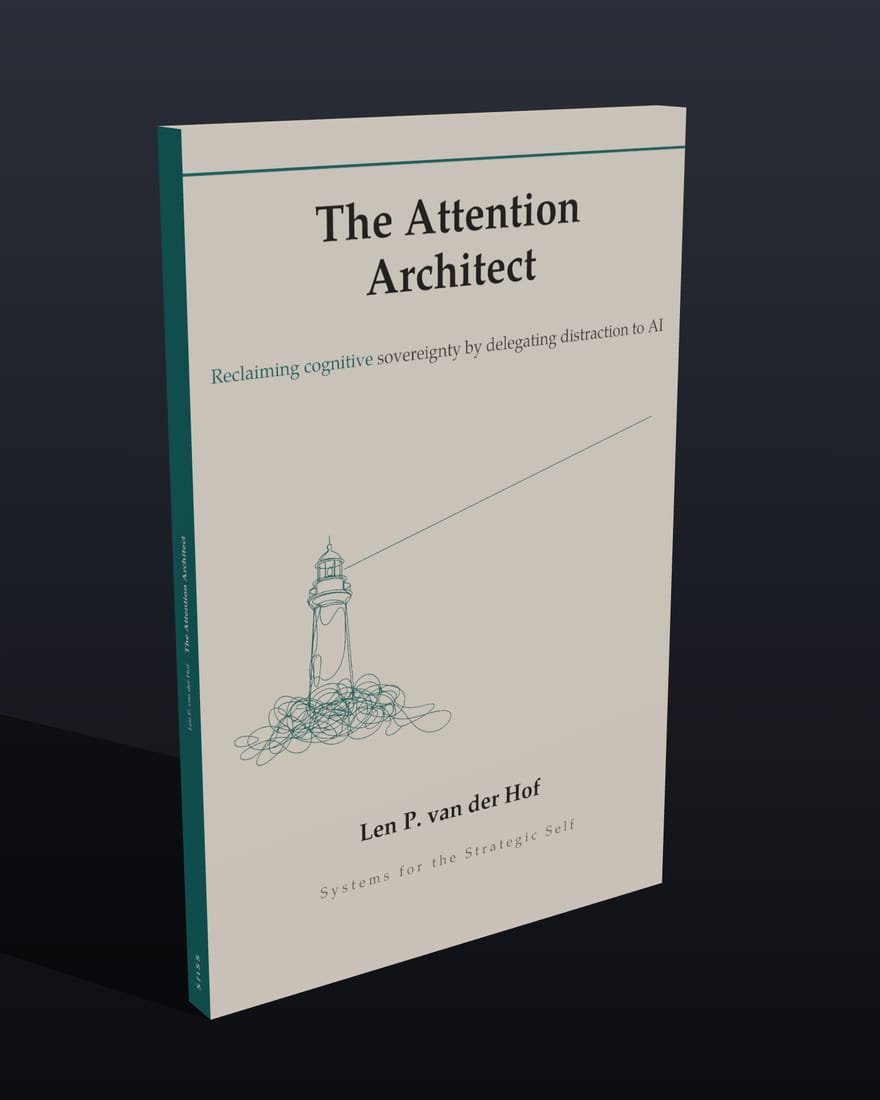
Paperback
The working copy. Mark it up. Take it into the meeting.


The book
Reclaiming Cognitive Sovereignty by Delegating Distraction to AI
You open the laptop to do one thing and surface an hour later having done eleven, none of them the one. The inbox sets your agenda before you do, and the work that matters comes due after your best attention is already spent on other people's urgencies. You are not short on hours. You are short on attention, and you spend your sharpest hours on your shallowest work.
The standard advice is a better app, a stricter list, more discipline. But that turns a structural problem into a willpower problem, and willpower loses to an environment engineered to interrupt you every afternoon.
The Attention Architect rejects the productivity-hack economy and gives you something you can run. Built on cognitive psychology, attention research, and systems thinking, it introduces the PACE framework (Protect, Allocate, Compress, Eliminate): four moves that turn attention from a resource you leak into infrastructure you design. It treats your cognitive bandwidth as a system to engineer, not a virtue to summon.
What you learn
What this book puts in your hands
- PACE: a four-layer attention architecture (Pipeline, AI Triage, Curation, Execution)
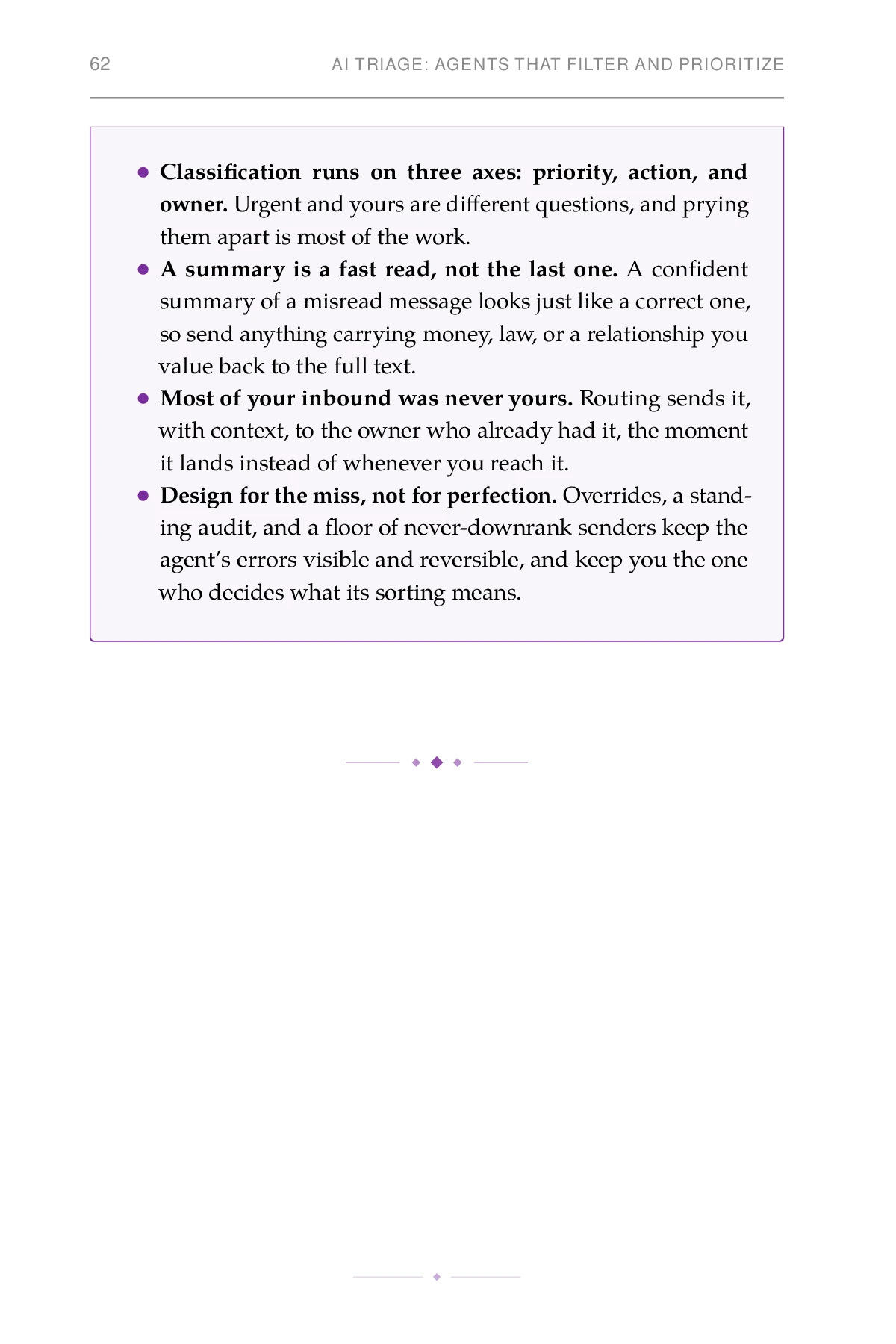
- AI agents that classify, summarize, and route your inbound so noise never reaches you
- Channel and SLA design that decides how people reach you, before they do
- A curated daily queue surfacing only what needs your unique judgment
- Protected focus blocks built for founders who stay reachable, not willpower hacks
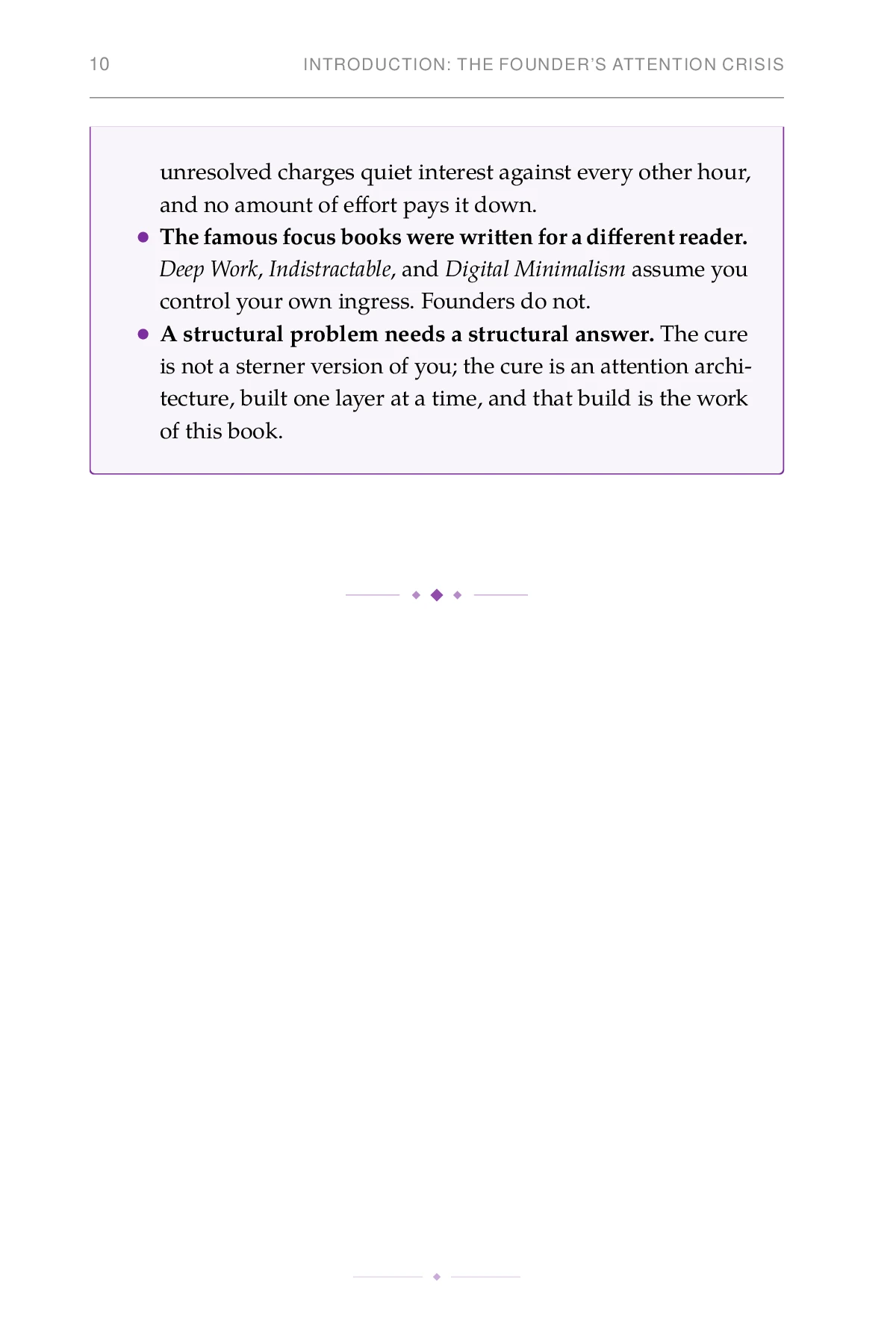
From the book
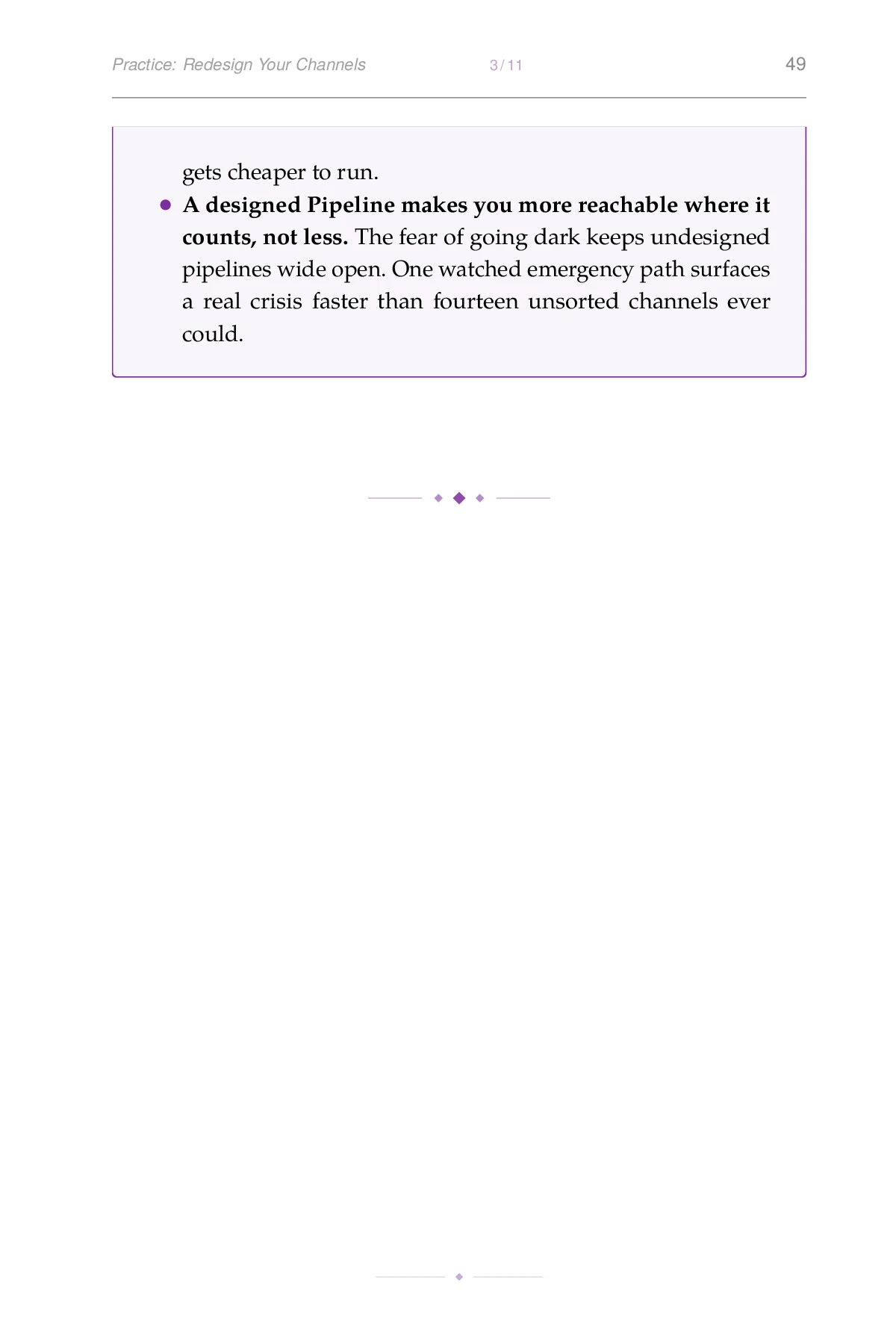
unresolved charges quiet interest against every other hour,
The Attention Architect, printed page: unresolved charges quiet interest against every other hour,
Inspect more pages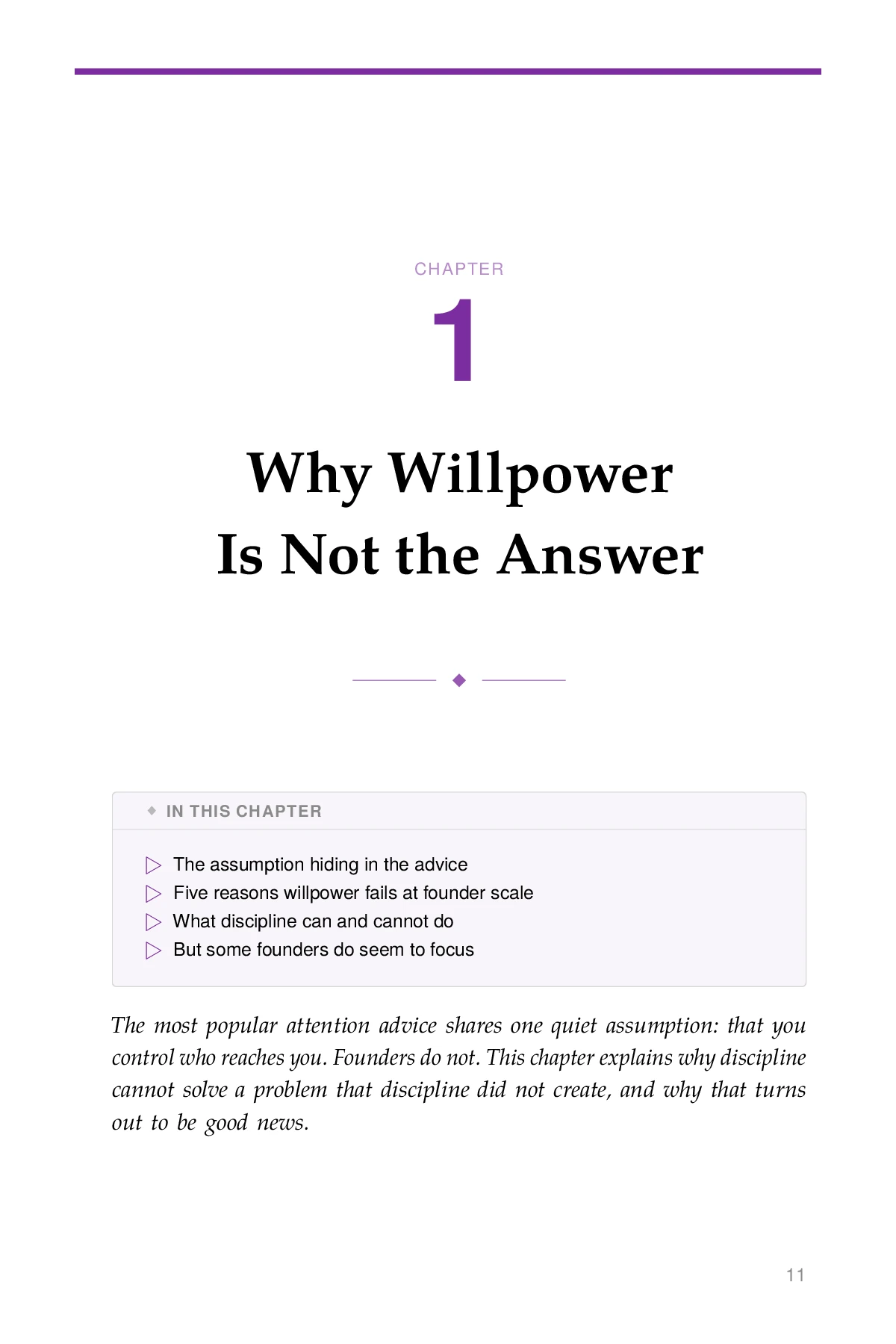
The contents
Chapter by chapter
Every chapter of The Attention Architect with its printed epigraph, what you can do afterwards, and the moment it is built for.
Introduction
Introduction: The Founder's Attention Crisis
Every focus method on the shelf was built for a reader who is allowed to close the door. Founders are not. This chapter names the crisis that advice was never designed to solve, and refuses to let you carry the blame for it.
What you can do afterwards
You will see that your attention crisis is structural, not a personal failing, so you can stop grading your character and start examining your conditions.
Use this chapter when
You have tried protected focus blocks, a cleared inbox, and a screen-free weekend, and each one collapsed the moment your team, your investors, or your customers needed you.
Chapter 1
Why Willpower Is Not the Answer
The most popular attention advice shares one quiet assumption: that you control who reaches you. Founders do not. This chapter explains why discipline cannot solve a problem that discipline did not create, and why that turns out to be good news.
What you can do afterwards
You will understand why willpower-based focus methods fail at founder scale, so you can stop grading yourself on a test that was rigged before you sat down.
Use this chapter when
You have tried to "just focus," it has not held, and a quiet voice keeps telling you the failure is yours.
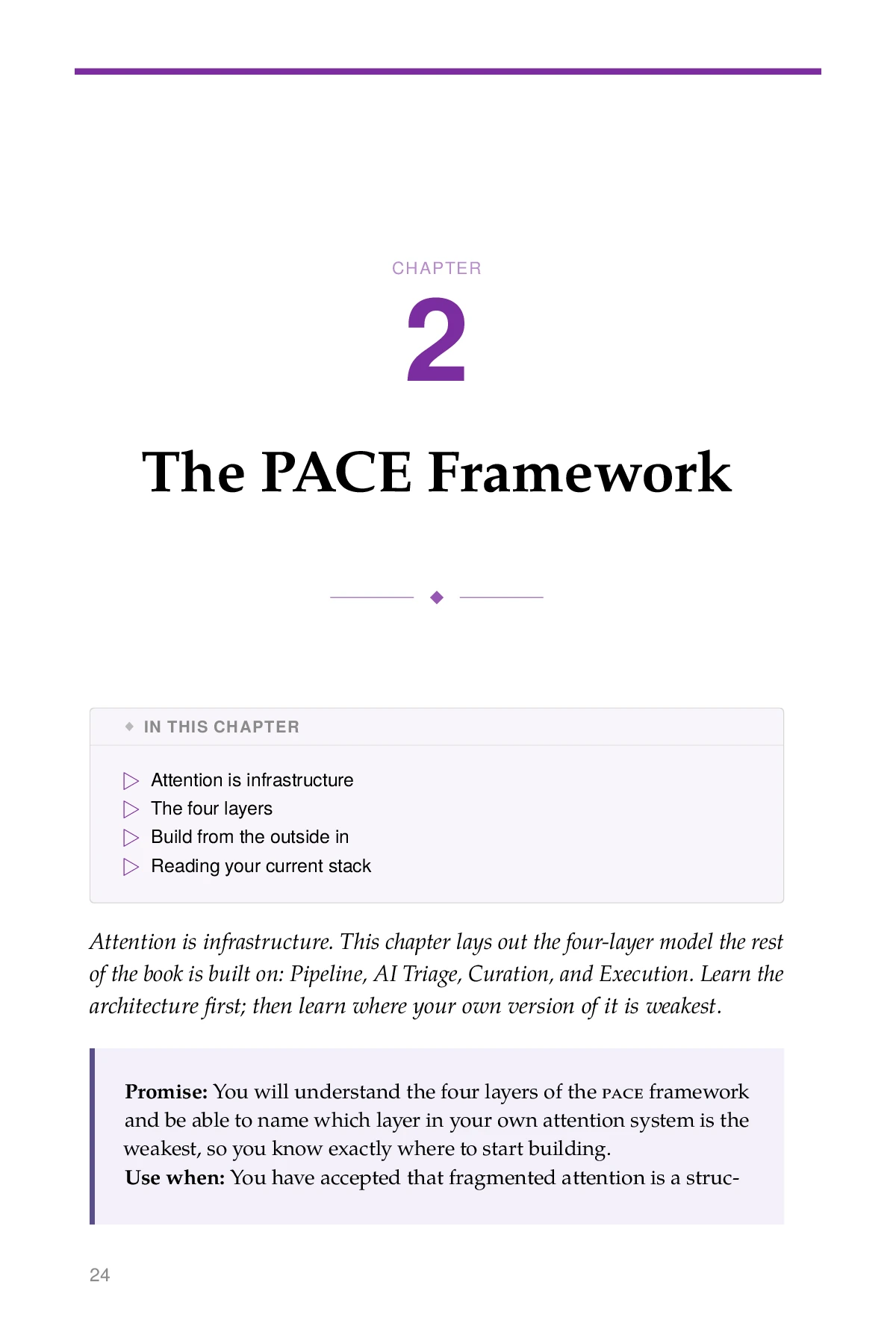
Chapter 2
The PACE Framework
Attention is infrastructure. This chapter lays out the four-layer model the rest of the book is built on: Pipeline, AI Triage, Curation, and Execution. Learn the architecture first; then learn where your own version of it is weakest.
What you can do afterwards
You will understand the four layers of the PACE framework and be able to name which layer in your own attention system is the weakest, so you know exactly where to start building.
Use this chapter when
You have accepted that fragmented attention is a structural problem, and you are ready to build a system instead of trying harder.
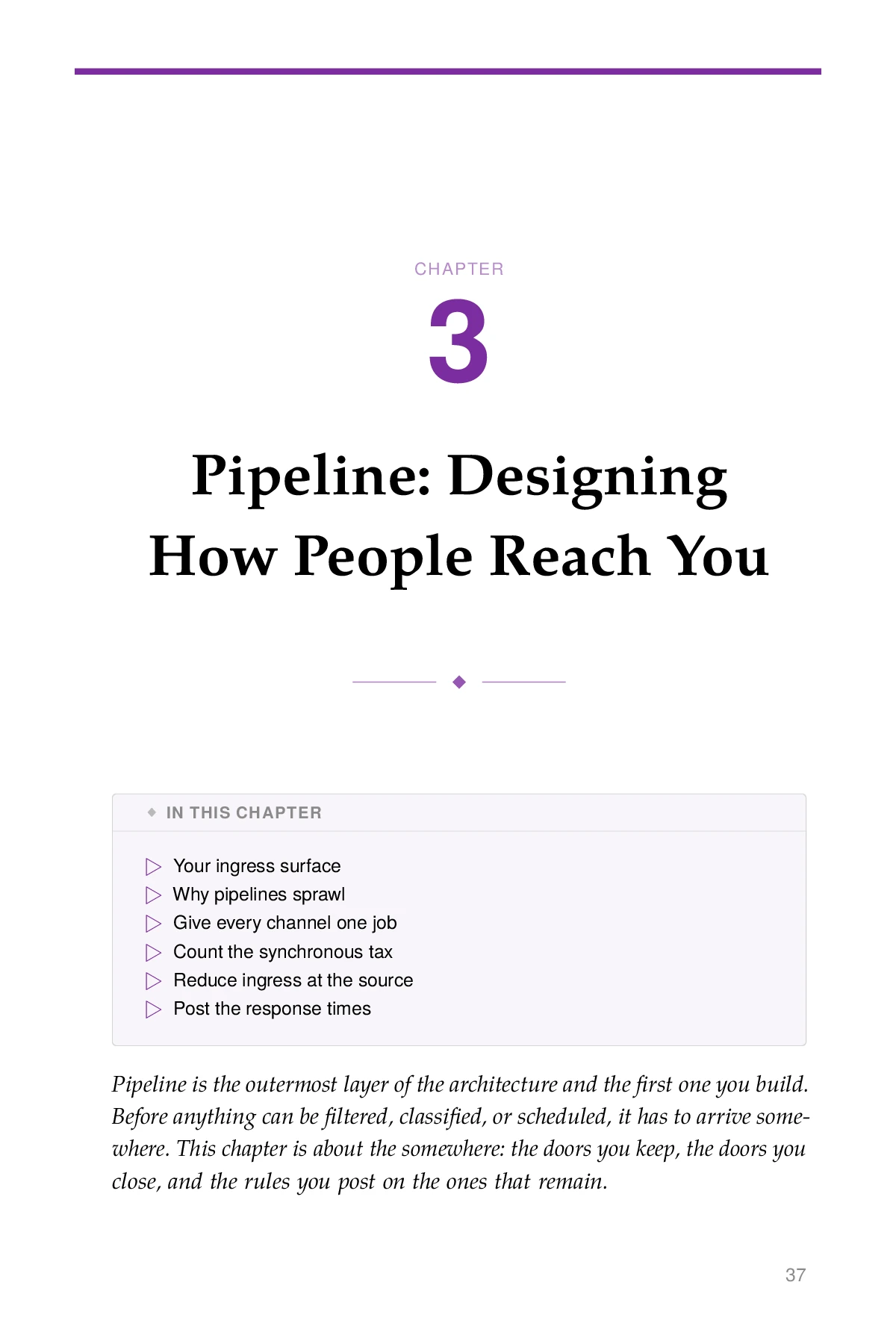
Chapter 3
Pipeline: Designing How People Reach You
Pipeline is the outermost layer of the architecture and the first one you build. Before anything can be filtered, classified, or scheduled, it has to arrive somewhere. This chapter is about the somewhere: the doors you keep, the doors you close, and the rules you post on the ones that remain.
What you can do afterwards
You will redesign your communication channels so that volume drops before triage even begins. You leave with fewer doors, a stated purpose and response time for each, and a single path held in reserve for the things that truly cannot wait.
Use this chapter when
You are drowning in messages from too many channels, and not one of them has a job you could name in a sentence.
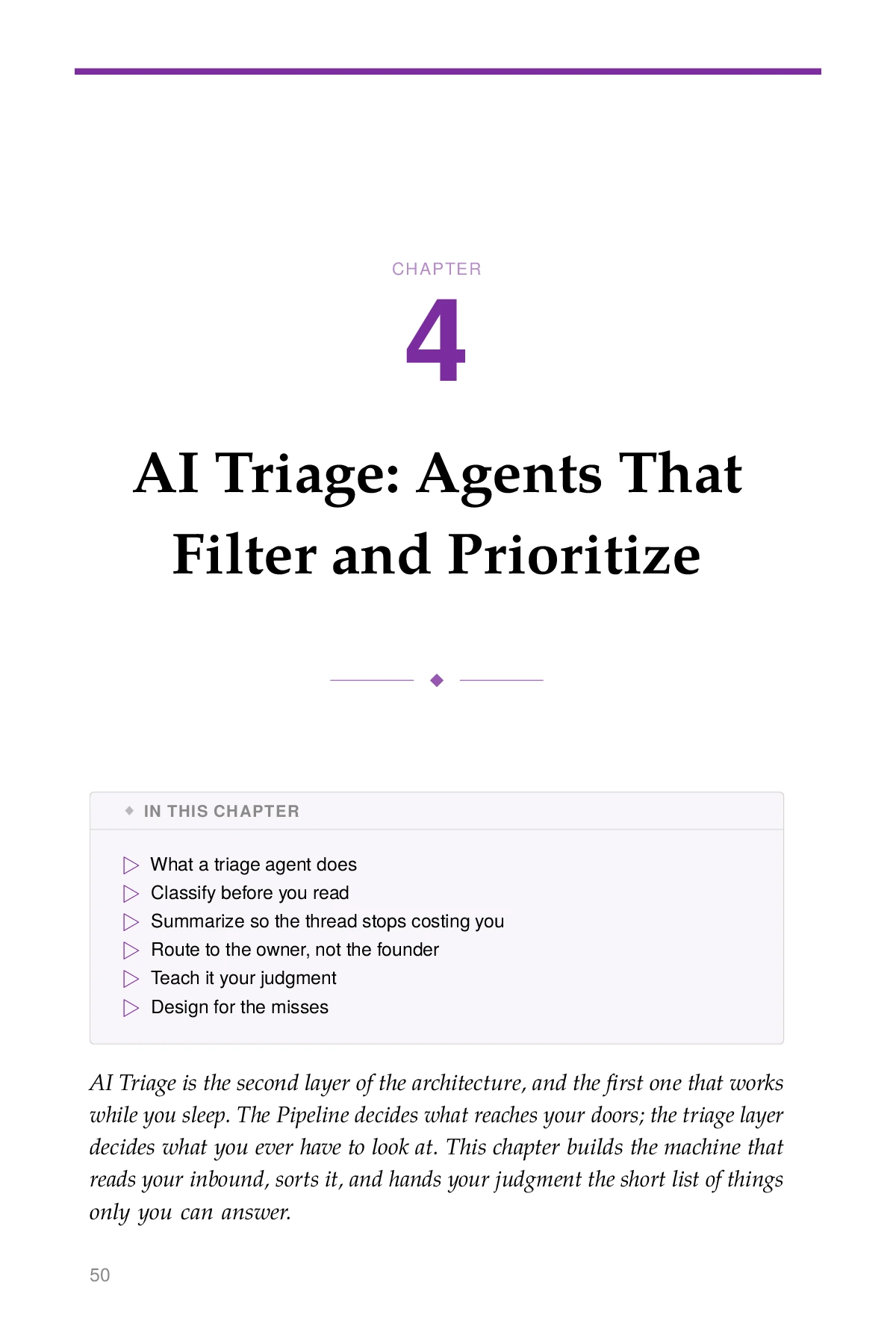
Chapter 4
AI Triage: Agents That Filter and Prioritize
AI Triage is the second layer of the architecture, and the first one that works while you sleep. The Pipeline decides what reaches your doors; the triage layer decides what you ever have to look at. This chapter builds the machine that reads your inbound, sorts it, and hands your judgment the short list of things only you can answer.
What you can do afterwards
You will stand up a triage agent that reads your inbound, classifies it by urgency and ownership, summarizes the long threads, and routes most of it without you. The hours you now lose to sorting by hand come back, and your judgment meets a short list in place of a firehose.
Use this chapter when
Your Pipeline is redesigned and the channels you kept still deliver more than you can read, so you remain the bottleneck, sorting by eye what a machine could sort for you.
Chapter 5
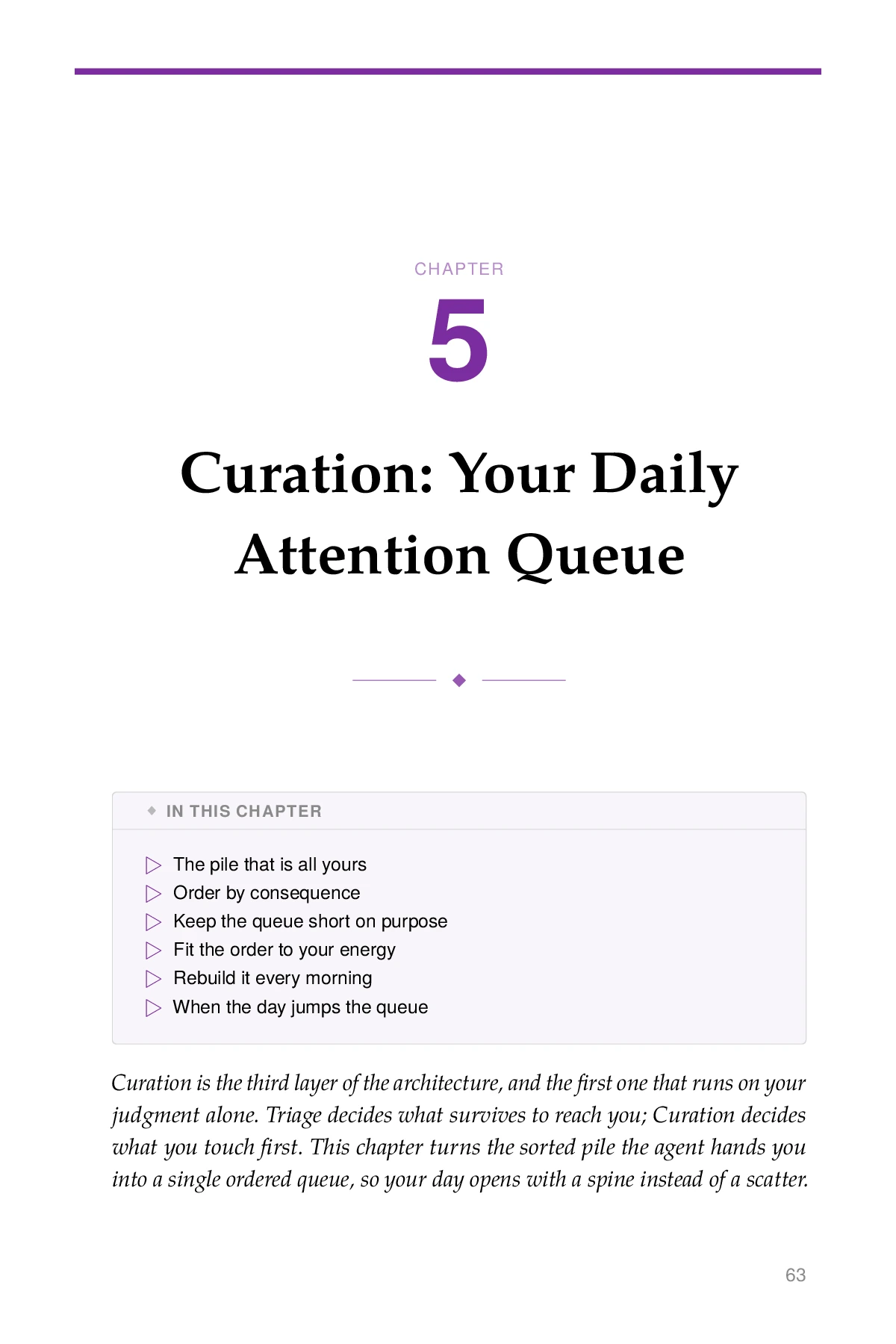
Curation: Your Daily Attention Queue
Curation is the third layer of the architecture, and the first one that runs on your judgment alone. Triage decides what survives to reach you; Curation decides what you touch first. This chapter turns the sorted pile the agent hands you into a single ordered queue, so your day opens with a spine instead of a scatter.
What you can do afterwards
Each morning you will build one short, ordered list of the work that needs your judgment, with the most consequential item at the top, and you will run your day from that list instead of from four scattered surfaces.
Use this chapter when
Your triage layer is running and the volume has dropped, yet you still open the day to a scatter of genuinely-yours items across inbox, chat, and your project board, with no single order telling you where to start.
Chapter 6
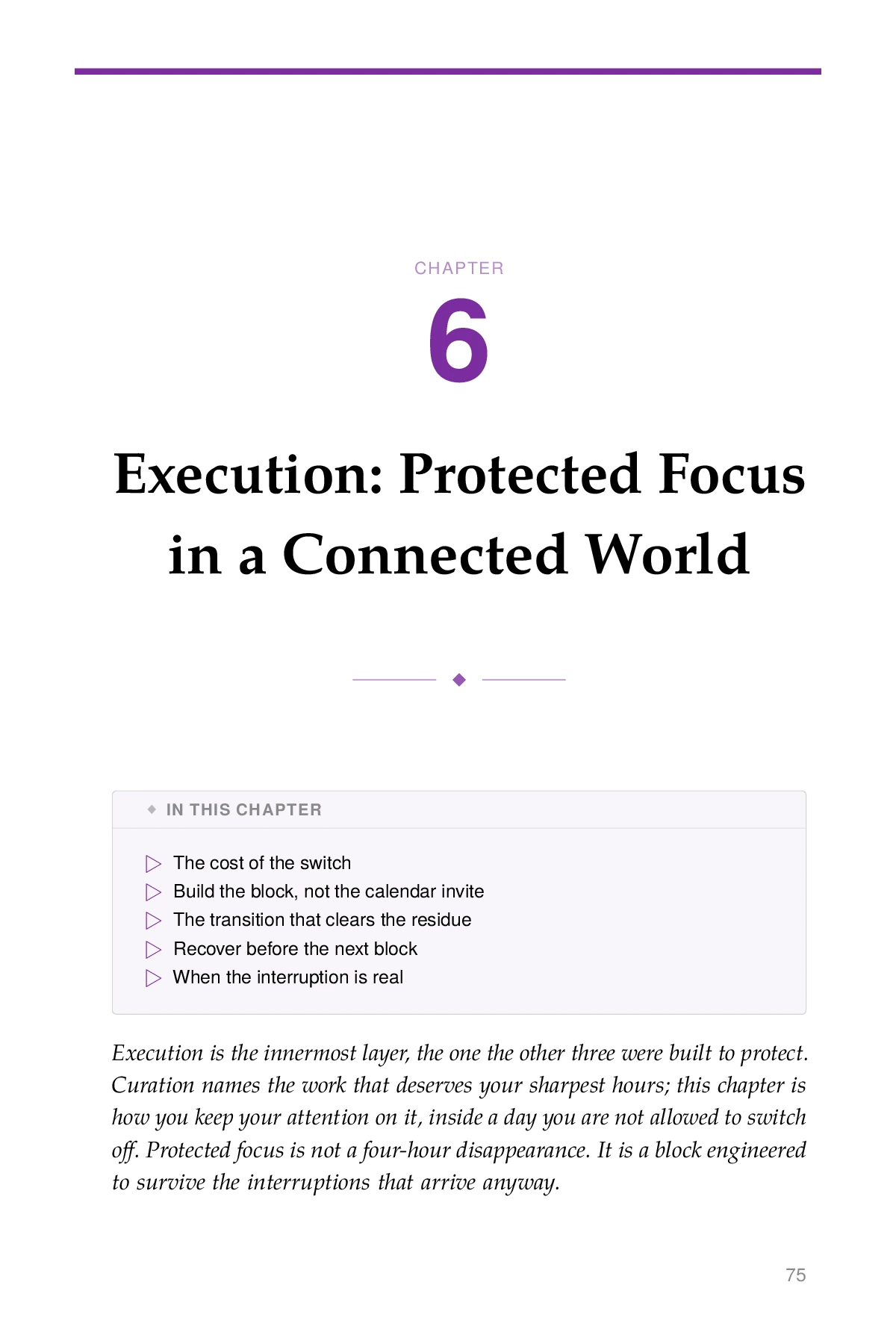
Execution: Protected Focus in a Connected World
Execution is the innermost layer, the one the other three were built to protect. Curation names the work that deserves your sharpest hours; this chapter is how you keep your attention on it, inside a day you are not allowed to switch off. Protected focus is not a four-hour disappearance. It is a block engineered to survive the interruptions that arrive anyway.
What you can do afterwards
You will run focus blocks that finish your most consequential work, built with a transition ritual on each side and a recovery beat after, in a job where you cannot disconnect from the people who need you.
Use this chapter when
Your queue is clean and ranked, yet the item at the top keeps surviving to tomorrow because the day shreds every block you set aside for it.
Chapter 7
The Attention Audit
Measurement is the moment the architecture stops being a theory. Every layer you built made a quiet promise about where your attention would go. The attention audit is how you find out whether the building kept its word, or whether it leaks in the places you never thought to look.
What you can do afterwards
You will run a five-day attention audit that shows where your attention truly goes, which work returns the most for it, and where the largest leaks are hiding, so your next redesign aims at a real gap instead of a guessed one.
Use this chapter when
You suspect your attention is not landing where you think it lands, and you want a record honest enough to settle the question.
Chapter 8
Team-Level Attention Architecture
Every layer you have built governs your own half of the system. The Pipeline sets which doors exist, the triage agent sorts what arrives, the queue ranks it, and protected focus spends it well. None of those layers reaches the expectation in someone else's head about how fast you will answer. A door has two sides. This chapter builds the side you do not own alone.
What you can do afterwards
You will turn the communication habits of your team into a written agreement, async by default and fast where it counts, so the one leak no private setting could close finally closes.
Use this chapter when
Your personal architecture works, yet a steady drip of interruptions still arrives because the people around you expect a speed you quietly stopped promising.
Chapter 9
Recovery: Attention as a Renewable Resource
The architecture is built and the team respects it, and a week of protected days can still end in fog. Attention pays for its own use. Every layer so far spends the resource well, and none of them puts it back. This chapter builds the layer that does, and treats recovery as a part of the work instead of the rest you take once the work is done.
What you can do afterwards
You will design recovery as a layer at three timescales above the focus block, the day, the week, and the season, so the architecture you built stays sustainable instead of grinding you down on schedule.
Use this chapter when
Your layers all work and your days are defended, and you still end the week depleted, with the last hours of each day and the last days of each week reliably your weakest.
Chapter 10
Building Your Attention Agent
What you can do afterwards
You will build or configure your triage agent for real, assembling it from a handful of durable parts so that it runs the first-pass sort of your inbound and keeps running when the tools underneath it change.
Use this chapter when
You have designed your Pipeline and your queue, you understand what the triage layer should do, and the agent still exists only as a page of notes because building it looks like work for someone more technical.
Chapter 11
Failure Modes
Every layer you have built can break, and the break to fear is the quiet one. This chapter maps how an attention architecture fails, layer by layer, and gives each failure a fallback plain enough to run on your worst morning, so that the next break becomes a recovery instead of a disaster.
What you can do afterwards
You will name the ways your attention architecture can fail before they happen, and write a fallback for each one, so the morning the system breaks you reach for a plan instead of for panic.
Use this chapter when
The architecture has run well for long enough that you have stopped watching it, and a part of you knows that a system you no longer check is a system you can no longer trust.
Conclusion
The Architect's Mindset
The building is finished, and the person who finished it is not the person who began. This chapter is about that person: the founder who stopped fighting the firehose and learned to design around it, and who now owns the one thing no method could hand over, the right to decide what their own mind works on.
What you can do afterwards
You will complete the shift the whole book was building toward, from someone whose attention is governed by whoever reaches them last to someone who designs where their attention goes, and you will leave knowing the work is a practice you keep, not a project you finish.
Use this chapter when
The architecture runs. The six layers hold, the fallbacks are written, and you are ready to name what changed in you while you built them.
Who it is for
Who this book was written for
This is not digital minimalism rebranded, or another tour of apps you abandon by Friday. It is operator-grade attention design: protocols you can run on a fragmented Tuesday, when the pings are constant and the asset every other skill draws on is overdrawn.
The result is not a founder who answers faster. It is one who spends the day's sharpest bandwidth on the work only they can do, and lets the rest wait.
If you build under pressure and refuse to let the loudest demand outrank the most important one, this is for the operator whose attention is the real bottleneck.
The reader it was written for
Growth-stage founder (5–50 employees) who is drowning in communication. They cannot quit Slack. They cannot ignore email. The team needs them, investors expect responsiveness, and deep work feels like a luxury they cannot afford. They have tried deep work, inbox zero, or digital minimalism and found them unsustainable.
Also a fit for
1. Senior operator / executive in a high-communication role. Similar attention problems to founders. 2. AAS reader who wants to apply AI agents to a new domain (attention management). 3. Knowledge worker with high coordination load — not a founder but faces the same structural attention problem.
What you will use it on
- **Reduce inbound noise** — "Stop the Slack firehose from controlling my day. I need an API gateway for my brain.
- **Protect deep work without abandoning the ship** — "Get 2-3 hours of uninterrupted focus without the cognitive tax of worrying that the company is burning down while I am away.
- **Know what actually matters** — "Filter the 200 daily pings down to the 3 things that genuinely require my asymmetric judgment.
- **Kill the context-switch tax** — "Eliminate the 25-minute cognitive reboot required every time I switch from strategic planning to a tactical Slack thread.
- **Scale attention linearly while communication scales exponentially** — "Build a system that handles 5x team growth without requiring 5x founder attention.
Probably not for you if
- People looking for a "quit social media" detox book
- Readers who believe the solution is pure willpower or habit change
- People in low-communication roles (the problem scales with responsibility)
- Technology rejectionists
Editions
Editions and specifications
| Edition | Formats | Chapters | Pages | Reading time | ISBN (paperback) |
|---|---|---|---|---|---|
| English The Attention Architect | In production | 13 | 208 | ± 3 hours | — |
| Dutch De aandachtsarchitect | In production | 13 | 218 | ± 3 hours | — |
Both editions are written natively. The Dutch text is not a machine translation of the English. · Trim size: 6x9″
Frequently asked
What readers usually want to know
What is The Attention Architect about?
PACE treats founder distraction as an architecture problem: route, triage, curate, and execute through AI systems so judgment is reserved for what only the operator can decide. The subtitle is: Reclaiming Cognitive Sovereignty by Delegating Distraction to AI.
Is there a Dutch edition?
Yes. The Dutch edition is De aandachtsarchitect, written as a native edition rather than a machine translation. It moves through the same production line.
How long is The Attention Architect?
This edition runs 13 chapters, 208 pages in print and roughly 3 hours of reading.
Who is The Attention Architect for?
If you build under pressure and refuse to let the loudest demand outrank the most important one, this is for the operator whose attention is the real bottleneck.
The production system
How this book was made
Every title moves through the same gated production line: sourced research, a claim-level evidence ledger, structural review, fact-checking, red-team critique, and a bilingual final edit. AI agents do specialist work inside those gates; judgment, voice, and accountability stay human.
- Claims enter an evidence ledger with a source and a confidence grade before they reach the page
- English and Dutch are two native editions, not a translation of one another
- Every chapter clears readability, rhythm, and style gates before it is typeset


