Available now · worldwide on Amazon
AI Agents for Startup Strategy
How Founders and Operators Deploy Agentic AI to Move Faster and Think Smarter
Sense markets while your competitors are still drafting emails
The SENSE framework turns AI from a productivity shortcut into a strategic intelligence layer that scans, evaluates, navigates, simulates, and supports execution without replacing founder judgment.
Get the book
Also on Bol.com → Third-party listing (not our storefront). Amazon remains the primary buy path.
Reading from another country?Pick your own Amazon marketplace — same edition, your store.
Amazon links may include affiliate tags. That does not change the price you pay. Bol.com listings are third-party.
English & Dutch editions · Kindle, Paperback, Hardcover · free on Kindle Unlimited · Nederlandse editie →
- pages
- 274
- chapters
- 17
- hours of reading
- ± 3
- editions
- EN · NL


The editions
Choose your format
Same book, your format. You buy on Amazon, not on this site.
-
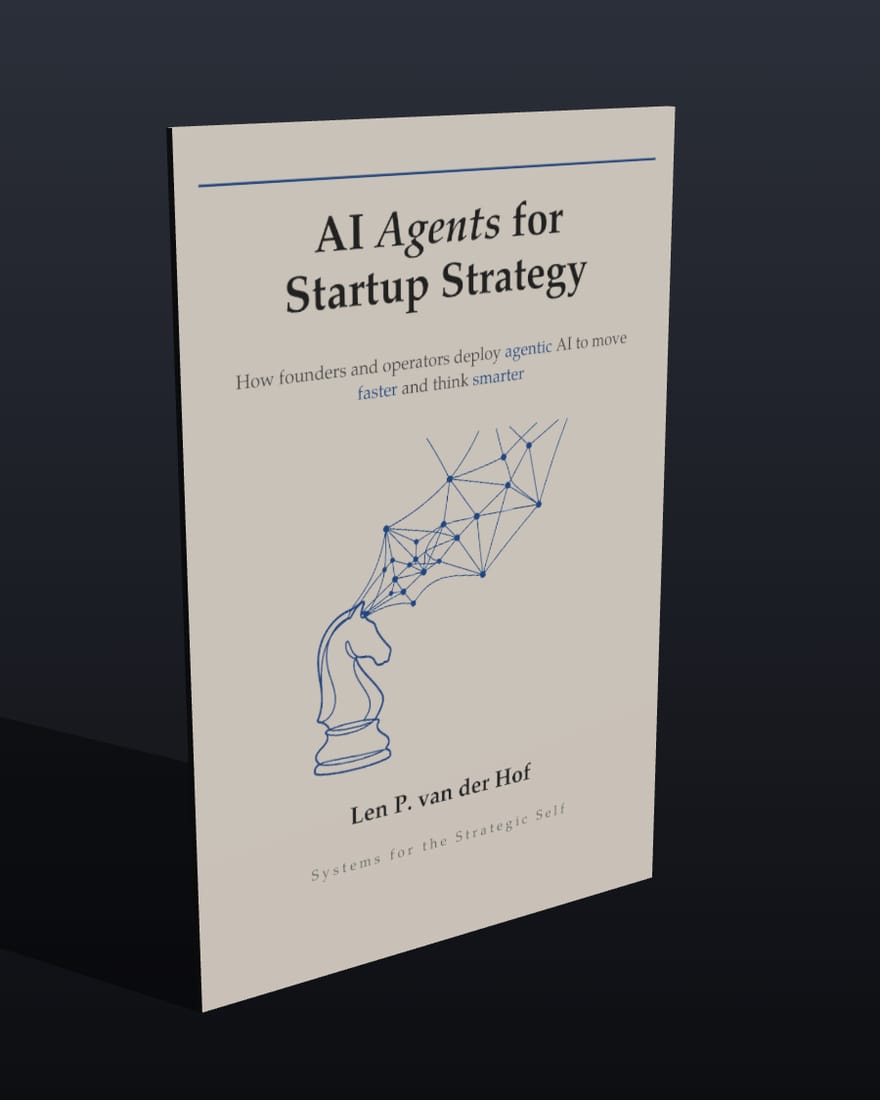
Kindle
Read now. Kindle Unlimited members get it at no extra cost.
Buy on Amazon -
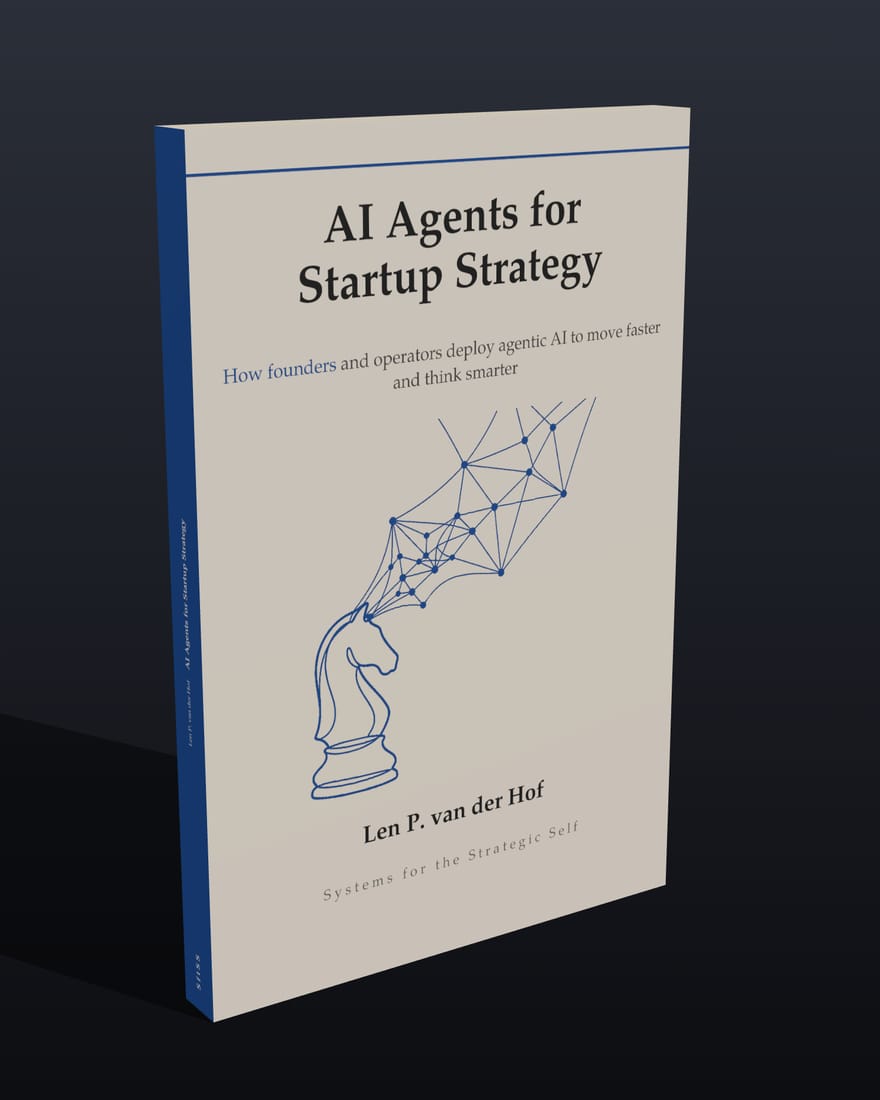
Paperback
The working copy. Mark it up. Take it into the meeting.
Buy on Amazon -
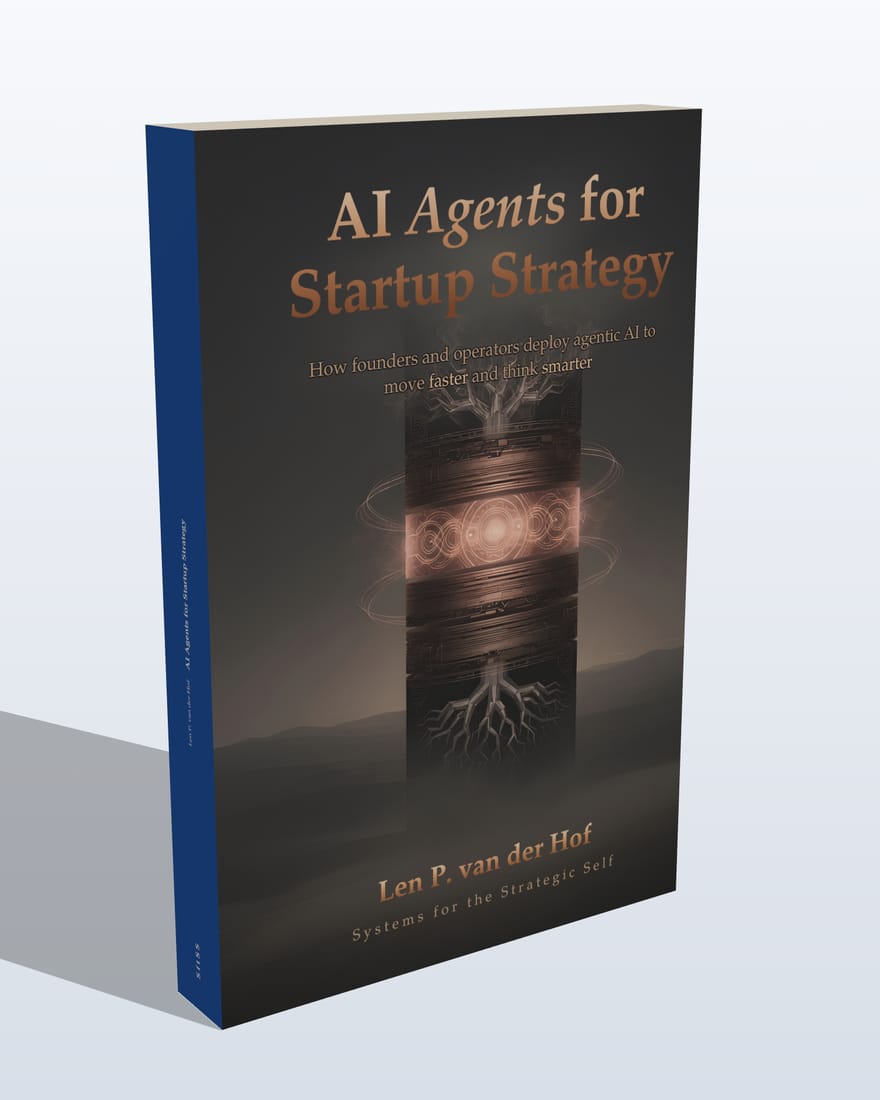
Hardcover
The shelf edition. Dark full-art jacket, built to stay in the room.
Buy on Amazon


Available now
How Founders and Operators Deploy Agentic AI to Move Faster and Think Smarter
You use AI every day, and your strategy still runs on luck and meetings. You ask a chatbot a question, copy the answer into a deck, and call it leverage. Meanwhile a competitor moves, the market shifts, a customer signal goes cold, and you find out a week too late, in a status update, when the cost of the delay is already booked.
The usual advice is to "adopt AI faster": buy more tools, write better prompts, wait for the next model. It fails because it leaves your strategic awareness exactly where it was, rented from whoever happened to be in the room.
This book gives you something you can build instead: a strategic intelligence layer. Its design grammar is SENSE (Scan, Evaluate, Navigate, Simulate, Execute), the five phases every durable agent system runs, and the five places most agent projects quietly collapse. SENSE is the spine; the tools are weather. When the models change, the layer still works.
Inside, you build the layer one system at a time:
What you can do
What this book puts in your hands
- Deploy five agent systems, from competitive and market to scenario, customer, and investor intelligence, wired into a defined decision cadence.
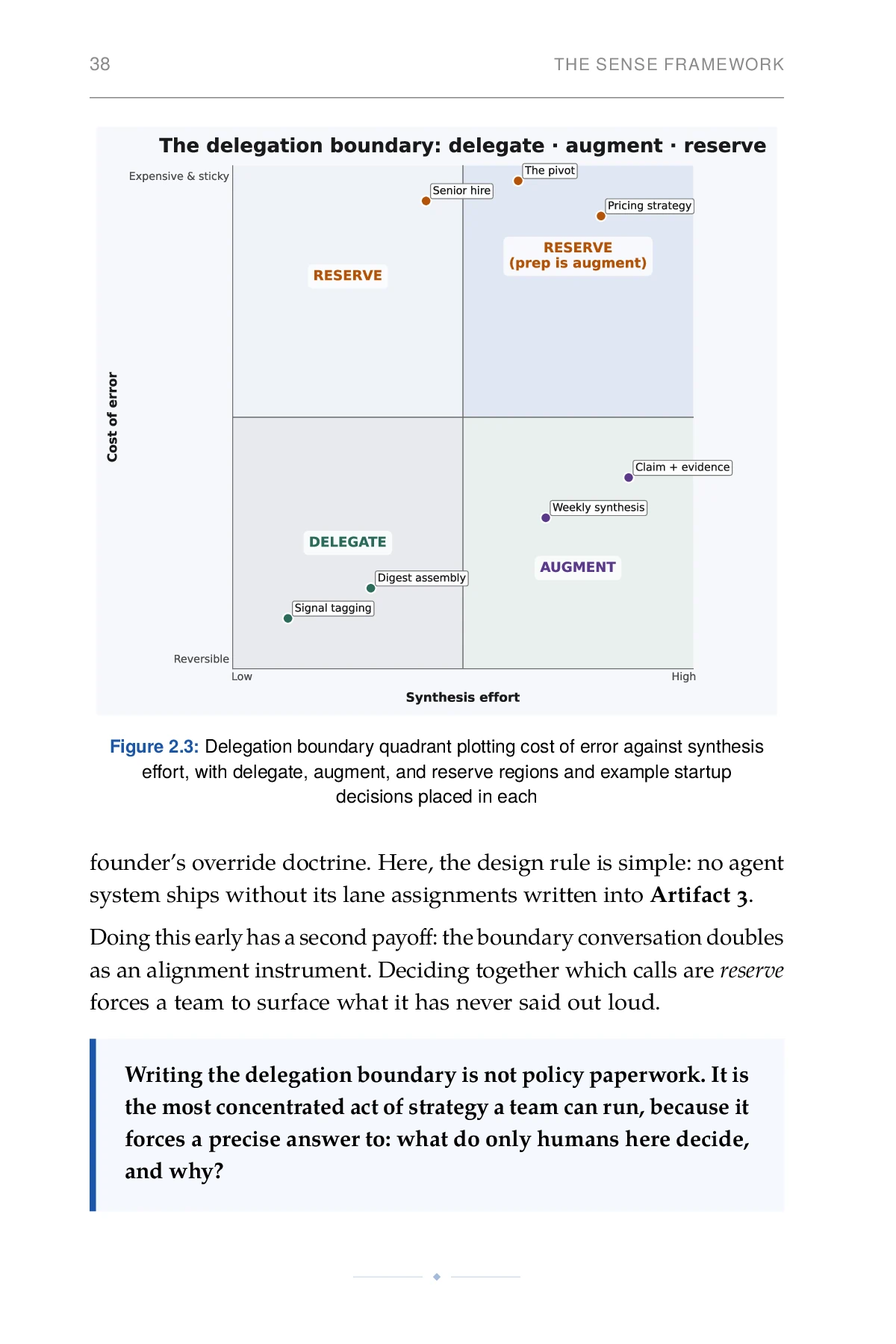
- Draw the boundary of delegation: classify each decision as delegate, augment, or reserve, and never hand a machine the judgment that is yours to keep.
- Run a 90-day deployment protocol that turns a diagram into a working system your team can operate.
- Read claims that are dated and sourced. This book tells you, in writing, when each capability claim expires.
The framework
SENSE: the system behind the book
a five-part architecture for autonomous strategic intelligence
-
Scan
Collection with a thesis: watch the competitor surfaces, regulatory dockets, and customer signals your strategy actually depends on.
-
Evaluate
Turn raw signal into a sourced claim with a confidence grade, instead of another summary nobody can act on.
-
Navigate
Make the claim change something real: the watchlist tightens, the assumption register updates, the strategy moves.
-
Simulate
Rehearse the future before it arrives: ask what would happen if, and pressure-test the plan against it.
-
Execute
Meet a decision or it never happened: a one-page brief in the Monday review, an alert the moment it matters.
From the book
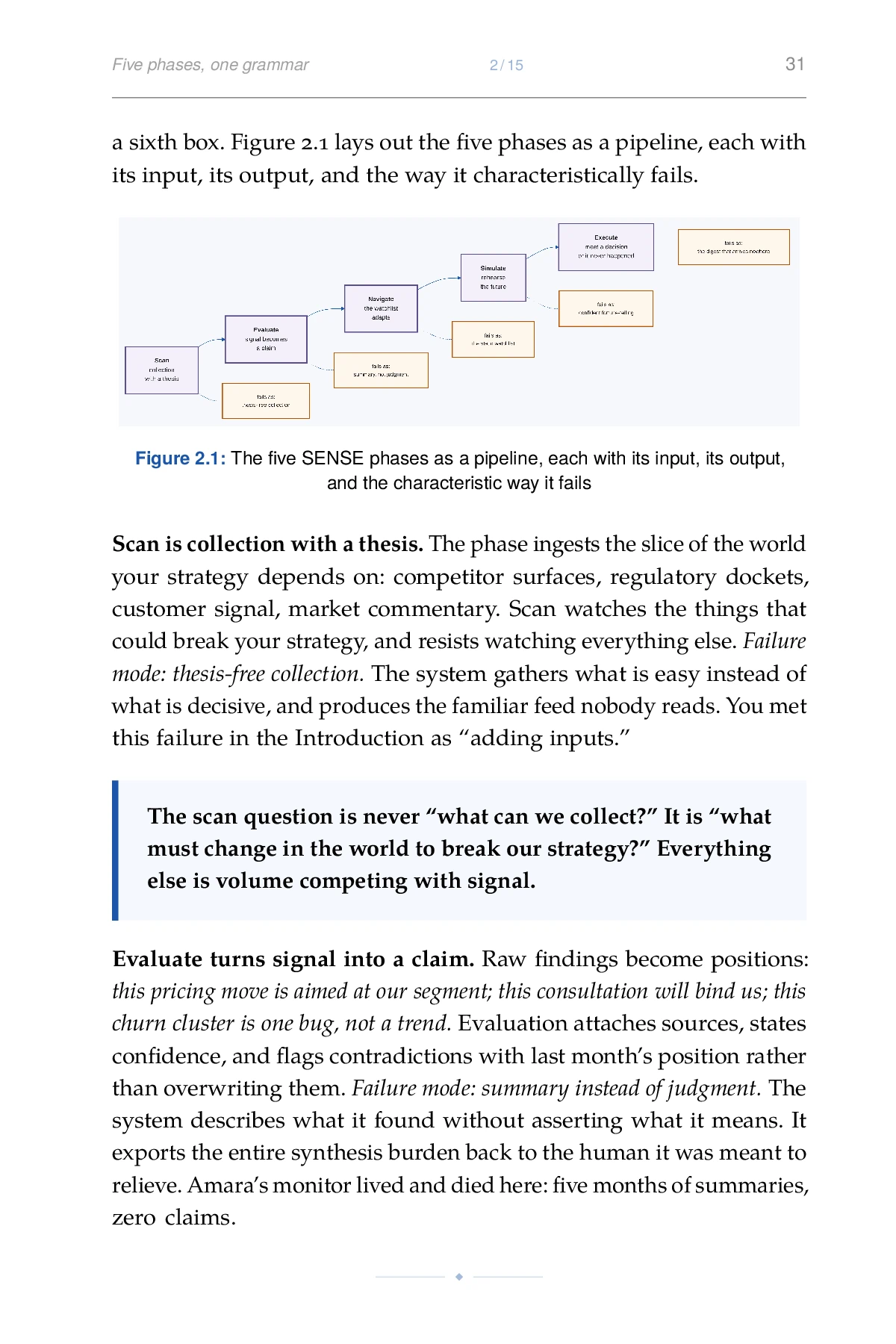
SENSE: five phases from signal to a decision point
SENSE is a five-phase design grammar for strategic agent systems. It turns collection into a claim, adapts what the system watches, rehearses plausible futures, and delivers the result where a person decides.
Detailed description
The diagram runs from left to right through five connected phases. Scan collects with a thesis; without one, it fails as thesis-free collection. Evaluate turns a signal into a claim; it fails when it produces a summary instead of judgment. Navigate adapts what the system watches in response to the claim; it fails when the watchlist stays static. Simulate rehearses a small set of plausible futures; it fails as confident fortune-telling. Execute brings prepared work to a concrete decision moment; it fails as a digest that arrives nowhere. Dotted lines pair each phase with its failure mode. SENSE deliberately has no Decide phase: the system prepares the choice, and a person owns the decision.
Look inside
Pages from the print edition.
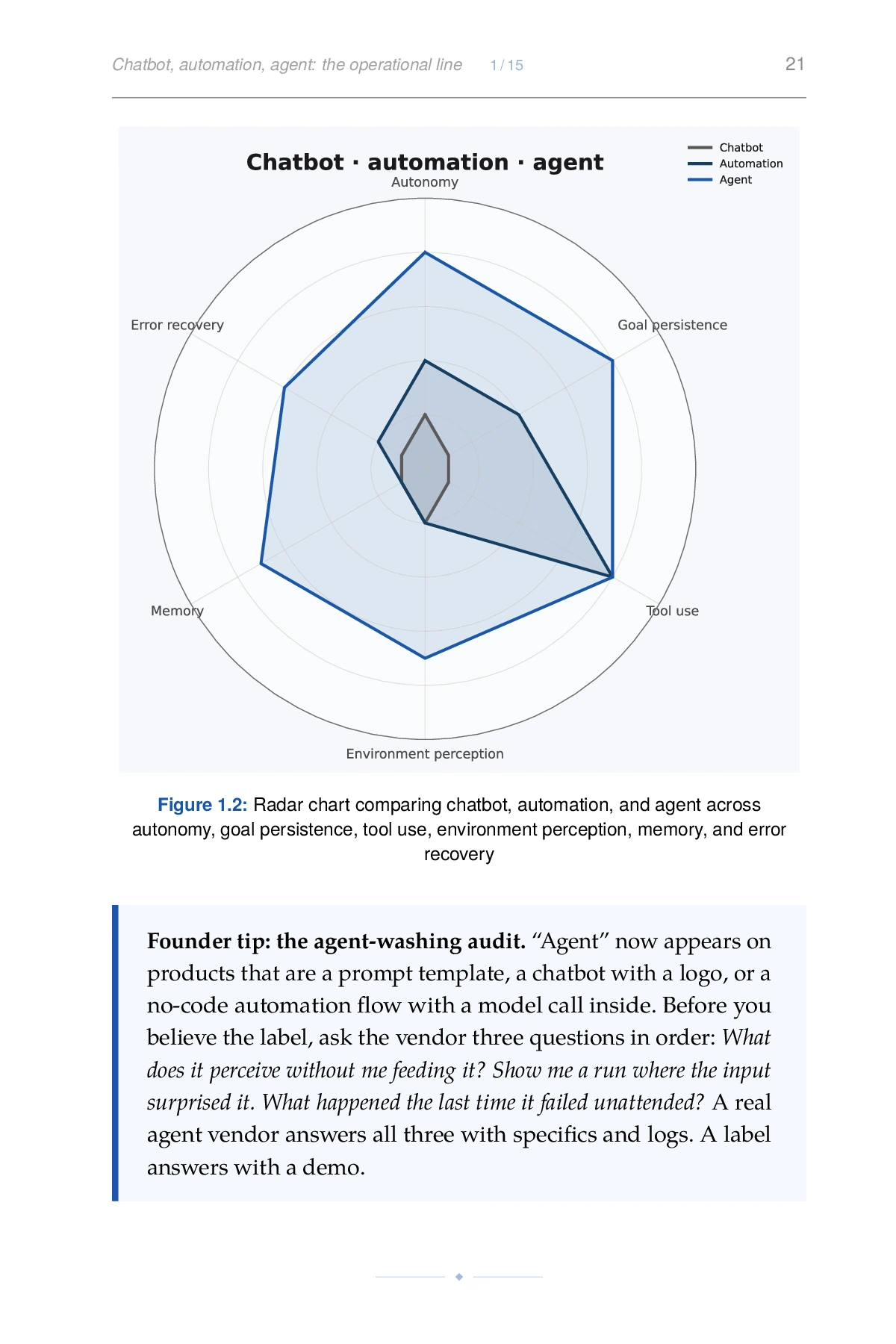
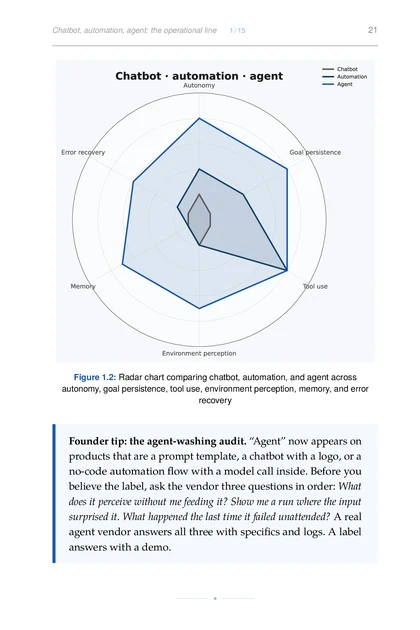 Radar: chatbot vs automation vs agent
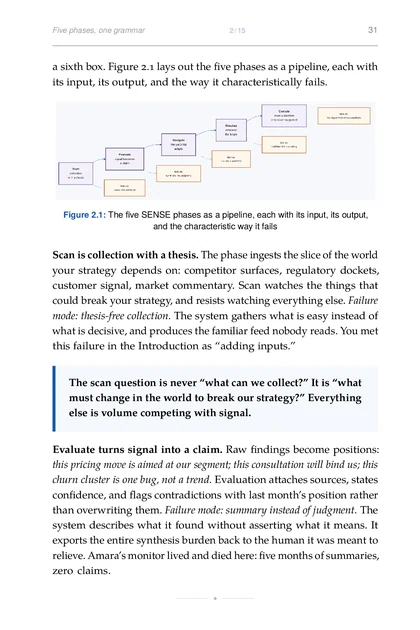 SENSE five-phase pipeline with failure modes
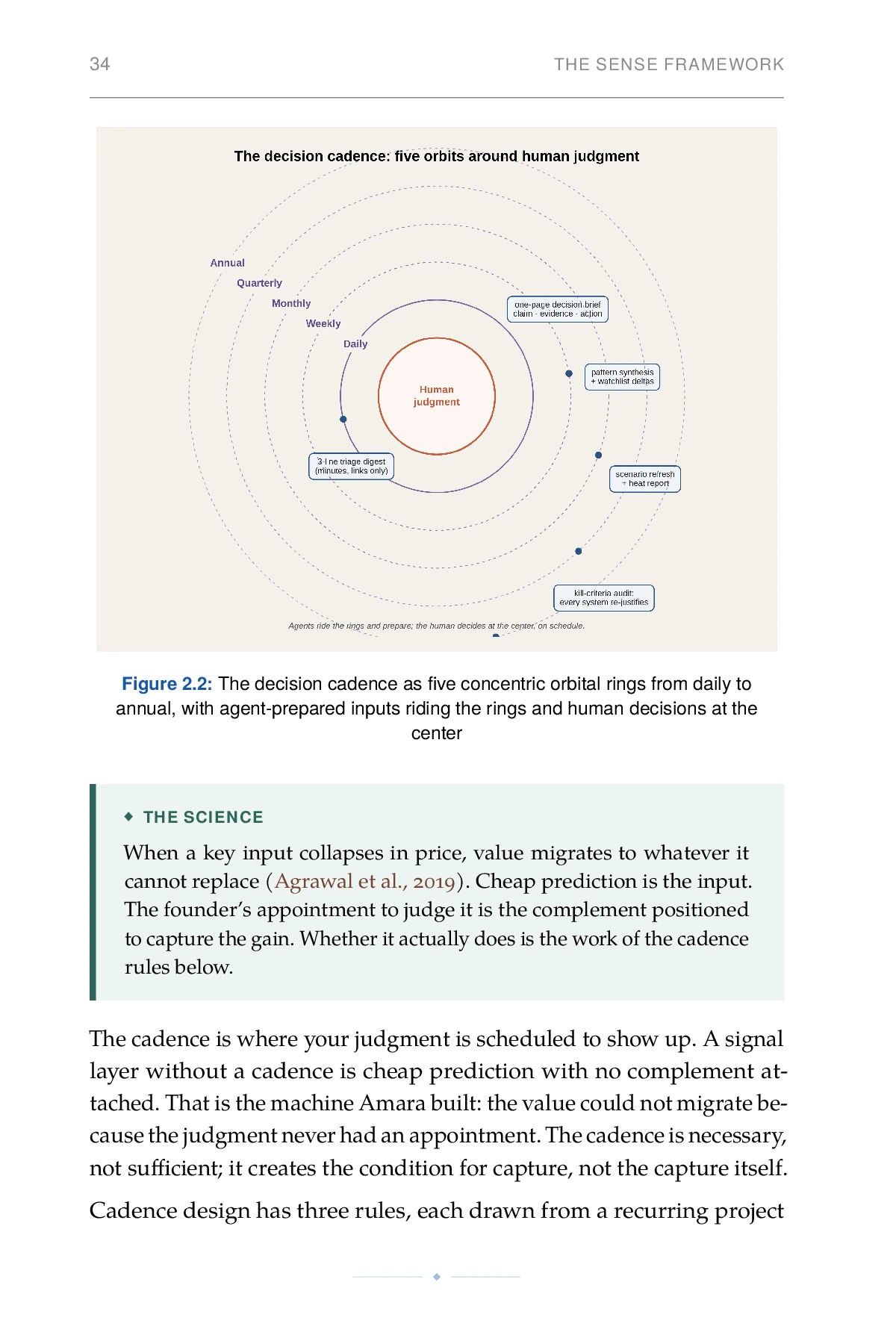
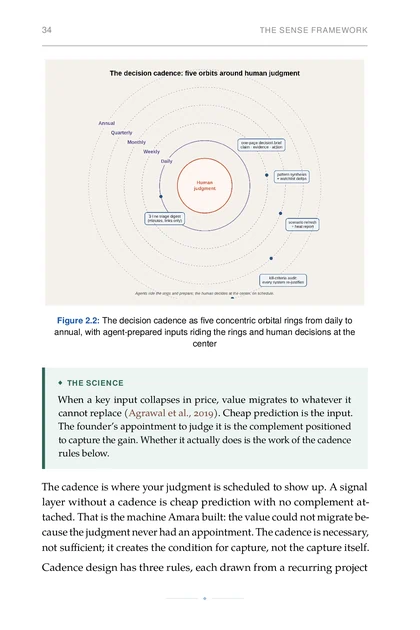 Decision cadence: five orbital rings around human judgment
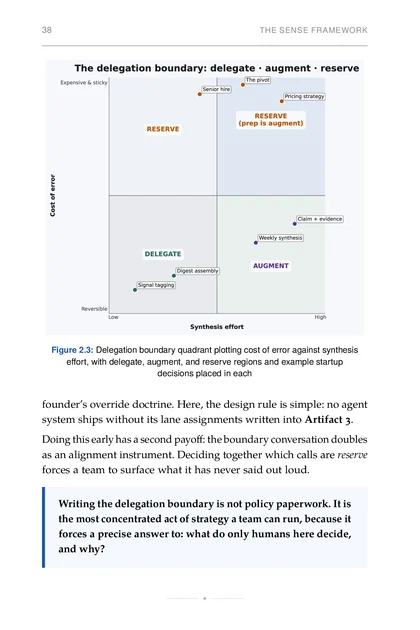 Delegation boundary: delegate · augment · reserve
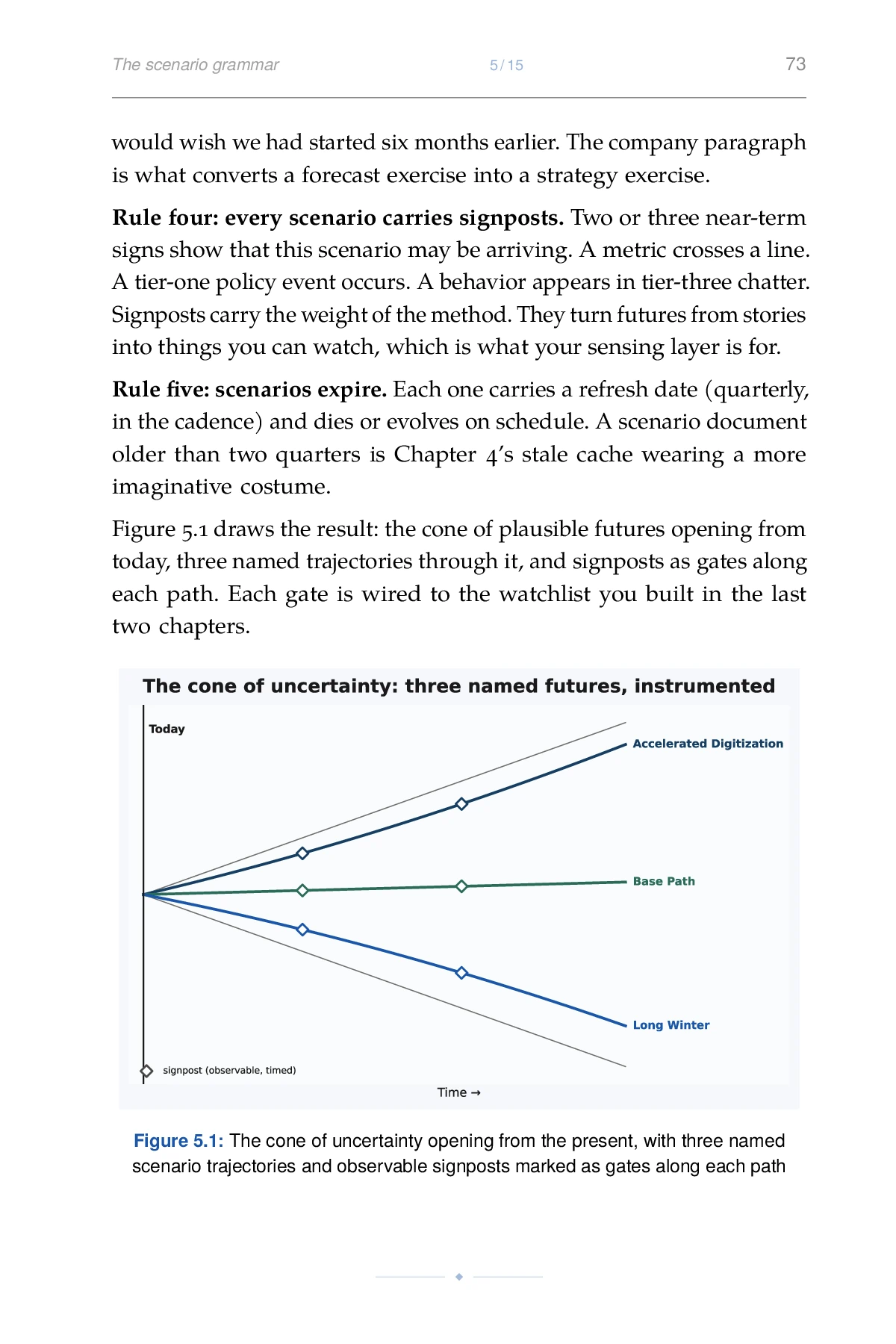
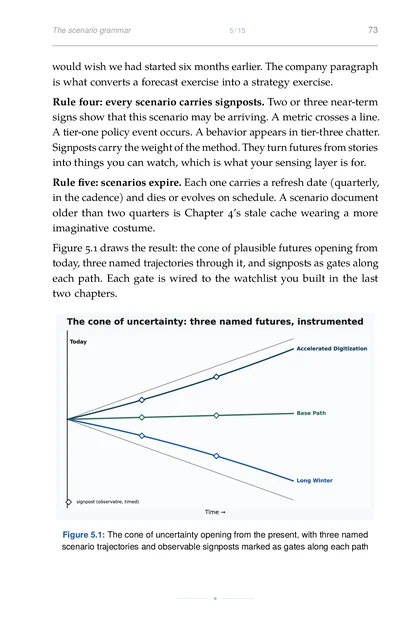 Cone of uncertainty with three named futures
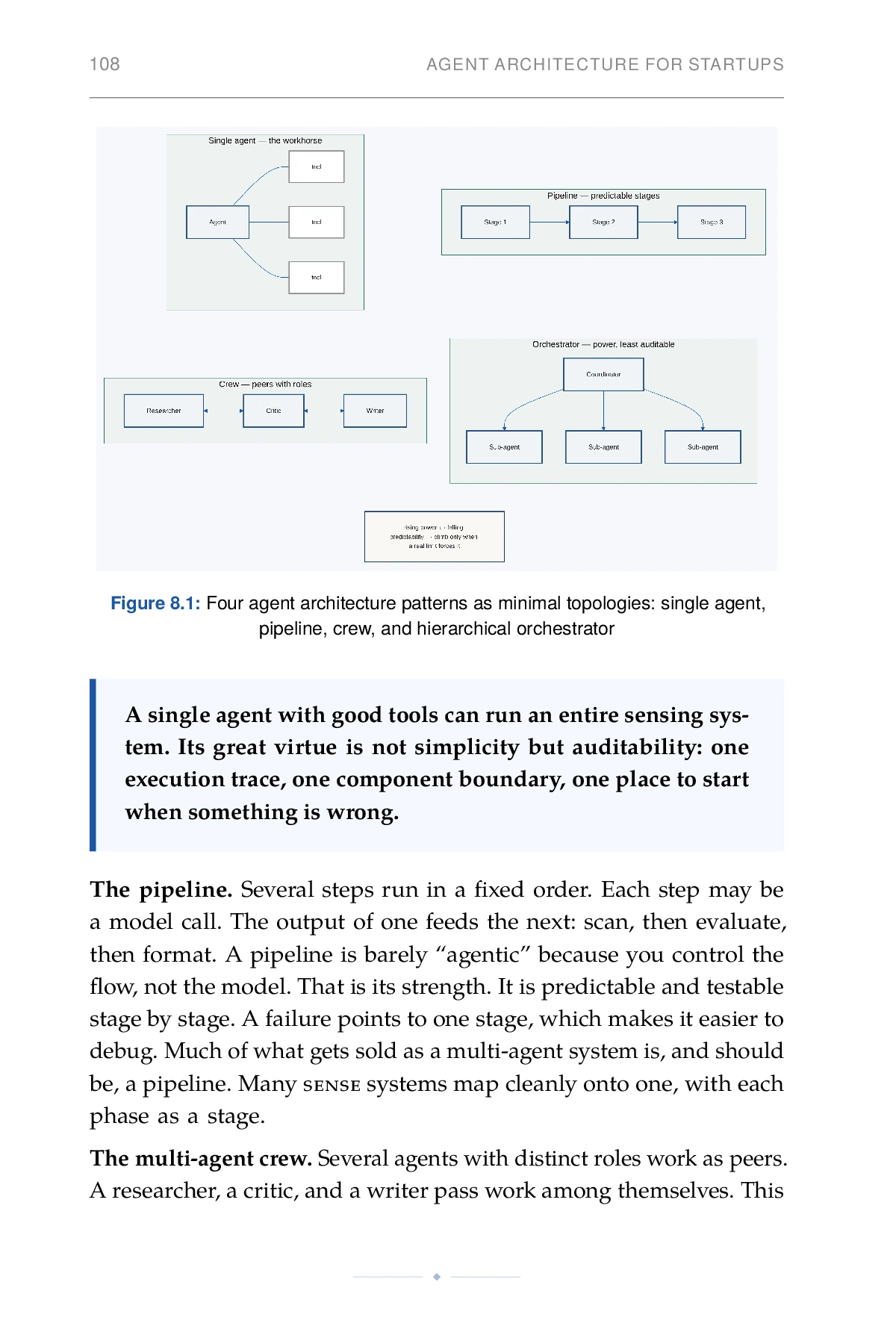
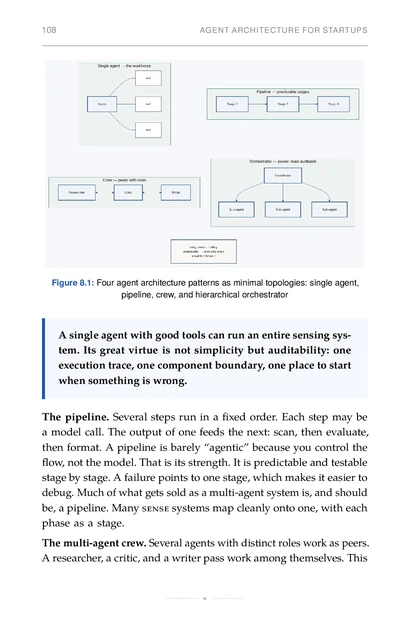 Four agent architecture patterns as topologies
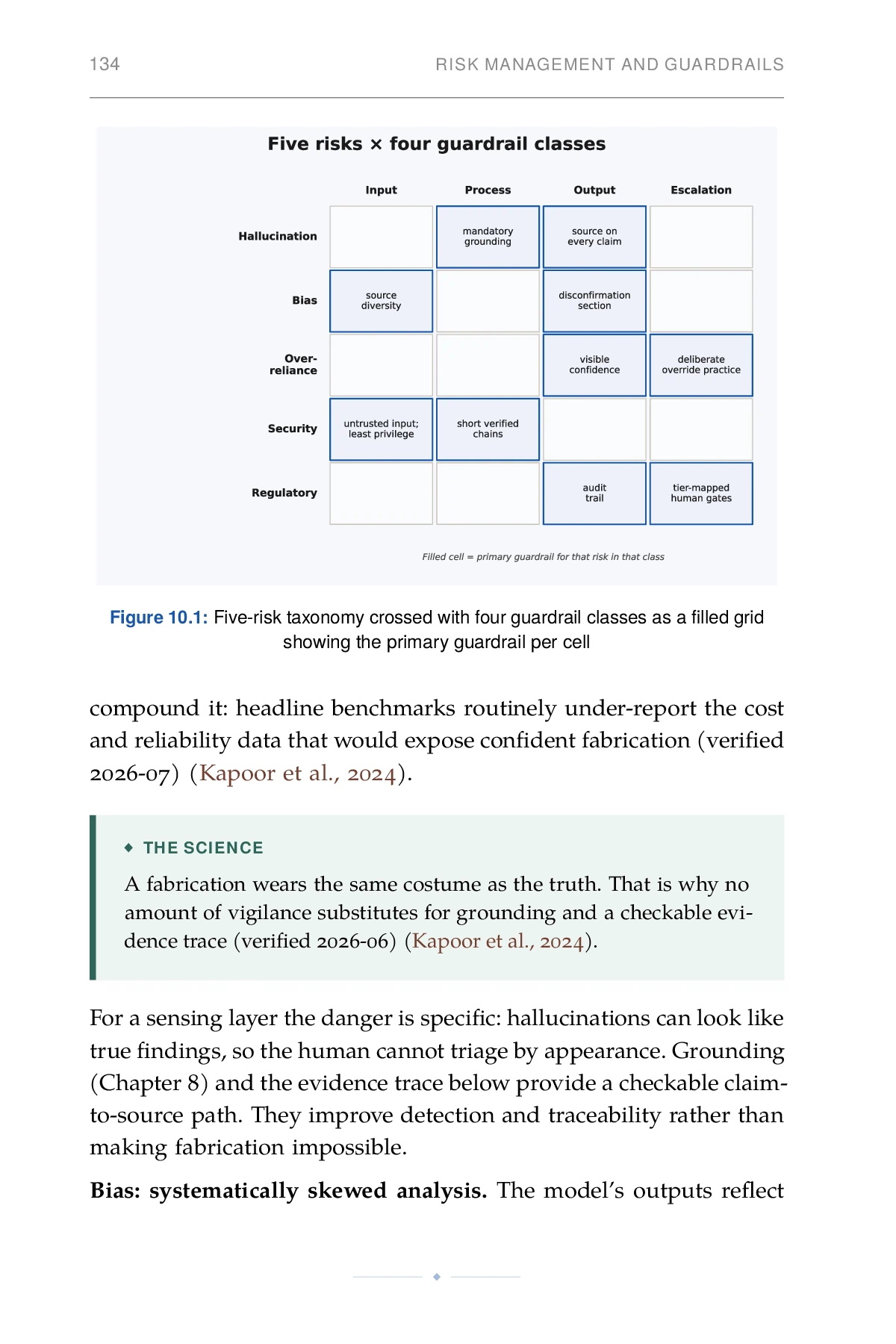
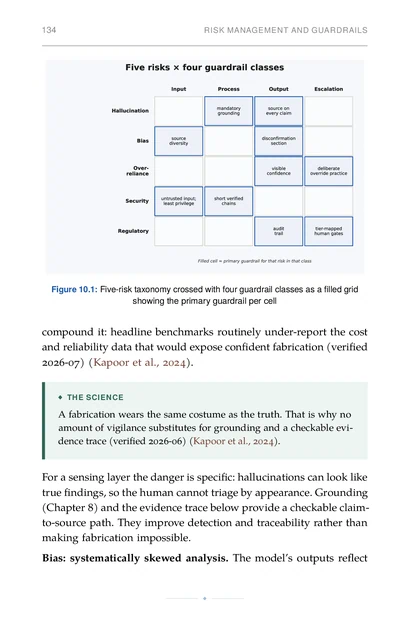 Five risks × four guardrail classes grid
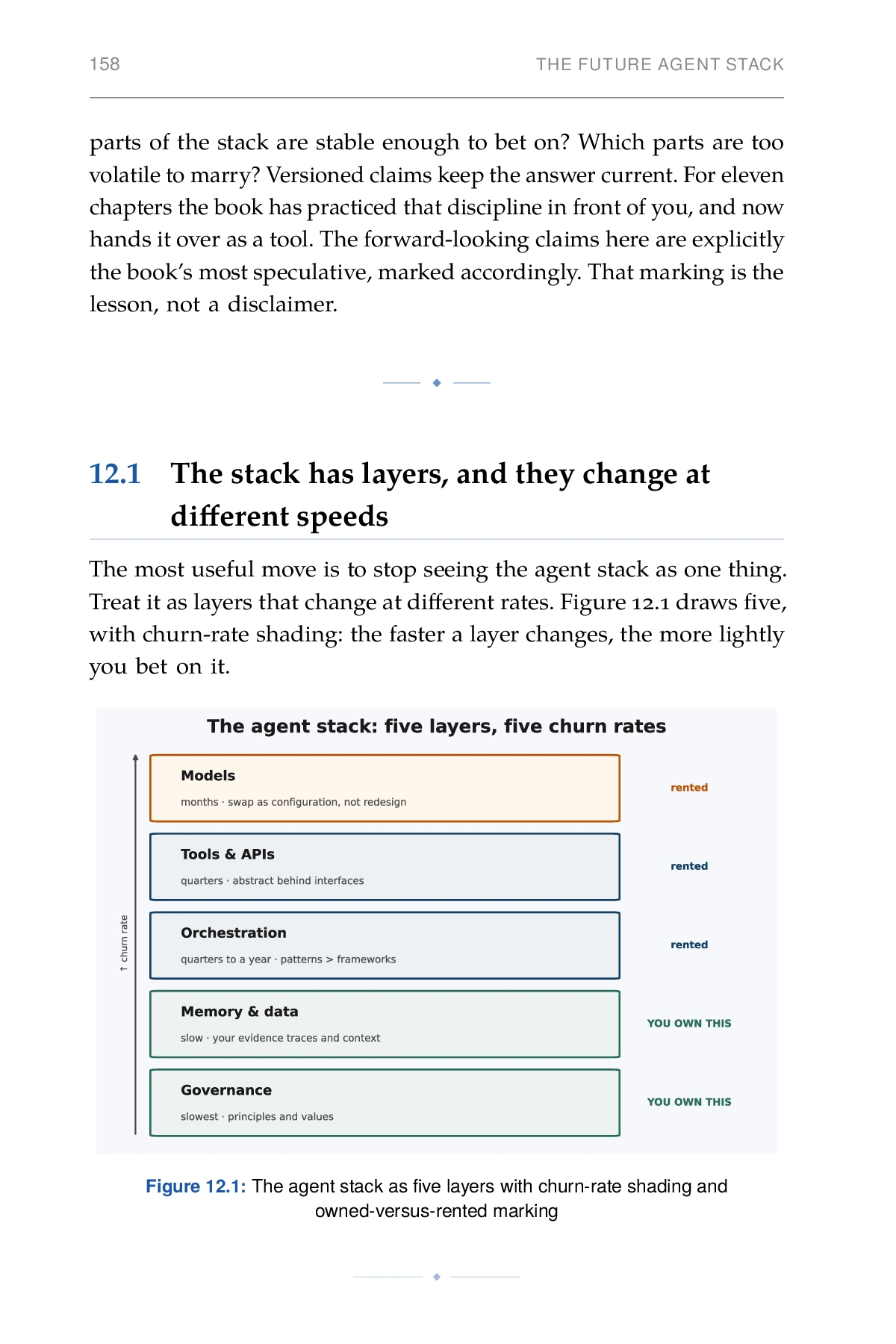
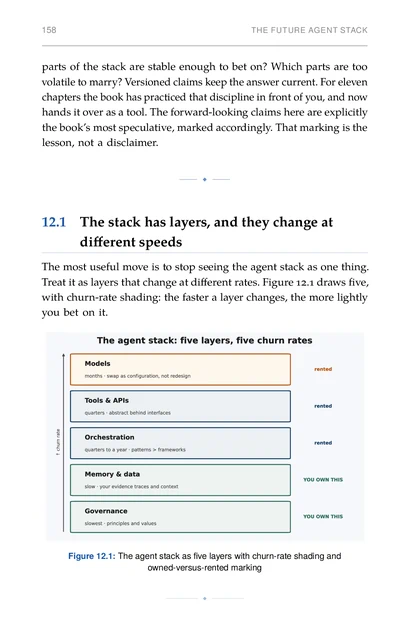 Agent stack: five layers with churn rates
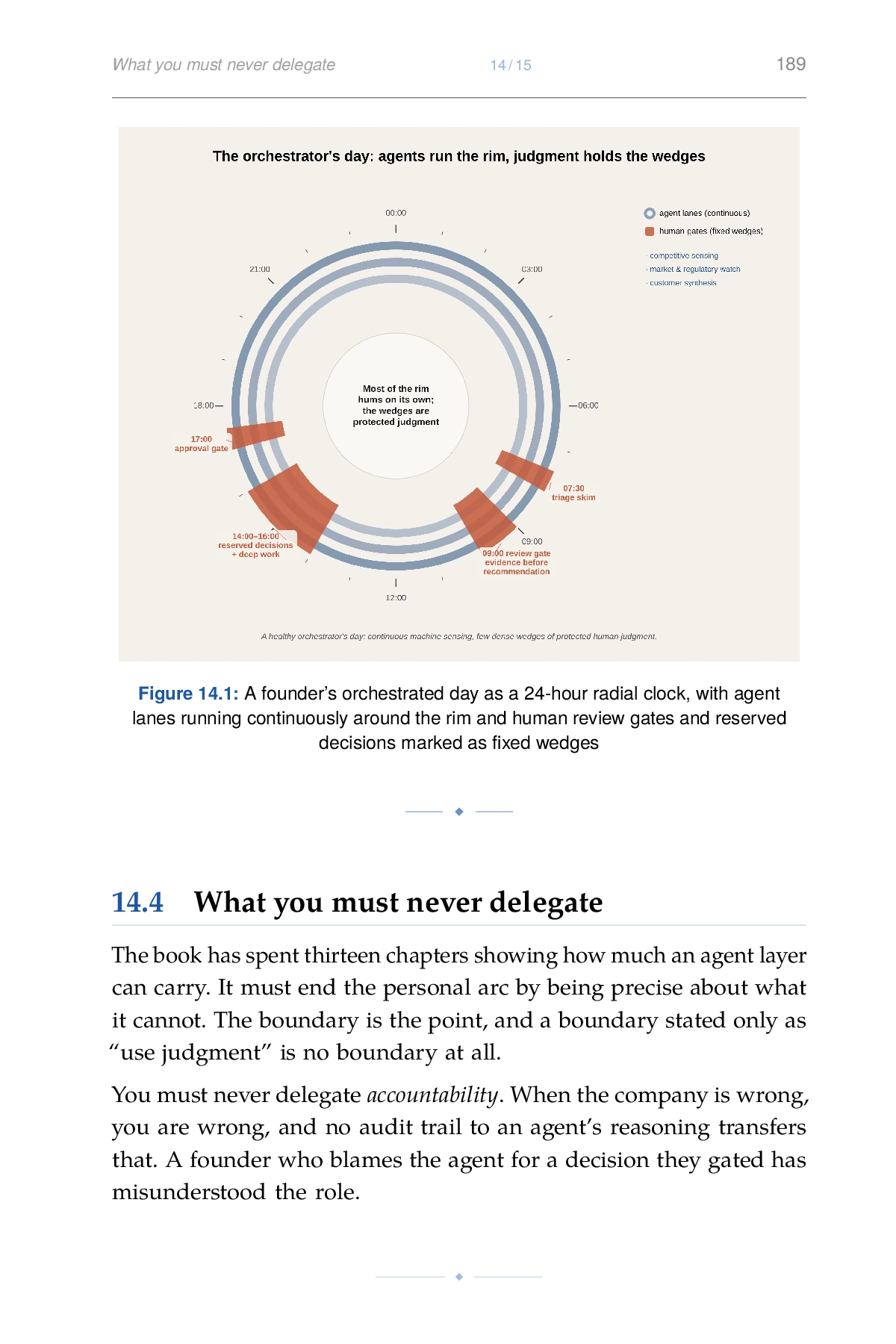
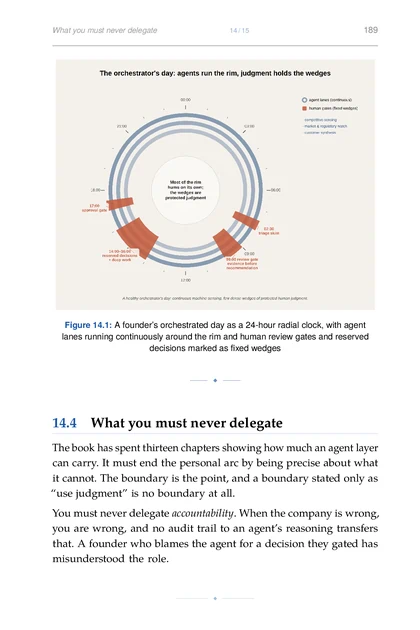 Orchestrator’s day as a 24-hour radial clock
Purchase takes place on Amazon, not on this website.
Buy the paperback on AmazonFrom the book
Read a page
Introduction
The strategic information crisis
You are not behind because you work too little. You are behind because the world changed how fast it tells you things, and your company still finds out the old way.
What you can do afterwards
You will name the real bottleneck on your strategy (sensing speed, not effort) and map your own information gaps tonight.
Use this chapter when
You keep learning about market moves after they have already cost you, or "research" has quietly become your second job.
What you get
What you get
- The SENSE framework: a five-part architecture for autonomous strategic intelligence
- Turn AI from a productivity hack into always-on competitive infrastructure
- Design agents that sense, evaluate, navigate, simulate, and execute on a decision cadence
- Manage the real risks: hallucination, bias, over-reliance, and security
- Built for founders and operators, not coders. No API docs, no prompt tricks
Who it's for
- See how an AI agent differs from a chatbot or a script
- Pick the strategic surface that is ripe for a first agent
- Design a system that delivers a claim into an existing meeting
- Draw the delegate / augment / reserve boundary and keep it
- Manage hallucination, bias, over-reliance, and security as operating risks
Who it's for
Who this book was written for
The result is precise: strategy stops being episodic and becomes ambient. You sense earlier, decide on rhythm, and let a system you built compound your advantage while your judgment stays in your hands.
If you are done with demos and ready to build, start here.
The reader it was written for
Startup founders and strategic operators at early- to growth-stage companies who own market, competitive, and fundraising calls and still run strategy on meetings.
Also a fit for
Operators who want agents that feed judgment on a cadence, not another chatbot for email.
What you will use it on
- See how an AI agent differs from a chatbot or a script
- Pick the strategic surface that is ripe for a first agent
- Design a system that delivers a claim into an existing meeting
- Draw the delegate / augment / reserve boundary and keep it
- Manage hallucination, bias, over-reliance, and security as operating risks
Probably not for you if
- Engineers looking for API docs or model-training guides
- Readers with no startup or business context
- Enterprise AI strategy teams at Fortune 500 scale
The contents
Chapter by chapter
Every chapter of AI Agents for Startup Strategy with its printed epigraph, what you can do afterwards, and the moment it is built for.
Introduction
The strategic information crisis
You are not behind because you work too little. You are behind because the world changed how fast it tells you things, and your company still finds out the old way.
What you can do afterwards
You will name the real bottleneck on your strategy (sensing speed, not effort) and map your own information gaps tonight.
Use this chapter when
You keep learning about market moves after they have already cost you, or "research" has quietly become your second job.
Chapter 1
The agent difference
The word "agent" is doing the heaviest marketing work in software right now. This chapter takes the word back, because underneath the noise is a real distinction, and the distinction is the foundation everything else in this book stands on.
What you can do afterwards
You will be able to say precisely what an agent is, apply three tests that separate agents from chatbots and automation, and explain why the difference changes strategy rather than just tooling.
Use this chapter when
A vendor calls something an "agent," a teammate says "isn't this just a chatbot with extra steps," or you are scoping your first system.
Chapter 2
The SENSE framework
Avoidable agent-project failures tend to expose a gap in one of five places. This chapter names the five and gives you a design grammar that covers them. It also hands you the two instruments (a cadence and a boundary) that decide whether the whole layer lives.
What you can do afterwards
You will design any strategic agent system through five phases, diagnose a failing one by naming its collapsed phase, and set the boundary that keeps judgment yours.
Use this chapter when
You are scoping a system, an existing "AI project" is quietly dying, or you cannot articulate why a promising pilot produced nothing.
Chapter 3
Competitive intelligence agents
Your competitors are narrating their strategy in public, continuously, in a voice just quiet enough that nobody at your company is assigned to listen. This chapter builds the listener.
What you can do afterwards
You will design a competitive signal map (what to watch, why, and at what latency) and the agent system that runs it through all five SENSE phases.
Use this chapter when
You keep being surprised by competitor moves, or your "competitive analysis" is a deck someone made for the last fundraise.
Chapter 4
Market sensing agents
A competitor at least has a face. The market moves against you facelessly. A rule is drafted in a building you have never entered. A buying behavior erodes one renewal at a time. A category quietly forms around someone else's vocabulary. This chapter builds the system that watches.
What you can do afterwards
You will turn market awareness from an episodic project into an ambient capability. The parts: tiered sources, a filtration discipline, and a regulatory watch that treats rules as signals with dates instead of weather.
Use this chapter when
Your last "market analysis" has a date on it, or you learned about a rule, trend, or shift from a competitor's announcement.
Chapter 5
Scenario planning agents
A strategy is a bet on one future. A resilient strategy knows which bet it is making, what the rival futures look like, and which doorbell rings first when the world picks a different one. This chapter builds the system that keeps those rival futures warm.
What you can do afterwards
You will run scenario planning as a standing capability instead of an offsite ritual: a strict grammar, agent-generated breadth with human-owned judgment, and signposts that turn futures into monitorable objects.
Use this chapter when
A board member asks "what if X flips?" and you have one plan; or your last scenario exercise produced a nice document and no instrumentation.
Chapter 6
Customer intelligence agents
Your customers have already told you what to build next. They told you in support tickets, sales-call asides, churn notes, and feature requests you marked "later." The roadmap is written. It is just unread, because reading it at strategic depth was never anyone's affordable job.
What you can do afterwards
You will turn the customer evidence already inside the company into a standing synthesis pipeline. It will collect across scattered surfaces, extract themes that resist your confirmation bias, and route themes from strategic question to decision.
Use this chapter when
You "have data but no insight," your roadmap is set by the loudest customer, or your support queue is a cost center instead of a signal asset.
Chapter 7
Fundraising and investor intelligence agents
Many founders treat fundraising as an event: a frantic quarter of outreach that starts when the runway gets short and ends when the money lands or does not. A standing relationship practice moves the research and trust-building earlier, so that the "raise" becomes the visible tip of work already under way.
What you can do afterwards
You will convert fundraising from a quarterly scramble into a continuous intelligence practice: investor tracking, stage-and-thesis matching, and an always-warm narrative, with a hard ethics line around investor data.
Use this chapter when
Your runway is shrinking and your investor list is a stale spreadsheet, or you raise by mass-emailing everyone with "VC" in their bio.
Chapter 8
Agent architecture for startups
You have used the word "agent" loosely for seven chapters. That was on purpose. Now you open the box. You do not need to become an engineer. You do need to make the design choices that decide whether your systems work in production or only in the demo where they were born.
What you can do afterwards
You will recognize four design patterns and match each one to a use case. You will also learn enough about memory and grounding to direct a build and reject a bad one.
Use this chapter when
You are scoping how a sensing system gets built, an engineer asks "single agent or multi-agent?", or a vendor's architecture sounds impressive and you cannot tell if it should.
Chapter 9
Integration and workflow design
The graveyard of agent projects is not full of bad models. It is full of good systems that met no meeting, answered no standing question, and waited in an inbox nobody opened. Eventually someone quietly turned off the subscription. This chapter is about the unglamorous discipline that decides whether anything you built in the last six chapters survives its first month.
What you can do afterwards
You will design the integration that keeps a sensing system alive. It will match an existing decision rhythm, use the right human-in-the-loop pattern, and fit the work rather than add to it.
Use this chapter when
A promising system is quietly dying, your team "won't adopt another tool," or you are about to ship and have not decided where the output lands.
Chapter 10
Risk management and guardrails
A wrong number almost reached Amara's board deck with her name under it. The agent had invented a regulation, cited it confidently, and formatted it to look exactly like the true findings around it. She caught it by luck. This chapter is about not needing luck.
What you can do afterwards
You will audit any agent system against a five-risk taxonomy. You will design the guardrail class that fits each risk. You will use the delegation boundary as a live risk instrument, not a static policy.
Use this chapter when
You are about to trust an agent's output in a real decision, scoping a system that touches anything consequential, or recovering from a near-miss.
Chapter 11
Building internal capability
A tool may improve on its vendor's schedule. Your capability improves only when a team learns around it. This chapter is about the difference, and about why technology alone is not the scarce resource.
What you can do afterwards
You will design the human side that turns guardrailed systems into a compounding capability: the roles that own them, the metrics that improve them, and the learning ritual that keeps them sharp.
Use this chapter when
Your agent systems work but stay static, you "tried AI once and it didn't stick," or you are deciding whether to hire for this.
Chapter 12
The future agent stack
This chapter is the one most likely to be wrong by the time you read it. The skill it teaches is not predicting the agent stack's future. It is knowing, at any moment, which of your beliefs about it are durable and which are merely current.
What you can do afterwards
You will map the agent stack into layers by how fast each one changes. You will adopt principles for betting on a moving field. You will learn the versioned-claim protocol the book has practiced on itself.
Use this chapter when
You are choosing what to build on, worried about betting on the wrong platform, or trying to tell durable strategy from vendor weather.
Chapter 13
AI-native go-to-market
Many startups with viable products still struggle to reach the market. Research, drafting, outreach, and measurement remain manual. A small team cannot sustain that load. This chapter turns the strategic signal layer toward that work.
What you can do afterwards
You will design an AI-native go-to-market loop for one channel. It will connect research, content, sales intelligence, and analytics, with humans placed at the moments that carry judgment.
Use this chapter when
Marketing and sales are your binding constraint, your outbound is capped by two people's hours, or your AI use is a pile of disconnected tools.
Chapter 14
The founder as orchestrator
One year in, Maya's calendar looks nothing like it did. She may not work fewer hours, but execution occupies far less of them. Her day is review gates, judgment calls, and the choices no system should make for her. This chapter defines the founder's role when agents carry more of the preparation.
What you can do afterwards
You will understand how the founder's role shifts from execution to orchestration. You will write your own override doctrine. You will name the small set of decisions you will never delegate, no matter how good the systems get.
Use this chapter when
Your agent layer is working and you feel strangely unsure what your job now is, or you sense your own judgment thinning as the systems improve.
Chapter 15
The agentic toolbox
What you can do afterwards
You will write shared instructions that tools can read, import, or receive through an adapter. You will choose tools by the choice they fit. You will route work by complexity and cost, then shape the context that grounds each strategic output.
Use this chapter when
You are standing up an agent stack for the first time, deciding whether to switch tools, or trying to understand why your systems burn budget without producing better judgment.
Conclusion
Conclusion, from tools to infrastructure
This book ends in a plan, not a pep talk. This final chapter spends most of its length on ninety days of specific action. It spends only a little on the idea underneath them, because you have read that idea across the preceding chapters. What remains is to build.
What you can do afterwards
You will leave with a written 90-day plan to deploy your first agent system. You will also name common failure modes in advance and adopt the operating discipline required to improve the system over time.
Use this chapter when
You have finished the book and need the single next action, not another concept.
Editions
Editions and specifications
| Edition | Formats | Chapters | Pages | Reading time | ISBN (paperback) |
|---|---|---|---|---|---|
| English AI Agents for Startup Strategy | Kindle, Paperback, Hardcover | 17 | 274 | ± 3 hours | 9798187502974 |
| Dutch AI-agenten voor startupstrategie | Kindle, Paperback, Hardcover | 17 | 292 | ± 3 hours | 9798187571208 |
Both editions are written natively. The Dutch text is not a machine translation of the English. · Trim size: 6x9″
Get the book
One title, every Amazon marketplace. Pick your format and your store.
Get the book
Also on Bol.com → Third-party listing (not our storefront). Amazon remains the primary buy path.
Reading from another country?Pick your own Amazon marketplace — same edition, your store.
Amazon links may include affiliate tags. That does not change the price you pay. Bol.com listings are third-party.
Frequently asked
What readers usually want to know
What is AI Agents for Startup Strategy about?
The SENSE framework turns AI from a productivity shortcut into a strategic intelligence layer that scans, evaluates, navigates, simulates, and supports execution without replacing founder judgment. The subtitle is: How Founders and Operators Deploy Agentic AI to Move Faster and Think Smarter.
What is the SENSE framework?
SENSE: Scan, Evaluate, Navigate, Simulate and Execute. a five-part architecture for autonomous strategic intelligence
In which formats is AI Agents for Startup Strategy available?
AI Agents for Startup Strategy ships as Kindle, Paperback and Hardcover, on every Amazon marketplace worldwide. The Kindle edition is enrolled in Kindle Unlimited, so KU members read it free.
Is there a Dutch edition?
Yes. The Dutch edition is AI-agenten voor startupstrategie, written as a native edition rather than a machine translation. It is available on Amazon too.
How long is AI Agents for Startup Strategy?
This edition runs 17 chapters, 274 pages in print and roughly 3 hours of reading.
Who is AI Agents for Startup Strategy for?
If you are done with demos and ready to build, start here.
Does AI Agents for Startup Strategy come with worksheets?
Yes. Fillable worksheets live on this site, alongside the print edition. They are operating instruments, not one-off exercises.
Do I need to know how to code?
No. The book is written for founders and operators. There are no API docs and no prompt tricks. You design the system; a builder can implement it.
Will this replace my judgment?
SENSE has no Decide phase on purpose. The system prepares a claim, a future, or a briefing. A person owns the decision.
Is this just ChatGPT with extra steps?
ChatGPT answers a question. SENSE is a five-phase architecture that watches named surfaces, grades claims, updates what you watch, rehearses futures, and delivers work to a real meeting.
What if the model hallucinates?
Hallucination is treated as an operating risk with a named guardrail class, not as a surprise. You design the trace back to a source before the claim can move a decision.
The production system
How this book was made
Every title moves through the same gated production line: sourced research, a claim-level evidence ledger, structural review, fact-checking, red-team critique, and a bilingual final edit. AI agents do specialist work inside those gates; judgment, voice, and accountability stay human.
- Claims enter an evidence ledger with a source and a confidence grade before they reach the page
- English and Dutch are two native editions, not a translation of one another
- Every chapter clears readability, rhythm, and style gates before it is typeset
Terminology
The production system


