

No. 29 · In design · Health & performance · LEDGER
The Cognitive Budget
Spend Focus, Judgment, and Emotion Like Capital
Spend focus, judgment, and emotion like the capital they are.
Mental capacity is finite, yet most founders run it without a ledger until they're overdrawn. The Cognitive Budget treats focus, judgment, and emotion as spend categories you can account for — so you manage your capacity on purpose instead of crashing into its limits.
- pages
- 278
- chapters
- 12
- hours of reading
- ± 4
- editions
- EN · NL
- Design
- Drafting
- Manuscript
- Production
- Launched
The editions
Kindle, Paperback and Hardcover
Production shots of the editions. Not for sale yet — this page is the public working version.
-
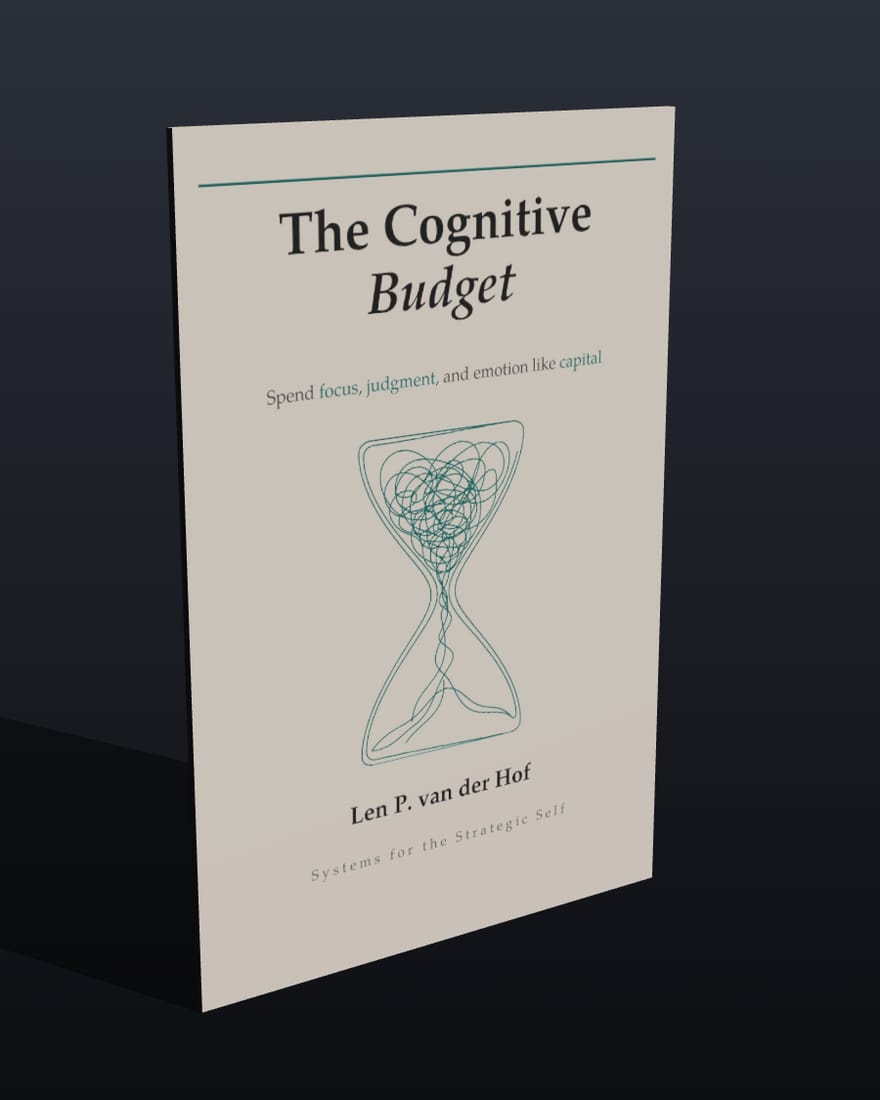
Kindle
The digital edition, ready in any Kindle app.
-
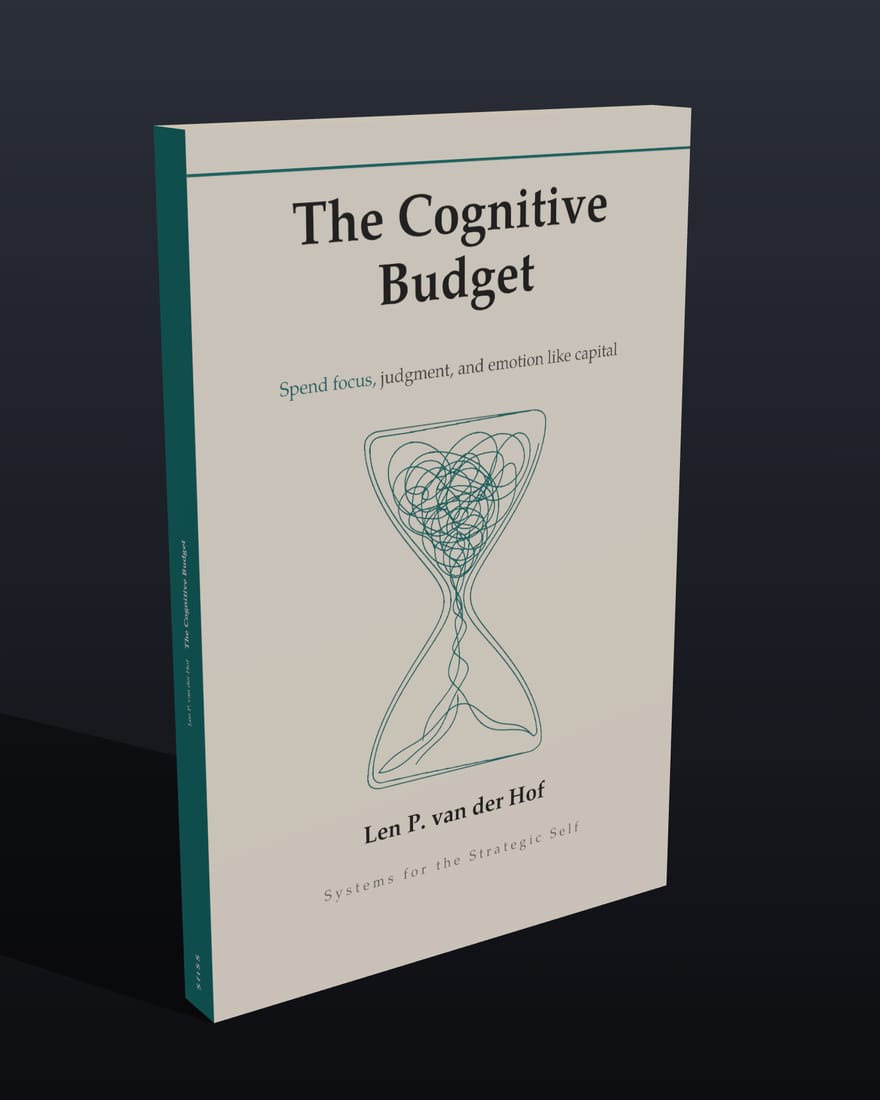
Paperback
The working copy. Mark it up. Take it into the meeting.
-
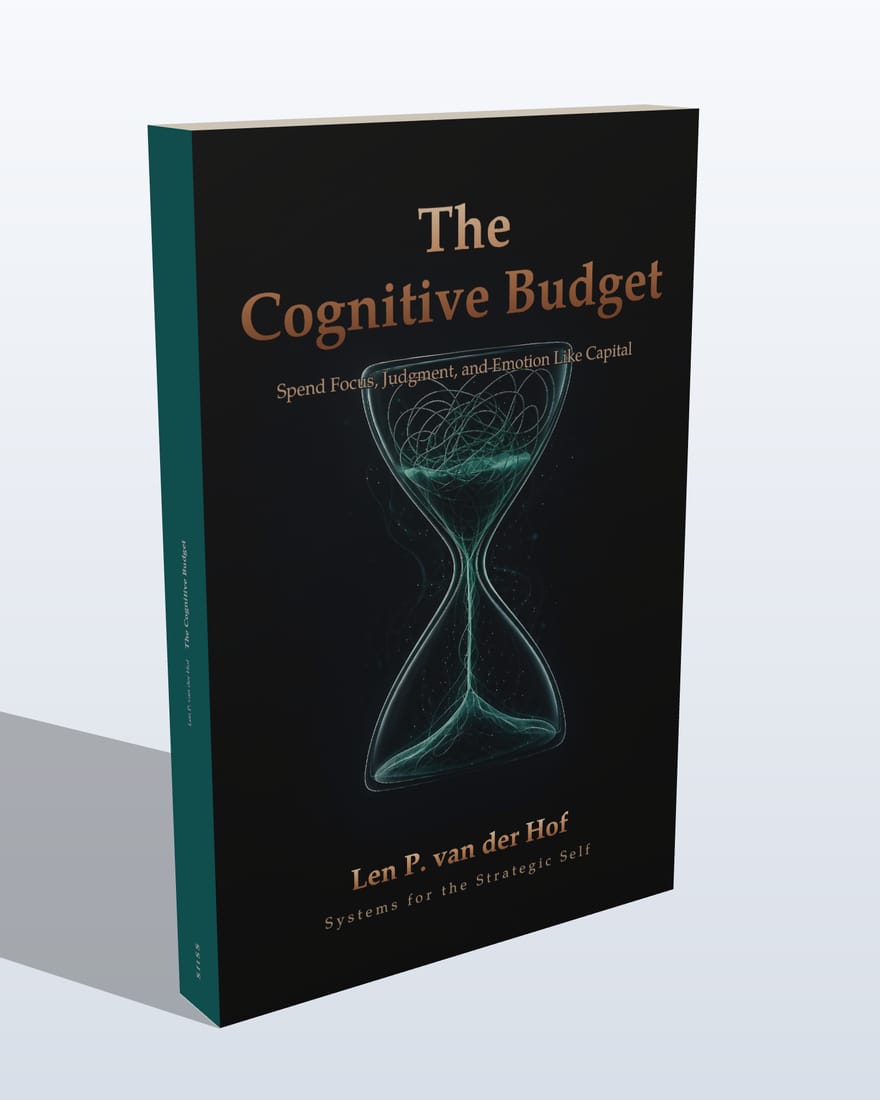
Hardcover
The shelf edition. Dark full-art jacket, built to stay in the room.


The book
Spend Focus, Judgment, and Emotion Like Capital
By 3 p.m. the quality of your thinking has quietly collapsed, and you do not notice because the calendar still says you are working. The hardest call gets made when you are emptiest, because that is simply when it came due. You ration coffee, not cognition, and treat a finite store of mental energy as if it refills between meetings. The day did not run out of hours; it ran out of you.
The standard advice is more discipline, more willpower, a harder push through the wall. But willpower is drawn from the same budget that is already empty, so the push spends your last reserves on a battle you lost hours ago.
The Cognitive Budget gives you something you can actually run. Built on cognitive psychology and decision science, it introduces the BUDGET framework (Baseline, Understand, Defend, Govern, Economize, Track), six moves that treat your cognition the way a serious operator treats capital: a finite account with a balance, a burn rate, and a spend you control.
What you learn
What this book puts in your hands
- The LEDGER system: account focus, judgment and emotion like capital
- See the three spend categories that bankrupt strategy
- Trade reactive meltdowns for proactive capacity management
The framework
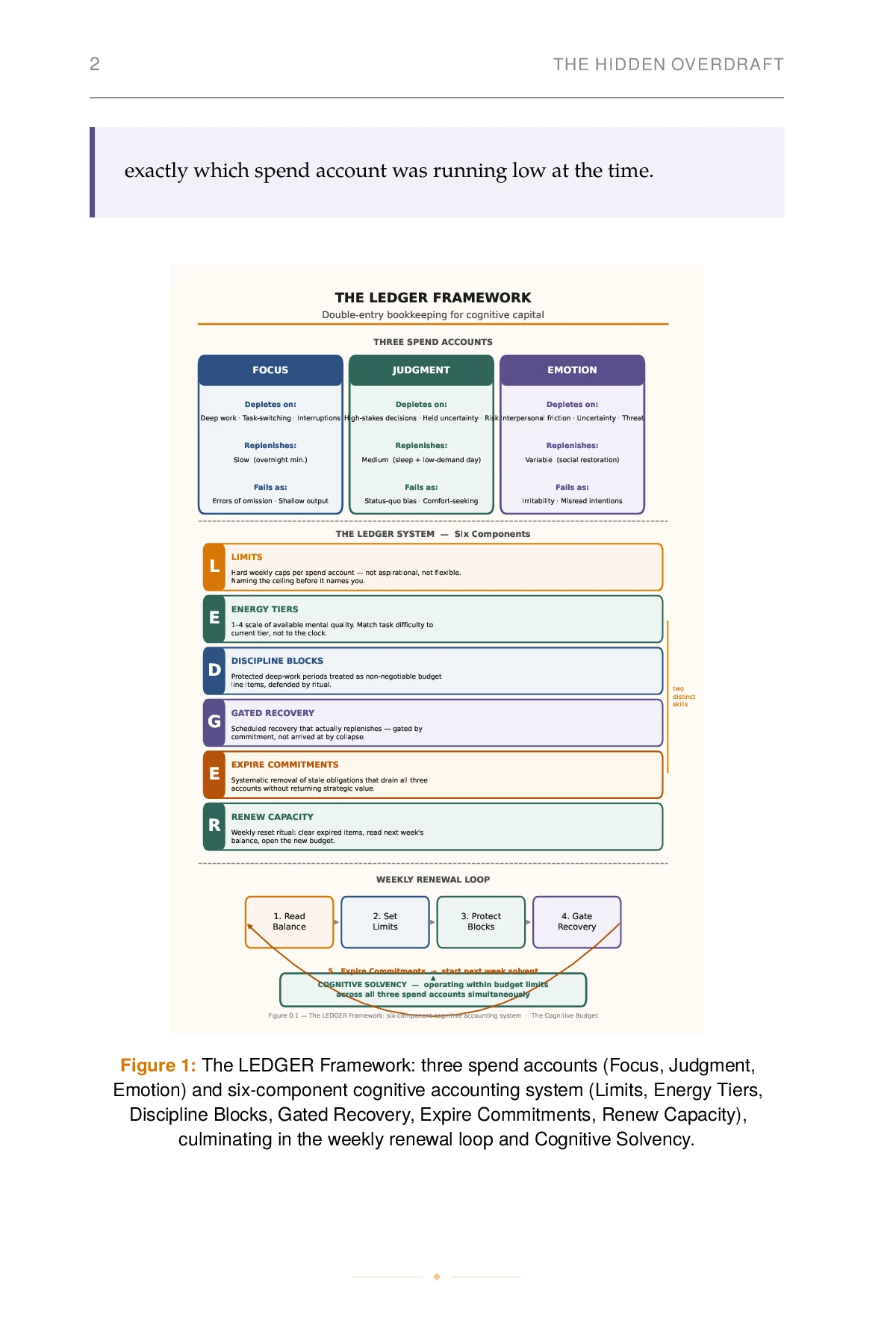
LEDGER, step by step
account focus, judgment and emotion like capital
From the book
Figure 0.1 The LEDGER Framework: six-component cognitive accounting system · The Cognitive Budget
The Cognitive Budget, printed page: Figure 0.1 The LEDGER Framework: six-component cognitive accounting system · The Cognitive Budget
Inspect more pagesLook inside
Pages from the print edition.
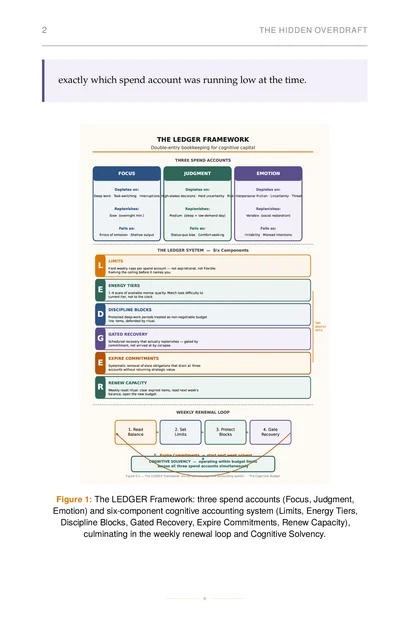 Figure 0.1 The LEDGER Framework: six-component cognitive accounting system · The Cognitive Budget
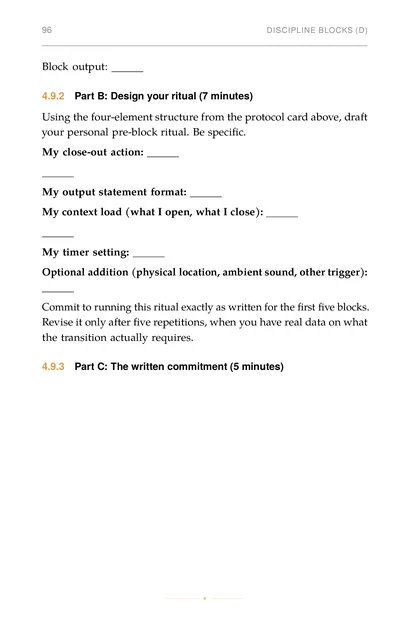 Block output:
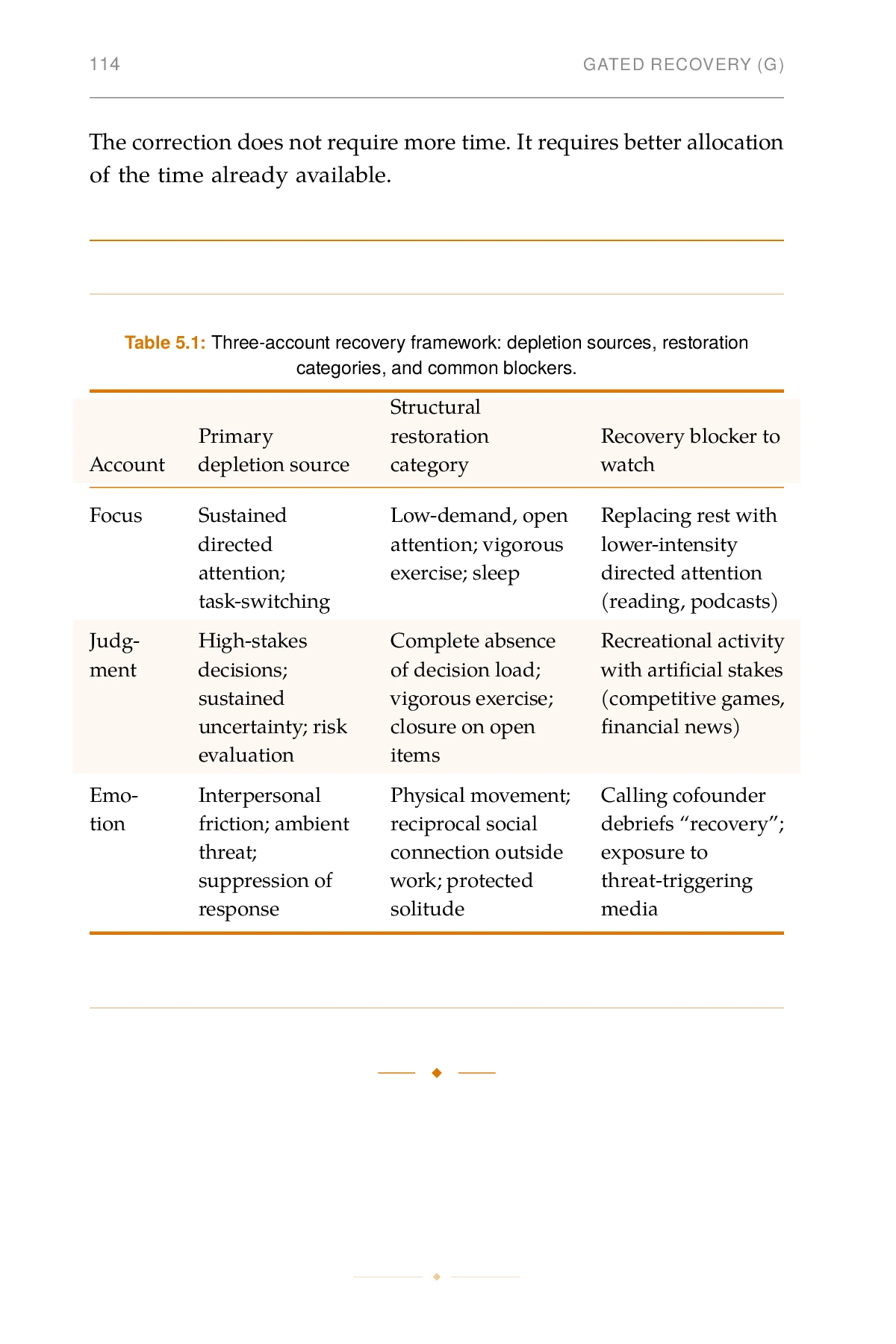
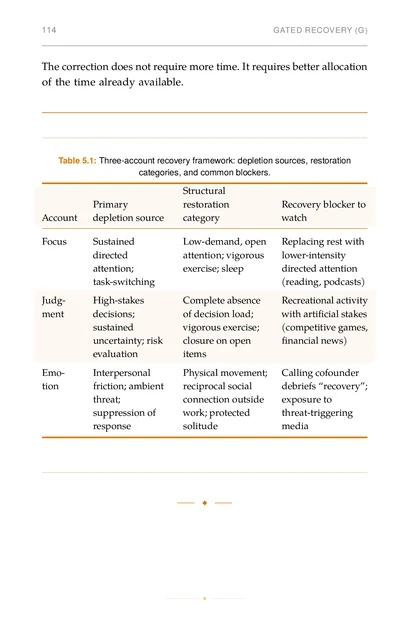 The correction does not require more time. It requires better allocation
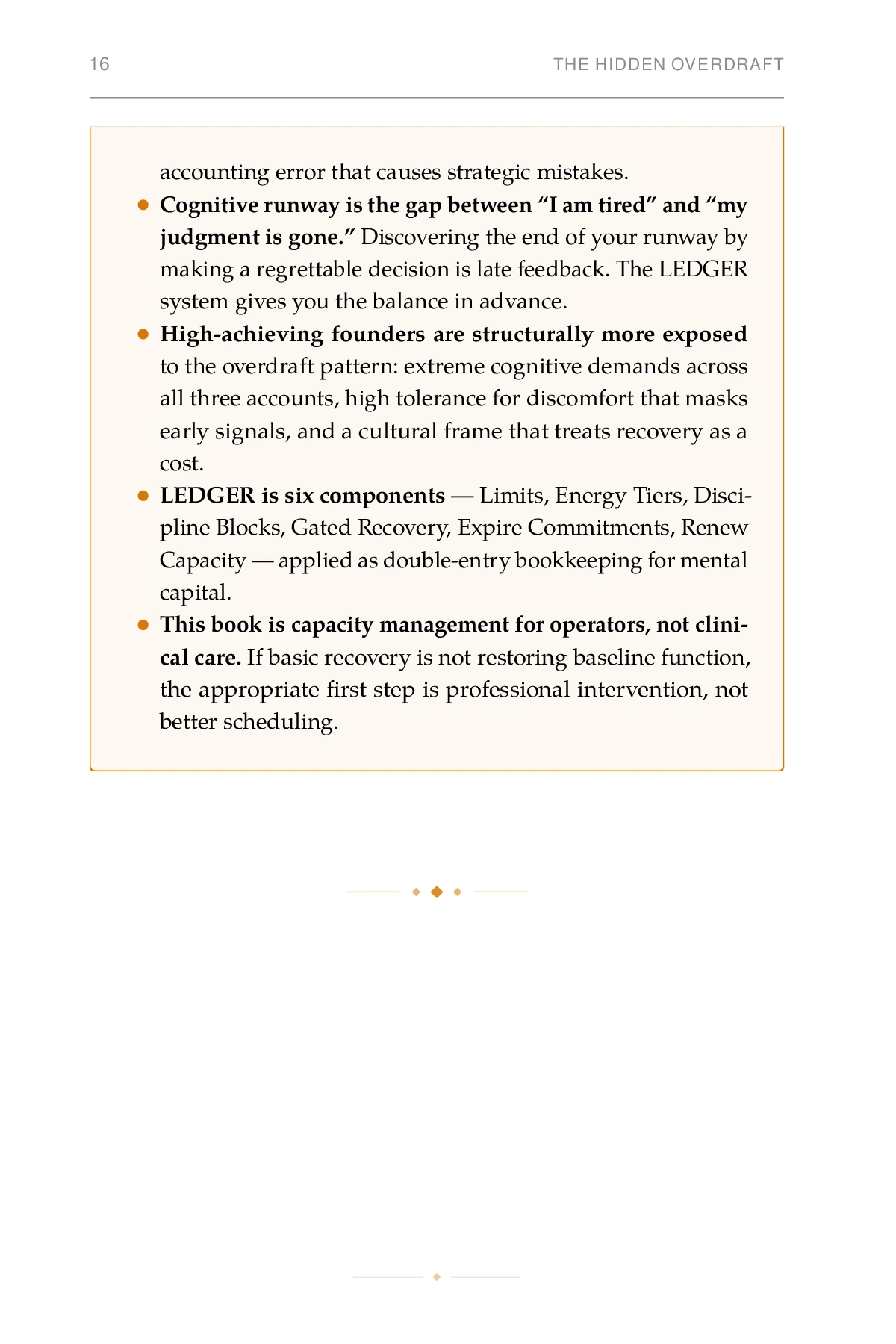
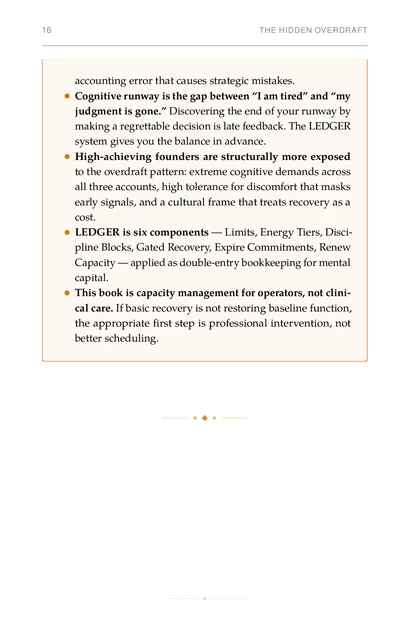 accounting error that causes strategic mistakes.
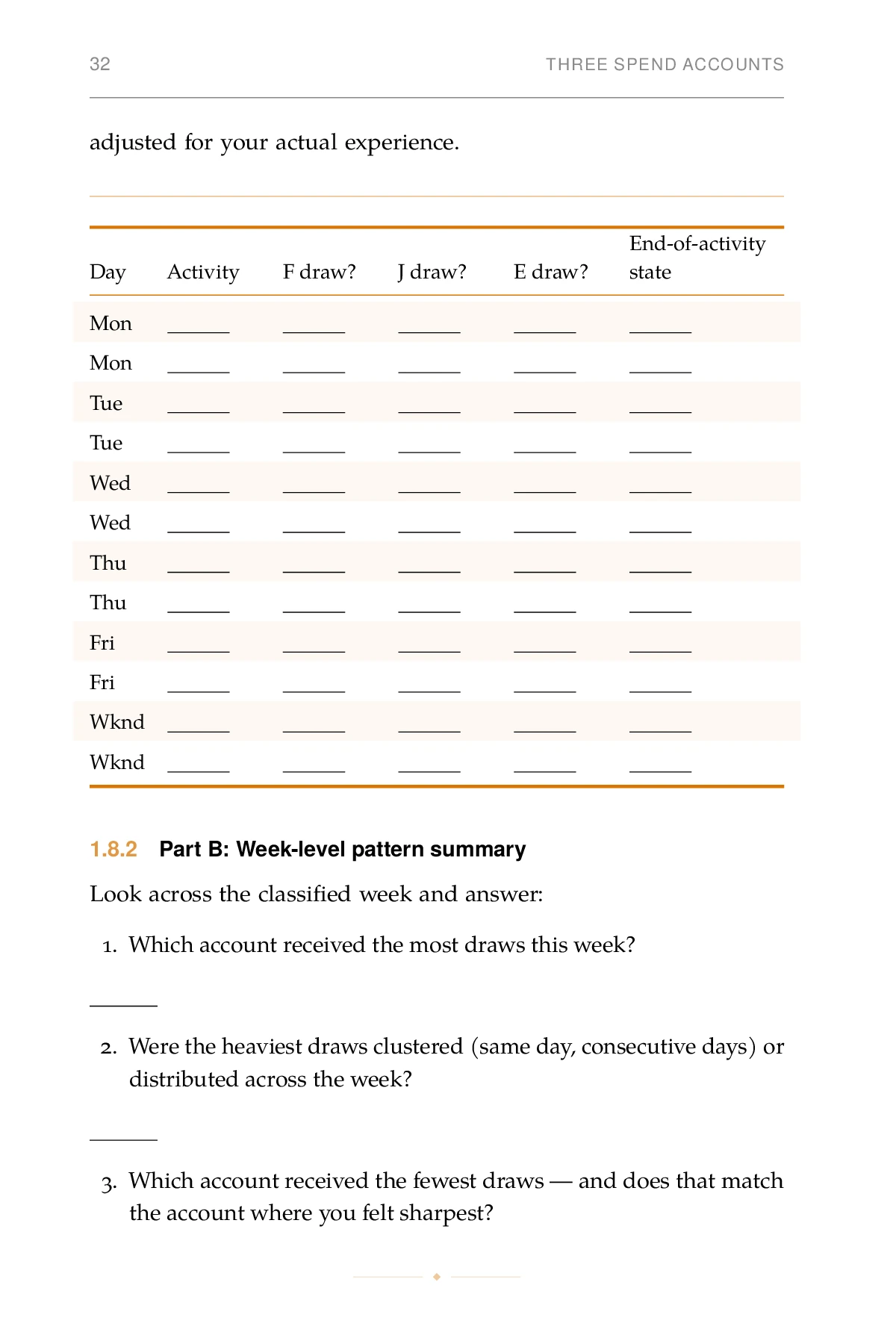
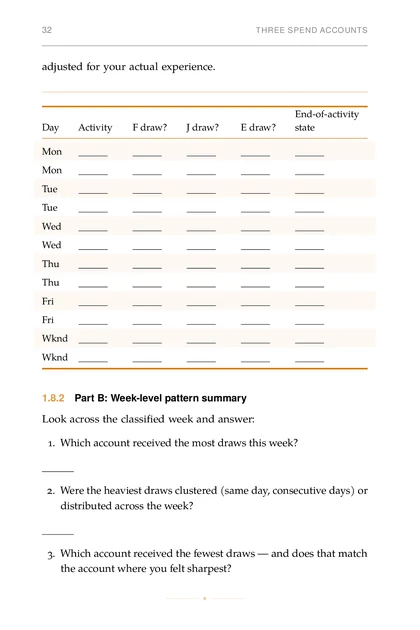 adjusted for your actual experience.
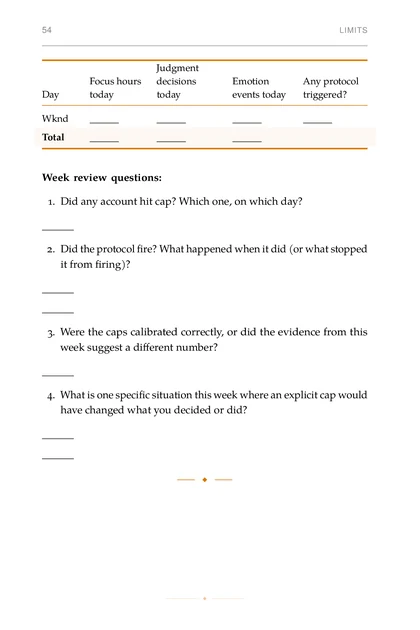 Judgment
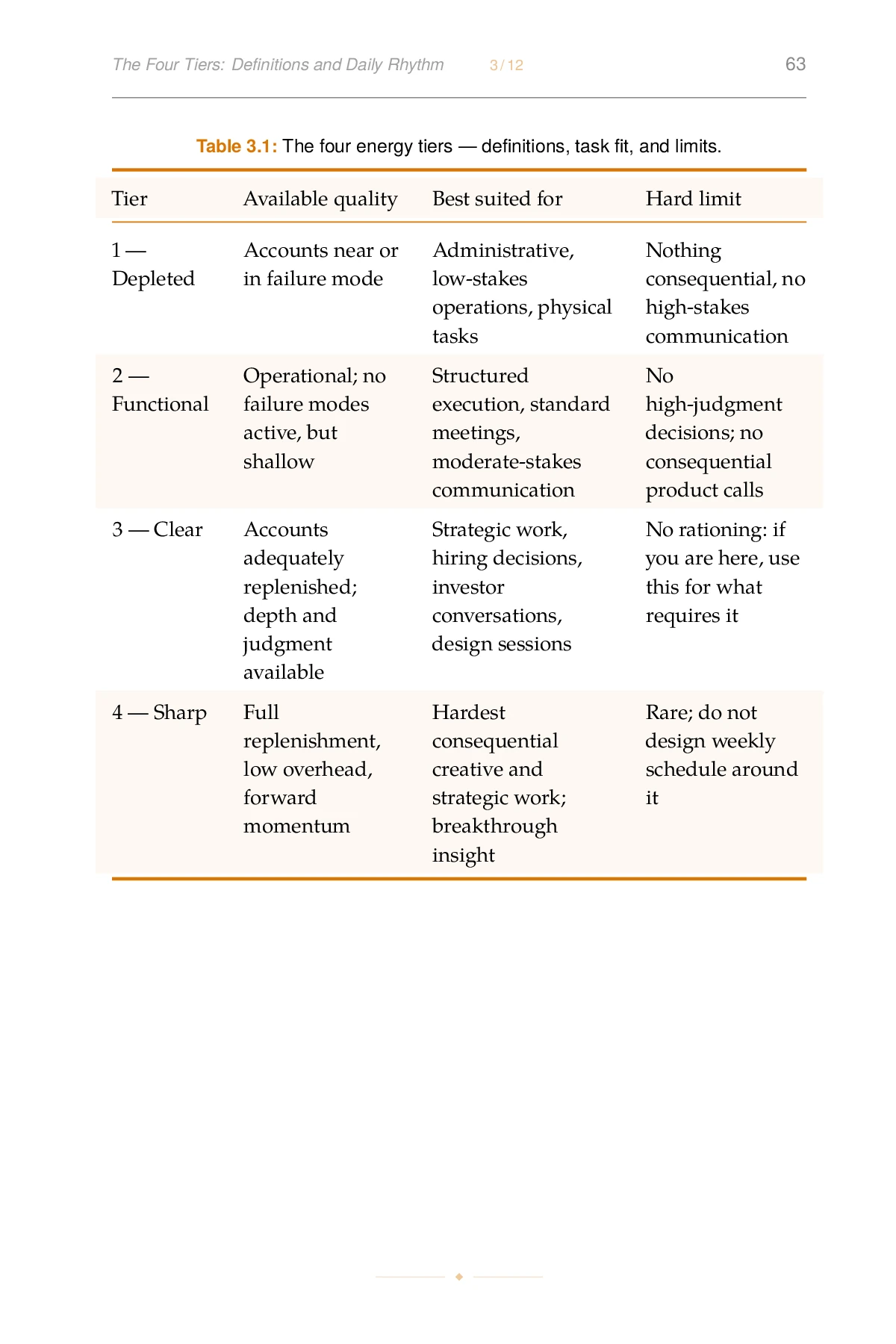
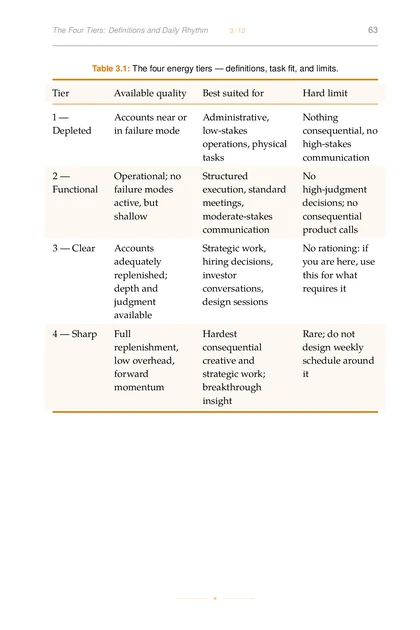 Table 3.1: The four energy tiers — definitions, task fit, and limits.
 something you can build.
 keeps high-tier windows available when you need them.
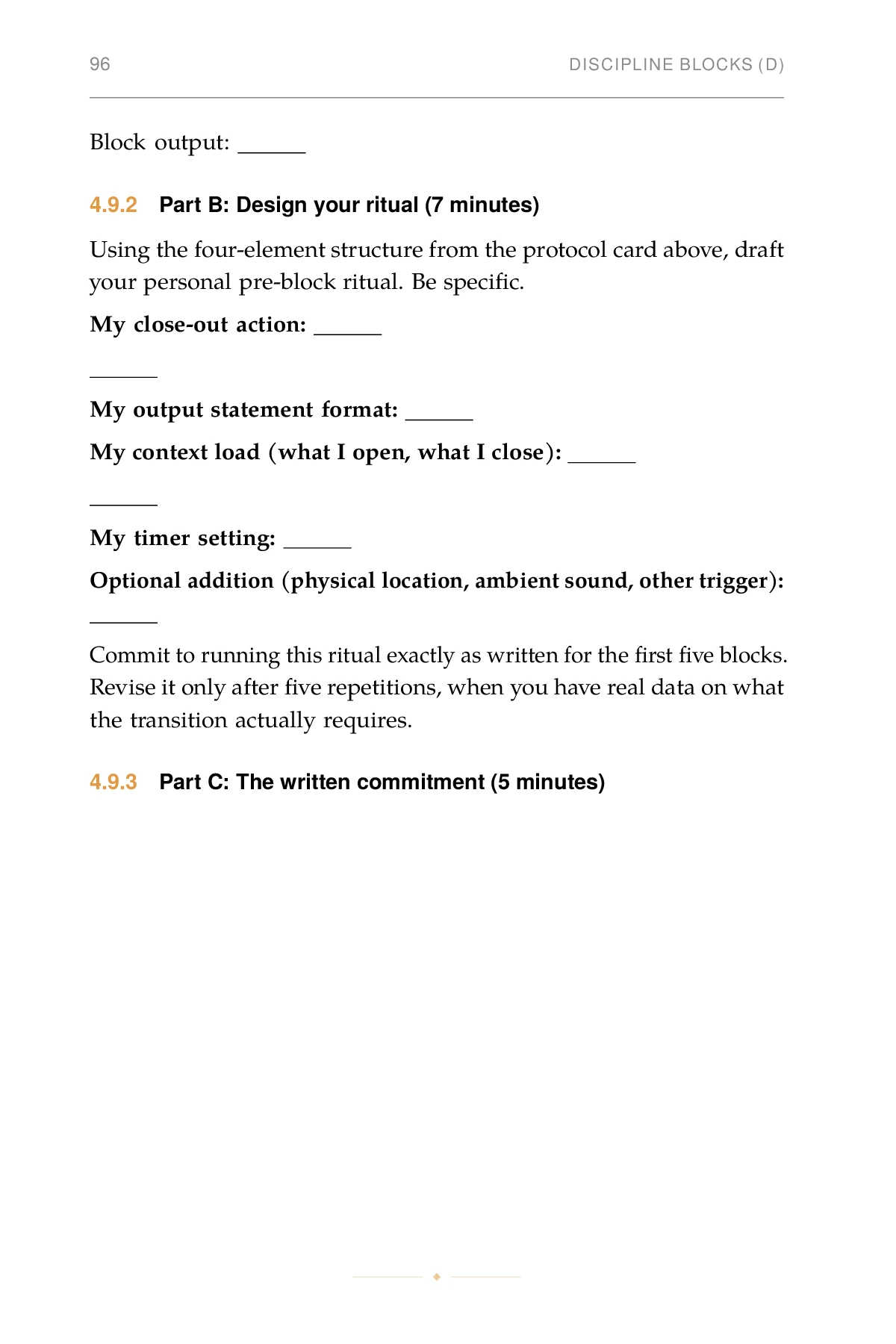


The contents
Chapter by chapter
Every chapter of The Cognitive Budget with its printed epigraph, what you can do afterwards, and the moment it is built for.
Introduction
The Hidden Overdraft
You track revenue and runway with precision. You have never built a balance sheet for the resource that actually limits what you decide.
What you can do afterwards
You leave this chapter with a name for the problem you have been misdiagnosing as a discipline failure — and a preview of the accounting system that will replace that diagnosis.
Use this chapter when
You notice that your Friday decisions are consistently worse than your Monday ones, that your irritability spikes before important conversations, or that you feel "productive" on a day that ends in a strategic mistake.
Chapter 1
Three Spend Accounts
Your calendar calls them all "work." Your brain does not.
What you can do afterwards
You can name, with precision, which of the three spend accounts a given task is drawing from — and what it looks like when that account runs dry.
Use this chapter when
You finish a day feeling "productive" but reactive, or you wake up dreading a meeting you are technically capable of running, or you notice that your Fridays feel qualitatively worse than your Mondays in ways hours alone cannot explain.
Chapter 2
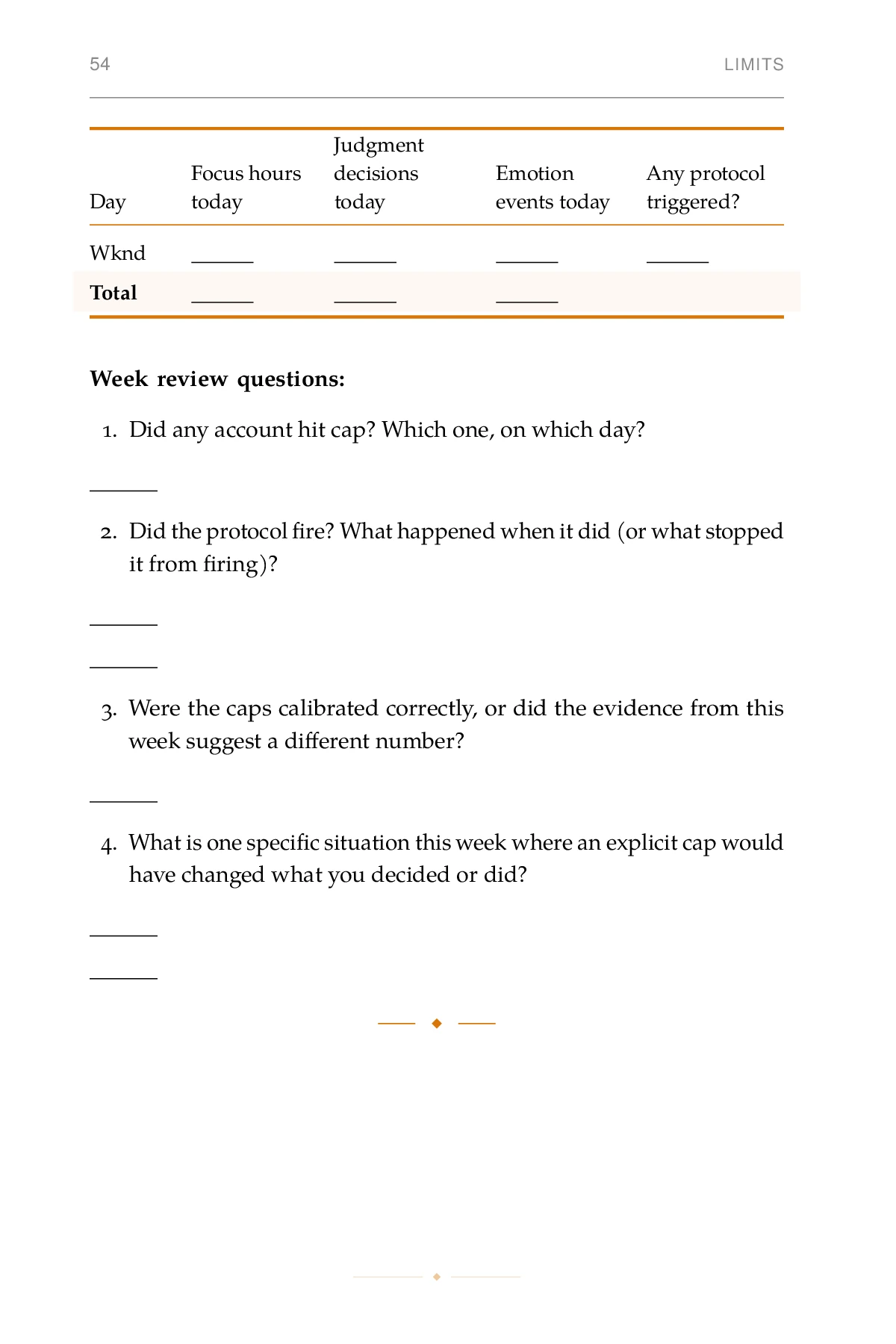
Limits
A policy holds when good intentions have stopped holding. The difference between the two is whether the number exists before the pressure arrives.
What you can do afterwards
You will leave this chapter with concrete weekly caps per spend account — derived from your actual failure history, not from an aspirational version of yourself — and a clear protocol for what happens when the limit is hit.
Use this chapter when
You have mapped your three spend accounts from Chapter 1, can identify your failure modes in each, and are now ready to convert that diagnosis into a budget with enforceable limits.
Chapter 3
Energy Tiers
The calendar is not a measure of what you can do. It is a map of when you agreed to do things — which is not the same map at all.
What you can do afterwards
You leave this chapter with a four-point language for your real-time cognitive quality and a simple matching rule that stops you from burning high-judgment decisions in low-quality windows.
Use this chapter when
You are scheduling important work by calendar availability rather than by what your cognitive state can actually support, or you realize — usually too late — that you made a consequential call at exactly the wrong moment in the day.
Chapter 4
Discipline Blocks (D)
The calendar does not protect what you value. It reflects what you surrendered.
What you can do afterwards
You will define at least one protected discipline block this week — a period of deep work that is treated as a non-negotiable budget line item and defended by ritual, not by willpower.
Use this chapter when
You know which tasks require your sharpest cognitive tier but cannot reliably find the uninterrupted time to do them. Your deep work gets scheduled, then yielded to the first urgent request that arrives.
Chapter 5
Gated Recovery (G)
You cannot replenish what you are still spending.
What you can do afterwards
You will leave this chapter with a precise distinction between fake rest and genuine recovery, and with at least one gated recovery activity scheduled as a non-negotiable line item in your calendar — not a reward for finishing, but a standing replenishment appointment.
Use this chapter when
You are sleeping enough but still arriving at important conversations reactive. You take breaks but they do not seem to help. You reach the weekend exhausted and return Monday equally drained. Recovery is happening but the accounts are not recovering.
Chapter 6
Expire Commitments (E)
The obligation you agreed to six months ago is still spending from your accounts today. The only question is whether it is buying anything worth the spend.
What you can do afterwards
You will run a commitment audit, identify at least three obligations that no longer justify their cognitive spend, and leave with a clean script for exiting each one without burning relationships.
Use this chapter when
Your calendar and obligation list are full, you have installed gated recovery but it still does not feel like enough — because the problem is not the rate of replenishment but the rate of drain. Something keeps refilling the deficit overnight.
Chapter 7
Renew Capacity (R)
The ledger that is never closed never balances. The operator who never checks the books cannot know whether they are solvent.
What you can do afterwards
You will leave this chapter with a defined weekly renewal ritual — 15 to 20 minutes — that closes the cognitive ledger, reads your opening balance, and begins each week from a known position rather than an accumulated deficit.
Use this chapter when
You regularly feel that Monday is a continuation of Friday's exhaustion. The week starts in arrears: unresolved items from last week, limits you did not check, recovery you did not schedule. The system works in principle but keeps slipping in practice.
Chapter 8
Budget and Big Decisions
The decisions that compound for years are almost always made in the hours when you had the least to give them.
What you can do afterwards
You leave this chapter with a personal overdrawn protocol: a short list of decision categories that cannot be made while cognitively depleted, and a three-step procedure for deferring or protecting any of them when your accounts are low.
Use this chapter when
You are about to sign, agree, hire, price, or kill something consequential — and any one of the following is also true: it is late in a long week, you have had more than three high-stakes conversations today, or you feel a pull toward just getting the decision done.
Chapter 9
Team Cognitive Budget
In a founding team, an overdraft is not a private event. The person next to you feels it before you say a word.
What you can do afterwards
You will leave this chapter with a shared vocabulary for cognitive capacity and a lightweight two-person check-in format that replaces the guessing and silent resentment that fills the gap when that vocabulary is missing.
Use this chapter when
You have a cofounder, a technical partner, or a key contractor whose cognitive state directly determines what you can take on — and right now you have no shared language for that state beyond "are you okay?" answered automatically with "yeah, fine."
Chapter 10
LEDGER with Agents
The agent did the work. You did the thinking required to direct it — and thinking, it turns out, is still the expensive part.
What you can do afterwards
You will treat every AI agent workflow as a budget line item, assign it a spend-account type and a cost estimate, and have a clear rule for when agent use is adding cognitive load rather than removing it.
Use this chapter when
You have adopted AI agents to handle parts of your work and feel simultaneously more efficient and more depleted — or when you notice that "automation" is creating new categories of cognitive overhead you did not expect.
Conclusion
Solvent Operator
A balance sheet you actually read is worth more than a perfect system you carry in your head.
What you can do afterwards
You leave this chapter with the identity that makes everything else in this book sustainable: you are a solvent operator — someone who budgets cognitive capital with the same seriousness they give to cash.
Use this chapter when
You have moved through the LEDGER framework and need to consolidate it into a practice rather than keep it as a concept. Also read this chapter if you skipped ahead and want to see what the full system delivers before deciding whether to build it.
Who it is for
Who this book was written for
This is not biohacking, or another morning routine you abandon by Friday. It is operator-grade energy management: protocols you run on a depleted Thursday, when the decisions keep coming long after your judgment went quiet.
The result is not a founder who works longer, but one who spends a scarce resource where it earns the most, and stops bankrupting tomorrow's judgment to look busy today.
If you build under pressure and refuse to confuse exhaustion with output, this was written for the operator whose mind is the bottleneck no hire can replace.
The reader it was written for
The overdrawn operator. Calendar full, decisions sloppy by Friday, irritable before hard conversations. Suspects burnout but frames it as weak discipline.
Also a fit for
The cofounder pair needing shared vocabulary for capacity limits.
Editions
Editions and specifications
| Edition | Formats | Chapters | Pages | Reading time | ISBN (paperback) |
|---|---|---|---|---|---|
| English The Cognitive Budget | In production | 12 | 278 | ± 4 hours | — |
| Dutch Het cognitieve budget | In production | 12 | 296 | ± 4 hours | — |
Both editions are written natively. The Dutch text is not a machine translation of the English. · Trim size: 6x9″
Frequently asked
What readers usually want to know
What is The Cognitive Budget about?
LEDGER helps operators account for focus, judgment, and emotion before those scarce resources get spent reactively by the loudest input. The subtitle is: Spend Focus, Judgment, and Emotion Like Capital.
What is the LEDGER framework?
account focus, judgment and emotion like capital
Is there a Dutch edition?
Yes. The Dutch edition is Het cognitieve budget, written as a native edition rather than a machine translation. It moves through the same production line.
How long is The Cognitive Budget?
This edition runs 12 chapters, 278 pages in print and roughly 4 hours of reading.
Who is The Cognitive Budget for?
If you build under pressure and refuse to confuse exhaustion with output, this was written for the operator whose mind is the bottleneck no hire can replace.
The production system
How this book was made
Every title moves through the same gated production line: sourced research, a claim-level evidence ledger, structural review, fact-checking, red-team critique, and a bilingual final edit. AI agents do specialist work inside those gates; judgment, voice, and accountability stay human.
- Claims enter an evidence ledger with a source and a confidence grade before they reach the page
- English and Dutch are two native editions, not a translation of one another
- Every chapter clears readability, rhythm, and style gates before it is typeset


