

No. 16 · In design · Health & performance
Strategic Solitude
How Deliberate Alone Time Sharpens Decision-Making
Your best thinking happens when no one else is in the room.
Always-on leadership erodes the quiet where judgment is made. Strategic Solitude is an operating system — not a retreat guide — for protecting and using deliberate alone time, with eight trainable skills that convert solitude into sharper decisions and genuine recovery.
- pages
- 308
- chapters
- 13
- hours of reading
- ± 4
- editions
- EN · NL
- Design
- Drafting
- Manuscript
- Production
- Launched
The editions
Kindle, Paperback and Hardcover
Production shots of the editions. Not for sale yet — this page is the public working version.
-
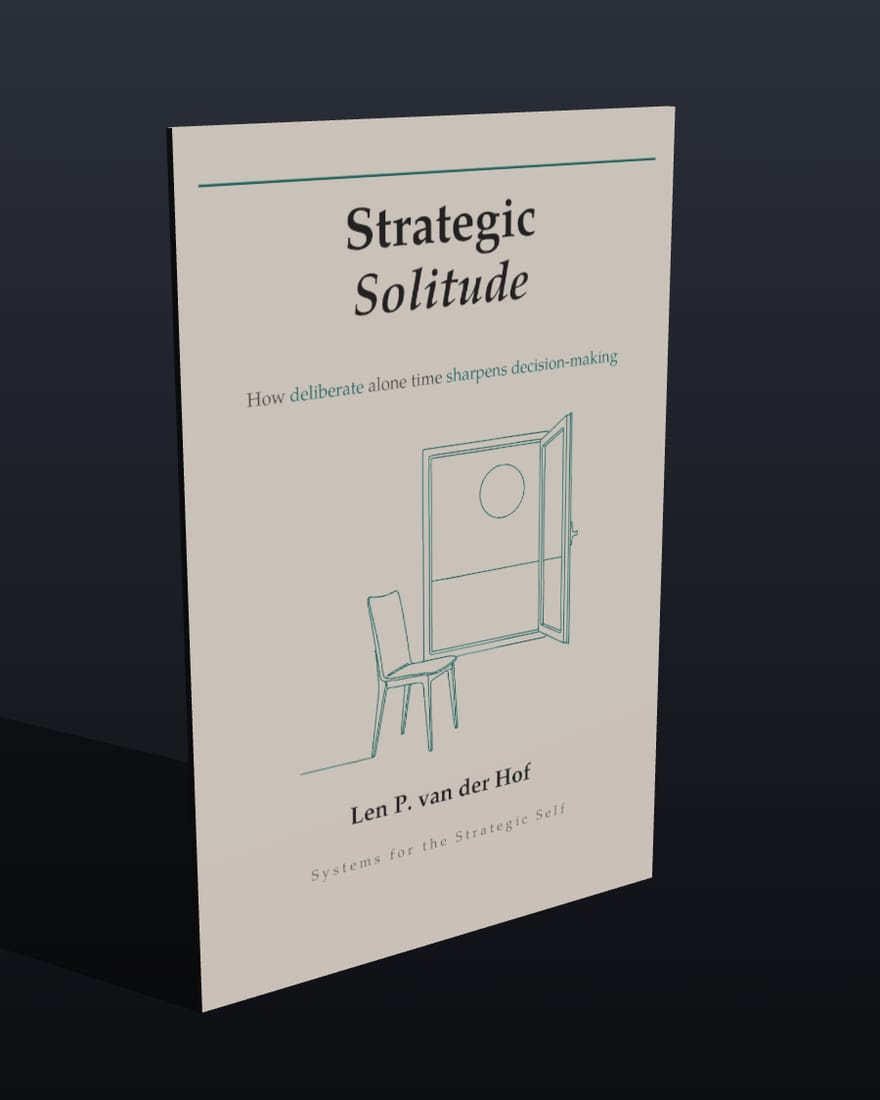
Kindle
The digital edition, ready in any Kindle app.
-
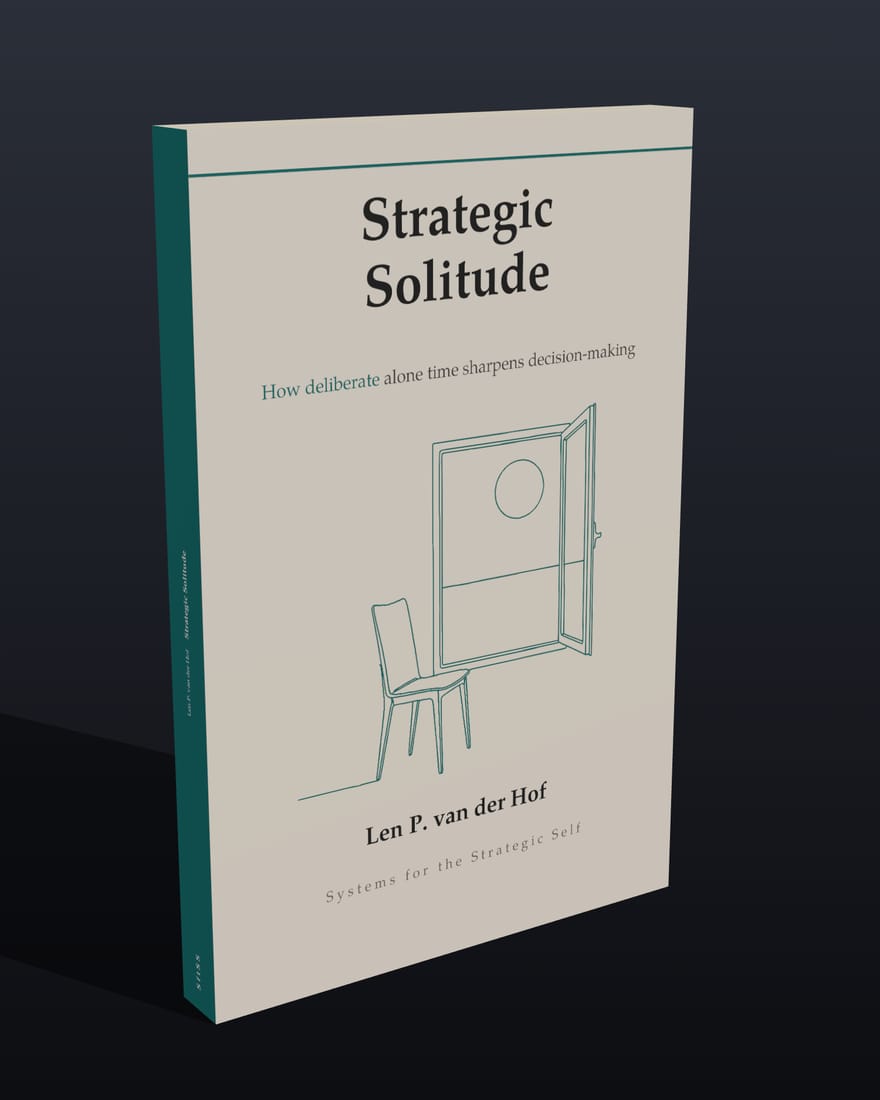
Paperback
The working copy. Mark it up. Take it into the meeting.
-
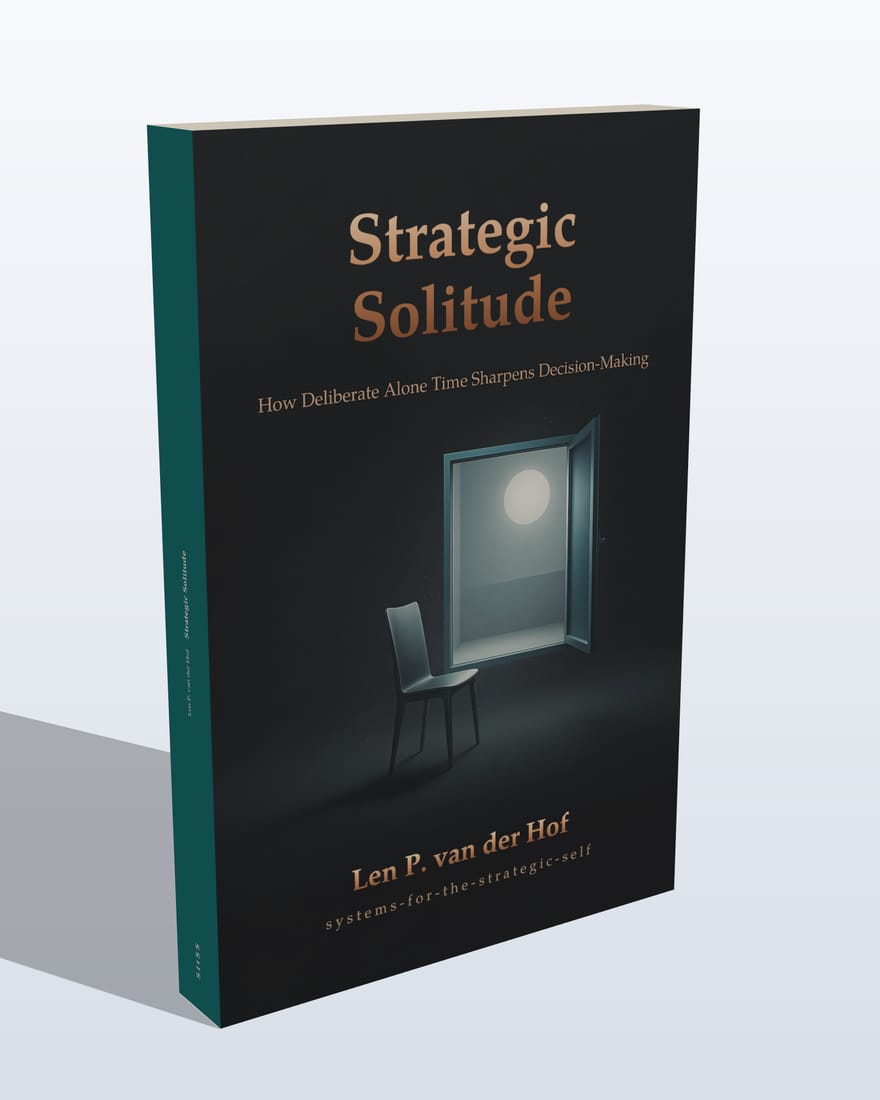
Hardcover
The shelf edition. Dark full-art jacket, built to stay in the room.


The book
How Deliberate Alone Time Sharpens Decision-Making
You answer in elevators. You think in the gaps between meetings, which is to say you have stopped thinking and started reacting. Your best decisions still arrive in the rare quiet (a long drive, an early hour before the inbox wakes), but you cannot reproduce that quiet on purpose, so you wait for it like weather. Meanwhile the calls that compound get the same scattered attention as the ones that do not matter.
The standard fix is a digital detox, a weekend off, a promise to slow down once this quarter clears. It fails because it treats solitude as recovery from work rather than as the infrastructure that makes the work sharp.
Strategic Solitude reframes aloneness as a performance system you can design, not a luxury you steal. Built on attention-restoration research, the science of the brain's default mode network, and Stoic practice, it introduces the SPACE framework (Select, Protect, Attend, Calibrate, Evaluate): five moves that turn scattered alone time into deliberate, measurable thinking time. It treats your solitude the way you treat your operations: as a system you can observe, protect, and improve.
What you learn
What this book puts in your hands
- An eight-skill system for deliberate, productive solitude
- Turn alone time into decision quality, creative depth and recovery
- For leaders who think clearest without an audience
The framework
SOLITUDE, step by step
-
Select
-
Occupy
-
Leverage
-
Integrate
-
Transition
-
Understand
-
Defend
-
Evaluate
From the book
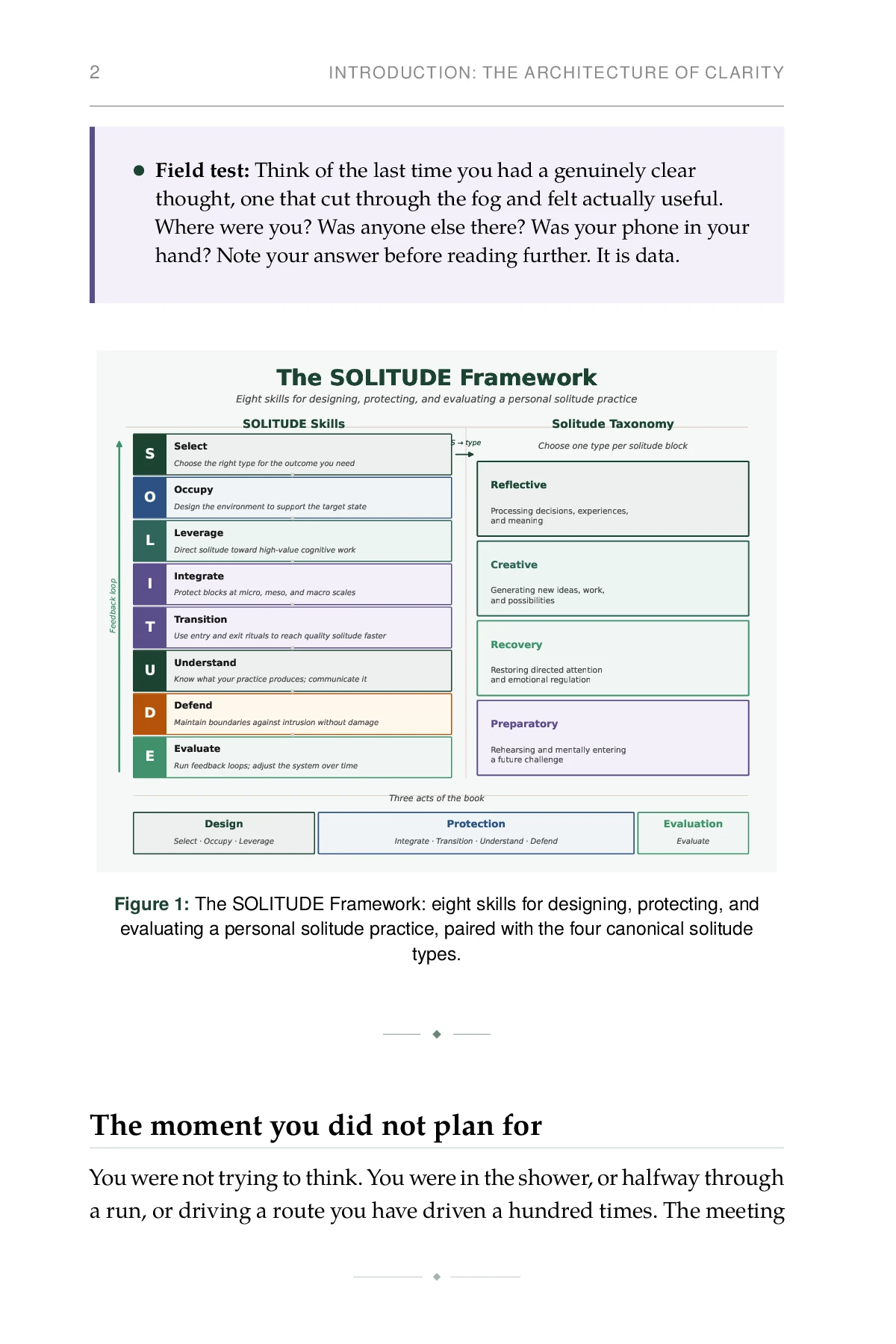
The SOLITUDE Framework: eight skills for designing, protecting, and evaluating a personal solitude practice, paired with the four canonical solitude
Strategic Solitude, printed page: The SOLITUDE Framework: eight skills for designing, protecting, and evaluating a personal solitude practice, paired with the four canonical solitude
Inspect more pagesLook inside
Pages from the print edition.
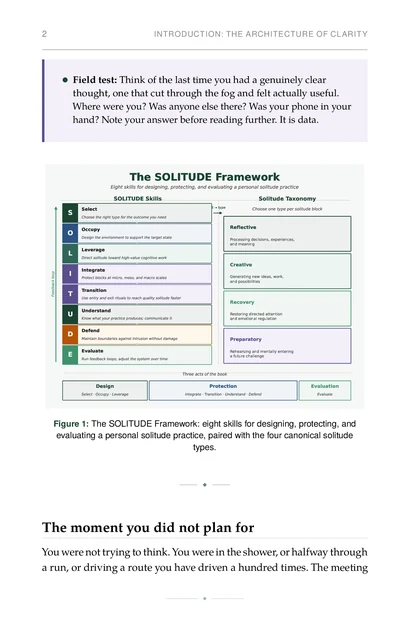 The SOLITUDE Framework: eight skills for designing, protecting, and evaluating a personal solitude practice, paired with the four canonical solitude
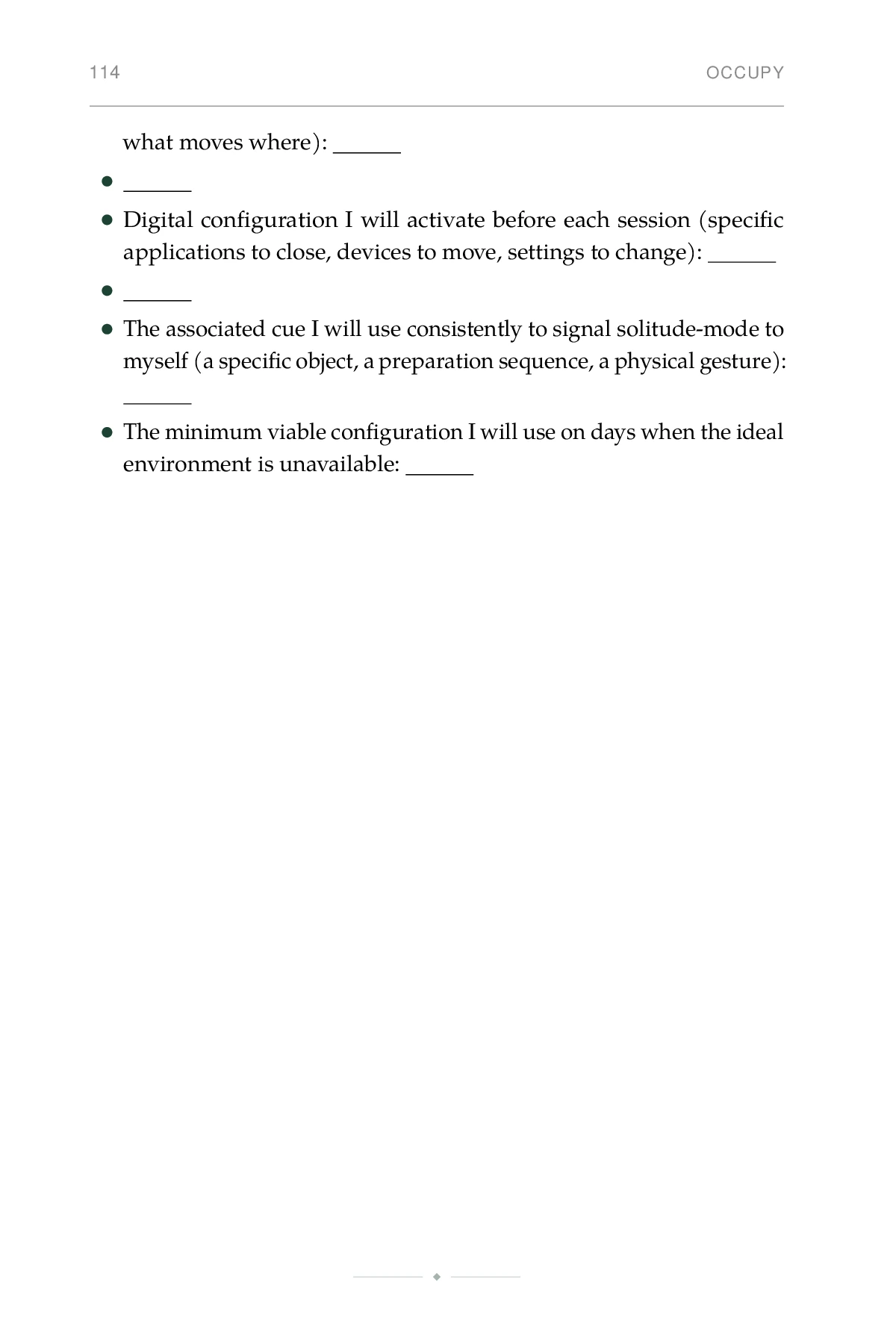
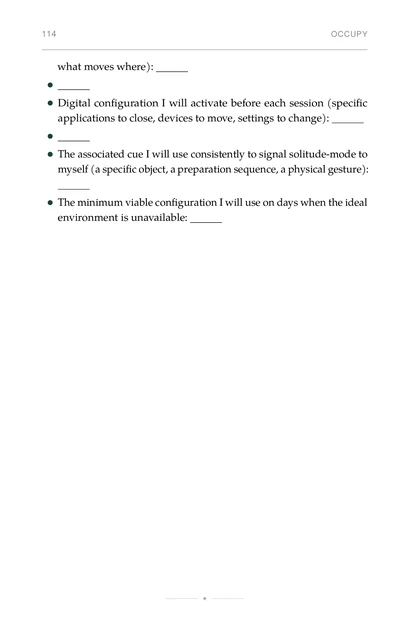 what moves where):
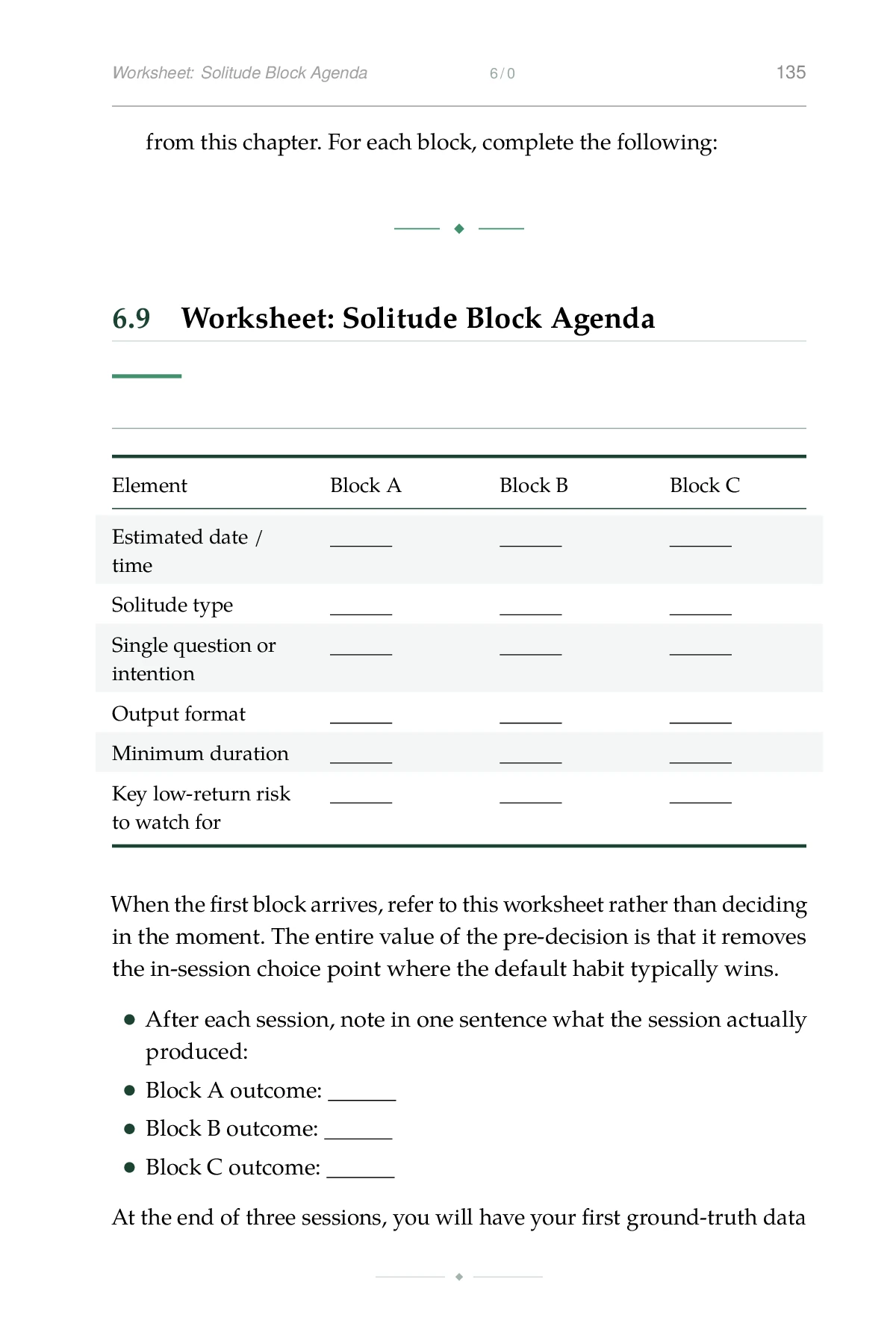
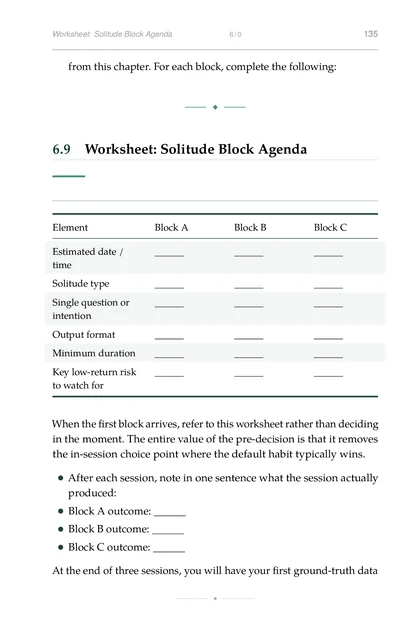 from this chapter. For each block, complete the following:
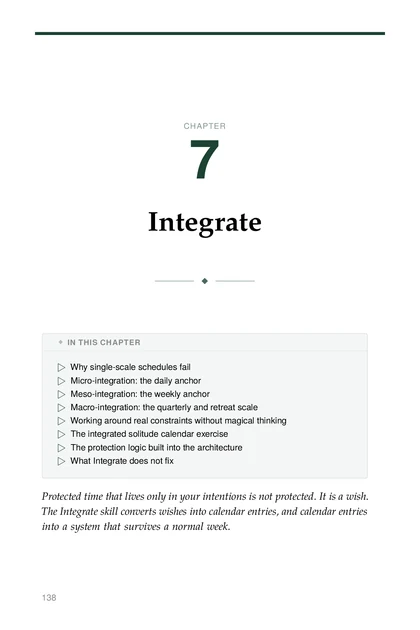 CHAPTER
 CHAPTER
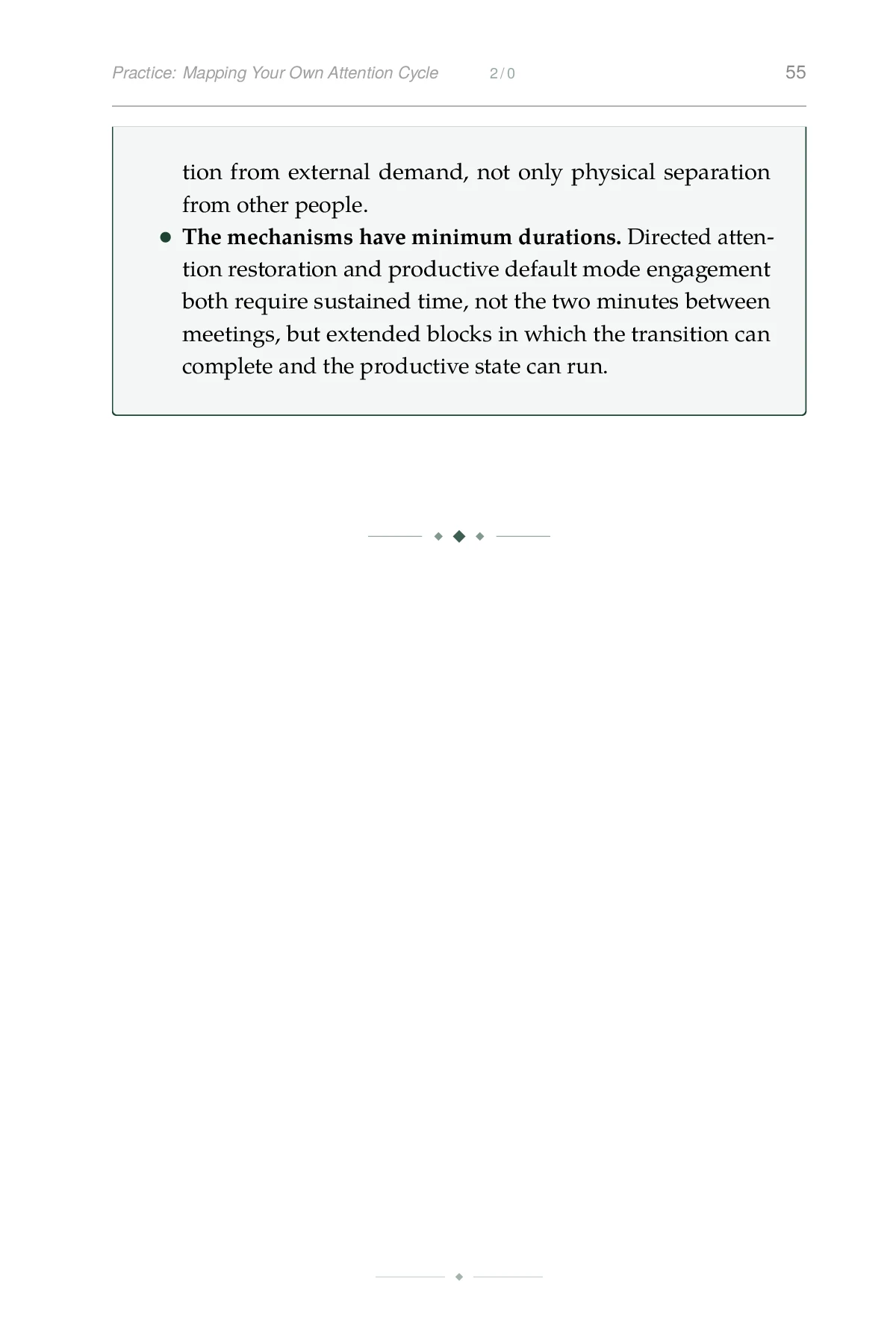
 tion from external demand, not only physical separation
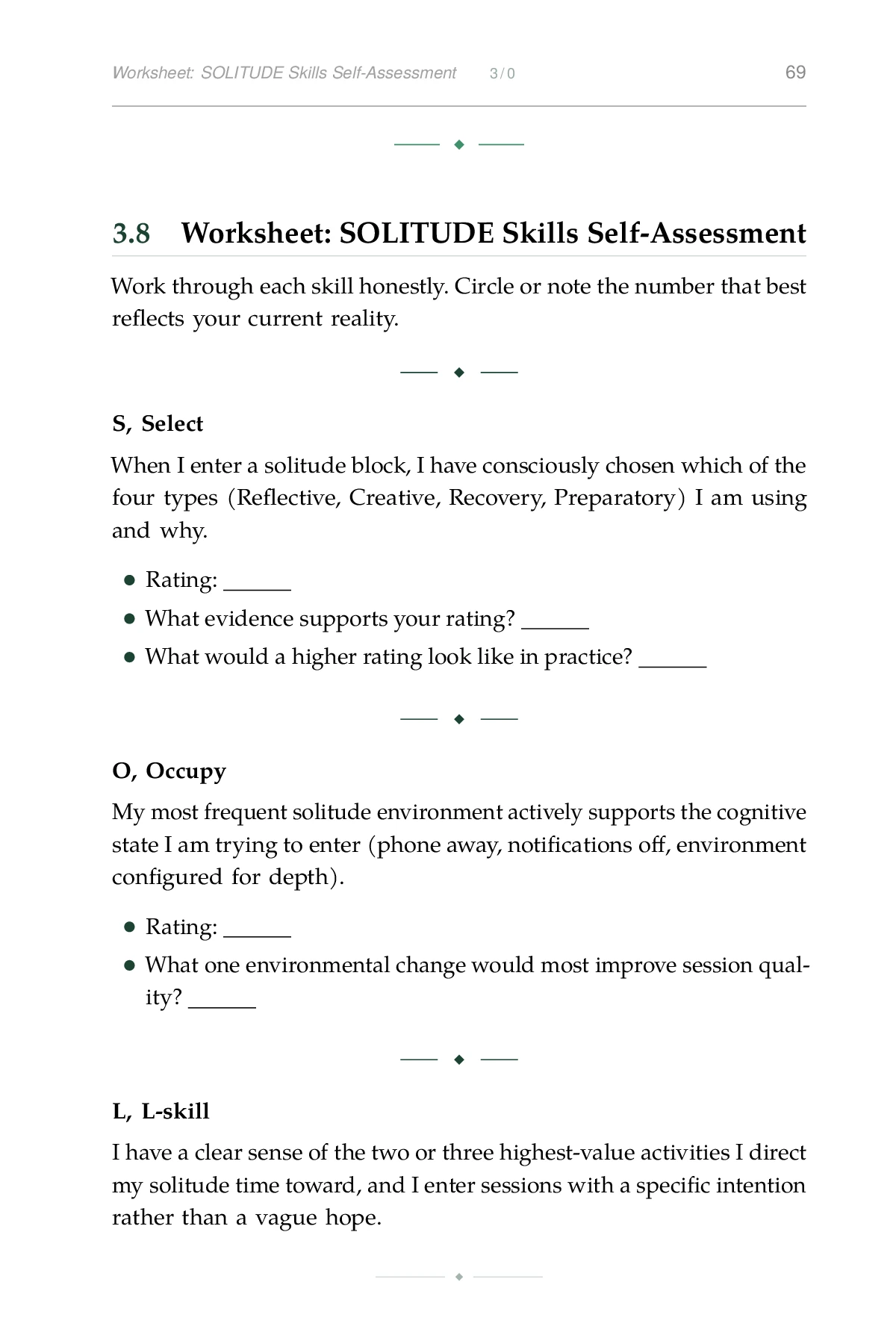
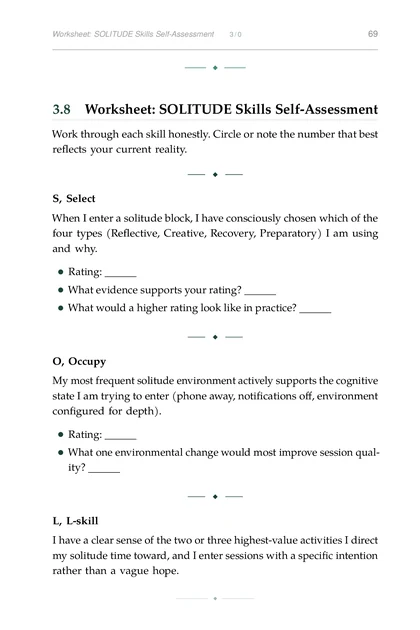 3.8 Worksheet: SOLITUDE Skills Self-Assessment
 Solitude is not what you do when your responsibilities allow it.
 CHAPTER

The contents
Chapter by chapter
Every chapter of Strategic Solitude with its printed epigraph, what you can do afterwards, and the moment it is built for.
Introduction
Introduction: The Architecture of Clarity
There is a version of your thinking that only shows up when no one is watching. This book is about building the conditions for it to arrive on purpose.
Chapter 1
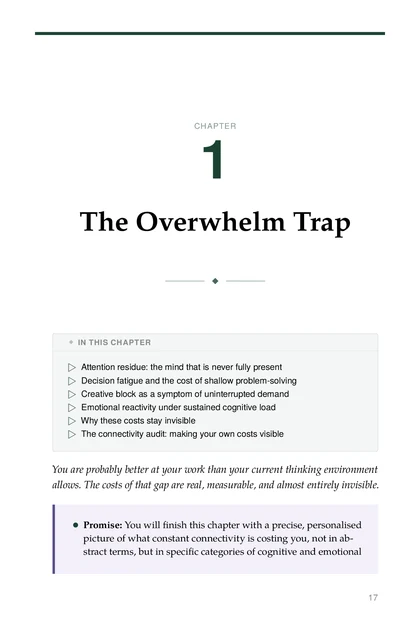
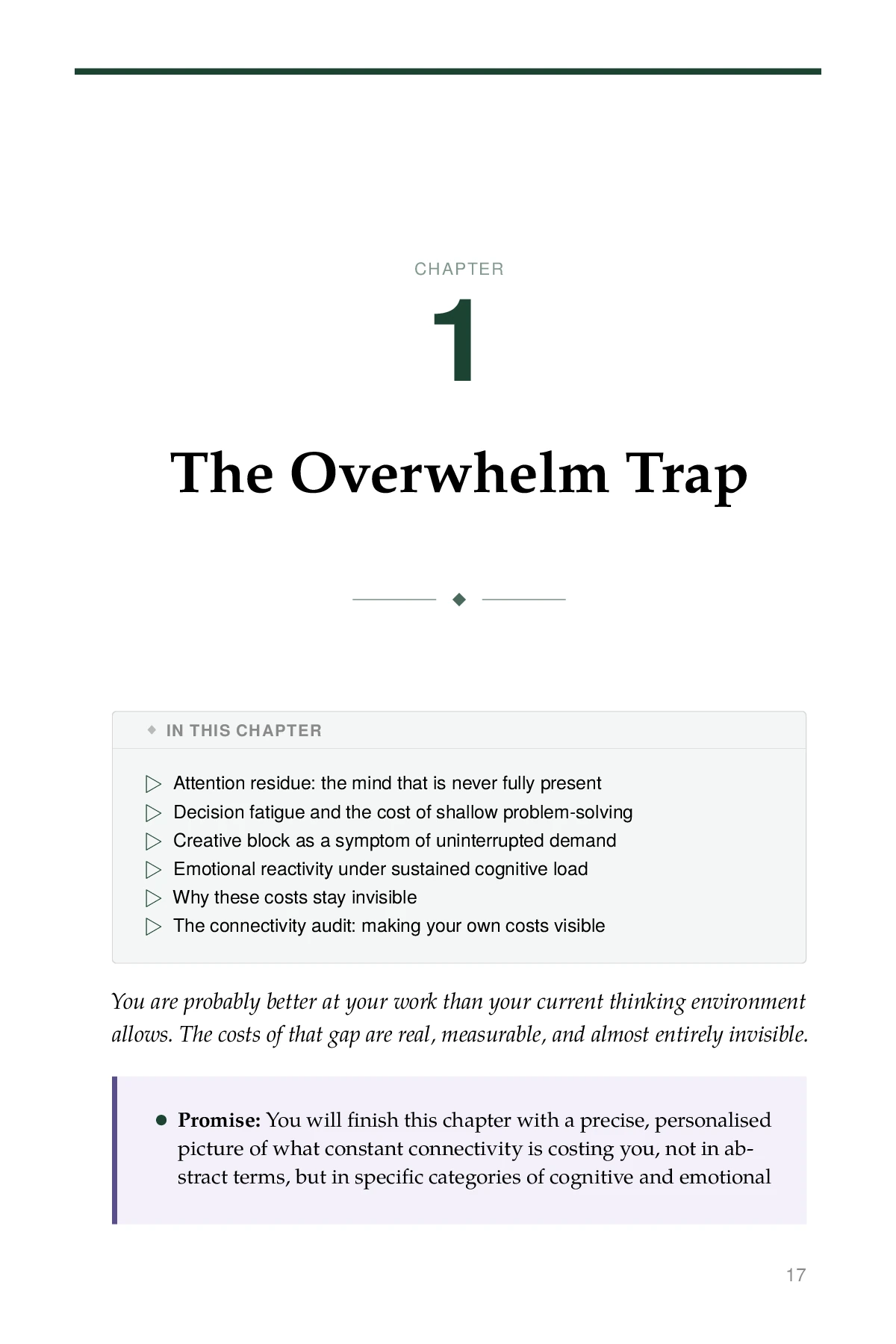
The Overwhelm Trap
You are probably better at your work than your current thinking environment allows. The costs of that gap are real, measurable, and almost entirely invisible.
Chapter 2
What Solitude Does to the Mind
The clarity you find in quiet places is not random good fortune. It is the product of specific, well-understood cognitive processes, and they require conditions that constant connectivity systematically destroys.
Chapter 3
The SOLITUDE Framework
A system for your alone time sounds counterintuitive until you realize that the only alternative is hoping for it, and hoping has a poor track record.
Chapter 4
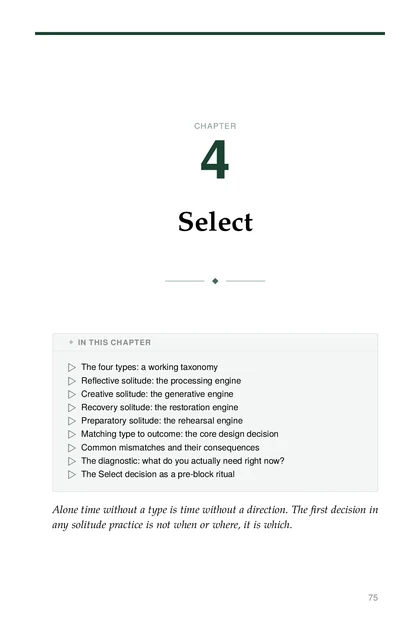
Select
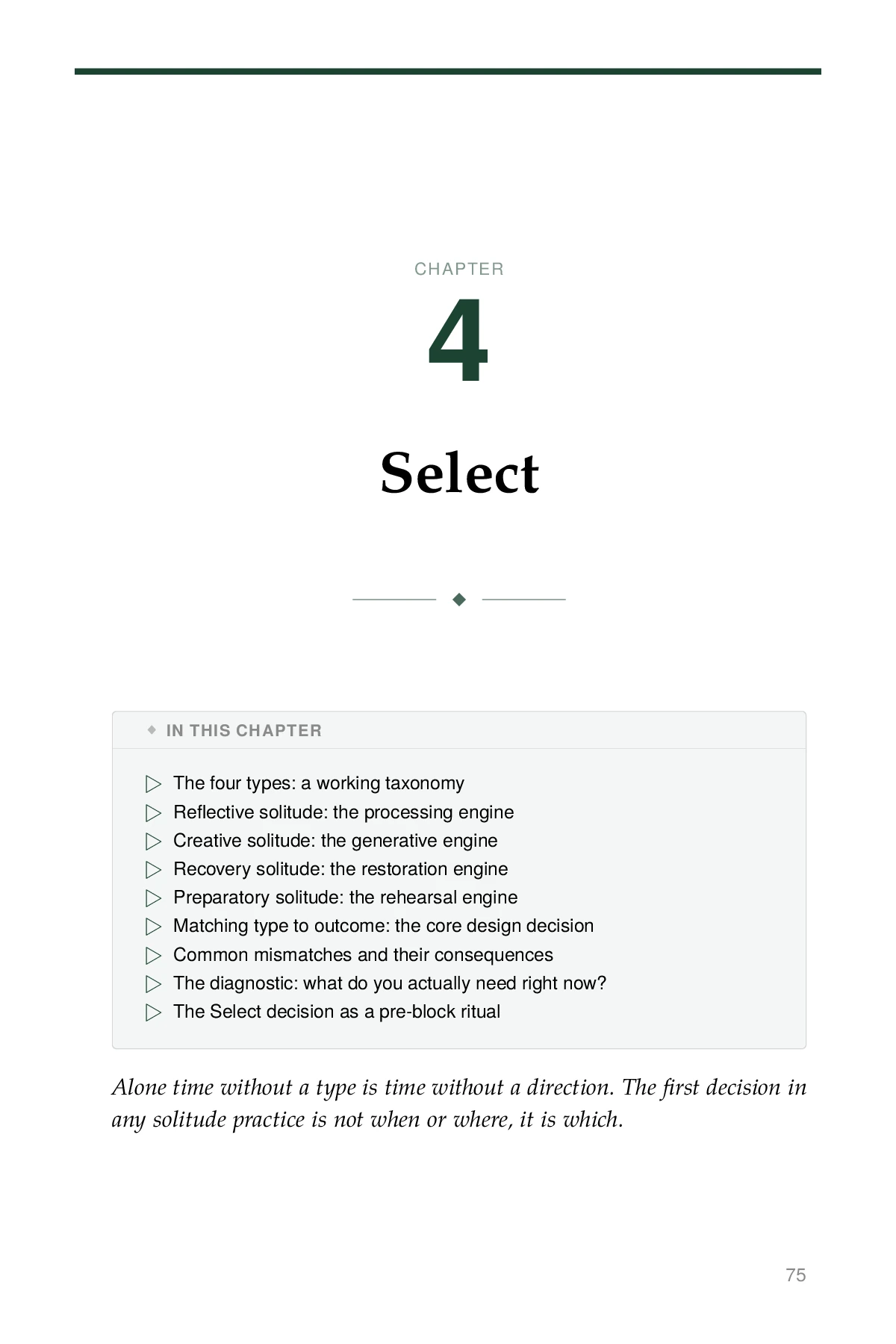
Alone time without a type is time without a direction. The first decision in any solitude practice is not when or where, it is which.
Chapter 5
Occupy
Chapter 6
L-skill
Protected time is potential energy. What you do inside it determines whether that potential becomes output, or simply disappears.
Chapter 7
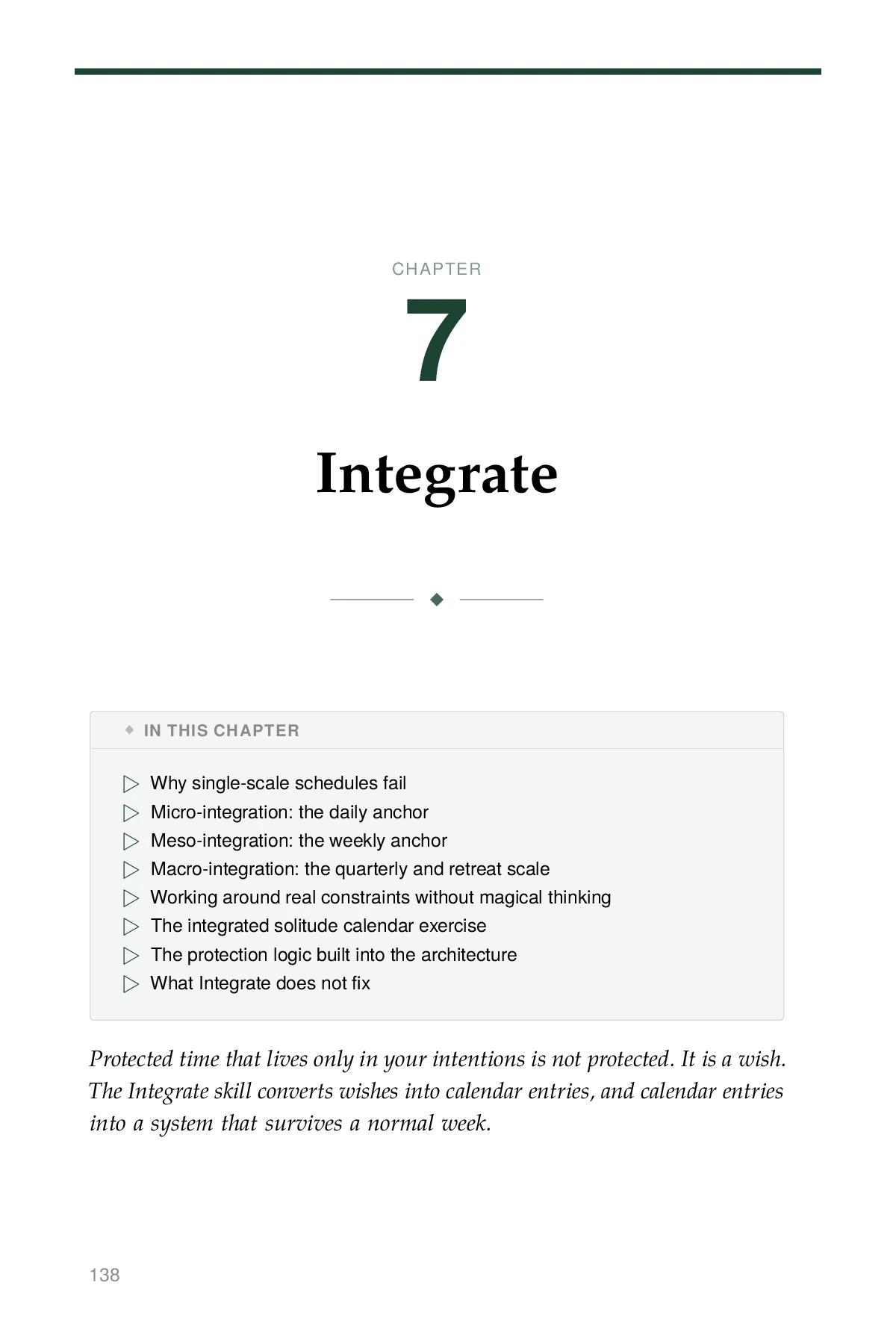
Integrate
Protected time that lives only in your intentions is not protected. It is a wish. The Integrate skill converts wishes into calendar entries, and calendar entries into a system that survives a normal week.
Chapter 8
Transition
The calendar gives you the block. The ritual gives you the state. Without both, you own the time but not the thinking.
Chapter 9
Understand
The practitioner who disappears without explanation creates a mystery. The practitioner who explains creates an invitation.
Chapter 10
Defend
A boundary declared once is a position. A boundary maintained repeatedly is a practice. Only the second one holds.
Chapter 11
Evaluate
A practice without feedback is a ritual. A ritual without feedback is drift wearing the name of discipline.
Conclusion
The Infrastructure Commitment
Clarity does not come to those who wait for it. It comes to those who build the conditions it requires, and then show up to use them.
Who it is for
Who this book was written for
You will not withdraw from your responsibilities or your relationships. You will think more clearly inside them, and sustain the clarity long after the founders who treated solitude as indulgence have burned through theirs.
If your sharpest judgment keeps arriving by accident, this book exists to make it arrive by design.
The reader it was written for
The overwhelmed high-performer. Founders, executives, creative directors, senior professionals, and entrepreneurs who are constantly connected, always available, and experiencing the costs: shallow thinking, decision fatigue, creative depletion, and reactive work patterns.
What you will use it on
- [ ] Design a schedule with protected solitude blocks
- [ ] Create physical and digital environments that support alone time
- [ ] Develop rituals for entering and exiting solitude states
- [ ] Communicate solitude needs to team, family, and clients
- [ ] Use solitude for specific high-value activities (strategy, creativity, recovery)
- [ ] Protect solitude from intrusion without damaging relationships
Probably not for you if
- People seeking a general self-help book on "me time" or relaxation
- Readers with clinical social anxiety, depression, or isolation issues (this is not a therapeutic guide)
- People looking for a digital detox or anti-technology manifesto
- Readers who already have abundant unstructured alone time and don't need a system
Editions
Editions and specifications
| Edition | Formats | Chapters | Pages | Reading time | ISBN (paperback) |
|---|---|---|---|---|---|
| English Strategic Solitude | In production | 13 | 308 | ± 4 hours | — |
| Dutch Strategische stilte | In production | 13 | 328 | ± 4 hours | — |
Both editions are written natively. The Dutch text is not a machine translation of the English. · Trim size: 6x9″
Frequently asked
What readers usually want to know
What is Strategic Solitude about?
A deliberate solitude system for founders and executives who need recovery, deep thinking, and higher-quality decisions away from the reflexive noise of teams. The subtitle is: How Deliberate Alone Time Sharpens Decision-Making.
What is the SOLITUDE framework?
SOLITUDE: Select, Occupy, Leverage, Integrate, Transition, Understand, Defend and Evaluate.
Is there a Dutch edition?
Yes. The Dutch edition is Strategische stilte, written as a native edition rather than a machine translation. It moves through the same production line.
How long is Strategic Solitude?
This edition runs 13 chapters, 308 pages in print and roughly 4 hours of reading.
Who is Strategic Solitude for?
If your sharpest judgment keeps arriving by accident, this book exists to make it arrive by design.
The production system
How this book was made
Every title moves through the same gated production line: sourced research, a claim-level evidence ledger, structural review, fact-checking, red-team critique, and a bilingual final edit. AI agents do specialist work inside those gates; judgment, voice, and accountability stay human.
- Claims enter an evidence ledger with a source and a confidence grade before they reach the page
- English and Dutch are two native editions, not a translation of one another
- Every chapter clears readability, rhythm, and style gates before it is typeset


