

No. 50 · Drafting (English edition first) · Decisions & philosophy · MEANING
The Meaning Operator
Applied Existentialism for Founders: Why You Build, What It Costs, What It Is Worth
The Meaning Operator: Applied Existentialism for Founders: Why You Build, What It Costs, What It Is Worth.
Another goal can restore motion; it cannot explain why the motion matters. MEANING treats meaning not as one hidden answer to discover but as an architecture to build, inspect, and maintain across mission, engagement, anchors, narrative, intrinsic worth, now, and growth. Applied Existentialism for Founders: Why You Build, What It Costs, What It Is Worth. The framework: MEANING.
- pages
- 118
- chapters
- 11
- hours of reading
- ± 2
- editions
- EN · NL
- Design
- Drafting
- Manuscript
- Production
- Launched
The editions
Kindle and Paperback
Production shots of the editions. Not for sale yet — this page is the public working version.
-
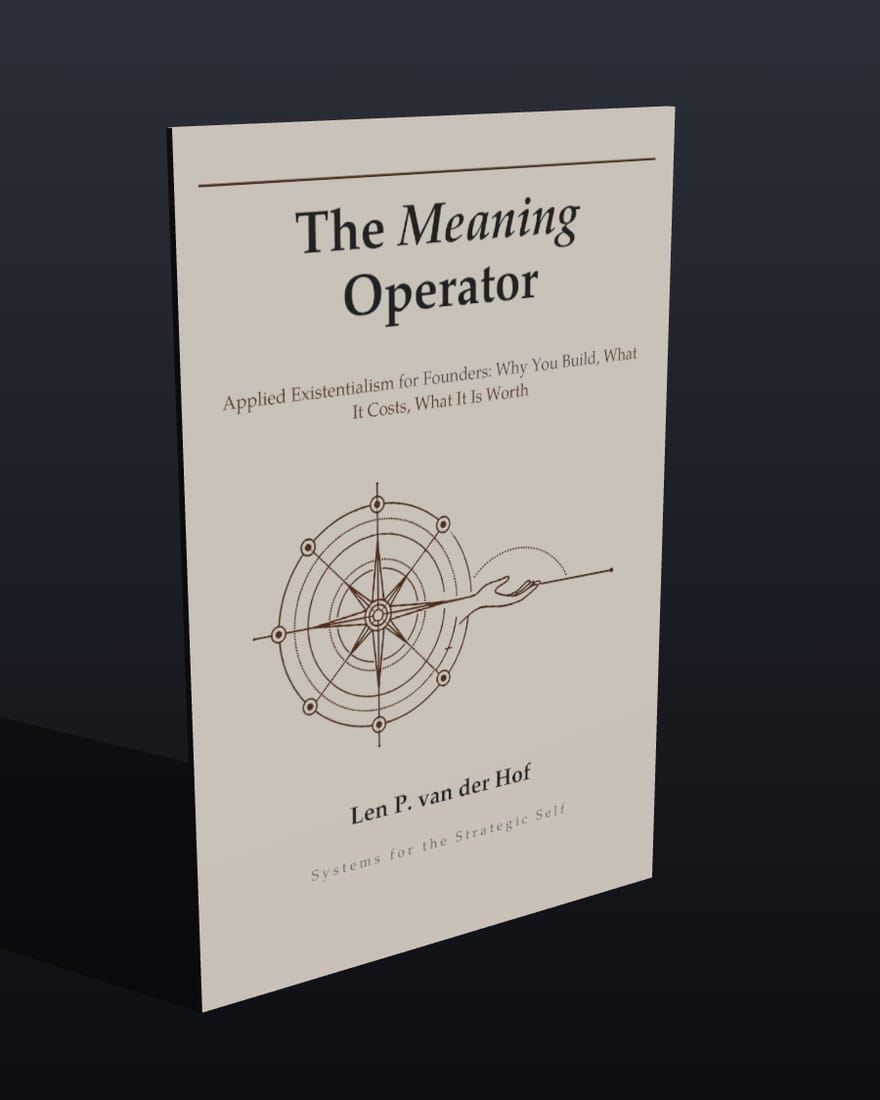
Kindle
The digital edition, ready in any Kindle app.
-
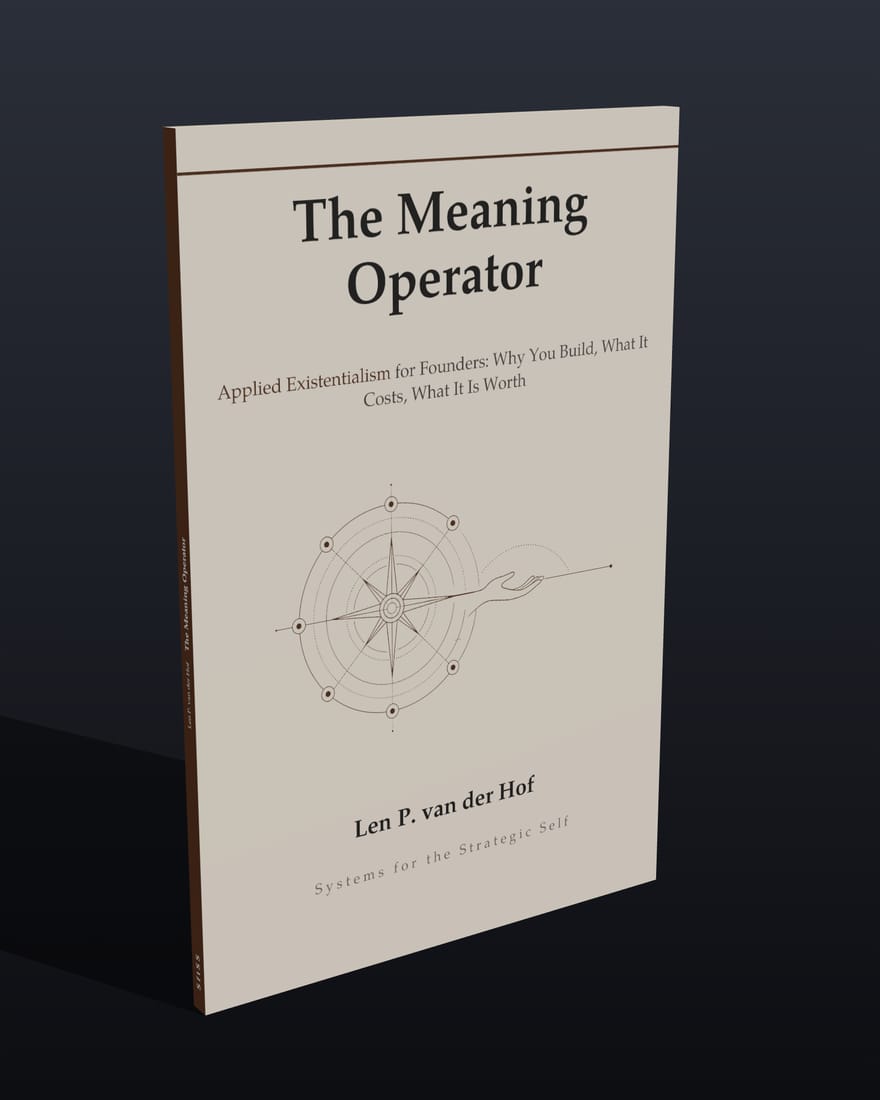
Paperback
The working copy. Mark it up. Take it into the meeting.


The book
Applied Existentialism for Founders: Why You Build, What It Costs, What It Is Worth
Why are you still building?
The question tends to arrive where startup culture has the least to say: after failure, after success, or halfway through years of competent work whose original purpose has quietly gone thin. Another goal can restore motion. It cannot explain why the motion matters.
The Meaning Operator translates existentialist philosophy into an operating discipline for founders. Its seven-part MEANING framework treats meaning not as one hidden answer to discover, but as an architecture to build, inspect, and maintain across Mission, Engagement, Anchors, Narrative, Intrinsic worth, Now, and Growth.
What you learn
What this book puts in your hands
- Distinguish motivation, which points action at a goal, from meaning, which explains why the goal matters.
- Recognize the different structures of the failure rupture, the success rupture, and the long middle.
- Diagnose which domain has gone quiet before treating the entire architecture as lost.
- Choose a mission you can endorse instead of inheriting one from status, investors, or an earlier version of yourself.
- Rebuild engagement by returning to work that absorbs rather than merely administers.
- Protect relationships, practices, and commitments that hold value when the company does not.
The framework
MEANING, step by step
-
Mission
-
Engagement
-
Anchors
-
Narrative
-
Intrinsic
-
Now
-
Growth
The contents
Chapter by chapter
Every chapter of The Meaning Operator with its printed epigraph, what you can do afterwards, and the moment it is built for.
Introduction
The question motivation cannot answer
What you can do afterwards
You will arrive at a precise vocabulary for the experience you have been carrying without words.
Use this chapter when
You are in any of the three rupture experiences, or in the long middle, or simply aware that your relationship to the work is not what it was.
Chapter 1
The existentialist's toolkit
What you can do afterwards
You will leave with four working tools and the names of the people who built them, so that when the question arrives you reach for equipment instead of a platitude.
Use this chapter when
You have felt the flatness the last chapter named, and you want to know whether anyone took it seriously before you did.
Chapter 2
The structure of meaning
What you can do afterwards
You will leave this chapter able to name which of seven domains has failed, instead of reporting that meaning in general has gone.
Use this chapter when
You can feel that your relationship to the work has changed but cannot locate the change, or when "I've lost my sense of why" is the most precise sentence you have.
Chapter 3
Mission as existential act
What you can do afterwards
You will be able to tell a mission you chose from a mission you were absorbed into, and to perform the choosing on purpose.
Use this chapter when
The company still runs and the numbers still move, but you cannot say why the work is yours without reaching for the words you would use on a stage.
Chapter 4
The engagement that matters
What you can do afterwards
You will be able to read Engagement and Intrinsic as two separate gauges, and to tell an absorption that has been scaled away from one that was never yours to begin with.
Use this chapter when
The work still matters and you can say why, but the hours have gone flat, and the flatness does not lift when the numbers are good.
Chapter 5
The three ruptures
What you can do afterwards
You will be able to tell the three ruptures apart, name which part of your meaning architecture each one has damaged, and stop applying the wrong repair to the wrong break.
Use this chapter when
A company has just ended, or a milestone has just failed to feel like anything, or a run of pivots has left you unsure who you are inside your own company.
Chapter 6
The narrative that enables
What you can do afterwards
You will be able to tell a narrative that punishes from one that enables, and you will have three stages for building the second without lying about the first.
Use this chapter when
You have come through a rupture and the story you tell about it closes doors instead of opening them.
Chapter 7
The discipline of now
What you can do afterwards
You will be able to tell meaning that has been deferred to an outcome from meaning located in the work of the present, and you will see why the first reliably fails to pay out.
Use this chapter when
The milestones keep arriving and the significance you attached to them does not, and each new target inherits the promise the last one failed to keep.
Chapter 8
Anchors, growth, and the long view
What you can do afterwards
You will be able to name the two domains of the meaning architecture that a bad outcome cannot reach, and to see why building them is a design task for the ordinary years and not a rescue attempted after a loss.
Use this chapter when
The whole of your meaning has migrated into the venture, so that a threat to the company reads as a threat to your existence, and nothing would still stand if the company were removed.
Chapter 9
The absurd hero
What you can do afterwards
You will be able to name the stance that lets a founder build with the question of meaning still open, and to see why that stance is a victory instead of a surrender.
Use this chapter when
You have done the work of the earlier domains and the question still will not close, and you are deciding whether to begin again with full knowledge of how the last attempt ended.
Conclusion
The question, again
What you can do afterwards
You will be able to run the seven domains as a recurring diagnostic, so that when the sense of meaning thins you can find the domain that has gone quiet in place of treating the whole architecture as lost.
Use this chapter when
The question has returned. The work feels thinner than it did, nothing obvious has broken, and you need to locate where the loss sits.
Who it is for
Who this book was written for
The result is a practical set of instruments: a mission test, engagement audit, anchor map, narrative reconstruction, intrinsic-worth test, present-tense practice, growth record, and recurring MEANING review.
This is not a motivational book, a promise that every venture is worth continuing, or a substitute for clinical care. It will not tell you what your life means. It is for founders and operators who want a rigorous way to decide what their work asks of them, what it costs, and whether they can still call it worth doing.
What you will use it on
- **Name** the experience they are having in terms that are both philosophically precise and immediately recognisable
- **Understand** the structural architecture of meaning — what makes work feel meaningful, what disrupts that feeling, and why disruption is constitutive of the founder arc rather than an aberration
- **Diagnose** which component(s) of the MEANING framework are under-developed or damaged in their current situation
- **Apply** Frankl's logotherapy, Yalom's existential confronts, and Camus's absurdist stance to the specific rupture experience they are currently in or recovering from
- **Build** a working practice for meaning maintenance that functions under uncertainty rather than requiring resolved certainty as a precondition
- **Navigate** the relationship between meaning and performance — specifically, how a more conscious relationship to meaning tends to improve decision quality at pivots, not undermine it
Probably not for you if
- Founders in the first eighteen months who are in the founding-enthusiasm phase — they will not recognise the rupture experiences, and the book will feel premature
- Readers seeking motivational reinforcement or permission to start
- Readers who approach meaning-seeking through spiritual, religious, or New Age frameworks — the book is secular and empirical; it does not accommodate those frameworks as equivalent
- Readers looking for a business strategy or operational system
Editions
Editions and specifications
| Edition | Formats | Chapters | Pages | Reading time | ISBN (paperback) |
|---|---|---|---|---|---|
| English The Meaning Operator | In production | 11 | 118 | ± 2 hours | — |
| Dutch De Zingevende Ondernemer | In production | — | — | — | — |
Both editions are written natively. The Dutch text is not a machine translation of the English. · Trim size: 6x9″
Frequently asked
What readers usually want to know
What is The Meaning Operator about?
Another goal can restore motion; it cannot explain why the motion matters. MEANING treats meaning not as one hidden answer to discover but as an architecture to build, inspect, and maintain across mission, engagement, anchors, narrative, intrinsic worth, now, and growth. The subtitle is: Applied Existentialism for Founders: Why You Build, What It Costs, What It Is Worth.
What is the MEANING framework?
MEANING: Mission, Engagement, Anchors, Narrative, Intrinsic, Now and Growth.
Is there a Dutch edition?
Yes. The Dutch edition is De Zingevende Ondernemer, written as a native edition rather than a machine translation. It moves through the same production line.
How long is The Meaning Operator?
This edition runs 11 chapters, 118 pages in print and roughly 2 hours of reading.
Who is The Meaning Operator for?
This is not a motivational book, a promise that every venture is worth continuing, or a substitute for clinical care. It will not tell you what your life means. It is for founders and operators who want a rigorous way to decide what their work asks of them, what it costs, and whether they can still call it worth doing.
The production system
How this book was made
Every title moves through the same gated production line: sourced research, a claim-level evidence ledger, structural review, fact-checking, red-team critique, and a bilingual final edit. AI agents do specialist work inside those gates; judgment, voice, and accountability stay human.
- Claims enter an evidence ledger with a source and a confidence grade before they reach the page
- English and Dutch are two native editions, not a translation of one another
- Every chapter clears readability, rhythm, and style gates before it is typeset
The series
More in this theme


