

No. 24 · Early draft · Decisions & philosophy · AGENCY
The Human-in-the-Loop Life
How to Stay Essential in an Age of AI Automation
When AI does the thing you were proudest of, the question is not whether you are replaced
Something shifts when an AI tool does the work you built a career on. This book takes that feeling seriously and replaces the unanswerable question, "will AI replace me?", with one you can act on: what do you delegate, augment, and protect, and who decides. Built on the six-practice AGENCY framework, it gives knowledge workers a durable personal system for governing AI rather than resisting or surrendering to it.
- pages
- 235
- chapters
- 12
- hours of reading
- ± 4
- editions
- EN · NL
- Design
- Drafting
- Manuscript
- Production
- Launched
The editions
Kindle, Paperback and Hardcover
Production shots of the editions. Not for sale yet — this page is the public working version.
-
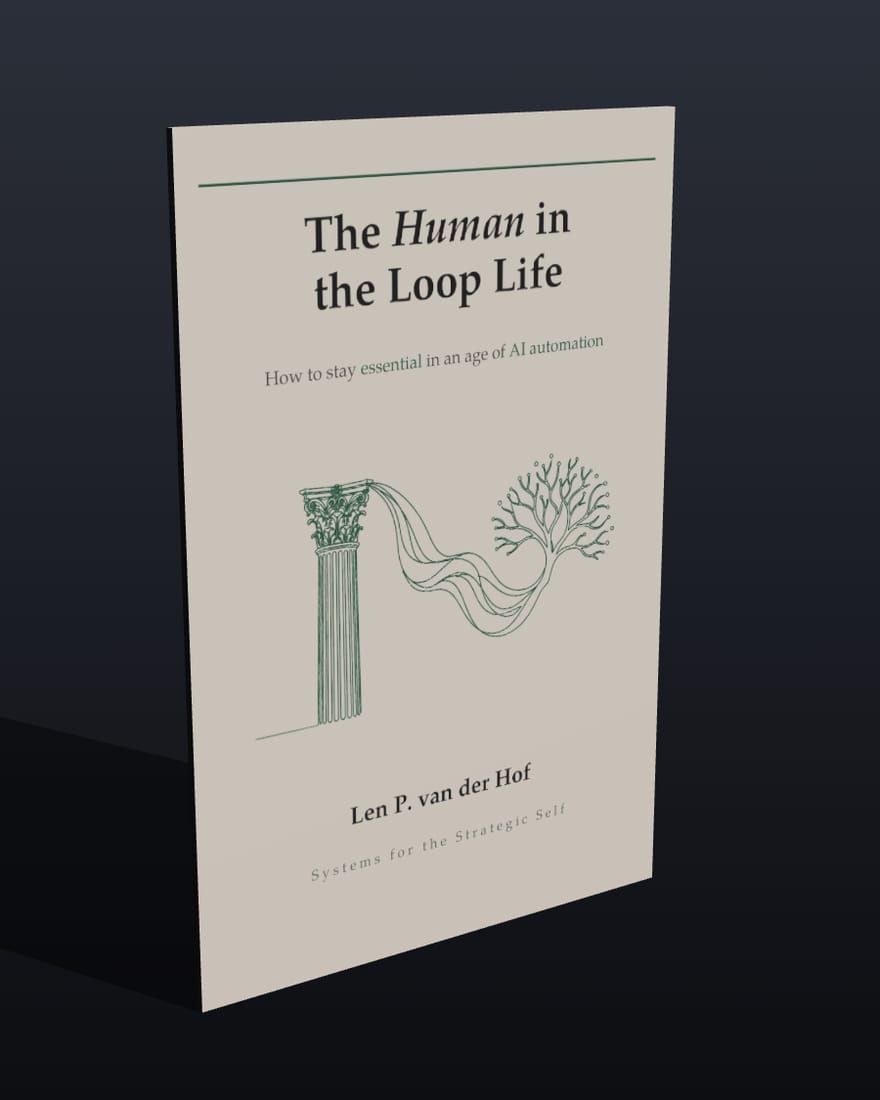
Kindle
The digital edition, ready in any Kindle app.
-
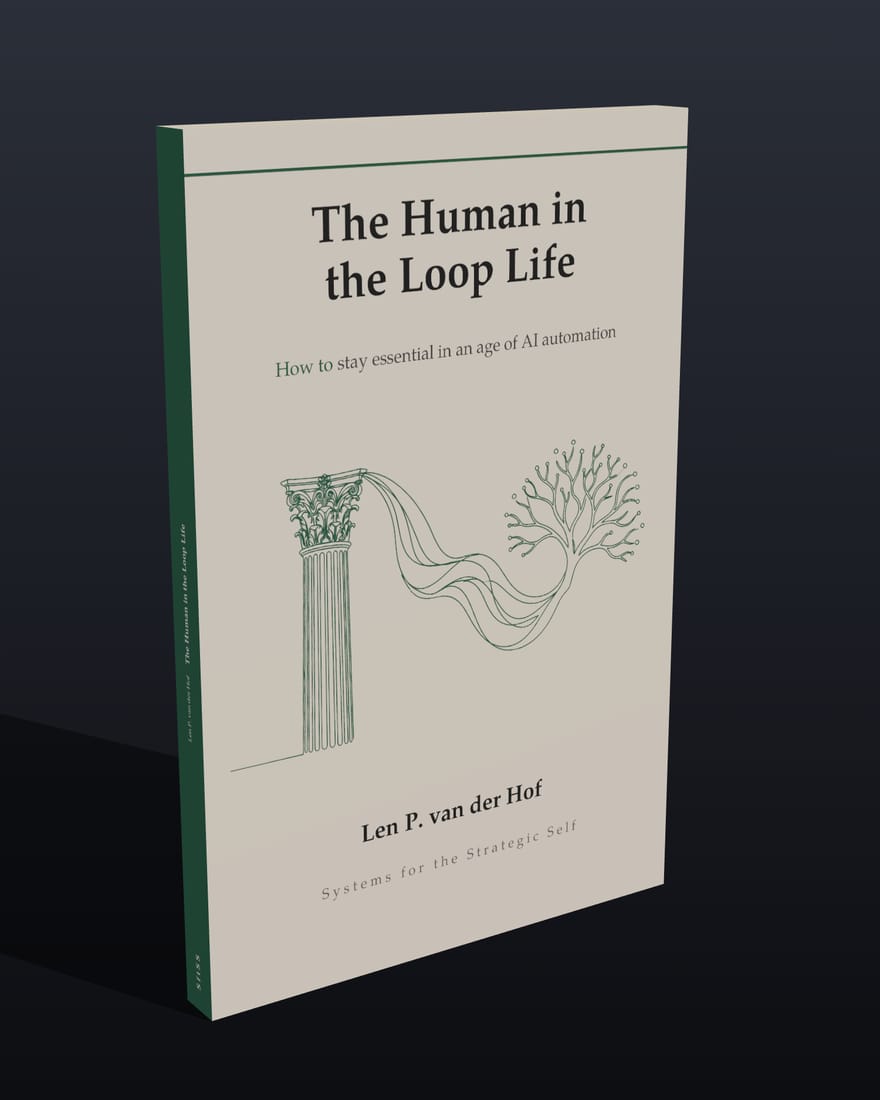
Paperback
The working copy. Mark it up. Take it into the meeting.
-
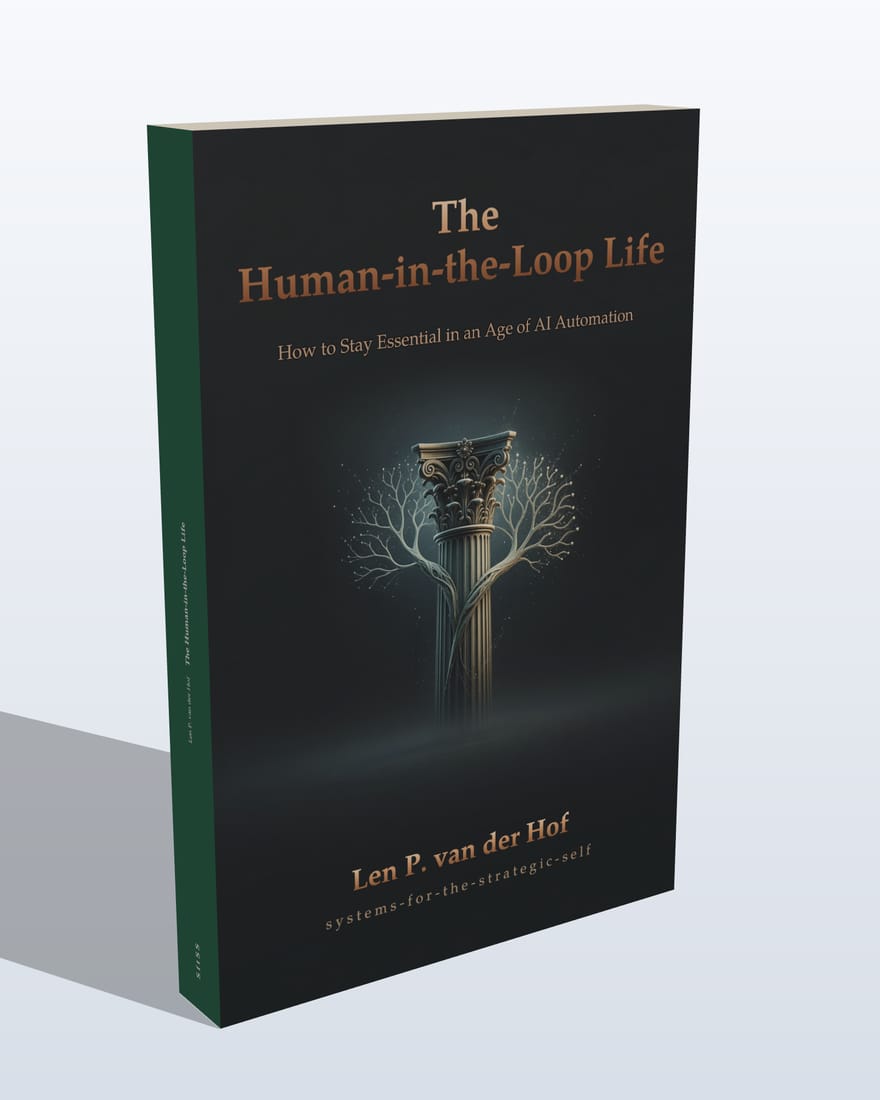
Hardcover
The shelf edition. Dark full-art jacket, built to stay in the room.


The book
How to Stay Essential in an Age of AI Automation
The feed already knew what you would watch. The model wrote the first draft, ranked the candidates, and quietly narrowed the route before you noticed there was a turn. You are still the one who clicks approve, but you cannot remember the last time approving meant anything more than agreeing with a machine that moved first. The convenience is real. So is the slow surrender of the call.
The usual response is to learn the tools faster: more prompts, more automations, more leverage. That accelerates the problem, because adding speed to a process you no longer judge does not make you sovereign; it makes you efficient at being overridden.
The Human in the Loop Life treats your autonomy the way a serious operator treats a critical system: as something you design on purpose, not something you hope survives the upgrade. It introduces the HUMAN framework: five disciplines for deciding, deliberately, where human judgment stays in the loop and where it should step out. The point is not to resist automation. It is to stop ceding the decisions that were yours to keep.
What you learn
What this book puts in your hands
- The AGENCY framework: Audit, Gate, Evaluate, Nurture, Check, Yield as a personal operating system
- A decision taxonomy for what to delegate, what to augment, and what to reserve for human judgment
- A skill-maintenance practice that protects expertise AI quietly erodes
- Human checkpoints you design on purpose, so accountability never leaks into the gap
- A technology-agnostic method that outlasts whichever AI tools are current
The framework
AGENCY, step by step
Audit, Gate, Evaluate, Nurture, Check, Yield as a personal operating system
-
Audit
-
Gate
-
Evaluate
-
Nurture
-
Check
-
Yield
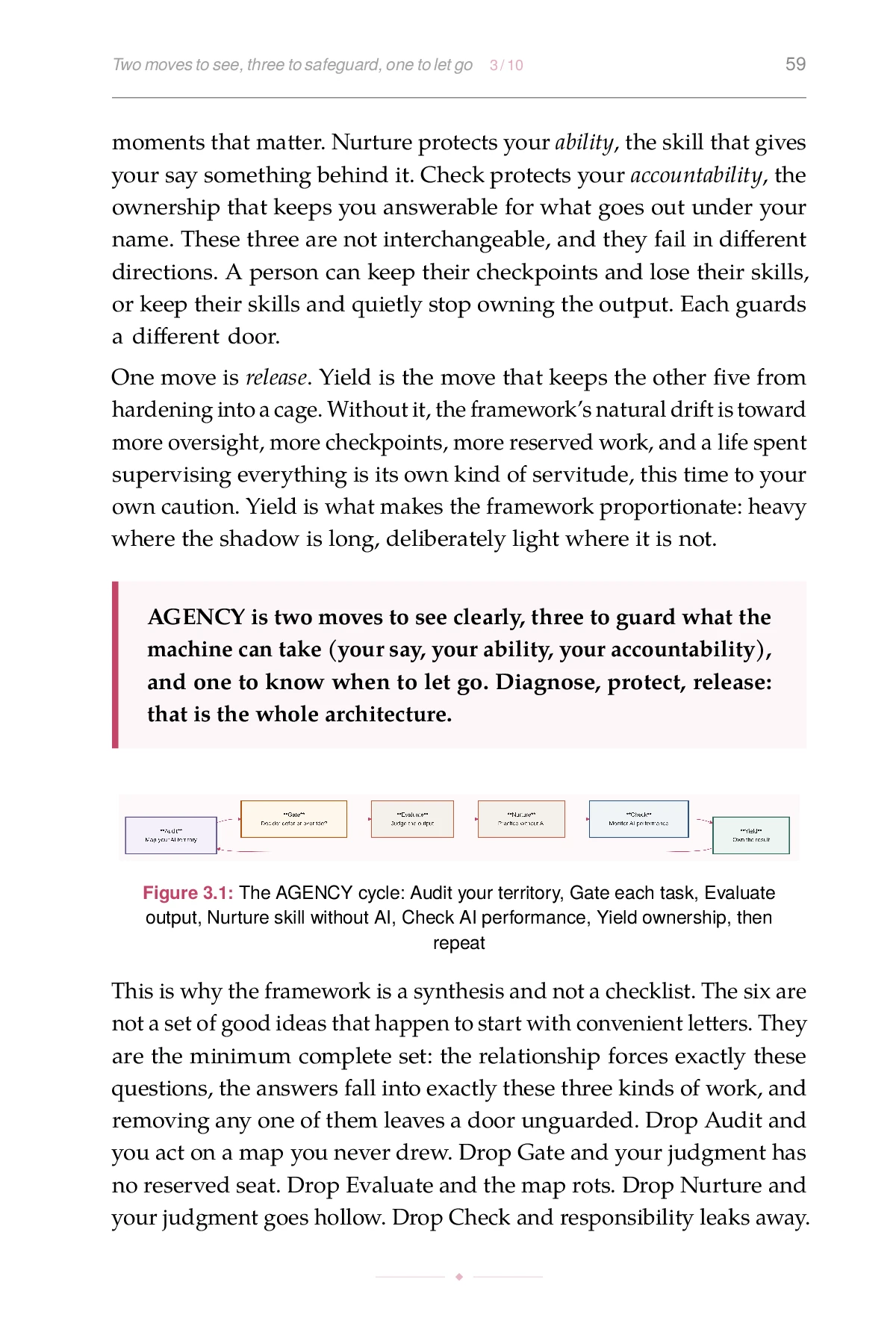
From the book
The AGENCY cycle: Audit your territory, Gate each task, Evaluate output, Nurture skill without AI, Check AI performance, Yield ownership, then
The Human-in-the-Loop Life, printed page: The AGENCY cycle: Audit your territory, Gate each task, Evaluate output, Nurture skill without AI, Check AI performance, Yield ownership, then
Inspect more pagesLook inside
Pages from the print edition.
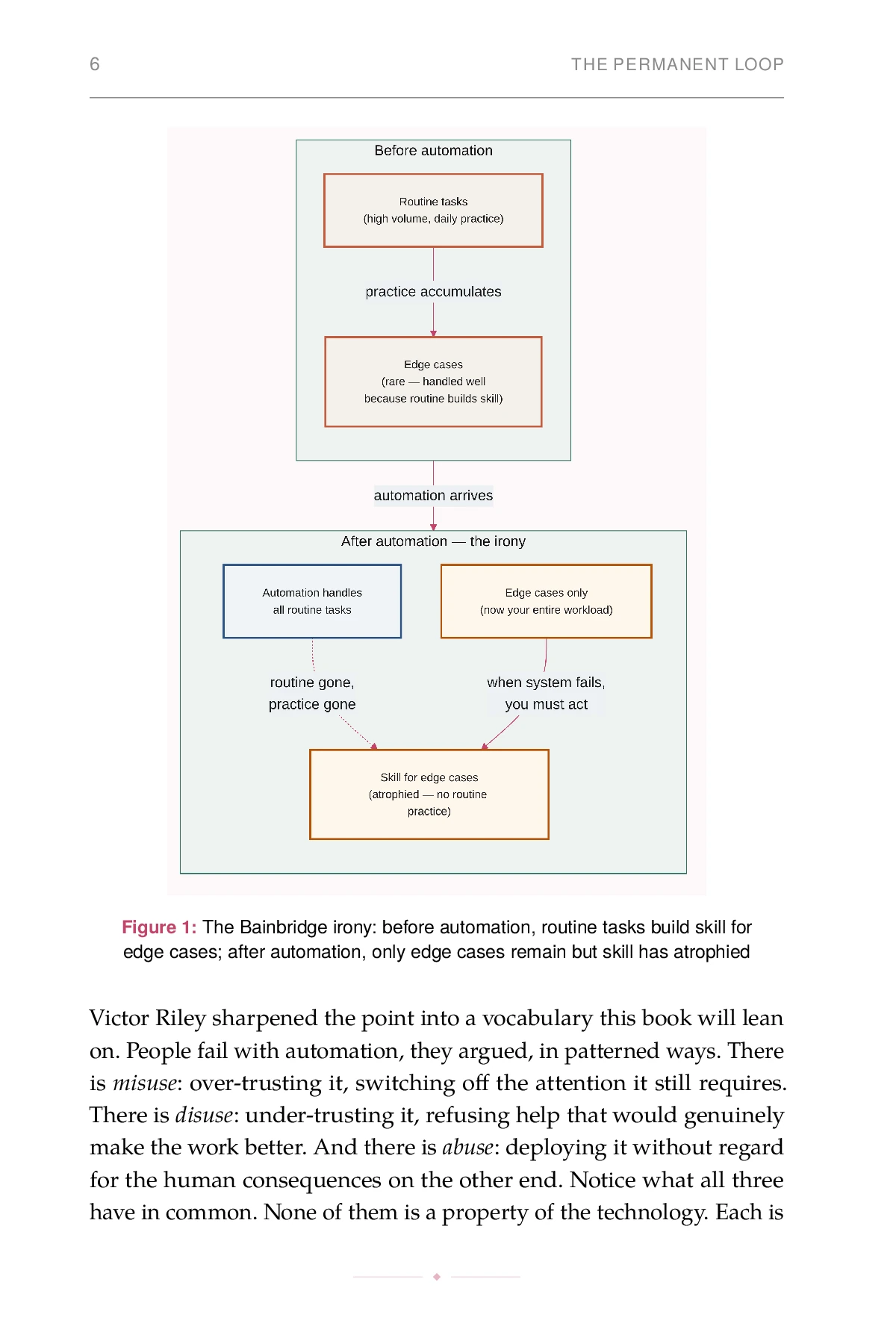
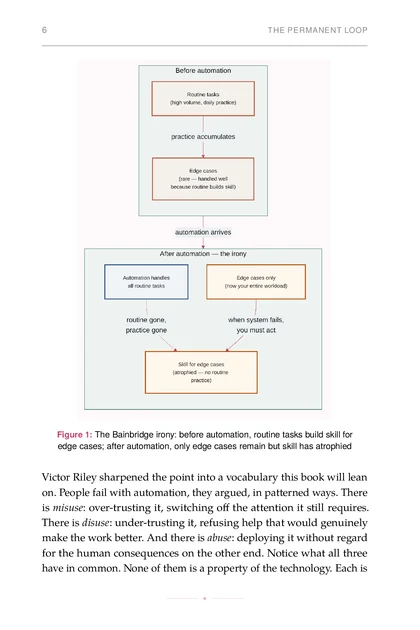 The Bainbridge irony: before automation, routine tasks build skill for edge cases; after automation, only edge cases remain but skill has atrophied
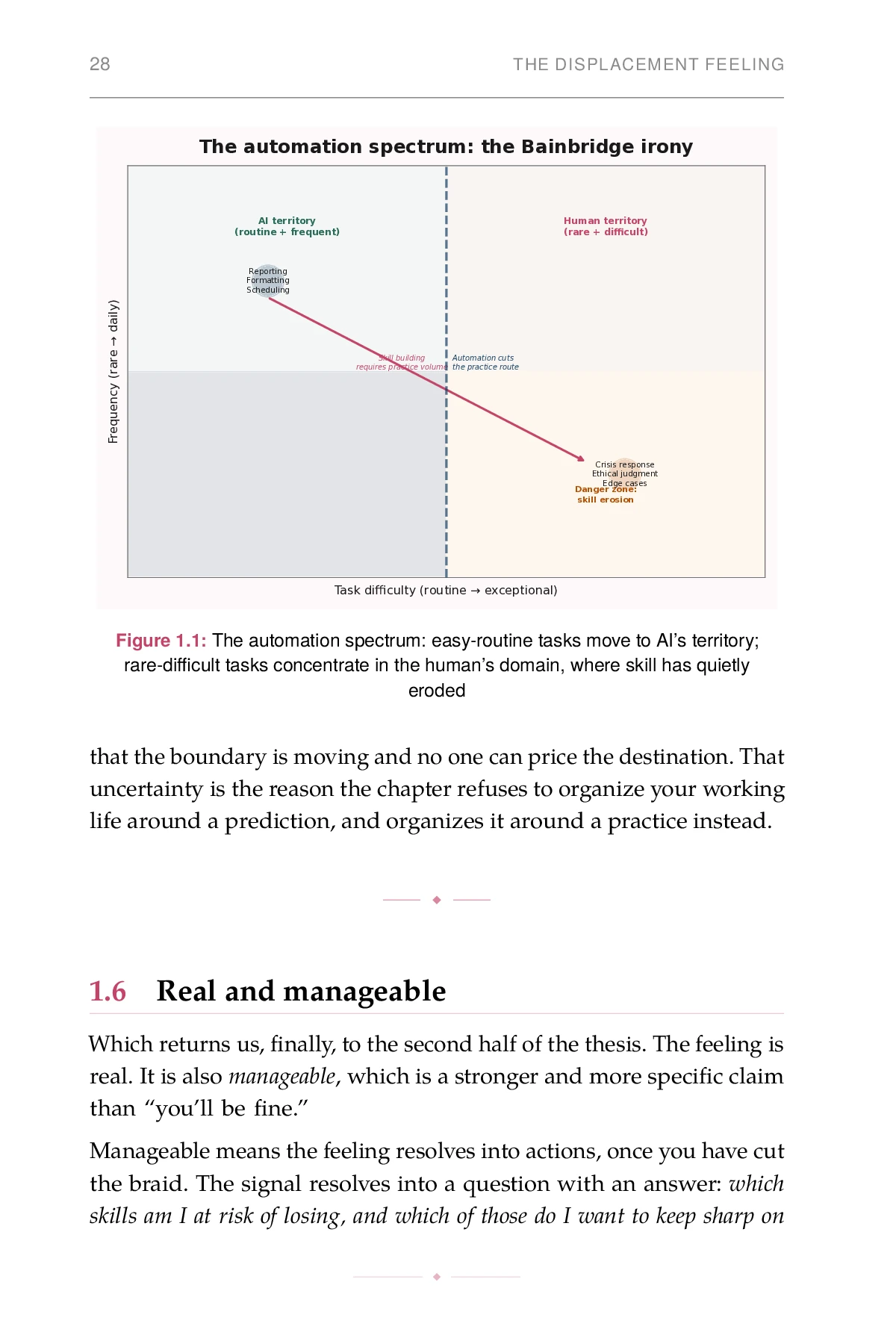
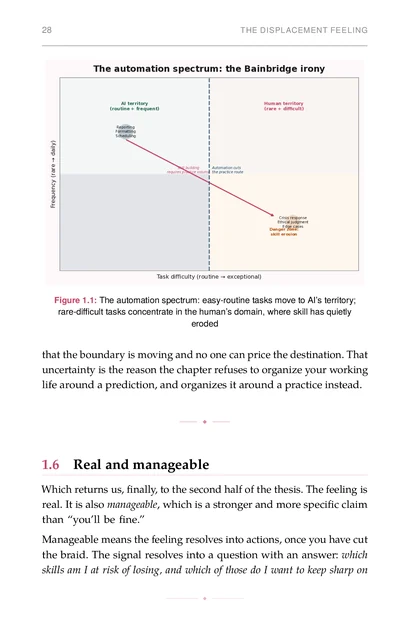 The automation spectrum: easy-routine tasks move to AI’s territory; rare-difficult tasks concentrate in the human’s domain, where skill has quietly
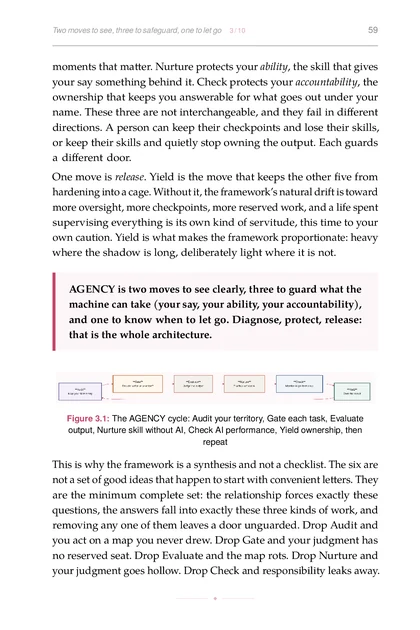 The AGENCY cycle: Audit your territory, Gate each task, Evaluate output, Nurture skill without AI, Check AI performance, Yield ownership, then
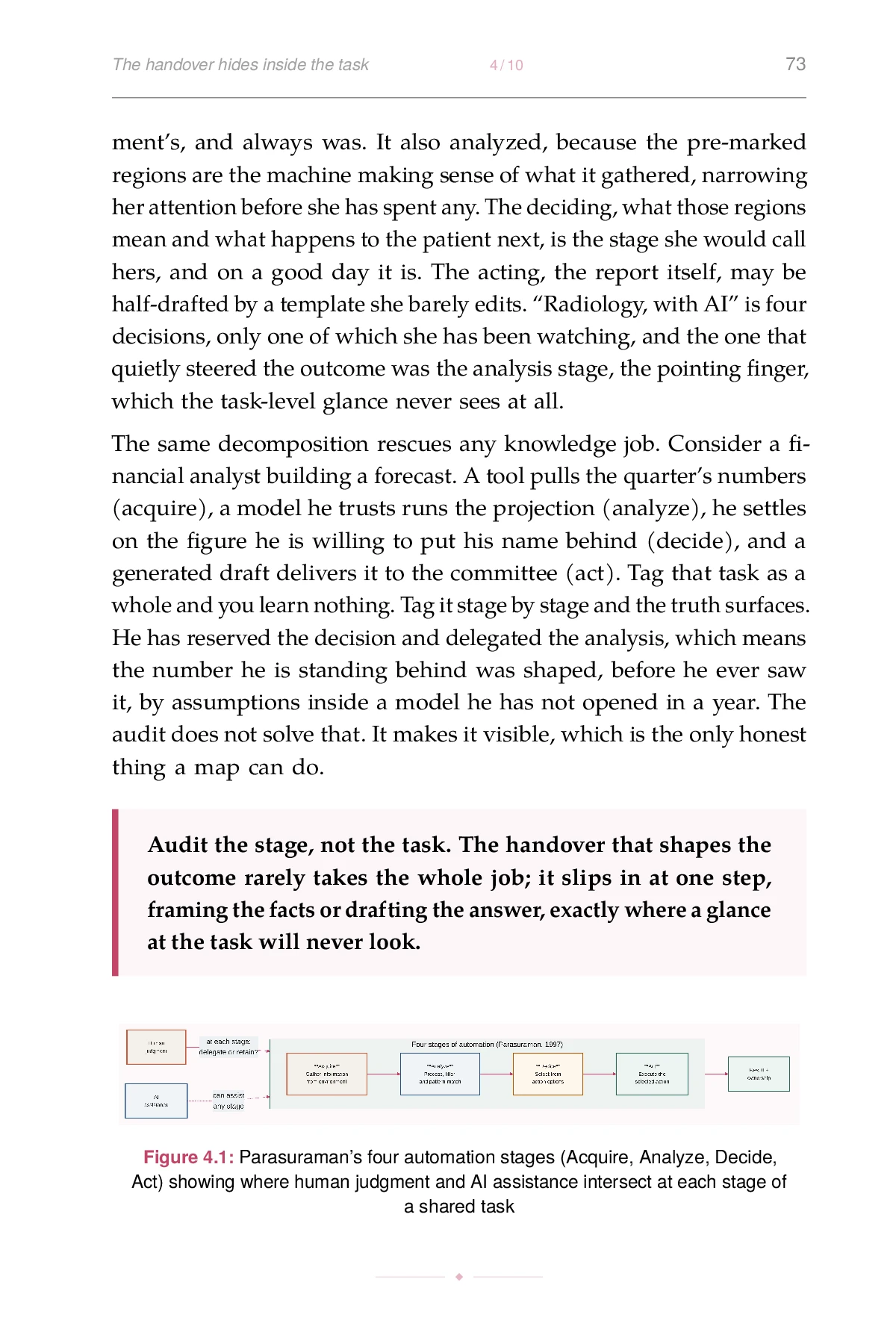
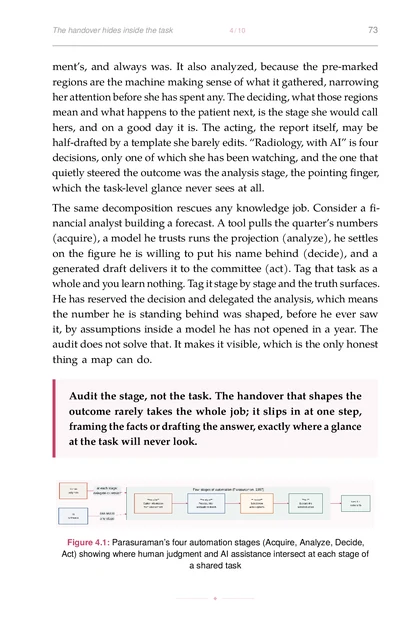 Parasuraman’s four automation stages (Acquire, Analyze, Decide, Act) showing where human judgment and AI assistance intersect at each stage of
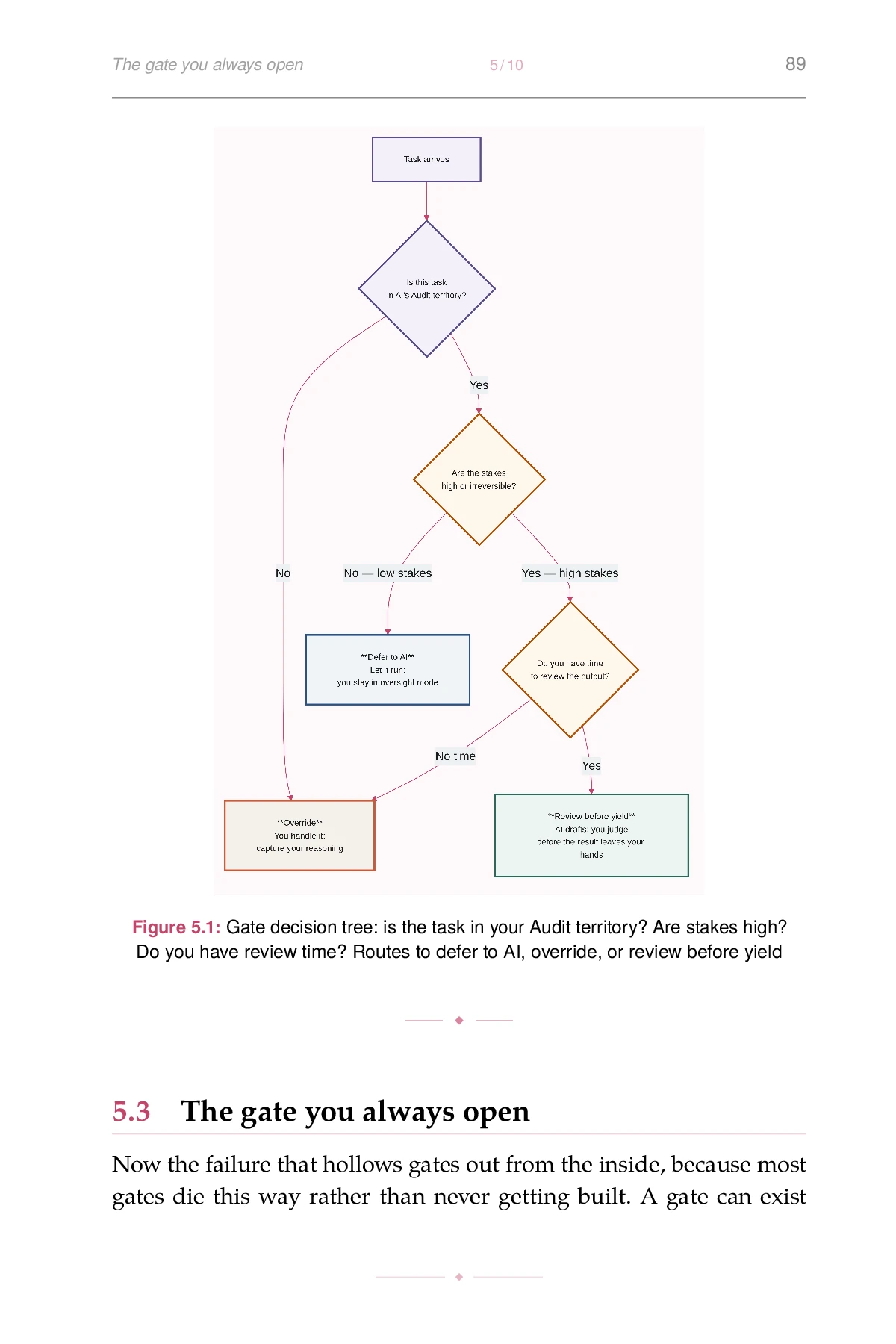
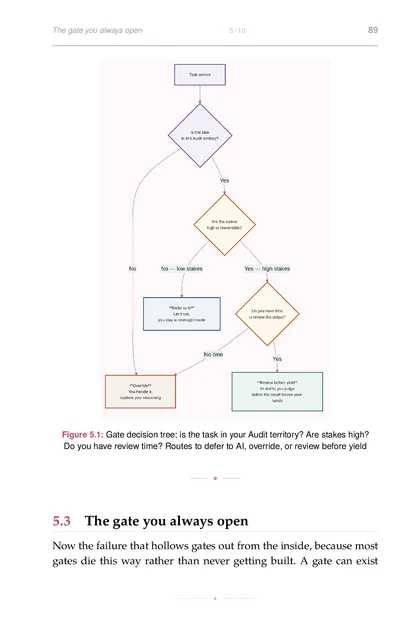 Gate decision tree: is the task in your Audit territory? Are stakes high? Do you have review time? Routes to defer to AI, override, or review bef…
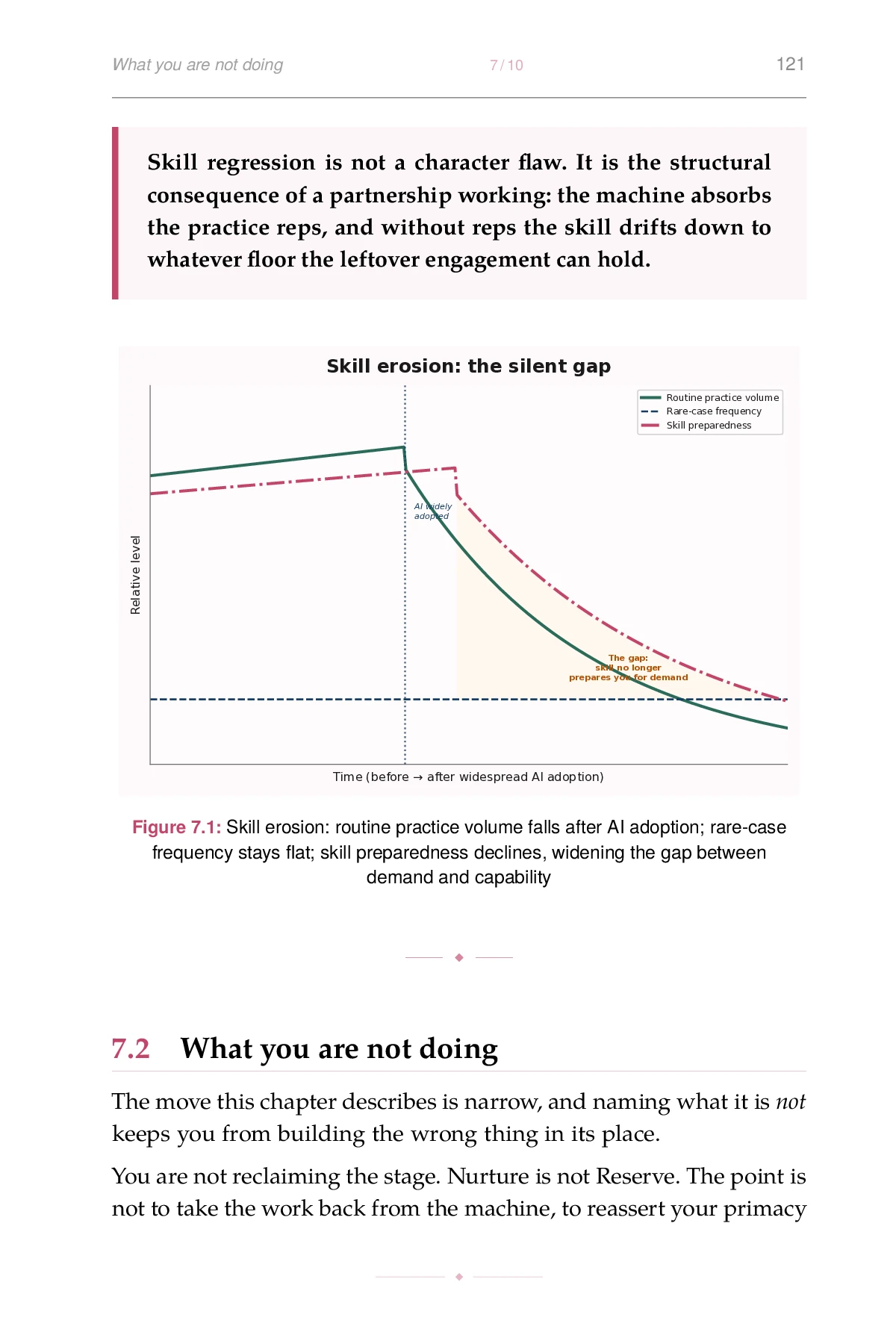
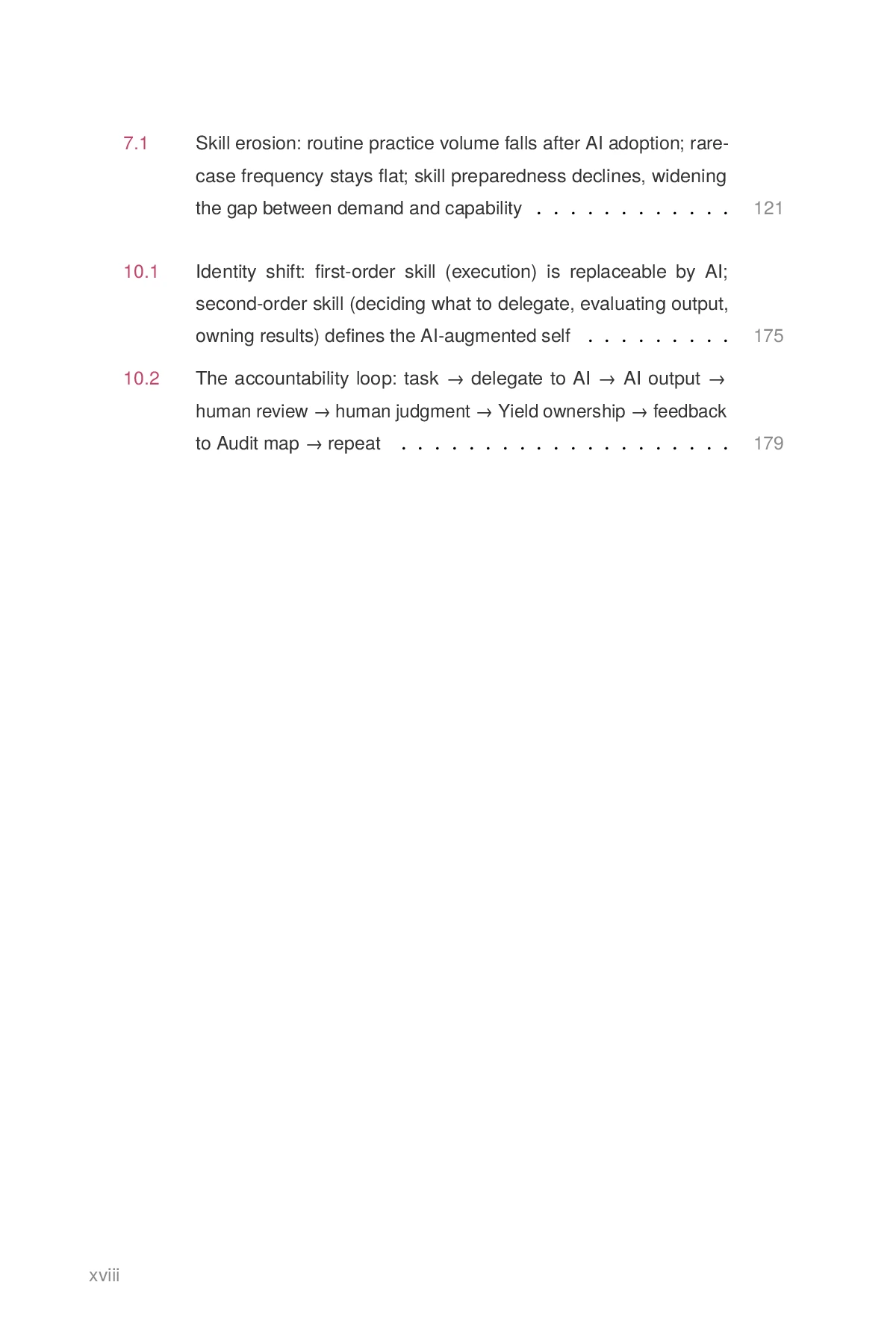
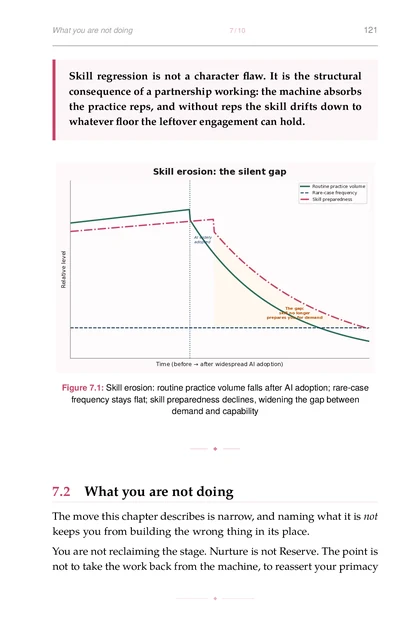 Skill erosion: routine practice volume falls after AI adoption; rare-case frequency stays flat; skill preparedness declines, widening the gap bet…
 CHAPTER
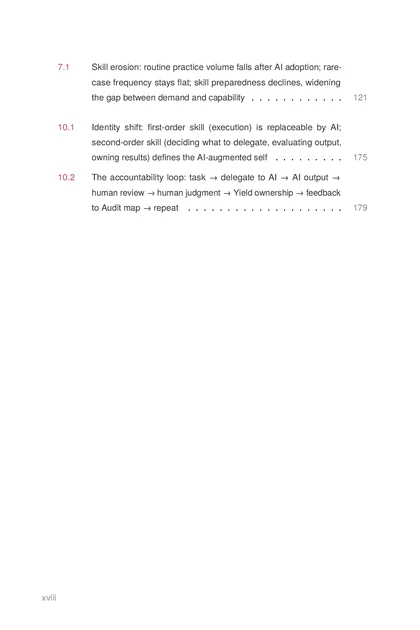 case frequency stays flat; skill preparedness declines, widening
 CHAPTER
The contents
Chapter by chapter
Every chapter of The Human-in-the-Loop Life with its printed epigraph, what you can do afterwards, and the moment it is built for.
Introduction
The Permanent Loop
What you can do afterwards
You will be able to replace the unanswerable question "will AI replace me?" with the one you can actually act on: which parts of your work you hand over, which you share, and which you keep, and who decides. You will also start your first decision audit today.
Use this chapter when
A tool has just done, in seconds, something you built a career around, and the relief came with a cold edge you have not been able to name.
Chapter 1
The Displacement Feeling
What you can do afterwards
You will be able to take the single lump of dread apart into a signal worth heeding (a real change in your work) and a verdict worth refusing (a false story about your worth), and to run that split in the moment the feeling hits.
Use this chapter when
A machine does your work well, you feel inadequate or quietly threatened, and you cannot tell whether the feeling is telling you something true or just frightening you.
Chapter 2
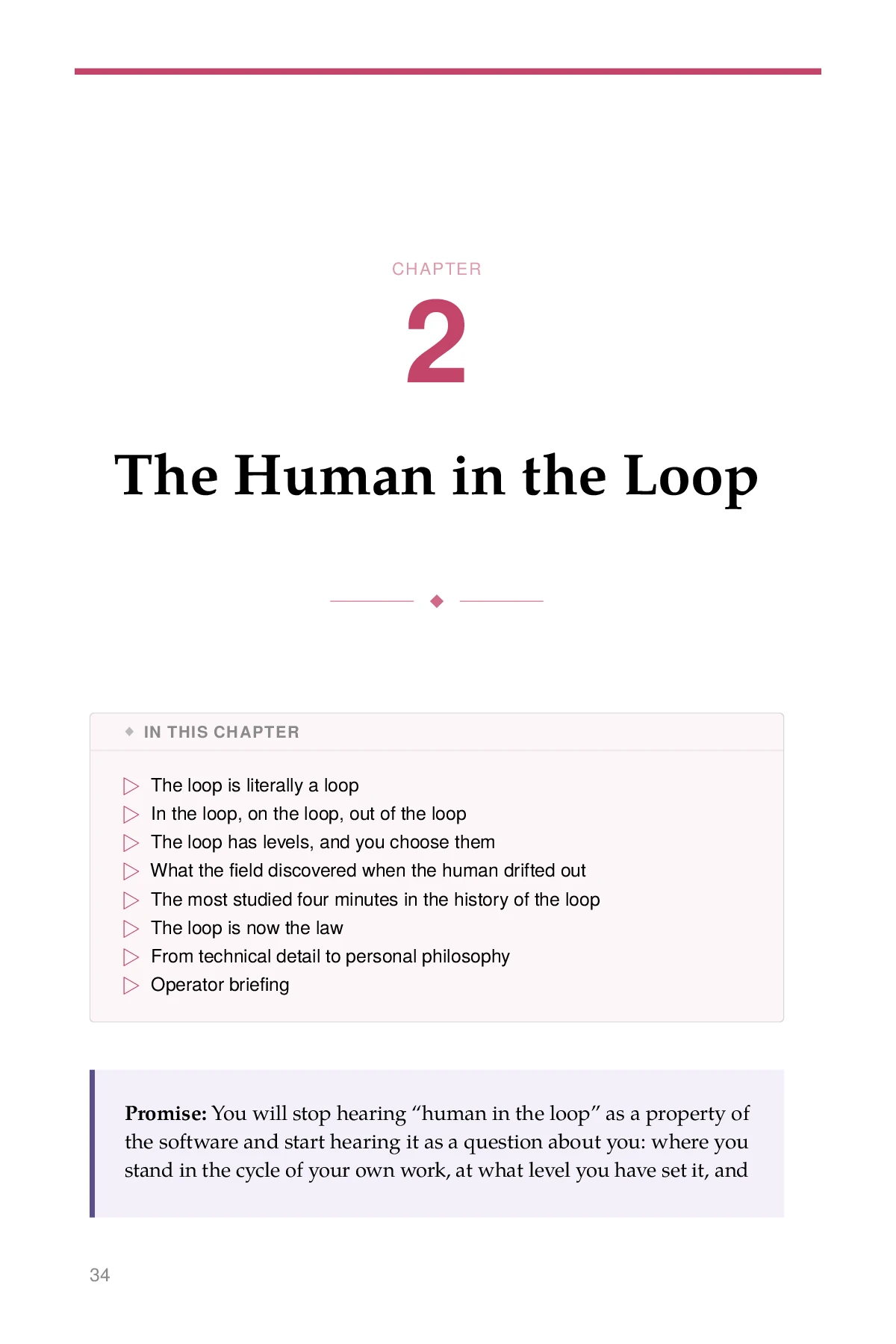
The Human in the Loop
What you can do afterwards
You will stop hearing "human in the loop" as a property of the software and start hearing it as a question about you: where you stand in the cycle of your own work, at what level you have set it, and whether you are truly there or only nominally watching.
Use this chapter when
You have realized that tasks you once approved one at a time now stream past you while you "keep an eye on them," and you suspect some of the keeping-an-eye-on has become a fiction.
Chapter 3
The AGENCY Framework
What you can do afterwards
You will carry away a single portable word, AGENCY, that turns understanding into a system you can run under load, plus a clear map of which of its six moves you most need and where to start.
Use this chapter when
You can name the displacement feeling and locate yourself in the loop, but the insight keeps failing on Tuesday, when the work moves faster than your resolve.
Chapter 4
Audit
What you can do afterwards
You will draw the first honest map of your actual working relationship with AI, broken down to the stage inside each task, so the handovers you never decided on finally become visible and governable.
Use this chapter when
You could not, asked right now, say what you have delegated to your tools and what you still do yourself, because the handovers arrived as conveniences rather than decisions.
Chapter 5
Gate
What you can do afterwards
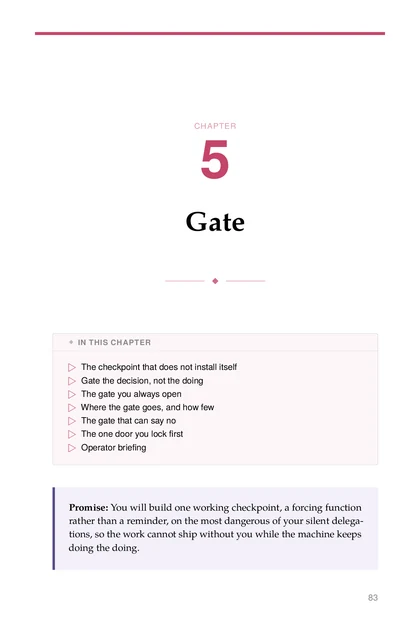
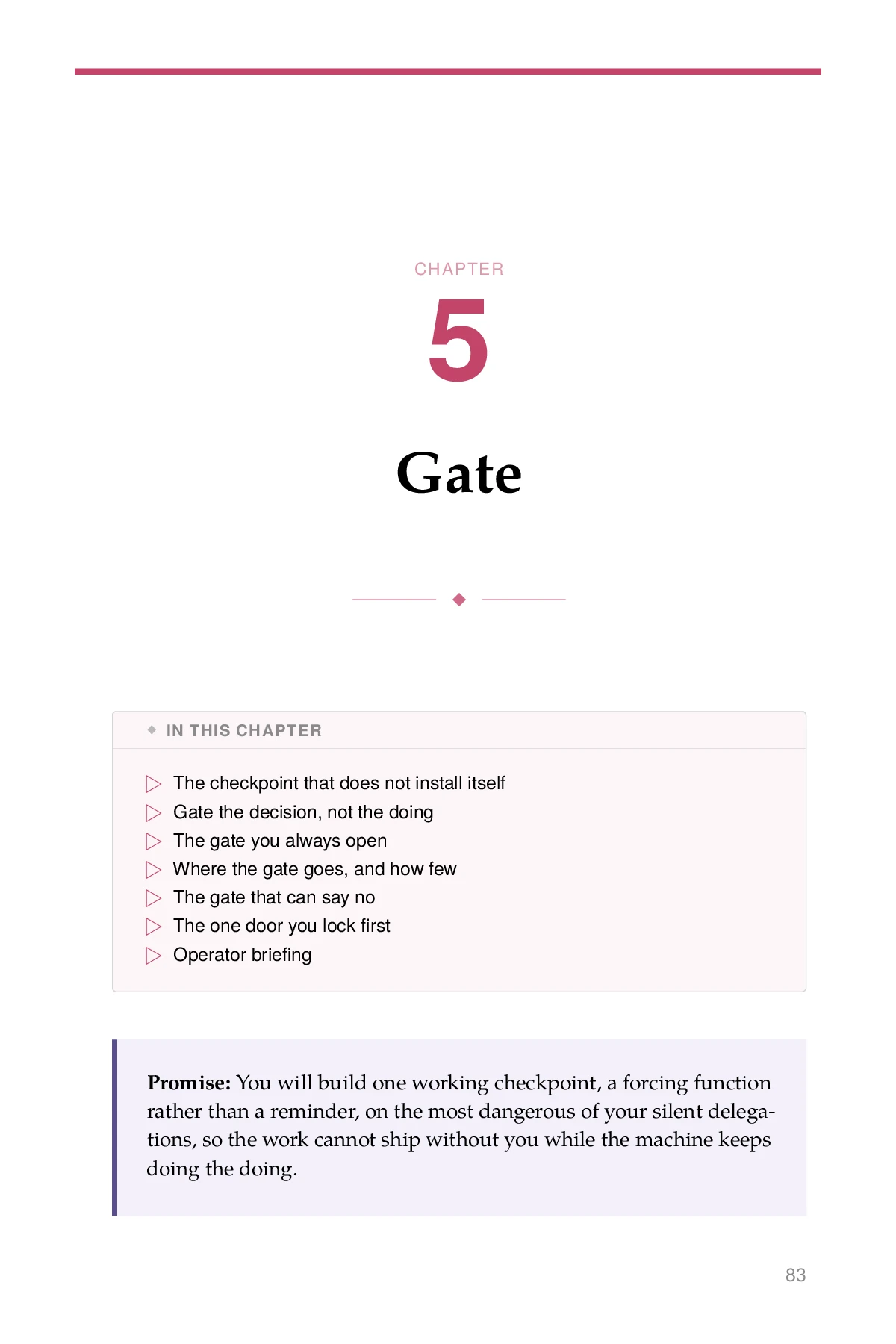
You will build one working checkpoint, a forcing function rather than a reminder, on the most dangerous of your silent delegations, so the work cannot ship without you while the machine keeps doing the doing.
Use this chapter when
Your audit turned up a stage where the work leaves your hands without your judgment, and the approval has quietly stopped being a decision and become the motion you make on the way to merging.
Chapter 6
Evaluate
What you can do afterwards
You will be able to catch the quiet decay of an AI partnership before you can feel it, by measuring the outcome you actually came for against a fixed point, on a schedule, instead of trusting the warm sense that things are fine.
Use this chapter when
A tool has been serving you well long enough that you have stopped genuinely checking it, and the number you watch every week (speed, volume, throughput) keeps rising while you have no reading on the thing you went into the work to produce.
Chapter 7
Nurture
What you can do afterwards
You will understand why skill erosion under automation is structural rather than a personal failing, and you will leave with a working regime for maintaining the capability the hard case will one day demand of you.
Use this chapter when
Your evaluation has surfaced a thinning skill, or you can feel that a stage you delegated to a machine is one you might someday need to perform with no machine in the room.
Chapter 8
Check
What you can do afterwards
You will learn to design accountability into the workflow rather than merely feel it after the fact, so that responsibility cannot leak into the gap between the machine and your name.
Use this chapter when
You are producing outputs with AI assistance that go to other people, carry your professional standing, or could cause harm if they are wrong.
Chapter 9
Yield
What you can do afterwards
You will be able to identify which stages in your current work meet the criteria for full delegation, make those releases explicit instead of letting them happen by default, and record them on your audit so that a deliberate Yield and an unexamined silence can never again be mistaken for each other.
Use this chapter when
Supervision is eating the attention your most consequential judgments need, and the logjam is made of routine outputs you have cleared as correct hundreds of times while the hard call waits its turn.
Chapter 10
The AI-Augmented Self
What you can do afterwards
You will learn to relocate your identity from the skill the machine is learning to the values only you can hold, and you will leave able to say in one or two sentences what your work is for, in a form no tool can produce for you.
Use this chapter when
You have run at least some of the AGENCY moves and are asking whether the framework is changing you, or should be, or what you are protecting it all for.
Conclusion
The Permanent Loop
What you can do afterwards
You will leave this book with a clear account of why the six moves form a system rather than a list, and with one concrete artifact in hand: a named protection and a built gate you can point to today.
Use this chapter when
You have finished the framework and want to know exactly what you are carrying out the door, so the work of the last ten chapters becomes a standing practice instead of an afternoon's good intentions.
Who it is for
Who this book was written for
The result is not a smaller role for AI. It is a clear one: automation handling what it should, and you authoring the decisions that carry your name.
If you work inside these systems every day and refuse to mistake convenience for agency, this was written for the operator you still intend to be.
The reader it was written for
The AI-anxious knowledge worker. Founders, professionals, creatives, analysts, and consultants who use AI tools daily (ChatGPT, Claude, Copilot, etc.) but feel a creeping sense of displacement. They are typically 28–50, highly educated, work in knowledge-intensive fields, and have built their identity around their expertise.
What you will use it on
- [ ] Decide which tasks to delegate to AI and which to keep
- [ ] Design workflows that use AI without becoming dependent on it
- [ ] Maintain and develop skills that AI might erode
- [ ] Handle the identity shift from "expert who does" to "expert who decides
- [ ] Communicate their AI use to colleagues, clients, and employers
- [ ] Evaluate whether AI is helping or harming their work quality
Probably not for you if
- AI researchers and engineers building autonomous systems
- Readers seeking a purely technical guide to AI tools or prompt engineering
- People who believe AI is an existential threat and want to opt out entirely
- Readers looking for a utopian or dystopian narrative about AI
Editions
Editions and specifications
| Edition | Formats | Chapters | Pages | Reading time | ISBN (paperback) |
|---|---|---|---|---|---|
| English The Human-in-the-Loop Life | In production | 12 | 235 | ± 4 hours | — |
| Dutch Het mens-in-de-lus leven | In production | 12 | 254 | ± 4 hours | — |
Both editions are written natively. The Dutch text is not a machine translation of the English. · Trim size: 6x9″
Frequently asked
What readers usually want to know
What is The Human-in-the-Loop Life about?
A personal operating system for deciding what to delegate, what to augment, and what must remain human because judgment is the work. The subtitle is: How to Stay Essential in an Age of AI Automation.
What is the AGENCY framework?
AGENCY: Audit, Gate, Evaluate, Nurture, Check and Yield. Audit, Gate, Evaluate, Nurture, Check, Yield as a personal operating system
Is there a Dutch edition?
Yes. The Dutch edition is Het mens-in-de-lus leven, written as a native edition rather than a machine translation. It moves through the same production line.
How long is The Human-in-the-Loop Life?
This edition runs 12 chapters, 235 pages in print and roughly 4 hours of reading.
Who is The Human-in-the-Loop Life for?
If you work inside these systems every day and refuse to mistake convenience for agency, this was written for the operator you still intend to be.
The production system
How this book was made
Every title moves through the same gated production line: sourced research, a claim-level evidence ledger, structural review, fact-checking, red-team critique, and a bilingual final edit. AI agents do specialist work inside those gates; judgment, voice, and accountability stay human.
- Claims enter an evidence ledger with a source and a confidence grade before they reach the page
- English and Dutch are two native editions, not a translation of one another
- Every chapter clears readability, rhythm, and style gates before it is typeset
The series
More in this theme


