

No. 27 · In design · Decisions & philosophy · ASSAULT
The Red Team Founder
Adversarial Thinking for Operators Who Cannot Afford Surprise
You plan forward and get surprised backward. Stress-test the plan first.
Post-mortems arrive too late, dissent gets smoothed over in the room, and you stress-test your code far harder than your strategy. This book introduces the ASSAULT protocol, six skills that make adversarial thinking a daily habit for founders making irreversible bets. No tanks, no quarterly offsite, no pretend enemy. Red teaming becomes decision hygiene, not cosplay, so you stop being surprised by your own optimism.
- pages
- 264
- chapters
- 12
- hours of reading
- ± 4
- editions
- EN · NL
- Design
- Drafting
- Manuscript
- Production
- Launched
The editions
Kindle and Paperback
Production shots of the editions. Not for sale yet — this page is the public working version.
-
Kindle
The digital edition, ready in any Kindle app.
-
Paperback
The working copy. Mark it up. Take it into the meeting.


The book
Adversarial Thinking for Operators Who Cannot Afford Surprise
You wrote the strategy, so you defend the strategy. In every review you answer the objection instead of weighing it, explain away the soft number, and read the one chart that confirms the plan you already love. The market will not be so generous. It runs the experiment you keep refusing to run, and sends the invoice in lost quarters, not in feedback you can still act on.
The usual answer is to gather more conviction: align the team, commit harder, treat doubt as a morale problem. Conviction feels like strength until the moment the blind spot becomes a crisis, and by then the only people stress-testing your strategy are your competitors.
The Red Team Founder treats adversarial review as what it is in security and the military: a discipline, not a mood. It introduces the ATTACK framework (Assume failure, Target your assumptions, Take the adversary's seat, Audit the evidence, Counter your own defenses, Kill or commit), six moves that turn the scrutiny you reserve for rivals onto your own plan, on schedule, before the cost is real.
What you learn
What this book puts in your hands
- The ASSAULT protocol: six skills that turn adversarial thinking into a daily habit
- Run pre-mortems that catch failure before you commit, not after the post-mortem
- Surface dissent on purpose, before reality surfaces it for you
- Stress-test plans, narratives, and bets against your strongest counter-case
- Decision logs and review cadences sized for solo and small-team reality
The framework
ASSAULT, step by step
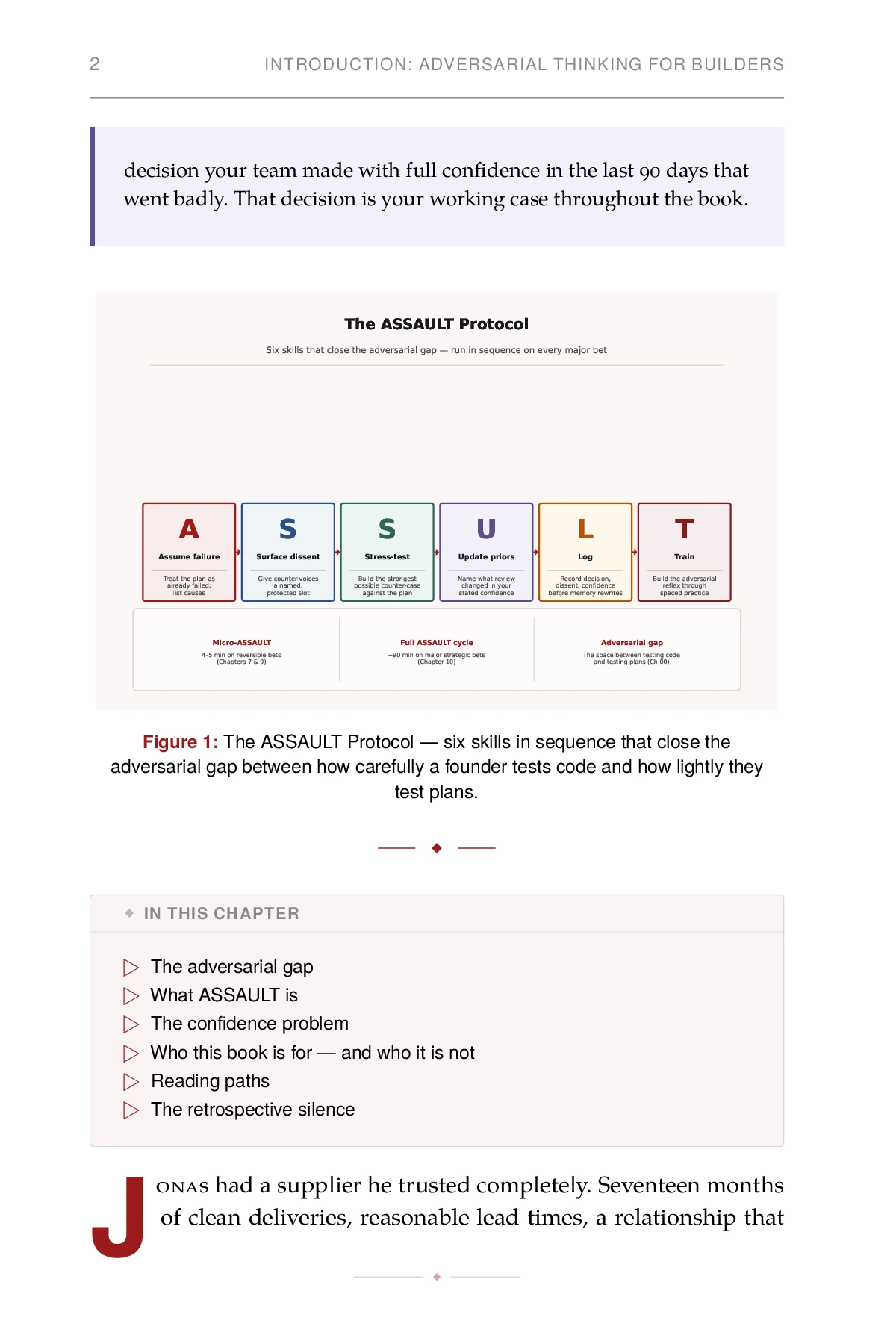
six skills that turn adversarial thinking into a daily habit
From the book
The ASSAULT Protocol — six skills in sequence that close the adversarial gap between how carefully a founder tests code and how lightly they
The Red Team Founder, printed page: The ASSAULT Protocol — six skills in sequence that close the adversarial gap between how carefully a founder tests code and how lightly they
Inspect more pagesLook inside
Pages from the print edition.
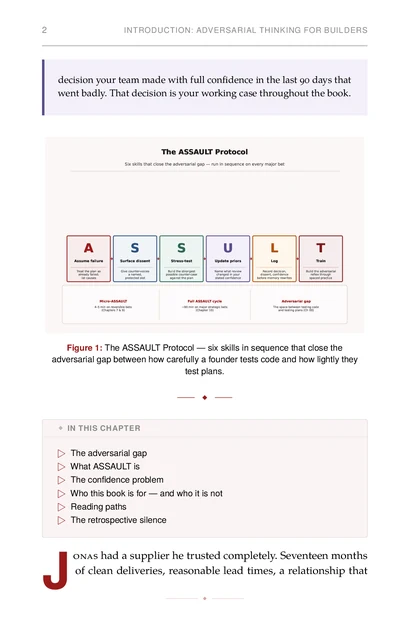 The ASSAULT Protocol — six skills in sequence that close the adversarial gap between how carefully a founder tests code and how lightly they
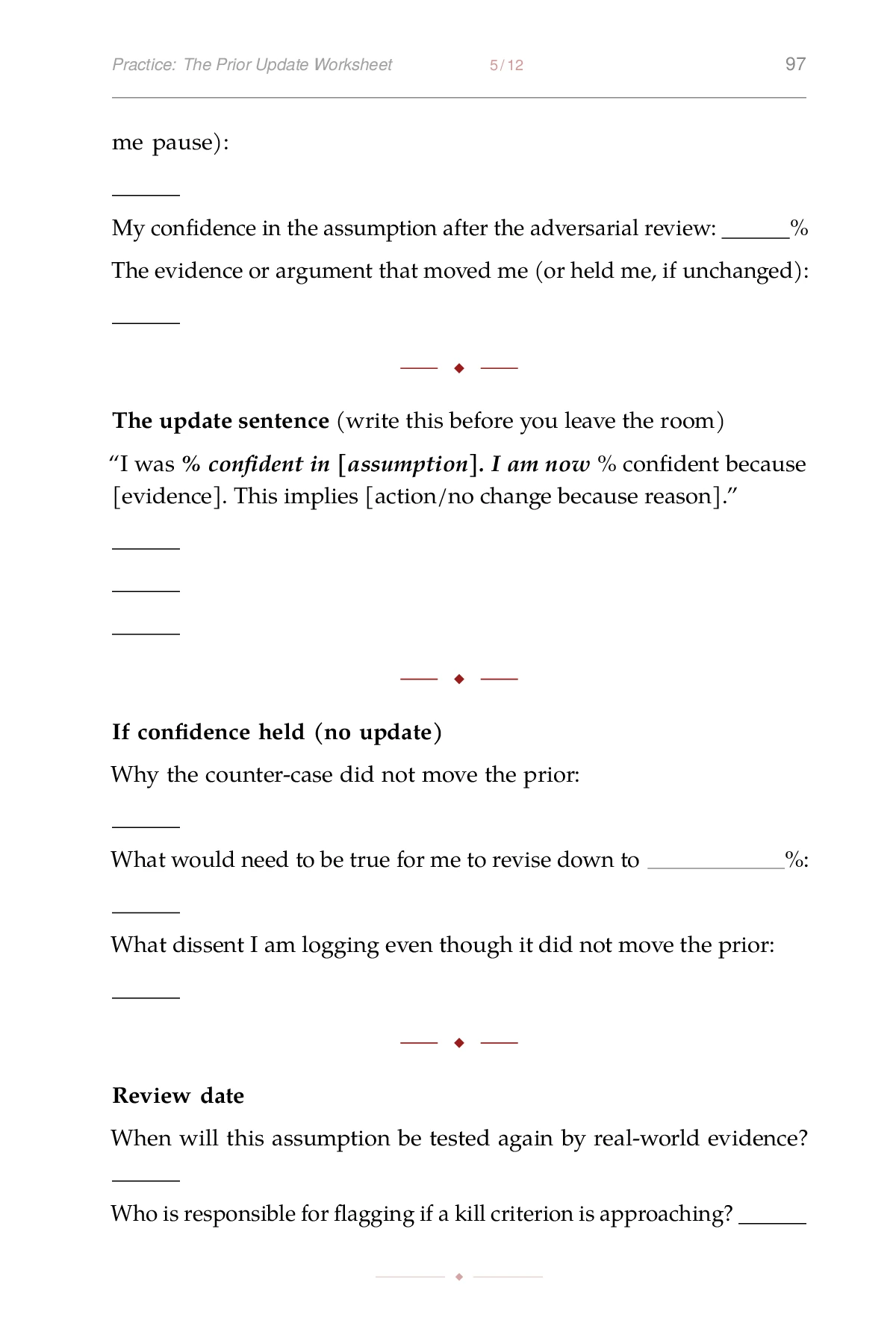
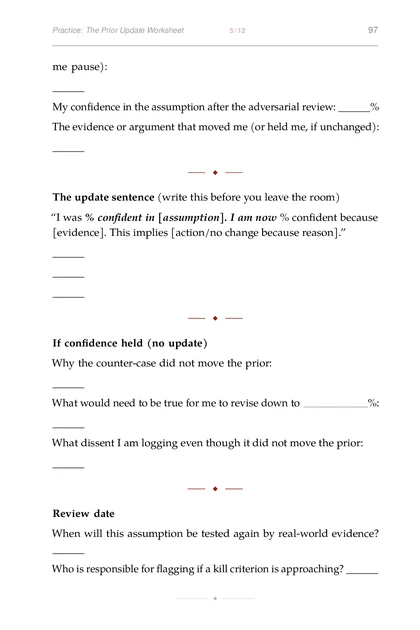 me pause):
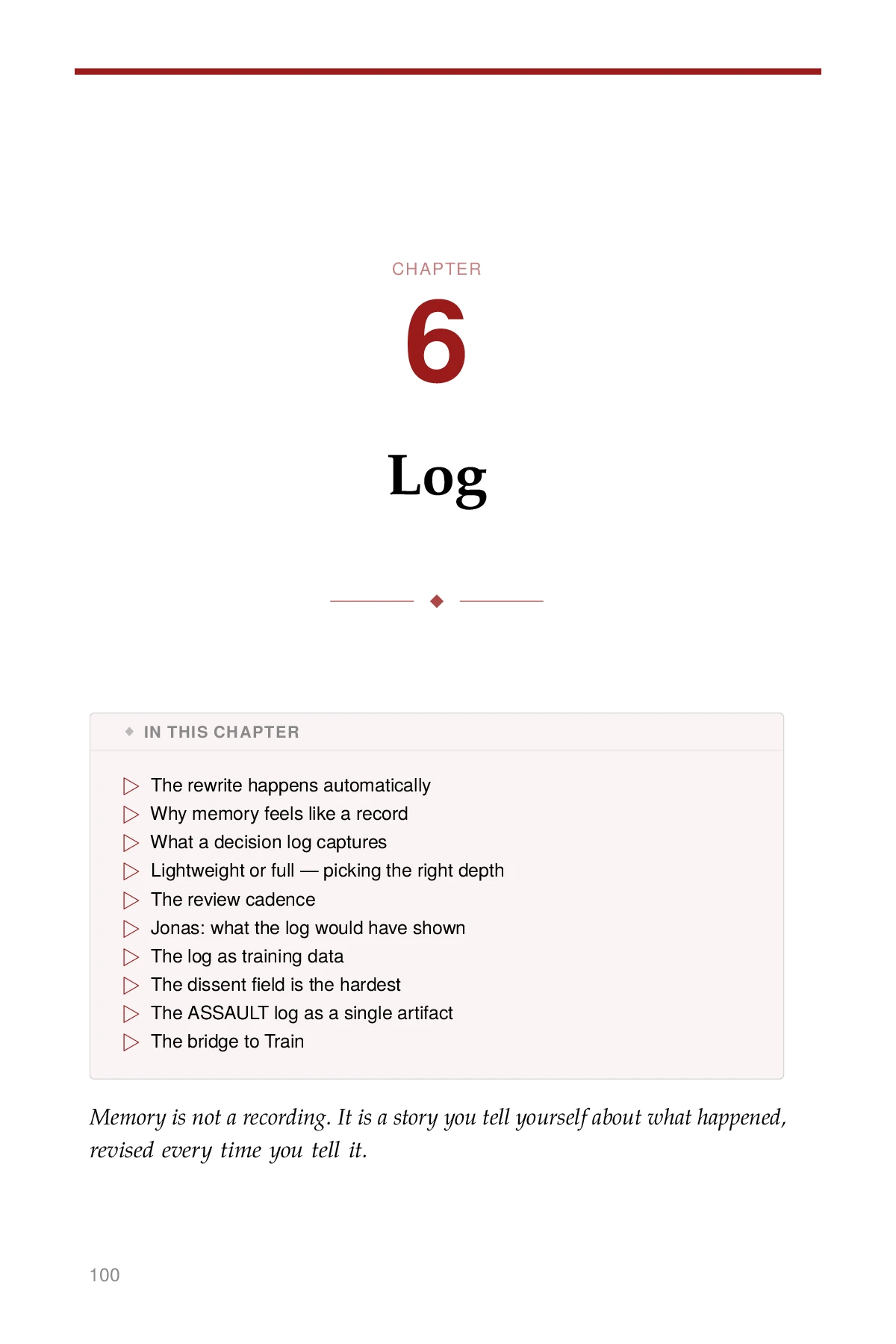
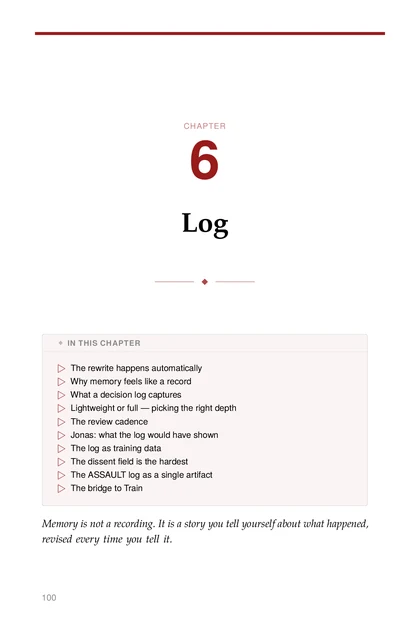 CHAPTER
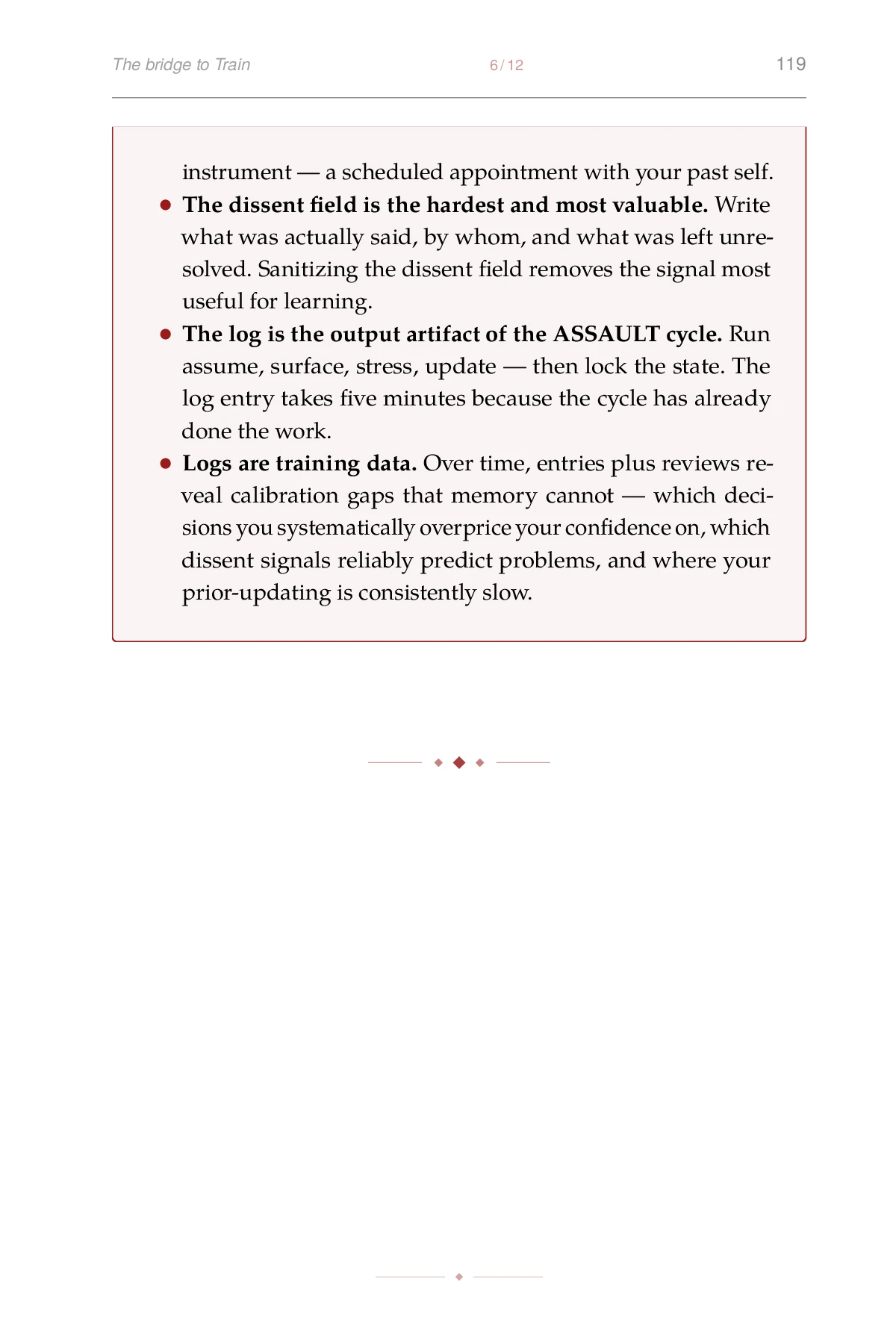
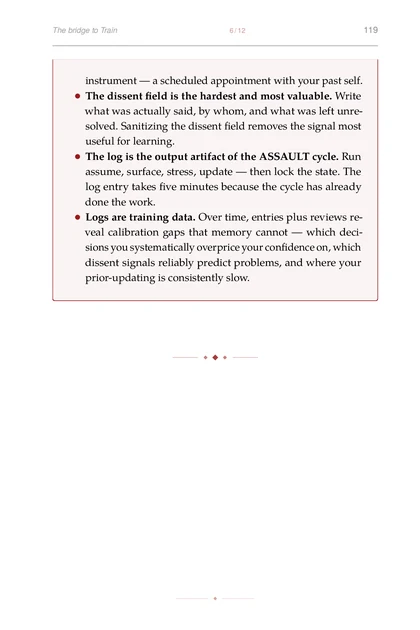 instrument — a scheduled appointment with your past self.
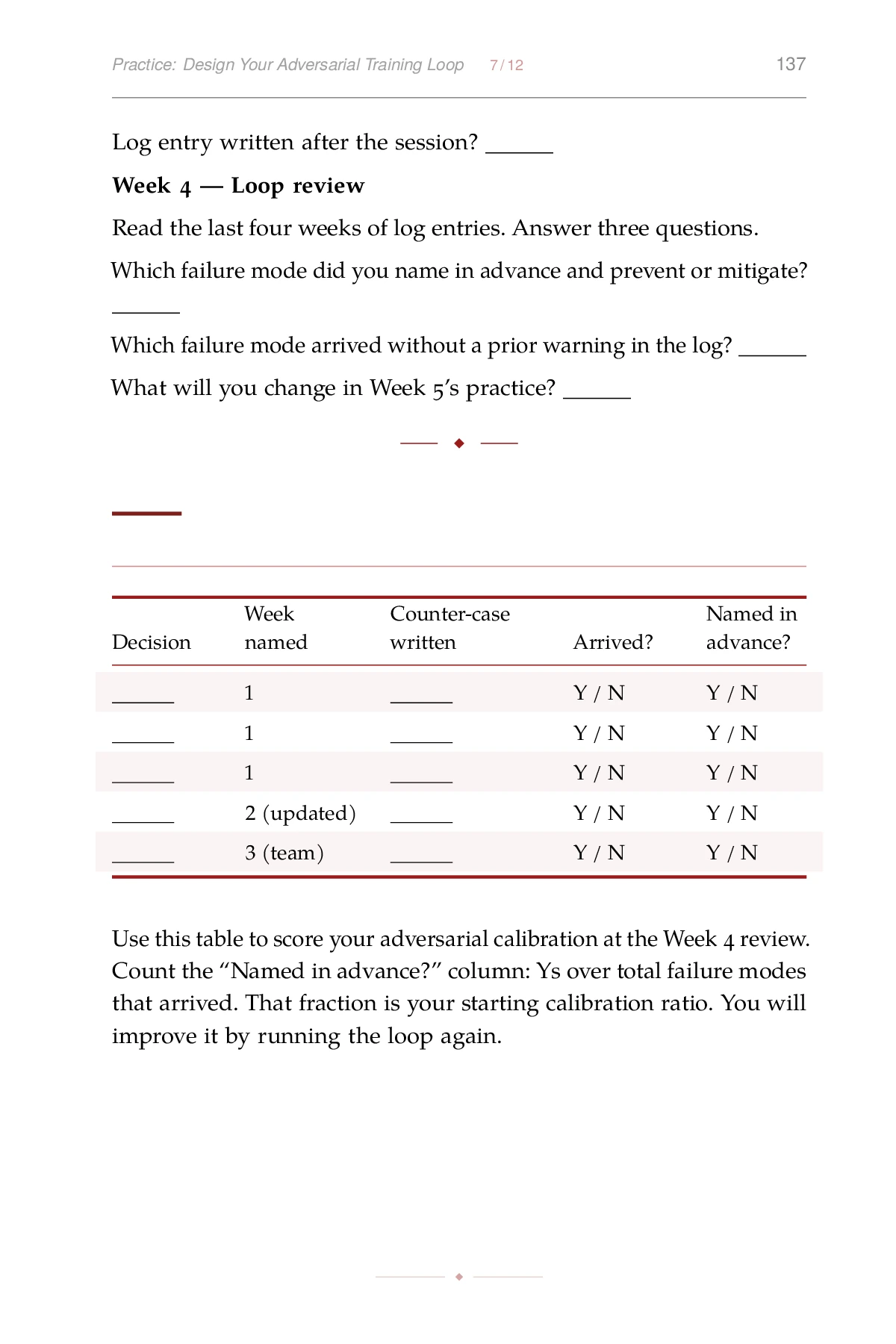
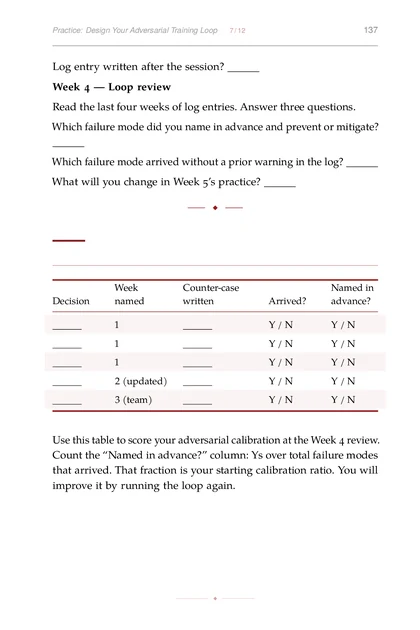 Log entry written after the session?
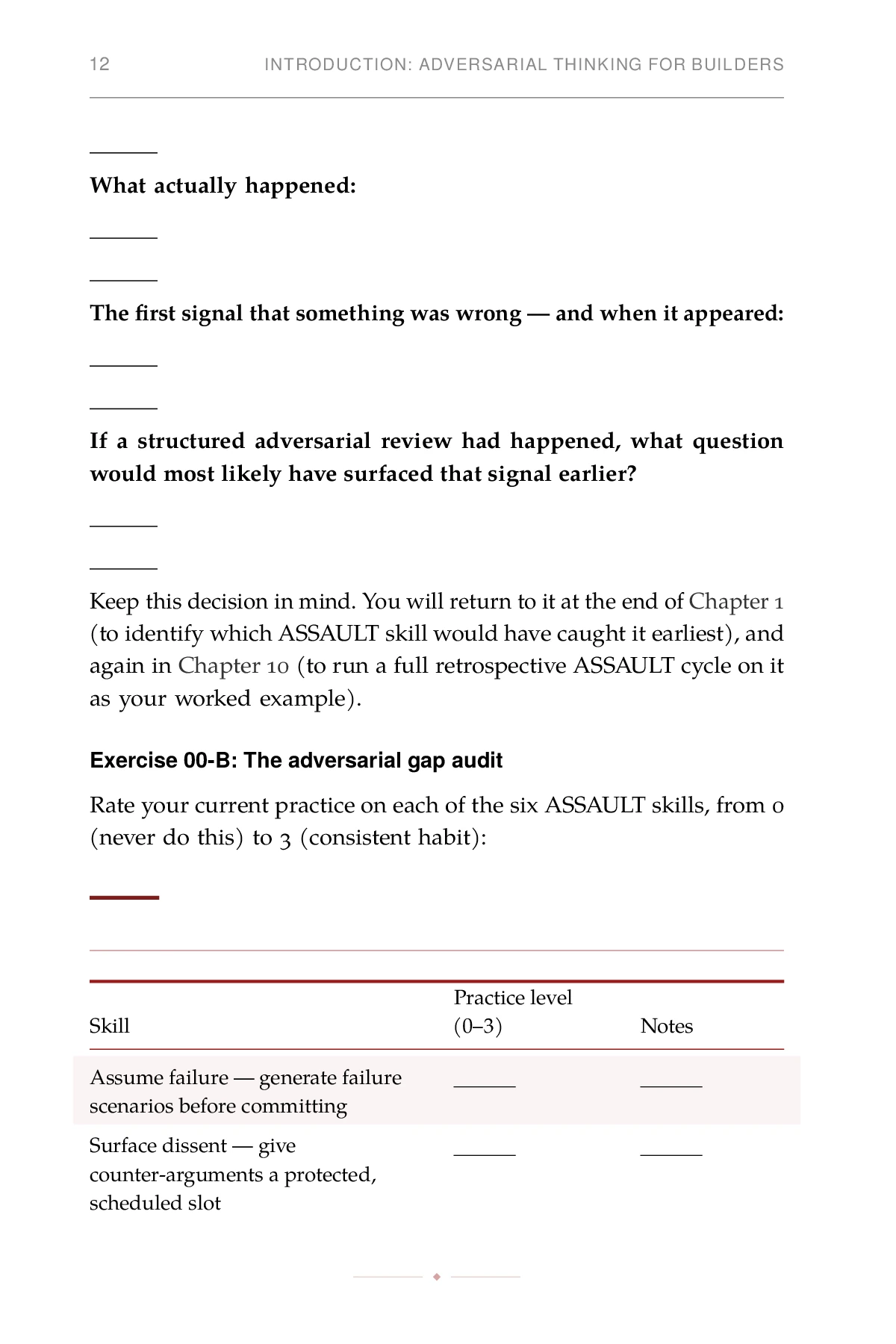
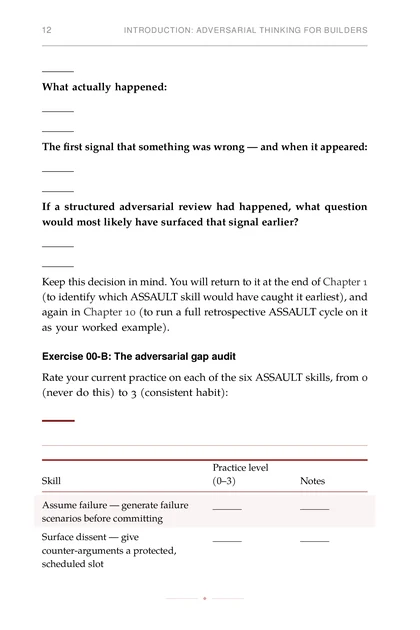 What actually happened:
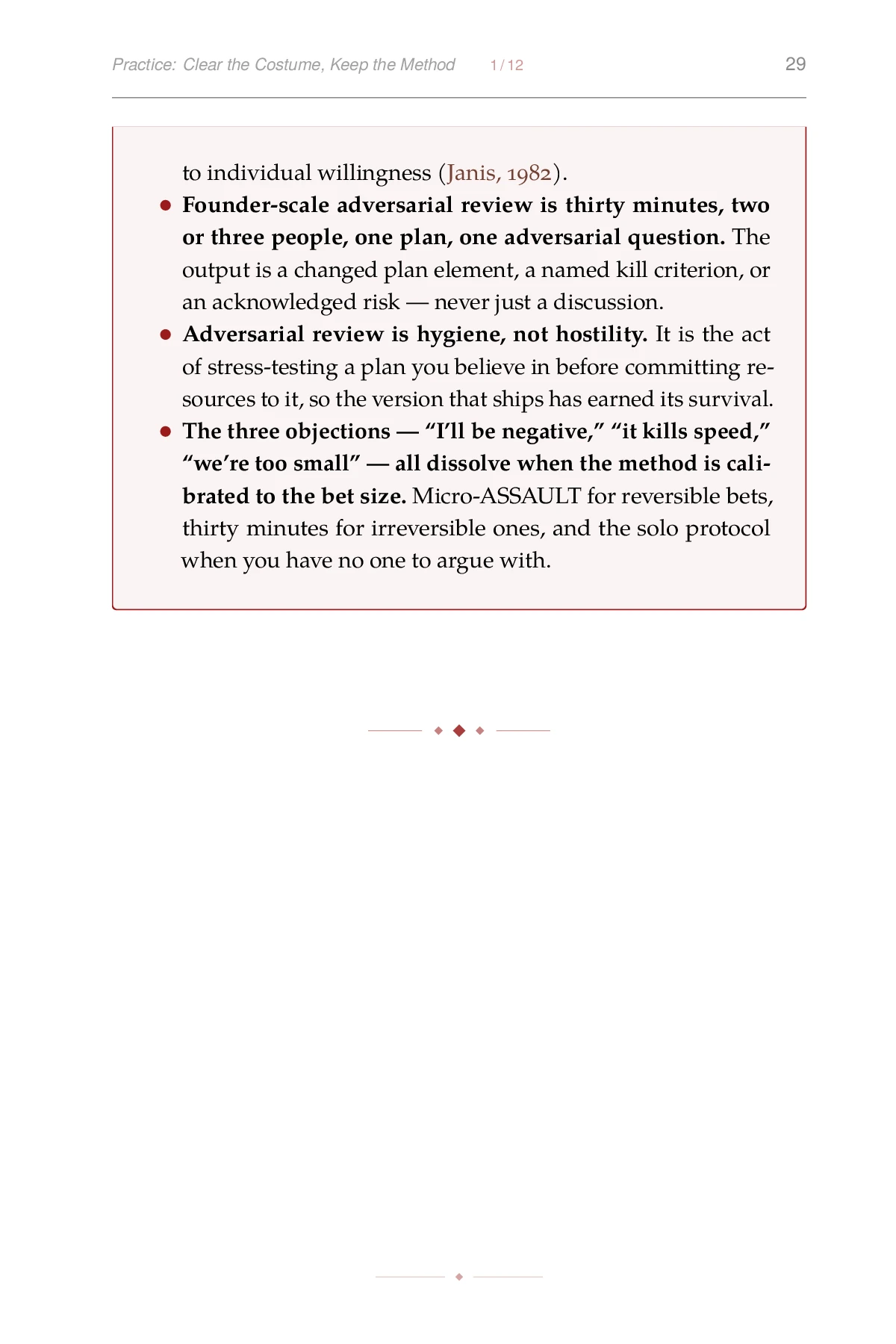
 to individual willingness (Janis, 1982).
 Break the plan before the market breaks you.
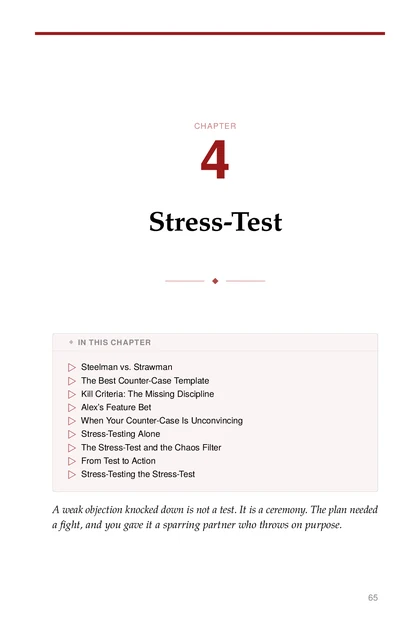 CHAPTER

The contents
Chapter by chapter
Every chapter of The Red Team Founder with its printed epigraph, what you can do afterwards, and the moment it is built for.
Introduction
Introduction: Adversarial Thinking for Builders
The plan did not fail because of bad luck. It failed because no one asked how it could fail.
What you can do afterwards
You will name the exact gap between how carefully you test your code and how lightly you test your plans — and walk away with a concrete method to close it.
Use this chapter when
A failure arrives as a surprise that, in hindsight, had been visible for months. Or before the next big bet, when the room is convinced and no one is asking hard questions.
Chapter 1
Beyond Military Cosplay
The costume is easy. The method is harder. Most organizations adopted the costume and stopped there.
What you can do afterwards
You will leave this chapter knowing the difference between red teaming as performance and red teaming as decision hygiene — and you will have a working definition small enough to use before lunch on a Tuesday.
Use this chapter when
You feel a reflexive resistance to "red teaming" because it sounds like something a defense contractor or a McKinsey war-games team does — not something a three-person startup does at a whiteboard.
Chapter 2
Assume Failure
The pessimist says the glass is half empty. The optimist says it is half full. The red team founder asks who drilled the hole in the bottom.
What you can do afterwards
You will run a prospective failure pass on an active plan before this chapter ends — and the failure list you produce will be more useful than a tenth iteration of the pitch deck.
Use this chapter when
You have committed to a plan in your head before you have tested it, or your team is generating enthusiasm faster than it is generating questions.
Chapter 3
Surface Dissent
The room agreed. Nobody said they agreed — they just stopped arguing. That is not consensus. That is the countdown.
What you can do afterwards
You will design a dissent slot for your next strategic meeting and a solo-founder equivalent that works without a team, so that the counter-argument reaches you before the market delivers it.
Use this chapter when
A plan has been discussed and everyone seems aligned — especially when the alignment was fast, harmonious, and uncomfortable to question.
Chapter 4
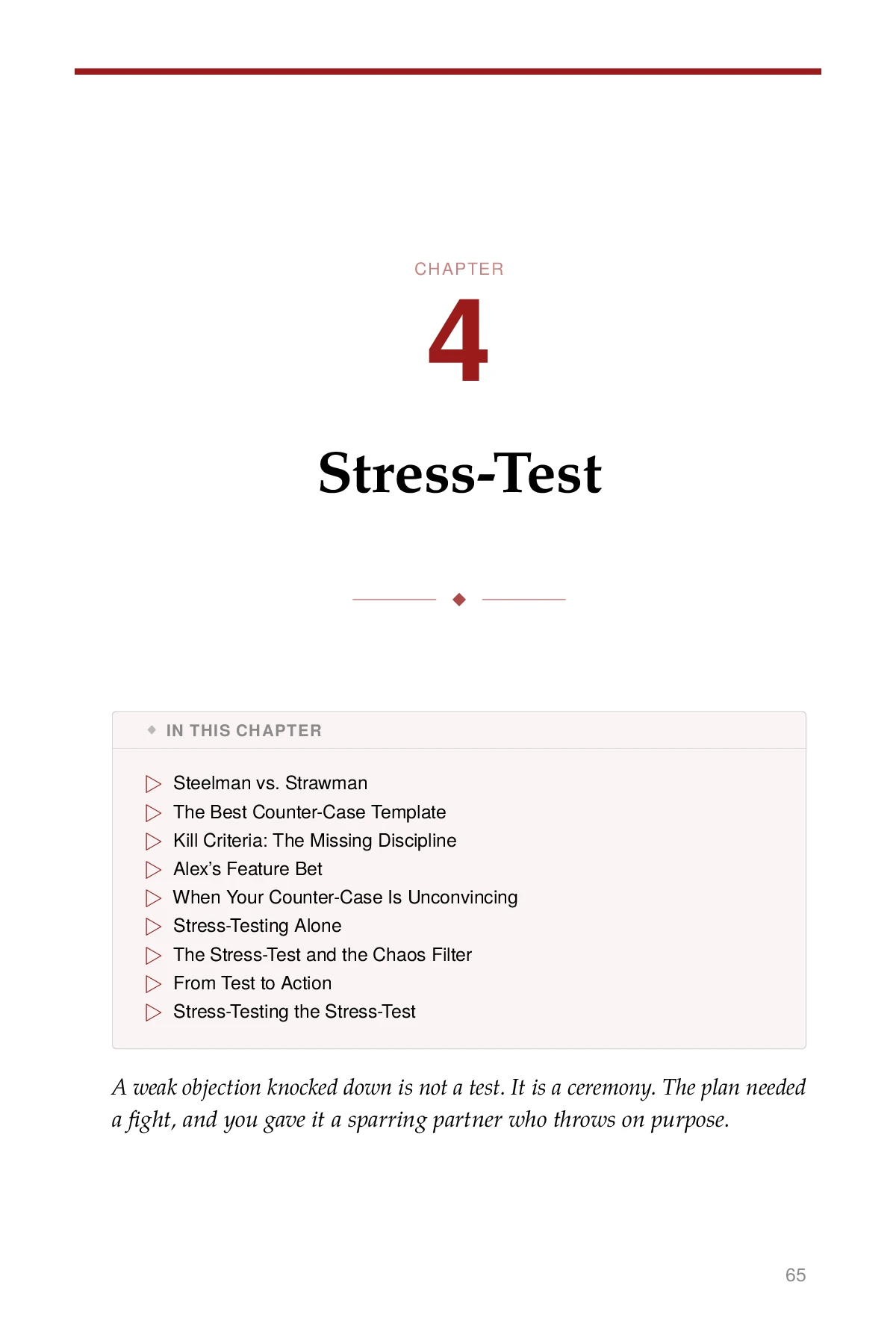
Stress-Test
A weak objection knocked down is not a test. It is a ceremony. The plan needed a fight, and you gave it a sparring partner who throws on purpose.
What you can do afterwards
You will replace informal "devil's advocate" sessions with a disciplined technique for building the strongest counter-case your plan can face — one capable of revealing genuine structural risks, not just surface objections.
Use this chapter when
You are about to commit resources to a plan that has won internal agreement — especially when the team feels confident and the path forward looks obvious.
Chapter 5
Update Priors
A stress-test that leaves your confidence unchanged is expensive venting. The whole point of running the exercise was to find out whether you were right.
What you can do afterwards
You will learn to translate adversarial evidence into concrete belief revisions — naming what moved, by how much, and why — so that ASSAULT produces genuine updates rather than the illusion of rigor.
Use this chapter when
You have just run a stress-test, pre-mortem, or dissent slot and are about to carry the original plan forward unchanged, as if the review had confirmed it rather than tested it.
Chapter 6
Log
Memory is not a recording. It is a story you tell yourself about what happened, revised every time you tell it.
What you can do afterwards
You will finish this chapter with a decision log template and one completed entry — an honest, time-stamped record of a decision that your memory will otherwise quietly rewrite.
Use this chapter when
You are about to commit resources to an irreversible bet, or you have just come out of an ASSAULT cycle and want the output to persist beyond the meeting.
Chapter 7
Train
What you can do afterwards
You will leave this chapter with a training loop — not a resolution to think more critically, but a concrete schedule that turns adversarial review from a one-time event into an automatic step you take before any significant commitment.
Use this chapter when
You have run one pre-mortem, or read two chapters on decision bias, and noticed that your thinking reverted to its prior state within ten days.
Chapter 8
Pre-Mortems in Practice
A plan carries its failure inside it from the first slide. The pre-mortem is not pessimism — it is the surgical tool you use to find that failure before the market does.
What you can do afterwards
You will leave this chapter with a scripted, 30-minute pre-mortem you can run before your next launch, hire, or pivot — one that uses the six ASSAULT skills together for the first time and produces specific owners, not a list.
Use this chapter when
A consequential, partially irreversible bet is between 48 hours and four weeks from commitment. Close enough that the failure assumption feels real; far enough that the outputs can still change the plan.
Chapter 9
Daily Decision Hygiene
Scale the method down, not the seriousness.
What you can do afterwards
You will match the depth of adversarial review to the actual weight of each decision — running micro-ASSAULT on reversible bets in under five minutes and knowing precisely when a decision has earned the full ASSAULT cycle instead.
Use this chapter when
You have run a pre-mortem and found it valuable, but the method still feels like something you deploy on launches and fundraises while the quieter decisions that shape each quarter pass without adversarial scrutiny at all.
Chapter 10
The Red Team Founder System
A plan that survives six skills in sequence is not the plan you started with. It is the plan the market will meet.
What you can do afterwards
You will run one complete ASSAULT cycle on a live strategic bet — from the selection criteria through the final log entry — and produce a plan that has been adversarially tested, belief-updated, and review-dated before you commit resources.
Use this chapter when
You have learned all six ASSAULT skills, practiced micro-ASSAULT on daily decisions, and run at least one pre-mortem. Now you want the full system on something that matters — a pricing change, a hire, a partnership, a pivot — not a workshop exercise.
Conclusion
Conclusion: Strong Plans Break Early
The founder who breaks a plan in a Tuesday conversation will not spend a Tuesday in March explaining to the board why nobody saw it coming.
What you can do afterwards
You will leave this chapter with one pre-mortem date blocked on your calendar, a clear picture of what the adversarial reflex looks like when it is fully installed, and a precise sense of how the six ASSAULT skills compound into something more valuable than their sum.
Use this chapter when
You have reached the end of the book with the method understood but the identity not yet claimed. The skills are in your toolkit. The reflex is not yet automatic. Something in this chapter should close that gap.
Who it is for
Who this book was written for
The result is not a more confident founder defending the same plan. It is an operator who has already survived the attack in private, so the public version holds.
If you would rather find your own blind spot on a Tuesday than have the market find it for you, this is the discipline you have been skipping.
The reader it was written for
The optimistic builder. Founder or operator aged 26–55 who ships fast, believes in the vision, and has been burned at least once by a plan that "could not fail." Intellectually honest enough to want adversarial methods; culturally allergic to corporate red-team theatre. Reads Kahneman, maybe Tetlock, probably skipped the war-game chapter in every other book.
Also a fit for
The technical cofounder pulled into strategy. Engineer who stress-tests systems but not roadmaps. Wants a protocol that feels like code review for decisions.
What you will use it on
- Run a pre-mortem before my next launch without facilitation training
- Get cofounder/board to disagree productively
- Stop repeating the same planning mistake quarterly
- Build adversarial habit as solo founder
- Connect red teaming to updating confidence, not just venting
Probably not for you if
- Professional offensive security red teamers
- Chronic pessimists seeking validation for inaction
- Enterprise risk officers needing SOX-aligned governance frameworks
Editions
Editions and specifications
| Edition | Formats | Chapters | Pages | Reading time | ISBN (paperback) |
|---|---|---|---|---|---|
| English The Red Team Founder | In production | 12 | 264 | ± 4 hours | — |
| Dutch De red team oprichter | In production | 12 | 294 | ± 4 hours | — |
Both editions are written natively. The Dutch text is not a machine translation of the English.
Frequently asked
What readers usually want to know
What is The Red Team Founder about?
ASSAULT turns red-team thinking into a daily founder habit: stress-test assumptions, strategy, incentives, and execution before reality does it for you. The subtitle is: Adversarial Thinking for Operators Who Cannot Afford Surprise.
What is the ASSAULT framework?
six skills that turn adversarial thinking into a daily habit
Is there a Dutch edition?
Yes. The Dutch edition is De red team oprichter, written as a native edition rather than a machine translation. It moves through the same production line.
How long is The Red Team Founder?
This edition runs 12 chapters, 264 pages in print and roughly 4 hours of reading.
Who is The Red Team Founder for?
If you would rather find your own blind spot on a Tuesday than have the market find it for you, this is the discipline you have been skipping.
The production system
How this book was made
Every title moves through the same gated production line: sourced research, a claim-level evidence ledger, structural review, fact-checking, red-team critique, and a bilingual final edit. AI agents do specialist work inside those gates; judgment, voice, and accountability stay human.
- Claims enter an evidence ledger with a source and a confidence grade before they reach the page
- English and Dutch are two native editions, not a translation of one another
- Every chapter clears readability, rhythm, and style gates before it is typeset


