

No. 25 · Active development · Decisions & philosophy · PROVISO
The Delegated Mind
Stoic Judgment in the Age of AI Delegation
Govern what you delegate to AI without outsourcing judgment or character
You delegate research, drafting, and analysis to AI every day, and you feel faster but less accountable. The Delegated Mind introduces the PROVISO system: six Stoic-operational skills for governing AI-assisted cognition. You pause before delegation, retain non-delegable agency, verify before integration, and stoically own every outcome. Delegation becomes a virtue practice, not a liability, for operators who want to govern AI with ancient discipline.
- pages
- 204
- chapters
- 12
- hours of reading
- ± 3
- editions
- EN · NL
- Design
- Drafting
- Manuscript
- Production
- Launched
The editions
Kindle and Paperback
Production shots of the editions. Not for sale yet — this page is the public working version.
-
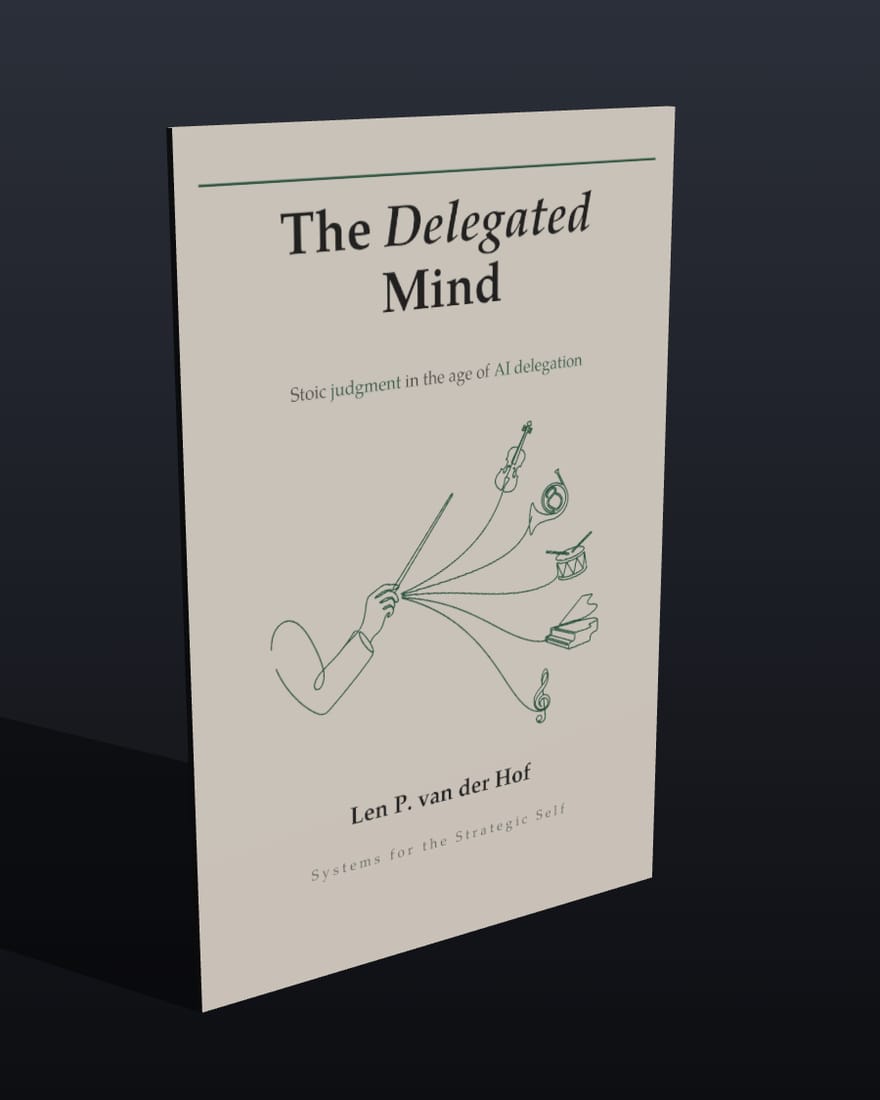
Kindle
The digital edition, ready in any Kindle app.
-

Paperback
The working copy. Mark it up. Take it into the meeting.


The book
Stoic Judgment in the Age of AI Delegation
Every important call still routes through you. The team waits outside your door, the Slack threads stall until you weigh in, and the calendar fills with decisions only you are "allowed" to make. You told yourself this was leadership. But the company now runs at the speed of one tired person, and that person is the reason the good people keep leaving.
The usual fix is to hire harder and delegate more tasks. It fails for the same reason every time: you hand off the work but keep the judgment, so everything still climbs back to your desk for a verdict.
The Delegated Mind treats delegation as what it actually is: not offloading tasks, but transferring judgment. It introduces the DELEGATE framework: a system for encoding how you decide into rules, defaults, and guardrails that let other people reach your standard without you in the room. You stop being the answer and start being the architecture that produces answers.
What you learn
What this book puts in your hands
- The PROVISO system: six Stoic-operational skills for governing AI-assisted cognition
- A repeatable protocol to pause, verify, and integrate only what survives scrutiny
- Diagnoses four delegation failures: speed without pause, agency erosion, verification collapse, character drift
- Stoic concepts (control, assent, amor fati) translated for operators, not scholars
- Tool-agnostic governance you can run daily, available in English and Dutch
The framework
PROVISO, step by step
six Stoic-operational skills for governing AI-assisted cognition

From the book
License & Disclaimer . . . . . . . . . . . . . . . . . . . . . . . . 189
The Delegated Mind, printed page: License & Disclaimer . . . . . . . . . . . . . . . . . . . . . . . . 189
Inspect more pages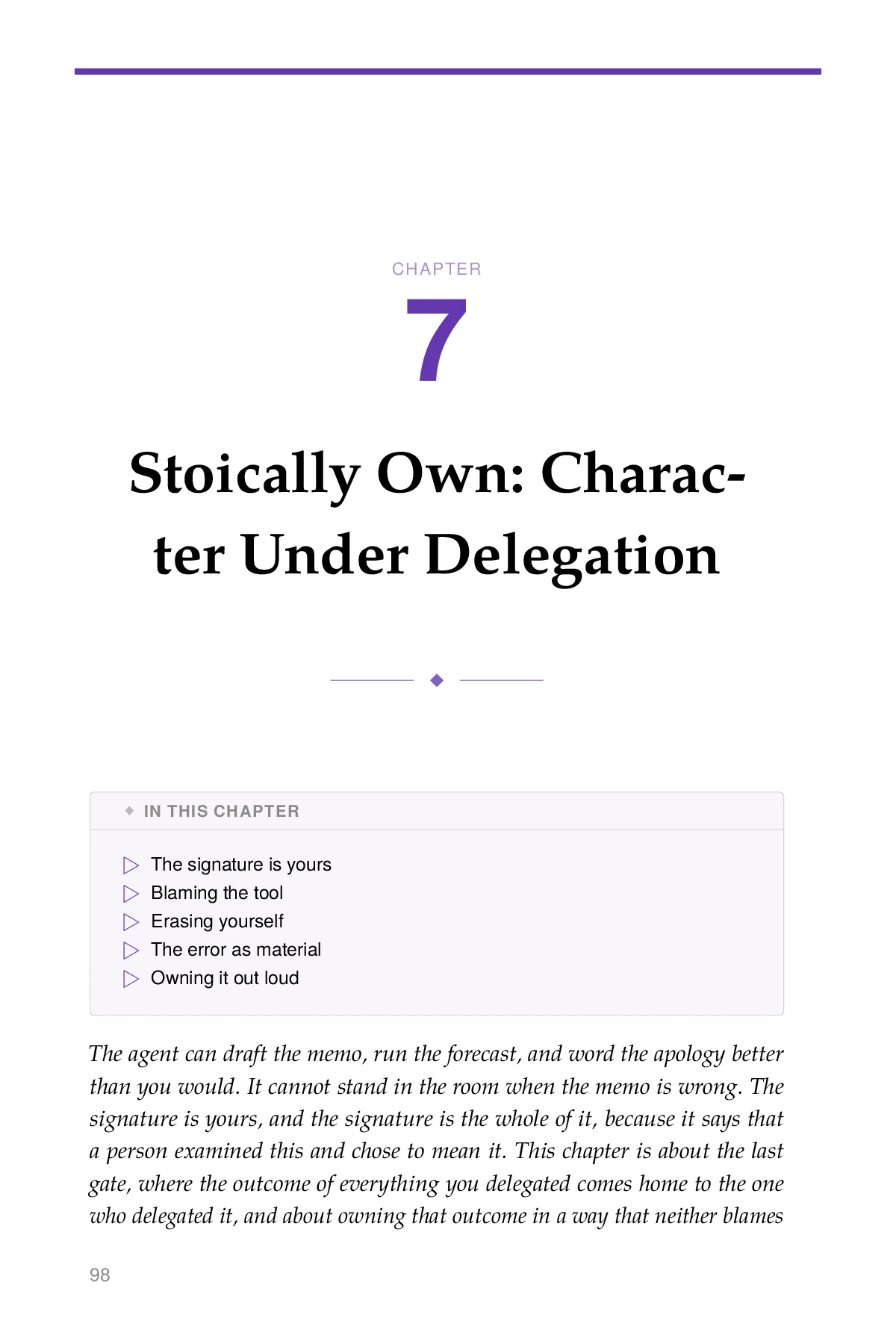

The contents
Chapter by chapter
Every chapter of The Delegated Mind with its printed epigraph, what you can do afterwards, and the moment it is built for.
Introduction
Introduction: The Delegation Problem
AI can draft your analysis, recommend your strategy, and imitate your judgment. It cannot carry your character. That gap is a design problem, and it has a design solution.
What you can do afterwards
You will stop treating AI delegation as a tooling question and start treating it as a governance question, with a protocol that keeps judgment, verification, and responsibility on the human side of the desk.
Use this chapter when
You rely on an AI agent for research, drafting, analysis, or recommendations, and you feel faster yet somehow less accountable.
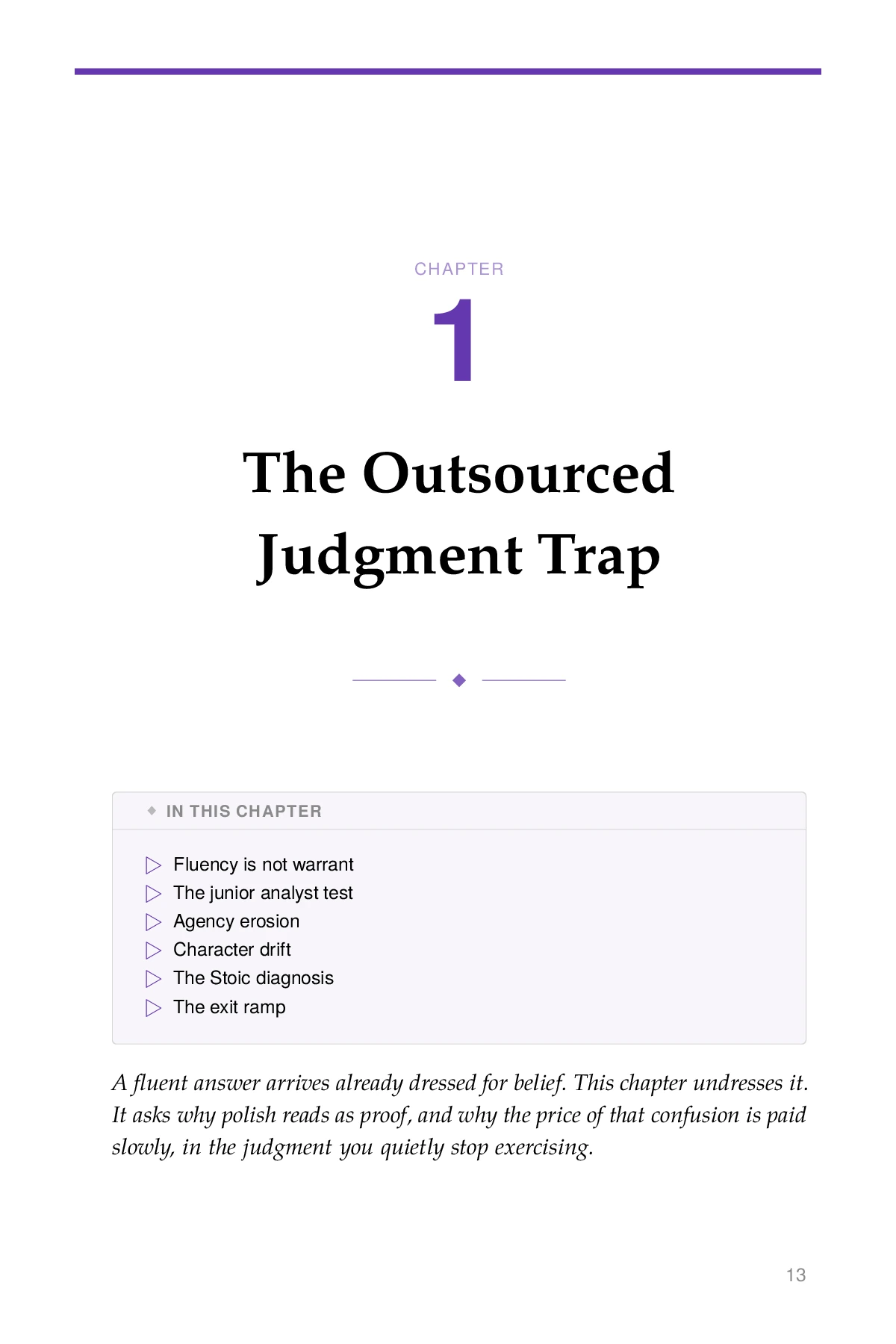
Chapter 1
The Outsourced Judgment Trap
A fluent answer arrives already dressed for belief. This chapter undresses it. It asks why polish reads as proof, and why the price of that confusion is paid slowly, in the judgment you quietly stop exercising.
What you can do afterwards
You will be able to name the trap precisely enough to catch yourself inside it: the moment a fluent output earns an agreement your evidence has not. You will see how a single fast yes, repeated without a gate, hardens into agency erosion and then into character drift.
Use this chapter when
An AI output reads so well that checking it feels unnecessary, and you are about to act on it.
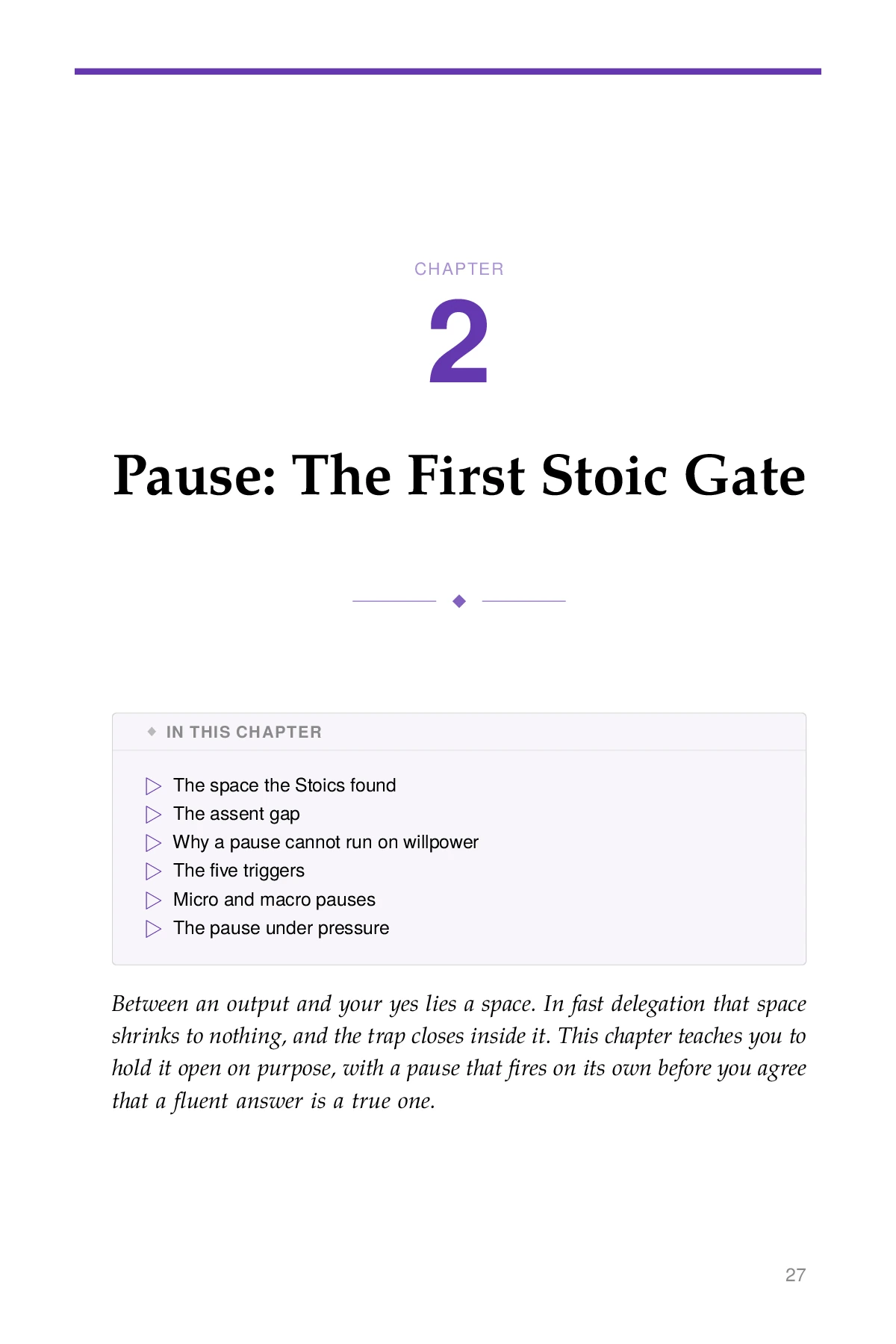
Chapter 2
Pause: The First Stoic Gate
Between an output and your yes lies a space. In fast delegation that space shrinks to nothing, and the trap closes inside it. This chapter teaches you to hold it open on purpose, with a pause that fires on its own before you agree that a fluent answer is a true one.
What you can do afterwards
You will install a pause that triggers on its own before you assent to a high-stakes output, built as a pre-committed reflex rather than a hope that you will remember to be careful.
Use this chapter when
A strong AI output sits in front of you and you can feel the pull to act on it now.
Chapter 3
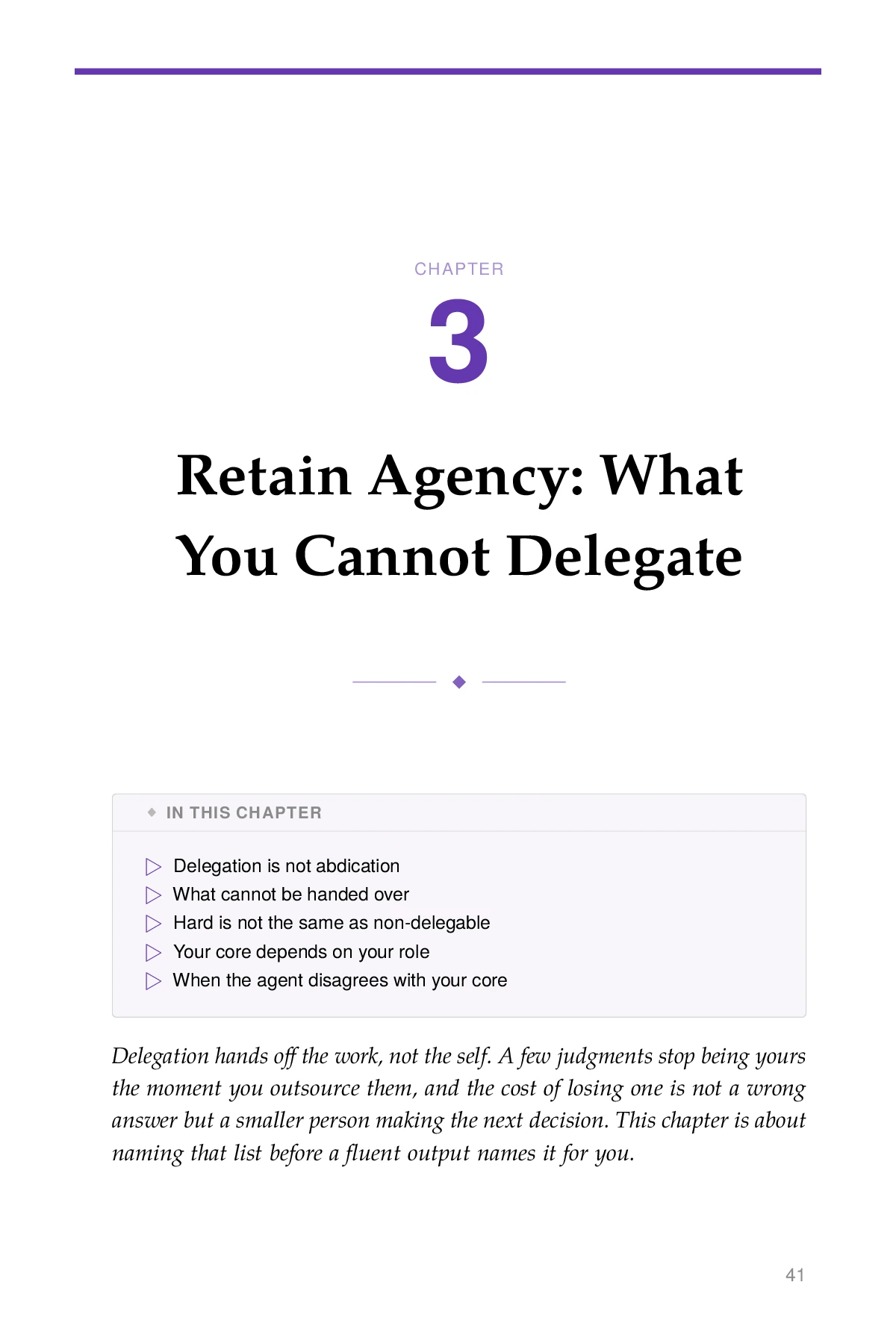
Retain Agency: What You Cannot Delegate
Delegation hands off the work, not the self. A few judgments stop being yours the moment you outsource them, and the cost of losing one is not a wrong answer but a smaller person making the next decision. This chapter is about naming that list before a fluent output names it for you.
What you can do afterwards
You will build a non-delegable core, a short written list of the judgments you refuse to outsource, tied to your role and your values, so the line between delegating a task and delegating yourself stops being something you redraw under pressure.
Use this chapter when
An agent offers a recommendation that touches what you stand for, what you are accountable for, or what you cannot take back.
Chapter 4
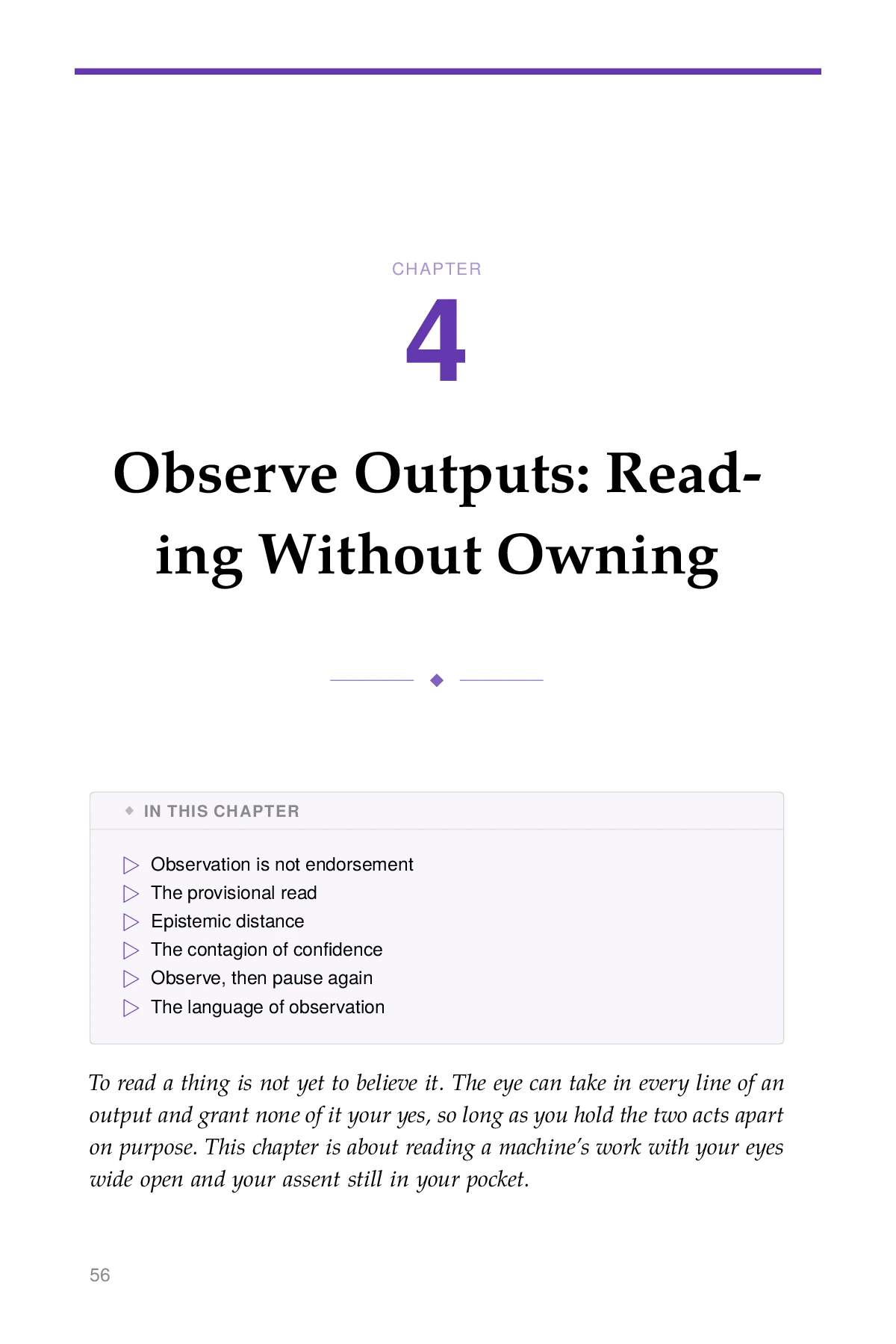
Observe Outputs: Reading Without Owning
To read a thing is not yet to believe it. The eye can take in every line of an output and grant none of it your yes, so long as you hold the two acts apart on purpose. This chapter is about reading a machine's work with your eyes wide open and your assent still in your pocket.
What you can do afterwards
You will learn to read any output provisionally, taking in everything it claims while holding each claim as a hypothesis, so that "I have seen this" never quietly becomes "I believe this" without your noticing the moment it changed.
Use this chapter when
A fluent, confident output sits in front of you and you can feel yourself starting to read it as though it were already true.
Chapter 5
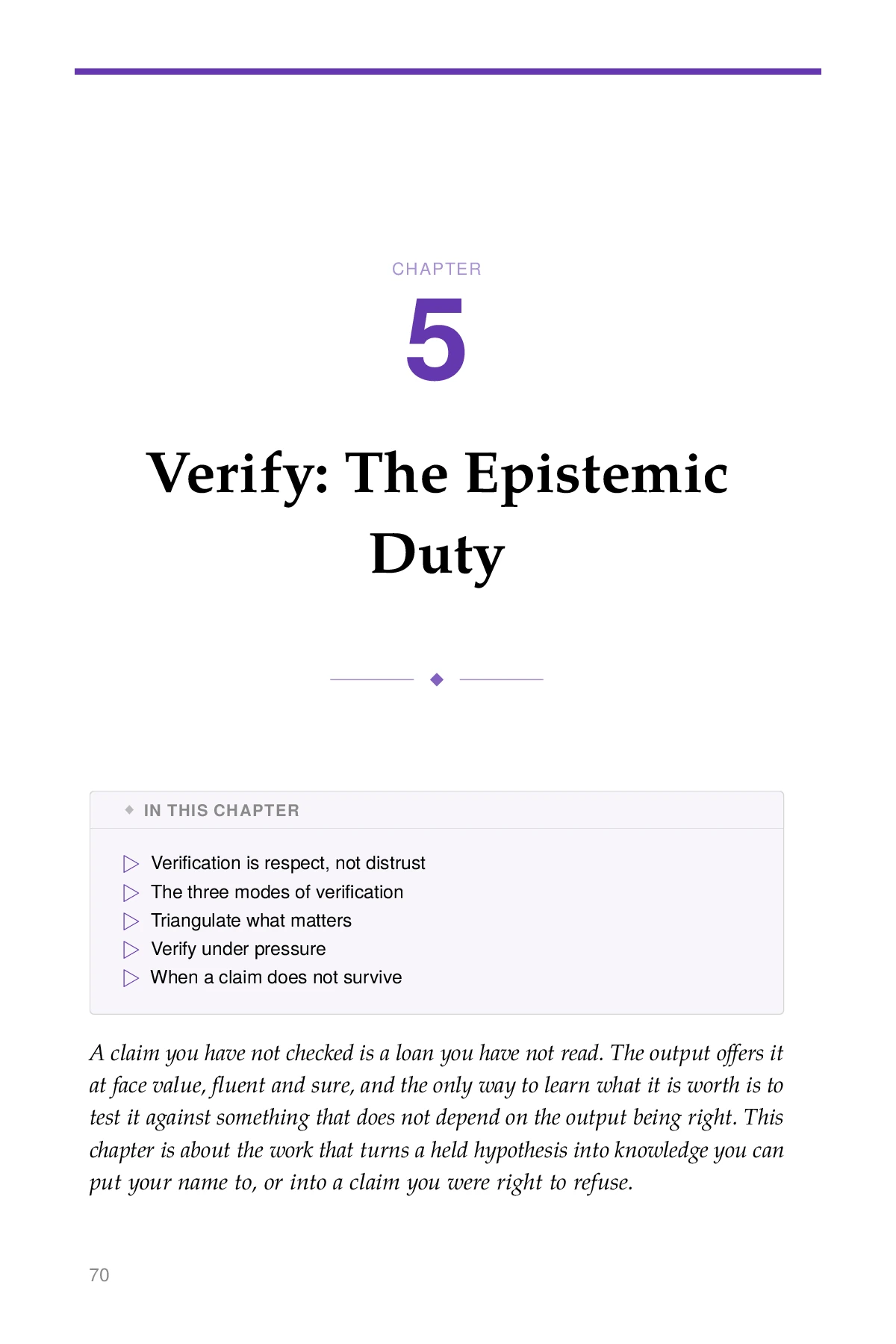
Verify: The Epistemic Duty
A claim you have not checked is a loan you have not read. The output offers it at face value, fluent and sure, and the only way to learn what it is worth is to test it against something that does not depend on the output being right. This chapter is about the work that turns a held hypothesis into knowledge you can put your name to, or into a claim you were right to refuse.
What you can do afterwards
You will build a verification ritual, a short repeatable set of checks you run on an output's load-bearing claims before any of them become yours, so that fluency stops standing in for proof and your certainty becomes something you earned rather than something the prose lent you.
Use this chapter when
A claim from an output is about to move money, ship under your name, or steer a decision someone will feel, and the only thing vouching for it so far is the output that made it.
Chapter 6
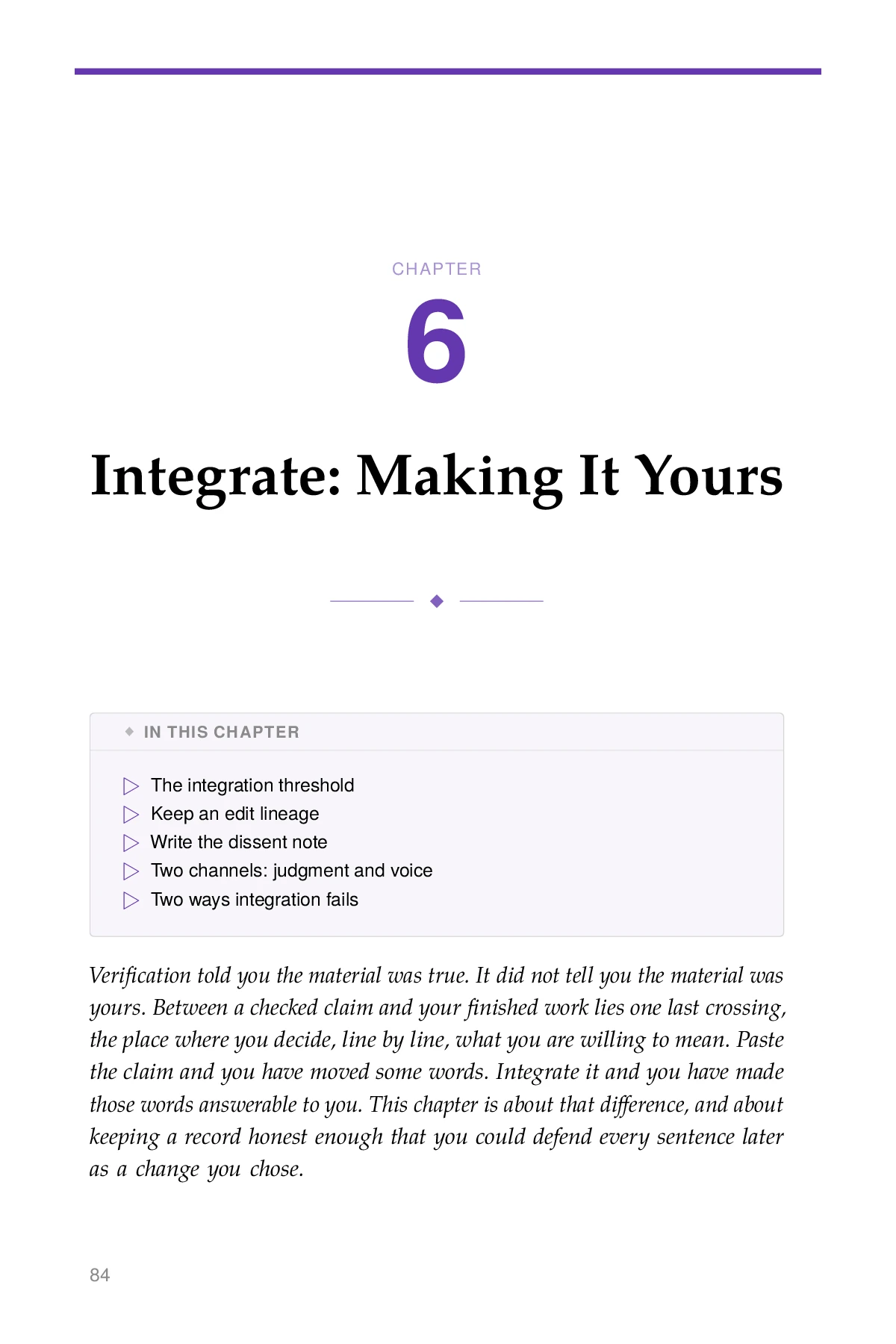
Integrate: Making It Yours
What you can do afterwards
You will set an integration threshold and keep an edit lineage, so that verified material enters your work by decision rather than by paste. Every sentence you ship becomes one you could defend as a change you chose to make.
Use this chapter when
A verified output is about to become part of your memo, your model, your product, or your position, and the only thing standing between its words and your name is the speed of a keystroke.
Chapter 7
Stoically Own: Character Under Delegation
What you can do afterwards
You will own the outcomes of what you delegate, stoically, accepting the error without blaming the tool that produced it or erasing the self that approved it. When something you shipped with an agent's help goes wrong, you will have a way to answer for it that keeps both your honesty and your standing intact.
Use this chapter when
A decision or output you delegated has shipped under your name and now has to be answered for, most of all when it went wrong and the easiest sentence available to you is the one that points at the machine.
Chapter 8
Delegation Under Pressure: Compressing the Protocol Without Dropping the Floor
Pressure does not ask whether you have time for your principles. It takes the time and leaves the question. This chapter builds a version of PROVISO small enough to survive a deadline, and a floor beneath each of its six gates that the deadline is not allowed to take.
What you can do afterwards
You will build a compressed form of PROVISO that you can run in about ninety seconds under a deadline, with a pre-set floor beneath each of the six gates, so that pressure can shorten the protocol without pushing any gate to zero.
Use this chapter when
A consequential output lands in front of you with a clock running, and the full protocol feels like time you do not have.
Chapter 9
Delegation in Teams: Turning a Private Protocol Into a Charter the Group Can Hold
A protocol that lives in one head cannot govern a draft that passes through six. The moment a team shares an agent, assent becomes plural, and one person's skipped check enters another's work as settled fact. This chapter turns the gates you hold for yourself into a charter the group can hold together.
What you can do afterwards
You will draft a one-page delegation charter that turns your private PROVISO gates into shared team norms: what your agents may do, what they may never do, how outputs get verified, who signs off, and whose name the output carries.
Use this chapter when
More than one person draws on the same agent, prompt library, or AI workflow, and those outputs flow into shared decisions, documents, or code.
Chapter 10
The Delegated Life: Building the Rhythm That Catches Drift Before It Sets
A protocol you ran once is a thing you did. A protocol you run on the ordinary days, when nothing is at stake and no one is watching, is a thing you are. The drift this book has tracked does its quietest work on those days. So the final skill is not a harder gate but a steadier rhythm: the standing review that returns you to the protocol before you notice you had drifted from it.
What you can do afterwards
You will install two review rhythms that keep PROVISO alive once its novelty fades: a weekly audit that catches character drift early, and a quarterly return to your non-delegable core that keeps the protocol current as your work changes.
Use this chapter when
The gates have become familiar enough to skip without noticing, and you want a standing practice that returns you to them on the ordinary days, not only the high-stakes ones.
Conclusion
Conclusion: Govern the Machine, Keep the Self
You can delegate the work, and you should delegate more of it than you do now. What you cannot hand across the desk is the act of agreeing that the result is true, or the name that goes on what follows. This book was one long argument for keeping those two things, and a protocol for keeping them under speed.
What you can do afterwards
You will leave with the whole of PROVISO gathered into one idea you can carry out the door, a clear view of what the protocol does and does not protect, and a direction for the work that comes after this book.
Use this chapter when
You have reached the end and want to hold, in one piece, what all of it was for.
Who it is for
Who this book was written for
The result is not a founder who delegates more. It is an organization that decides well when you are unreachable: on a flight, on holiday, or simply busy with the one decision that was actually yours to make.
If you build under pressure and refuse to confuse being needed with being effective, this was written for the operator who wants to scale judgment, not just headcount.
The reader it was written for
The delegating operator. Founder, product lead, strategist, or senior knowledge worker aged 30–55 who uses AI agents daily for research, drafting, analysis, and decision support. Stoically inclined or Stoic-curious. They value character, clarity, and accountability — and sense that speed is costing them something they cannot articulate.
Also a fit for
The team lead designing AI norms. Engineering manager, COO, head of ops — anyone setting "how we use AI here" without a philosophical backbone. They need language for non-delegable judgment and shared verification.
What you will use it on
- Give me a protocol I run before I act on any AI recommendation
- Help me define what I should never delegate
- Show me how to verify without becoming a bottleneck
- Give me language for my team about AI accountability
- Reconnect Stoicism to my actual work — not just morning journaling
Probably not for you if
- AI abolitionists and pure Luddites
- ML engineers optimizing models, not morals
- Academic Stoic scholars seeking philological precision
- Readers wanting prompt packs only
Editions
Editions and specifications
| Edition | Formats | Chapters | Pages | Reading time | ISBN (paperback) |
|---|---|---|---|---|---|
| English The Delegated Mind | In production | 12 | 204 | ± 3 hours | — |
| Dutch De gedelegeerde geest | In production | 12 | 226 | ± 3 hours | — |
Both editions are written natively. The Dutch text is not a machine translation of the English.
Frequently asked
What readers usually want to know
What is The Delegated Mind about?
PROVISO is a Stoic operating protocol for AI-assisted cognition: pause, retain agency, observe, verify, integrate, and own every delegated outcome. The subtitle is: Stoic Judgment in the Age of AI Delegation.
What is the PROVISO framework?
six Stoic-operational skills for governing AI-assisted cognition
Is there a Dutch edition?
Yes. The Dutch edition is De gedelegeerde geest, written as a native edition rather than a machine translation. It moves through the same production line.
How long is The Delegated Mind?
This edition runs 12 chapters, 204 pages in print and roughly 3 hours of reading.
Who is The Delegated Mind for?
If you build under pressure and refuse to confuse being needed with being effective, this was written for the operator who wants to scale judgment, not just headcount.
The production system
How this book was made
Every title moves through the same gated production line: sourced research, a claim-level evidence ledger, structural review, fact-checking, red-team critique, and a bilingual final edit. AI agents do specialist work inside those gates; judgment, voice, and accountability stay human.
- Claims enter an evidence ledger with a source and a confidence grade before they reach the page
- English and Dutch are two native editions, not a translation of one another
- Every chapter clears readability, rhythm, and style gates before it is typeset


