

No. 19 · Manuscript complete · Decisions & philosophy · CASCADE
The Second-Order Thinker
Trace the Full Cascade of a Decision Before You Commit to It
The Second-Order Thinker: Trace the Full Cascade of a Decision Before You Commit to It.
CASCADE trains decision-makers to inspect second-order effects, incentives, reversibility, timing, and hidden dependencies before committing. Trace the Full Cascade of a Decision Before You Commit to It. The framework: CASCADE.
- pages
- 226
- chapters
- 14
- hours of reading
- ± 3
- editions
- EN · NL
- Design
- Drafting
- Manuscript
- Production
- Launched
The editions
Kindle, Paperback and Hardcover
Production shots of the editions. Not for sale yet — this page is the public working version.
-

Kindle
The digital edition, ready in any Kindle app.
-

Paperback
The working copy. Mark it up. Take it into the meeting.
-
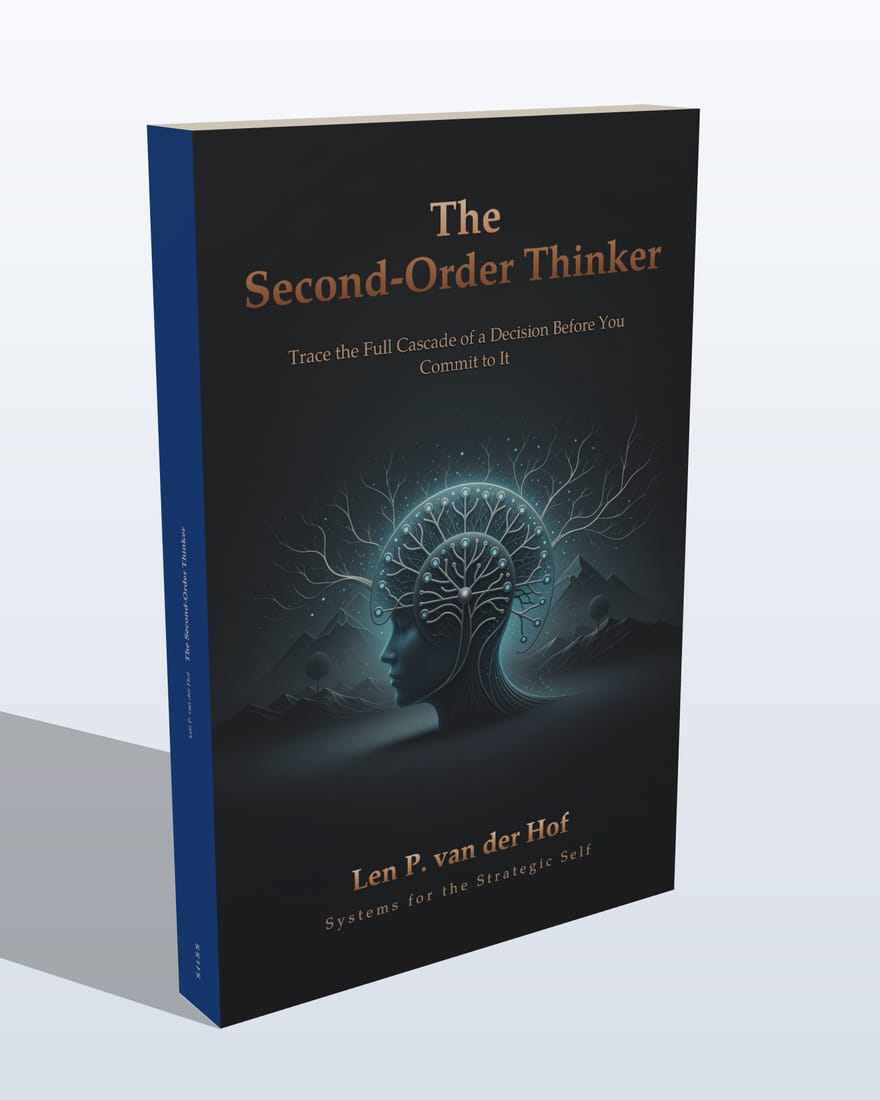
Hardcover
The shelf edition. Dark full-art jacket, built to stay in the room.


The book
Trace the Full Cascade of a Decision Before You Commit to It
The feature shipped and the dashboard lit up. Inference was 1.5x faster, the demo looked stronger, and the decision got celebrated. The next afternoon the pilots read the speed as a budget cut, by Friday the support thread was on fire, and the renewal calls went sideways. The win on the visible metric had already eaten the second-order trust, and no one traced the chain before the signature.
The reflex is to add more local metrics and promise to be more careful. That does not help. The visible metric is only the first link in a chain that keeps moving at the speed of the system, long after the meeting, until it reaches something expensive.
This book installs the opposite of caution: a repeatable practice for tracing a decision before you commit to it. The Second-Order Thinker introduces the CASCADE framework, seven moves that replace first-order reaction with deliberate, personal tracing.
What you learn
What this book puts in your hands
- Draw a one-page consequence map that traces any material decision to its third link, naming the audience and time horizon for each.
- Tell an amplifying loop from a dampening one, so you know whether the next link is larger or smaller than the last.
- Weigh time horizons and discounting, and map the network and emergent effects that first-order thinking never sees.
- Build a personal cascade protocol you run on every material call, then evaluate after the fact so the practice keeps correcting itself.
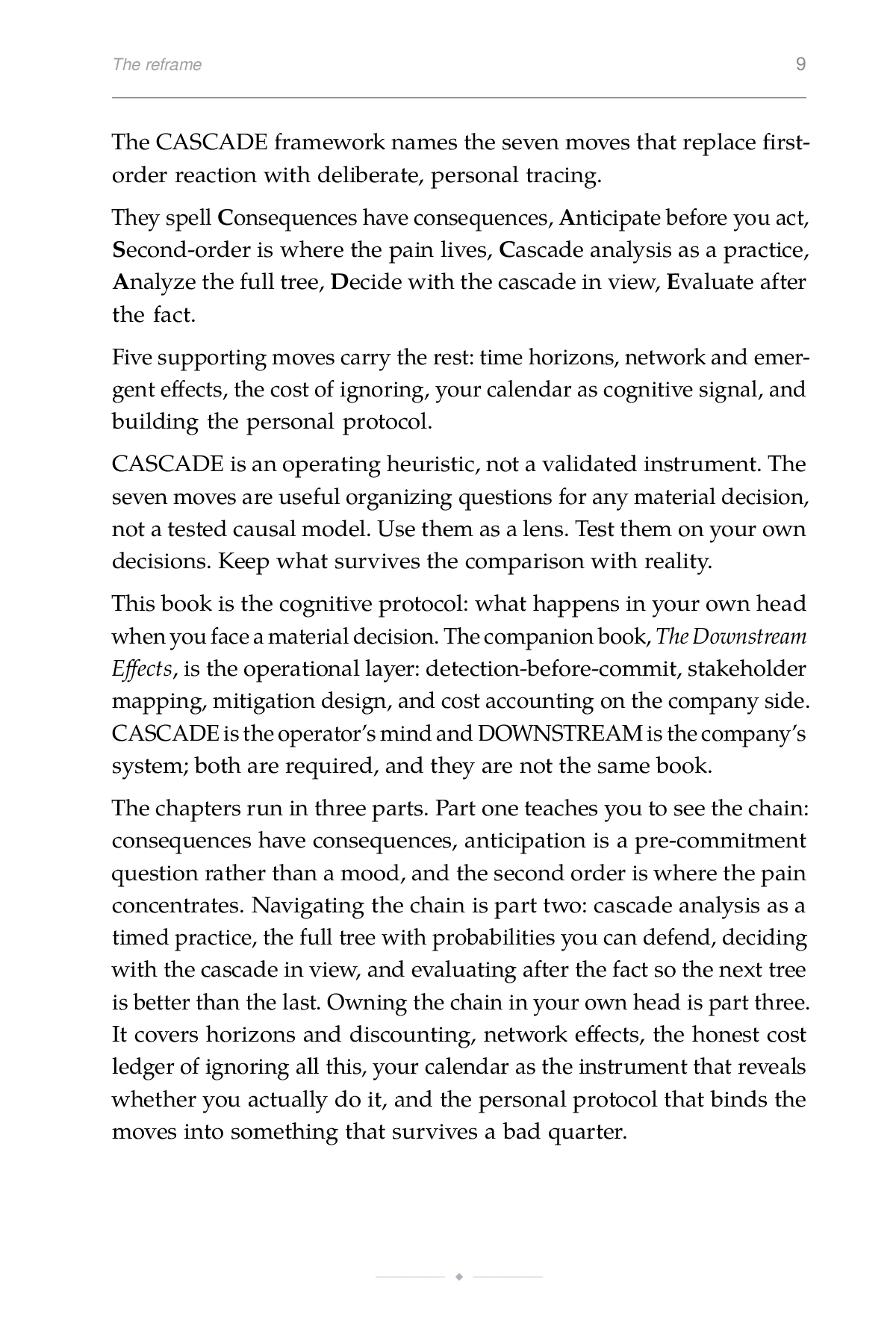
From the book
CASCADE is the operator’s mind and DOWNSTREAM is the company’s
The Second-Order Thinker, printed page: CASCADE is the operator’s mind and DOWNSTREAM is the company’s
Inspect more pagesLook inside
Pages from the print edition.
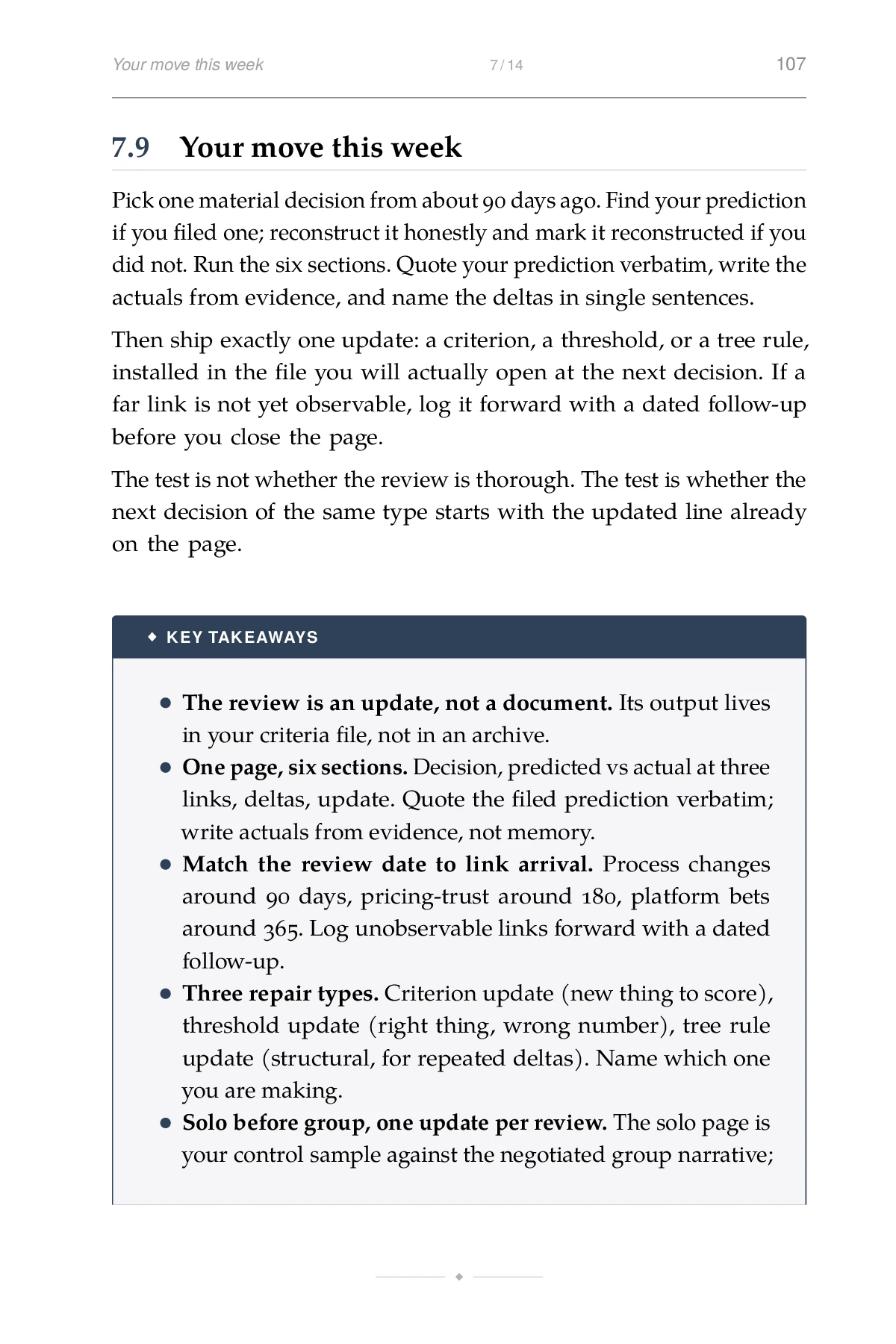
 Your move this week 7 14 107
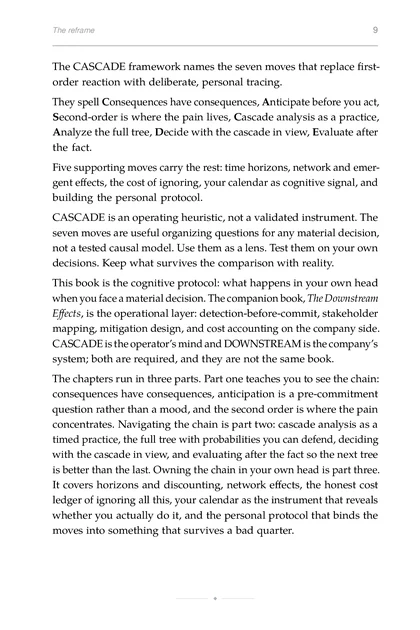 CASCADE is the operator’s mind and DOWNSTREAM is the company’s
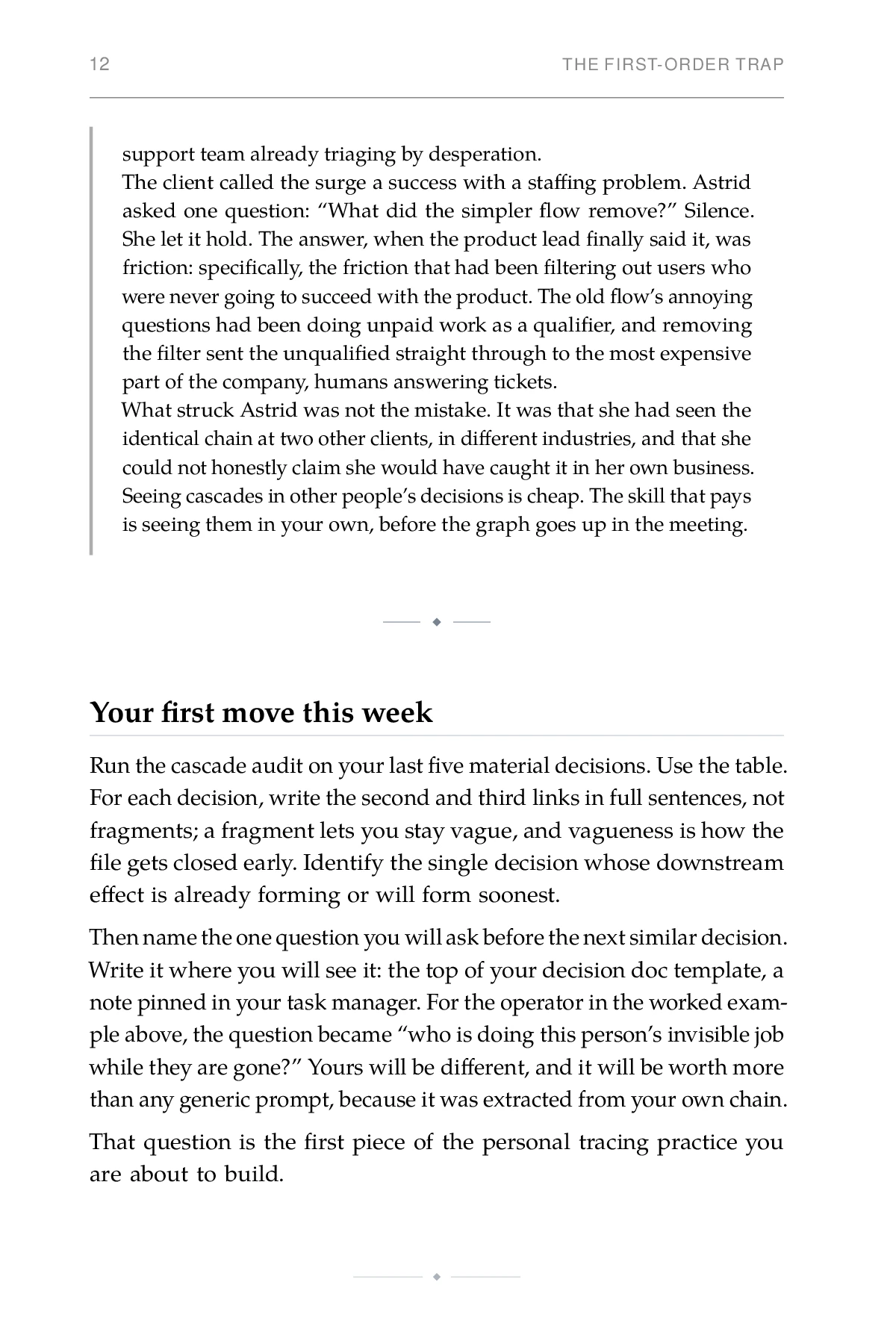
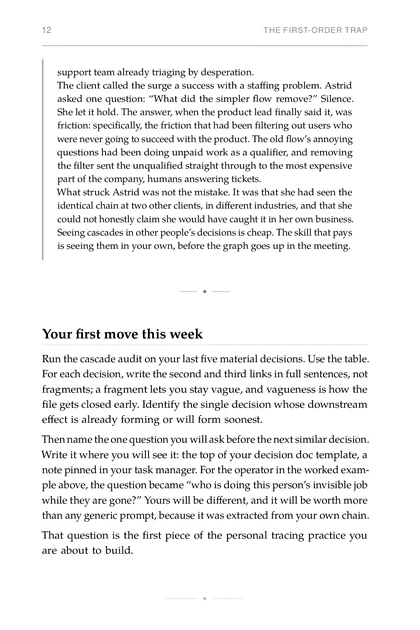 Your first move this week
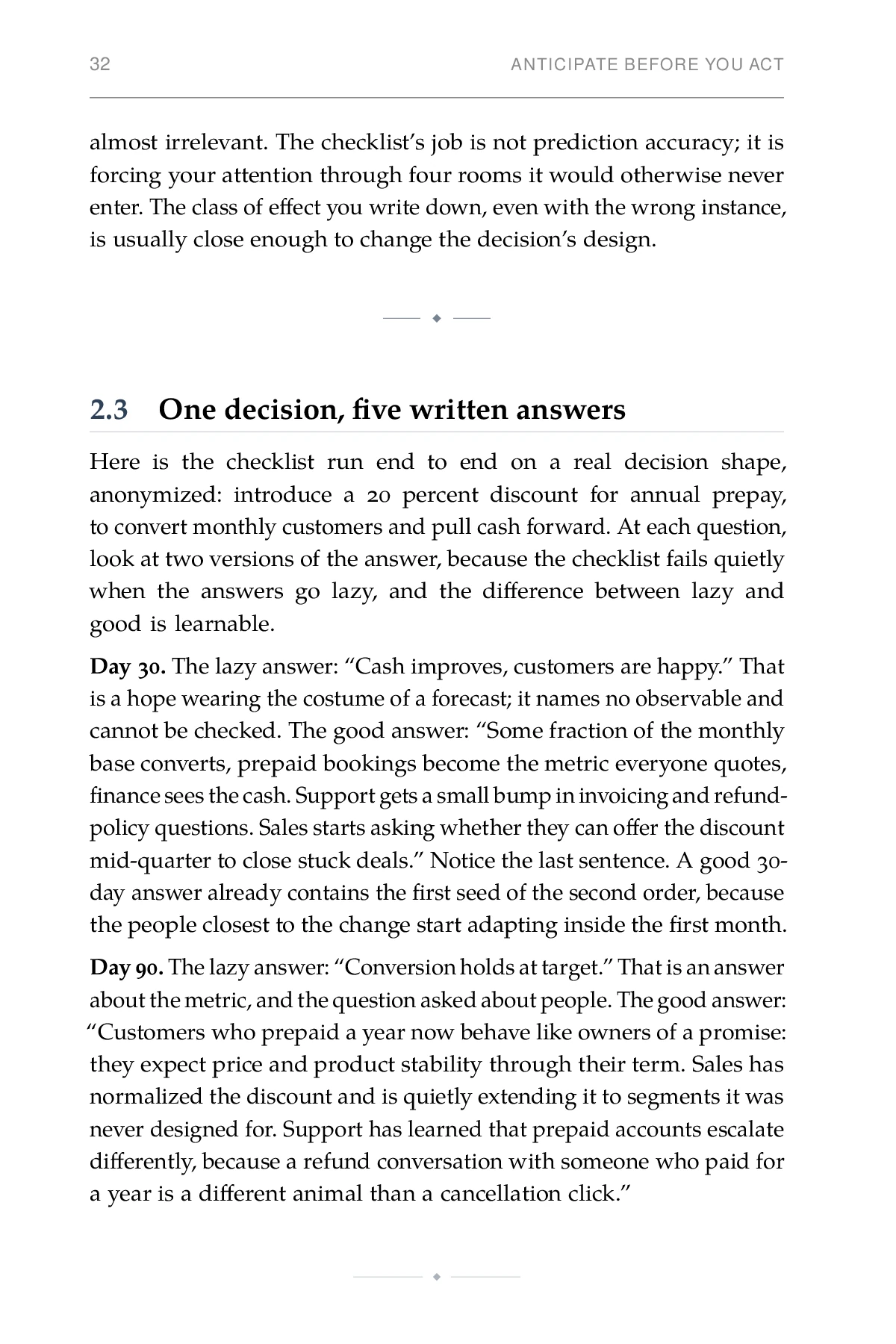
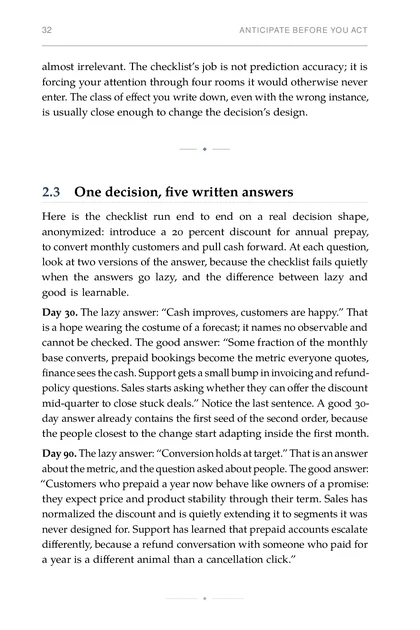 Day 30. The lazy answer: “Cash improves, customers are happy.” That
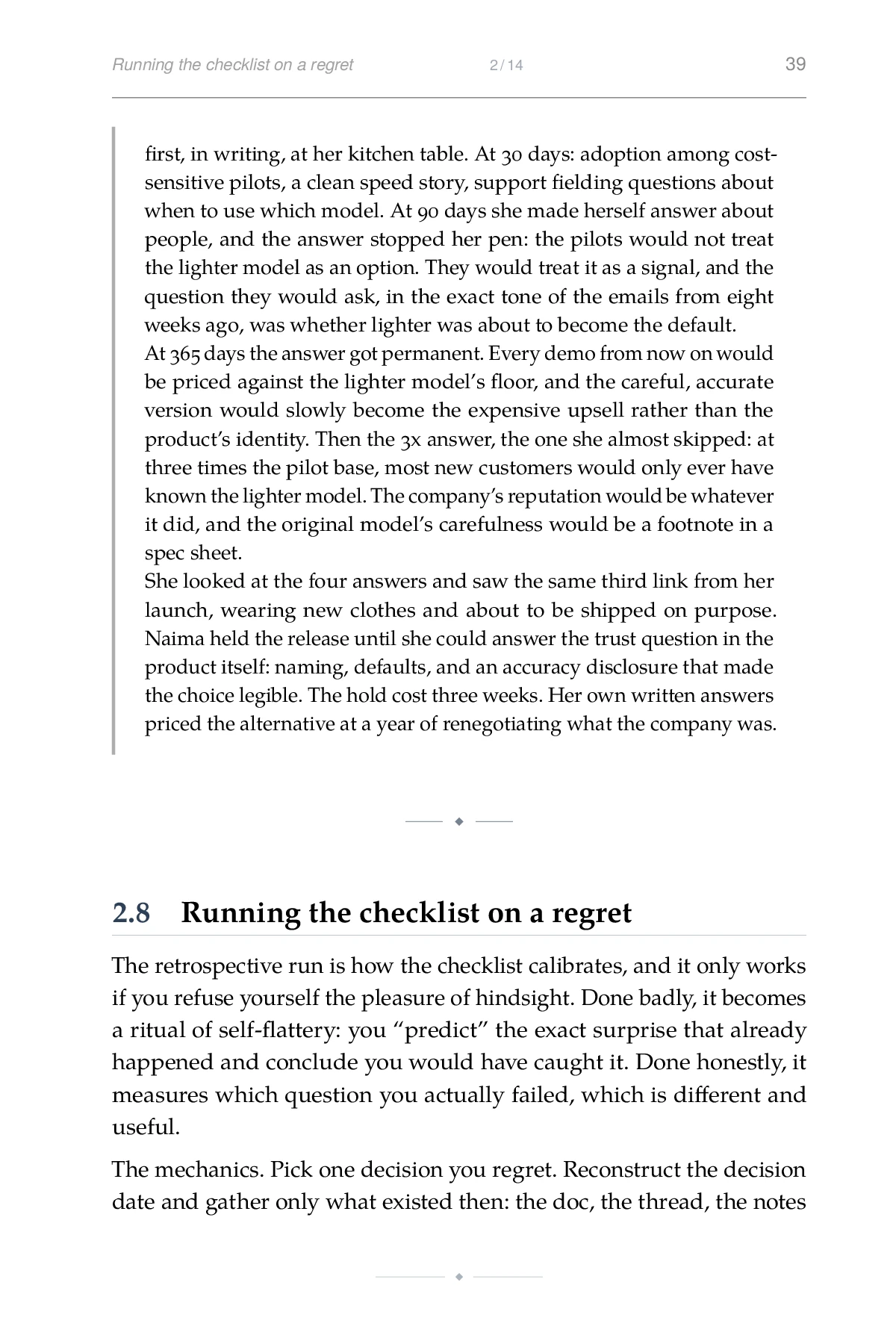
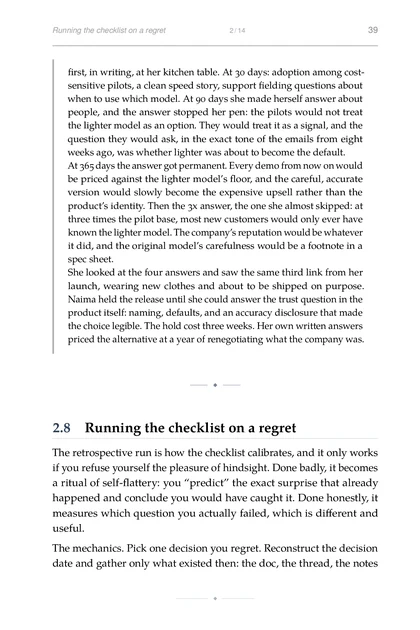 At 365 days the answer got permanent. Every demo from now on would
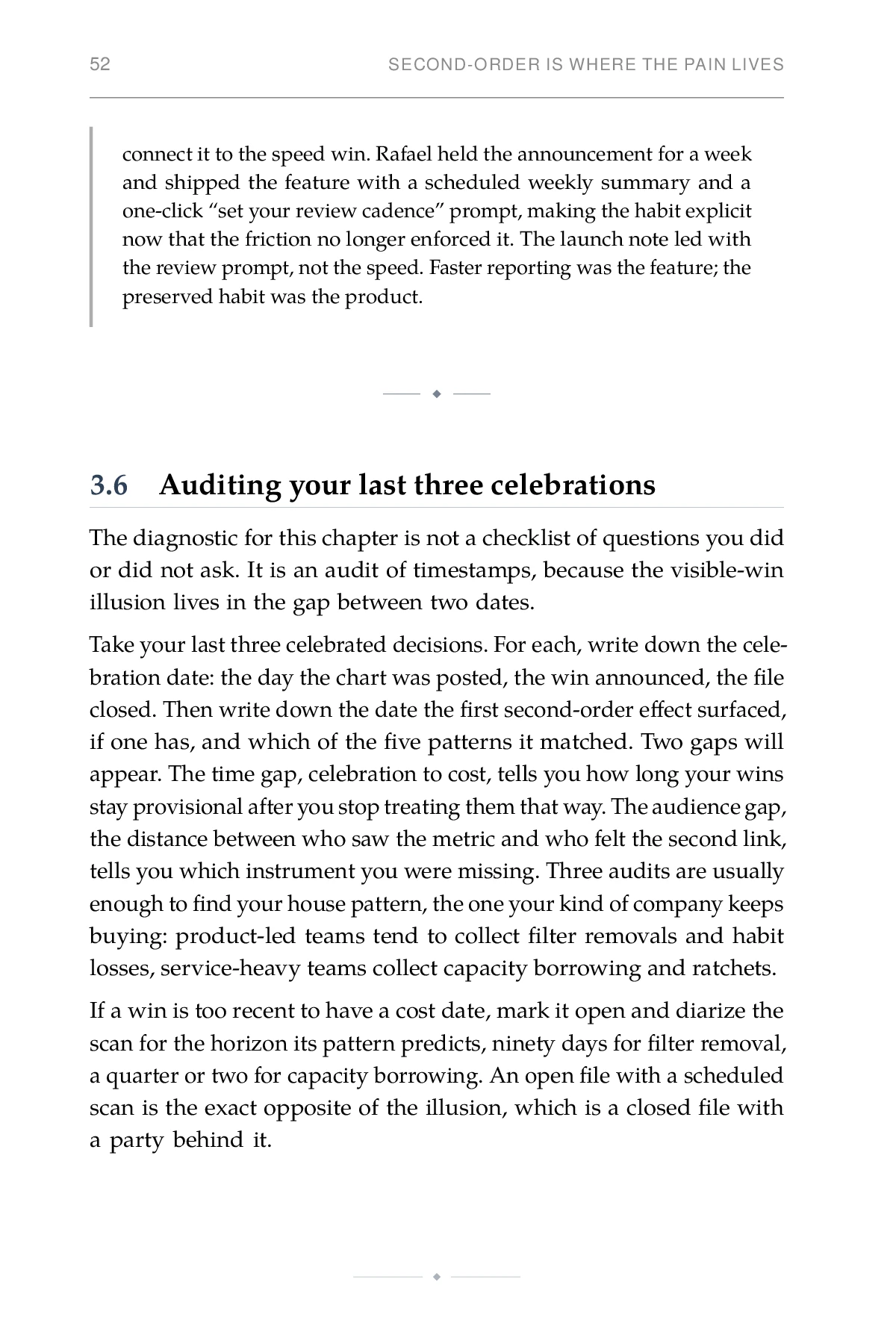
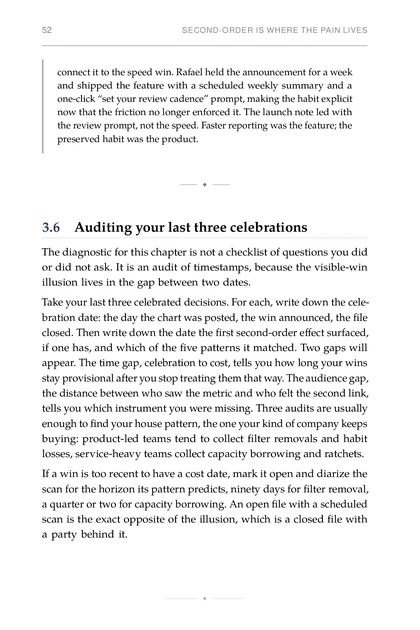 The diagnostic for this chapter is not a checklist of questions you did
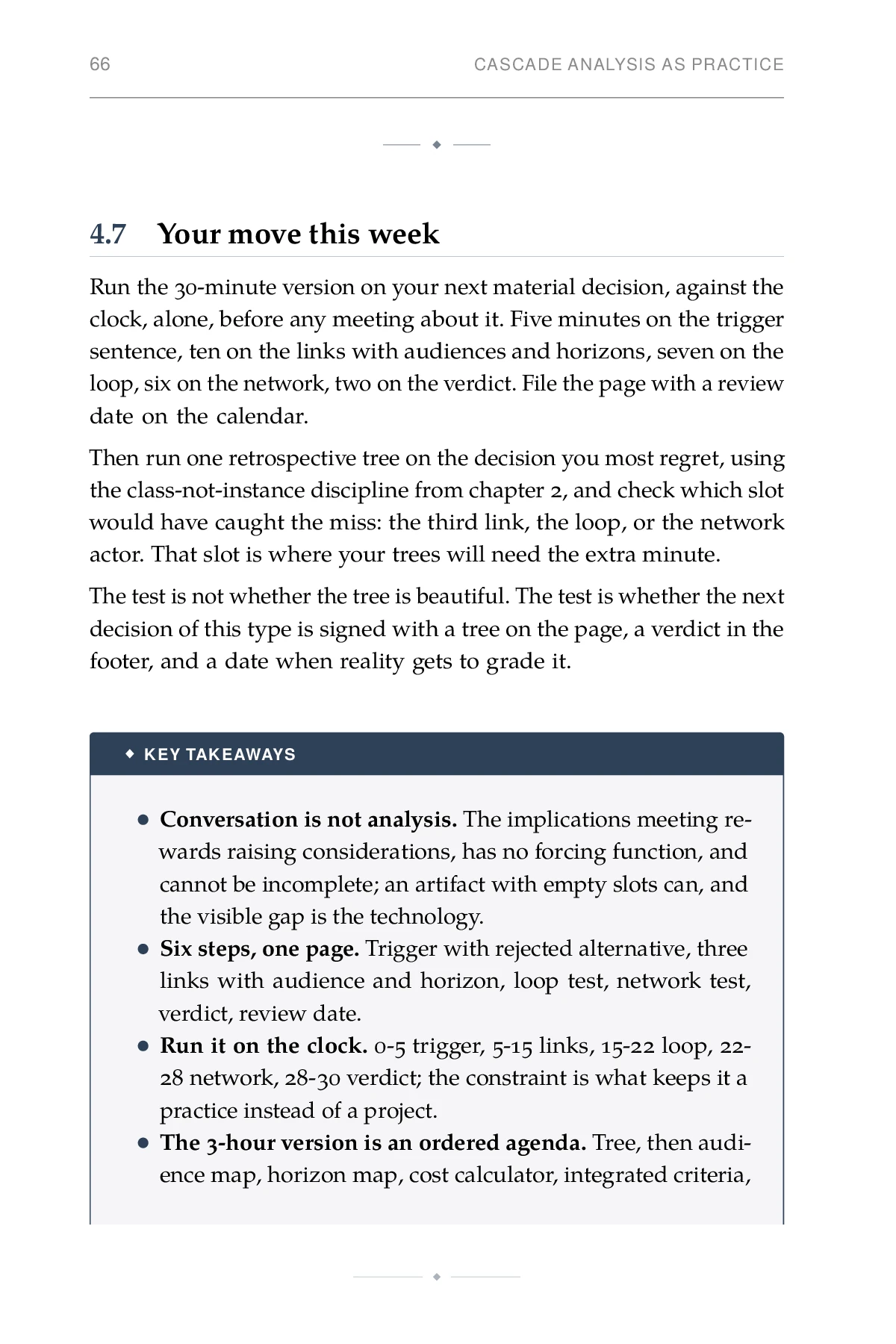
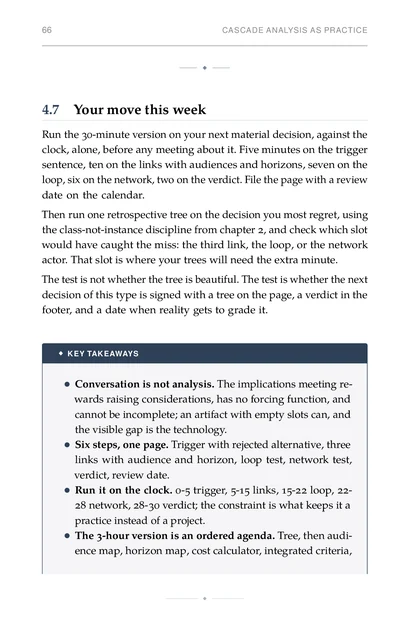 practice instead of a project
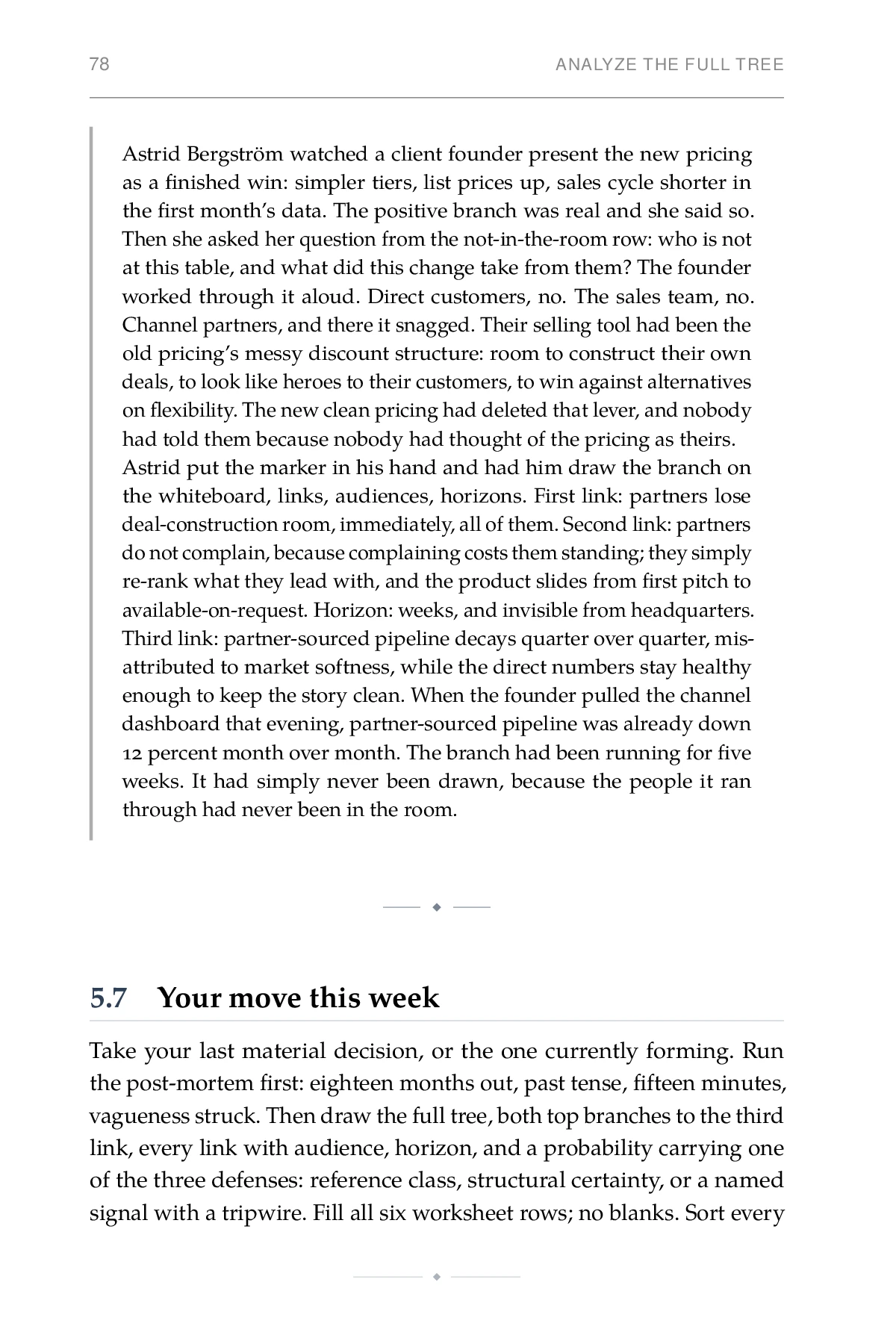
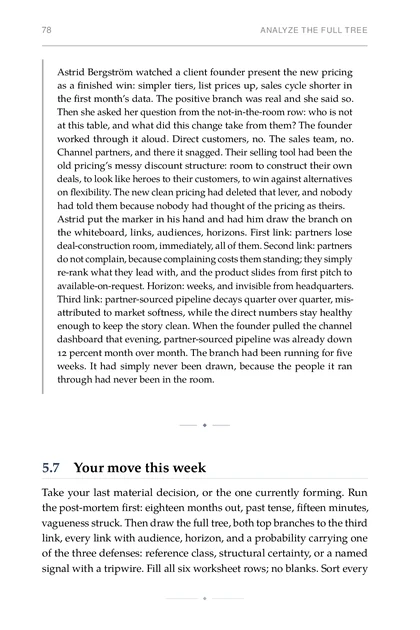 Astrid put the marker in his hand and had him draw the branch
The contents
Chapter by chapter
Every chapter of The Second-Order Thinker with its printed epigraph, what you can do afterwards, and the moment it is built for.
Introduction
The First-Order Trap
Decisions that feel right on the visible, first-order metric routinely produce delayed, amplified, and more expensive second-order, third-order, and network consequences that no one traced before committing. The first move is to see the trap from inside your own head.
What you can do afterwards
You will run a personal cascade audit on your last five material decisions, trace each through "and then what?" three times, and name the second-order effect that is already forming or will form.
Use this chapter when
A "win" on the visible metric is starting to create downstream drag you did not model and the brain is still calling it a win.
Chapter 1
Consequences Have Consequences
Every action changes the system, and the visible effect is only the first link in a chain that continues until someone traces it or it breaks something expensive. The cognitive move is to see the chain inside your own head before the system sees it for you.
What you can do afterwards
You will draw a personal consequence chain to the third link for each of your last three material decisions, annotate every link with direction, delay, and audience, and identify the one link that would have altered the call.
Use this chapter when
You have made a decision recently and the visible effect is the only one in the room.
Chapter 2
Anticipate Before You Act
The question "and then what?" asked at multiple time horizons before the decision is the smallest unit of personal second-order thinking. Without it, every choice is a bet on the visible, and the brain is not a reliable bettor.
What you can do afterwards
You will run the five-question anticipation checklist on your next material decision at the 30, 90, 365, and 1095-day horizons plus 3x scale, with written answers that name people and observable states, not hopes and metrics.
Use this chapter when
A decision is forming and the only horizon in the room is the one that pays the visible metric.
Chapter 3
Second-Order Is Where the Pain Lives
The first effect is rarely the most important or costly. Second-order, third-order, and network effects are where the real damage or opportunity lives, and they are the ones the operator's eye is least trained to see. The cognitive move is to look at the effect of the effect.
What you can do afterwards
You will run the five-question second-order scan on your last three wins, with full written answers, and name the one second-order effect that would have changed the call if it had been visible at decision time.
Use this chapter when
A recent win is being defended, the celebration has happened, and something in the system feels quieter than it should.
Chapter 4
Cascade Analysis as Practice
Ad-hoc "thinking about consequences" is not a practice. A repeatable cascade analysis method that the operator can run in 30 minutes or 3 hours is required to make second-order thinking operational in the operator's own head. The method is what turns a good intention into a personal protocol.
What you can do afterwards
You will run the 30-minute cascade analysis, minute by minute, on your next material decision. The output: a one-page cascade tree naming the third link, audience and horizon per link, the loop verdict, and whether any of it changes the call.
Use this chapter when
A material decision is forming and "thinking about consequences" is the only thing scheduled.
Chapter 5
Analyze the Full Tree
The tree that only shows the branches the operator likes is not analysis. Mapping both the upside and downside cascades, including the ones that feel unlikely, is required to make the decision honest. The cognitive move is the operator's own intellectual honesty.
What you can do afterwards
You will draw the full tree on a material decision: positive and negative branches to the third link, each link carrying an audience, a horizon, and a probability defended from your own decision log rather than the word "probably."
Use this chapter when
The decision is being defended and the branches that would change the call are not on the page.
Chapter 6
Decide with the Cascade in View
A decision made with the cascade in view is a different decision. The criteria, the options, and the threshold for "yes" must change when the full tree is on the table. The cognitive move is the operator's own discipline to refuse to sign without the tree in the room.
What you can do afterwards
You will write an integrated criteria document for your next material decision: four weighted sections scored with visible arithmetic, a threshold set against the feared branch before the meeting, and a tripwire that can veto the decision after it ships.
Use this chapter when
The decision is forming and the criteria are being set in a room where the tree is not present.
Chapter 7
Evaluate After the Fact
Prediction without comparison to reality is not learning. It is note-taking. A structured post-decision review asks one question: what did the cascade actually do? The answer, held against what you predicted, is the only raw material your criteria can improve on. This is the E in CASCADE, and it is the move that makes the other six compound.
What you can do afterwards
You will run a structured review on a decision that is at least 90 days old, name the deltas between the cascade you predicted and the cascade that arrived, and convert one delta into a specific update to a criterion, a threshold, or a tree rule.
Use this chapter when
A decision is old enough that its second and third links should have arrived, and you can still reconstruct what you expected when you signed it.
Chapter 8
Time Horizons and Discounting
Effects arrive at different times, and everything in the room is calibrated to price the near ones. A deliberate horizon map, with weights set before the meeting, is how the 365-day and three-year effects keep their seat in the decision. This is the personal override of the present bias, built as an artifact instead of a resolution.
What you can do afterwards
You will draw a horizon map for your next material decision at 30, 90, 365, and 1095 days, score each horizon with an explicit weight, run the arithmetic, and install a mechanical veto rule that lets the far horizon overrule the near win.
Use this chapter when
A material decision is forming and the only horizon anyone in the room is defending is the one that fits inside the next board meeting.
Chapter 9
Network and Emergent Effects
Some consequences never appear on a tree, because they are not links. They are interactions between responses, and they only become visible when the diagram holds every actor at once. The cognitive move is the shift from "I draw trees" to "I see the system," and it happens on paper, not by resolve.
What you can do afterwards
You will redraw your last material decision as a network: actors, response arrows, closing loops, and pools. You will run the emergent-effect test on it, name the one interaction that was invisible on the linear tree, and add that interaction to your criteria for the next decision of the same type.
Use this chapter when
A change in one part of your system produced behavior in another part that you did not model, because you stopped at the direct link.
Chapter 10
The Cost of Ignoring the Cascade
The cost of untraced cascades is not only on the company P&L. It lands on you: the time, the attention, the credibility, the optionality, and the energy that every surprise consumes. The move is an honest personal accounting, because a cost that stays invisible keeps getting paid.
What you can do afterwards
You will run a personal cascade cost ledger on your last three untraced decisions, count each of the five lines with the estimation heuristics below, and read the total on a quiet day, as the business case for the protocol you will build in chapter 12.
Use this chapter when
The company cost of an untraced cascade is being written off as "the cost of doing business" while your own cost stays uncounted.
Chapter 11
Your Calendar as Cognitive Signal
Where you spend time is the loudest signal about what you are actually willing to think about. Words are edited; decks are rehearsed; the calendar is the one artifact that records what really happened to your attention. The move is to audit it, read it without flinching, and redesign it so the thinking you claim to value has an address.
What you can do afterwards
You will audit your last 90 days of calendar hour by hour against a strict rubric, compute your cascade-thinking percentage, and if it sits below the 8% floor, redesign the next 30 days around three protected blocks that bring it to the 12% target.
Use this chapter when
You hear yourself telling the team, the board, or your partner that cascade thinking is how you decide, and you have never checked whether your own time agrees.
Chapter 12
Building Your Cascade Protocol
Every material decision feels new, and every surprise feels original, until the seven moves live in a written protocol you actually run. This chapter binds everything the book has built into one artifact: seven pages, three rituals, a version number, and the pre-commitments that keep it alive through a bad quarter.
What you can do afterwards
You will write version 1.0 of your personal cascade protocol, one page per major move in your own language, put the three rituals on your calendar with their interiors defined, and run the protocol on your next material decision within 30 days.
Use this chapter when
You have run the moves individually on real decisions and the next decision should start from the protocol, not from a conversation.
Conclusion
The Quiet Power of Layers
Operators who think in layers carry a different competence into the room. It is not a personality trait. It is a mind re-engineered, one decision at a time, to hold the chain, the horizon, the network, and the cost before the signature. The book ends where your own practice begins.
What you can do afterwards
You will write your personal quiet-competence commitment, one crafted sentence, dated and shared, and schedule the 90-day review that checks whether the protocol is actually running.
Use this chapter when
You have run the seven moves on real decisions and the next material decision should start in your own head, not in the room's momentum.
Who it is for
Who this book was written for
CASCADE is not caution for its own sake, and not a slower operator. It is an operating heuristic you test on your own decisions, keeping what survives contact with reality. Second-order, third-order, and network consequences stop arriving as surprises, because you traced the chain while it was still cheap to change.
If your decisions now travel further than your attention, this was written for you.
The reader it was written for
Founders, product leaders, and operators at 15–100 person companies who have made decisions that produced expensive, delayed consequences they did not anticipate. They are intellectually capable but still surprised by second-order effects. Psychographics:
Probably not for you if
- Pure theorists.
- Readers who never make material decisions.
- Those seeking only bias checklists.
Editions
Editions and specifications
| Edition | Formats | Chapters | Pages | Reading time | ISBN (paperback) |
|---|---|---|---|---|---|
| English The Second-Order Thinker | In production | 14 | 226 | ± 3 hours | — |
| Dutch De tweede-orde-denker | In production | 14 | 206 | ± 3 hours | — |
Both editions are written natively. The Dutch text is not a machine translation of the English.
Frequently asked
What readers usually want to know
What is The Second-Order Thinker about?
CASCADE trains decision-makers to inspect second-order effects, incentives, reversibility, timing, and hidden dependencies before committing. The subtitle is: Trace the Full Cascade of a Decision Before You Commit to It.
Is there a Dutch edition?
Yes. The Dutch edition is De tweede-orde-denker, written as a native edition rather than a machine translation. It moves through the same production line.
How long is The Second-Order Thinker?
This edition runs 14 chapters, 226 pages in print and roughly 3 hours of reading.
Who is The Second-Order Thinker for?
If your decisions now travel further than your attention, this was written for you.
The production system
How this book was made
Every title moves through the same gated production line: sourced research, a claim-level evidence ledger, structural review, fact-checking, red-team critique, and a bilingual final edit. AI agents do specialist work inside those gates; judgment, voice, and accountability stay human.
- Claims enter an evidence ledger with a source and a confidence grade before they reach the page
- English and Dutch are two native editions, not a translation of one another
- Every chapter clears readability, rhythm, and style gates before it is typeset
Terminology
The series
More in this theme


