

No. 28 · In design · Decisions & philosophy · FENCE
The Constraint Founder
Stoic Limits for Bootstrapped Ambition
Ten priorities is zero priorities. Find the one that gates everything.
Bootstrapped founders drown in ten priorities and ship none of them. The Constraint Founder fuses Stoic acceptance with the Theory of Constraints into one protocol: find the single bottleneck that gates revenue or survival, fence it, and let everything else wait.
- pages
- 264
- chapters
- 12
- hours of reading
- ± 4
- editions
- EN · NL
- Design
- Drafting
- Manuscript
- Production
- Launched
The editions
Kindle, Paperback and Hardcover
Production shots of the editions. Not for sale yet — this page is the public working version.
-
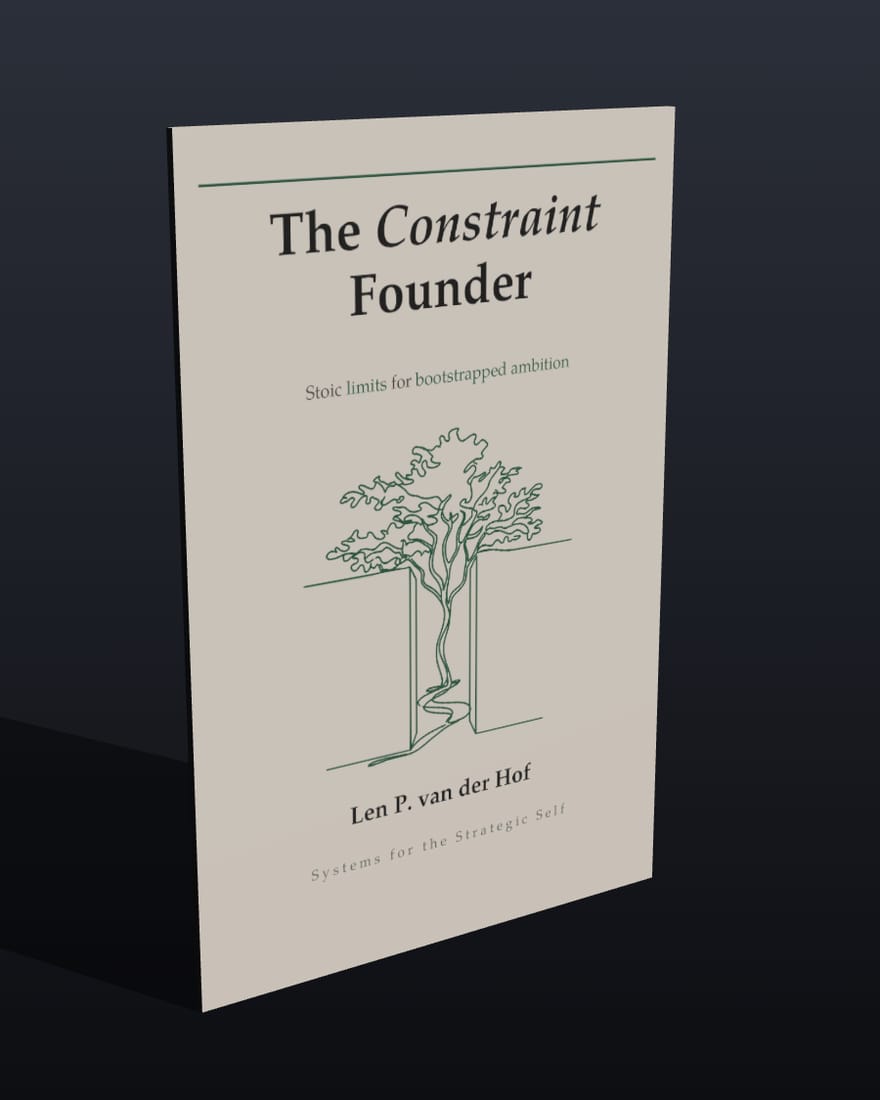
Kindle
The digital edition, ready in any Kindle app.
-
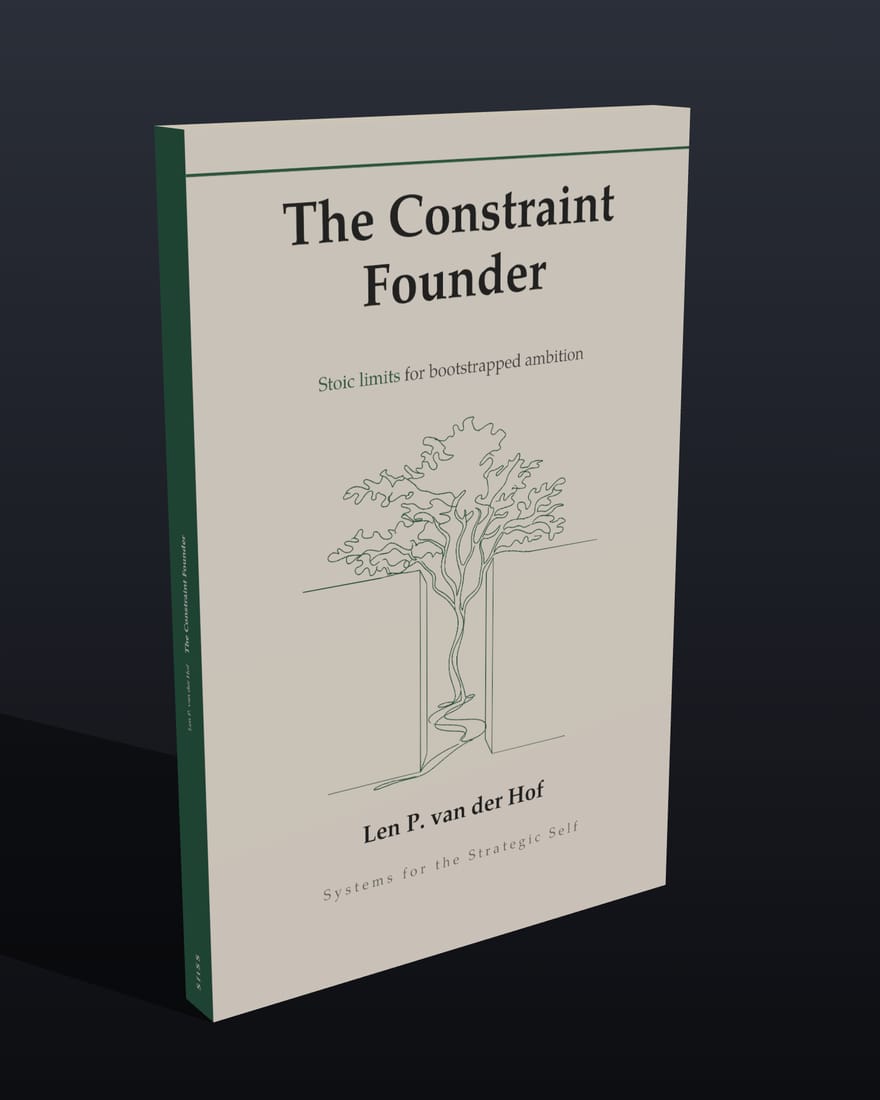
Paperback
The working copy. Mark it up. Take it into the meeting.
-
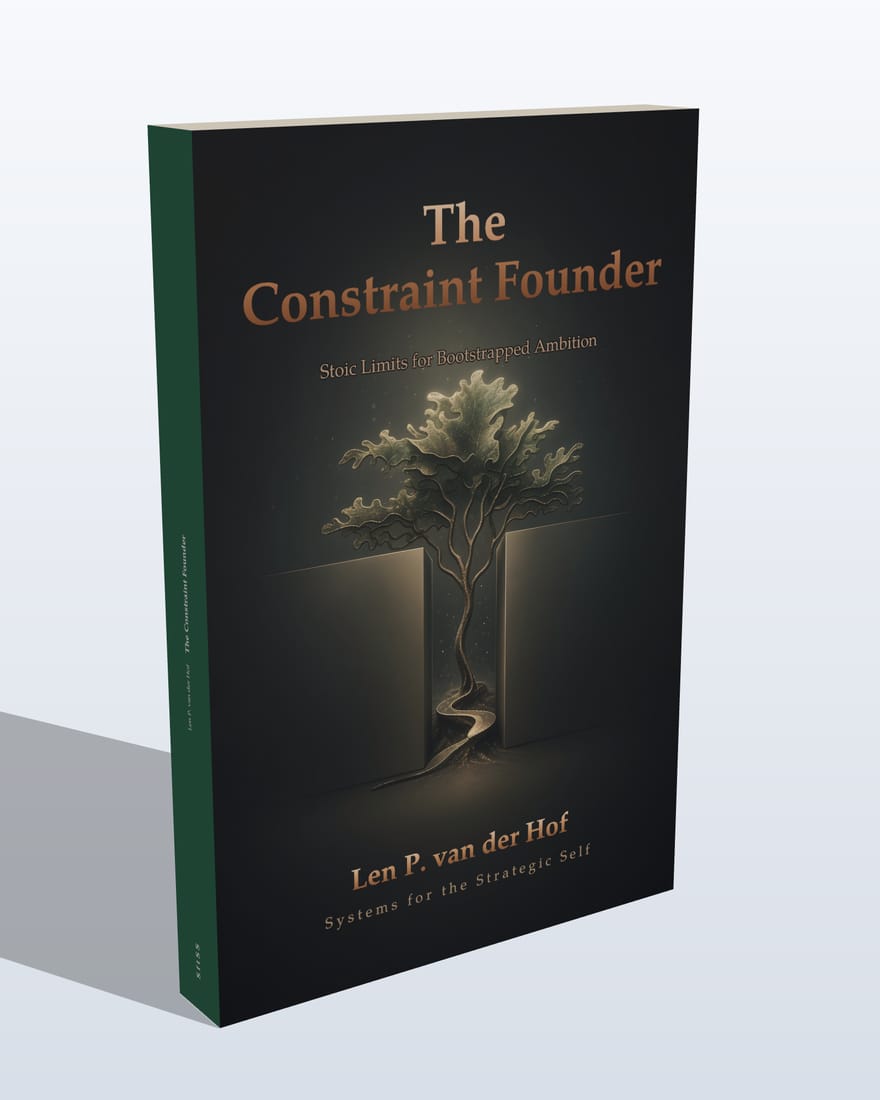
Hardcover
The shelf edition. Dark full-art jacket, built to stay in the room.


The book
Stoic Limits for Bootstrapped Ambition
You have ten priorities, which means you have none. Four initiatives sit at fifty percent, each one starving the others of the hours, cash, and attention you do not have. You apologize for the budget you were never given, treat every limit as an insult to the vision, and call the chronic almost-shipping "moving fast." The constraints did not slow the company down. Your refusal to choose one did.
The usual answer is to raise more, hire ahead, and buy your way past the fence. But capital does not teach focus. It postpones the day you learn it, and the founder who never had to choose ships a worse product than the one who could not afford to be vague.
The Constraint Founder treats your limits as the asset they actually are. Drawing on Goldratt's Theory of Constraints and the Stoic discipline of accepting what you cannot yet change, it installs FENCE: a quarterly operating protocol that turns a scarce resource into a competitive position funded rivals cannot copy.
What you learn
What this book puts in your hands
- The FENCE protocol: Focus, Eliminate, Non-negotiables, Capacity, End scope creep
- Stoicism plus Theory of Constraints for bootstrappers
- Trade chronic almost-shipping for one decisive bottleneck
The framework
FENCE, step by step
Focus, Eliminate, Non-negotiables, Capacity, End scope creep
-
Focus
-
Eliminate
-
Non-negotiables
-
Capacity
-
End scope creep
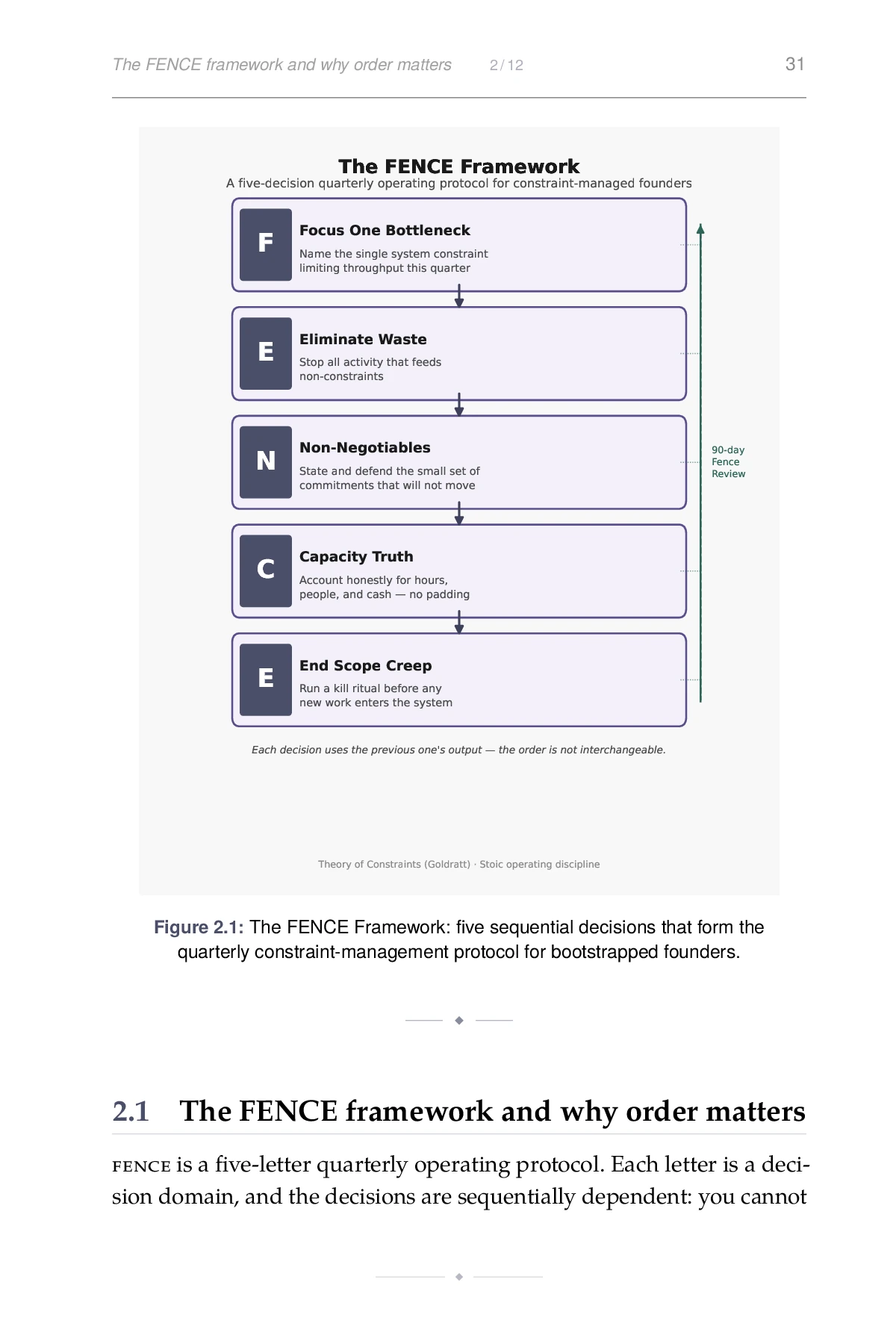
From the book
The FENCE Framework: five sequential decisions that form the
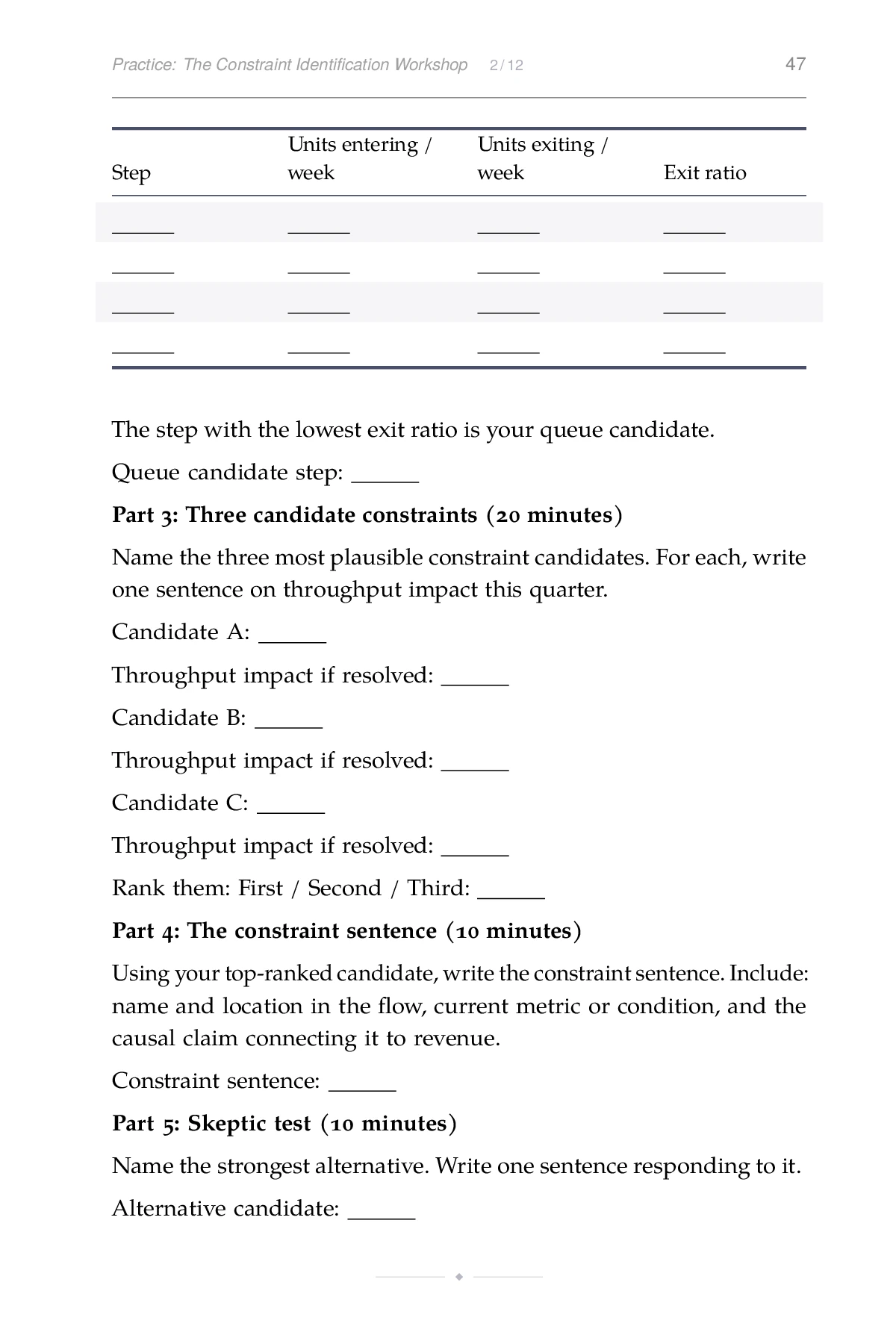
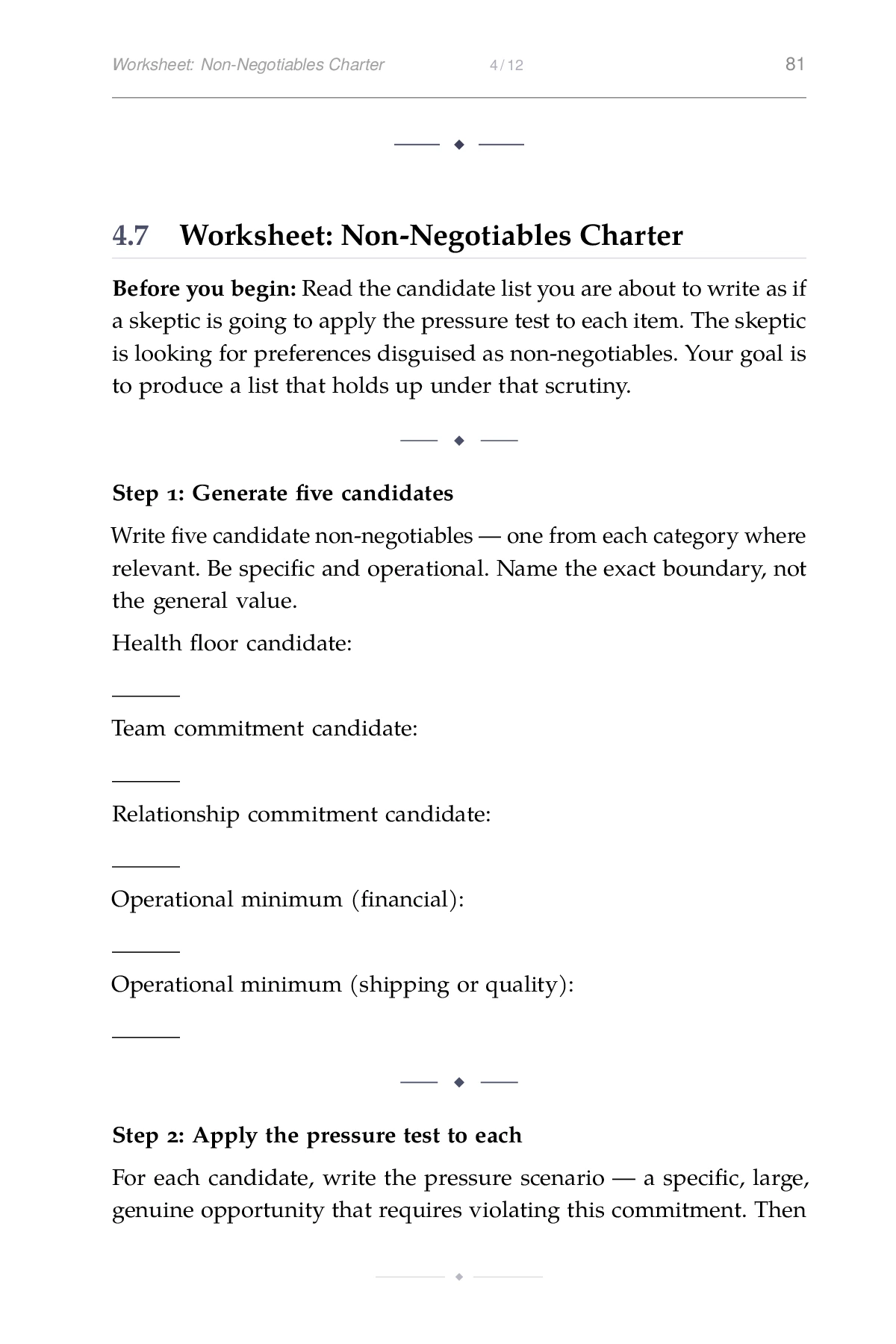
The Constraint Founder, printed page: The FENCE Framework: five sequential decisions that form the
Inspect more pagesLook inside
Pages from the print edition.
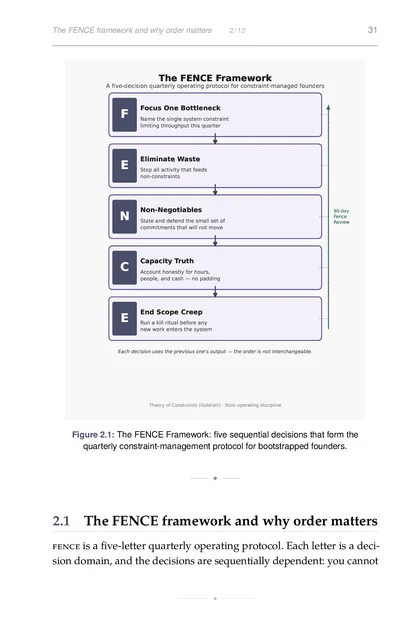 The FENCE Framework: five sequential decisions that form the
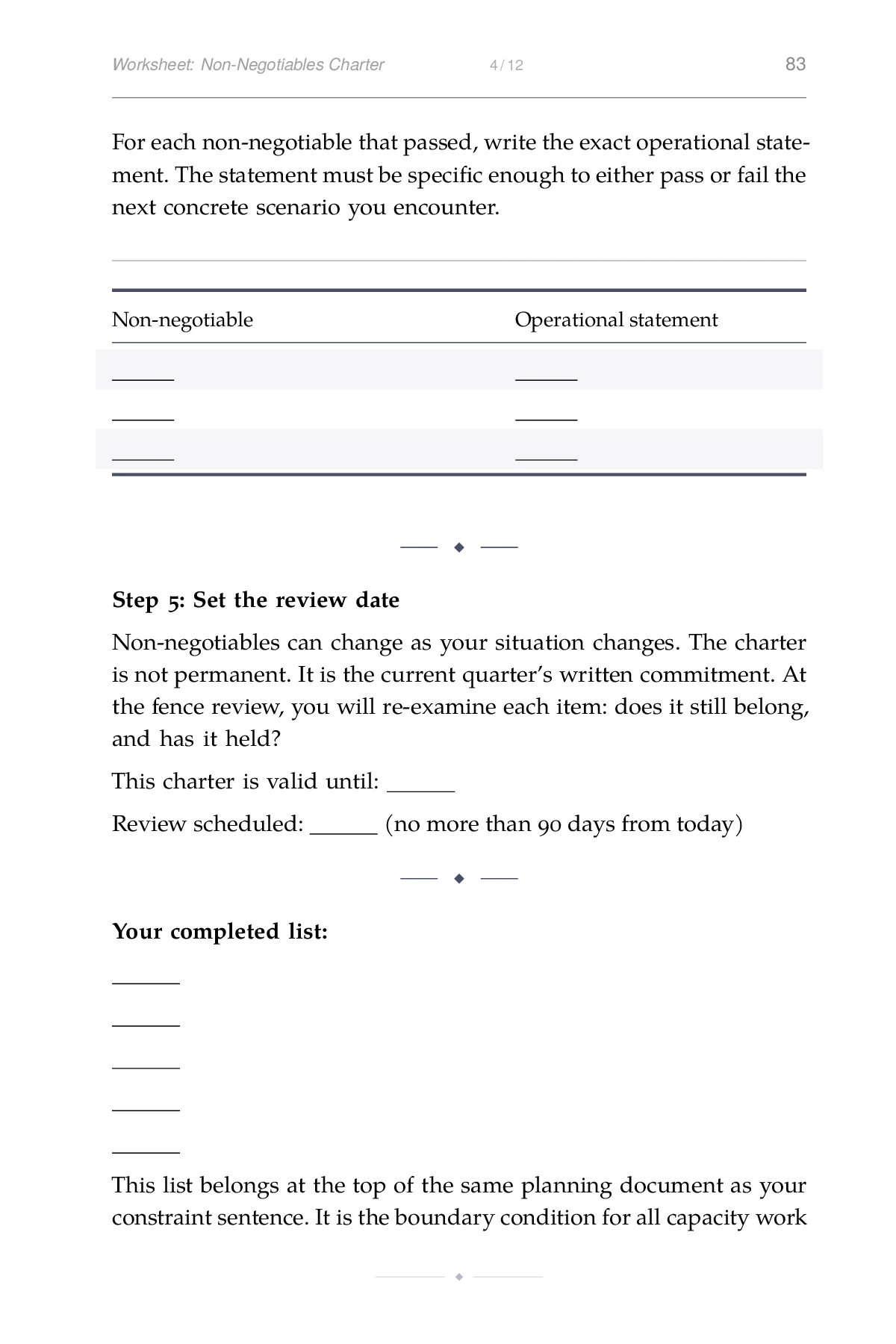
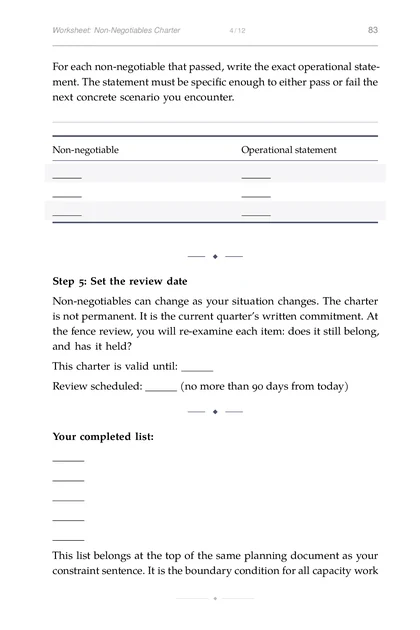 For each non-negotiable that passed, write the exact operational state-
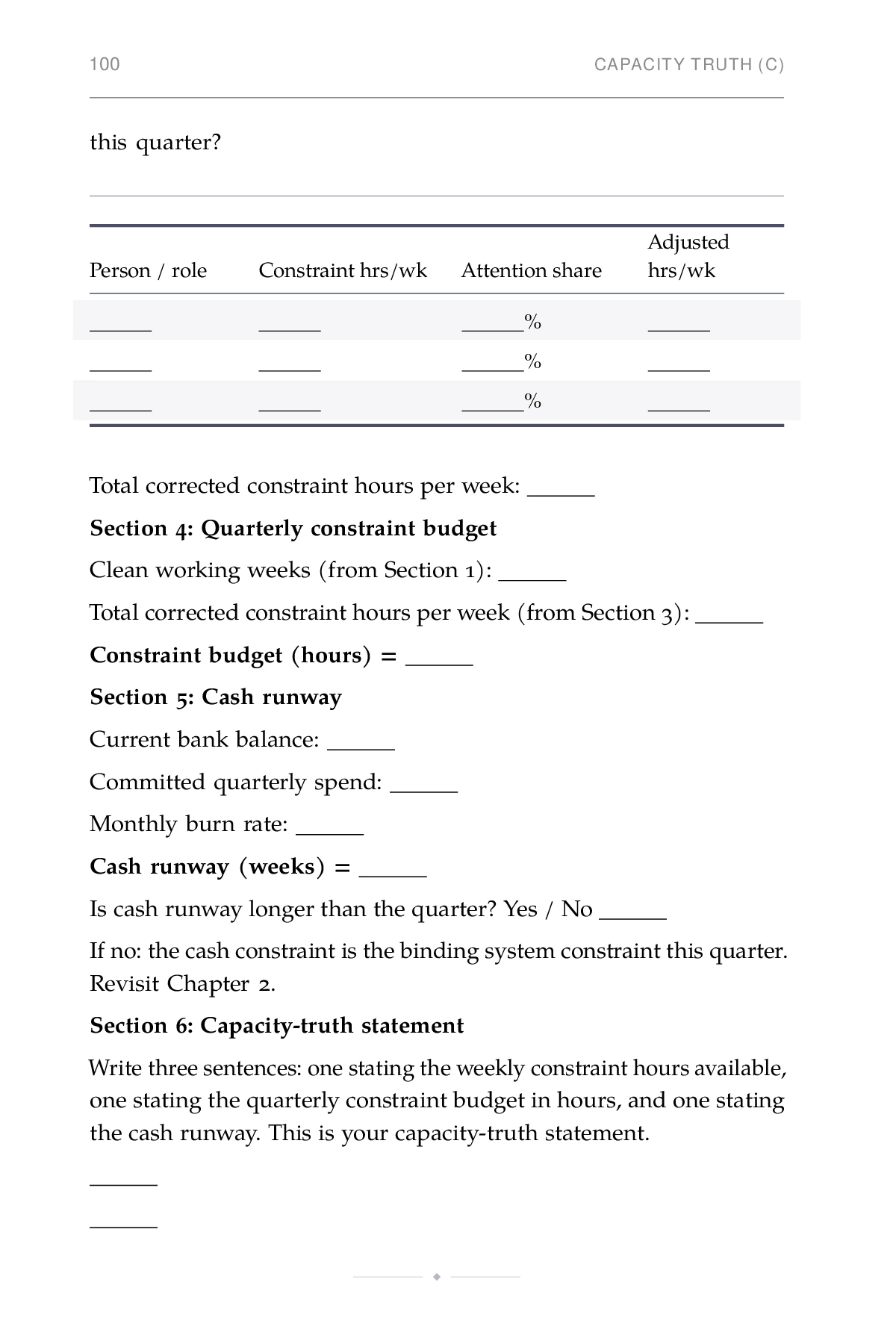
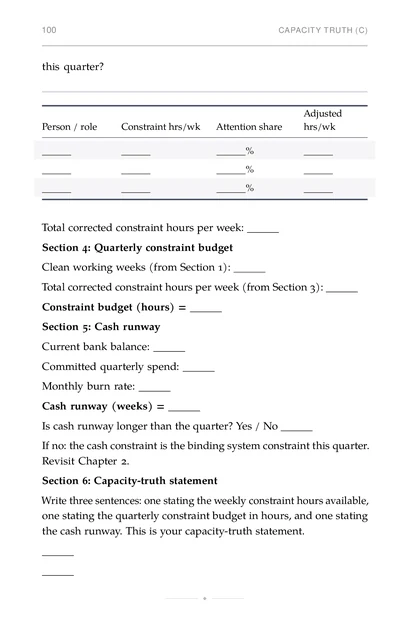 this quarter?
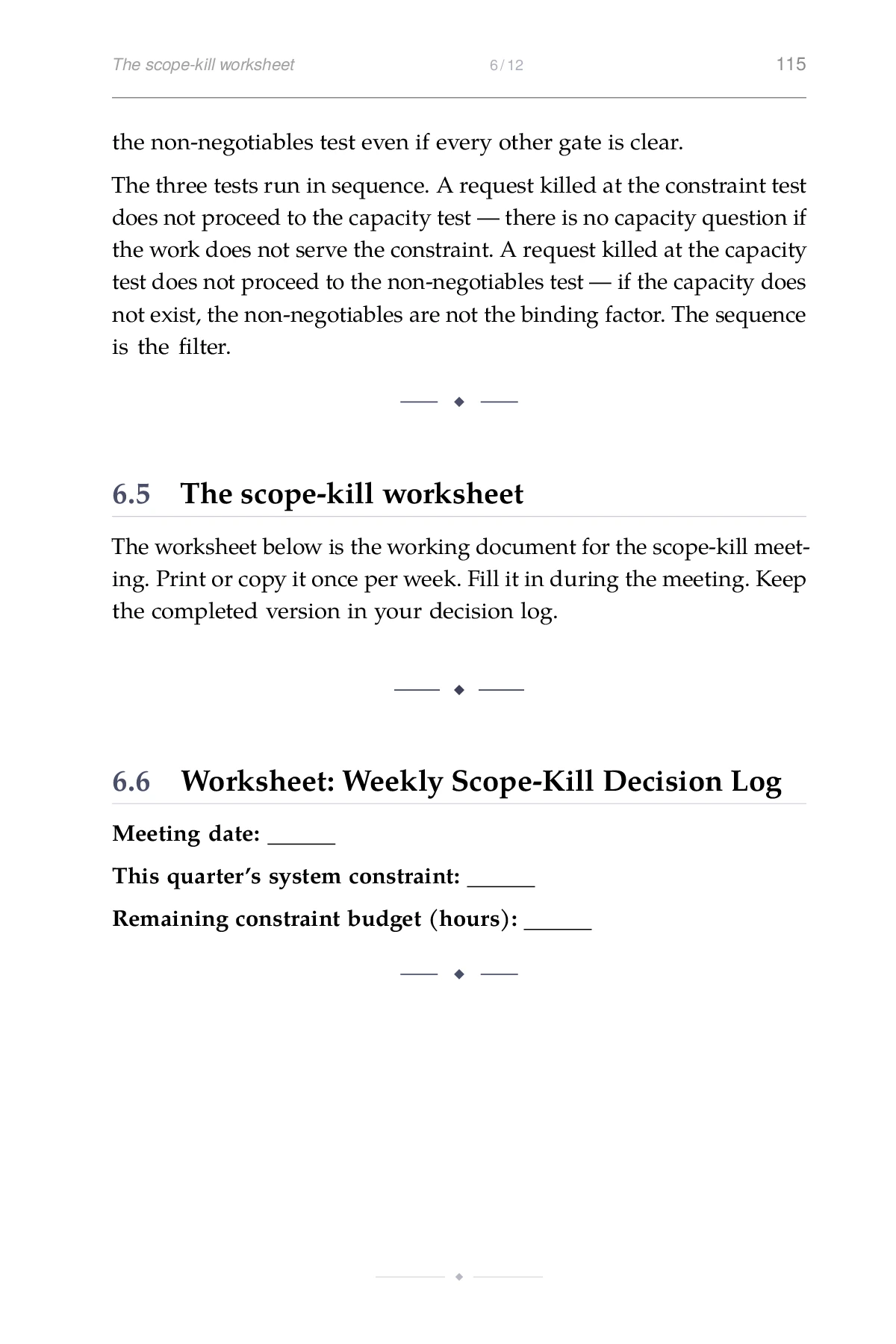
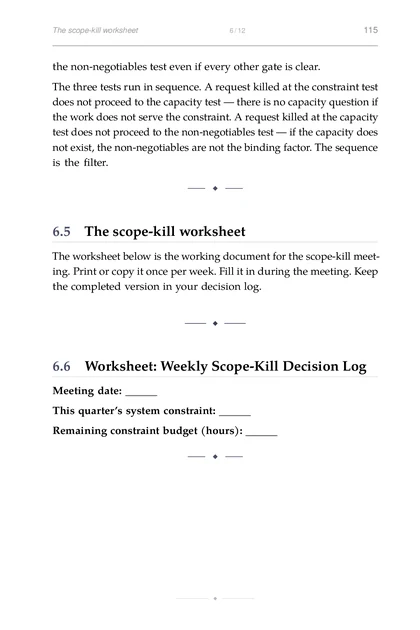 the non-negotiables test even if every other gate is clear.
 each one. . . . . . . . . . . . . . . . . . . . . . . . . . . 216
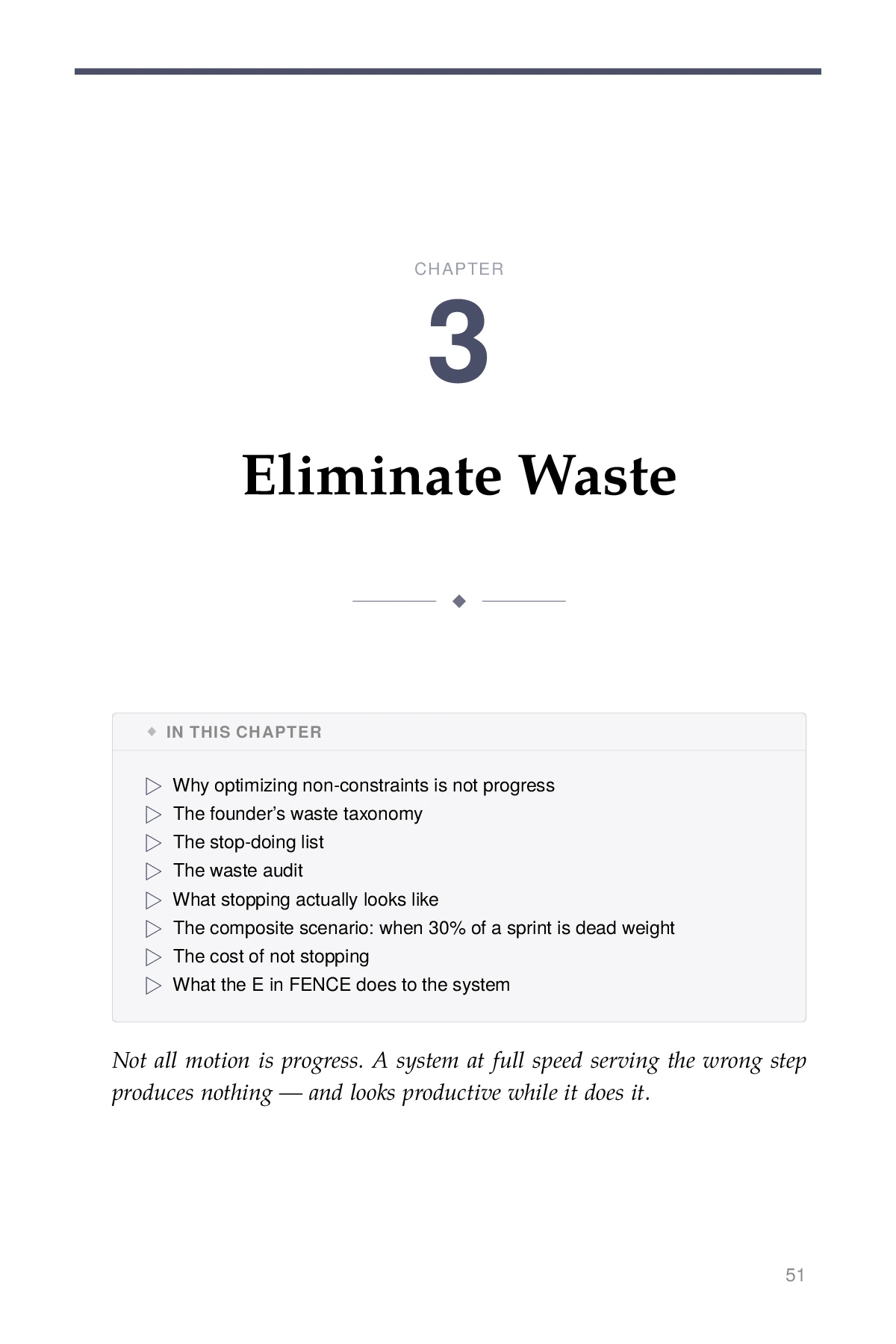
 CHAPTER
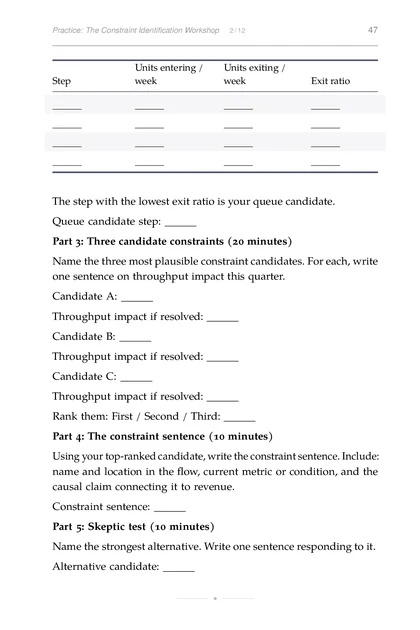 Units entering / Units exiting /
 CHAPTER
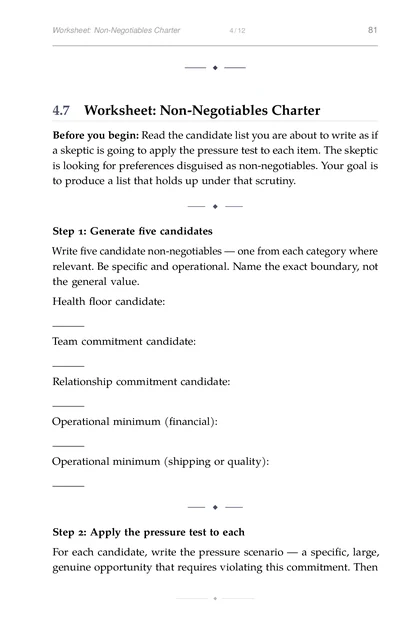 4.7 Worksheet: Non-Negotiables Charter

The contents
Chapter by chapter
Every chapter of The Constraint Founder with its printed epigraph, what you can do afterwards, and the moment it is built for.
Introduction
Introduction: Ambition Needs a Fence
The founder who spreads effort across ten initiatives is not hedging risk. They are guaranteeing that none of them finish.
What you can do afterwards
You will recognise the structural cause of the parallel half-project trap — not as a failure of discipline but as the predictable outcome of a system with no named constraint — and you will understand why the FENCE protocol is the correct response.
Use this chapter when
You are running multiple initiatives simultaneously, progress on each feels real, but nothing has shipped in the last ninety days.
Chapter 1
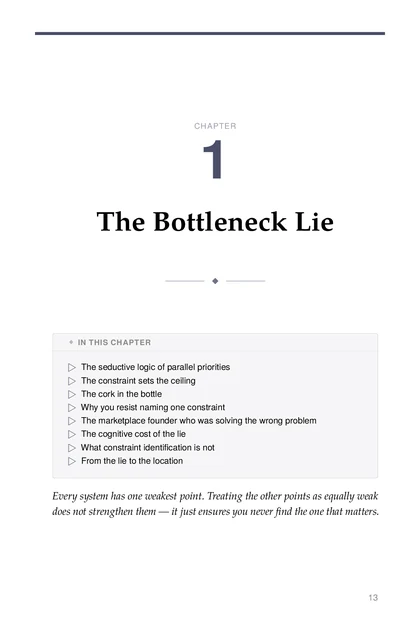
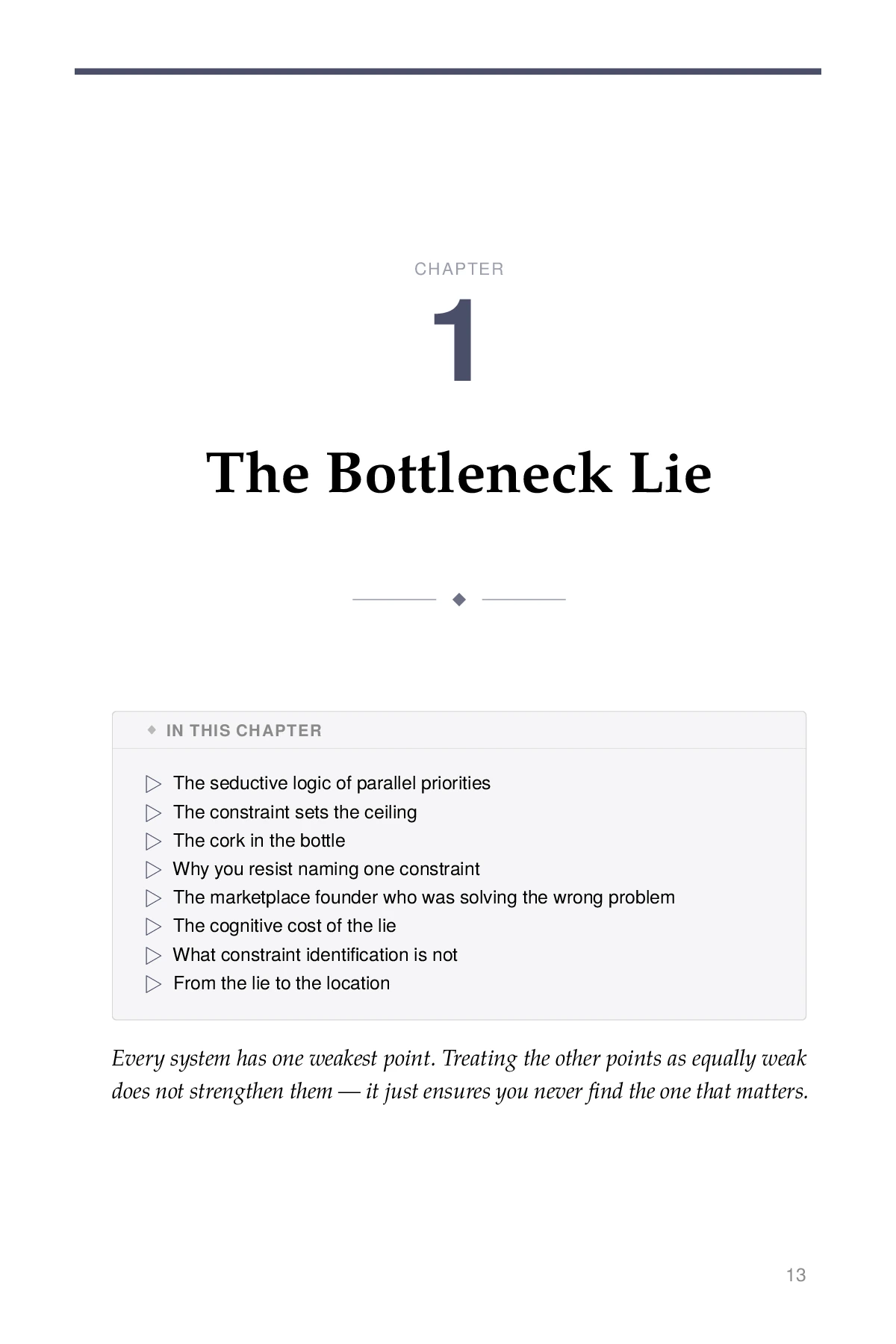
The Bottleneck Lie
Every system has one weakest point. Treating the other points as equally weak does not strengthen them — it just ensures you never find the one that matters.
What you can do afterwards
You will understand why naming a single system constraint is not a simplification but a structural truth, and why acting on ten priorities at once is the mechanism that keeps the system stalled.
Use this chapter when
Your quarter has more than two active initiatives, none are near complete, and you feel the persistent pressure that you should be doing more things rather than fewer.
Chapter 2
Focus One Bottleneck (F)
A constraint unnamed is a constraint unmanaged. Name it precisely enough to defend it — then everything else can follow.
What you can do afterwards
You will leave this chapter with one sentence that names your system constraint this quarter, plus a written rationale you could defend to a skeptic in three minutes.
Use this chapter when
You are about to run a sprint planning session, a quarterly offsite, or any meeting where the team divides its attention across multiple projects simultaneously.
Chapter 3
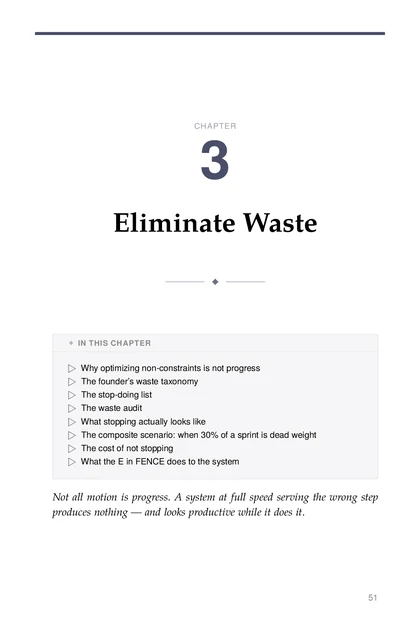
Eliminate Waste
Not all motion is progress. A system at full speed serving the wrong step produces nothing — and looks productive while it does it.
What you can do afterwards
You will identify every active activity that consumes your constrained resources without serving the named system constraint — and you will stop at least one this week, not reduce it.
Use this chapter when
You have completed Chapter 2 and hold a named constraint. You are now ready to audit everything else against it.
Chapter 4
Non-Negotiables (N)
The small written list of what you will not trade is also the map of what cannot be taken from you.
What you can do afterwards
You will leave this chapter with a written non-negotiables list — no more than five items — that has survived a pressure test and is specific enough to defend the next time a large opportunity arrives asking for one of them.
Use this chapter when
You are about to enter a negotiation, accept a contract, say yes to a strategic partnership, or plan a sprint — any moment where an attractive opportunity might quietly require you to sacrifice something you said you would not.
Chapter 5
Capacity Truth (C)
You do not have the capacity you think you have. You have the capacity that remains after you stop hiding from the numbers.
What you can do afterwards
You will produce a capacity-truth statement — hours per week per person, cash runway in weeks, and the resulting constraint budget — that would survive a post-mortem audit.
Use this chapter when
You are about to commit your team to a quarterly plan and you need to know, honestly, how many engineering or product hours are actually available for constraint work after non-negotiables and overhead are protected.
Chapter 6
End Scope Creep (E)
Every new request arrives dressed as an obvious yes. The scope-kill meeting is the room where it has to prove it.
What you can do afterwards
You will design and schedule a scope-kill meeting — a 30-minute weekly ritual with a fixed decision rule — so that new work must pass three explicit tests before entering your system.
Use this chapter when
Your list of active projects keeps growing despite your best intentions, the word "just" appears in every new request ("it's just one feature," "it's just one channel"), and you have not formally killed a single initiative this quarter.
Chapter 7
Stoic Acceptance vs Quitting
The fence is not where ambition ends. It is where ambition becomes serious.
What you can do afterwards
You will be able to distinguish stoic acceptance from resignation at the operational level — not as a philosophical position but as a concrete test you can apply to your own state of mind this quarter — and you will have a tool for using the constraint as planning terrain rather than fighting it.
Use this chapter when
You have named your system constraint and run the full FENCE protocol, but the constraint still feels like a verdict about your company's limitations rather than a fact about your operating terrain this quarter.
Chapter 8
Constraint in Product
A product grows to fill the attention available to it. The discipline is not building less — it is building only where the user cannot yet get through.
What you can do afterwards
You will identify the one point in your user journey where activation breaks down and learn to concentrate all engineering attention there until the bottleneck clears — the same logic as FENCE, applied to your backlog.
Use this chapter when
You have a product with real users and a growing backlog, and you are about to plan a sprint that spreads engineering across three or four different problem areas instead of one.
Chapter 9
Constraint in GTM
The founder who tries every channel proves none of them. The constraint is not about choosing the right channel — it is about working one channel long enough for the data to mean something.
What you can do afterwards
You will identify where in your go-to-market flow qualified leads are stalling, draft a one-channel fence with a concrete decision rule, and know what proof looks like before you run a single additional outreach cycle.
Use this chapter when
Your pipeline is inconsistent — some weeks full, some weeks empty — and the team is split across three or more acquisition channels, none of which has produced a repeatable result in the last ninety days.
Chapter 10
The 90-Day Fence Review
The fence you built last quarter was built for last quarter's system. Run the review or you will defend a constraint that no longer exists.
What you can do afterwards
You will design your 90-day fence review as a fixed calendar ritual — a half-day that re-runs all five FENCE decisions and either confirms or resets each one — so that your operating system stays accurate as the system beneath it changes.
Use this chapter when
You have completed one full FENCE cycle and are approaching the end of the quarter; or you have been running FENCE for one to two months and suspect that the constraint you named at the start may no longer be the binding bottleneck.
Conclusion
Conclusion: Executable Ambition
A fence is where ambition stops being a list and starts becoming a company.
What you can do afterwards
You will leave this chapter with one action — scheduled, specific, impossible to confuse with vague intent — and you will understand why the FENCE protocol is not a constraint on what you are building but the structure that makes building it possible.
Use this chapter when
You have read the book, run some or all of the FENCE protocol, and want to consolidate what it means before putting it into operation — or before starting the second quarter of running it.
Who it is for
Who this book was written for
The result is not a bigger war chest. It is an operator who builds a moat out of the very limits a competitor would have spent past, and a company that ships because it finally decided what not to do.
If you build under pressure and refuse to mistake a fuller bank account for a sharper plan, this is the fence you have been improvising without.
Editions
Editions and specifications
| Edition | Formats | Chapters | Pages | Reading time | ISBN (paperback) |
|---|---|---|---|---|---|
| English The Constraint Founder | In production | 12 | 264 | ± 4 hours | — |
| Dutch De constraint-founder | In production | 12 | 284 | ± 4 hours | — |
Both editions are written natively. The Dutch text is not a machine translation of the English. · Trim size: 6x9″
Frequently asked
What readers usually want to know
What is The Constraint Founder about?
FENCE combines Stoic constraint acceptance with bottleneck discipline so bootstrapped founders can focus on the limit that gates survival. The subtitle is: Stoic Limits for Bootstrapped Ambition.
What is the FENCE framework?
FENCE: Focus, Eliminate, Non-negotiables, Capacity and End scope creep. Focus, Eliminate, Non-negotiables, Capacity, End scope creep
Is there a Dutch edition?
Yes. The Dutch edition is De constraint-founder, written as a native edition rather than a machine translation. It moves through the same production line.
How long is The Constraint Founder?
This edition runs 12 chapters, 264 pages in print and roughly 4 hours of reading.
Who is The Constraint Founder for?
If you build under pressure and refuse to mistake a fuller bank account for a sharper plan, this is the fence you have been improvising without.
The production system
How this book was made
Every title moves through the same gated production line: sourced research, a claim-level evidence ledger, structural review, fact-checking, red-team critique, and a bilingual final edit. AI agents do specialist work inside those gates; judgment, voice, and accountability stay human.
- Claims enter an evidence ledger with a source and a confidence grade before they reach the page
- English and Dutch are two native editions, not a translation of one another
- Every chapter clears readability, rhythm, and style gates before it is typeset
The series
More in this theme


