

No. 51 · Active development · Founder psychology · COMMAND
The Crisis Command
COMMAND: Calm, Assess, Map, Mandate, Unify, Notify, Decide. The Trained Response
The Crisis Command: COMMAND: Calm, Assess, Map, Mandate, Unify, Notify, Decide. The Trained Response.
A rehearsable operating sequence for the first hours and days of an acute company crisis. COMMAND organises seven moves and never asks you to become invulnerable: it gives you structure while fear, urgency, and incomplete information are still in the room. COMMAND: Calm, Assess, Map, Mandate, Unify, Notify, Decide. The Trained Response. The framework: COMMAND.
- pages
- 198
- chapters
- 14
- hours of reading
- ± 3
- editions
- EN · NL
- Design
- Drafting
- Manuscript
- Production
- Launched
The editions
Kindle and Paperback
Production shots of the editions. Not for sale yet — this page is the public working version.
-
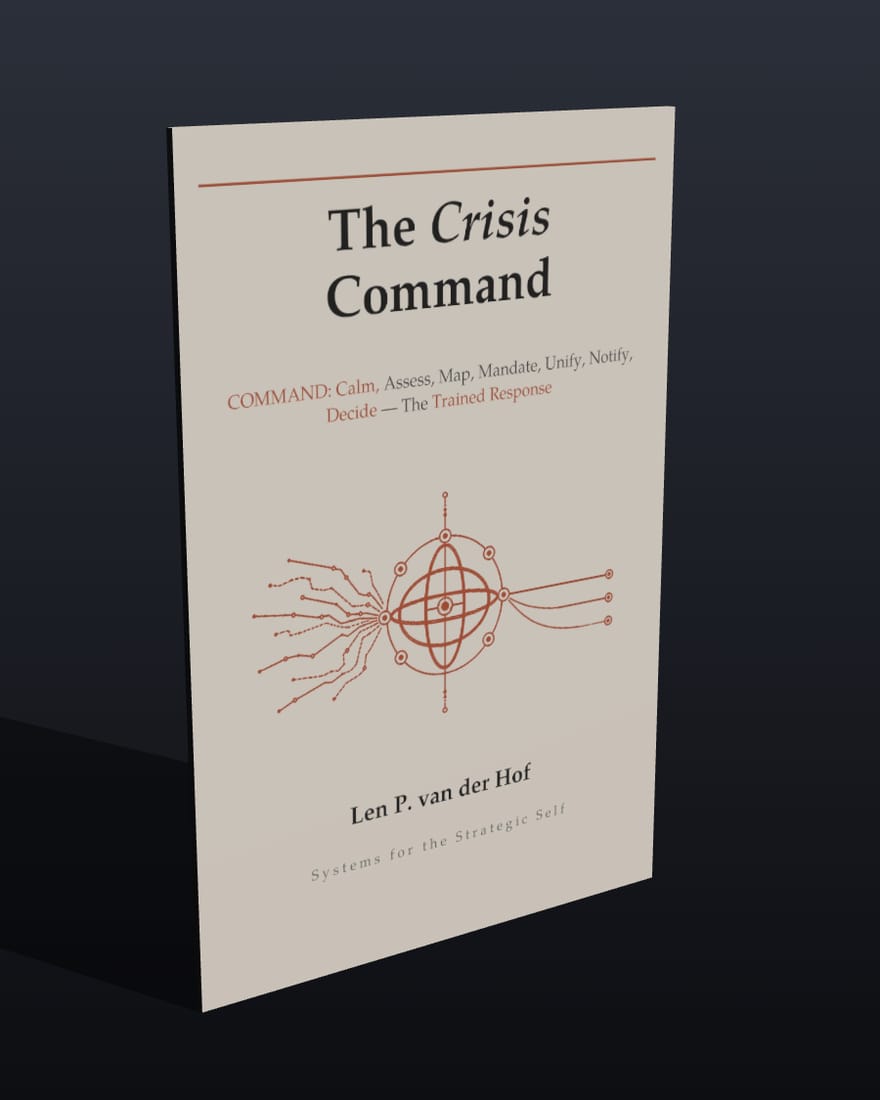
Kindle
The digital edition, ready in any Kindle app.
-
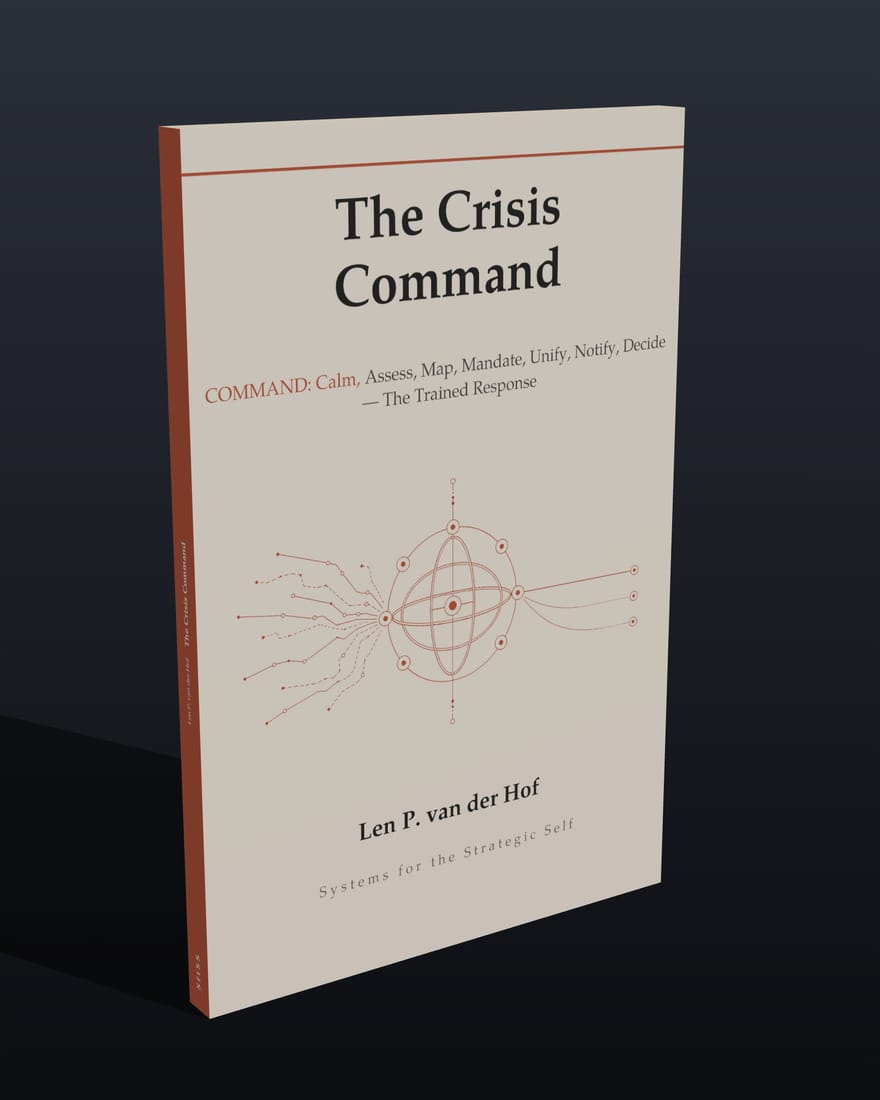
Paperback
The working copy. Mark it up. Take it into the meeting.


The book
COMMAND: Calm, Assess, Map, Mandate, Unify, Notify, Decide. The Trained Response
A crisis hits and the pressure to move becomes immediate. Leaders accelerate, freeze, centralize every answer, or perform certainty for a team that can see the uncertainty anyway. Motion multiplies while orientation disappears.
The Crisis Command offers a rehearsable operating sequence for the first hours and days of an acute company crisis. COMMAND organizes seven moves: Calm, Assess, Map, Mandate, Unify, Notify, and Decide. It does not ask you to become invulnerable. It gives you a structure to use while fear, urgency, grief, and incomplete information are still present.
What you learn
What this book puts in your hands
- Establish enough presence to interrupt reflexive action without pretending to feel calm.
- Separate what is known, unknown, assumed, and time-sensitive before the story hardens.
- Map viable options and their consequences before urgency chooses one for you.
- Issue a mandate with a clear owner, scope, authority, and review point.
- Unify the team around one operational truth without suppressing dissent or expertise.
- Design notifications around people, evidence, counsel, and applicable duties.
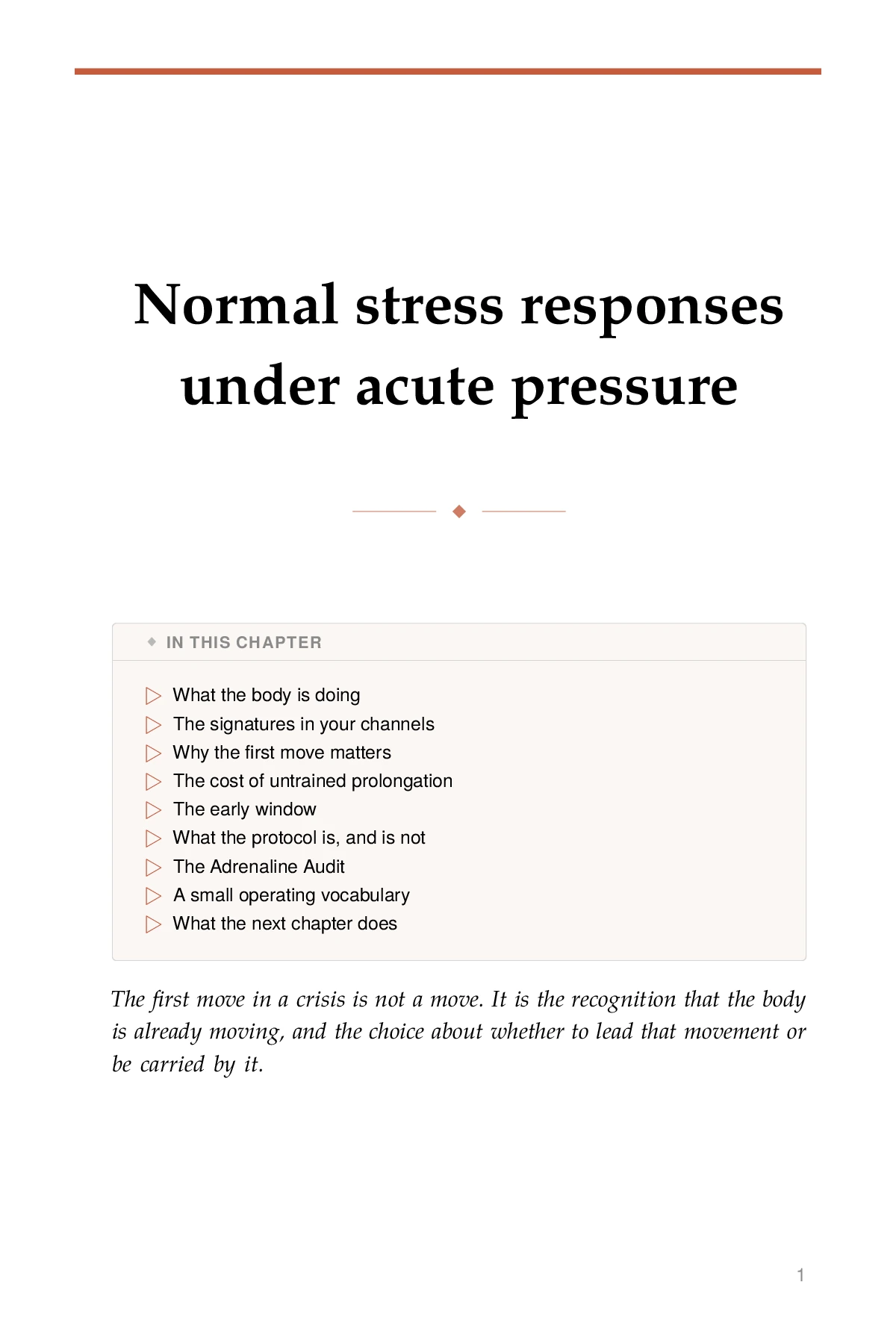
From the book
under acute pressure
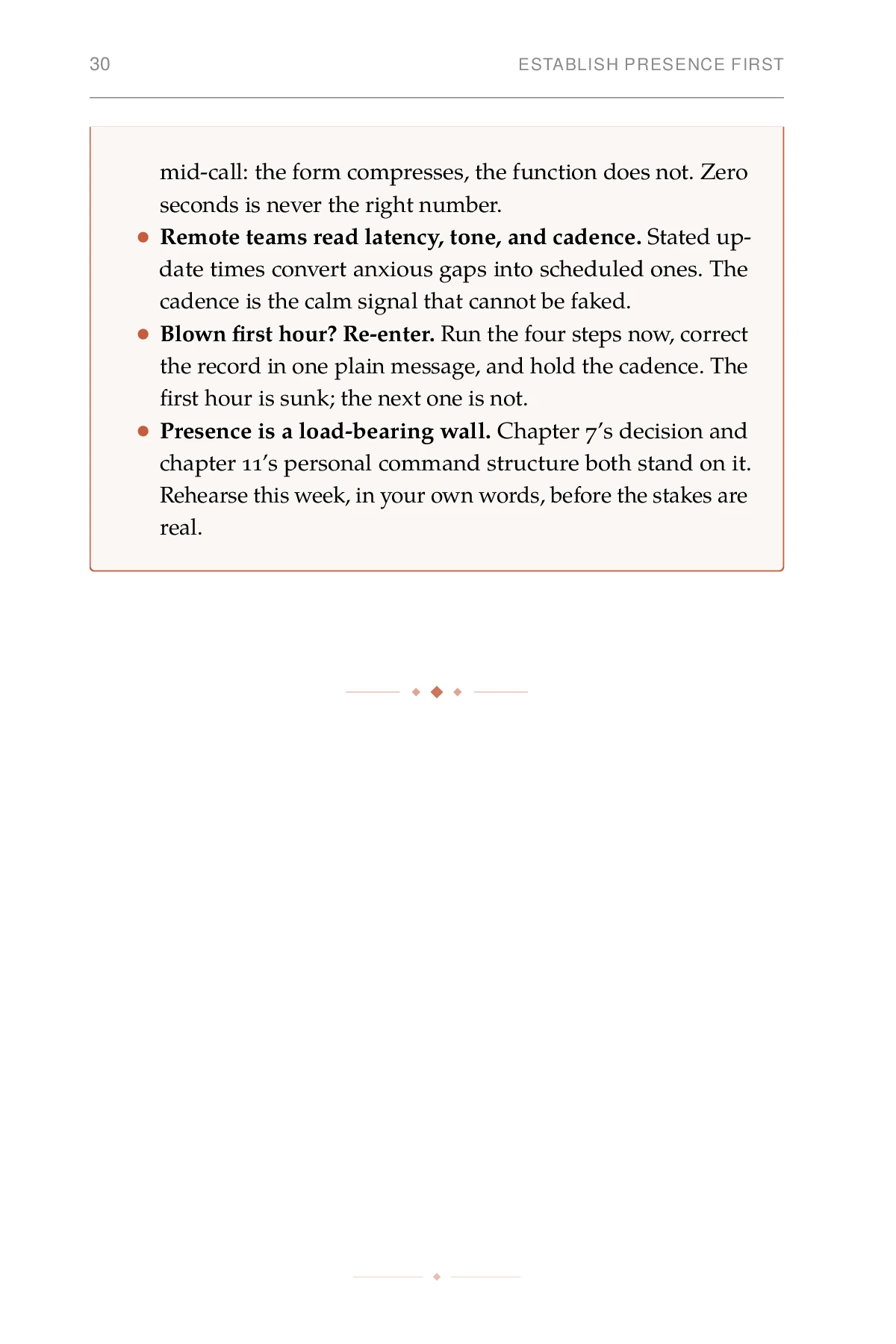
The Crisis Command, printed page: under acute pressure
Inspect more pages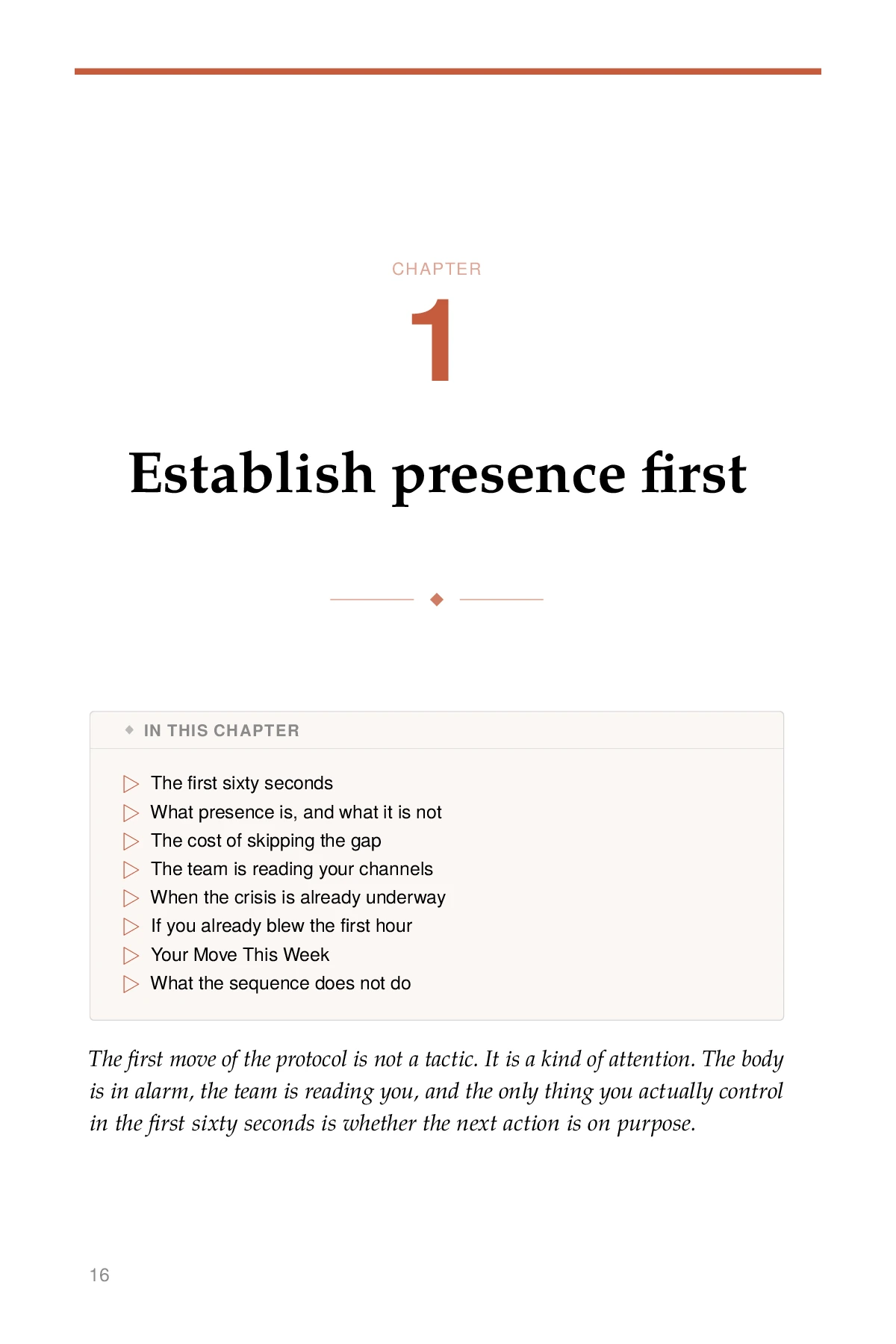
The contents
Chapter by chapter
Every chapter of The Crisis Command with its printed epigraph, what you can do afterwards, and the moment it is built for.
Introduction
Normal stress responses under acute pressure
The first move in a crisis is not a move. It is the recognition that the body is already moving, and the choice about whether to lead that movement or be carried by it.
What you can do afterwards
You will see the body's acute stress response as a normal, observable process, learn to read its signatures in your own channels, and complete the Adrenaline Audit on your last crisis.
Use this chapter when
You feel an overwhelming urge to act, your team is mirroring your panic, or you are about to send a message you cannot retract.
Chapter 1
Establish presence first
The first move of the protocol is not a tactic. It is a kind of attention. The body is in alarm, the team is reading you, and the only thing you actually control in the first sixty seconds is whether the next action is on purpose.
What you can do afterwards
You will leave with a single, rehearsable four-step sequence for the first minutes of a crisis, adaptations for the office, remote channels, and mid-call moments, and a re-entry script for when you have already blown the first hour.
Use this chapter when
You are at minute zero, you are mid-call when the alert lands, or you are at hour three and the team is mirroring your state.
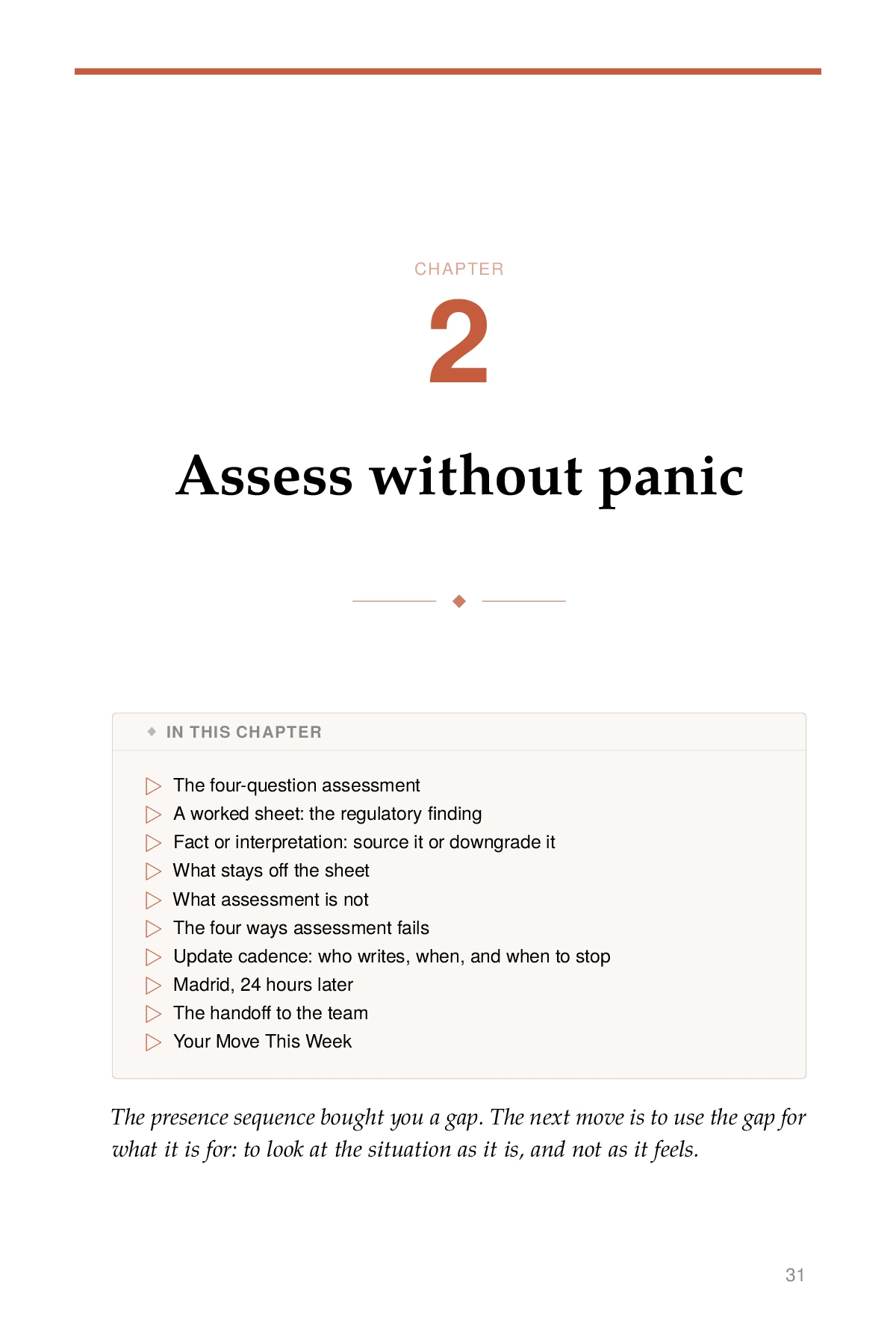
Chapter 2
Assess without panic
The presence sequence bought you a gap. The next move is to use the gap for what it is for: to look at the situation as it is, and not as it feels.
What you can do afterwards
A four-question structure for assessing an acute situation in under thirty minutes, a fully worked sheet for a regulatory finding, and your own blank template built before you need it.
Use this chapter when
You have just established presence, or you are tempted to skip assessment and go straight to action.
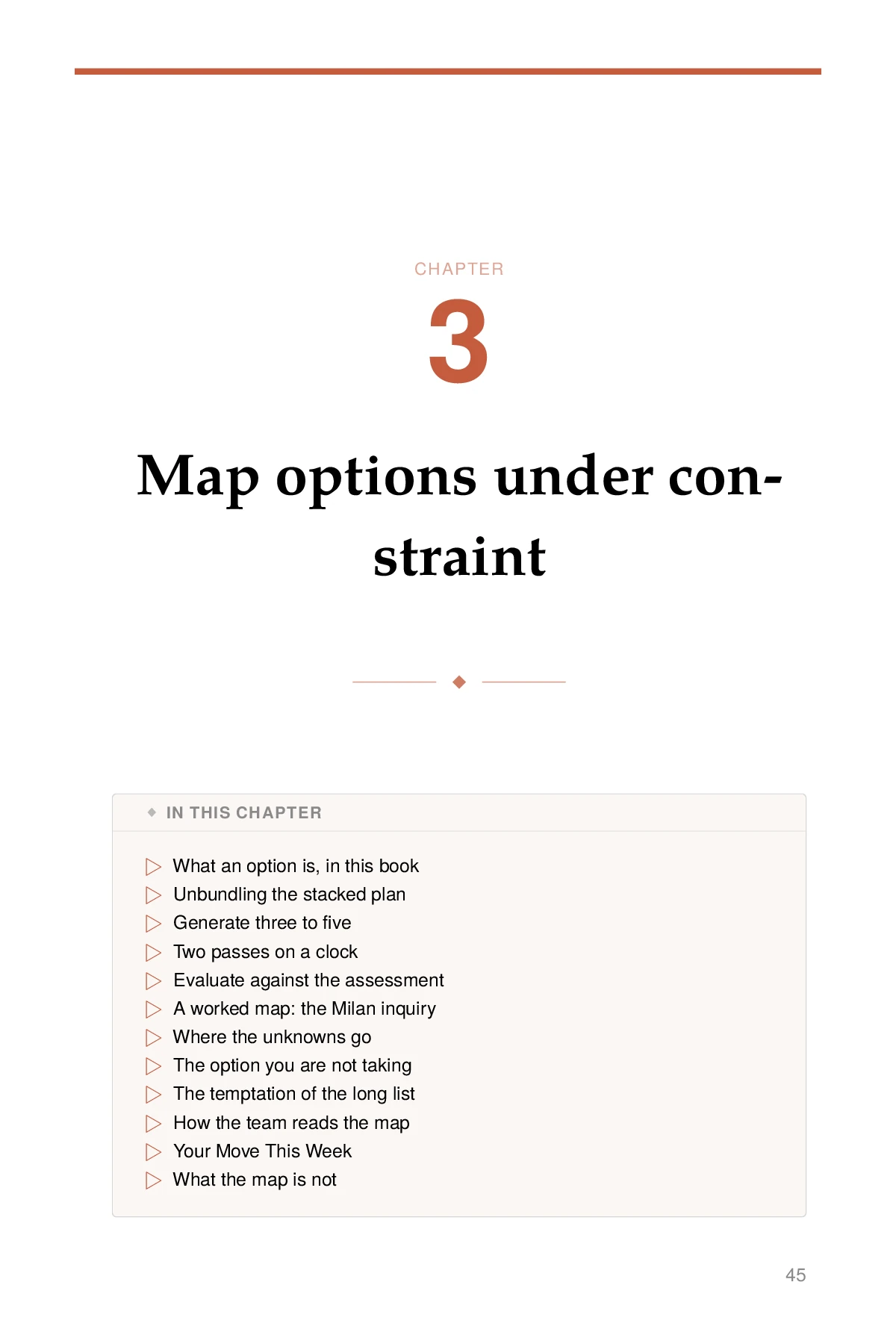
Chapter 3
Map options under constraint
The assessment is a description. The next move is to use the description to generate the choices that the situation actually allows, and to make those choices visible to the team and to yourself.
What you can do afterwards
A structure for generating options under acute constraint, three prompts that surface the options fear hides, a worked map for a regulatory inquiry, and a template you can fill in sixty minutes.
Use this chapter when
The four-question assessment is on paper, the team is asking "what do we do," and the body is pulling you toward a single option.
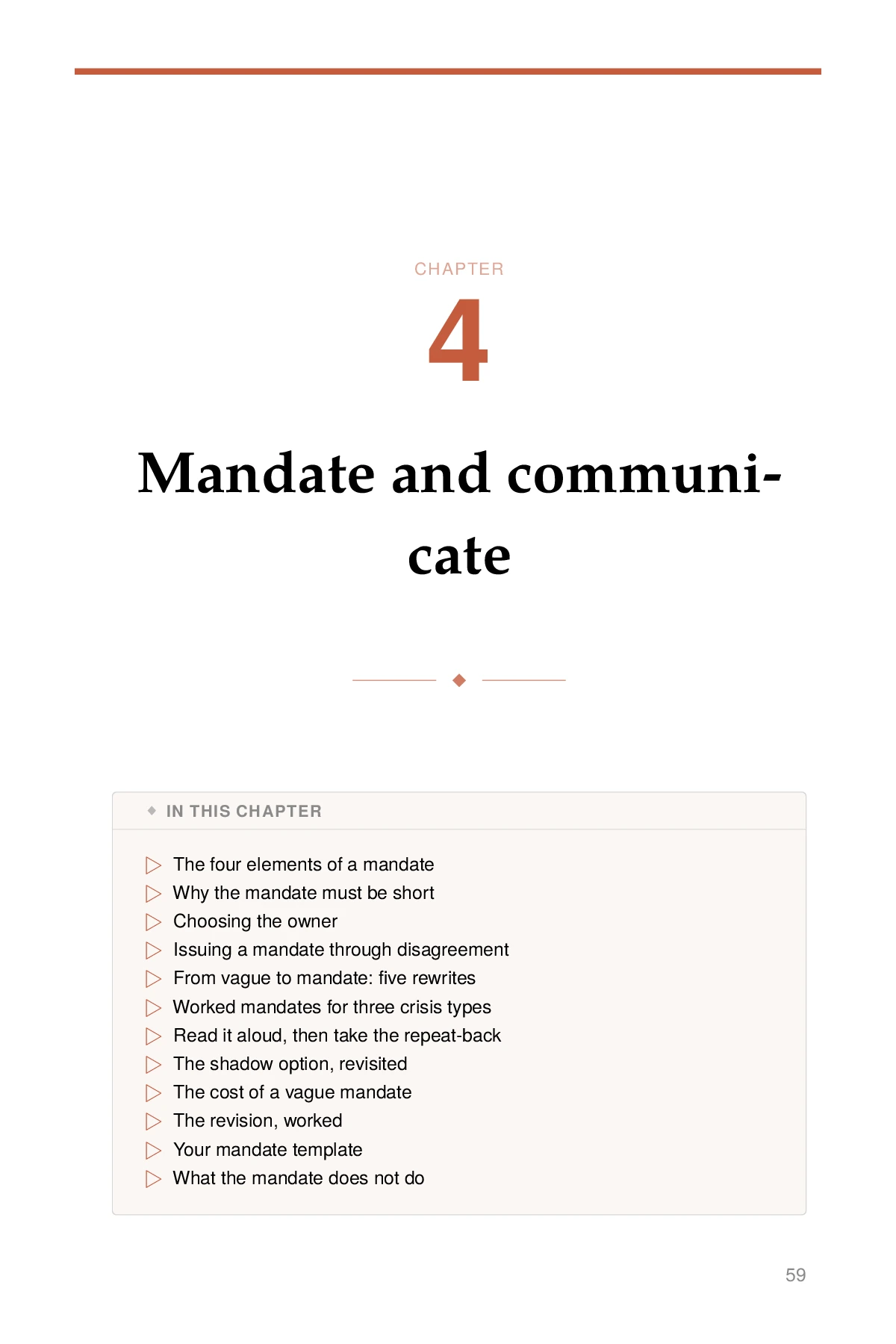
Chapter 4
Mandate and communicate
An option is a description. A mandate is a commitment. The next move is to make the chosen option specific enough that one person, in the next 24 hours, can act on it without re-asking.
What you can do afterwards
A mandate short enough to read aloud, specific enough to act on, and durable enough to defend at 04:00. Five vague mandates get rewritten in front of you, and you leave with a fill-in template.
Use this chapter when
The option has been chosen, the team is waiting for direction, and the risk is that the mandate is either too vague to act on or too rigid to revise.
Chapter 5
Unify the remaining team
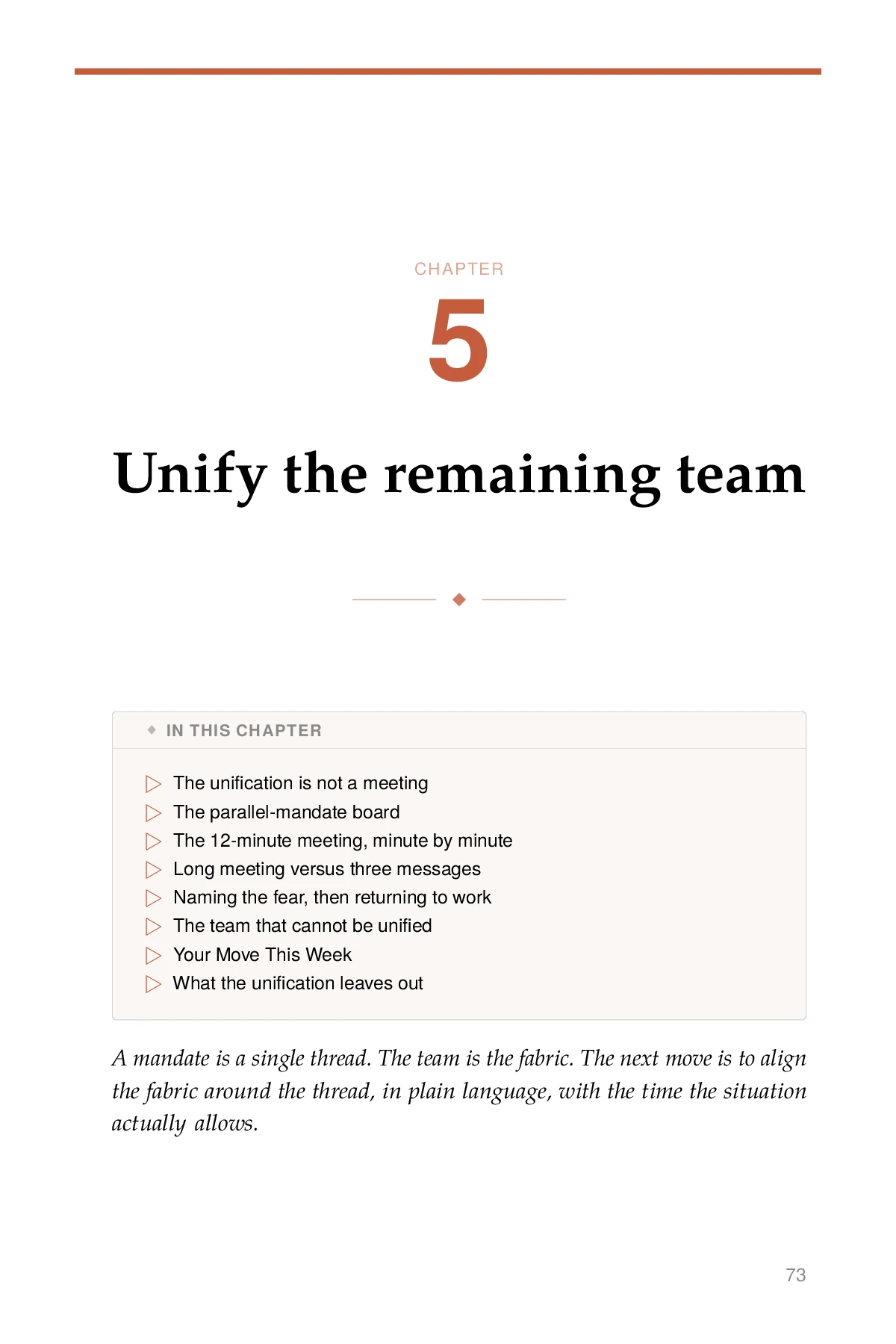
A mandate is a single thread. The team is the fabric. The next move is to align the fabric around the thread, in plain language, with the time the situation actually allows.
What you can do afterwards
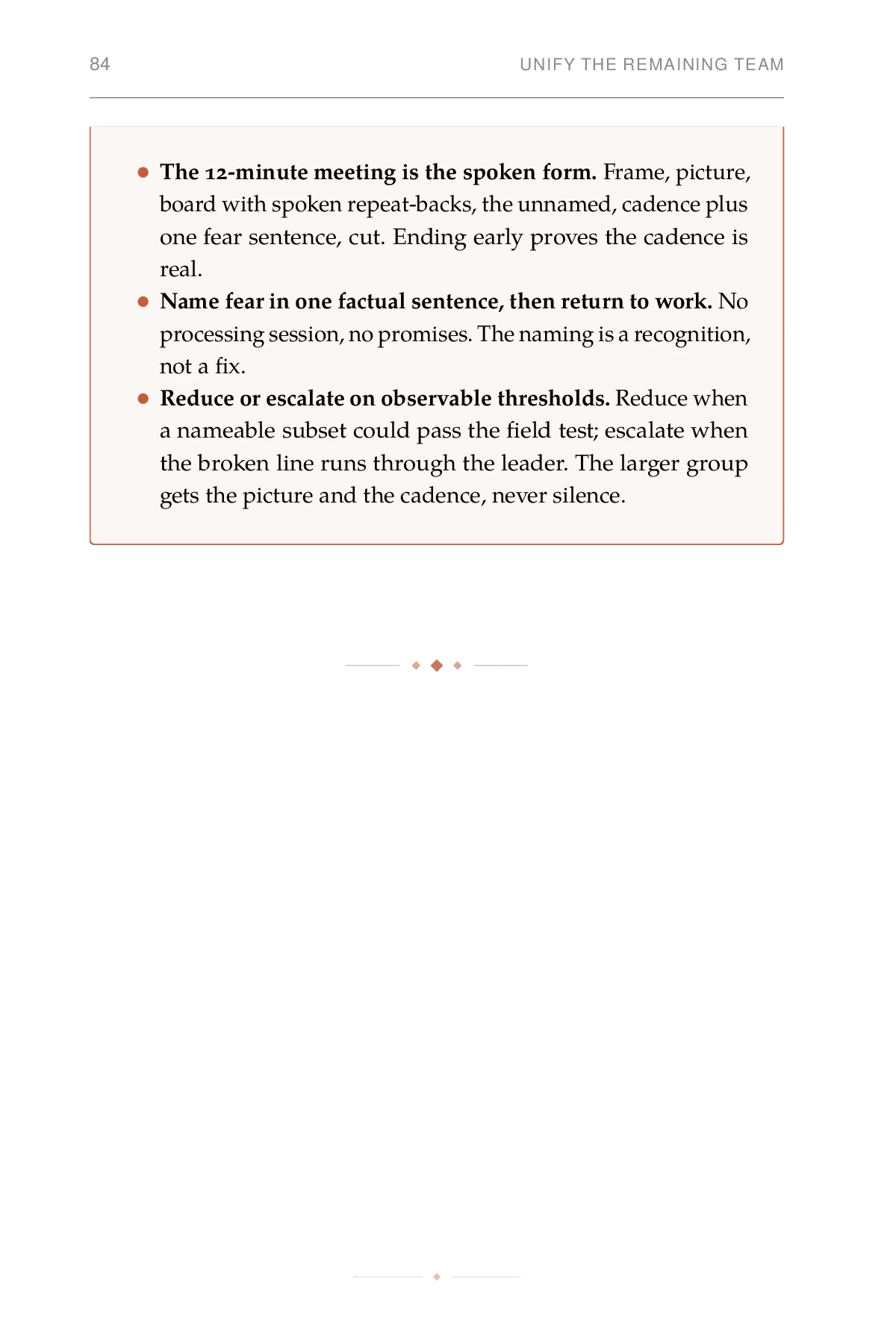
You will learn to align a team under acute load in three short messages, with copy-ready template text for each, a visible board for parallel mandates, and a 12-minute meeting agenda that replaces the 90-minute one.
Use this chapter when
The mandate has been issued, the team is reading the channel, and the risk is that the team is not yet aligned on what they are doing or why.
Chapter 6
Notify the right people
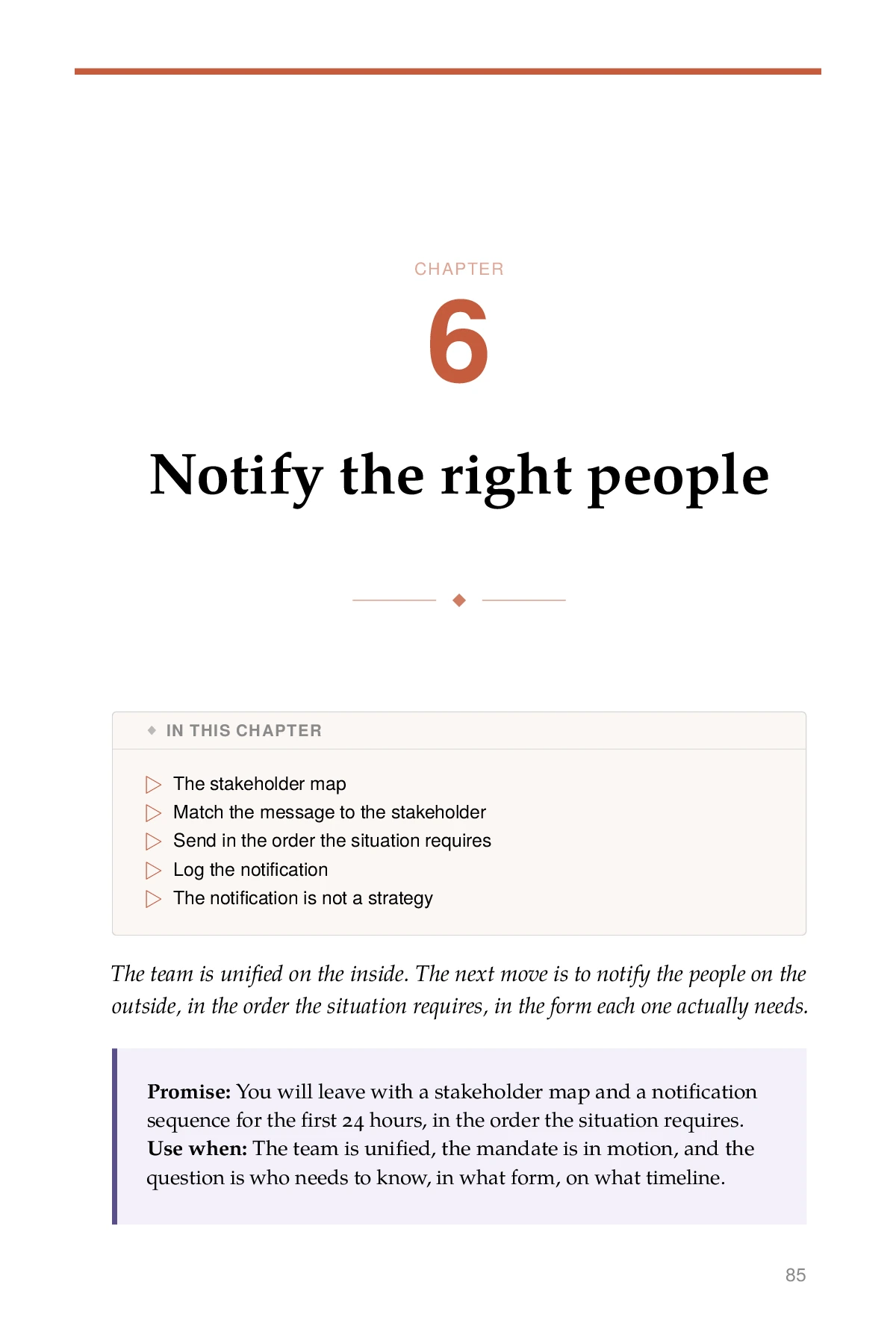
The team is unified on the inside. The next move is to notify the people on the outside, in the order the situation requires, in the form each one actually needs.
What you can do afterwards
You will leave with a stakeholder map and a notification sequence for the first 24 hours, in the order the situation requires.
Use this chapter when
The team is unified, the mandate is in motion, and the question is who needs to know, in what form, on what timeline.
Chapter 7
Decide and act
An assessment describes. A map offers choices; a mandate commits; notifications align. What remains is the call itself, made with the information the team has, in the time the situation allows.
What you can do afterwards
You will leave with a structure for making a high-stakes decision under acute load: a 30-minute window, four inputs you already have, a one-paragraph artifact with a revision trigger. You will also know how to carry a decision that is not yours to make.
Use this chapter when
The mandate is in motion, the notifications are out, and the question is whether to commit to the move, revise it, or escalate.
Chapter 8
Early decision windows
The decision has been made. What remains is the timing question: how long the team has, said in plain language, with the discipline of the structure, and without pretending that any protocol can predict what the situation will do.
What you can do afterwards
A working language for crisis timing: the one-paragraph timing note, a 72-hour timeline built from three 24-hour iterations, and a script for the "how long do we have" question. You will also know what this language cannot do.
Use this chapter when
The decision has been made, the team is asking "how long do we have," and the body is generating either compression or denial.
Chapter 9
Post-crisis reset
The crisis is not over when the loudest signal stops. The reset is the part of the protocol that addresses what the work has done to the team, and what the team needs to be operational in the next iteration.
What you can do afterwards
A bounded reset structure for the first 72 hours after the loudest signal stops: a fill-in reset plan, working coverage mechanics, and a discipline for resetting while the situation is still open.
Use this chapter when
The decision has been made, the next iteration is named, and the team is moving into a quieter phase that is not the same as recovery.
Chapter 10
Learning without blame
The after-action is not a verdict. It is a structure: what the protocol did, what it missed, what the next iteration needs, in plain language, without naming the people.
What you can do afterwards
A working after-action: three questions in a fixed order, a facilitation plan for the 90 minutes, a worked one-page example, and the rewrite discipline that turns blame sentences into structure sentences.
Use this chapter when
The reset is in motion, the loudest signal has stopped, and the team is asking what the team learned.
Chapter 11
Personal command under load (aspirational; no guarantees)
The protocol is portable. The leader is not. What remains is to look at what the work has done to the leader, and what the leader needs to be operational in the next iteration.
What you can do afterwards
A personal command plan for the leader: four elements with decision rules, a fill-in worksheet, a one-page worked example, named triggers for professional support, and a clear escalation path. Aspirational throughout; no guarantees anywhere.
Use this chapter when
The after-action is in motion, the team's structure is holding, and the leader is asking, or avoiding asking, what the leader needs.
Chapter 12
Building your command protocol
The protocol is portable. The next move is to make it the leader's own, with the cadence, with the triggers, with the structure the leader has, in the time the leader has, before the next crisis.
What you can do afterwards
You will leave with a personal command protocol, in one page, with the cadence, the triggers, the named support, and the next iteration date.
Use this chapter when
The crisis is past the loudest phase, the after-action is in motion, and the leader is asking what the leader does before the next time.
Conclusion
Conclusion, presence as leadership practice (aspirational)
You opened this book in the middle of a crisis, or close to one, or with the memory of one still sharp. You have walked through a sequence of moves, and the sequence has produced a structure, and the structure is portable. The next move is the one you make when you close the book.
What you can do afterwards
You will close with a portable structure, with a clear next-iteration date, and with a discipline for the moment the body returns to the old questions.
Use this chapter when
You need the final argument for why the protocol is an operator practice, not a heroic one.
Who it is for
Who this book was written for
The result is a practical set of instruments: presence protocol, assessment checklist, option map, mandate template, unification plan, notification plan, decision record, reset, and one-page living COMMAND protocol.
This book is an educational training tool, not medical, psychological, legal, financial, regulatory, or crisis-communications advice. No protocol guarantees calm, protection from harm, optimal decisions, company survival, or positive recovery. Acute distress, impaired capacity, suicidal thoughts, or clinical symptoms require immediate qualified support; material company decisions require appropriate professional counsel in the relevant jurisdiction.
The reader it was written for
Founders, CEOs, and operator-leaders who have faced or are facing an acute crisis (cash out in <30 days, major customer churn, existential regulatory threat, public incident, core team exodus).
Probably not for you if
- Chronic distress.
- No-crisis aspirants.
- Readers seeking only mindset.
Editions
Editions and specifications
| Edition | Formats | Chapters | Pages | Reading time | ISBN (paperback) |
|---|---|---|---|---|---|
| English The Crisis Command | In production | 14 | 198 | ± 3 hours | — |
| Dutch Crisisregie | In production | 14 | 140 | ± 2 hours | — |
Both editions are written natively. The Dutch text is not a machine translation of the English. · Trim size: 6x9″
Frequently asked
What readers usually want to know
What is The Crisis Command about?
A rehearsable operating sequence for the first hours and days of an acute company crisis. COMMAND organises seven moves and never asks you to become invulnerable: it gives you structure while fear, urgency, and incomplete information are still in the room. The subtitle is: COMMAND: Calm, Assess, Map, Mandate, Unify, Notify, Decide. The Trained Response.
Is there a Dutch edition?
Yes. The Dutch edition is Crisisregie, written as a native edition rather than a machine translation. It moves through the same production line.
How long is The Crisis Command?
This edition runs 14 chapters, 198 pages in print and roughly 3 hours of reading.
Who is The Crisis Command for?
This book is an educational training tool, not medical, psychological, legal, financial, regulatory, or crisis-communications advice. No protocol guarantees calm, protection from harm, optimal decisions, company survival, or positive recovery. Acute distress, impaired capacity, suicidal thoughts, or clinical symptoms require immediate qualified support; material company decisions require appropriate professional counsel in the relevant jurisdiction.
The production system
How this book was made
Every title moves through the same gated production line: sourced research, a claim-level evidence ledger, structural review, fact-checking, red-team critique, and a bilingual final edit. AI agents do specialist work inside those gates; judgment, voice, and accountability stay human.
- Claims enter an evidence ledger with a source and a confidence grade before they reach the page
- English and Dutch are two native editions, not a translation of one another
- Every chapter clears readability, rhythm, and style gates before it is typeset
The series
More in this theme


