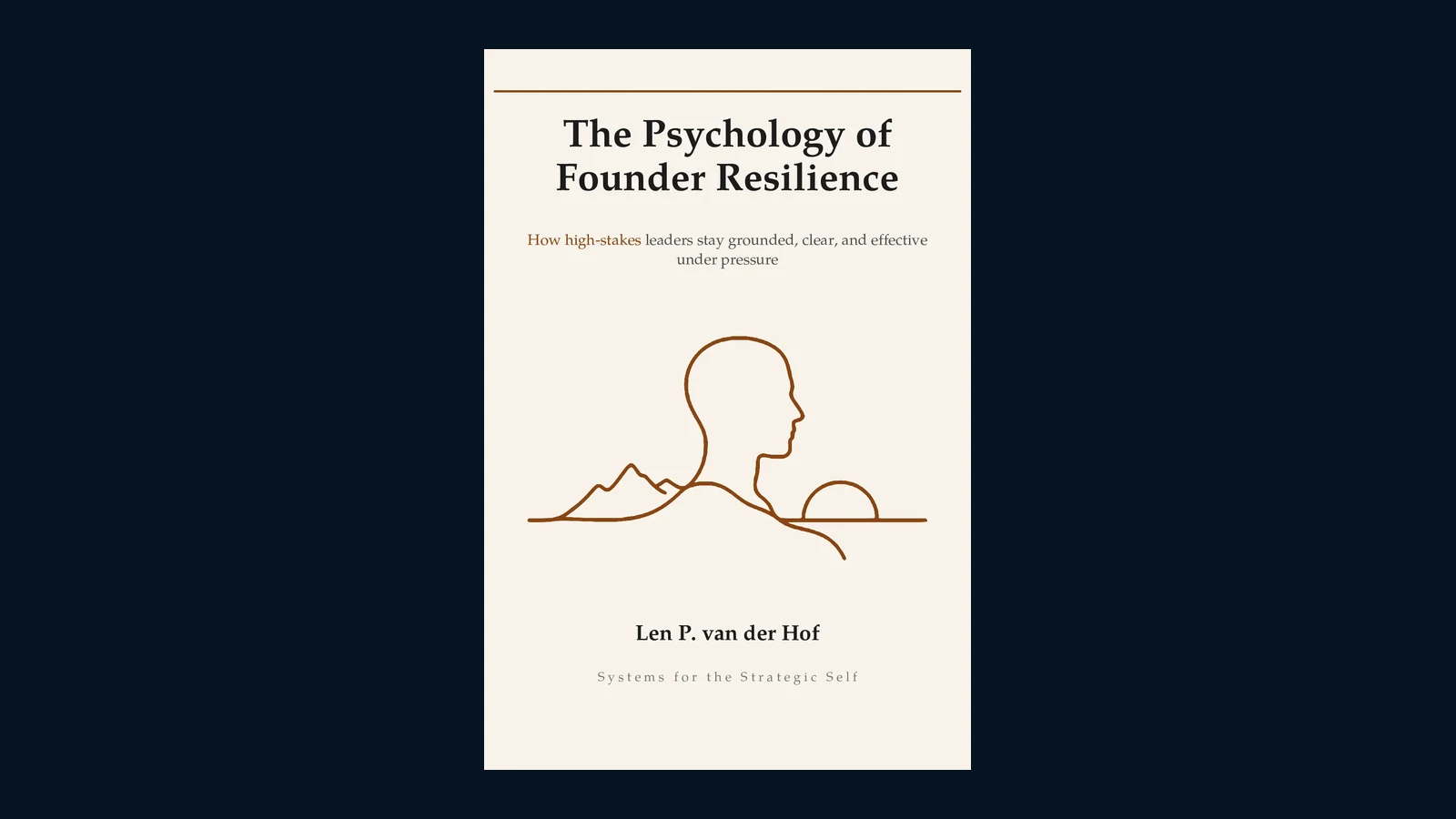
Capacity is not a mood. It is infrastructure.
You are not failing because you feel strain.
You are succeeding at a role that manufactures strain by design.
High ambiguity. Identity fused to the company. Irreversible calls. Quiet isolation. Sleep slips first. Judgment slips next.
Most founder advice answers with push harder.
That is not a system. That is a tax on the one instrument this operation cannot replace.
The Psychology of Founder Resilience is the operator-grade answer: a trainable stack for staying grounded, clear, and effective when the week turns hostile.
Resilience is not what you are. It is what you run.
The problem is structural
Founders do not merely “have stress.” They run a special load:
- Identity fusion turns every product miss into a self-verdict.
- Decision density drains the same mind that must stay sharp.
- Ambiguity never clocks out.
- Isolation hides early warning signals until they become expensive.
If the company dashboard is rich and the operator dashboard is empty, you are flying with one instrument panel missing.
This book installs that panel.
The reframe that changes the week
Grit says: endure more.
This book says: build recoverable capacity.
You train reappraisal so a setback stops rewriting your identity. You name emotion with precision instead of flooding. You protect attention like runway. You design decisions before fatigue designs them for you. You recover on purpose. You engineer support. You treat stress as a calibrated signal, not a fixed identity.
That is the difference between a slogan and a protocol.
Inside the RESILIENT operating model
The core is the RESILIENT nine-capacity system: interior mechanics, exterior decision craft, and integrative recovery.
You get:
- Interior system — identity boundaries, cognitive reappraisal, emotional granularity.
- Exterior system — attentional control and decision architecture under uncertainty.
- Integrative system — recovery discipline, social resilience, and antifragile growth.
- Integration chapter — a personal protocol you can run weekly when you are already tired.
Every chapter is built for use, not admiration. Short practices. Deeper drills. Printable artifacts you keep beside the calendar.
This is not “feel better eventually.”
This is run capacity like you run runway.
Who this book is for
Buy it if you are:
- a founder carrying the company in your nervous system
- a co-founder who still performs while privately depleted
- an operator who wants instruments, not therapy-speak
- a coach or accelerator lead who needs a structured founder protocol
Skip it if you want hustle theater or empty inspiration.
That filter earns its keep.
What makes it different on the shelf
Plenty of books name founder burnout.
Fewer treat resilience as operations.
This one does, with:
- a named operating model instead of a mood board
- practices that fit a brutal calendar
- composite founder arcs that carry real argument weight
- bilingual native English and Dutch production
- clinical boundaries that stay honest
Credibility without guru posture. Depth without fluff.
Buy the edition that matches how you work
Start on the full buy grid, then pick your format:
English editions (Amazon.com)
| Format | Link |
|---|---|
| Kindle | Buy English Kindle |
| Paperback | Buy English paperback |
| Hardcover | Buy English hardcover |
Dutch editions (Amazon.nl)
| Format | Link |
|---|---|
| Kindle | Koop Nederlandse Kindle |
| Paperback | Koop Nederlandse paperback |
| Hardcover | Koop Nederlandse hardcover |
Prefer Dutch copy? Use the Dutch book page.
Want instruments before the full read? Open the companion worksheets.
The question that settles it
If your company ran recovery the way your calendar currently does, would you still fund it?
Probably not.
So stop treating the operator as expendable infrastructure.
Build the system.
Then run it on the Tuesday that tries to break you.