

No. 31 · Manuscript complete · Decisions & philosophy · TABLE
The Simulation Table
War Games for Teams Too Small for a Strategy Department
Turn surprise into a scheduled rehearsal.
Most teams are too small for a strategy department and get surprised because of it. The Simulation Table is a 90-minute monthly war-game, a simple six-part protocol, that turns red-team thinking into calendar discipline, so the futures that would blindside you get rehearsed first.
- pages
- 240
- chapters
- 11
- hours of reading
- ± 3
- editions
- EN · NL
- Design
- Drafting
- Manuscript
- Production
- Launched
The editions
Kindle and Paperback
Production shots of the editions. Not for sale yet — this page is the public working version.
-
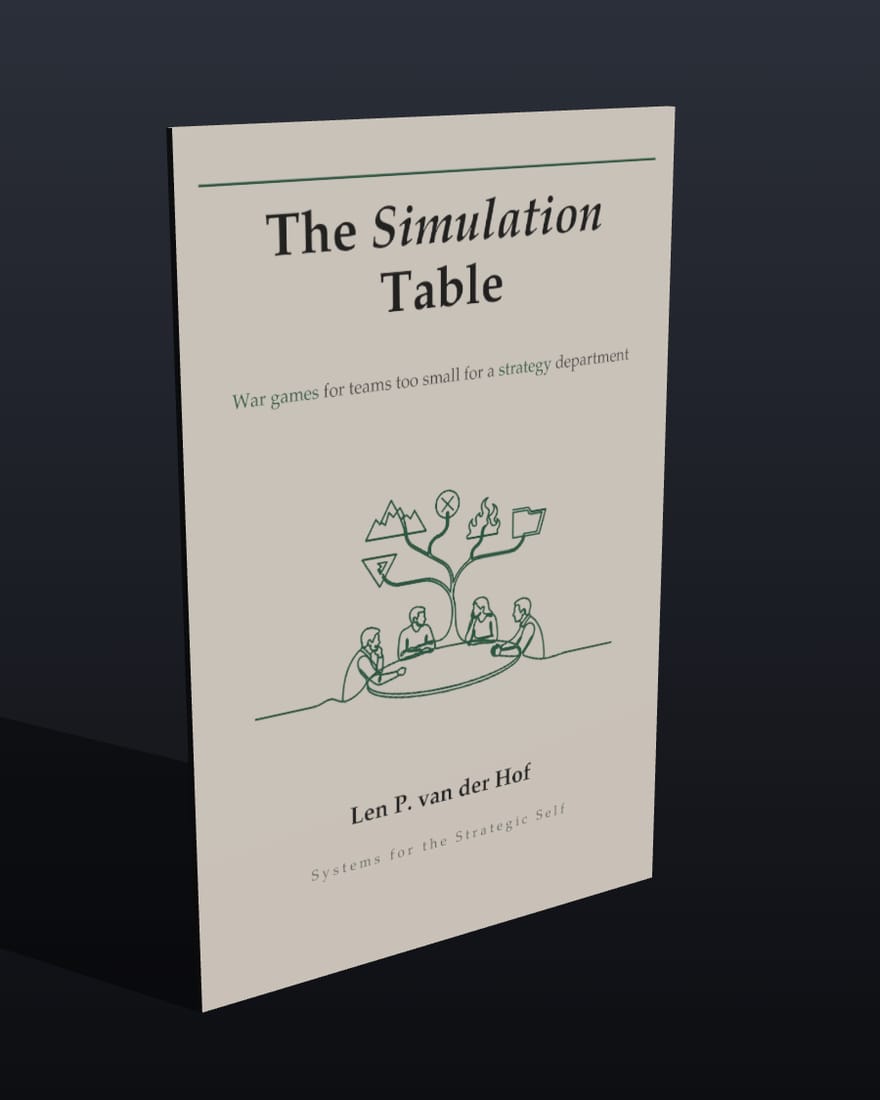
Kindle
The digital edition, ready in any Kindle app.
-
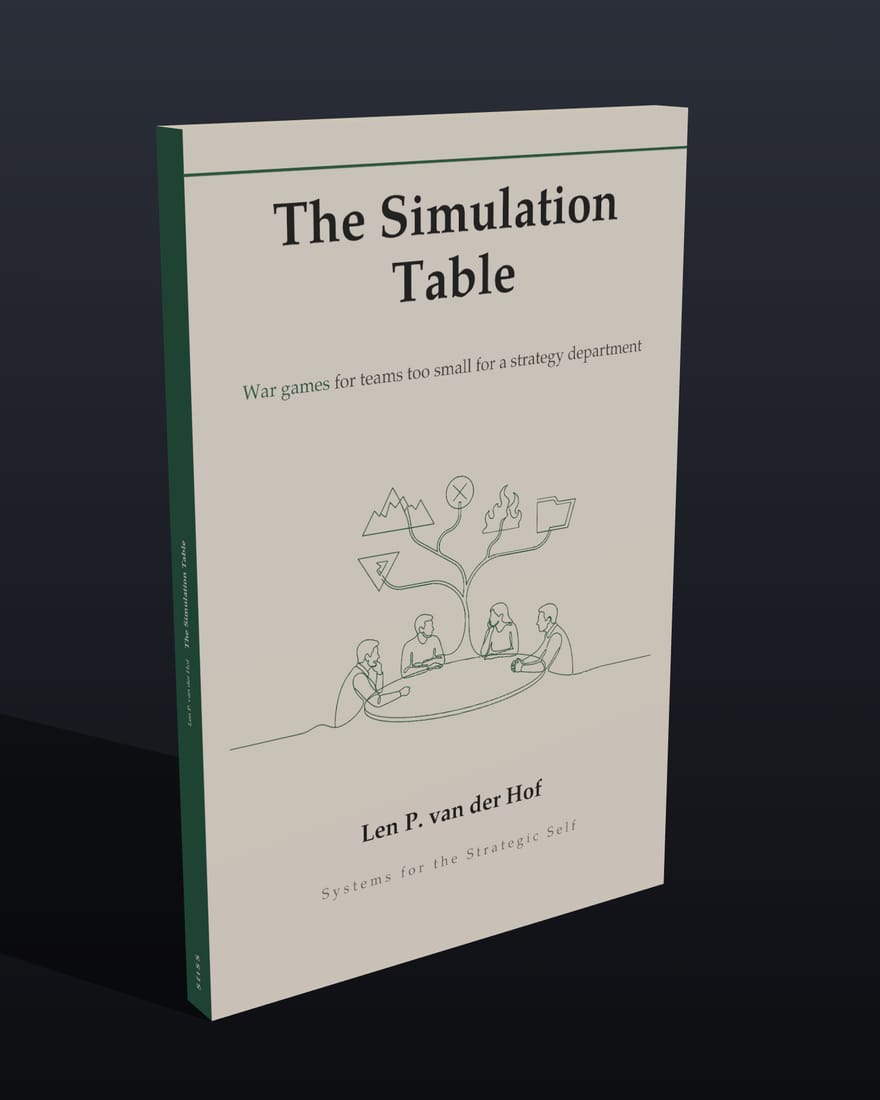
Paperback
The working copy. Mark it up. Take it into the meeting.


The book
War Games for Teams Too Small for a Strategy Department
You commit, then you find out. You reason a hire, a price, a pivot through in your head, decide it feels right, and run the experiment for real, with money on the line. When it fails, you call the wreckage a lesson, as if there were no cheaper place to learn it. The market becomes the only room where your strategy is tested, and it charges full price.
The usual advice is to move fast and trust that you will figure it out in flight. That holds until the call is large and irreversible, and then "figure it out later" is just tuition for what a few hours of structured thinking would have shown you for free.
The Simulation Table treats strategy the way an engineer treats a design: something you stress-test on the bench before staking anything real on it. It introduces SIMULATE: a system for war-gaming a decision against opponents, second-order effects, and your own blind spots, so the expensive surprises happen at the table, not in the market. This is operator-grade rehearsal, not forecasting theater.
What you learn
What this book puts in your hands
- The TABLE protocol: Threats, Assumptions, Bets, Limits, Exercises, Lessons
- A 90-minute monthly war-game for 2-8 person teams
- Rehearse the futures that would otherwise blindside you
The framework
TABLE, step by step
Threats, Assumptions, Bets, Limits, Exercises, Lessons
-
Threats
-
Assumptions
-
Bets
-
Limits
-
Exercises
-
Lessons
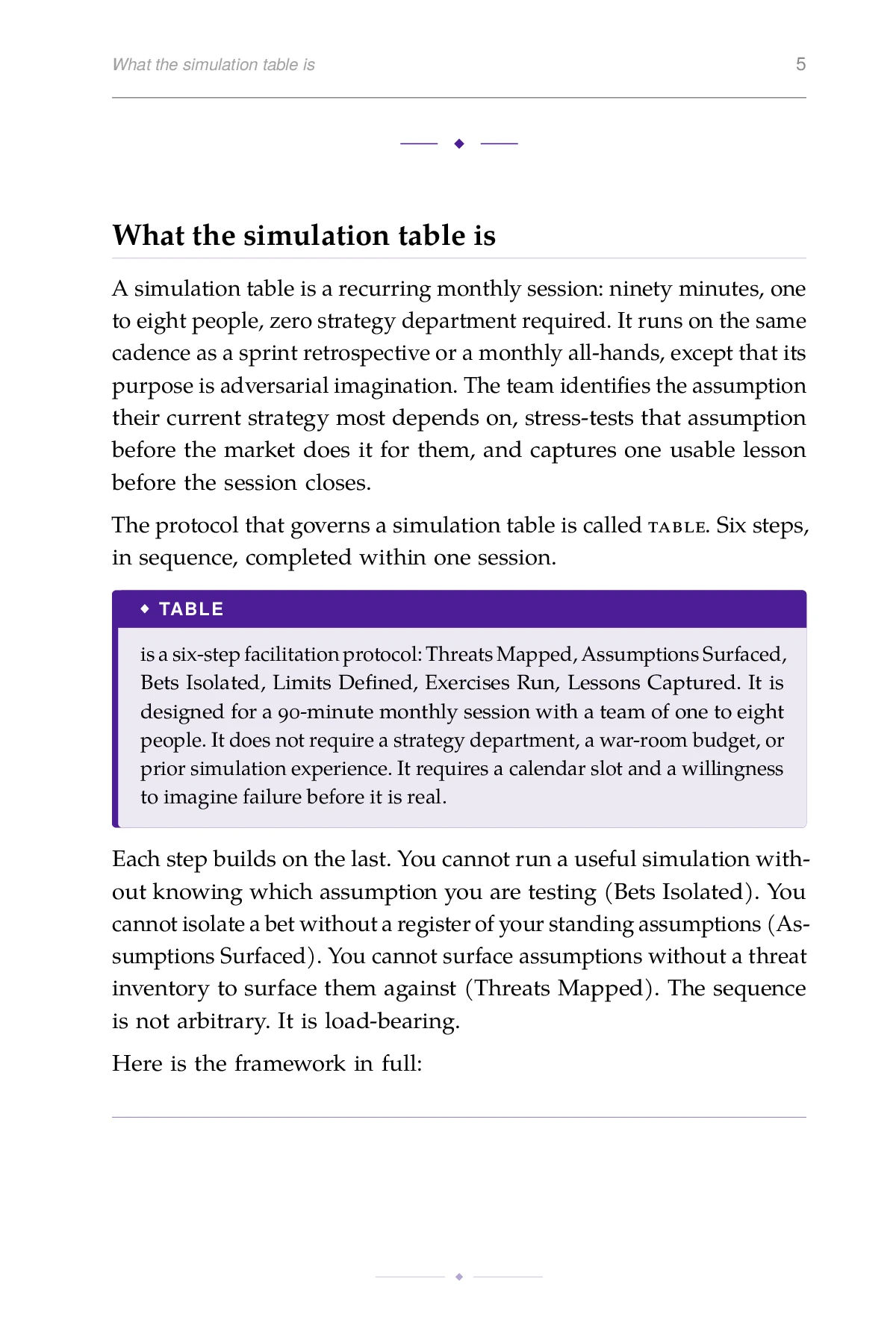
From the book
What the simulation table is
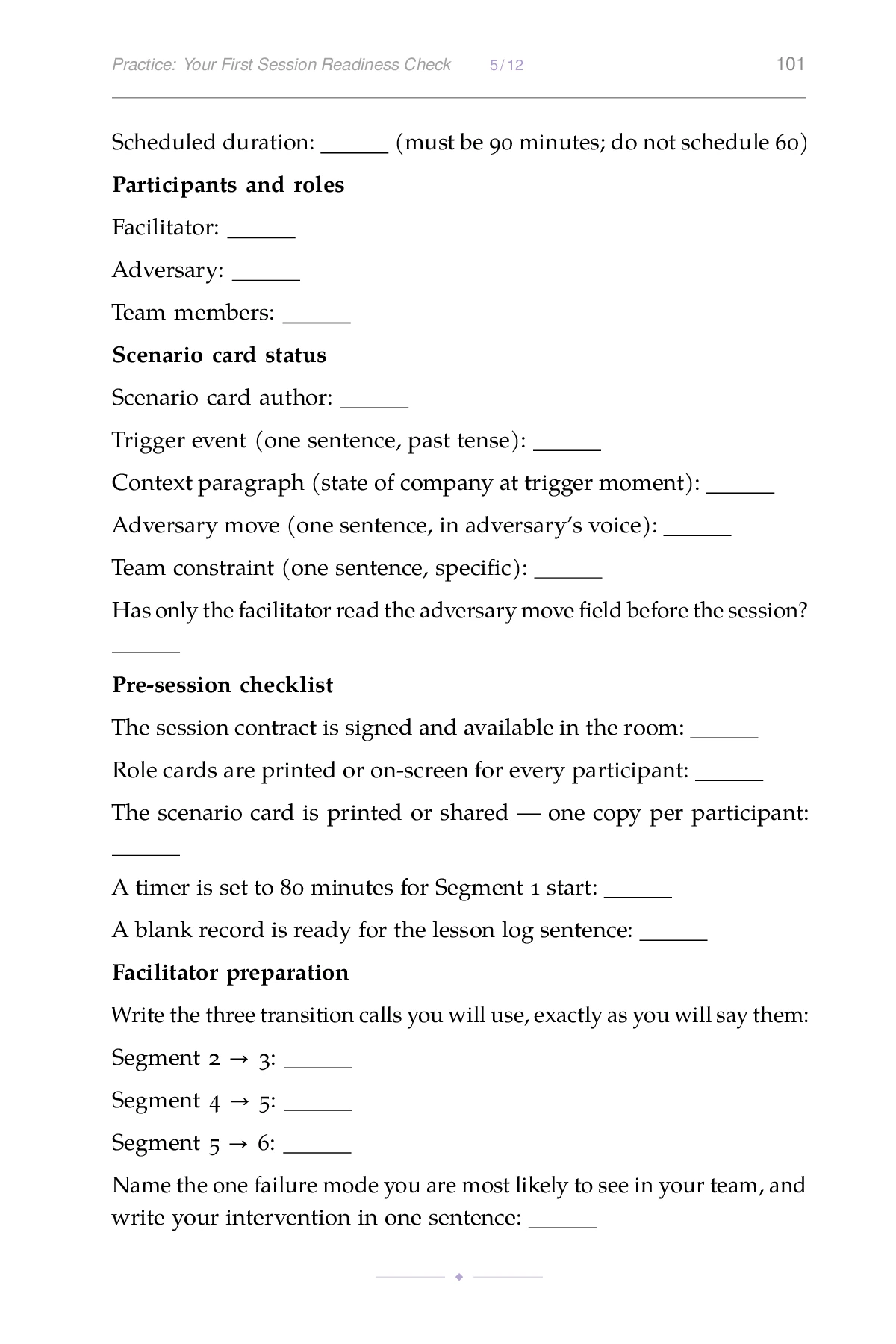
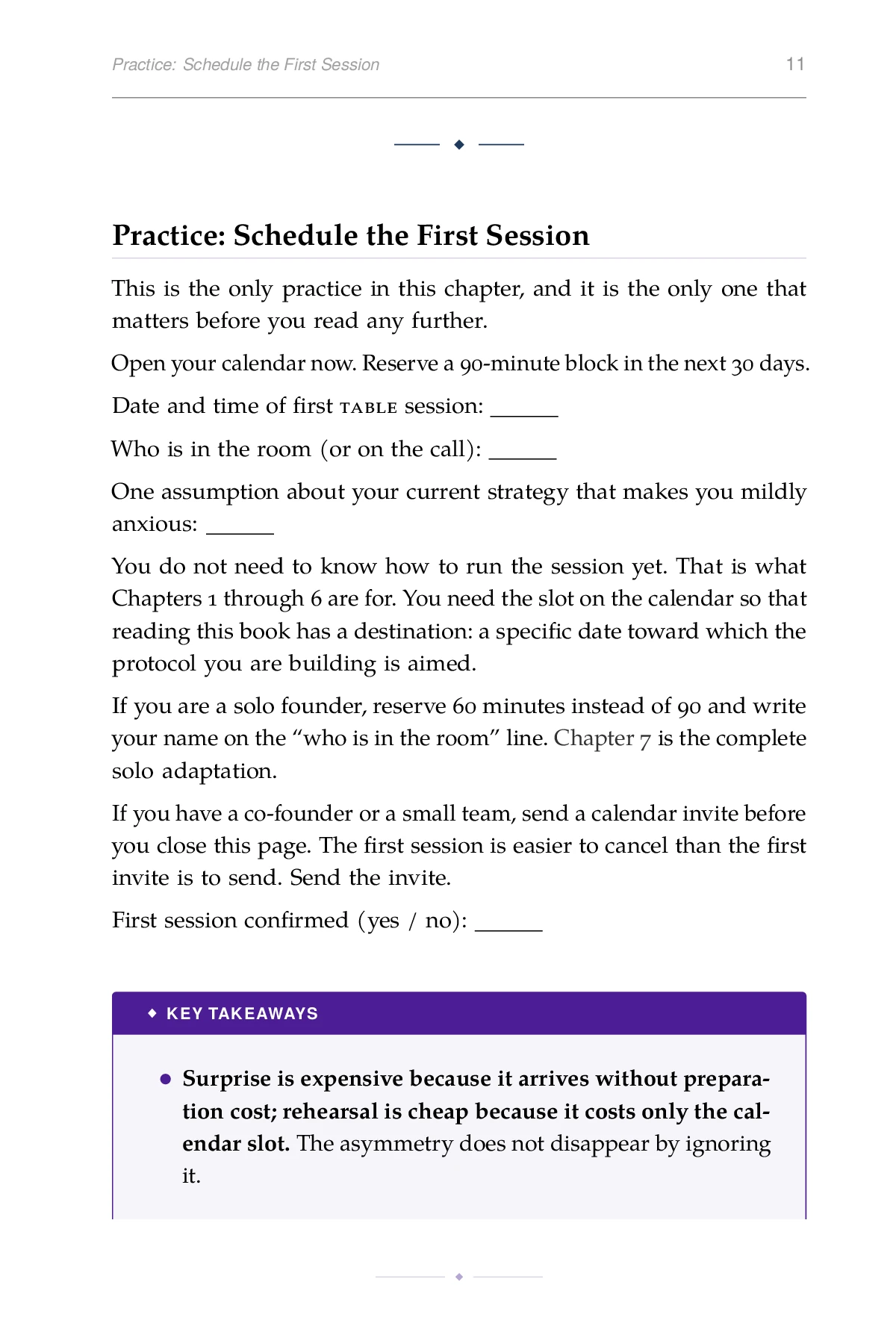
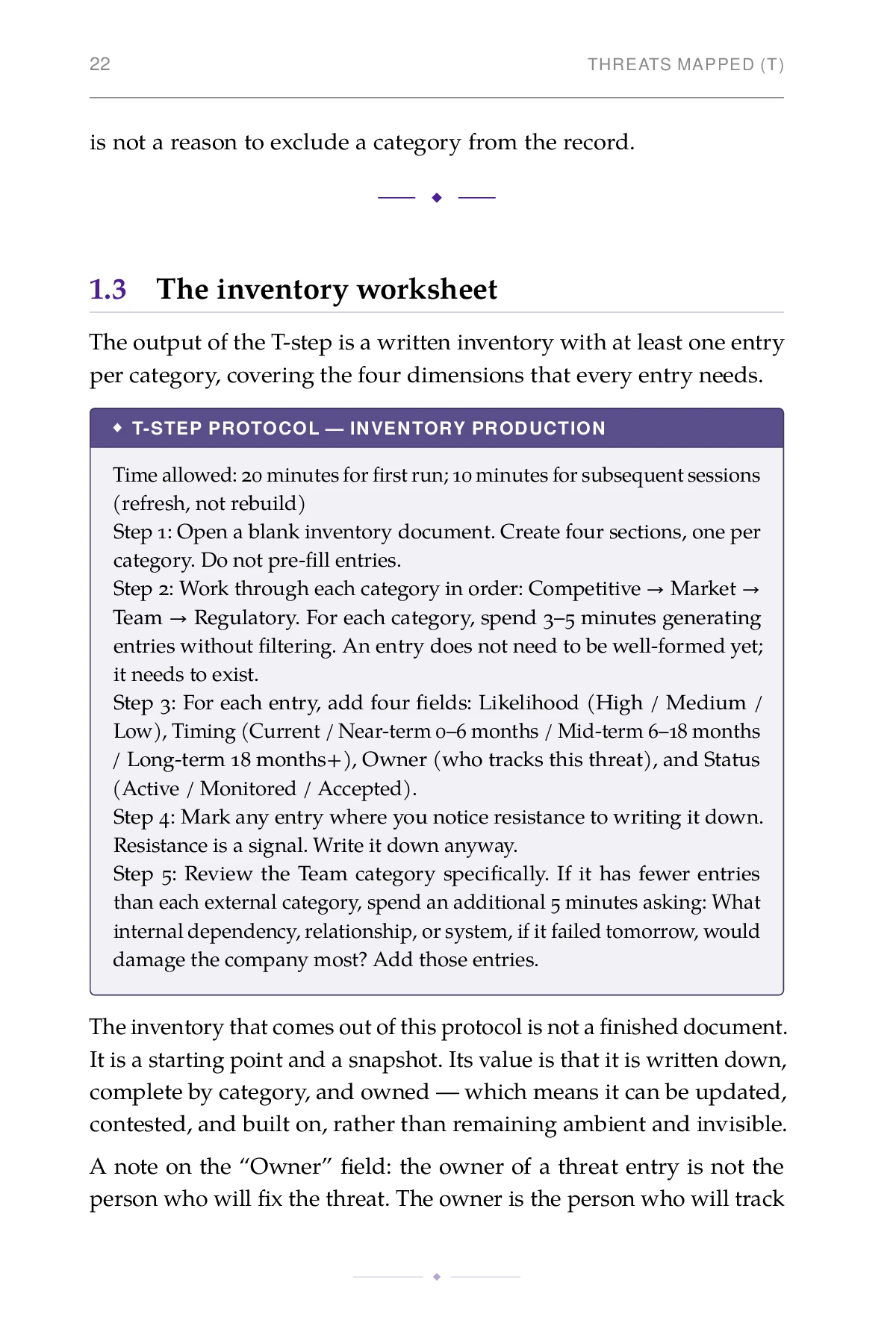
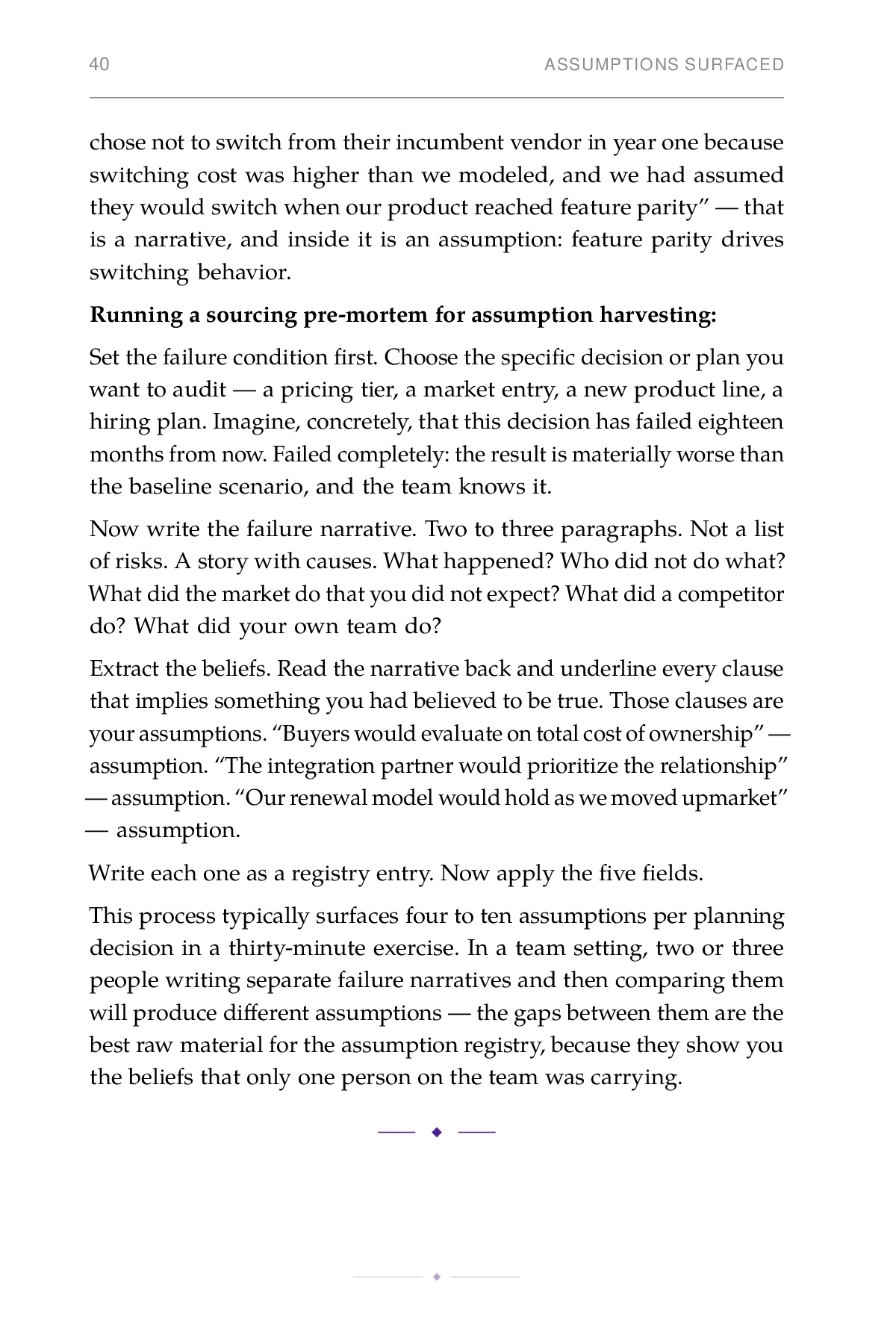
The Simulation Table, printed page: What the simulation table is
Inspect more pagesLook inside
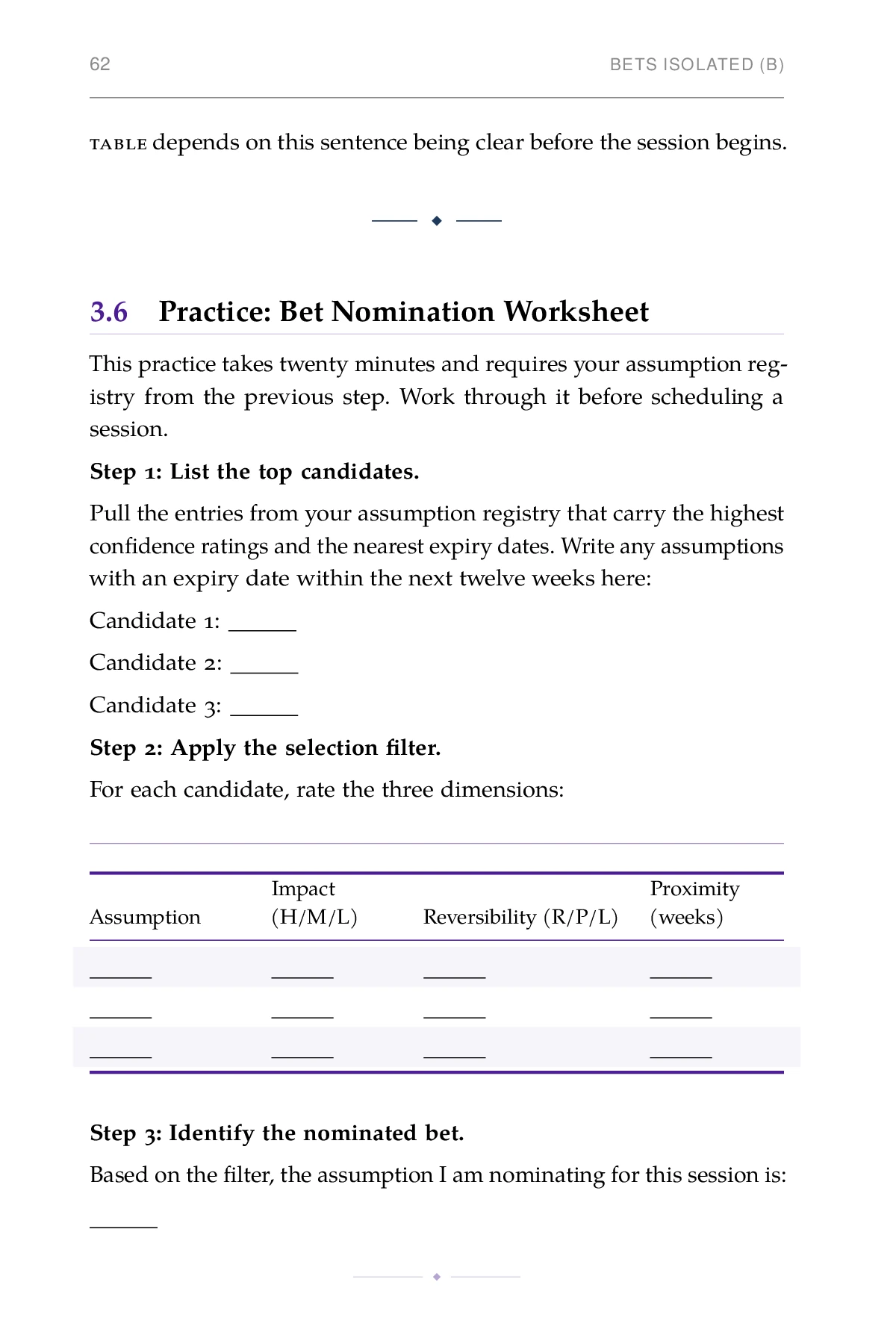
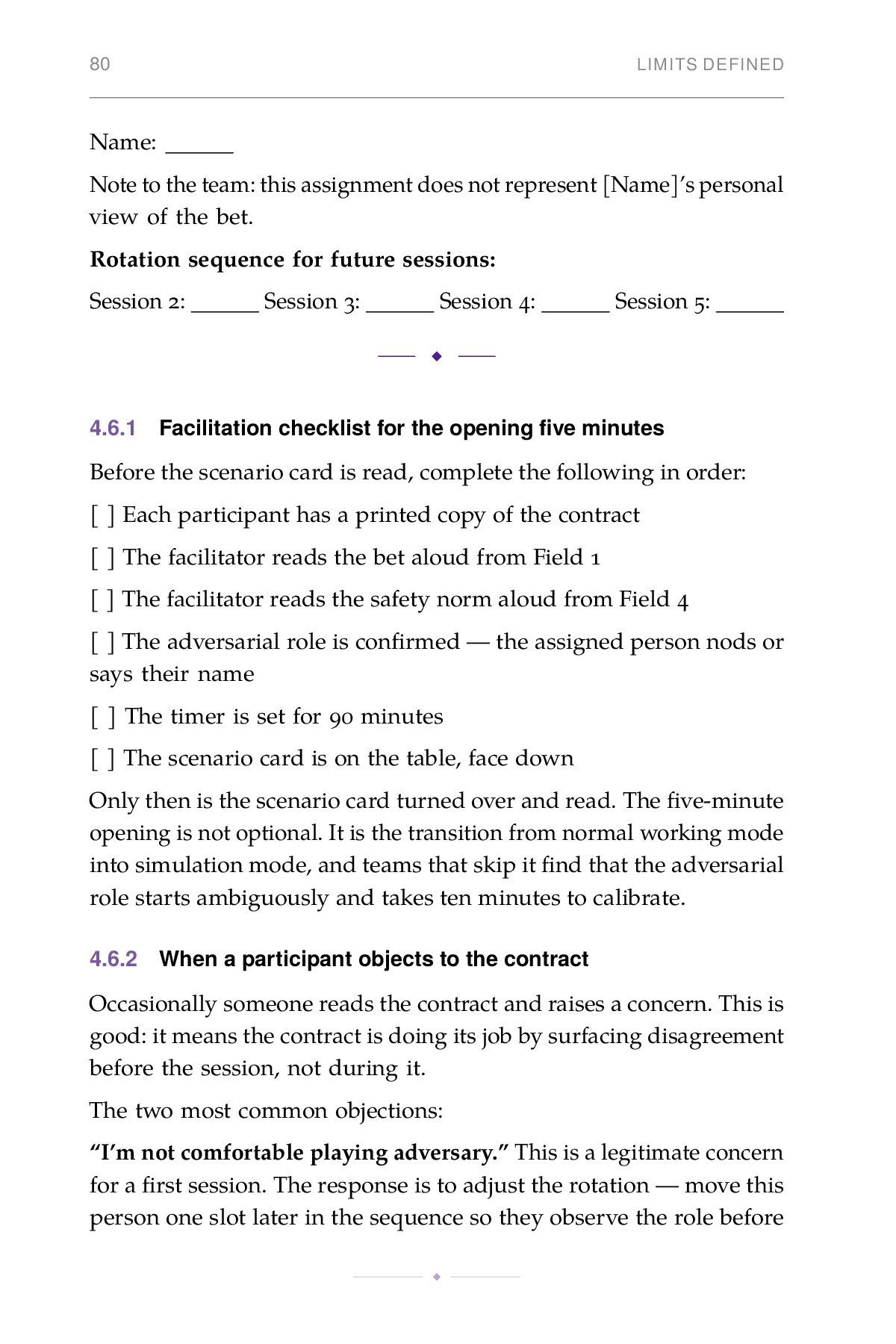
Pages from the print edition.
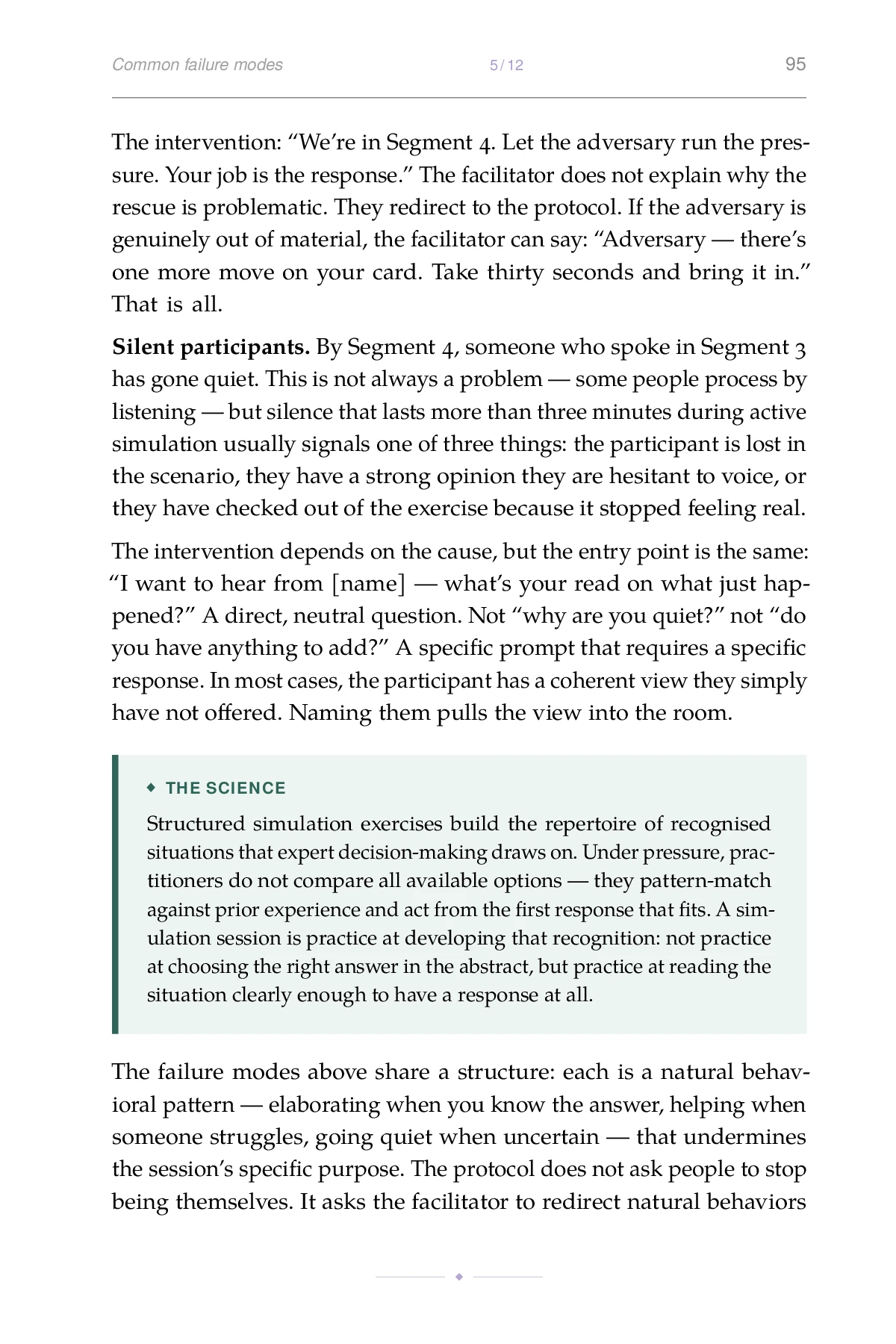
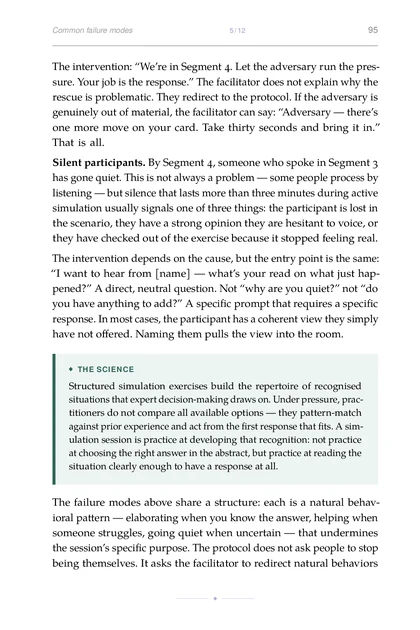 Silent participants. By Segment 4, someone who spoke in Segment 3
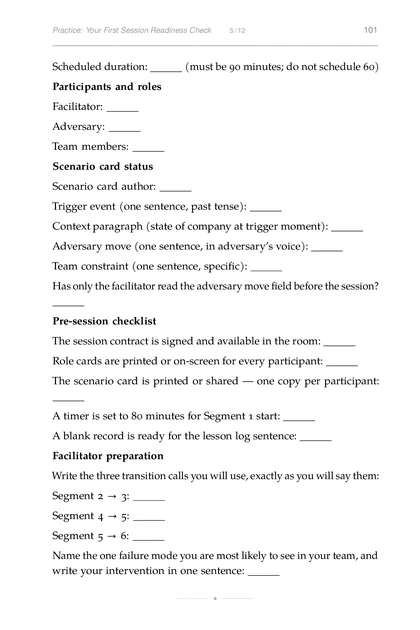 Practice: Your First Session Readiness Check 5 12 101
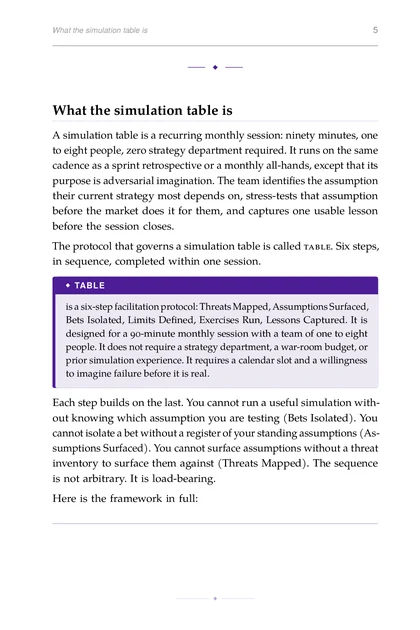 What the simulation table is
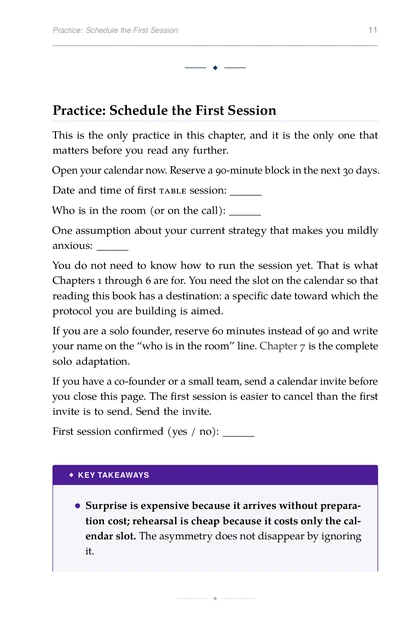 Practice: Schedule the First Session 11
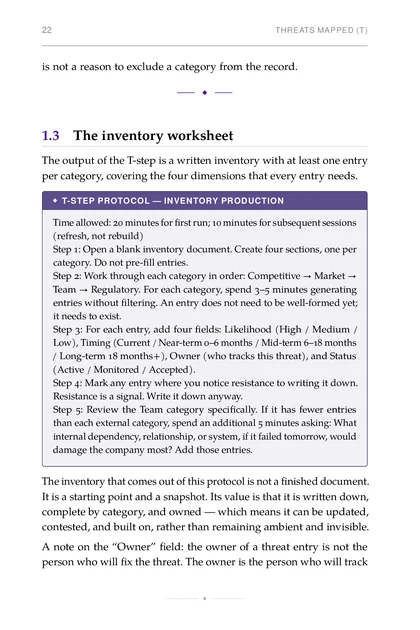 Step 1: Open a blank inventory document. Create four sections, one per
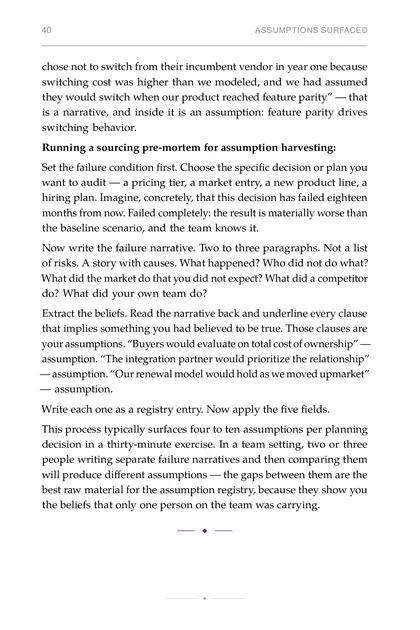 Now write the failure narrative. Two to three paragraphs. Not a list
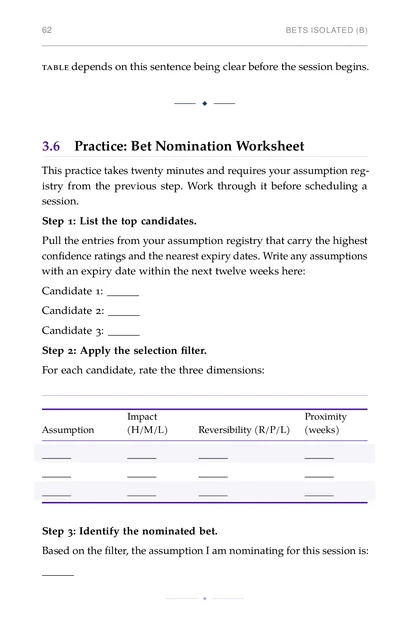 Step 1: List the top candidates
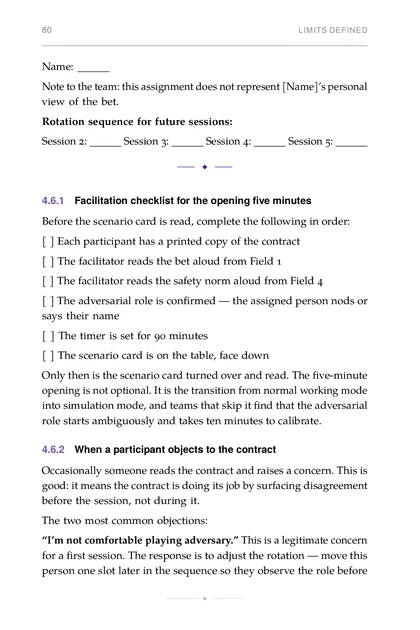 Only then is the scenario card turned over and read. The five-minute
The contents
Chapter by chapter
Every chapter of The Simulation Table with its printed epigraph, what you can do afterwards, and the moment it is built for.
Introduction
Introduction: Schedule the Surprise
Surprise is not the failure. Unscheduled surprise is.
What you can do afterwards
You will understand what TABLE is, why a recurring monthly session outperforms occasional red-teaming, and leave this introduction with a first session committed to a calendar.
Use this chapter when
You have been blindsided before, by churn, a competitor move, a cofounder tension, and know, with some quiet honesty, that you saw none of it coming.
Chapter 1
Threats Mapped (T)
The list of threats you did not write down is the one that will end you.
What you can do afterwards
You will produce a first threat inventory that covers all four categories, competitive, market, team, and regulatory, including the internal threats most founders never write down until they have already landed.
Use this chapter when
You are about to run your first TABLE session, or you notice that your existing threat picture has not been updated in more than one session cycle.
Chapter 2
Assumptions Surfaced
The most dangerous beliefs in a business are not the ones you know are wrong. They are the ones you have forgotten you are holding.
What you can do afterwards
You will convert the invisible beliefs propping up your current strategy into named, dated. Owner-assigned entries in a working assumption registry, so that when one of them expires, you know before the market tells you.
Use this chapter when
You are running the A-step of a TABLE session, or any time a threat from your inventory traces back to something your plan silently depends on being true.
Chapter 3
Bets Isolated (B)
The strategist who tries to hold ten threads at once holds none. Isolation is not a narrowing of vision. It is the condition under which vision becomes precise.
What you can do afterwards
You will leave this chapter with exactly one assumption nominated for simulation. And you will know in one sentence why that assumption, and why this session.
Use this chapter when
You have an assumption registry (or a short list from the Assumptions Surfaced step) and need to decide which one to put on the table for the upcoming session.
Chapter 4
Limits Defined
A simulation without agreed limits is a conversation with no walls. Something useful might happen. Something costly might happen instead.
What you can do afterwards
You will leave this chapter with a completed session contract, one printed page. That gives your team explicit permission to play adversary, a bounded scope for the session, a time cap, and a confidentiality rule. The social anxiety about running a TABLE session dissolves when the rules exist in writing.
Use this chapter when
You have a bet isolated from Chapter 3 and you are preparing to run your first session. Or when a previous session felt awkward or pulled punches because the team was unsure what the exercise actually permitted.
Chapter 5
Exercises Run (E)
The script is the session. Every minute without a structure is a minute the room fills with someone's anxiety instead of the problem.
What you can do afterwards
You can run a complete 90-minute TABLE session from this chapter alone, setup through debrief, minute by minute, with a clean output at the end.
Use this chapter when
Your session contract is agreed, your bet is nominated, and you are standing at the edge of the room wondering exactly what to do next.
Chapter 6
Lessons Captured
A session without a lesson log is a conversation that evaporated. The debrief structure is not the cleanup after the work: it is the work.
What you can do afterwards
You will leave every TABLE session with a structured, blame-free lesson log, three fields, no ambiguity, ready to reach the roadmap within 72 hours.
Use this chapter when
You have just completed the 90-minute exercise and the team is still in the room. The first ten minutes after the scenario ends determine whether anything changes.
Chapter 7
Solo Founder Table
The adversarial voice does not disappear when there is no one else in the room. It goes underground. Your job is to dig it back up.
What you can do afterwards
You can run a complete TABLE session alone, same six steps, adapted tools, and surface the assumptions your optimism is quietly protecting.
Use this chapter when
You are a solo founder, a sole operator in a team that cannot or will not do this with you yet. Or a founder who wants to pressure-test a decision before bringing it to anyone else.
Chapter 8
Agent-Generated Scenarios
The question is never whether an AI can build your scenario cards. It can, faster than you will. The question is what it cannot do, and whether you are honest enough about that distinction to keep your hand on the wheel.
What you can do afterwards
You will know exactly where an AI agent belongs in your TABLE preparation workflow, what it accelerates without risk, and where human judgment must take back the pen.
Use this chapter when
You are preparing scenario cards for a session and want to generate more variants, stress-test your adversarial framing, or cover threat dimensions your team has not yet considered.
Chapter 9
From Table to Roadmap
A session that changes nothing is a rehearsal without consequence. The 90 minutes at the table cost you something. The next 72 hours determine whether they were worth it.
What you can do afterwards
You will know exactly how to move a lesson log entry off the table and onto the roadmap, with an owner, a deadline, and a decision that was not there before.
Use this chapter when
You have completed a TABLE session and produced a lesson log, and you are now wondering what happens next.
Conclusion
Practiced Operator
The first session is a beginning. The twelfth session is infrastructure.
What you can do afterwards
You will leave this chapter with a concrete first-session plan, a one-page quick-start card. And a clear picture of what a practiced operator looks like, not as an aspiration, but as a set of specific behaviors that twelve months of TABLE produces.
Use this chapter when
You have reached the end of this book and want to understand what you are building toward. Or when you have already run a few sessions and need to calibrate your progress against what TABLE looks like when it has become routine.
Who it is for
Who this book was written for
The result is not a slower founder who never commits. It is an operator who walks into the irreversible call (on a Thursday afternoon, with partial information) having already lost the cheap version of it first.
If your decisions move real resources and you are done discovering the downside only after you have paid for it, this is the table you have been deciding without.
The reader it was written for
The surprised founder. Has been blindsided by churn, competition, or internal conflict. Liked Red Team Founder but needs a calendar artifact.
Also a fit for
The 3-person leadership team without a head of strategy.
Editions
Editions and specifications
| Edition | Formats | Chapters | Pages | Reading time | ISBN (paperback) |
|---|---|---|---|---|---|
| English The Simulation Table | In production | 11 | 240 | ± 3 hours | — |
| Dutch De simulatie-tafel | In production | 11 | 256 | ± 3 hours | — |
Both editions are written natively. The Dutch text is not a machine translation of the English. · Trim size: 6x9″
Frequently asked
What readers usually want to know
What is The Simulation Table about?
TABLE gives small teams a monthly war-game cadence for threats, assumptions, bets, limits, exercises, and lessons before surprise arrives. The subtitle is: War Games for Teams Too Small for a Strategy Department.
What is the TABLE framework?
TABLE: Threats, Assumptions, Bets, Limits, Exercises and Lessons. Threats, Assumptions, Bets, Limits, Exercises, Lessons
Is there a Dutch edition?
Yes. The Dutch edition is De simulatie-tafel, written as a native edition rather than a machine translation. It moves through the same production line.
How long is The Simulation Table?
This edition runs 11 chapters, 240 pages in print and roughly 3 hours of reading.
Who is The Simulation Table for?
If your decisions move real resources and you are done discovering the downside only after you have paid for it, this is the table you have been deciding without.
The production system
How this book was made
Every title moves through the same gated production line: sourced research, a claim-level evidence ledger, structural review, fact-checking, red-team critique, and a bilingual final edit. AI agents do specialist work inside those gates; judgment, voice, and accountability stay human.
- Claims enter an evidence ledger with a source and a confidence grade before they reach the page
- English and Dutch are two native editions, not a translation of one another
- Every chapter clears readability, rhythm, and style gates before it is typeset
The series
More in this theme


