

No. 54 · Active development · Founder psychology · SCALE
The Scale-Up Operator
Build the Operating System That Runs the Company Without You in Every Room
The Scale-Up Operator: Build the Operating System That Runs the Company Without You in Every Room.
SCALE helps founders turn a company that depends on their presence into an operating system with cadence, ownership, metrics, and delegation. Build the Operating System That Runs the Company Without You in Every Room. The framework: SCALE.
- pages
- 216
- chapters
- 14
- hours of reading
- ± 3
- editions
- EN · NL
- Design
- Drafting
- Manuscript
- Production
- Launched
The editions
Kindle and Paperback
Production shots of the editions. Not for sale yet — this page is the public working version.
-
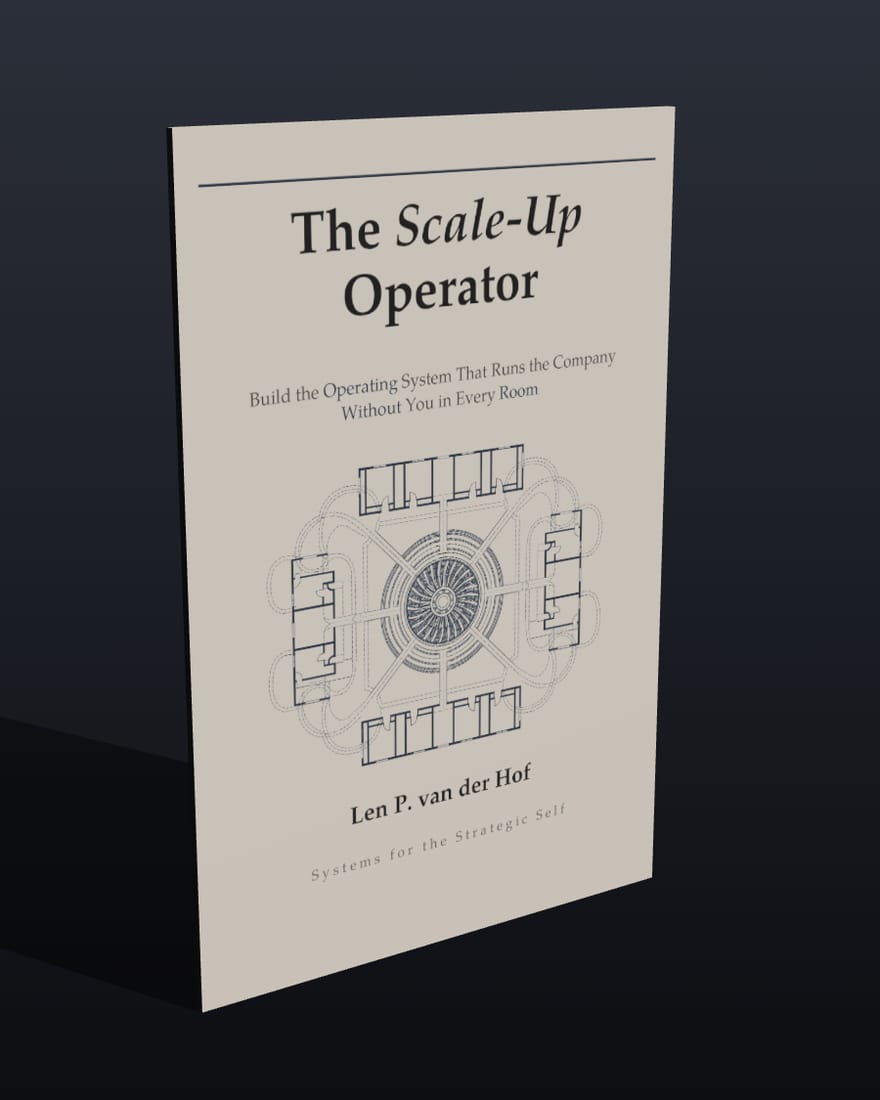
Kindle
The digital edition, ready in any Kindle app.
-
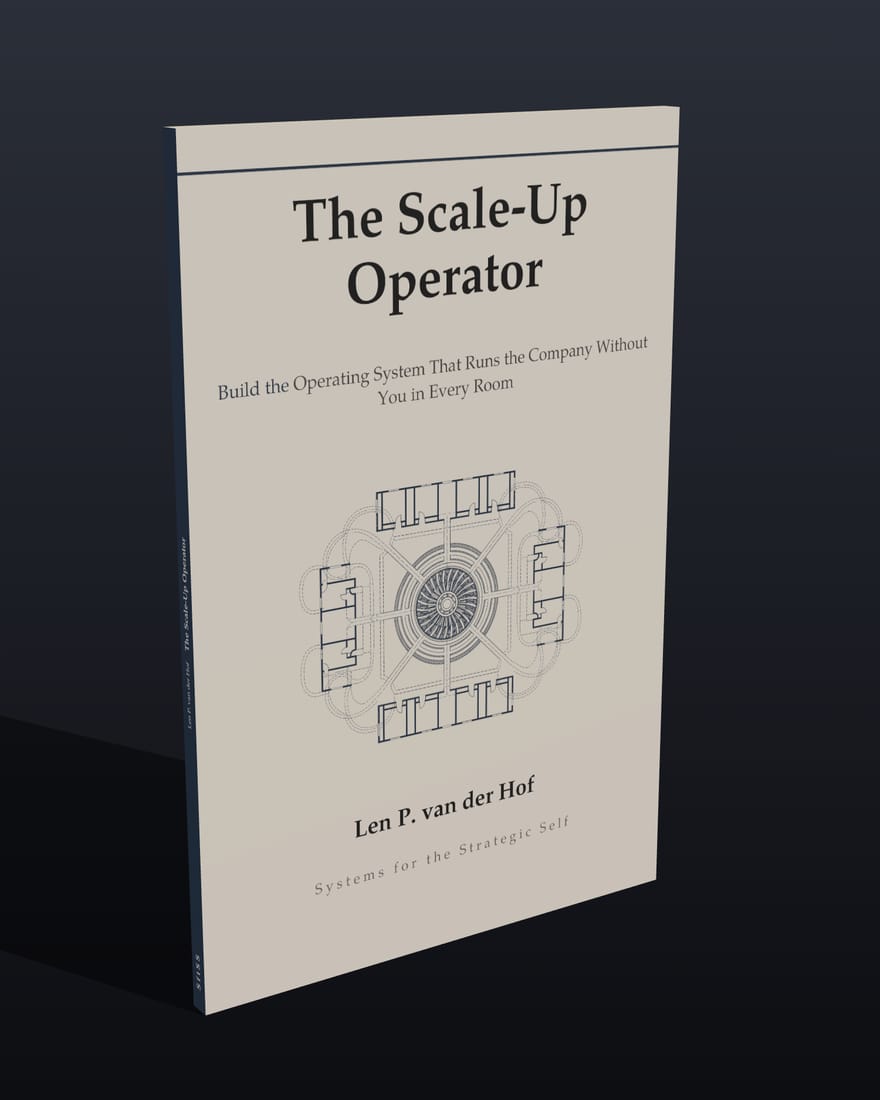
Paperback
The working copy. Mark it up. Take it into the meeting.


The book
Build the Operating System That Runs the Company Without You in Every Room
The company crossed thirty-five people and something inverted. The product still ships and revenue still climbs, yet every new hire creates two meetings and one exception only you can resolve. Decisions sit in your Slack for days. You are more needed than ever and moving the needle less. The reflex is to add a hire, an hour, a meeting, but that scales the tax, not the work: more headcount through the same undefined interfaces hands you one more person waiting on your signal.
This book offers the opposite: a company designed to run without you in every room. The Scale-Up Operator introduces the SCALE framework (Structure, Cadence, Alignment, Leverage, Execution), five components that replace personal presence with an operating system, so coordination becomes infrastructure instead of a bottleneck.
What you learn
What this book puts in your hands
- Turn ambiguous handoffs into explicit ownership with one-page role charters and a RACI with one Accountable per decision.
- Design a cadence that surfaces the top three risks each week before you walk in.
- Write decision rights and thresholds that let people act without you, routing the exceptions that matter to your desk.
- Document a high-frequency process in one page, train someone from it alone, and verify it ran a week without you.
- Run a 90-minute friction diagnostic, then fix the worst system in a time-boxed sprint while the company runs.
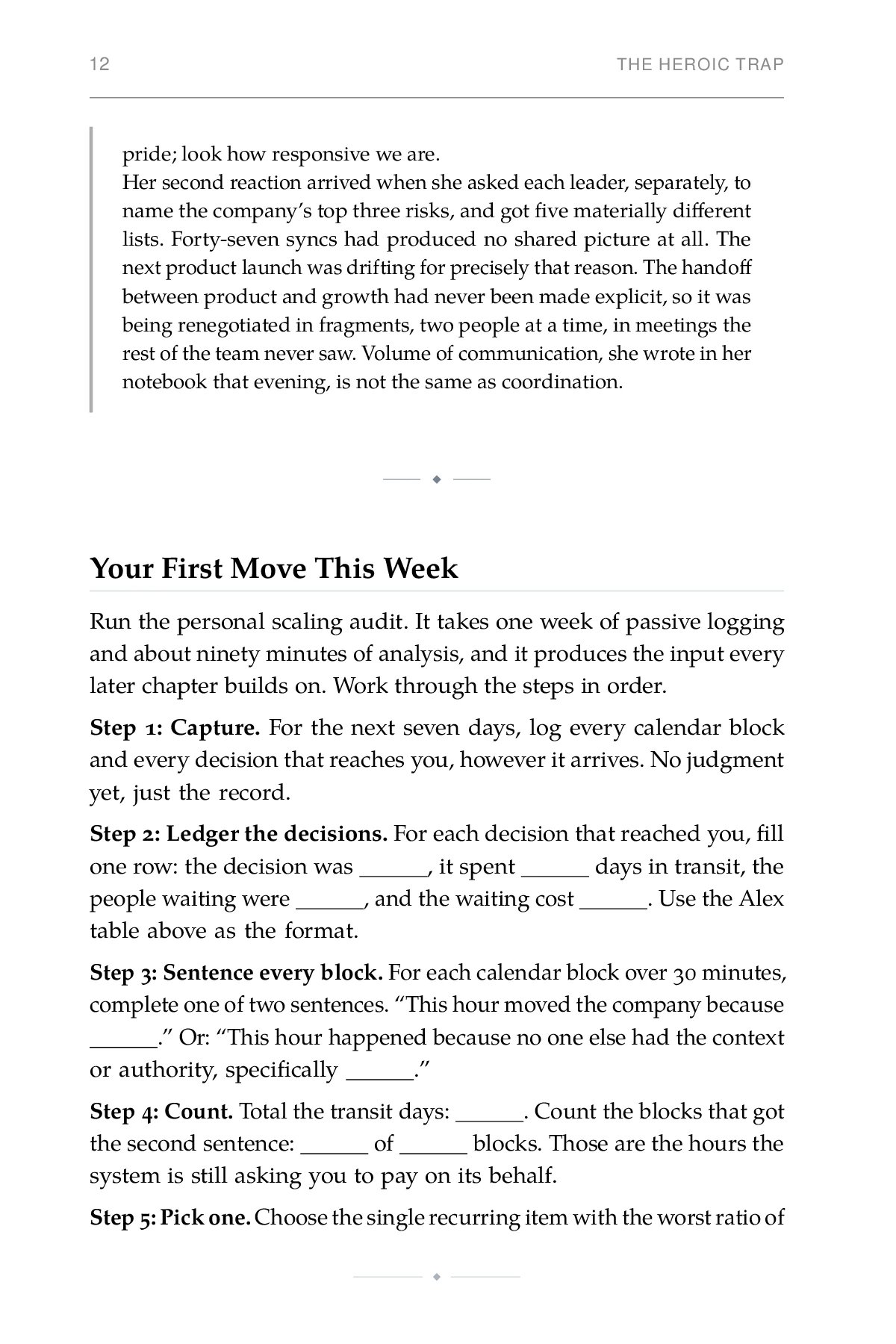
From the book
Step 1: Capture. For the next seven days, log every calendar block
The Scale-Up Operator, printed page: Step 1: Capture. For the next seven days, log every calendar block
Inspect more pagesLook inside
Pages from the print edition.
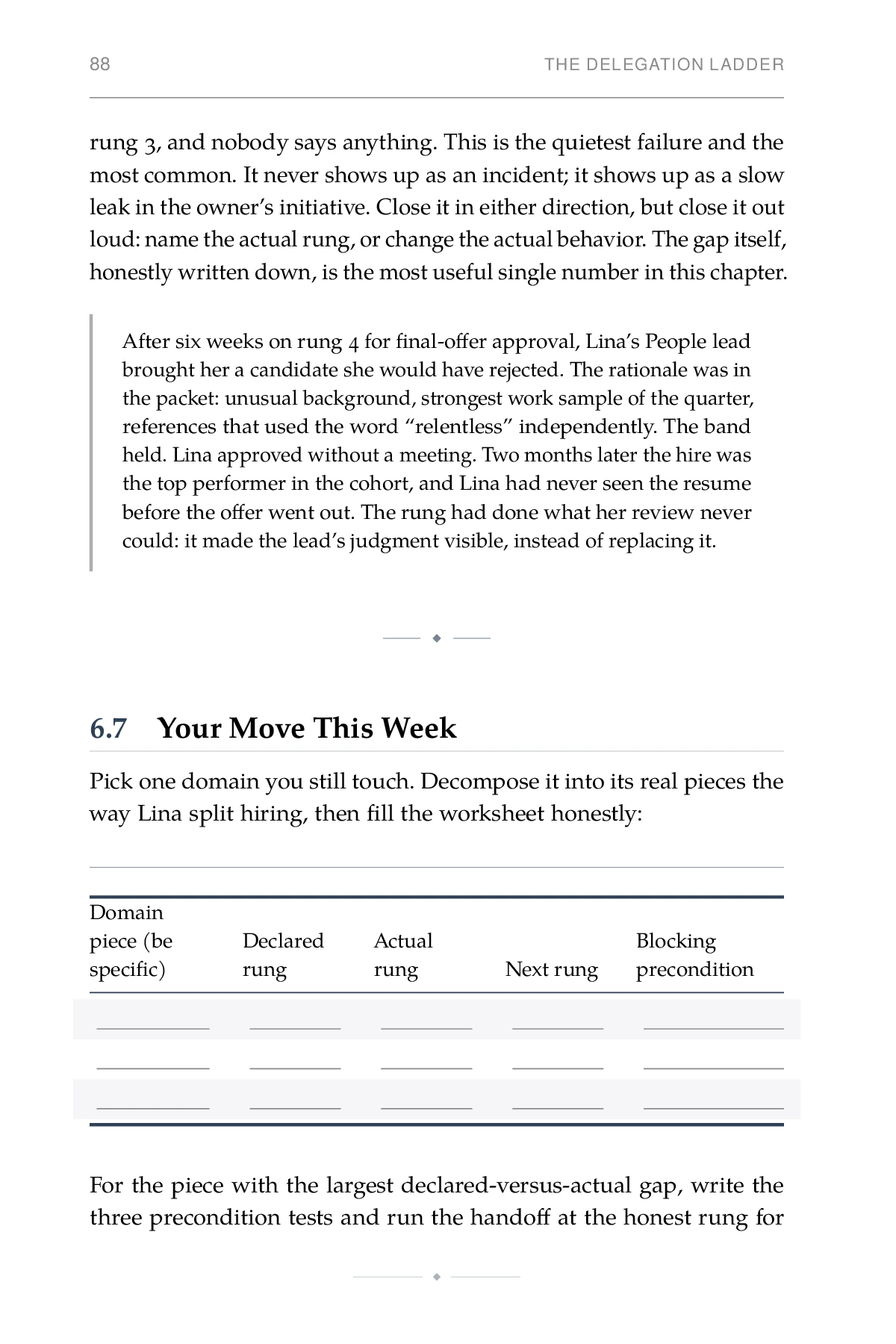
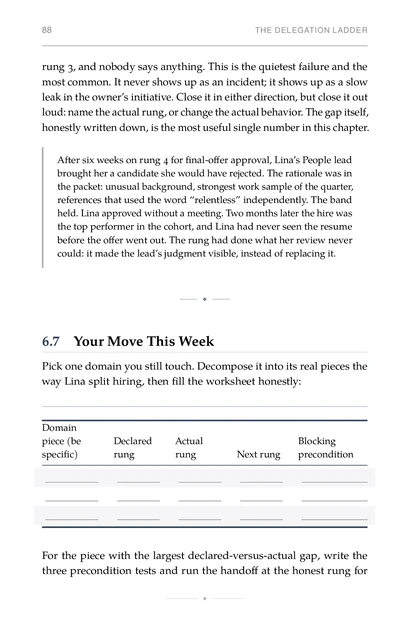 For the piece with the largest declared-versus-actual gap, write
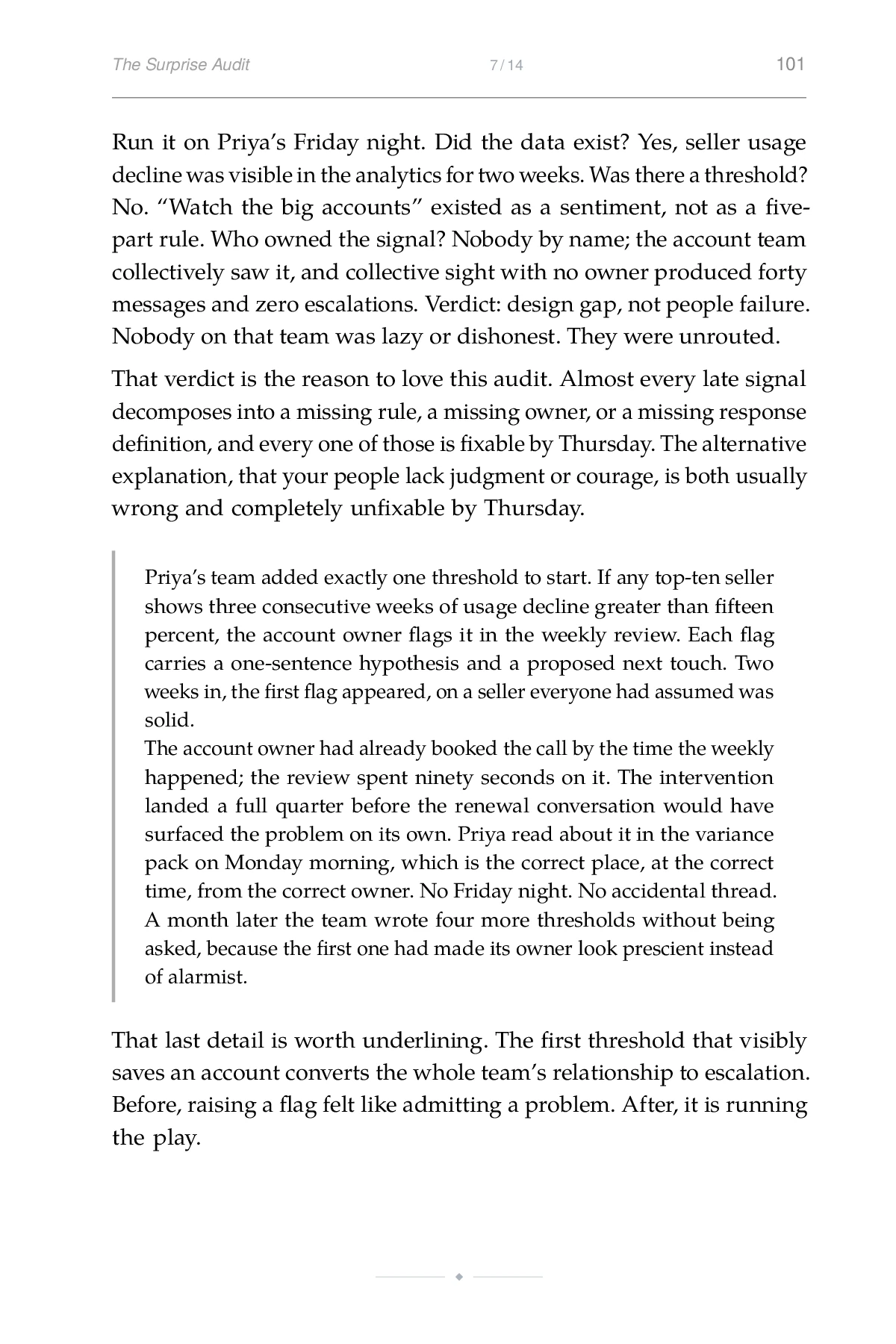
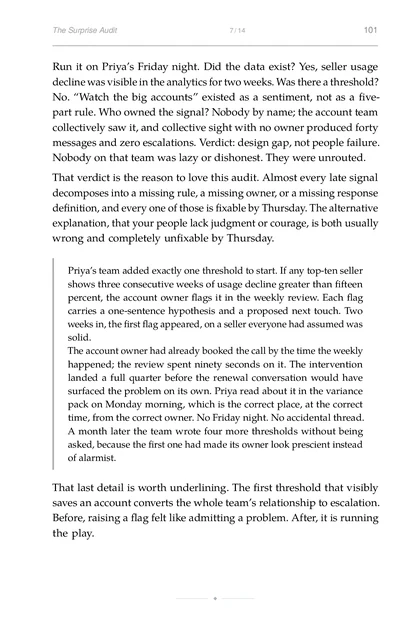 A month later the team wrote four more thresholds without being
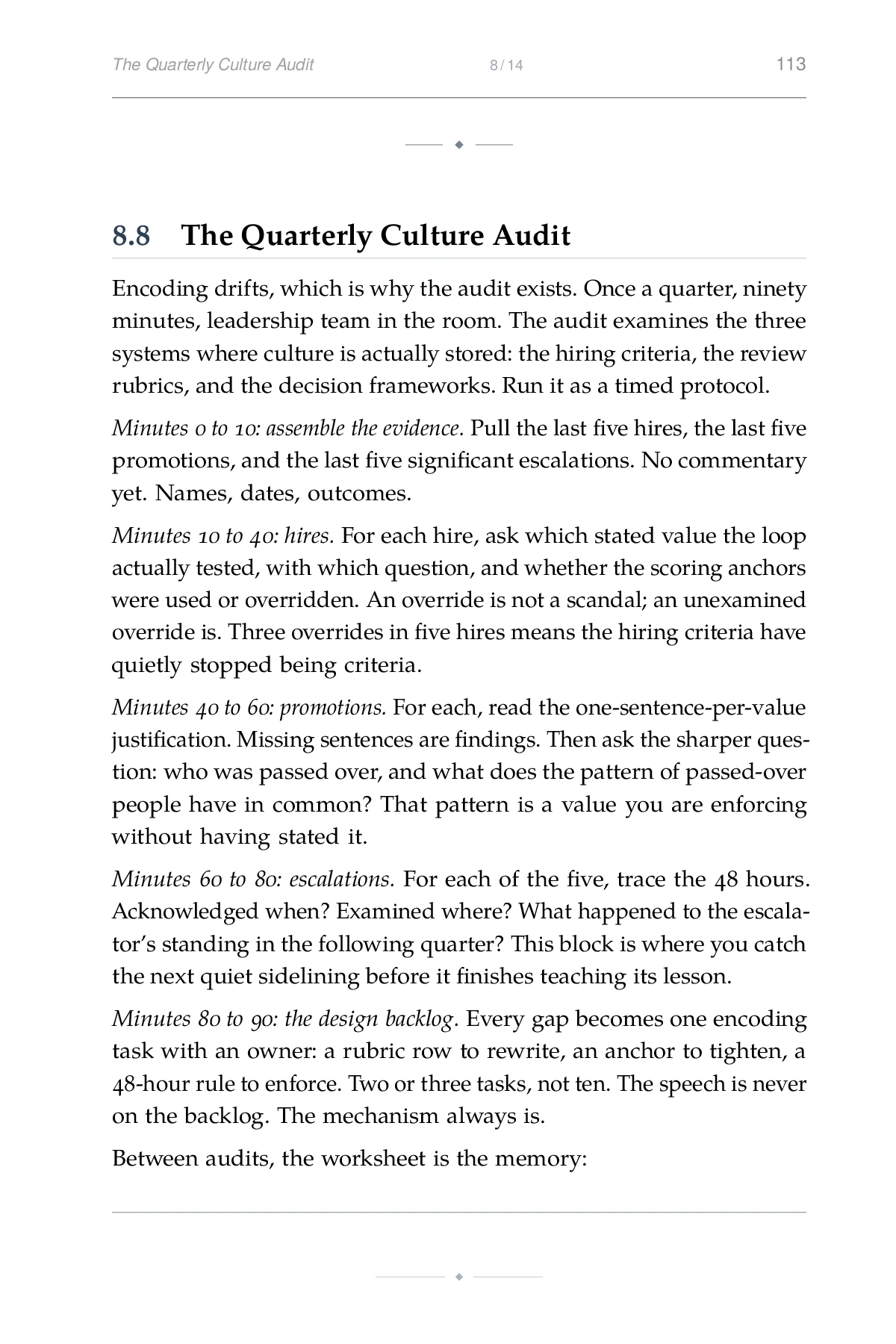
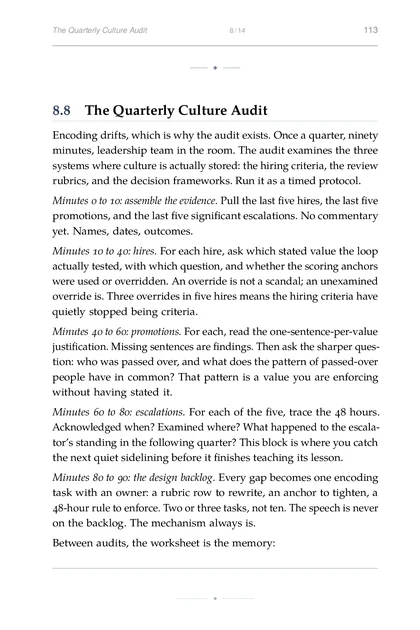 Acknowledged when? Examined where? What happened to the escala-
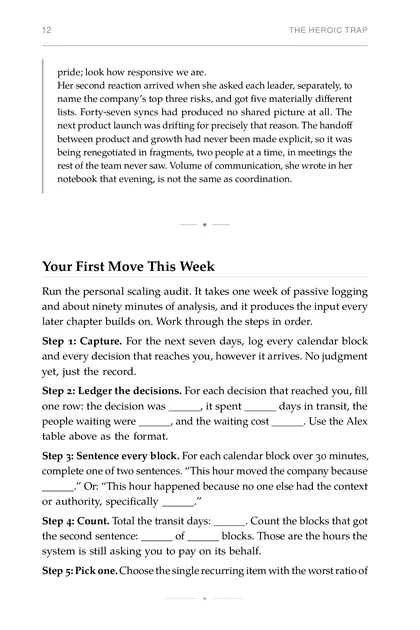 Step 1: Capture. For the next seven days, log every calendar block
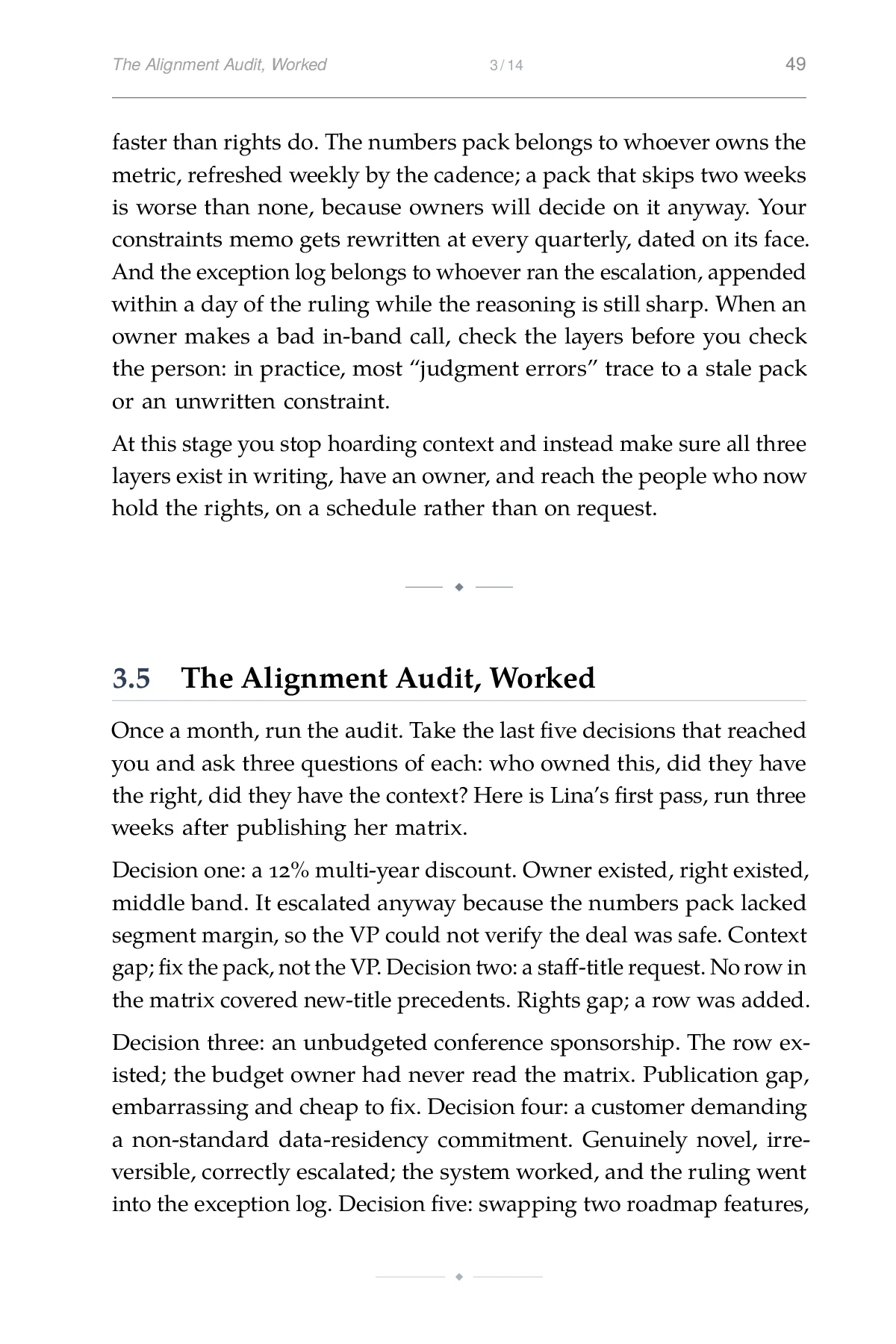
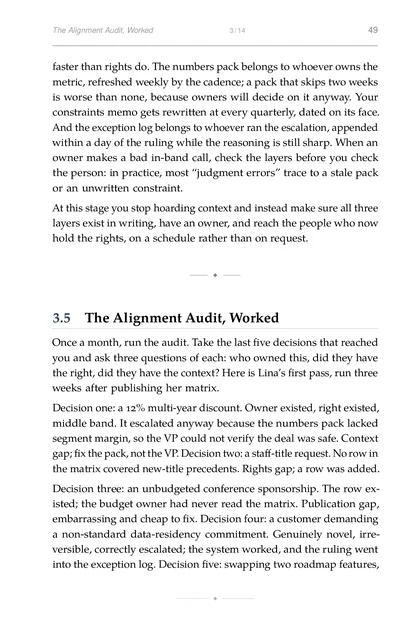 Decision three: an unbudgeted conference sponsorship. The row ex-
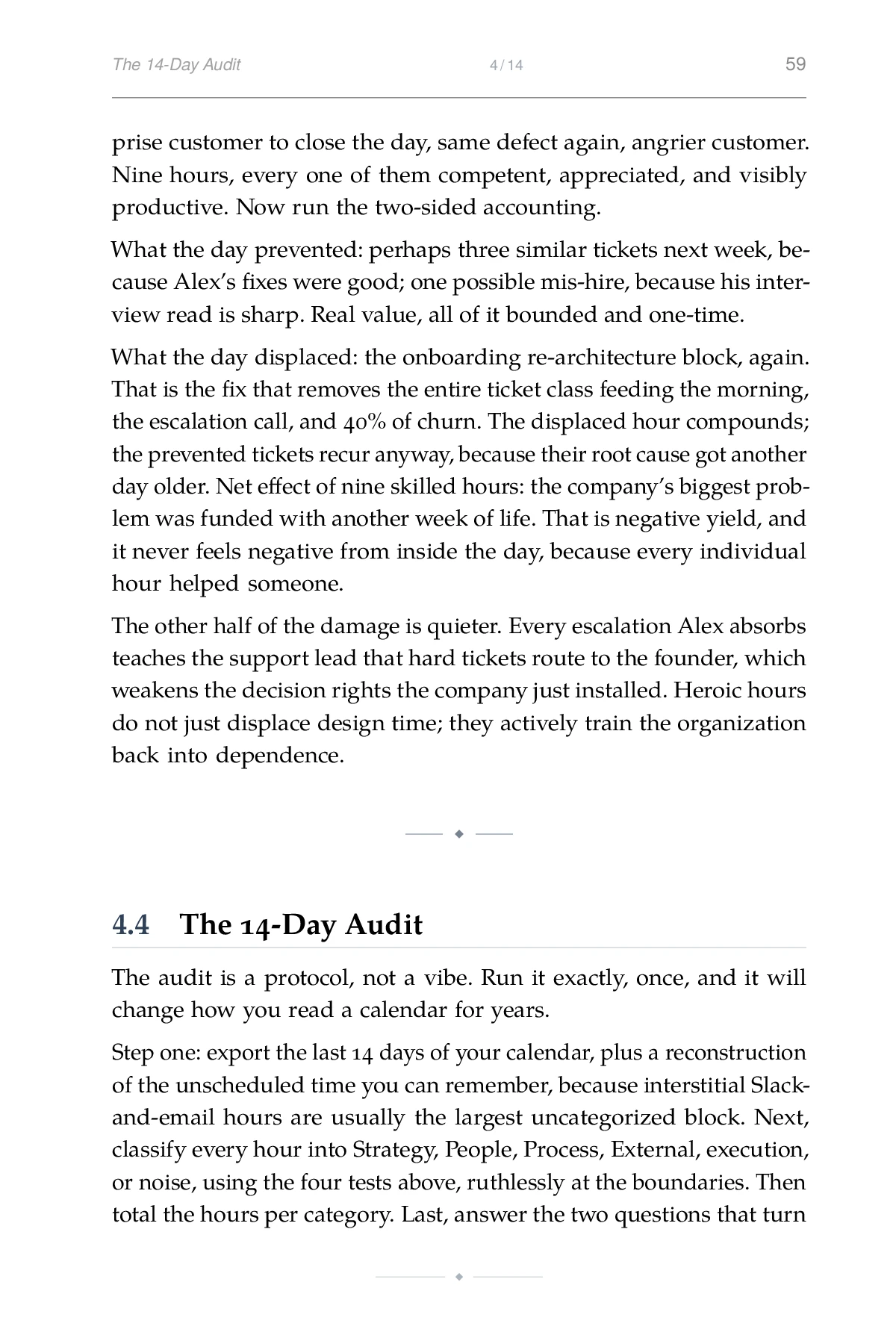
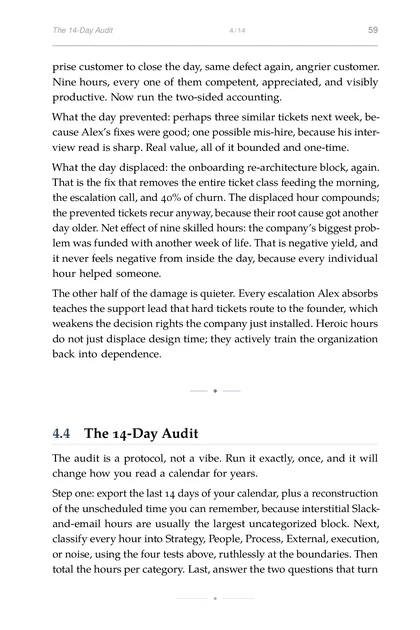 Step one: export the last 14 days of your calendar, plus a reconstruction
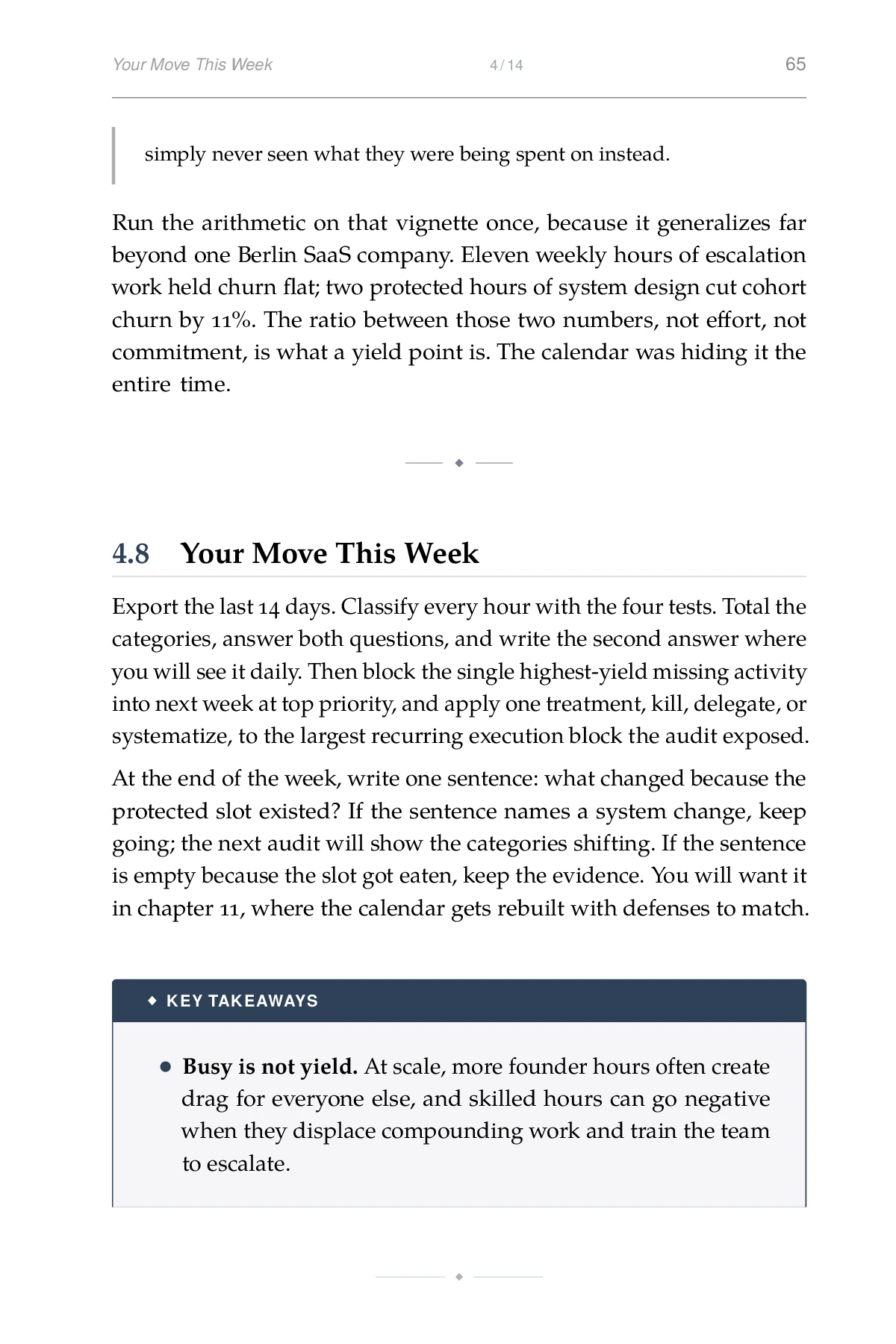
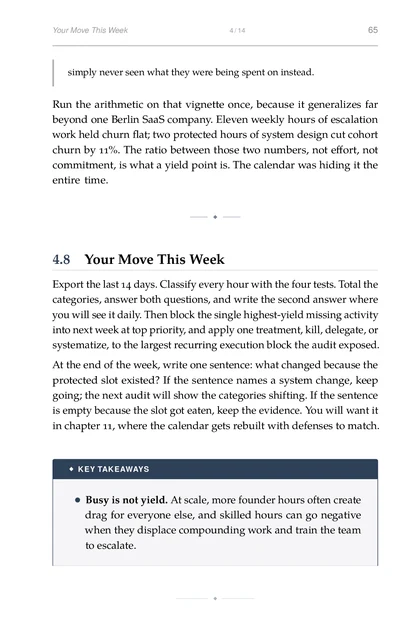 Your Move This Week 4 14 65
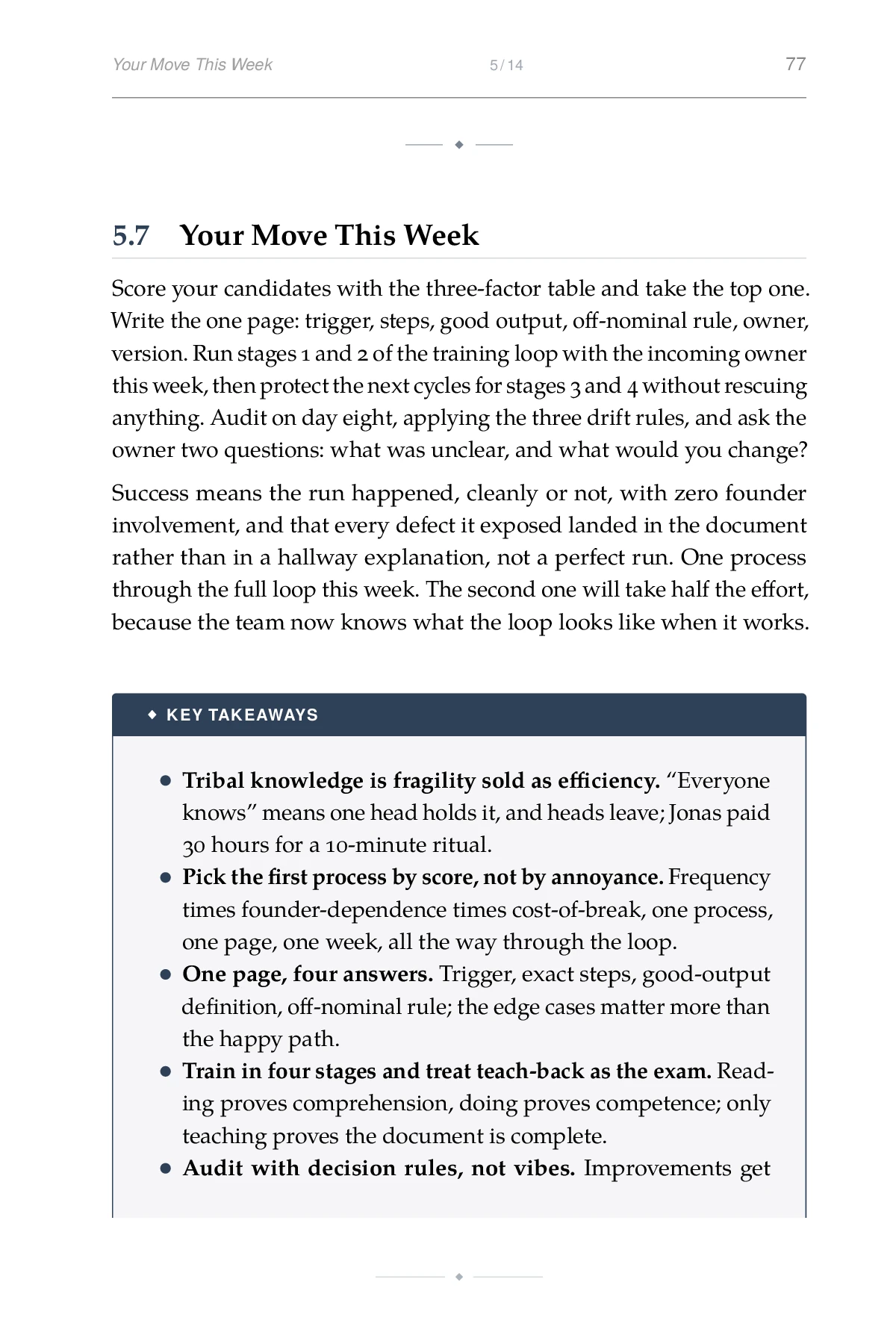
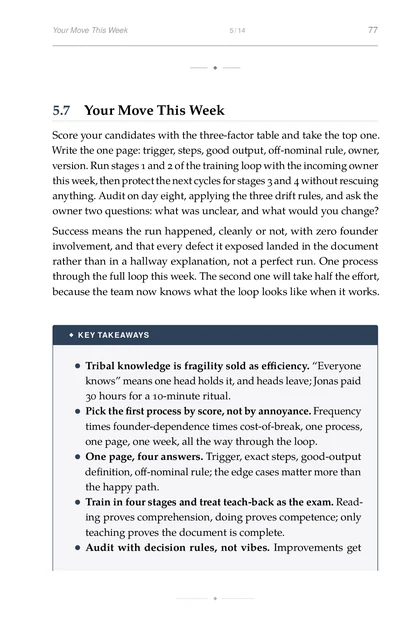 Your Move This Week 5 14 77
The contents
Chapter by chapter
Every chapter of The Scale-Up Operator with its printed epigraph, what you can do afterwards, and the moment it is built for.
Introduction
The Heroic Trap
Growth turns the founder's personal heroics from the company's greatest asset into its central coordination bottleneck. The first move is to see the trap clearly enough to stop feeding it.
What you can do afterwards
You will count what your presence costs in transit days, see why the cost appears at 20–50 people, and audit your way to the first structural fix you ship this week.
Use this chapter when
Revenue is growing but every decision still routes through you, the team waits for your signal, and your calendar is the company's real org chart.
Chapter 1
Structure Before Speed
Undefined roles and interfaces create invisible coordination drag that no amount of effort or additional headcount can fix. The first engineering move is to make ownership explicit.
What you can do afterwards
You will write one real role charter, build a working RACI for your three most escalated decisions, and map the interfaces where work actually crosses teams, using artifacts you can copy directly.
Use this chapter when
Decisions bounce between people or stall because "I thought you owned that," and every cross-team question defaults to your inbox.
Chapter 2
Cadence as the Operating Rhythm
Without predictable meeting and review rhythms, coordination debt compounds faster than revenue. The rhythm is the mechanism that makes structure executable without constant founder intervention.
What you can do afterwards
You will install a four-layer cadence with a specified slot, agenda, pre-work, and output artifact for each layer, run one full week of it, and read your first exception log.
Use this chapter when
Your calendar is full of "quick syncs," every urgent issue spawns an unplanned meeting, and no two leaders carry the same list of top risks.
Chapter 3
Alignment Without Micromanagement
Clear decision rights plus shared context allow real autonomy without the founder becoming the single point of failure. The architecture is what makes delegation safe instead of reckless.
What you can do afterwards
You will build a decision rights matrix for the three decision classes that reach you most, derive each threshold from three properties instead of gut feel, and ship the context that makes rights usable.
Use this chapter when
You say "you have full ownership" but still approve every exception, hire, or spend, and your evenings are a queue of one-off judgment calls.
Chapter 4
Fulcrum Points Over Activity
Most founder activity at scale has low or negative yield. The job is to identify and protect the small fraction of time that actually moves the company.
What you can do afterwards
You will run the 14-day calendar audit against the four yield categories, name the highest-yield activity currently missing from your week, and block it before anything else claims the slot.
Use this chapter when
Your days are full but the company is not moving faster, and the work that would compound keeps sliding to nights, weekends, or never.
Chapter 5
Execution Systems That Survive You
Processes must be documented, trained, and audited so that quality and speed do not depend on the founder's daily presence. The system is what remains when you are not in the room.
What you can do afterwards
You will pick the right first process with a scoring heuristic, document it on one page, run the four-stage training loop, and audit for drift with explicit decision rules.
Use this chapter when
Quality drops or speed slows the moment you step away or a key person leaves, and the instructions for critical work live in individual heads.
Chapter 6
The Delegation Ladder
Moving from "I do it" to "I design how it is done" requires explicit stages, not a sudden leap of faith. The ladder makes the identity shift visible and manageable.
What you can do afterwards
You will decompose one domain you still touch, place each piece honestly on the delegation ladder, write the exact next rung with its three preconditions, and run the handoff for seven days with a journal.
Use this chapter when
You say "you own it" but still review every output, or you avoid handing off because it feels like loss of control.
Chapter 7
Information Architecture
The right data at the right time to the right person prevents both organizational blindness and founder overload. Information is the nervous system that makes delegated execution visible and correctable.
What you can do afterwards
You will build an information map for one domain, write three five-part threshold rules, and cut your dashboard to the thinnest view you have ever run a company on.
Use this chapter when
You learn about major risks from random Slack threads on Friday night, or you are drowning in dashboards that tell you nothing actionable.
Chapter 8
Culture as Operating System
Values only matter when they are encoded into hiring rubrics, review criteria, promotion decisions, and meeting norms. Culture is what the system reinforces when no one is watching.
What you can do afterwards
You will encode your three stated values into hiring questions with scoring anchors, review criteria two reviewers would score the same way, and a rule for the 48 hours after someone escalates.
Use this chapter when
People say "we value ownership," but the person who escalated a bad decision was quietly sidelined, and now nobody escalates anything.
Chapter 9
Diagnosing Scale Friction
Leading indicators reveal where the system is breaking before revenue does. The diagnostic turns vague "things feel slow" into a precise map of friction points.
What you can do afterwards
You will measure the four leading indicators with a 15-minute weekly log, run a 90-minute diagnostic, and produce a one-page friction map naming your two highest-friction systems.
Use this chapter when
Revenue is growing but your calendar is 70 percent firefighting again, and the head of ops says "everything is fine."
Chapter 10
Repairing and Refactoring
When operating systems calcify, you run time-boxed refactoring sprints that improve the machine while it is still running. Repair is a discipline, not a one-off project.
What you can do afterwards
You will write a one-page sprint charter for your highest-friction system, design the parallel track with pilot cohort and cutover criteria, and log everything that attacks the time.
Use this chapter when
Everyone knows a process is broken but no one has time to fix it, because they are busy running the broken process.
Chapter 11
Founder Time at Scale
At scale your calendar and attention allocation become the primary fulcrum, and must be redesigned as deliberately as any other system. Your time is no longer a personal schedule. It is the company's operating system.
What you can do afterwards
You will run the 14-day founder time audit with its yield-versus-visibility second pass, redesign the calendar kill-list-first, and defend two protected blocks with prepared scripts.
Use this chapter when
You still block "strategy" time that dies for customer fires, and your partner is asking why you work until 11pm with 42 people on payroll.
Chapter 12
Building Your Scale Protocol
The SCALE components only become a competitive advantage when synthesized into a living operating manual that you and your team actually use and evolve. The protocol is the single source of truth for how this company runs.
What you can do afterwards
You will assemble this book's artifacts into one living document with an owner and review rhythm per section, run a full weekly cycle from it without narrating, and ship Version 1.1 by Friday.
Use this chapter when
You can explain the pieces of your operating system but cannot answer "how do we run this company?" in under two minutes.
Conclusion
The Operator Who Scales
The founder's job at scale is no longer to do the work but to own the system that does the work. Keep redesigning that system as the company grows. The transformation is complete when the company is stronger without you than it was with you at the center.
What you can do afterwards
You will write the one-sentence commitment that governs your calendar and decisions for the next 12 months, share it with your leadership team, and schedule the first quarterly protocol review.
Use this chapter when
You have built the systems but still feel that stepping back would cause collapse.
Who it is for
Who this book was written for
The result is a company that compounds without you at the center: a living protocol your team runs from, a calendar built around the few hours that move the business, and an organization that returns from your two-week absence stronger. SCALE is a lens, not a validated instrument; test it and keep what survives.
If you built the company on personal heroics and now feel it straining against them, this was written for the founder you become when the system is finally yours.
The reader it was written for
Series A–early Series B founders (15–80 FTE, post-PMF, pre-stable scaling systems) who are technically strong or operationally gifted but hitting the "people problem" wall for the first time. Psychographics: Jobs-to-be-done:
Probably not for you if
- Pre-PMF or <10-person teams (framework creates overhead).
- Corporate middle managers (no founder identity fusion or total P&L ownership).
- Pure sales or marketing operators without cross-functional scope.
- Founders seeking only capital or product advice.
Editions
Editions and specifications
| Edition | Formats | Chapters | Pages | Reading time | ISBN (paperback) |
|---|---|---|---|---|---|
| English The Scale-Up Operator | In production | 14 | 216 | ± 3 hours | — |
| Dutch De scale-up-operator | In production | 14 | 144 | ± 2 hours | — |
Both editions are written natively. The Dutch text is not a machine translation of the English. · Trim size: 6x9″
Frequently asked
What readers usually want to know
What is The Scale-Up Operator about?
SCALE helps founders turn a company that depends on their presence into an operating system with cadence, ownership, metrics, and delegation. The subtitle is: Build the Operating System That Runs the Company Without You in Every Room.
Is there a Dutch edition?
Yes. The Dutch edition is De scale-up-operator, written as a native edition rather than a machine translation. It moves through the same production line.
How long is The Scale-Up Operator?
This edition runs 14 chapters, 216 pages in print and roughly 3 hours of reading.
Who is The Scale-Up Operator for?
If you built the company on personal heroics and now feel it straining against them, this was written for the founder you become when the system is finally yours.
The production system
How this book was made
Every title moves through the same gated production line: sourced research, a claim-level evidence ledger, structural review, fact-checking, red-team critique, and a bilingual final edit. AI agents do specialist work inside those gates; judgment, voice, and accountability stay human.
- Claims enter an evidence ledger with a source and a confidence grade before they reach the page
- English and Dutch are two native editions, not a translation of one another
- Every chapter clears readability, rhythm, and style gates before it is typeset
The series
More in this theme


