

No. 30 · In design · Decisions & philosophy · REPS
The Judgment Gym
Maintain the Thinking That Makes You Worth Hiring When AI Thinks Faster
Keep the judgment that makes you worth hiring.
When AI thinks faster, the temptation is to let it think for you — even where your judgment is the product. The Judgement Gym is a conditioning program: a repeatable protocol that keeps your decision-making sharp while you delegate the rest.
- chapters
- 12
- hours of reading
- ± 4
- editions
- EN · NL
- Design
- Drafting
- Manuscript
- Production
- Launched
The editions
Kindle and Paperback
Production shots of the editions. Not for sale yet — this page is the public working version.
-
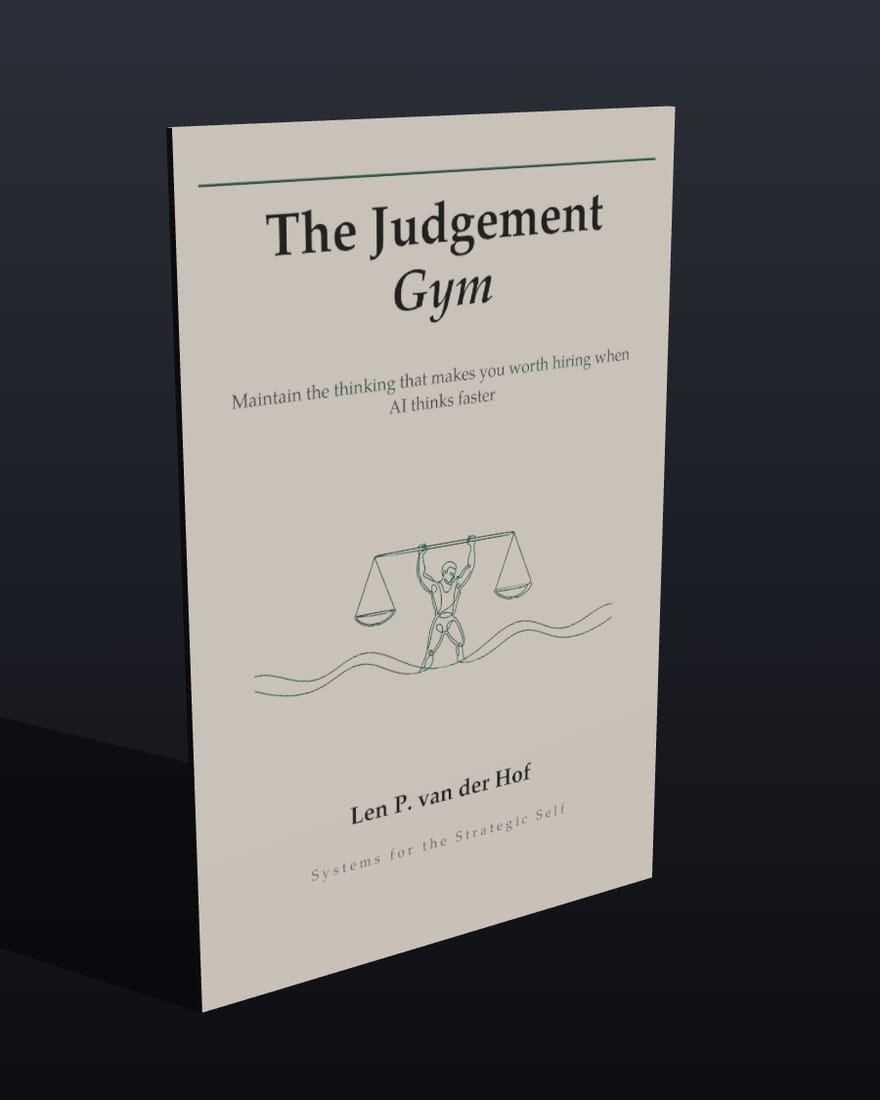
Kindle
The digital edition, ready in any Kindle app.
-
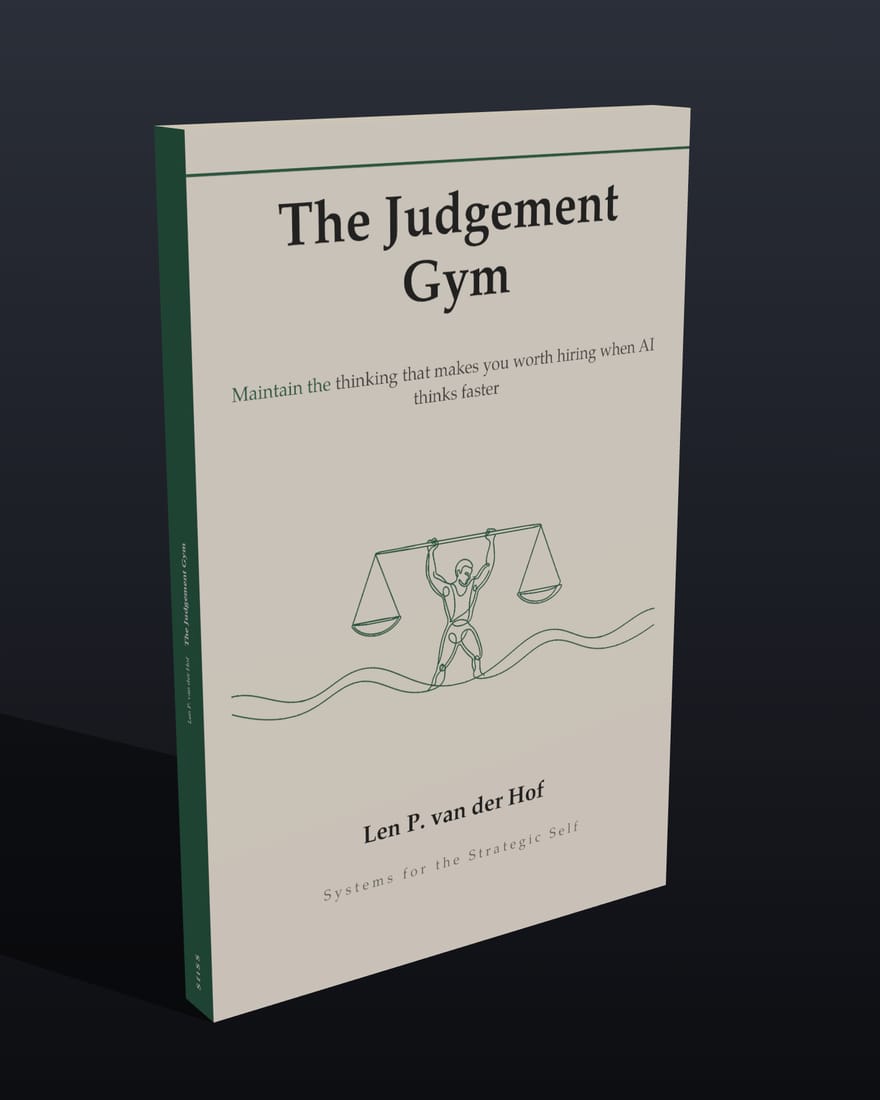
Paperback
The working copy. Mark it up. Take it into the meeting.


The book
Maintain the Thinking That Makes You Worth Hiring When AI Thinks Faster
You decide the way you always have: fast, by feel, on the experience you happen to have accumulated. Most of the time it works, so you never inspect the machinery underneath. Then a hire goes wrong, a price gets set out of habit, a call you cannot reverse gets made at the end of a long day, and you realize the quality of your judgment is something you have been hoping for, not building.
The usual advice is to trust your instincts and get more reps on the job. But unexamined repetition does not train judgment; it only rehearses whatever you already do, including the mistakes.
The Judgement Gym treats decision-making the way a serious athlete treats the body: as a capacity you improve on purpose, through deliberate load, measurement, and recovery. It introduces TRAIN, a system that turns scattered decisions into structured practice, so the quality of your thinking compounds instead of drifting. It is the difference between logging hours and actually getting stronger.
What you learn
What this book puts in your hands
- The REPS protocol: Retain, Exercise, Pause, Selective delegation
- Train judgment alongside AI instead of letting it atrophy
- Know where to keep your hands on the decision
The framework
REPS, step by step
Retain, Exercise, Pause, Selective delegation
-
Retain
-
Exercise
-
Pause
-
Selective delegation
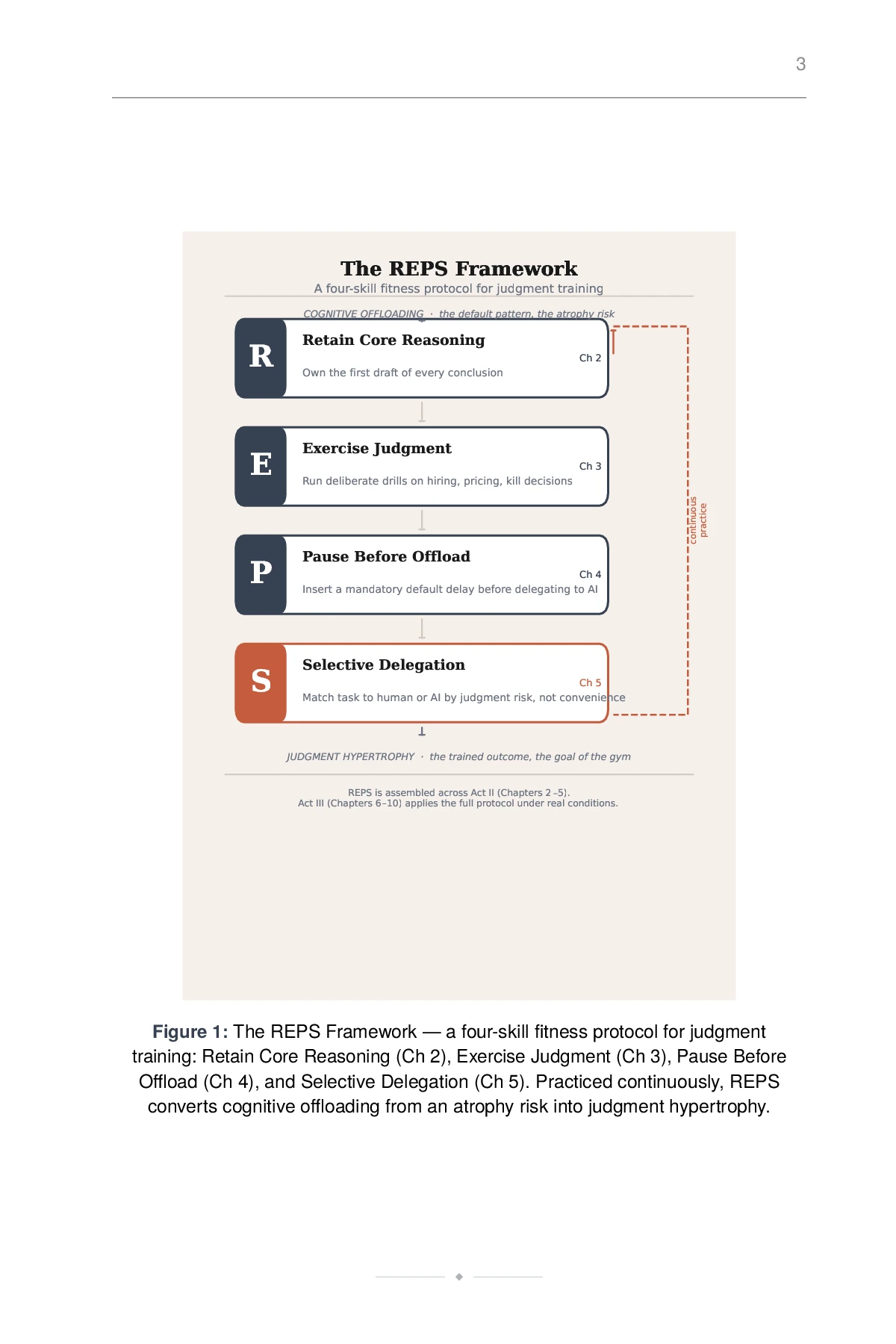
From the book
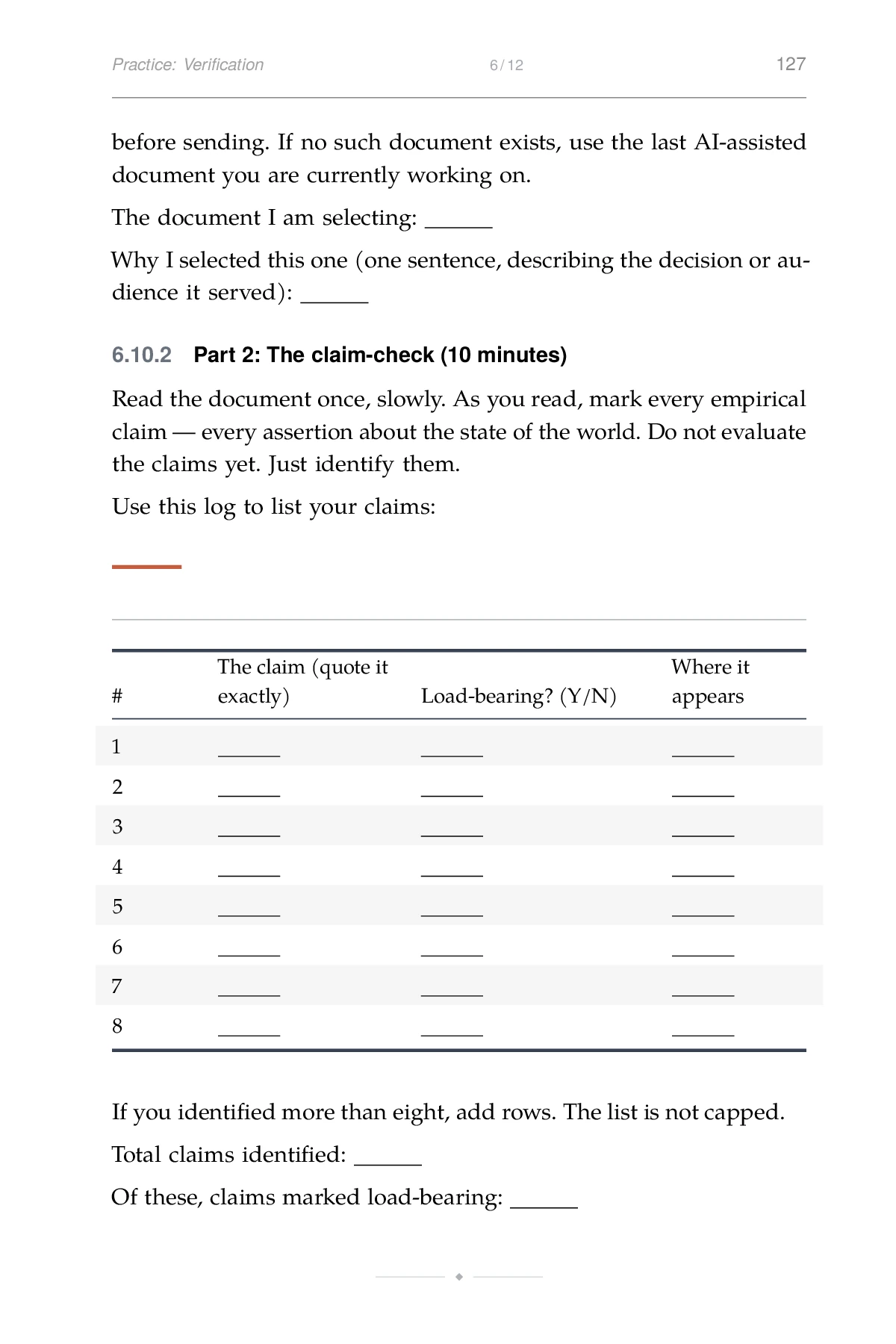
The REPS Framework — a four-skill fitness protocol for judgment training: Retain Core Reasoning (Ch 2), Exercise Judgment (Ch 3), Pause Before
The Judgement Gym, printed page: The REPS Framework — a four-skill fitness protocol for judgment training: Retain Core Reasoning (Ch 2), Exercise Judgment (Ch 3), Pause Before
Inspect more pagesLook inside
Pages from the print edition.
 The REPS Framework — a four-skill fitness protocol for judgment training: Retain Core Reasoning (Ch 2), Exercise Judgment (Ch 3), Pause Before
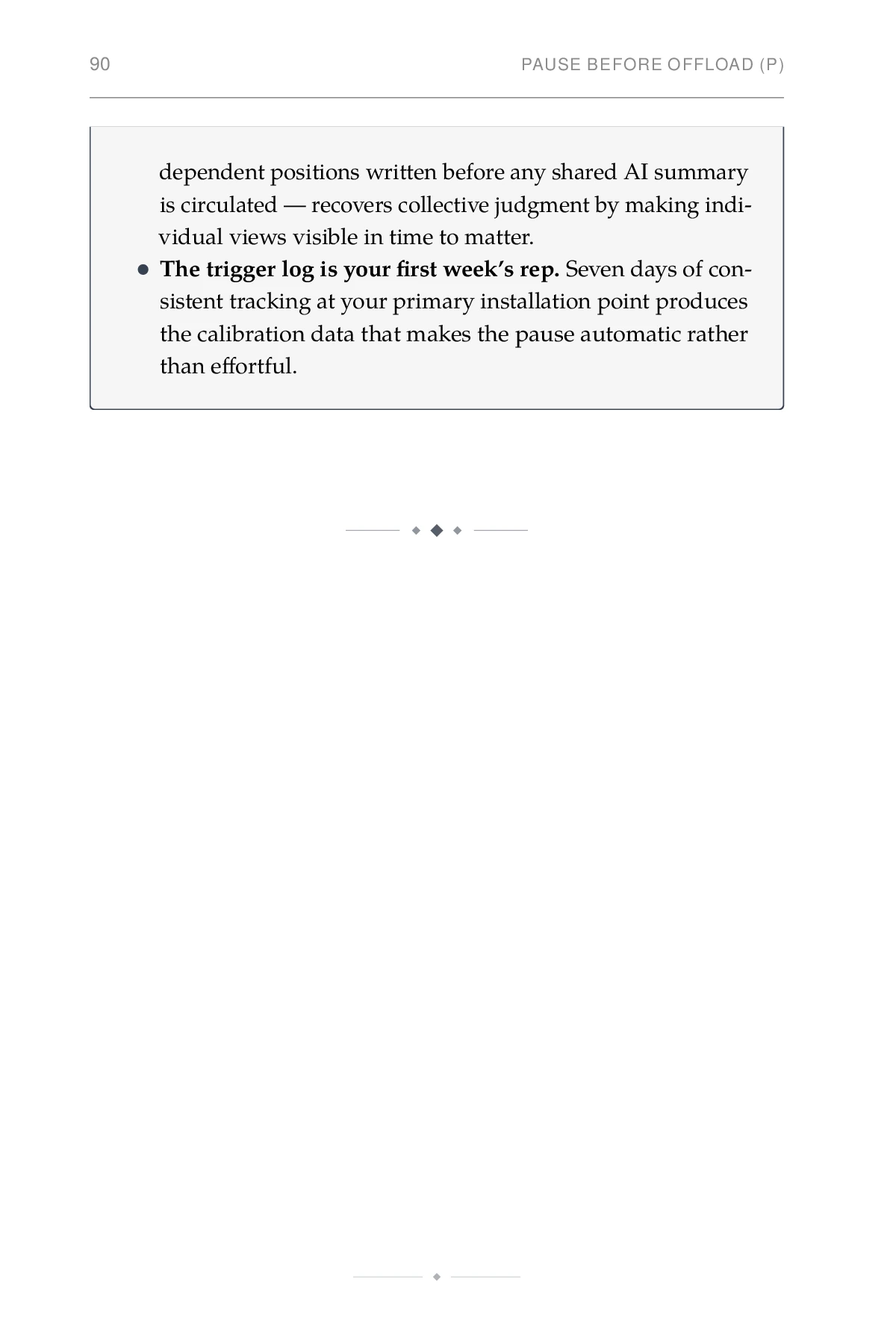
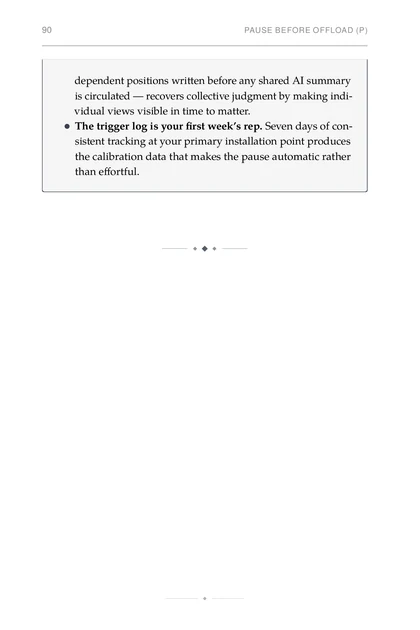 dependent positions written before any shared AI summary
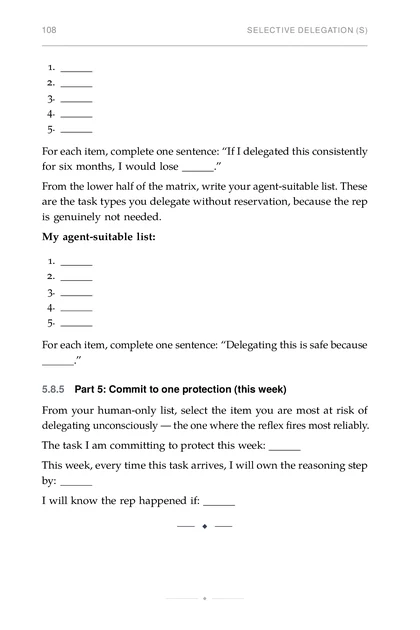 1.
1.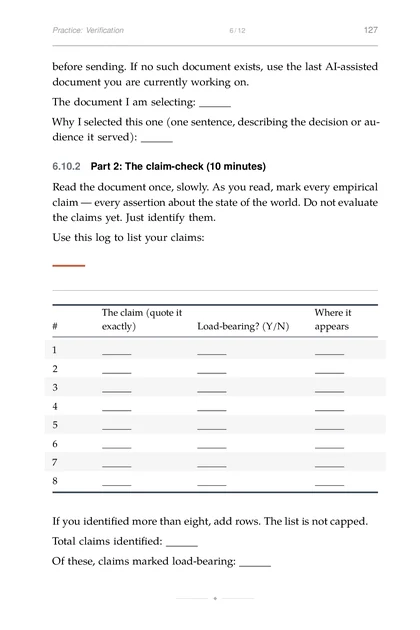 before sending. If no such document exists, use the last AI-assisted
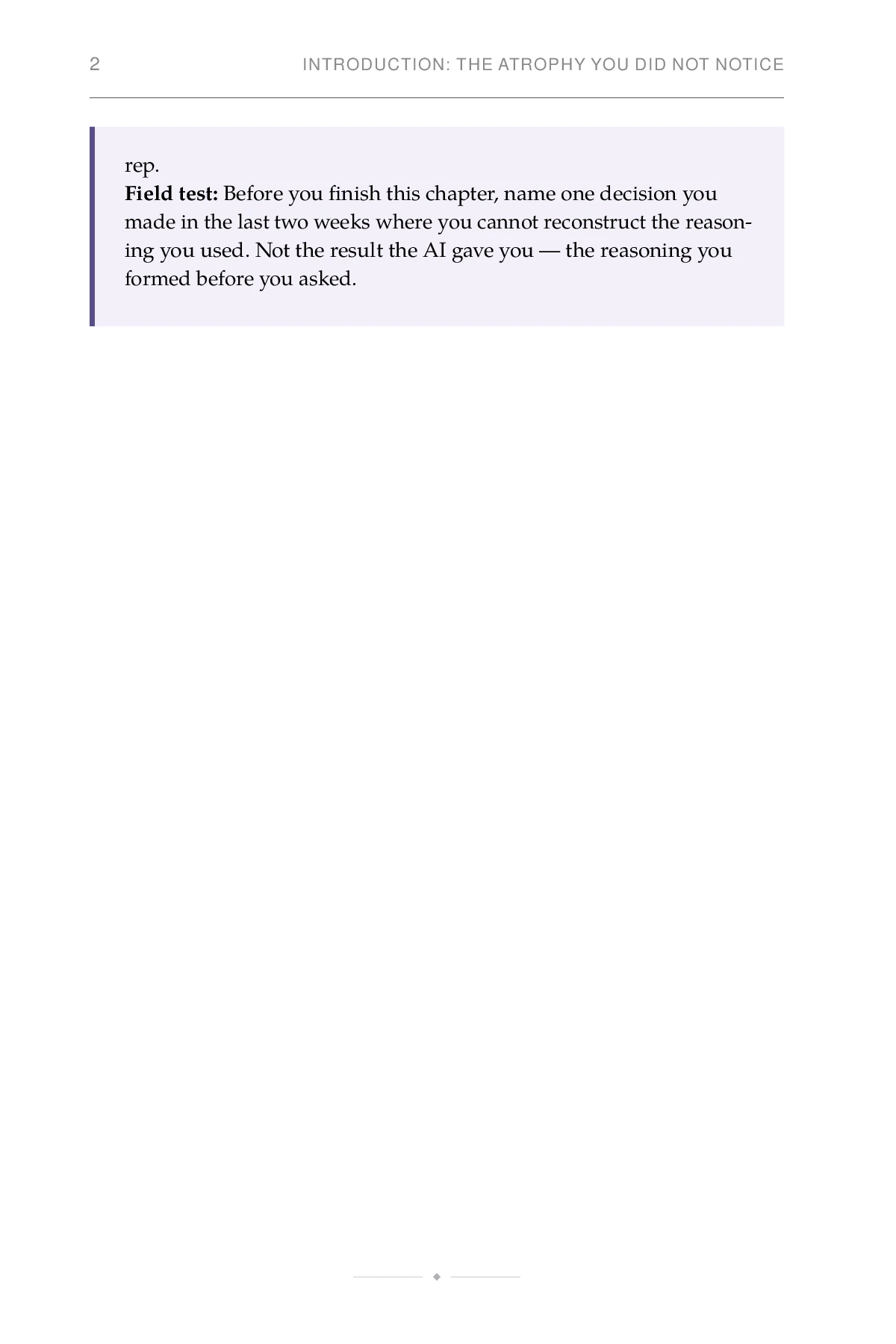
 rep.
rep.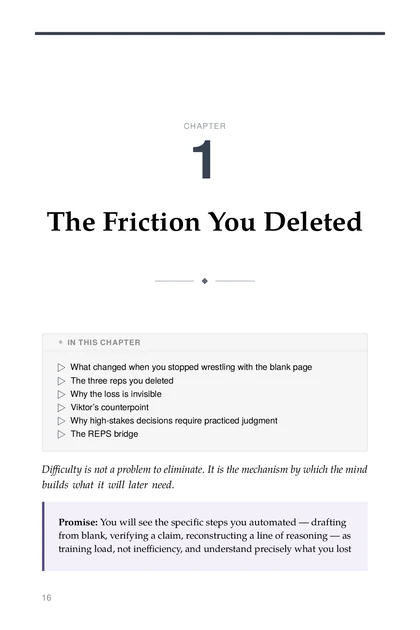 CHAPTER
 CHAPTER
 them, that recognition is the point, not a coincidence.
 CHAPTER

The contents
Chapter by chapter
Every chapter of The Judgment Gym with its printed epigraph, what you can do afterwards, and the moment it is built for.
Introduction
Introduction: The Atrophy You Did Not Notice
The gym you stopped going to does not send a warning. It simply waits while you lose the strength you did not notice you were losing.
What you can do afterwards
You will name the mechanism by which fluent AI output makes judgment atrophy invisible — and you will understand why this book offers a training protocol, not a critique of how you work.
Use this chapter when
You sense that thinking from scratch feels harder than it used to, or that you struggle to reconstruct your own reasoning after an AI-assisted decision.
Chapter 1
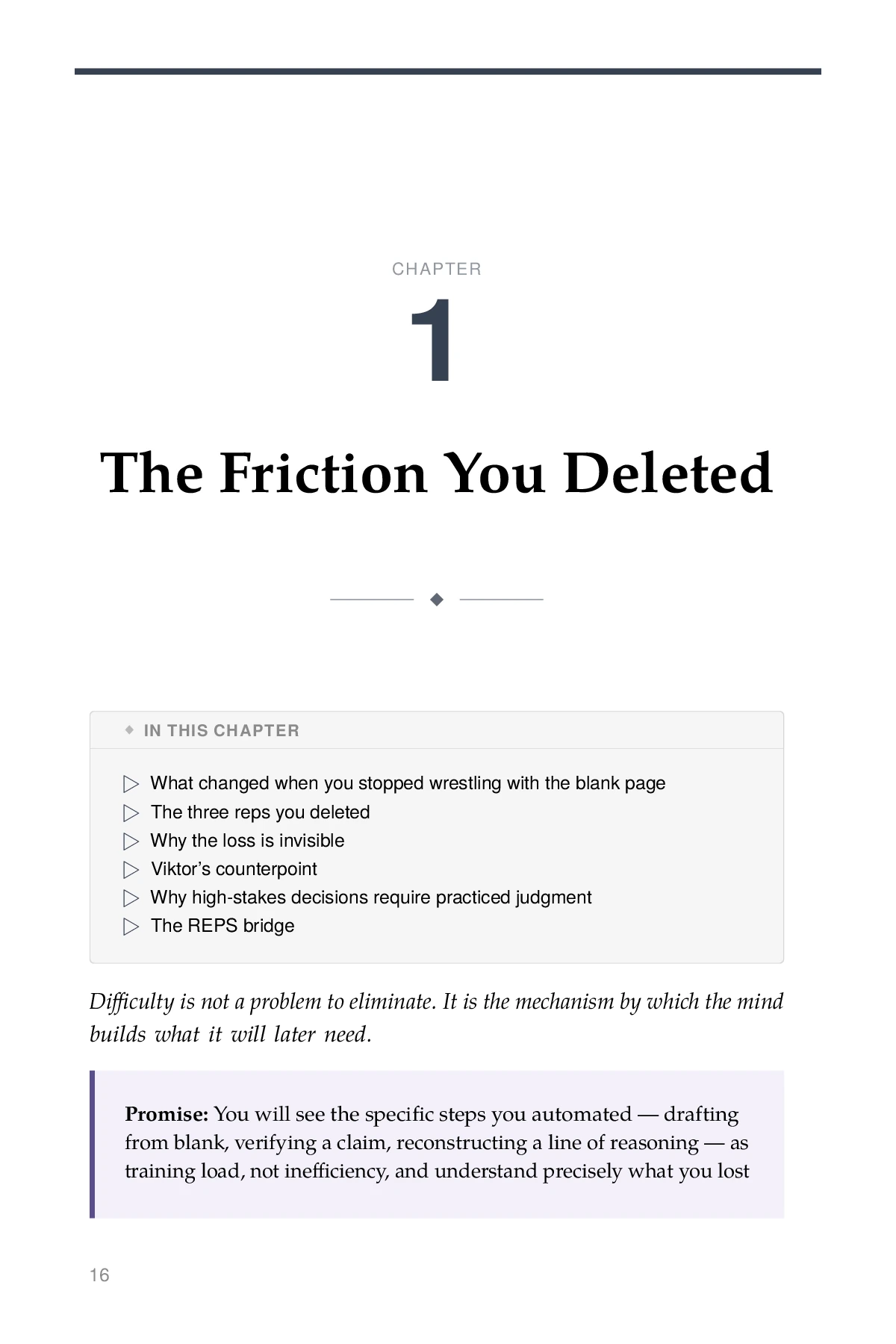
The Friction You Deleted
Difficulty is not a problem to eliminate. It is the mechanism by which the mind builds what it will later need.
What you can do afterwards
You will see the specific steps you automated — drafting from blank, verifying a claim, reconstructing a line of reasoning — as training load, not inefficiency, and understand precisely what you lost by removing them.
Use this chapter when
You have the nagging sense that decisions feel harder than they used to, or that you cannot quite explain your reasoning on a call, or that you reach for a tool before you have finished forming the thought.
Chapter 2
Retain Core Reasoning (R)
You cannot verify a conclusion you never formed. The first rep is the one you almost always skip.
What you can do afterwards
You leave this chapter able to apply the "own the conclusion first" rule to a real hiring, pricing, or strategy decision this week — and you understand why R is the load-bearing skill the other three REPS letters rest on.
Use this chapter when
You are about to open a frontier model, paste in a problem, and accept the first coherent answer — without pausing to form your own position first.
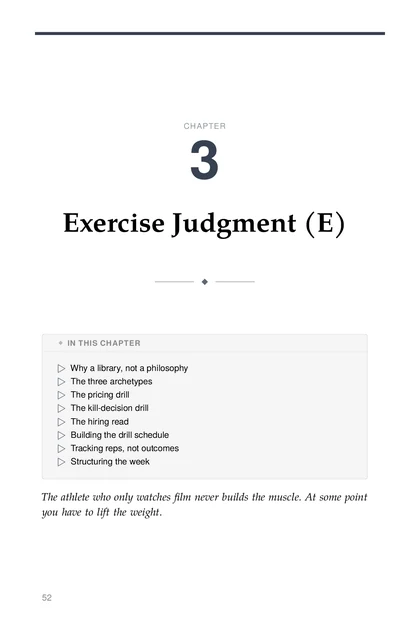
Chapter 3
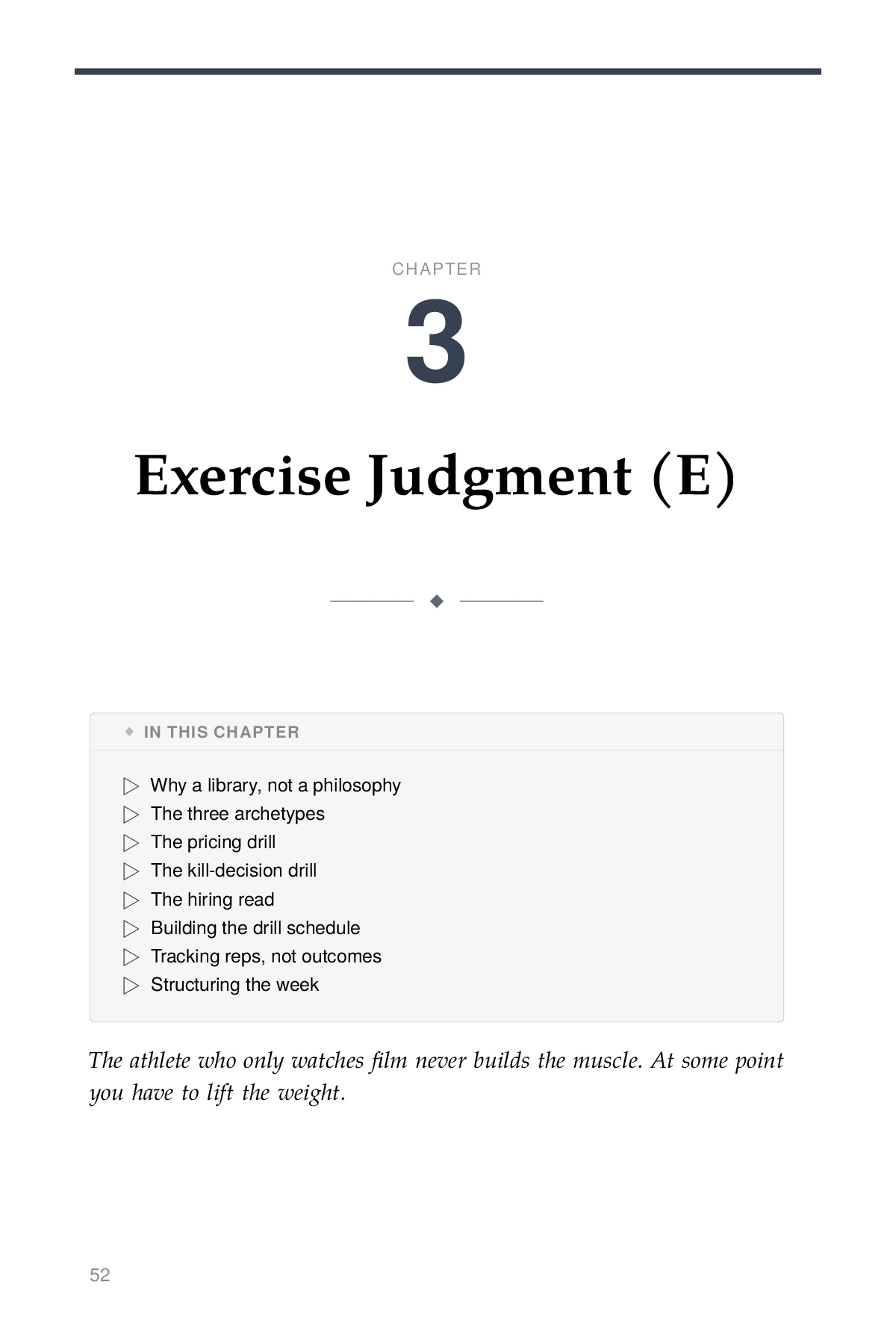
Exercise Judgment (E)
The athlete who only watches film never builds the muscle. At some point you have to lift the weight.
What you can do afterwards
You will build a personal drill library — a small set of recurring decision exercises on hiring, pricing, and kill decisions — and a practice log format that tracks reps, not outcomes.
Use this chapter when
You have installed Retain Core Reasoning (R) from Chapter 2 and are ready to add the second skill: deliberate, scheduled practice on the decision types where judgment matters most.
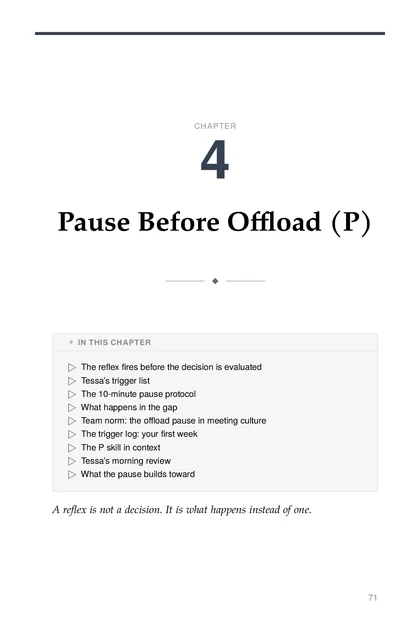
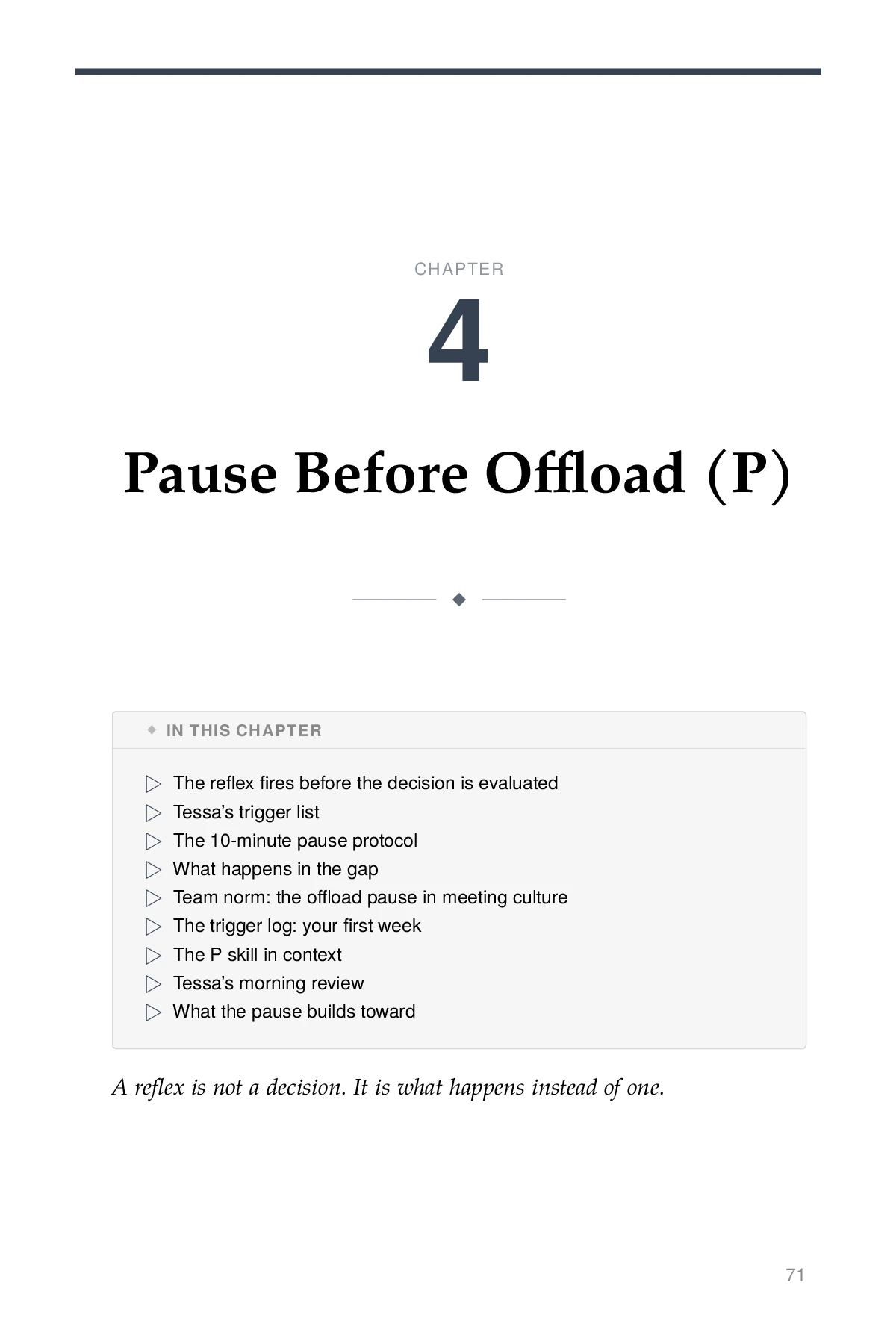
Chapter 4
Pause Before Offload (P)
A reflex is not a decision. It is what happens instead of one.
What you can do afterwards
You leave this chapter with a personal trigger list — eight or more moments when you reach for AI before thinking — and a 10-minute pause protocol you can install in your workflow before the end of the week.
Use this chapter when
You notice you have already pasted a problem into a tool before you had finished forming the question — or when your team's default response to any uncertainty is "let's ask the model."
Chapter 5
Selective Delegation (S)
The question is not whether you delegate. The question is whether the criterion for what you delegate is judgment risk — or just convenience.
What you can do afterwards
You leave this chapter with a personal delegation matrix — a two-axis grid that sorts your actual task list by judgment risk and time sensitivity — and a clear, articulable set of criteria for what you delegate to AI versus what you keep.
Use this chapter when
You have run the pause protocol from Chapter 4 for at least a week and have begun to notice which of your offload moments carry real judgment stakes and which do not. The delegation matrix converts that raw observation into a durable operating rule.
Chapter 6
The Verification Layer
The document looked finished. It was not. It had only learned to look that way.
What you can do afterwards
You leave this chapter with a four-step verification checklist you can apply to any AI-assisted output, and the ability to identify the four red flags that reliably signal fluency without accuracy.
Use this chapter when
You are about to send, publish, or act on any document, analysis, or recommendation that was drafted or substantially shaped by an AI tool, especially when the output reads well and sounds confident.
Chapter 7
Judgment Under Speed
Speed is a training condition, not a permission slip.
What you can do afterwards
You leave this chapter with an abbreviated REPS sub-routine you can run in five minutes on any fast-moving decision — and a test for distinguishing genuine time pressure from the urgency reflex that masquerades as it.
Use this chapter when
A decision is arriving faster than your full judgment protocol allows, or when you catch yourself using speed as the reason to skip the rep entirely.
Chapter 8
Team Judgment
Silence in a meeting is not agreement. Sometimes it is the sound of everyone deferring to the same confident source.
What you can do afterwards
You will be able to diagnose your team's current judgment culture and introduce at least one structural change — a devil's advocate rotation, a team drill log, or a meeting norm — before your next product review.
Use this chapter when
You notice that your team's meetings have become shorter and smoother since AI started summarizing the pre-reads — and you are not sure that is a good sign.
Chapter 9
Agents Without Atrophy
A system that acts on your behalf is not the same as a system that thinks on your behalf. Knowing where one ends and the other begins is the judgment you cannot delegate.
What you can do afterwards
You leave this chapter with a practical framework for redesigning agent workflows so the steps that require your judgment stay yours — while automating everything that is genuinely safe to hand over.
Use this chapter when
You run, or plan to run, any agent workflow that acts autonomously — sending messages, filing documents, making API calls, generating content, routing tasks — and you have not yet mapped which steps inside that workflow should never fire without your review.
Chapter 10
The 30-Day Gym Plan
Declaring an intention changes nothing. A scheduled rep does.
What you can do afterwards
You leave this chapter with a complete 30-day REPS protocol — four weeks of structured installation, daily drills, and checkpoint reviews — and three metrics that let you see your judgment fitness improving in real time.
Use this chapter when
You have read the book and want to stop reading and start training. Or you skimmed straight here because you needed a plan first and you will read the reasoning later. Either path works.
Conclusion
Conclusion: Worth Hiring
The test was never whether you could outthink the machine. It was whether you were the kind of person who would be accountable for what the machine said.
What you can do afterwards
You leave this chapter with a clear articulation of why practiced judgment is a strategic moat — not because AI reasons poorly, but because judgment carries properties that cannot be transferred to any model, at any capability level.
Use this chapter when
You have worked through the book and need to integrate what REPS is actually for — not as a productivity protocol, but as a claim about what makes you worth having in the room.
Who it is for
Who this book was written for
The result is not a more cautious version of you. It is an operator whose judgment holds under load, sharper after ten years of decisions instead of merely more confident.
If you are done leaving the most important skill you own to chance, this is the training you have been improvising without.
The reader it was written for
The fluent delegator. Uses AI for drafts, research, and analysis daily. Increasingly uncomfortable with how hard "thinking from scratch" feels. Wants to stay strategically valuable as models improve.
Also a fit for
The engineering leader responsible for team AI policy and judgment quality.
Editions
Editions and specifications
| Edition | Formats | Chapters | Pages | Reading time | ISBN (paperback) |
|---|---|---|---|---|---|
| English The Judgment Gym | In production | 12 | — | ± 4 hours | — |
| Dutch De oordeels-gym | In production | 12 | — | ± 4 hours | — |
Both editions are written natively. The Dutch text is not a machine translation of the English. · Trim size: 6x9″
Frequently asked
What readers usually want to know
What is The Judgment Gym about?
REPS is a training protocol for keeping judgment strong while AI accelerates analysis: retain, exercise, pause, and delegate selectively. The subtitle is: Maintain the Thinking That Makes You Worth Hiring When AI Thinks Faster.
What is the REPS framework?
REPS: Retain, Exercise, Pause and Selective delegation. Retain, Exercise, Pause, Selective delegation
Is there a Dutch edition?
Yes. The Dutch edition is De oordeels-gym, written as a native edition rather than a machine translation. It moves through the same production line.
How long is The Judgment Gym?
This edition runs 12 chapters and roughly 4 hours of reading.
Who is The Judgment Gym for?
If you are done leaving the most important skill you own to chance, this is the training you have been improvising without.
The production system
How this book was made
Every title moves through the same gated production line: sourced research, a claim-level evidence ledger, structural review, fact-checking, red-team critique, and a bilingual final edit. AI agents do specialist work inside those gates; judgment, voice, and accountability stay human.
- Claims enter an evidence ledger with a source and a confidence grade before they reach the page
- English and Dutch are two native editions, not a translation of one another
- Every chapter clears readability, rhythm, and style gates before it is typeset
The series
More in this theme


