

No. 57 · Active development · Founder psychology · PACT
The Deal Architect
Design High-Stakes Deals That Create Value and Protect Optionality
The Deal Architect: Design High-Stakes Deals That Create Value and Protect Optionality.
PACT helps operators design deals around power, alignment, constraints, terms, and future options instead of optimizing one visible number. Design High-Stakes Deals That Create Value and Protect Optionality. The framework: PACT.
- pages
- 202
- chapters
- 14
- hours of reading
- ± 3
- editions
- EN · NL
- Design
- Drafting
- Manuscript
- Production
- Launched
The editions
Kindle and Paperback
Production shots of the editions. Not for sale yet — this page is the public working version.
-
Kindle
The digital edition, ready in any Kindle app.
-
Paperback
The working copy. Mark it up. Take it into the meeting.


The book
Design High-Stakes Deals That Create Value and Protect Optionality
The term sheet arrives at 9pm on a Friday, and the number feels like proof you won. Nobody has mapped the other interested parties, nobody has written a walk-away, and the governance clause that reads as minor tonight becomes material at the next round. Six months later the regret is never the headline number. It is the board seat you traded too cheaply and the relationship capital you burned in the rush.
The reflex is to push harder or fold faster: treat every term as a zero-sum fight, or take the first credible offer as the best you will get. Both are reactive, and both leave value on the table, because both start after the other side has drawn the map.
This book treats the deal as a designed system, not a battle or a courtship. The Deal Architect introduces the PACT framework (Prepare the terrain, Align interests before positions, Concede strategically, Trade value rather than price): four moves that shape the outcome before you enter the room.
What you learn
What this book puts in your hands
- Build a BATNA while the deal is still possible, not the one you discover when it collapses.
- Draw the information map (what I know, what they know, what neither knows) and decide which asymmetries to close, exploit, or hold.
- Read a term sheet as the first operating agreement, where every clause allocates power for years.
- Write a walk-away as one pre-committed sentence the adrenaline of the room cannot override.
- Turn the four moves into a repeatable protocol your team runs on every high-stakes deal.
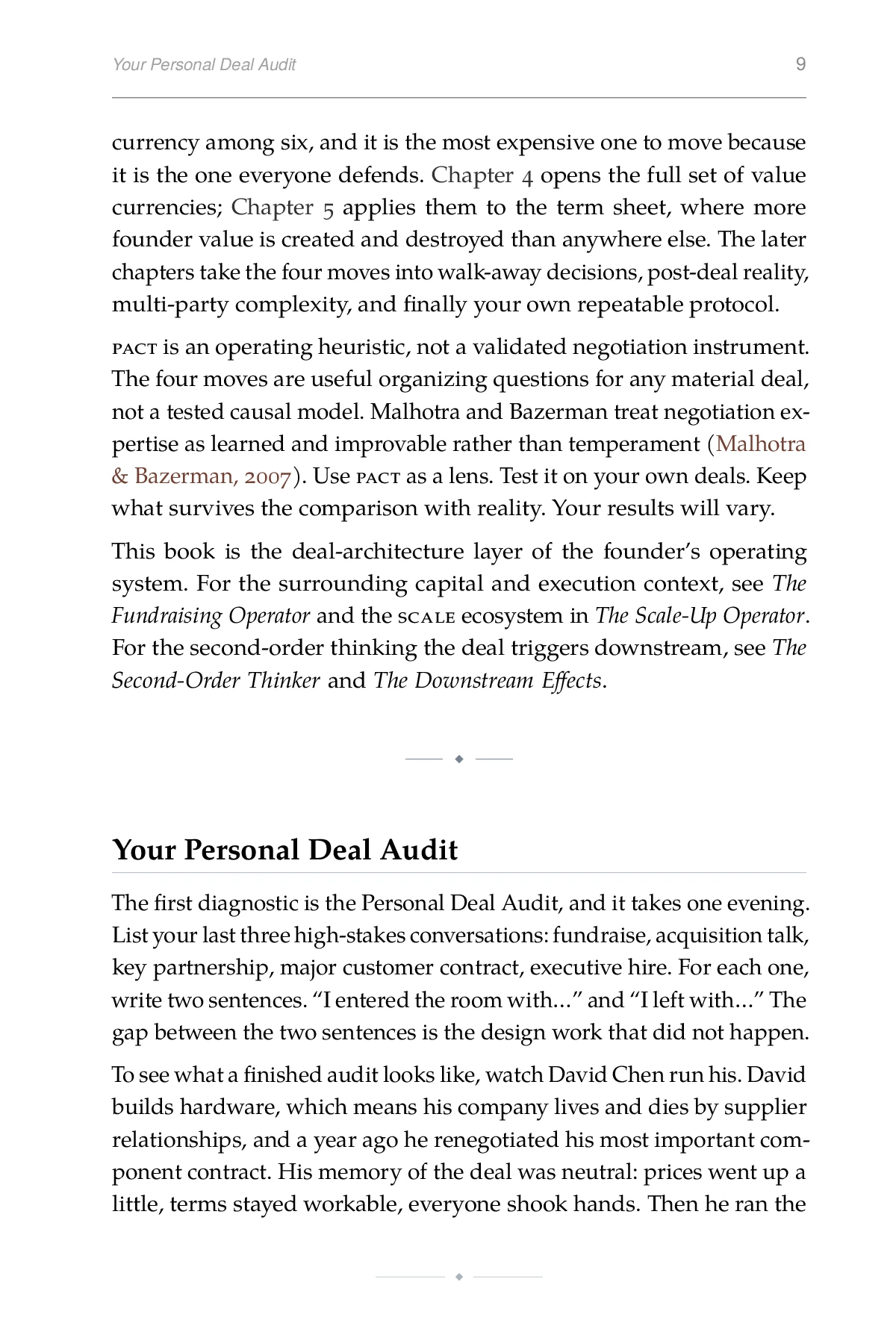
From the book
Your Personal Deal Audit
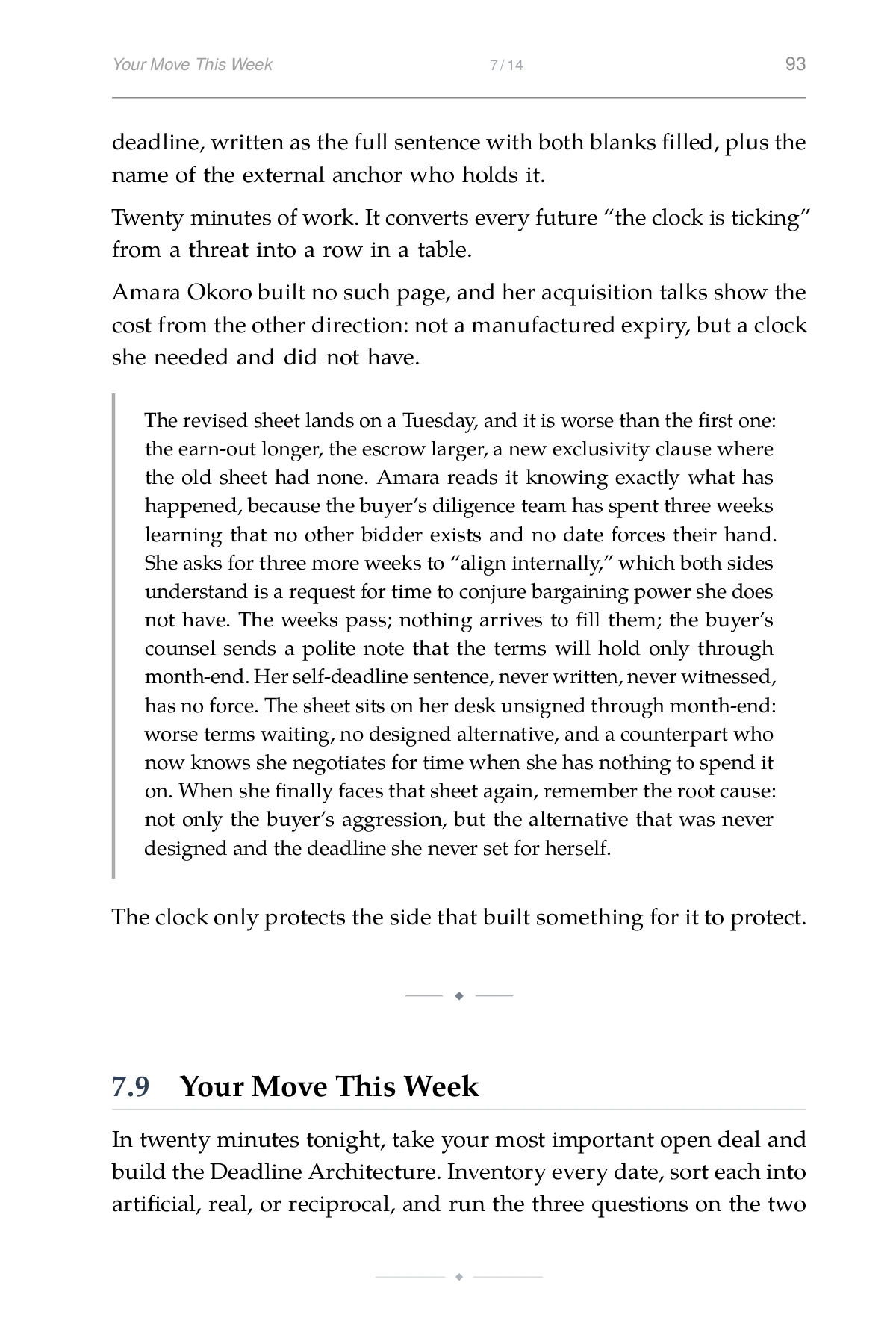
The Deal Architect, printed page: Your Personal Deal Audit
Inspect more pagesLook inside
Pages from the print edition.
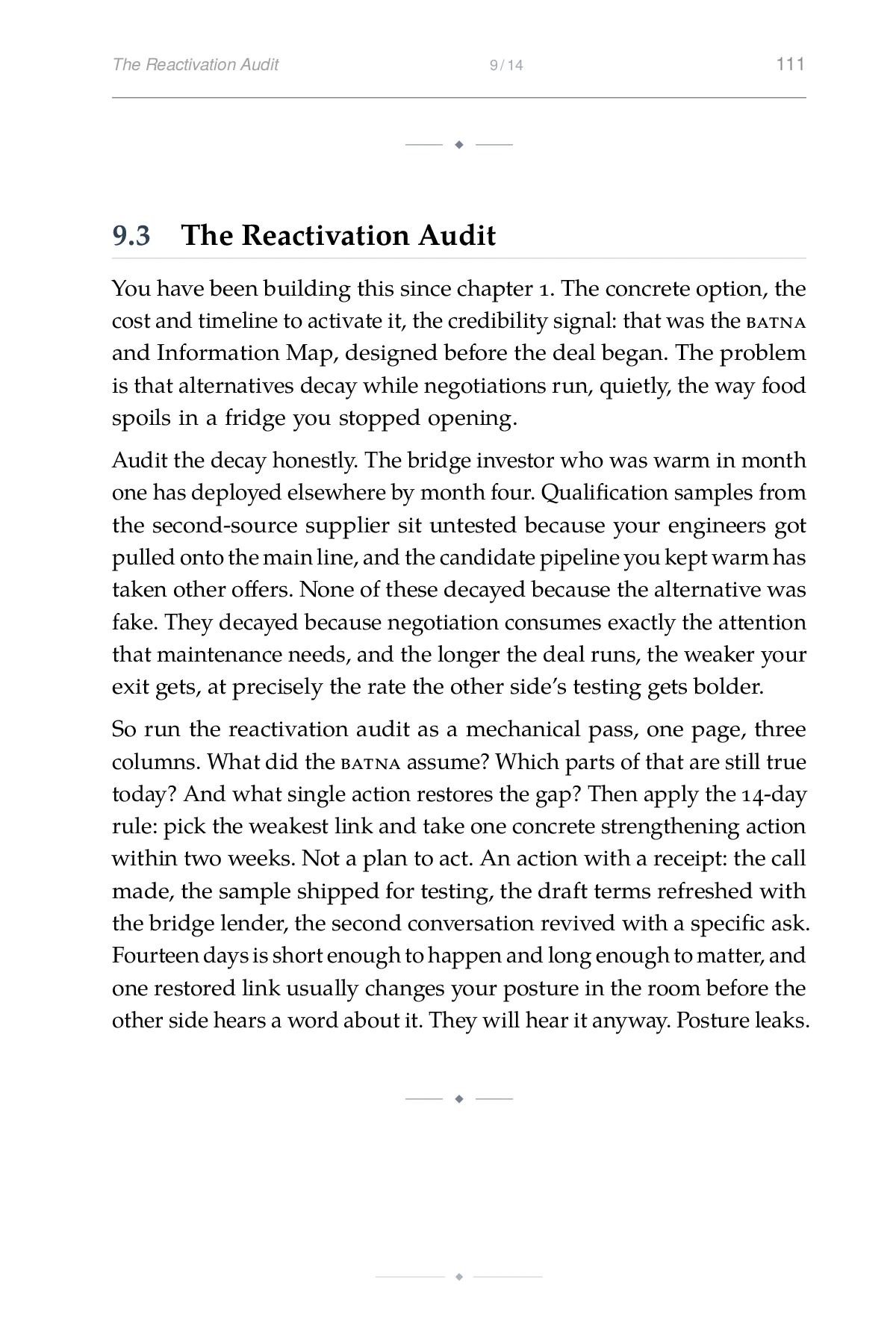
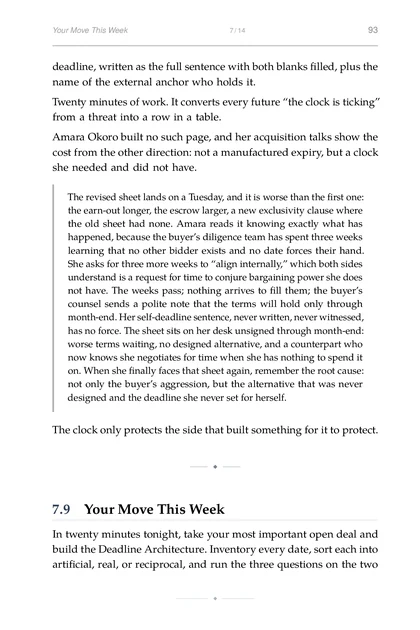 Your Move This Week 7 14 93
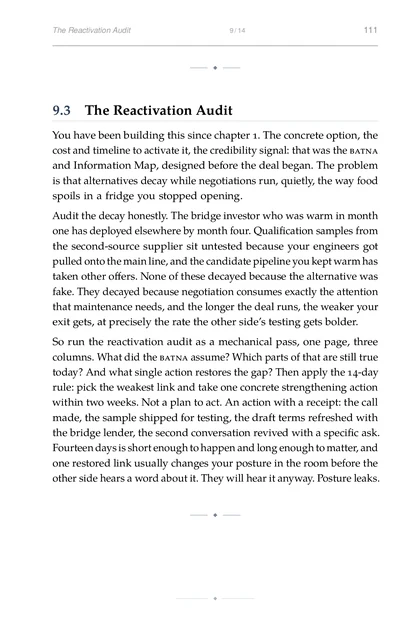 Audit the decay honestly. The bridge investor who was warm in month
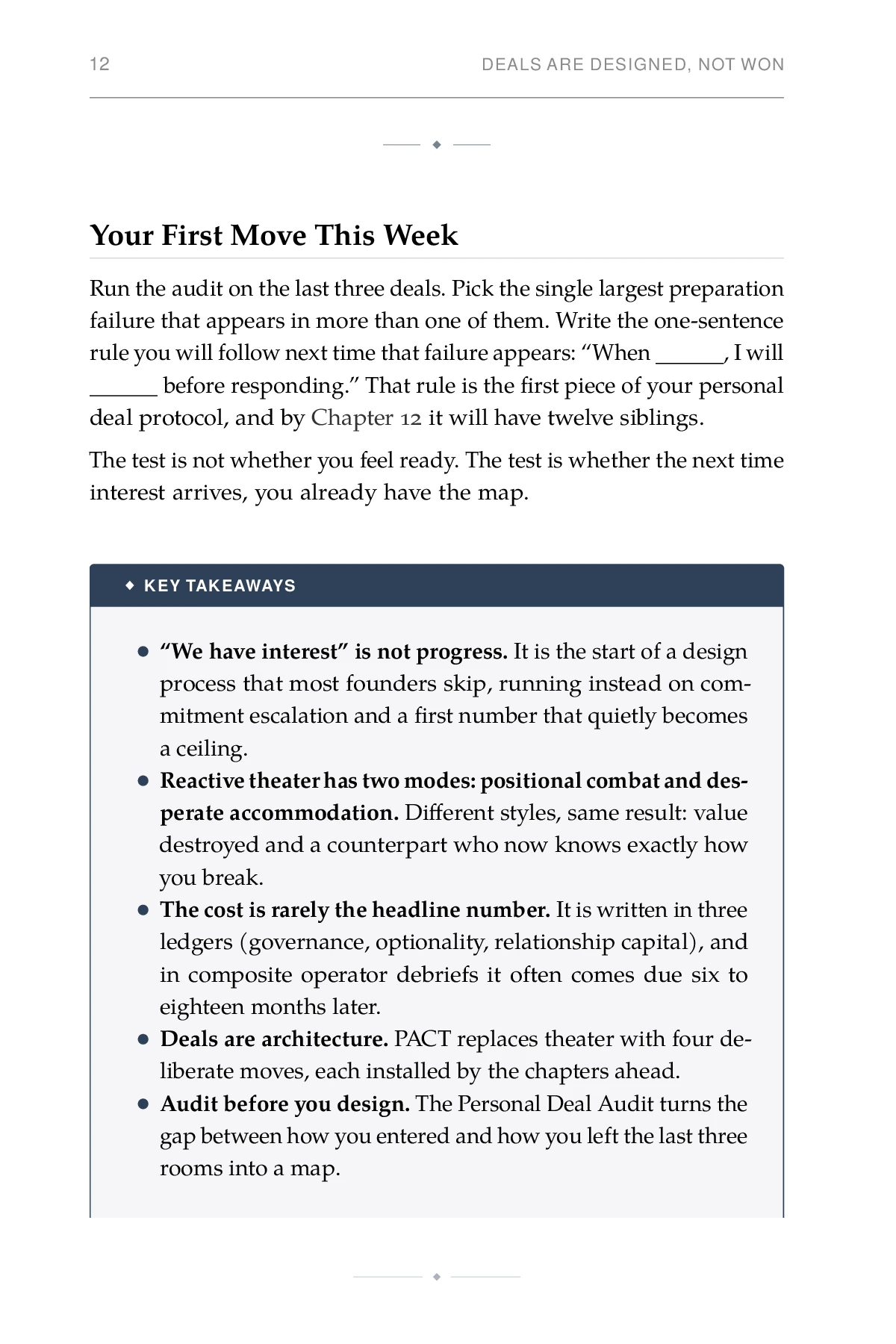
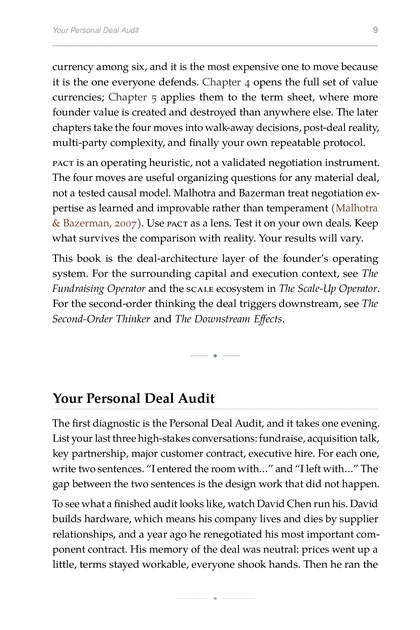 Your Personal Deal Audit
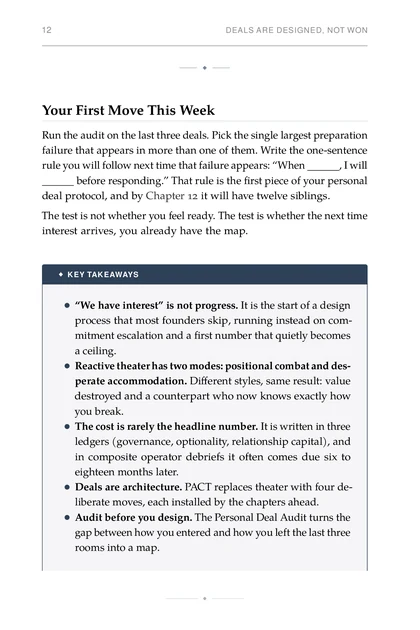 Your First Move This Week
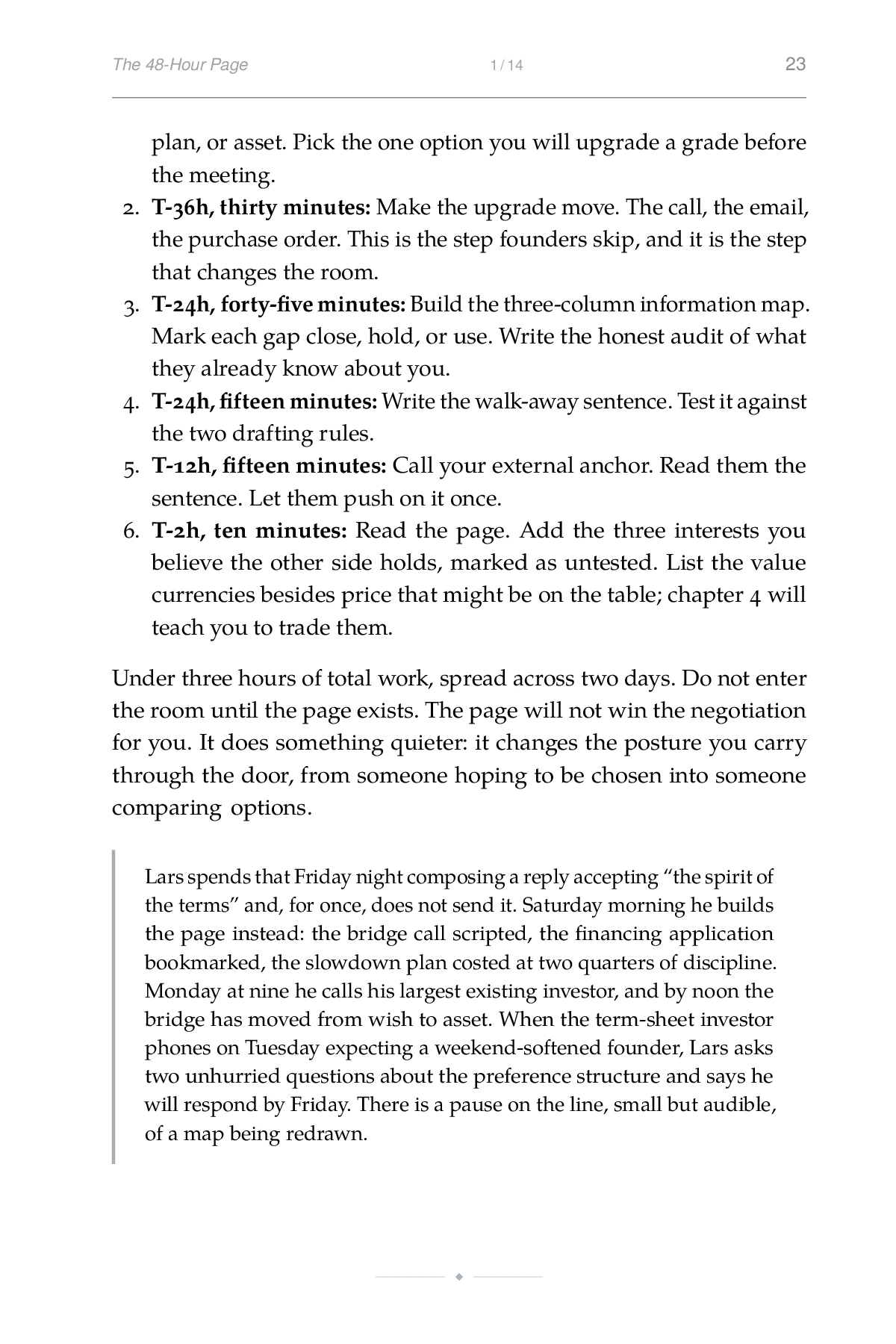
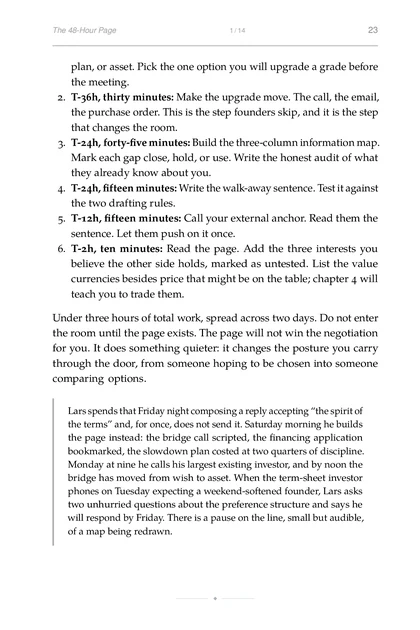 Mark each gap close, hold, or use. Write the honest audit of what
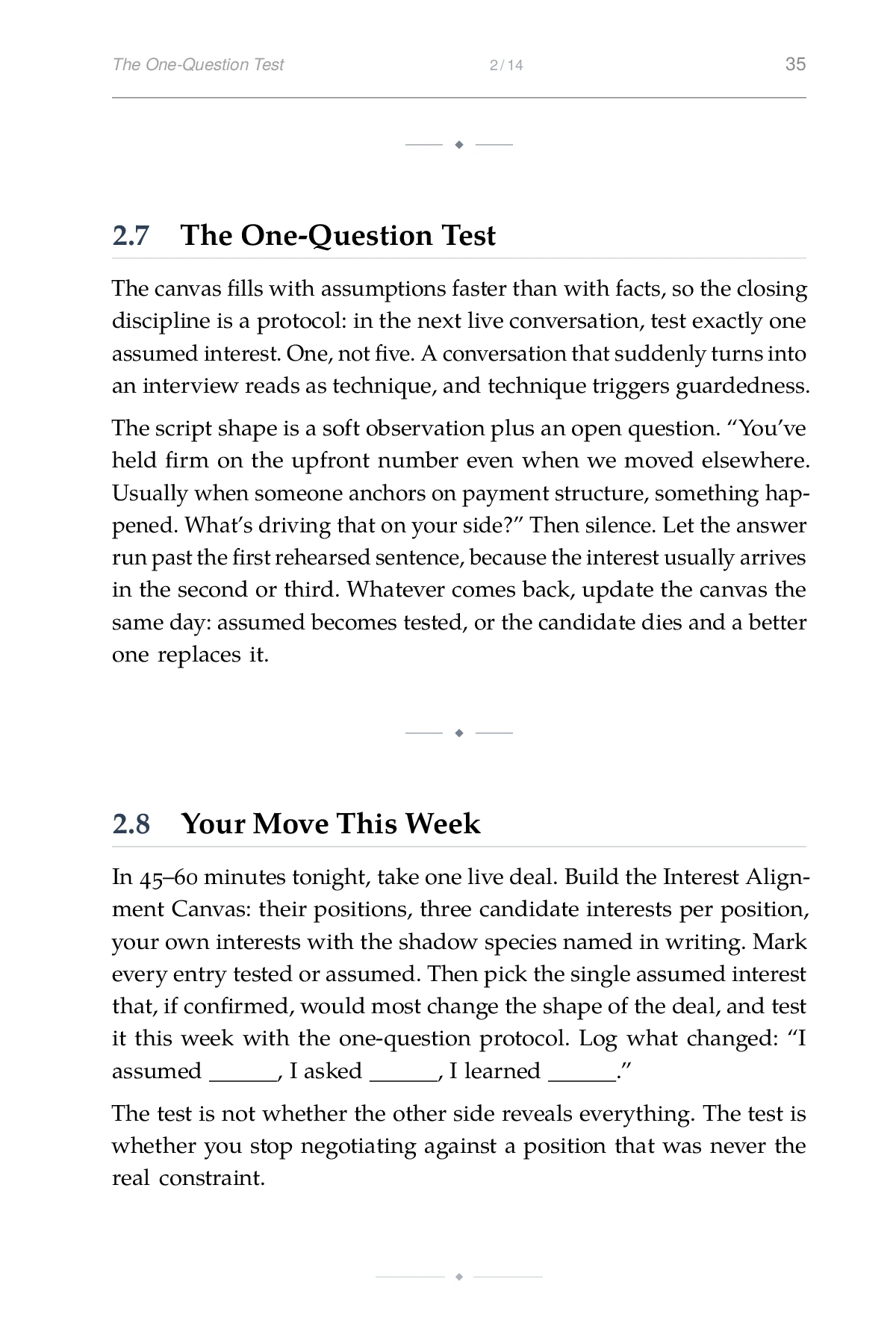
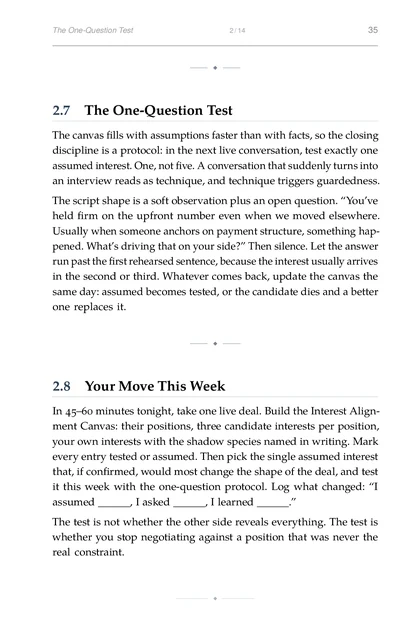 Usually when someone anchors on payment structure, something hap-
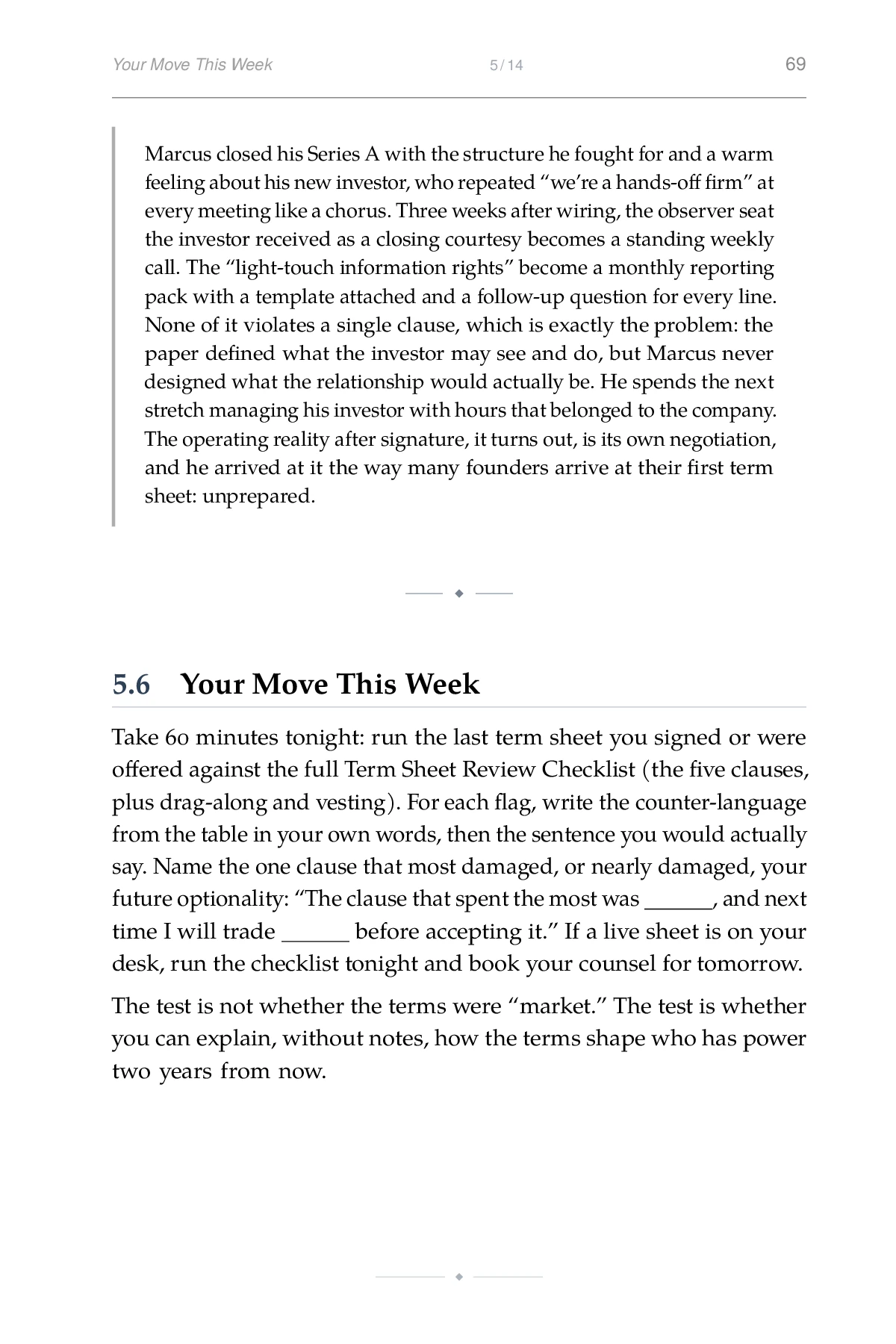
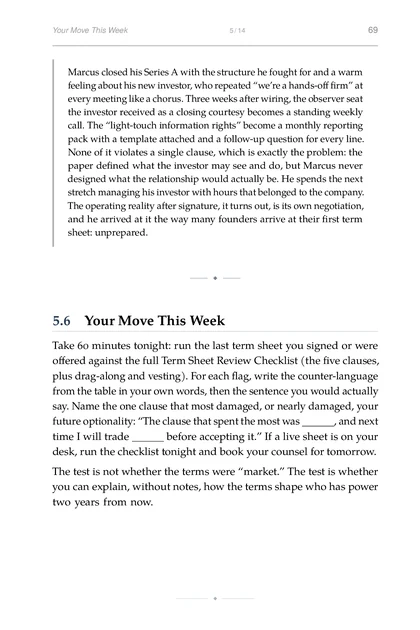 Your Move This Week 5 14 69
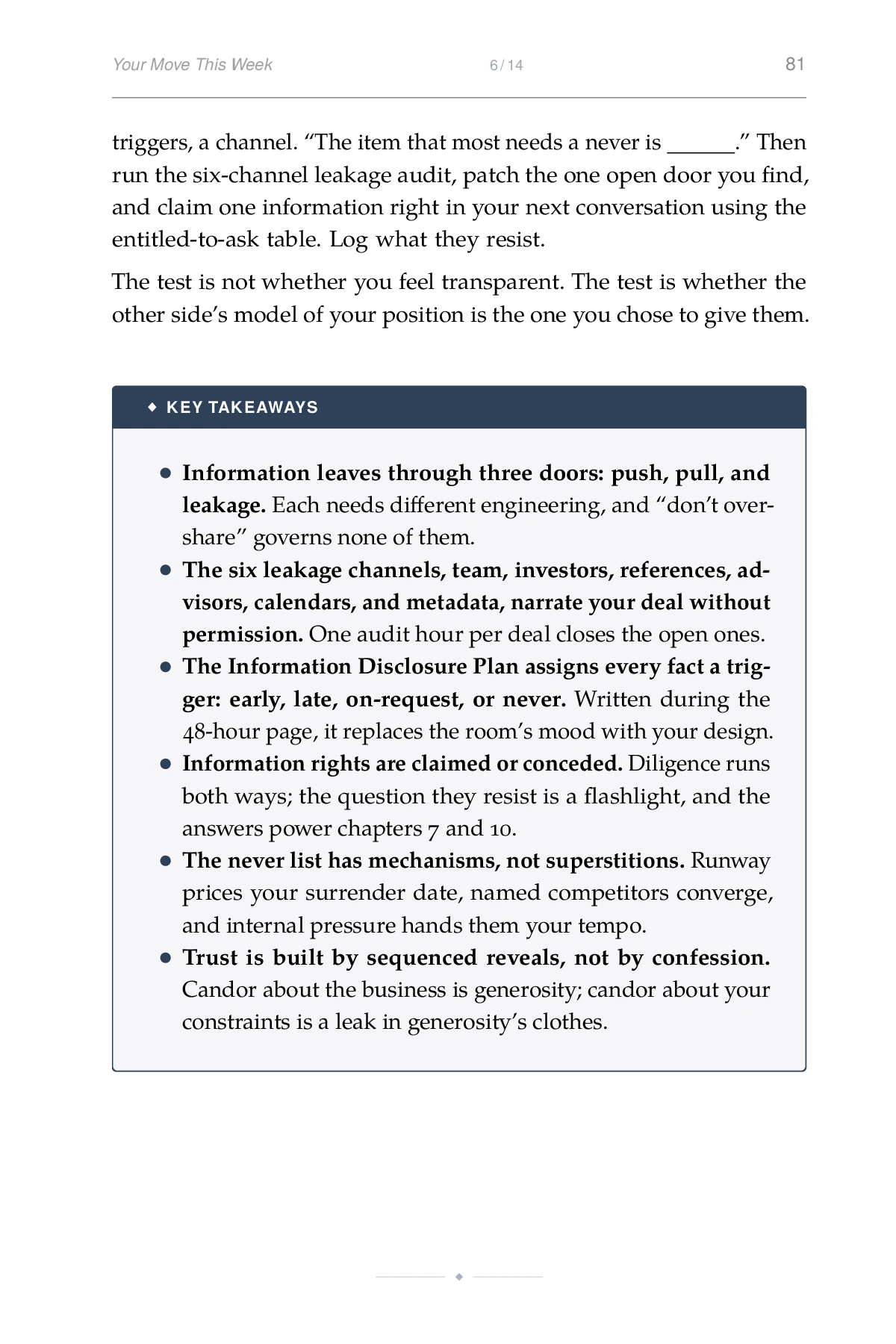
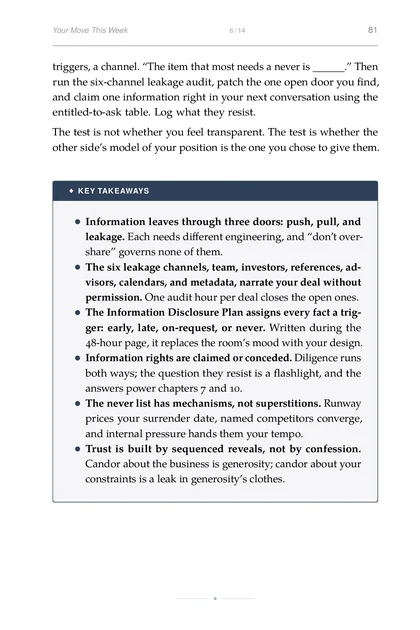 Your Move This Week 6 14 81
The contents
Chapter by chapter
Every chapter of The Deal Architect with its printed epigraph, what you can do afterwards, and the moment it is built for.
Introduction
Deals Are Designed, Not Won
Most high-stakes deal-making is reactive, positional, or relationship-driven theater that destroys long-term value and optionality. The first move is to treat the deal as a designed system rather than an event.
What you can do afterwards
You will audit your last three high-stakes deals with the Personal Deal Audit and name the single preparation failure that cost the most value or optionality.
Use this chapter when
You find yourself reacting to term sheets, acquisition interest, or partnership offers without a map.
Chapter 1
Prepare the Terrain
Information asymmetry, BATNA, and walk-away clarity must be deliberately engineered before any conversation begins. Preparation is not research; it is architecture.
What you can do afterwards
You will enter your next high-stakes conversation with a completed BATNA and Information Map and an explicit walk-away condition, built in one sitting.
Use this chapter when
Interest has arrived and the clock in your head has started.
Chapter 2
Align Interests Before Positions
Positions are symptoms; the real work is surfacing and aligning the underlying interests before anyone starts trading numbers. Alignment is the move that makes every later trade possible.
What you can do afterwards
You will build an Interest Alignment Canvas for a live deal and name the one interest the other side has not yet voiced.
Use this chapter when
You are negotiating over stated demands and the conversation feels stuck on numbers or terms.
Chapter 3
Concede Strategically
Every concession must be planned in advance, traded for something of value, and never handed over for free or to "be reasonable." Concession is a design move, not a social reflex .
What you can do afterwards
You will run a Concession Log on your last deal, plan the trades for your next one, and stop moving without receiving.
Use this chapter when
You feel pressure to "be reasonable" or close the gap quickly.
Chapter 4
Trade Value, Not Price
Before you divide the pie, expand it. Six value currencies move every material deal, and price is the laziest and most expensive of them. The architecture is in the other five.
What you can do afterwards
You will build a Value Trade Matrix for a live deal and lead with the currency the other side values more than price.
Use this chapter when
The conversation has collapsed to a single number and both sides are digging in.
Chapter 5
The Architecture of Term Sheets
Term sheets are not neutral documents; every clause shapes who has power and who captures value for years. The paper is the first operating agreement.
What you can do afterwards
You will run the Term Sheet Review Checklist on the next sheet you receive and name the one clause that most damages future optionality.
Use this chapter when
You have received a term sheet that "looks mostly standard."
Chapter 6
Information Architecture in Deals
In high-stakes deals, the architecture of information, what you reveal, when, and to whom, is often more decisive than the price or terms themselves . Information is optionality before it is data.
What you can do afterwards
You will build an Information Disclosure Plan that assigns every material fact you hold a trigger: early, late, on-request, or never.
Use this chapter when
You are about to share data, references, or plans in a negotiation.
Chapter 7
Deadlines and Momentum
Deadlines are design tools. The side that controls the clock usually controls the outcome, and momentum is not urgency: it is engineered movement on a tempo you chose.
What you can do afterwards
You will sort every deadline in your current deal into artificial, real, or reciprocal, run the three-question test on each, and design one counter-deadline that protects you. The Deadline Architecture is the artifact you leave with.
Use this chapter when
The other side sets a timeline that feels urgent and you notice yourself reacting instead of designing.
Chapter 8
The Human Layer
Ego, trust, and relationship are three separate design variables in every high-stakes deal. Ignore any one of them and you will pay in the terms, or in the years after the terms. People are not obstacles. They are the operating system the deal runs on.
What you can do afterwards
You will build the Relationship Map for your current deal, treating ego, trust, and relationship as three distinct variables, and design one move per person that costs you nothing on substance.
Use this chapter when
The conversation feels purely transactional, or someone on the other side is behaving in a way that makes no sense on paper.
Chapter 9
Walk-Away Power
The strongest position in any deal is the credible, prepared ability to leave it. That ability is designed, not hoped for, and walking away cleanly is often the highest-value outcome on the table.
What you can do afterwards
You will audit the BATNA you have been building since chapter 1, restore what decayed, and write the full Walk-Away Protocol: message, first 48 hours, honesty guard.
Use this chapter when
The terms are drifting against you and you feel the pull to "just close it."
Chapter 10
Post-Deal Architecture
The signed paper is the start of the real work. Chapter 5 designed the constitution; this chapter designs the government, because the operating reality after the ink determines whether the deal creates or destroys value over time.
What you can do afterwards
You will design the Post-Deal Operating Map before you sign: decision rights, information flow, escalation, rituals. At least one component gets negotiated while you still have the bargaining power to do it.
Use this chapter when
You are close to signing and the conversation has been entirely about the terms on the page.
Chapter 11
Multi-Party and Complex Deals
When more than two parties have skin in the game, the architecture must map coalitions, blockers, and shifting interests. Fail to draw that map and the deal will be captured by whoever understands it best. Two-party thinking does not degrade gracefully at scale; it collapses.
What you can do afterwards
You will build the Multi-Party Map for your most complex live deal: parties, wants, blockers, swing voters, influence lines. From it, you will pick one sequencing move or one coalition move that changes the game.
Use this chapter when
You are negotiating across more than two tables at once, or a third party keeps appearing inside a deal you thought had two sides.
Chapter 12
Building Your Deal Protocol
The four moves only become a repeatable advantage when they are synthesized into one living protocol that you and your team actually run on every high-stakes conversation. The protocol is the memory and the immune system.
What you can do afterwards
You will assemble the thirteen artifacts this book built into one living document, the Personal PACT Protocol, and run the full 48-hour ritual on your next material conversation.
Use this chapter when
Every high-stakes conversation still feels new and you are rebuilding the map from scratch each time.
Conclusion
The Architect Who Walks Away Stronger
Whether the deal closes or not, the architect who designs with PACT walks away with more optionality, better relationships, and a stronger reputation than the founder who treated it as a battle. The identity shift is permanent.
What you can do afterwards
You will write the one-sentence commitment that governs how you enter and leave every high-stakes deal for the next 12 months.
Use this chapter when
You have finished the book and the next term sheet, acquisition interest, or key partnership conversation is on the calendar.
Who it is for
Who this book was written for
The result is a discipline that compounds: you enter each room with a map, protect the optionality that matters after the signature, and walk away stronger whether the deal closes or not. It was written for the operator you are when the offer lands and the terms are yours.
The reader it was written for
Founders and operator-CEOs at Series A–C who negotiate 2–6 high-stakes deals per year (raises, acquisitions, key partnerships, executive hires, major customer or supplier contracts). They have "won" and "lost" deals and feel the long-term cost of both. Psychographics:
Probably not for you if
- High-volume sales or procurement negotiators.
- Corporate development teams with M&A quotas.
- Readers seeking only "how to raise money".
Editions
Editions and specifications
| Edition | Formats | Chapters | Pages | Reading time | ISBN (paperback) |
|---|---|---|---|---|---|
| English The Deal Architect | In production | 14 | 202 | ± 3 hours | — |
| Dutch De deal architect | In production | 14 | 164 | ± 2 hours | — |
Both editions are written natively. The Dutch text is not a machine translation of the English.
Frequently asked
What readers usually want to know
What is The Deal Architect about?
PACT helps operators design deals around power, alignment, constraints, terms, and future options instead of optimizing one visible number. The subtitle is: Design High-Stakes Deals That Create Value and Protect Optionality.
Is there a Dutch edition?
Yes. The Dutch edition is De deal architect, written as a native edition rather than a machine translation. It moves through the same production line.
How long is The Deal Architect?
This edition runs 14 chapters, 202 pages in print and roughly 3 hours of reading.
Who is The Deal Architect for?
The result is a discipline that compounds: you enter each room with a map, protect the optionality that matters after the signature, and walk away stronger whether the deal closes or not. It was written for the operator you are when the offer lands and the terms are yours.
The production system
How this book was made
Every title moves through the same gated production line: sourced research, a claim-level evidence ledger, structural review, fact-checking, red-team critique, and a bilingual final edit. AI agents do specialist work inside those gates; judgment, voice, and accountability stay human.
- Claims enter an evidence ledger with a source and a confidence grade before they reach the page
- English and Dutch are two native editions, not a translation of one another
- Every chapter clears readability, rhythm, and style gates before it is typeset
The series
More in this theme


