

No. 46 · Active development · Decisions & philosophy
Decision-Making Under Chaos
A Practical Toolkit for High-Stakes Decisions Under Uncertainty
Five questions that hold up any high-stakes call when the conditions are genuinely bad
Most decision frameworks assume you have time to think. Founders and operators rarely do. This book gives you a single portable protocol for making defensible decisions when information is incomplete, emotions are loud, and the clock is running. Built on decision science and distilled into five questions, it runs fast enough to matter and holds up when the pressure is off. The sequel to Stoic Systems for Decision-Making.
- pages
- 260
- chapters
- 11
- hours of reading
- ± 3
- editions
- EN · NL
- Design
- Drafting
- Manuscript
- Production
- Launched
The editions
Kindle and Paperback
Production shots of the editions. Not for sale yet — this page is the public working version.
-
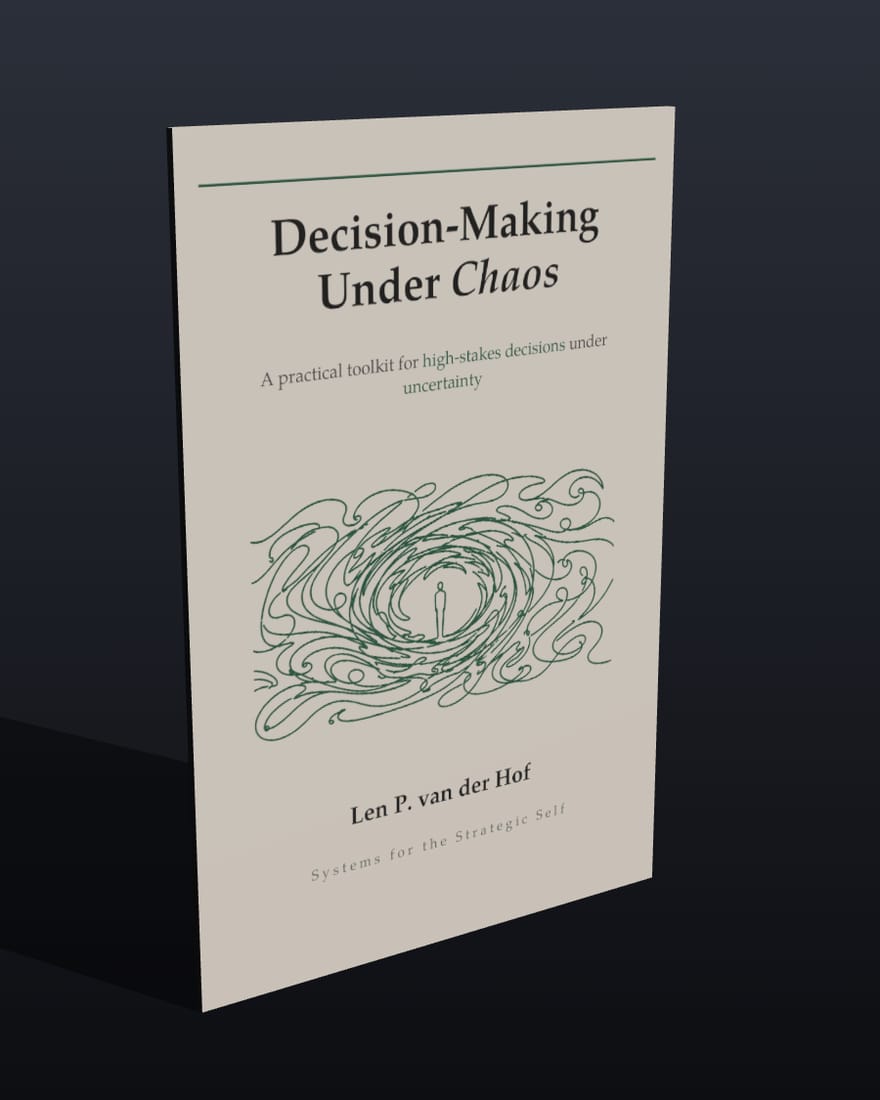
Kindle
The digital edition, ready in any Kindle app.
-
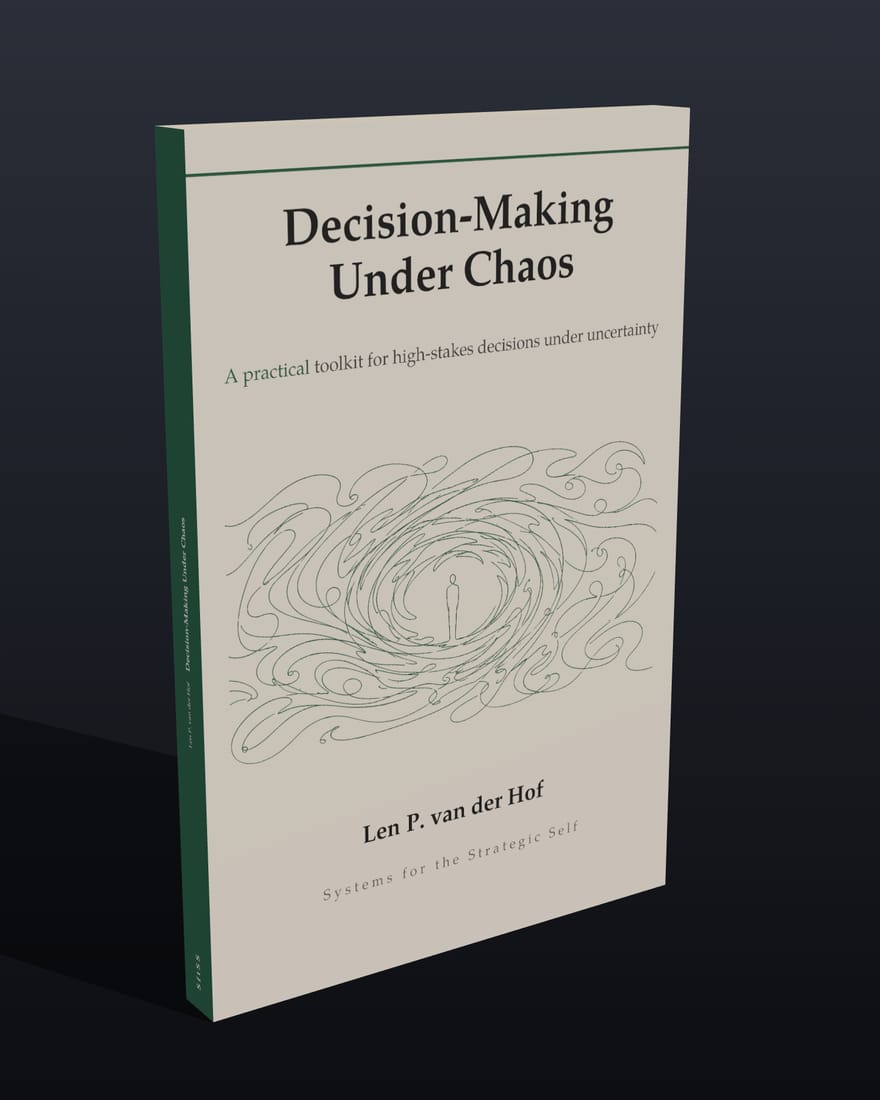
Paperback
The working copy. Mark it up. Take it into the meeting.


The book
A Practical Toolkit for High-Stakes Decisions Under Uncertainty
The term sheet expires in twenty-six hours. The data is partial, your co-founder disagrees, and the part of you that usually thinks clearly has gone quiet under the noise. So you stall, or you lunge, and either way you are deciding by reflex, then living with it for years.
The usual advice is to gather more information and trust your gut. Under genuine chaos, both fail: there is no time to gather, and the gut you are trusting is the one panic just hijacked.
Decision-Making Under Chaos gives founders and operators a single portable protocol for the conditions most frameworks were never built for. At its center is the 5-Question Chaos Filter: five questions, answered in order, that you can run in ten minutes and defend afterward. It does not chase the perfect call. It protects against the predictable ways smart people decide badly when the stakes are real and the clock is loud.
What you learn
What this book puts in your hands
- A five-question chaos filter you can run in ten minutes under real pressure
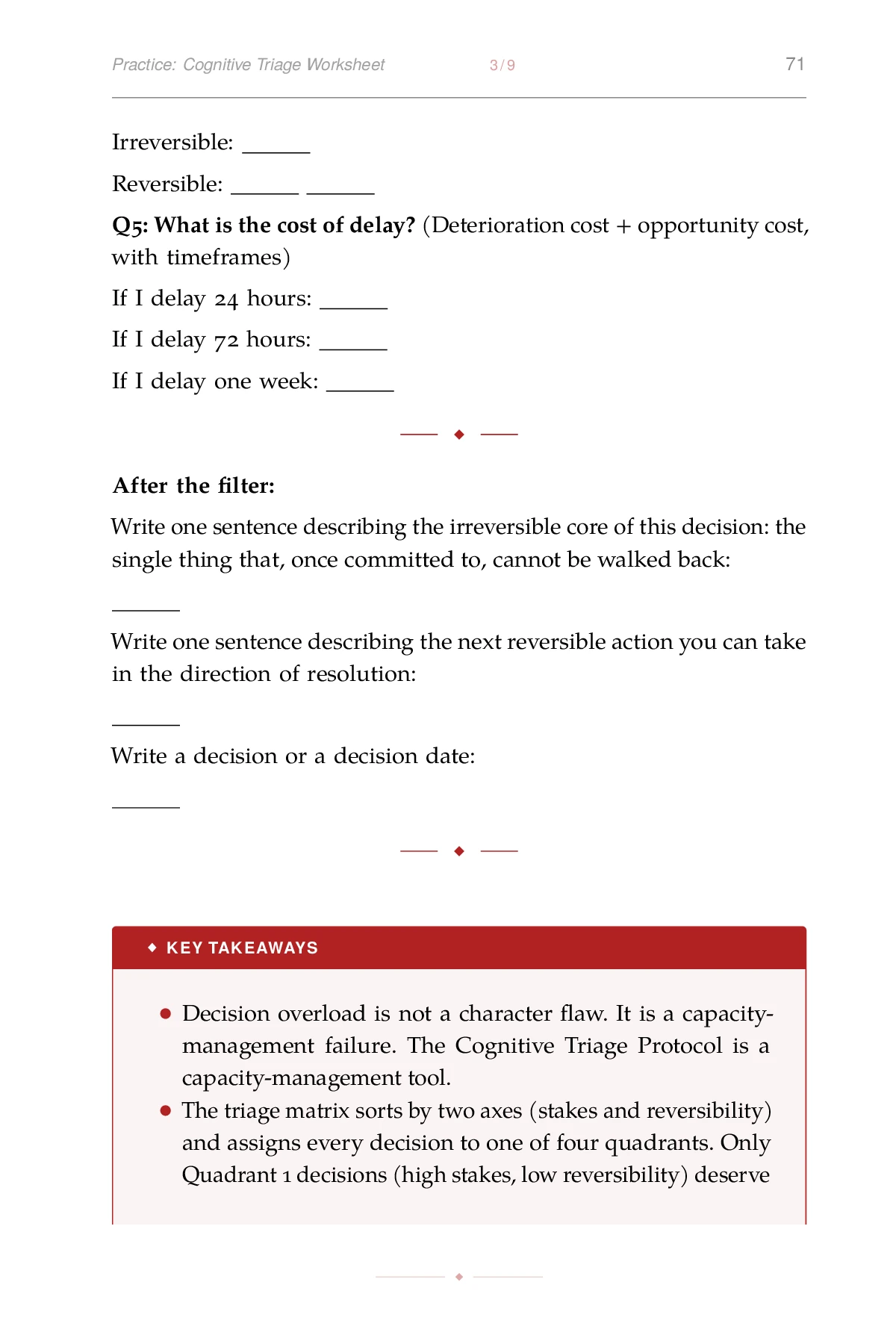
- A taxonomy that separates reversible, irreversible, compounding, and moral decisions
- Protocols for cognitive triage, time compression, and an information diet under fire
- Team decision architecture that spreads cognitive load without diluting accountability
- Pre-mortems and recovery practices that turn outcomes into learning, not hindsight bias

From the book
in calm. This book is the practice.
Decision-Making Under Chaos, printed page: in calm. This book is the practice.
Inspect more pages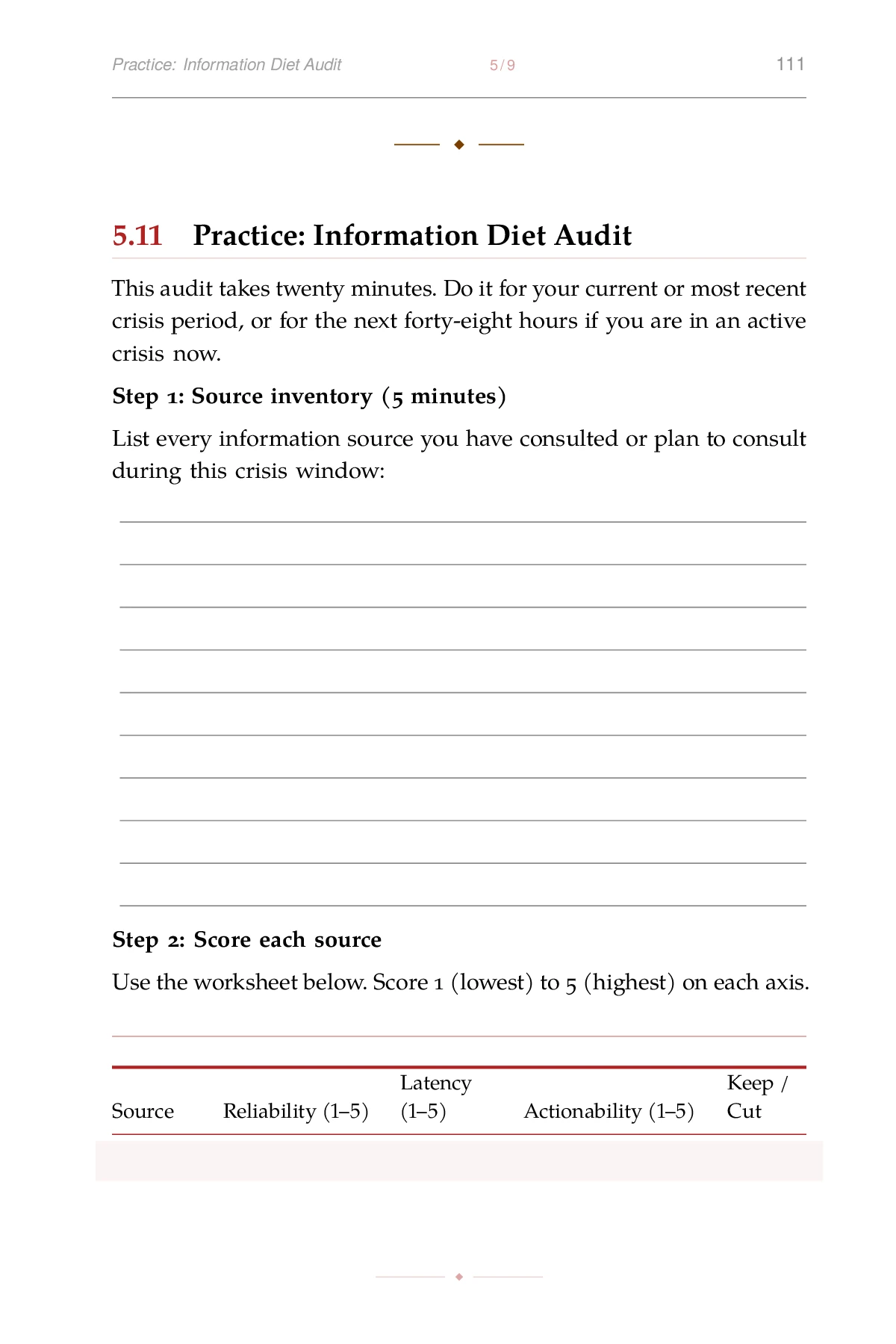

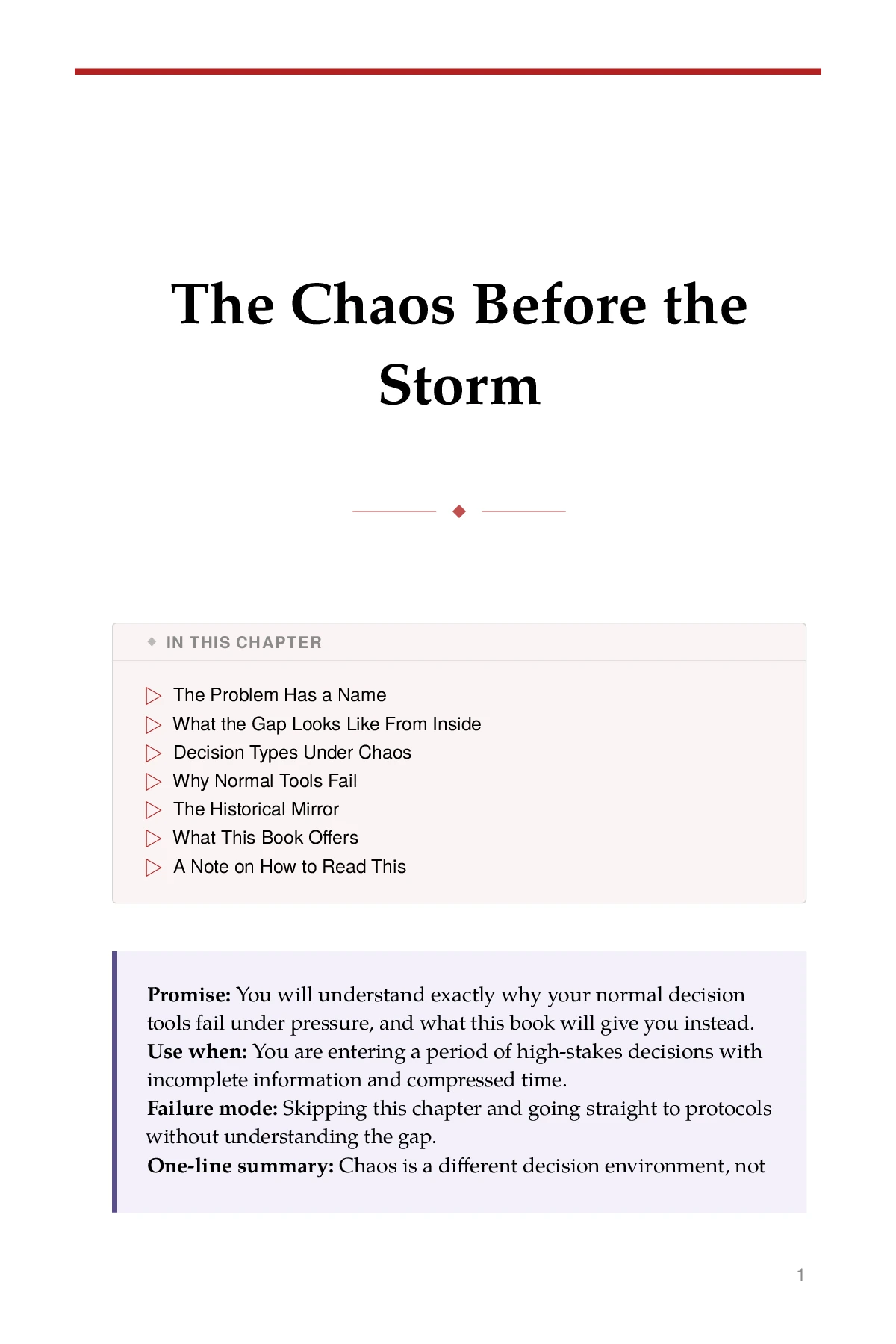
The contents
Chapter by chapter
Every chapter of Decision-Making Under Chaos with its printed epigraph, what you can do afterwards, and the moment it is built for.
Introduction
The Chaos Before the Storm
What you can do afterwards
You will understand exactly why your normal decision tools fail under pressure, and what this book will give you instead.
Use this chapter when
You are entering a period of high-stakes decisions with incomplete information and compressed time.
Chapter 1
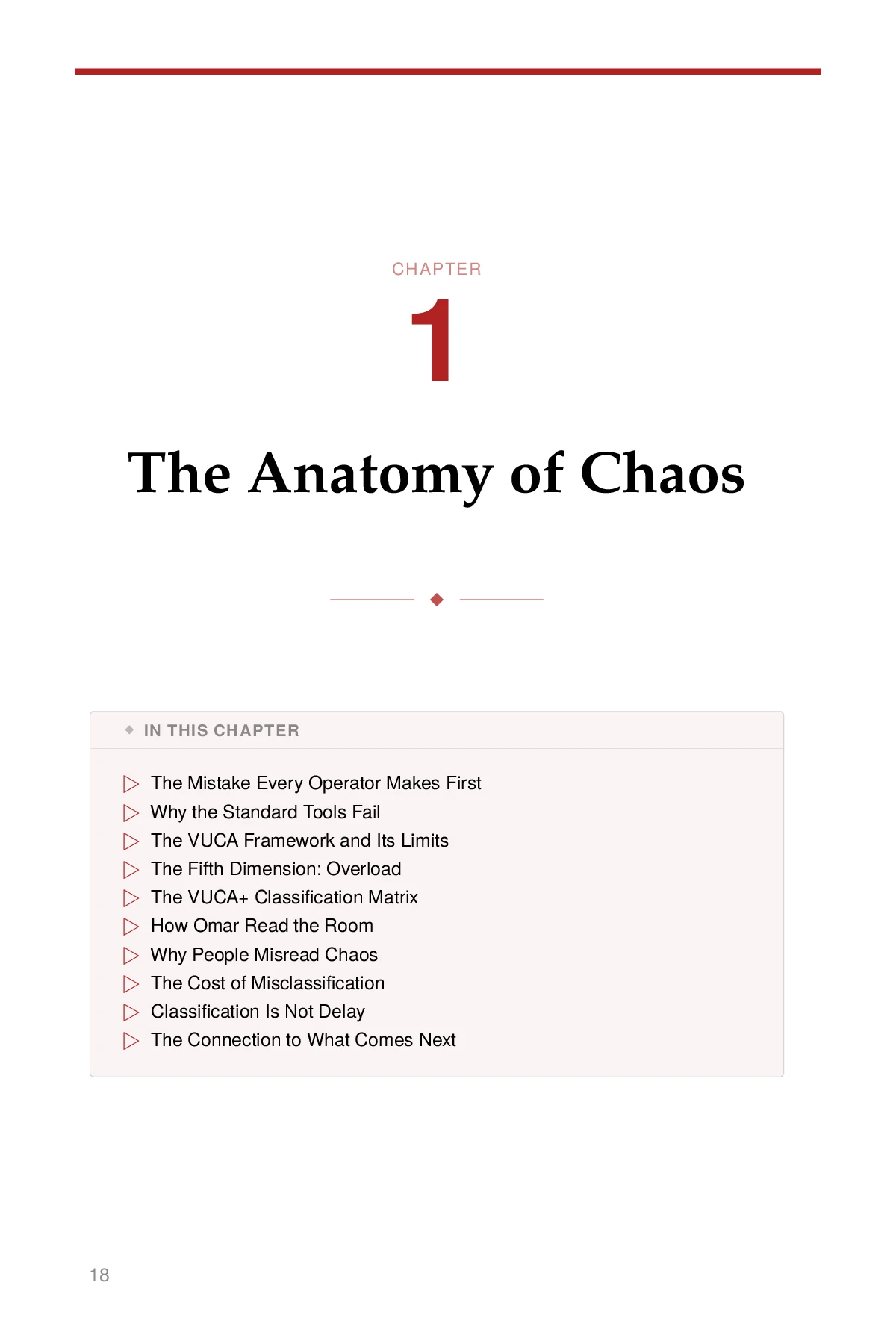
The Anatomy of Chaos
What you can do afterwards
You will stop treating all chaos as the same emergency and start classifying it fast, because the right response depends entirely on the right diagnosis.
Use this chapter when
You are standing in the middle of a crisis and cannot tell whether to gather more information, act immediately, experiment, or wait.
Chapter 2
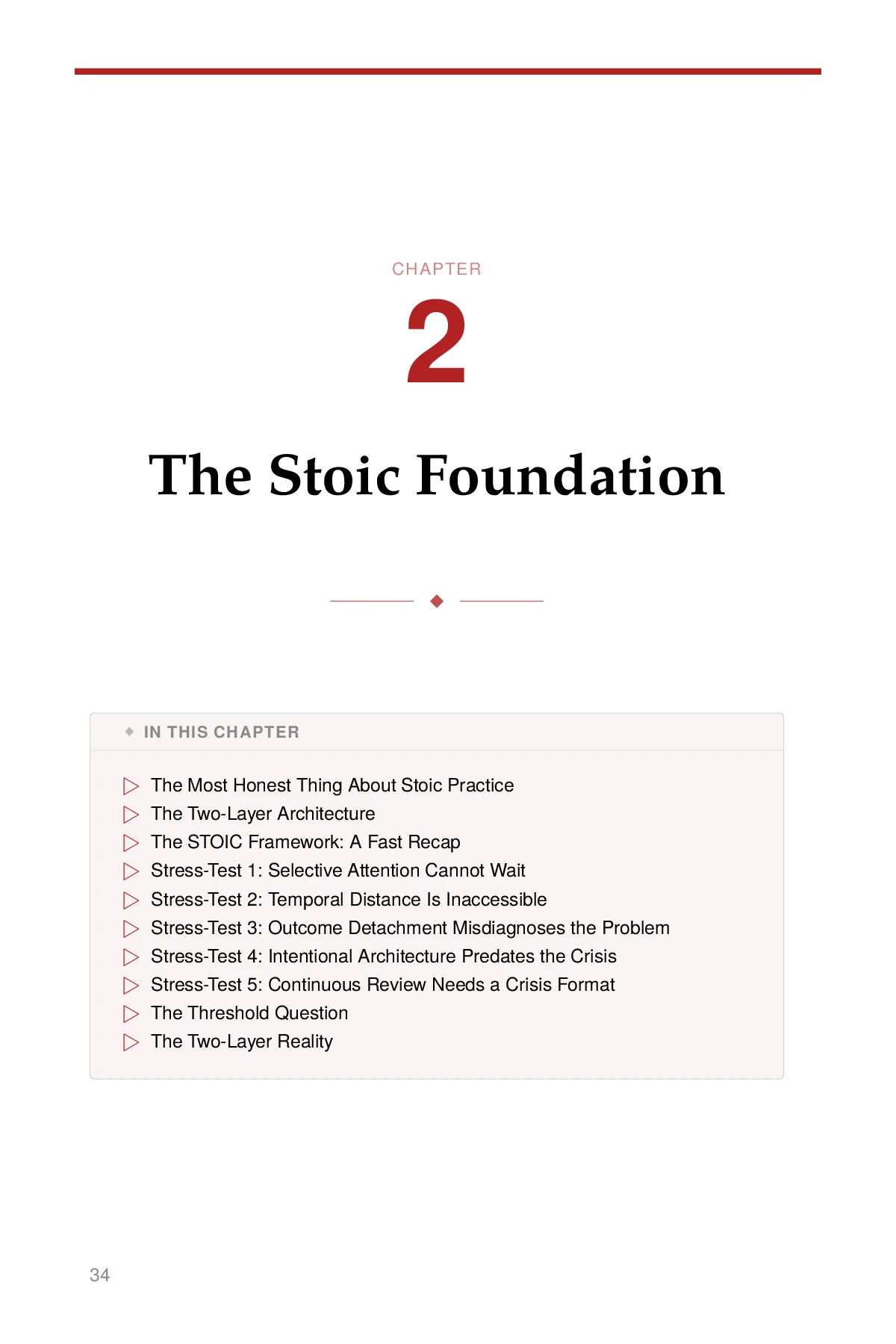
The Stoic Foundation
What you can do afterwards
Understand why Stoic training is necessary but not sufficient, and what to add when calm disappears.
Use this chapter when
You have Stoic habits but they keep failing you in genuine crises.
Chapter 3
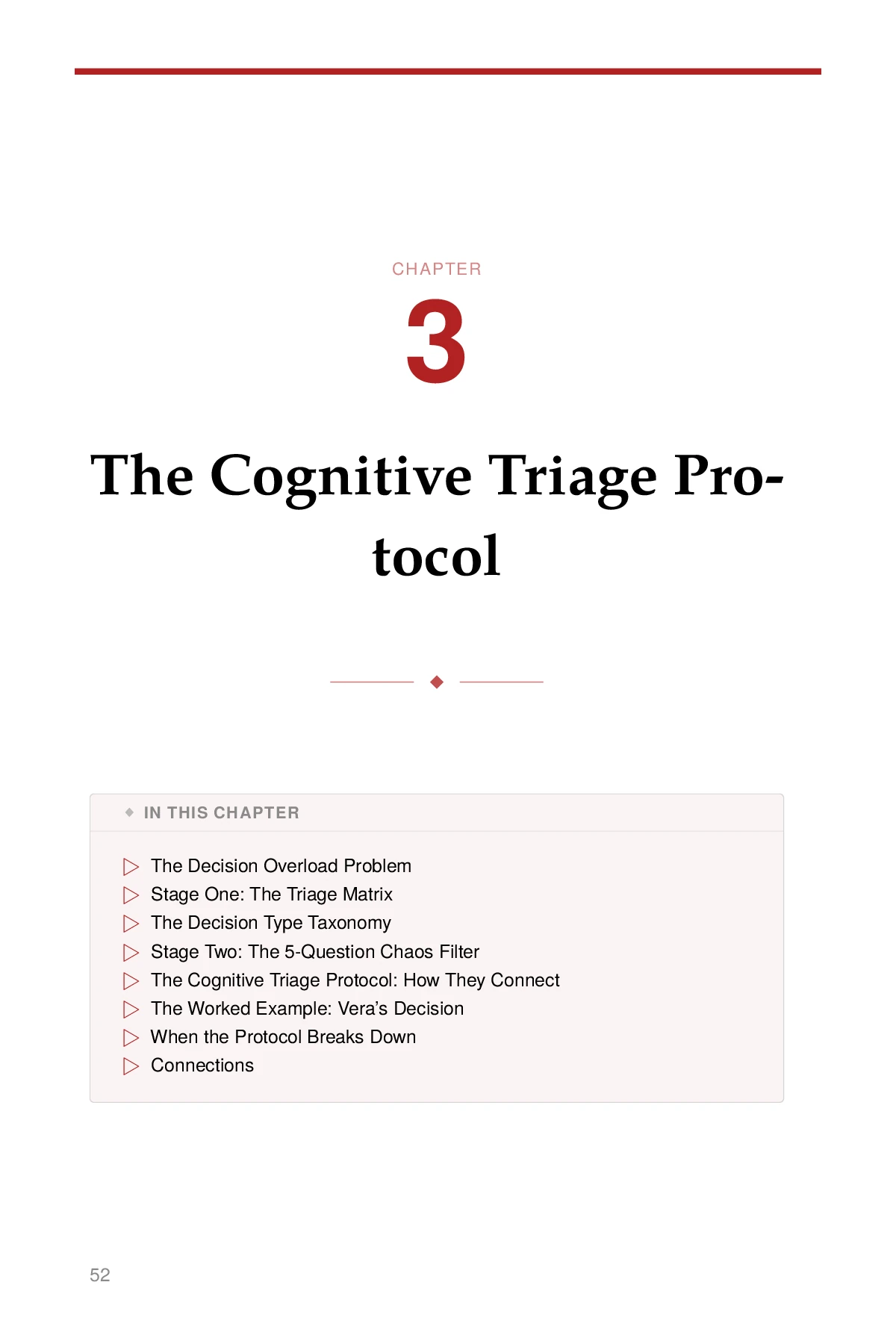
The Cognitive Triage Protocol
What you can do afterwards
A named, repeatable protocol that tells you what to decide first and how to decide it, even when everything is on fire.
Use this chapter when
You are facing more decisions than bandwidth, at least one of which feels high-stakes and irreversible.
Chapter 4
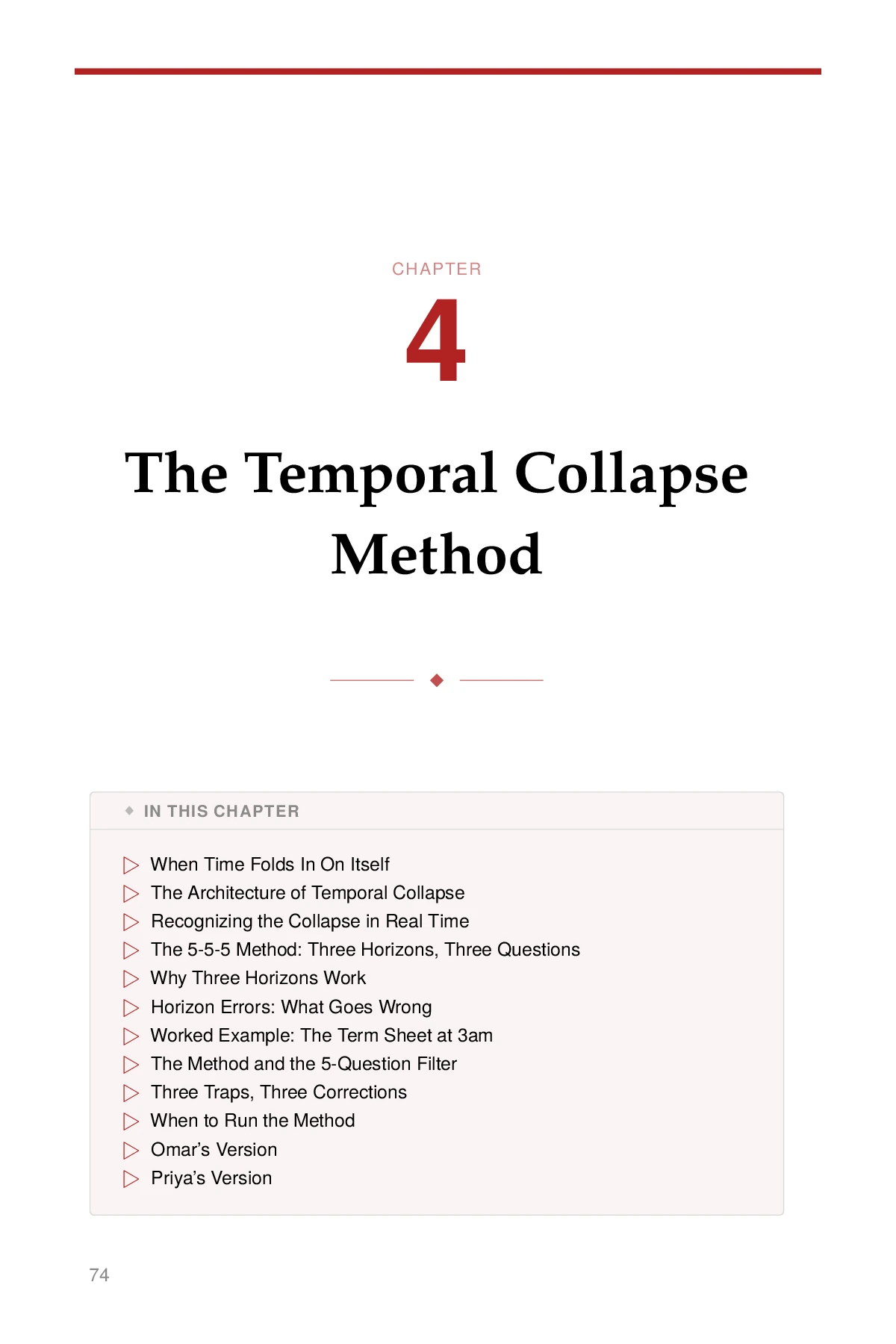
The Temporal Collapse Method
What you can do afterwards
A three-horizon framework that re-expands compressed time perception so you can act with clarity instead of panic.
Use this chapter when
You are frozen, spiraling, or making reactionary decisions because every crisis feels simultaneous and urgent.
Chapter 5
The Information Diet Under Fire
What you can do afterwards
A three-axis protocol that separates signal from noise so you can make better decisions with less information during a crisis.
Use this chapter when
You are drowning in incoming information (Slack, email, advisor calls, board updates, news) and none of it is telling you what to do next.
Chapter 6
The Team Decision System
What you can do afterwards
You will have a concrete architecture for distributing decisions across your team under pressure, without losing accountability or speed.
Use this chapter when
You are the person who keeps centralizing decisions during a crisis, or you have a team that keeps escalating everything to you.
Chapter 7
The Recovery Architecture
What you can do afterwards
You will have a three-part system for turning post-crisis time into learning rather than drift, along with a structured after-action review you can run in twenty-five minutes.
Use this chapter when
The acute crisis has passed and you need to decide what to do with what just happened.
Chapter 8
The Pre-Mortem as Habit
What you can do afterwards
You will learn to build your crisis response before the crisis exists, turning a single diagnostic technique into an institutional practice that makes catastrophic failure predictable.
Use this chapter when
You have survived a crisis and want to ensure the next one does not find you unprepared, or when you are designing a new initiative and want to surface failure modes while there is still time to address them.
Chapter 9
The Integration
What you can do afterwards
You will leave with a maintenance system (daily, weekly, monthly) that keeps chaos capability alive between the crises that test it.
Use this chapter when
The acute phase is over, the frameworks are fresh in your mind, and you want to make sure they are still there when the next wave hits.
Conclusion
Conclusion: The Calm Within
What you can do afterwards
You will leave this book with a complete picture of what chaos-capable looks like, not as an ideal, but as a practice you can assess, maintain, and improve.
Use this chapter when
You have finished the book and want to consolidate what you have built, or you are returning after your first real crisis to take stock of what held.
Who it is for
Who this book was written for
You will not eliminate chaos. You will stay operational inside it: deciding faster, under worse conditions, with a record you can stand behind when the pressure lifts.
If you have ever frozen on a decision that mattered, or made the call and never understood why it went the way it did, this book was built for that moment.
The reader it was written for
Founders and operators making high-stakes decisions with incomplete information. They are typically:
What you will use it on
- Make faster decisions without sacrificing quality
- Avoid analysis paralysis under time pressure
- Manage emotional noise (panic, ego, sunk cost)
- Design team decision processes for chaotic contexts
- Learn from outcomes without hindsight bias
- Use AI as a decision assistant, not a replacement
Probably not for you if
- People looking for a purely philosophical treatise (this is applied)
- Readers who want certainty (this book teaches confidence under irreducible uncertainty)
- People in low-stakes, high-structure environments (this is for chaos, not routine)
Editions
Editions and specifications
| Edition | Formats | Chapters | Pages | Reading time | ISBN (paperback) |
|---|---|---|---|---|---|
| English Decision-Making Under Chaos | In production | 11 | 260 | ± 3 hours | — |
| Dutch Beslissen onder chaos | In production | 11 | 274 | ± 4 hours | — |
Both editions are written natively. The Dutch text is not a machine translation of the English. · Trim size: 6x9″
Frequently asked
What readers usually want to know
What is Decision-Making Under Chaos about?
A portable five-question protocol for calls made with incomplete information, loud emotion, limited time, and real consequences. The subtitle is: A Practical Toolkit for High-Stakes Decisions Under Uncertainty.
Is there a Dutch edition?
Yes. The Dutch edition is Beslissen onder chaos, written as a native edition rather than a machine translation. It moves through the same production line.
How long is Decision-Making Under Chaos?
This edition runs 11 chapters, 260 pages in print and roughly 3 hours of reading.
Who is Decision-Making Under Chaos for?
If you have ever frozen on a decision that mattered, or made the call and never understood why it went the way it did, this book was built for that moment.
The production system
How this book was made
Every title moves through the same gated production line: sourced research, a claim-level evidence ledger, structural review, fact-checking, red-team critique, and a bilingual final edit. AI agents do specialist work inside those gates; judgment, voice, and accountability stay human.
- Claims enter an evidence ledger with a source and a confidence grade before they reach the page
- English and Dutch are two native editions, not a translation of one another
- Every chapter clears readability, rhythm, and style gates before it is typeset
The series
More in this theme


