

No. 22 · Manuscript complete · Evidence & learning · TRIAL
The Experimental Founder
N=1 Protocols for Cognitive and Physical Performance
You A/B test your funnel. You guess about your own brain.
Founders optimize the business with experiments and optimize themselves with superstition. The Experimental Founder closes that gap with TRIAL, a five-step method adapted from single-subject research design, for testing any protocol on your own cognition, energy, sleep, and mood. No bro-science, no guaranteed protocols. Just a repeatable way to find what actually works for you, and the honesty to know the limits of n=1.
- pages
- 268
- chapters
- 13
- hours of reading
- ± 3
- editions
- EN · NL
- Design
- Drafting
- Manuscript
- Production
- Launched
The editions
Kindle, Paperback and Hardcover
Production shots of the editions. Not for sale yet — this page is the public working version.
-
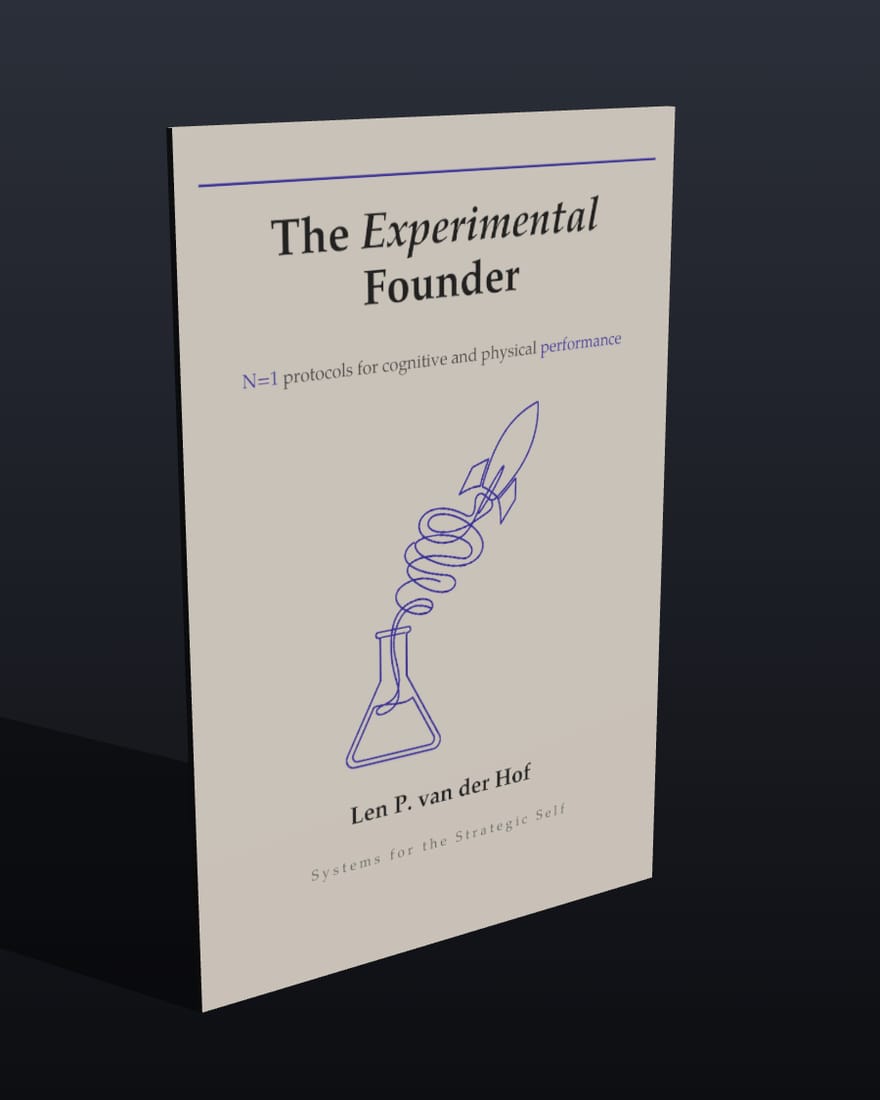
Kindle
The digital edition, ready in any Kindle app.
-
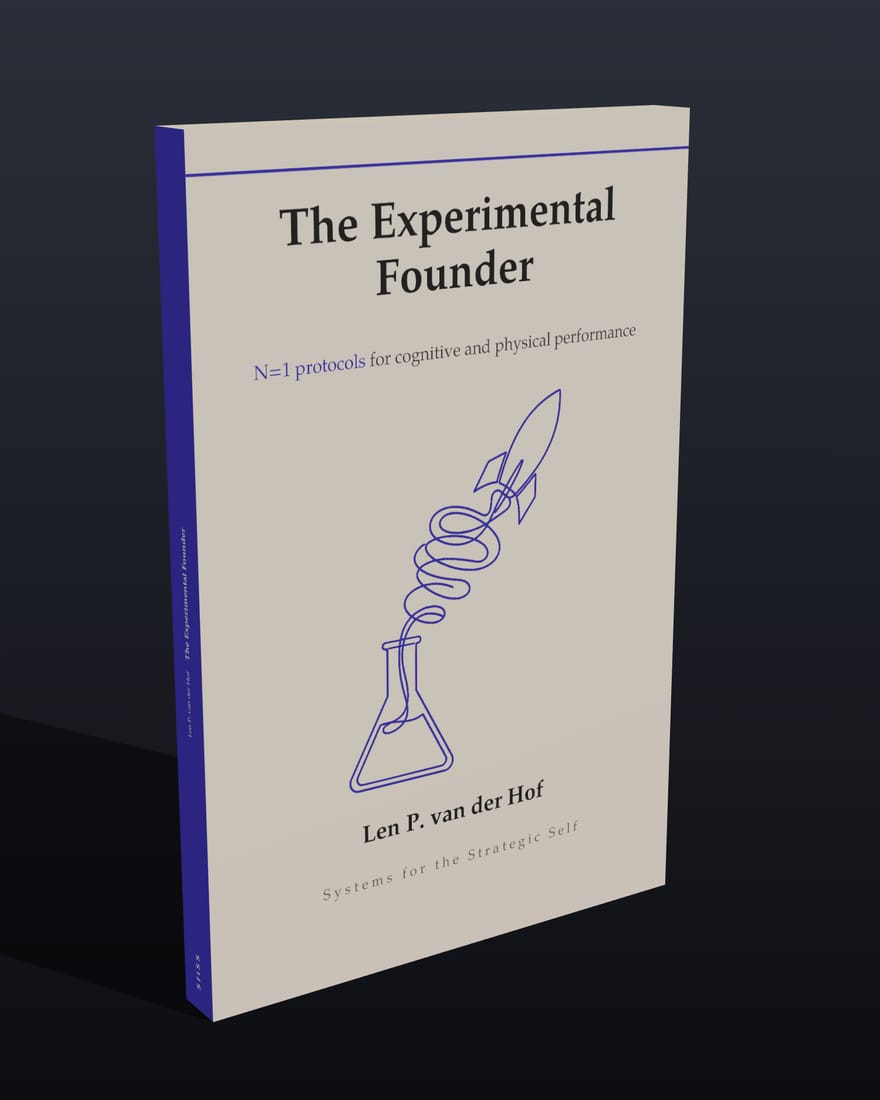
Paperback
The working copy. Mark it up. Take it into the meeting.
-
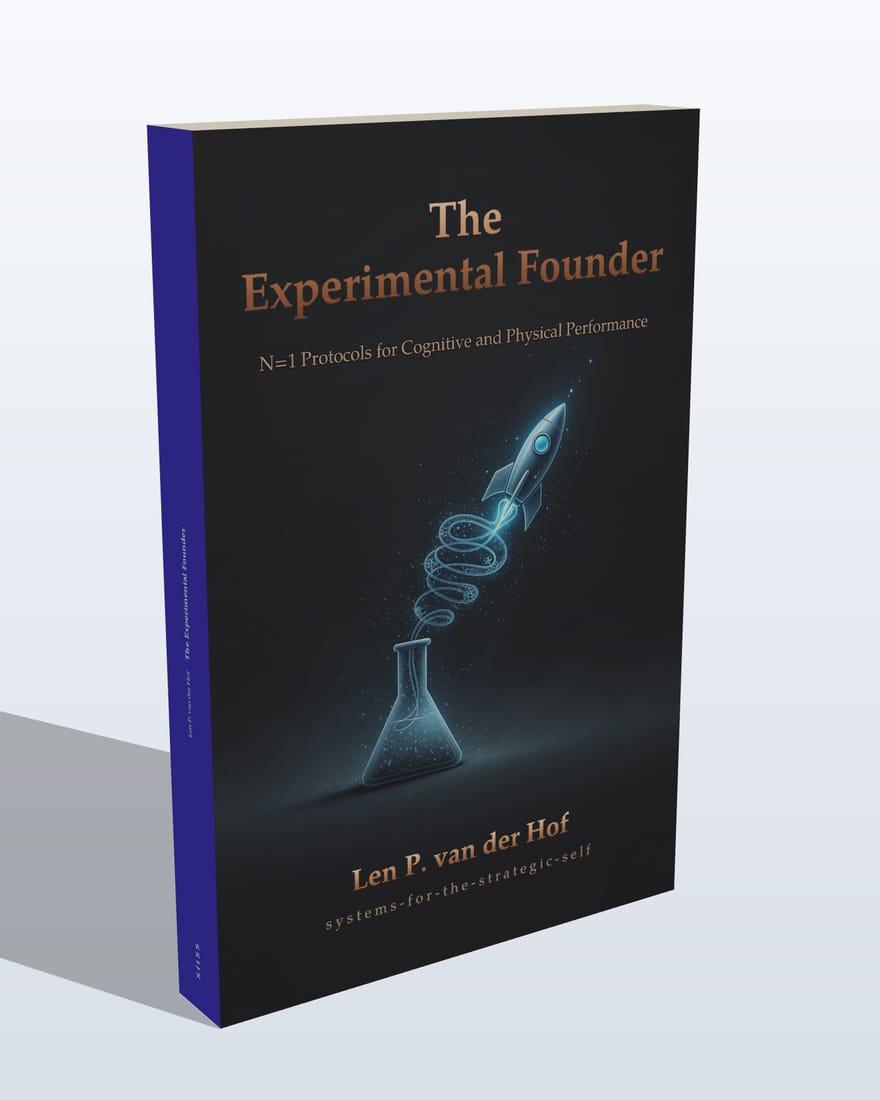
Hardcover
The shelf edition. Dark full-art jacket, built to stay in the room.


The book
N=1 Protocols for Cognitive and Physical Performance
You A/B test the landing page. You read the cohort curves before you trust a feature. But when it comes to your own performance, you run on a podcast clip and a supplement someone swore by. You bought the ring, the magnesium, and the new morning routine, and three months later you cannot say which one did anything. You measure everything that ships, and guess about the one asset every ship depends on.
The usual answer is another protocol: a stack to copy, a routine to adopt, a regimen built on studies that were never run on anyone like you. Copying a protocol cannot tell you whether it works for you; it only tells you it worked for someone, somewhere, once.
The Experimental Founder rejects the protocol economy and gives you the method underneath it. It introduces the TRIAL framework (Target, Record, Intervene, Analyze, Learn), five steps that turn the experimental discipline you already use on your business inward, onto your own cognition and body. It does not hand you answers. It hands you a way to manufacture your own.
What you learn
What this book puts in your hands
- The TRIAL method: Target, Record, Intervene, Analyze, Learn for any n=1 experiment
- Design clean experiments with proper baselines, washouts, and replication
- Tell signal from noise in your own cognition, energy, sleep, and mood data
- Avoid placebo, confounders, and novelty effects that fake a result
- A method to generate your own protocols, not a list of protocols to follow
The framework
TRIAL, step by step
Target, Record, Intervene, Analyze, Learn for any n=1 experiment
-
Target
-
Record
-
Intervene
-
Analyze
-
Learn for any n=1 experiment
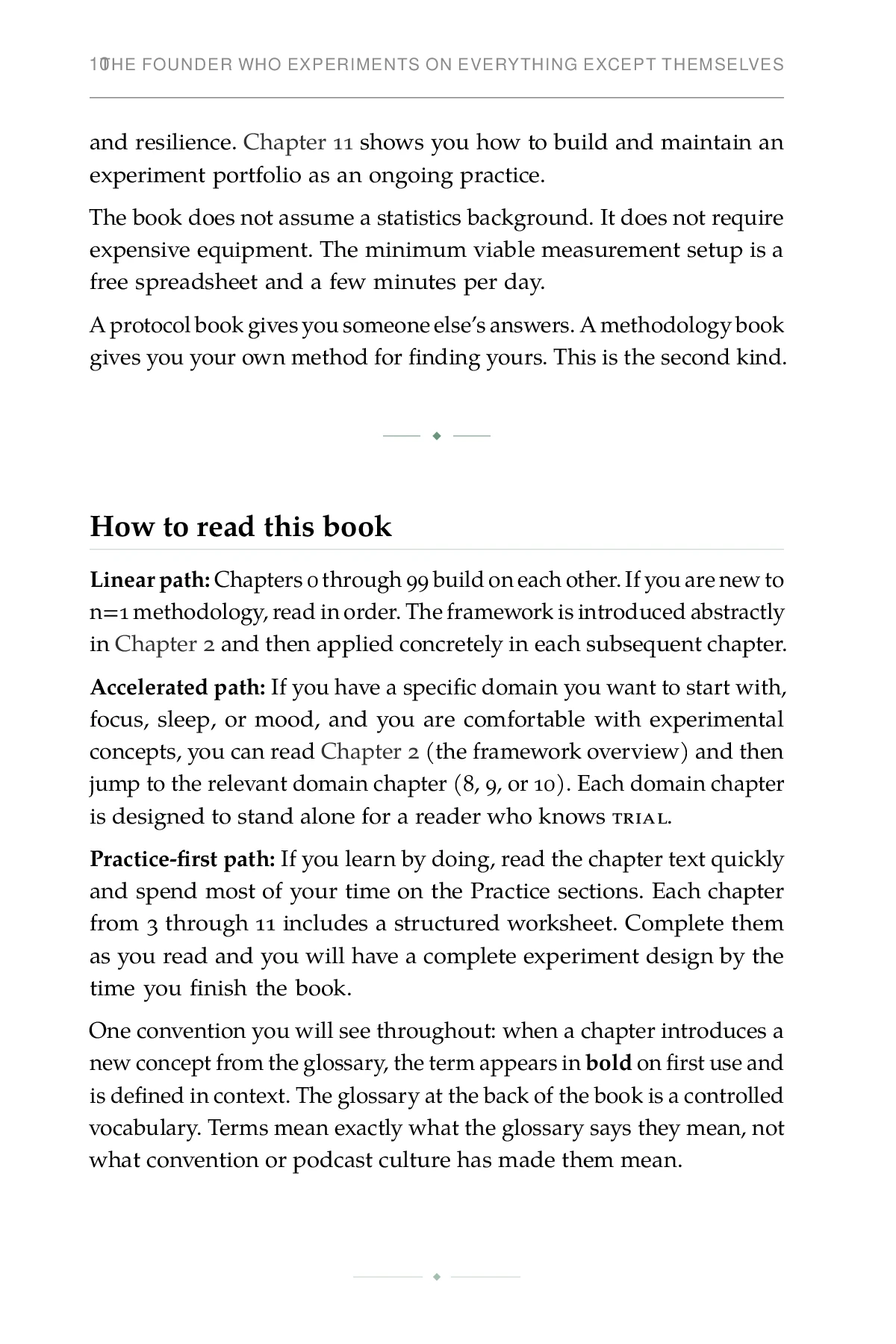
From the book
Practice-first path: If you learn by doing, read the chapter text quickly
The Experimental Founder, printed page: Practice-first path: If you learn by doing, read the chapter text quickly
Inspect more pagesLook inside
Pages from the print edition.
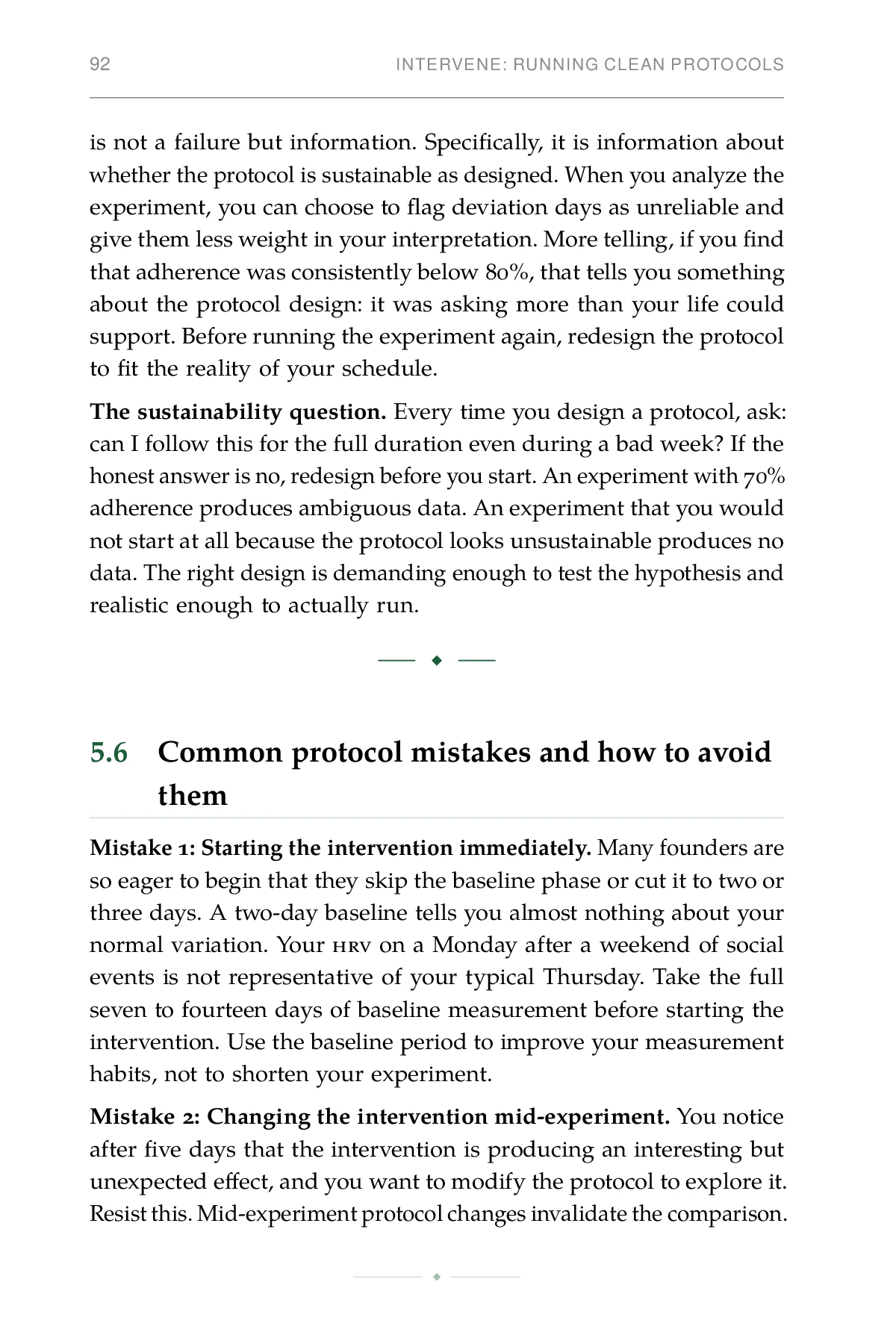
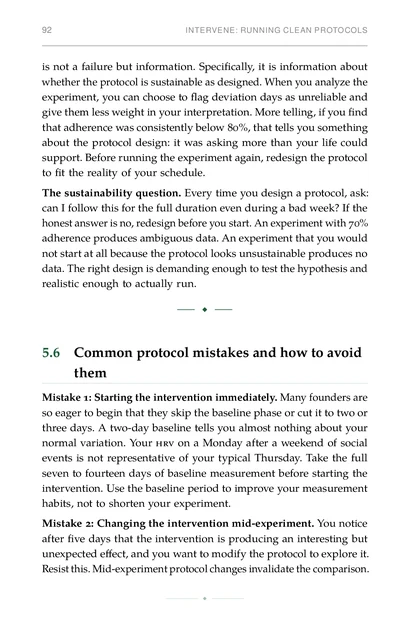 Mistake 2: Changing the intervention mid-experiment. You notice
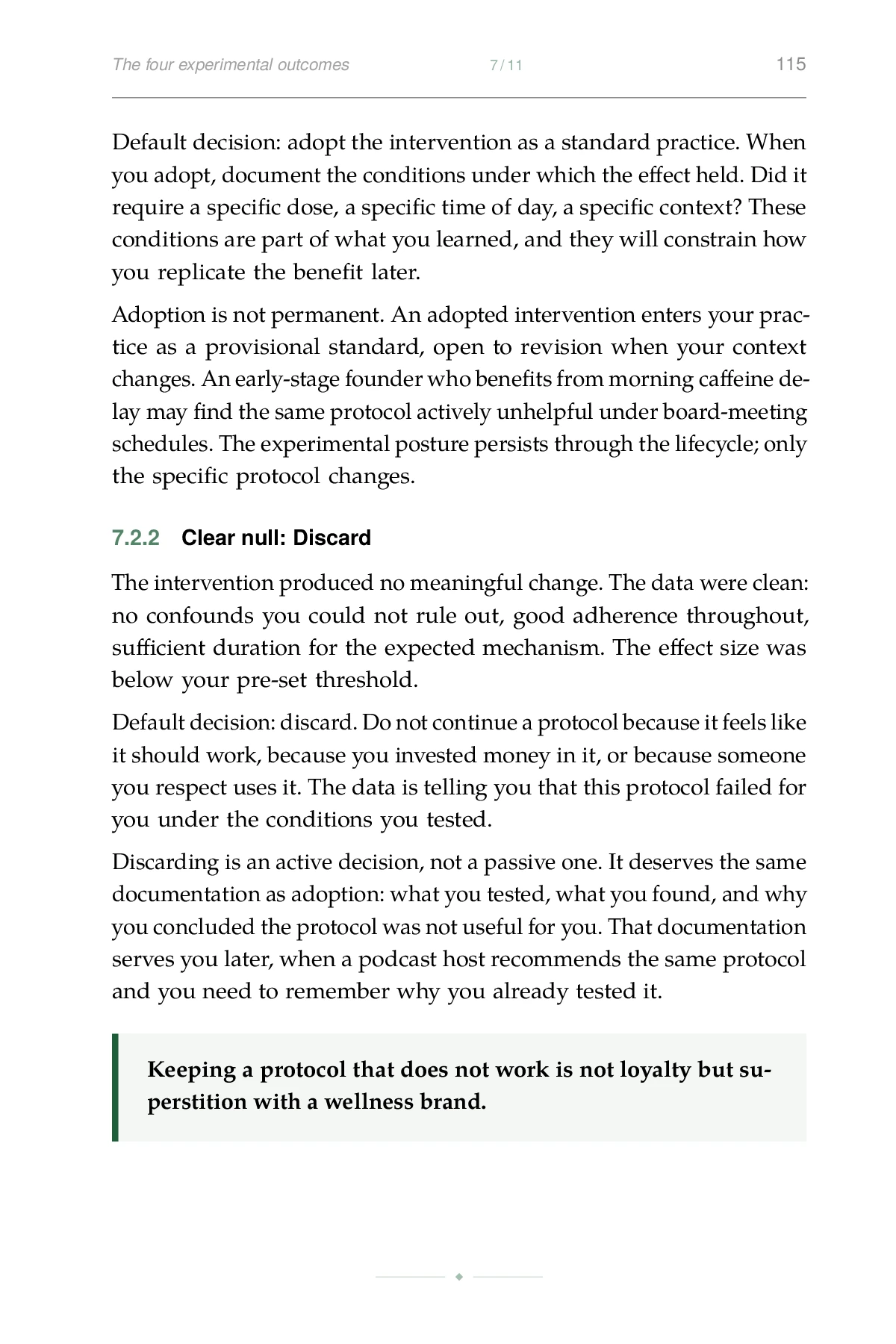
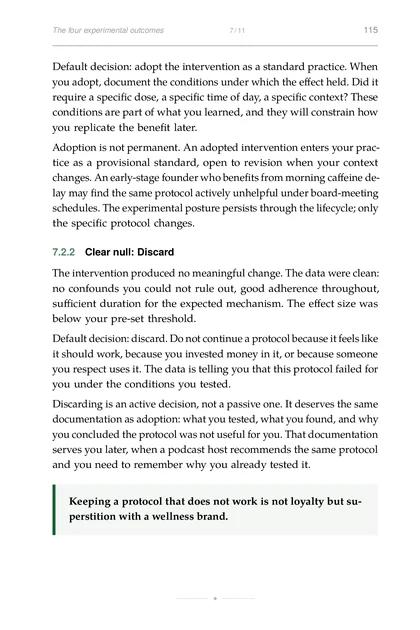 Keeping a protocol that does not work is not loyalty but su-
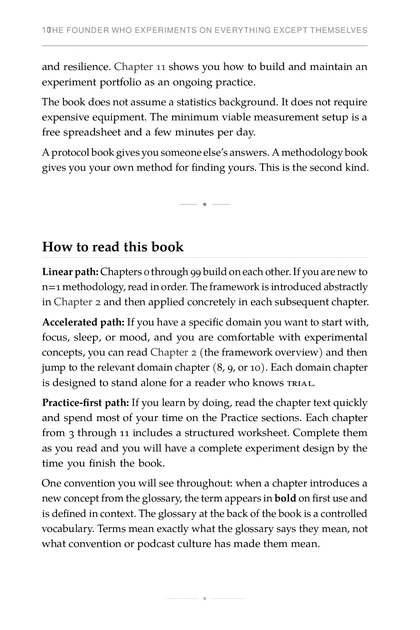 Practice-first path: If you learn by doing, read the chapter text quickly
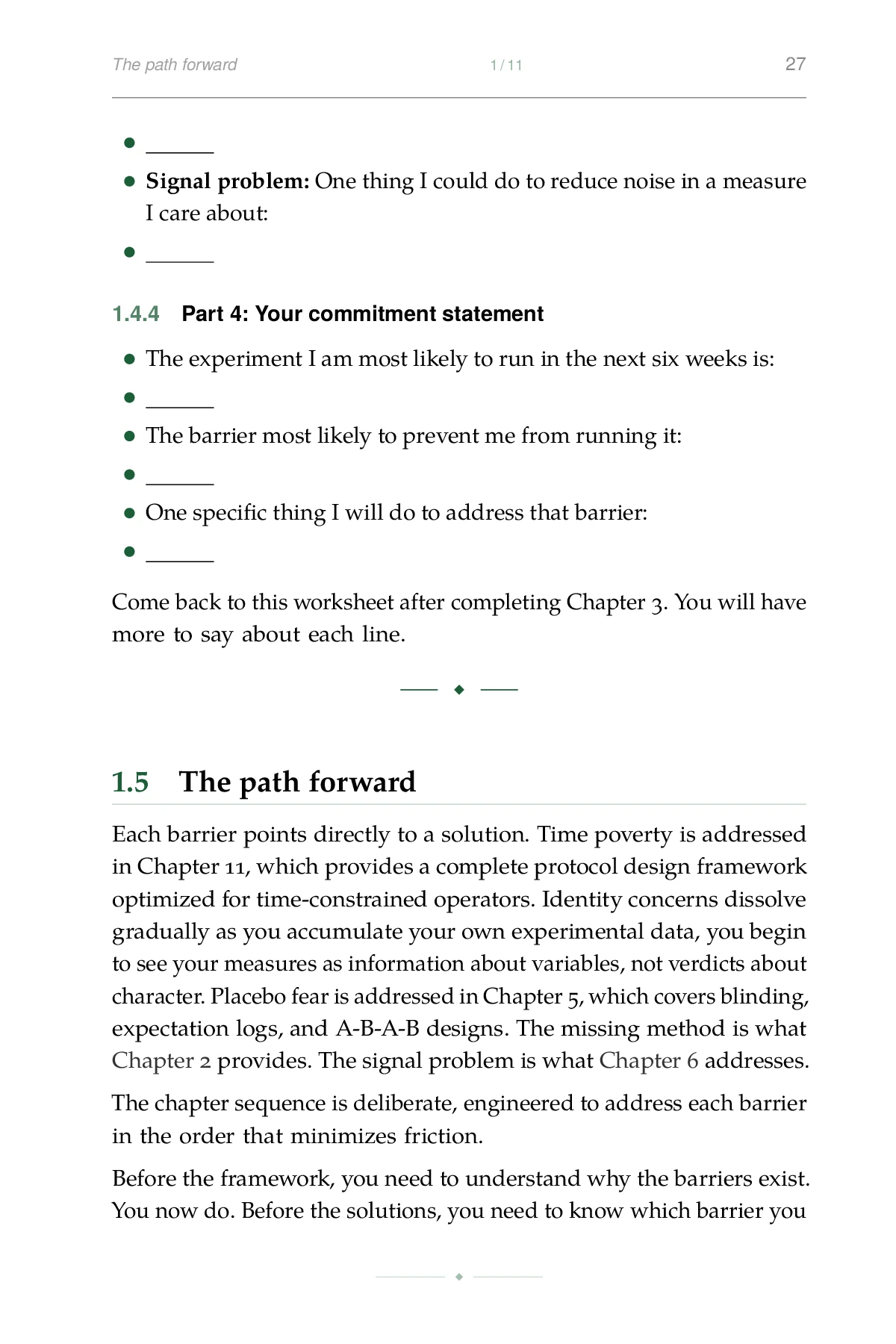
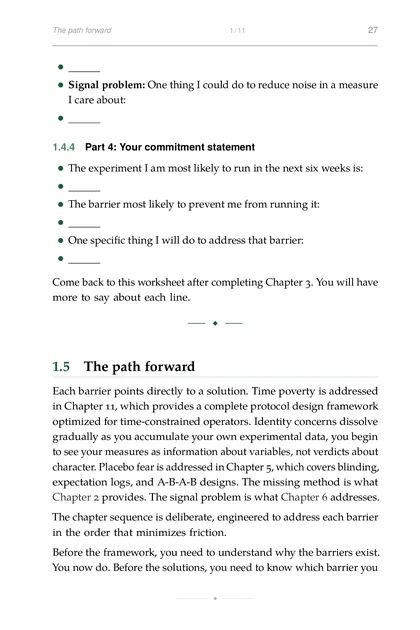 Signal problem: One thing I could do to reduce noise in a measure
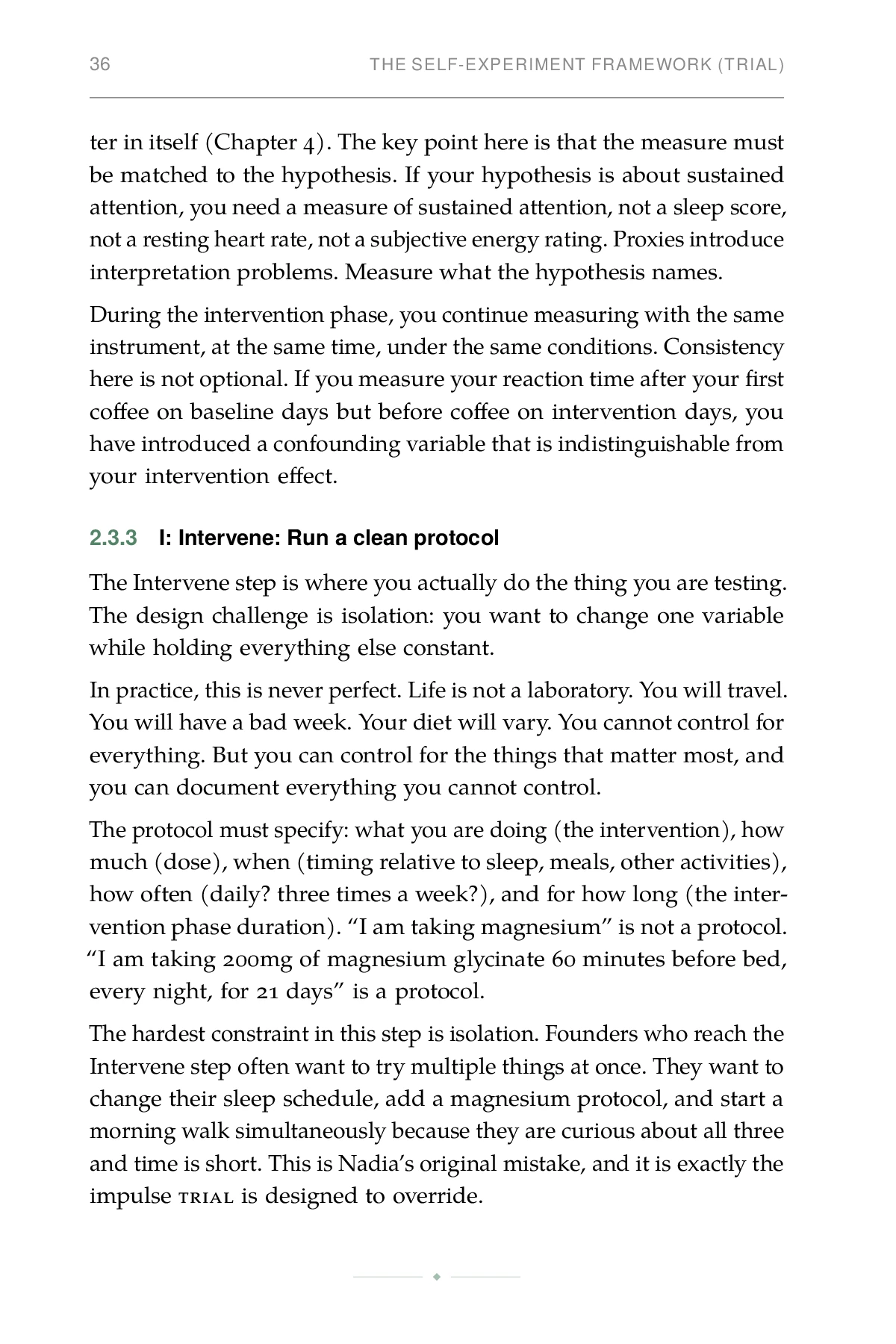
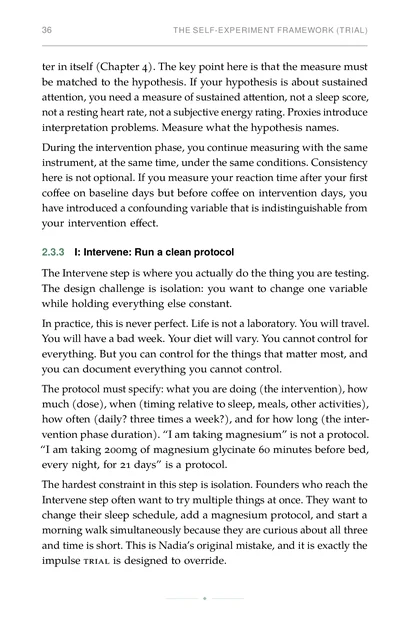 The design challenge is isolation: you want to change one variable
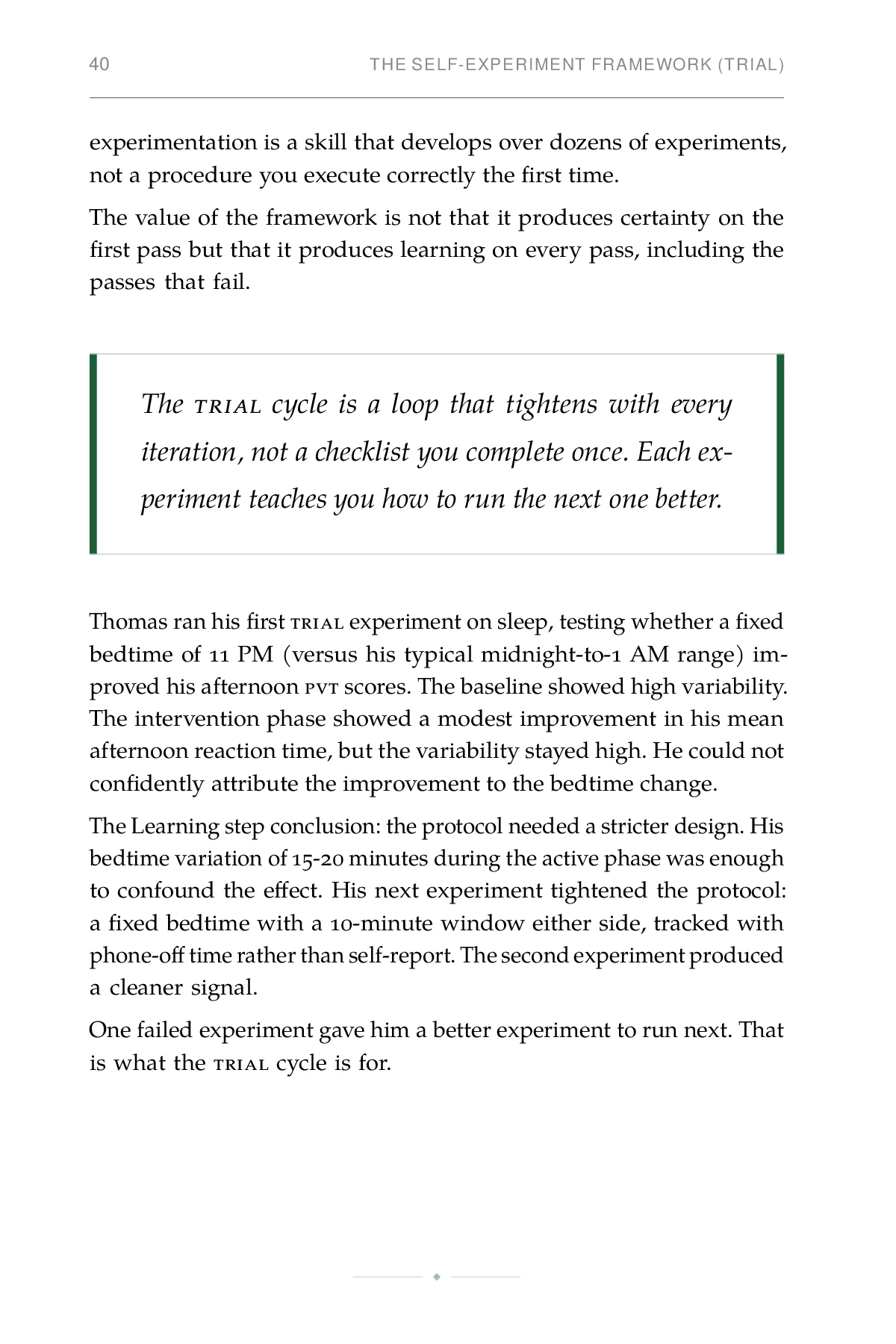
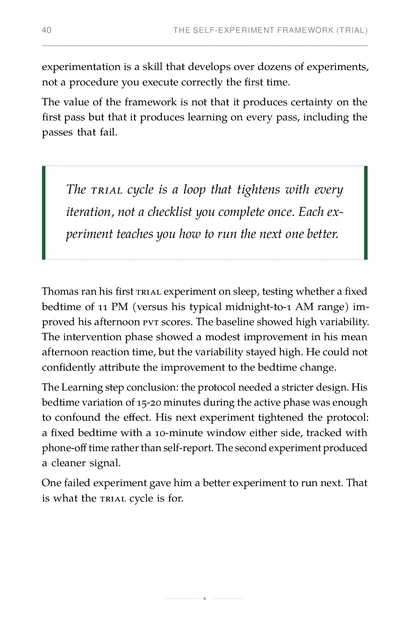 The trial cycle is a loop that tightens with every
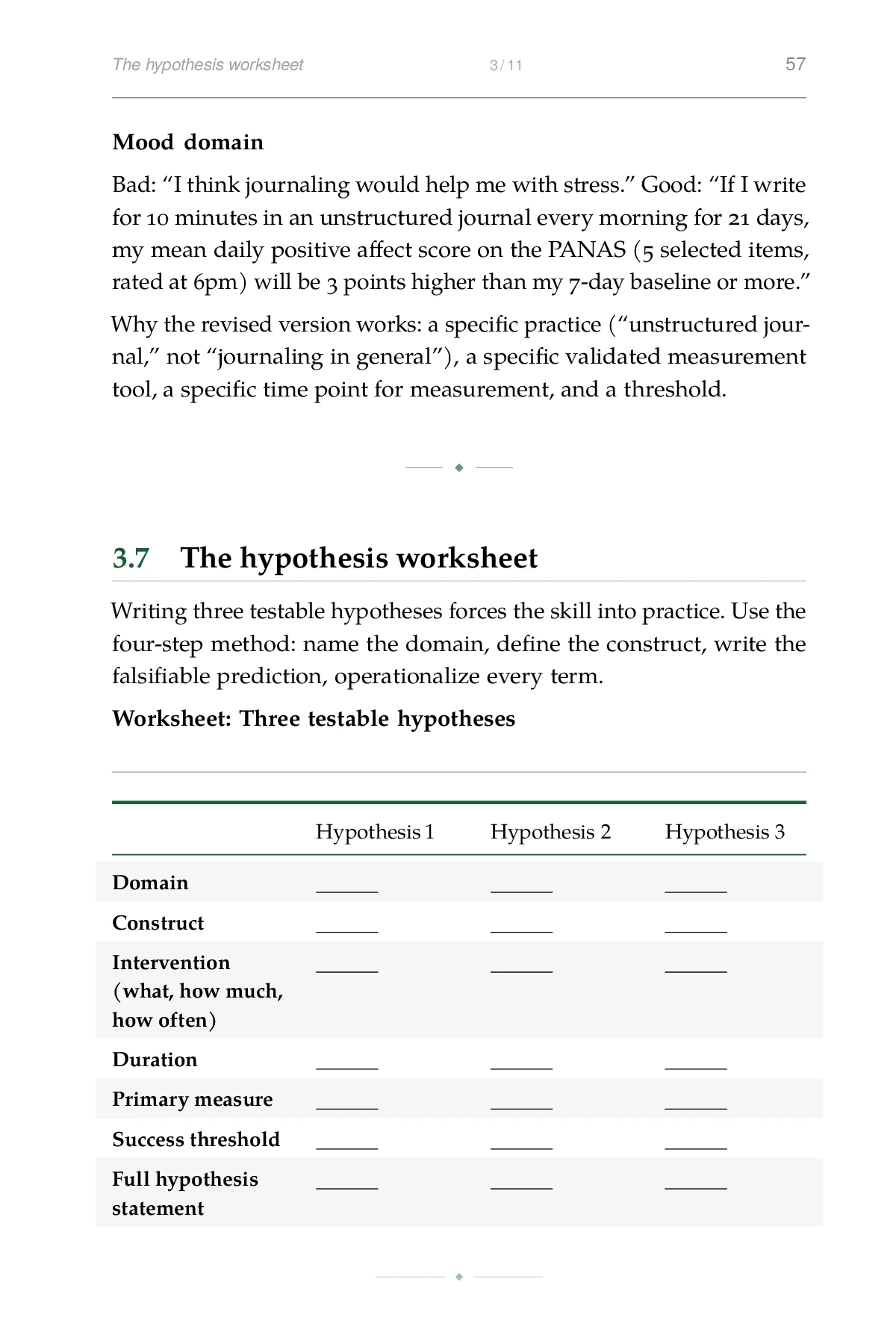
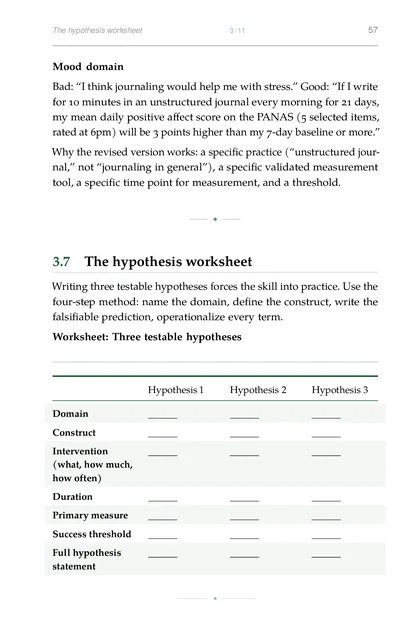 Worksheet: Three testable hypotheses
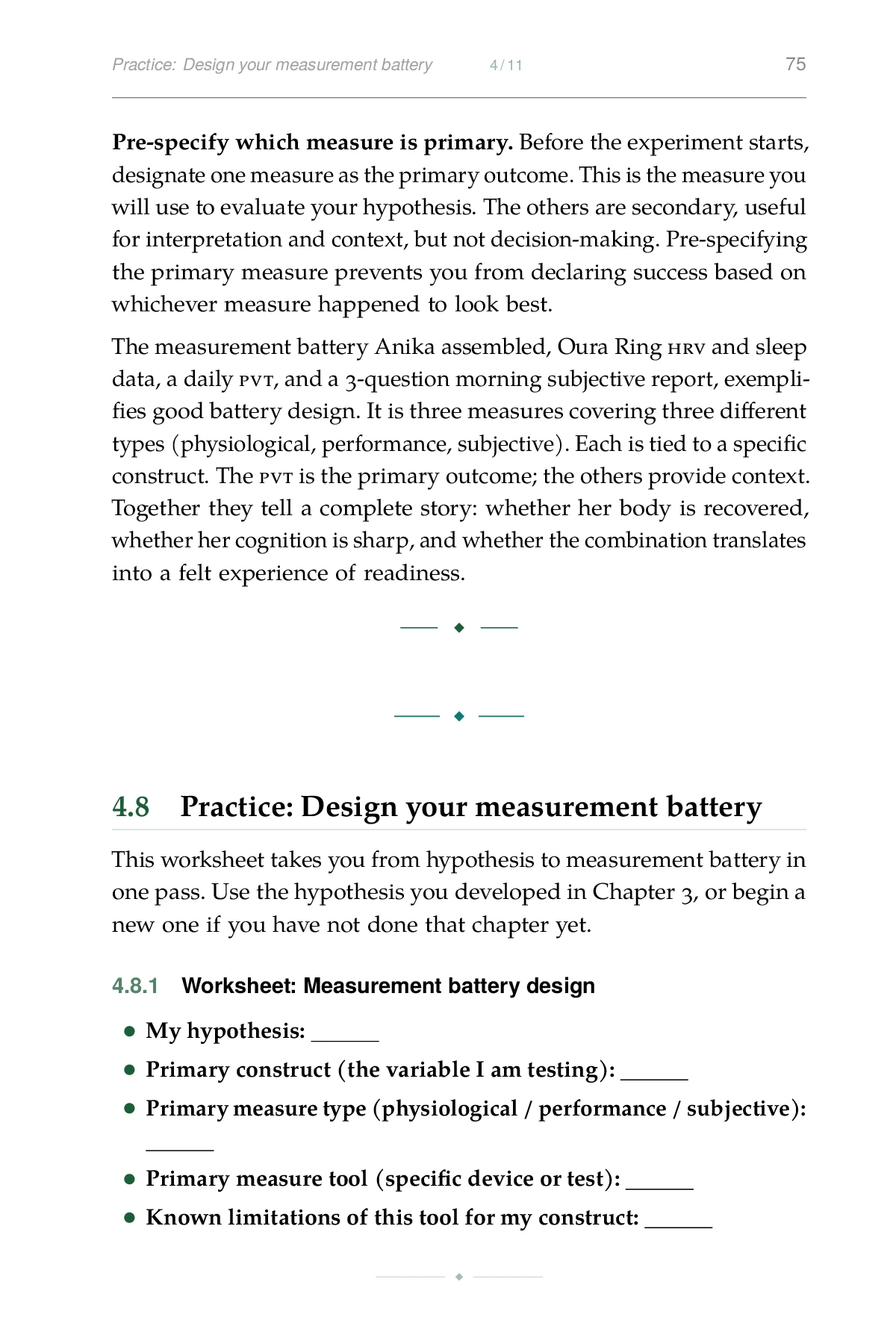
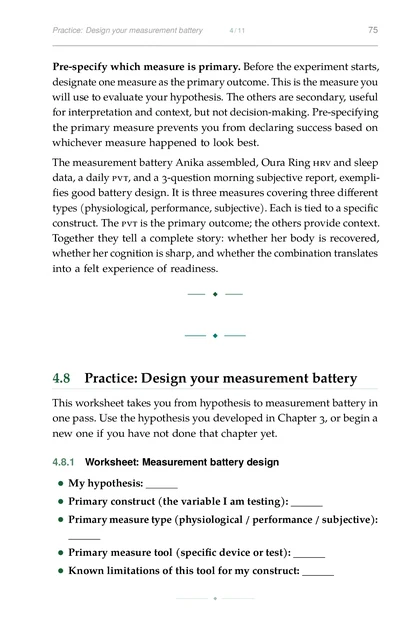 Practice: Design your measurement battery 4 11 75
The contents
Chapter by chapter
Every chapter of The Experimental Founder with its printed epigraph, what you can do afterwards, and the moment it is built for.
Introduction
The Founder Who Experiments on Everything Except Themselves
The same founder who runs A/B tests on landing pages, cohort analyses on retention, and growth loops on acquisition has never once tested whether their sleep protocol actually works. This chapter names the gap and makes the case that closing it is not self-indulgence: it is competitive advantage.
What you can do afterwards
Recognize the mismatch between your business rigor and personal superstition, and understand why closing that gap is worth your time.
Use this chapter when
You have tried protocols from podcasts, bought supplements based on anecdotes, and still cannot tell what actually works for your own performance.
Chapter 1
Why Business Rigor Stops at the Skin
Five structural barriers keep founders from applying their experimental discipline to their own performance. Naming them is the first step to dismantling them.
What you can do afterwards
Understand the five specific barriers that prevent self-experimentation, and see that each is solvable.
Use this chapter when
You have tried to be more systematic about your own performance but keep reverting to intuition and anecdotes.
Chapter 2
The Self-Experiment Framework (TRIAL)
A repeatable five-step method for running n=1 experiments. This is the framework the entire book builds on.
What you can do afterwards
Understand and be able to apply the five-step TRIAL framework for any self-experiment.
Use this chapter when
You have a question about your own performance and need a systematic way to answer it.
Chapter 3
Target: Defining the Question
The most important step in any experiment is the one most often skipped. A vague question produces useless data, no matter how carefully you measure.
What you can do afterwards
Turn a vague desire ("I want more energy") into a testable, falsifiable hypothesis that can drive a clean experiment.
Use this chapter when
You know something is not working but cannot articulate what exactly you want to test.
Chapter 4
Record: Measuring What Matters
The right measure makes the signal visible. The wrong measure, or no measure at all, makes every experiment a guess.
What you can do afterwards
Select valid, reliable measures for any self-experiment, distinguishing between objective and subjective tools and knowing the strengths and limits of each.
Use this chapter when
You have a hypothesis but are not sure what to measure or which tool to use.
Chapter 5
Intervene: Running Clean Protocols
The quality of your intervention design determines the quality of your answer. A confounded experiment teaches nothing, or worse, it teaches the wrong lesson.
What you can do afterwards
Design an intervention protocol that isolates one variable, controls for confounds, and can be analyzed meaningfully.
Use this chapter when
You have a hypothesis and a measurement strategy, and you need to turn them into a repeatable protocol.
Chapter 6
Analyze: Separating Signal from Noise
You have collected two weeks of baseline and two weeks of intervention. Now what? This chapter gives you the tools to interpret your own data without overclaiming or underreading.
What you can do afterwards
Analyze single-subject data using visual inspection, trend analysis, and meaningful change thresholds, and know when not to trust what you see.
Use this chapter when
You have data from a completed experiment and need to decide whether the intervention actually changed anything.
Chapter 7
Learn: Decide, Iterate, or Commit
The data is in. The harder work now begins: deciding what to do with it.
What you can do afterwards
Apply a structured decision framework to experimental results, keep the intervention, modify it, discard it, or design the follow-up, without falling into the two traps of premature certainty and indefinite equivocation.
Use this chapter when
Your experiment is complete and you have analyzed the data, but you are not sure what the result means for your ongoing practice.
Chapter 8
Cognitive Experiments: Focus, Memory, Processing Speed
Applying the TRIAL framework to the domain founders care about most, where the evidence is most commonly misunderstood.
What you can do afterwards
Design and run experiments on your own cognitive performance using validated measures, while avoiding the most common mistakes in nootropic and training research.
Use this chapter when
You want to know whether a cognitive intervention (a nootropic, a productivity protocol, or a training practice) actually improves your focus, memory, or processing speed.
Chapter 9
Energy Experiments: Sleep, Circadian, HRV
Applying the TRIAL framework to the domain with the strongest evidence base, and the most variables to control.
What you can do afterwards
Design and run experiments on your own energy physiology, sleep extension, circadian alignment, and HRV biofeedback, using well-validated measures and clean experimental designs.
Use this chapter when
You suspect your sleep, recovery, or circadian rhythm is limiting your performance but want to test specific interventions rather than adopting protocols based on recommendations from podcasts or peers.
Chapter 10
Mood and Resilience Experiments
Applying the TRIAL framework to the domain where measurement is hardest and the payoff is highest.
What you can do afterwards
Design and run experiments on your own emotional state, mood, motivation, resilience, using validated subjective measures and enough baseline data to see your own patterns before you confound them.
Use this chapter when
You want to test whether a practice (exercise, journaling, social connection, nature exposure, a recovery protocol) actually improves your mood or resilience, rather than just feeling like it should.
Chapter 11
Building Your Personal Research Protocol
The meta-system: how to run an ongoing portfolio of experiments without it becoming a second job.
What you can do afterwards
Design a sustainable self-experimentation practice: a portfolio of experiments managed across time, energy, and attention constraints. The goal is learning that compounds over years instead of stalling after one or two runs.
Use this chapter when
You have run one or two experiments and want to make self-experimentation a permanent part of your practice, not a one-time project.
Conclusion
The Founder as Scientist of Self
The identity shift from protocol consumer to evidence generator, and what it means for the rest of your work.
What you can do afterwards
Complete the identity shift from someone who tries random protocols to someone who generates their own evidence, and understand how this changes everything else.
Use this chapter when
You have run several experiments and the method has become natural, but you have not yet articulated what this way of thinking means for your broader practice.
Who it is for
Who this book was written for
The result is not a better protocol. It is the end of needing one. You stop renting other people's conclusions and start generating your own, on the only sample that governs your output: yourself.
If you build under pressure and refuse to run your own physiology on superstition, this was written for the operator who would rather know than believe.
The reader it was written for
The data-literate growth-stage founder. 3-10 years in, 5-50 employees, $500K-$20M ARR. Technical enough to understand A/B testing and cohort analysis. Already tracks something — steps, sleep, weight — but has no systematic method for experimenting. Skeptical of influencer protocols. Wants evidence but does not have time to evaluate it.
Also a fit for
1. The biohacking-curious operator. Has tried supplements, morning routines, or productivity systems. Cannot tell which ones actually work. Frustrated with bro-science. Wants a method they can trust. 2. The quantified-self enthusiast. Has wearables, apps, and data streams. Needs a rigorous experimental framework to make sense of the noise. 3. The evidence-aware professional.
What you will use it on
- **Validate or invalidate a protocol** — "Does this supplement/morning routine/sleep intervention actually work for me?
- **Escape the protocol treadmill** — Stop trying random things; develop a method for evaluating any intervention
- **Allocate optimization effort wisely** — "Where should I put my limited time and money for the highest ROI?
- **Measure what matters** — "Which metrics actually predict my performance, and which are vanity metrics on myself?
- **Build an ongoing practice** — "How do I make self-experimentation a sustainable habit, not a one-time project?
Probably not for you if
- People looking for specific protocol recommendations ("take X mg of Y this book is method, not prescription)
- General readers without interest in data or tracking (the book assumes some numerical literacy)
- Clinical populations seeking treatment (this is performance optimization, not therapy or medicine)
- Pure scientists looking for controlled-trial rigor (n=1 experiments have inherent limitations, and the book is honest about them)
Editions
Editions and specifications
| Edition | Formats | Chapters | Pages | Reading time | ISBN (paperback) |
|---|---|---|---|---|---|
| English The Experimental Founder | In production | 13 | 268 | ± 3 hours | — |
| Dutch De experimentele founder | In production | 13 | 280 | ± 3 hours | — |
Both editions are written natively. The Dutch text is not a machine translation of the English. · Trim size: 6x9″
Frequently asked
What readers usually want to know
What is The Experimental Founder about?
TRIAL helps founders run rigorous self-experiments on sleep, energy, focus, and performance without confusing noise for personal evidence. The subtitle is: N=1 Protocols for Cognitive and Physical Performance.
What is the TRIAL framework?
TRIAL: Target, Record, Intervene, Analyze and Learn for any n=1 experiment. Target, Record, Intervene, Analyze, Learn for any n=1 experiment
Is there a Dutch edition?
Yes. The Dutch edition is De experimentele founder, written as a native edition rather than a machine translation. It moves through the same production line.
How long is The Experimental Founder?
This edition runs 13 chapters, 268 pages in print and roughly 3 hours of reading.
Who is The Experimental Founder for?
If you build under pressure and refuse to run your own physiology on superstition, this was written for the operator who would rather know than believe.
The production system
How this book was made
Every title moves through the same gated production line: sourced research, a claim-level evidence ledger, structural review, fact-checking, red-team critique, and a bilingual final edit. AI agents do specialist work inside those gates; judgment, voice, and accountability stay human.
- Claims enter an evidence ledger with a source and a confidence grade before they reach the page
- English and Dutch are two native editions, not a translation of one another
- Every chapter clears readability, rhythm, and style gates before it is typeset


