

No. 15 · Active development · Evidence & learning · PREDICT
The Predictive Founder
When to Trust Your Gut, When to Override It, and How to Keep Score
The Predictive Founder: When to Trust Your Gut, When to Override It, and How to Keep Score.
PREDICT turns judgment into an inspectable practice: prior, reality-test, evidence, decide, iterate, calibrate, track. It shows when experience deserves weight and when a consequential call needs an explicit test. When to Trust Your Gut, When to Override It, and How to Keep Score. The framework: PREDICT.
- pages
- 184
- chapters
- 12
- hours of reading
- ± 2
- editions
- EN · NL
- Design
- Drafting
- Manuscript
- Production
- Launched
The editions
Kindle, Paperback and Hardcover
Production shots of the editions. Not for sale yet — this page is the public working version.
-
Kindle
The digital edition, ready in any Kindle app.
-
Paperback
The working copy. Mark it up. Take it into the meeting.
-
Hardcover
The shelf edition. Dark full-art jacket, built to stay in the room.


The book
When to Trust Your Gut, When to Override It, and How to Keep Score
You have made a high-stakes call on pattern recognition: a market entry, a fundraise, a key hire. You have been right often enough that trust in your own read feels earned. You have also been wrong with equal conviction. Felt certainty could not tell you which case you were in.
The Predictive Founder is not a warning to distrust your gut. It is a practical system for discovering when experience deserves weight, when the environment has changed, and when a consequential call needs an explicit test.
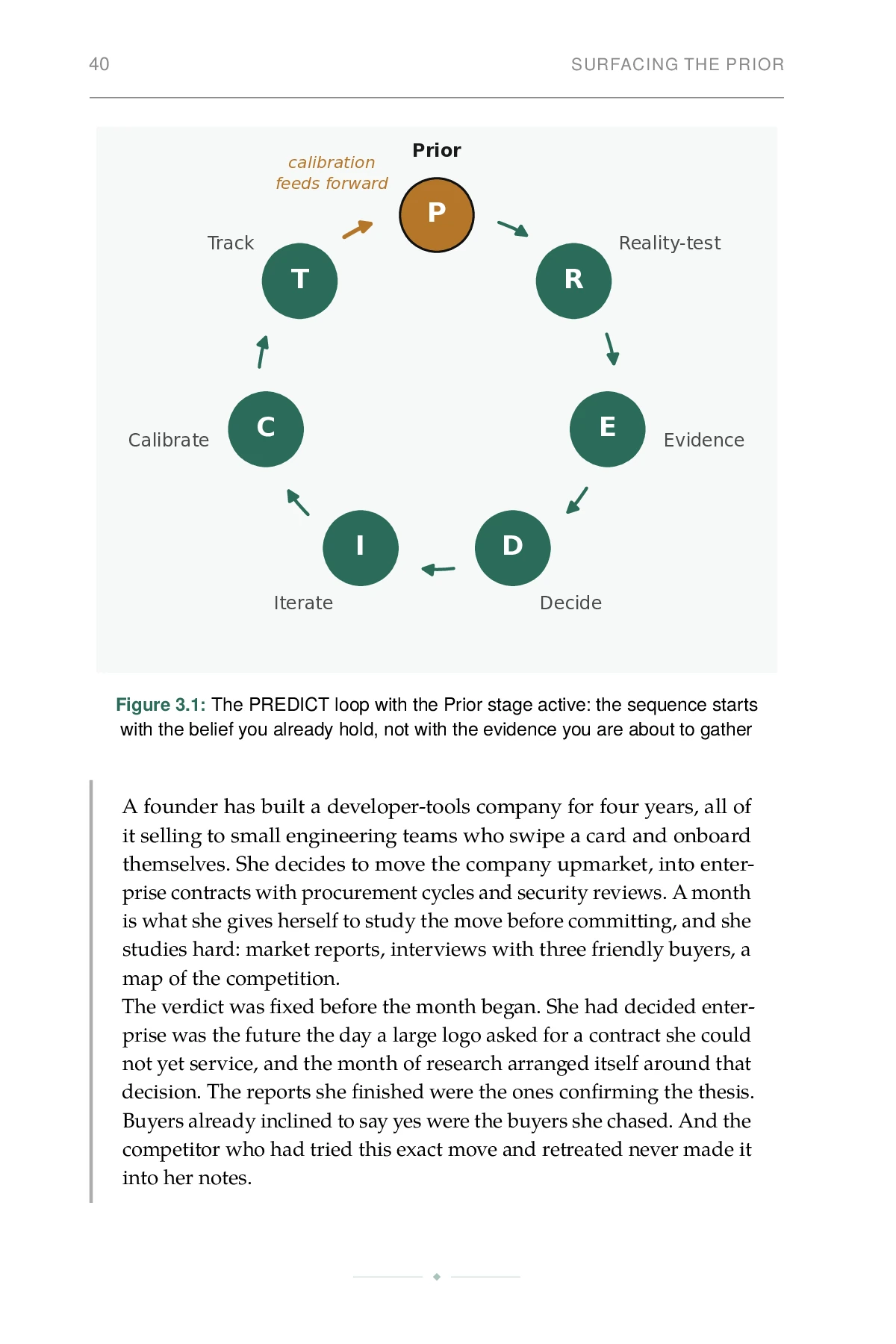
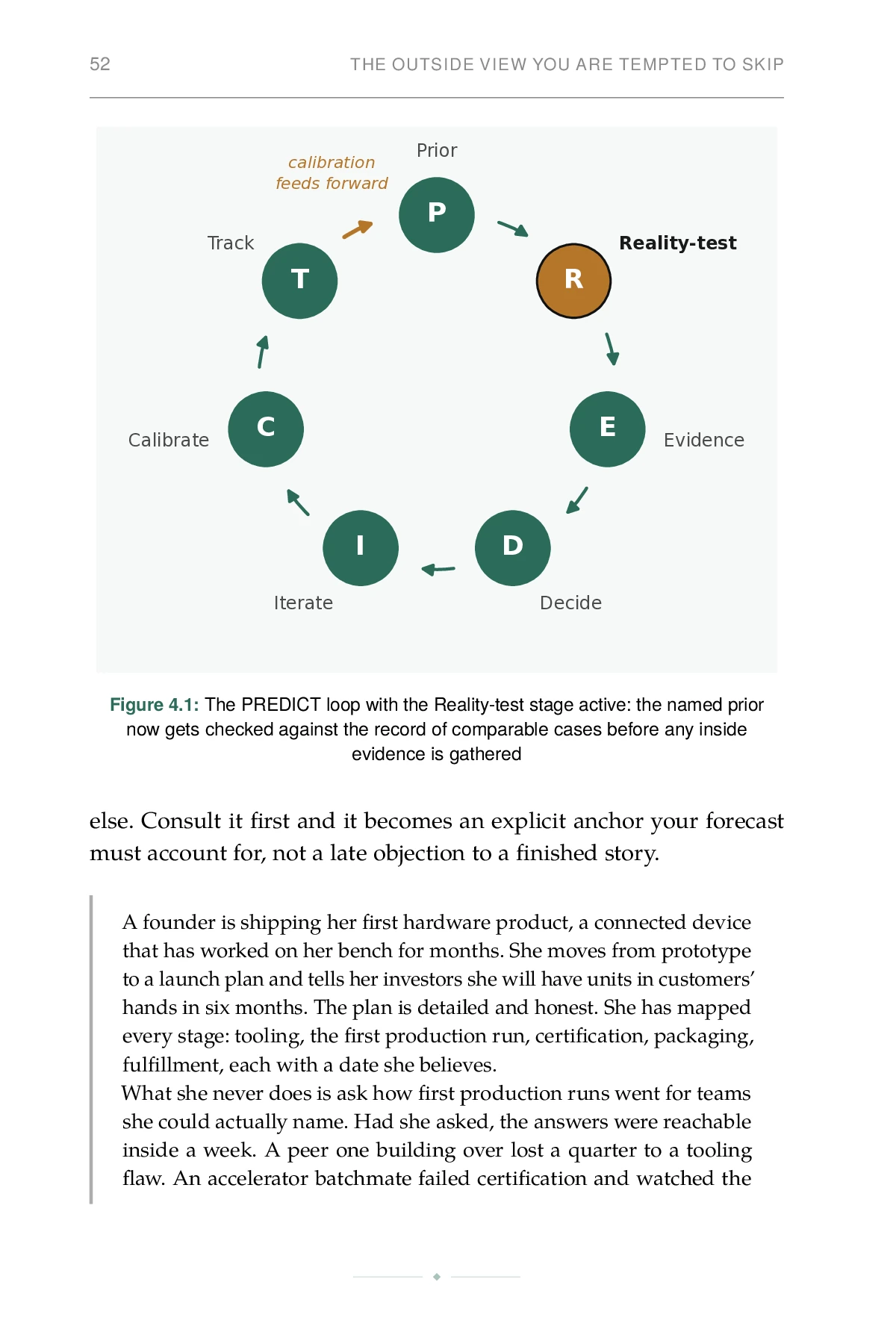
The PREDICT loop turns judgment into an inspectable practice: Prior, Reality-test, Evidence, Decide, Iterate, Calibrate, Track. It preserves what you believed before the outcome, which evidence could change your mind, how the forecast evolved, and whether the result actually supports the story you tell about it.
What you learn
What this book puts in your hands
- Audit whether your experience contains stable patterns and useful feedback.
- Replace vague confidence with explicit, reviewable probabilities.
- Use outside views and reference classes without surrendering operator context.
- Define update triggers before commitment makes revision politically expensive.
- Score comparable forecasts without turning one outcome into a verdict on your judgment.
The framework
PREDICT, step by step
-
Prior
-
Reality-test
-
Evidence
-
Decide
-
Iterate
-
Calibrate
-
Track
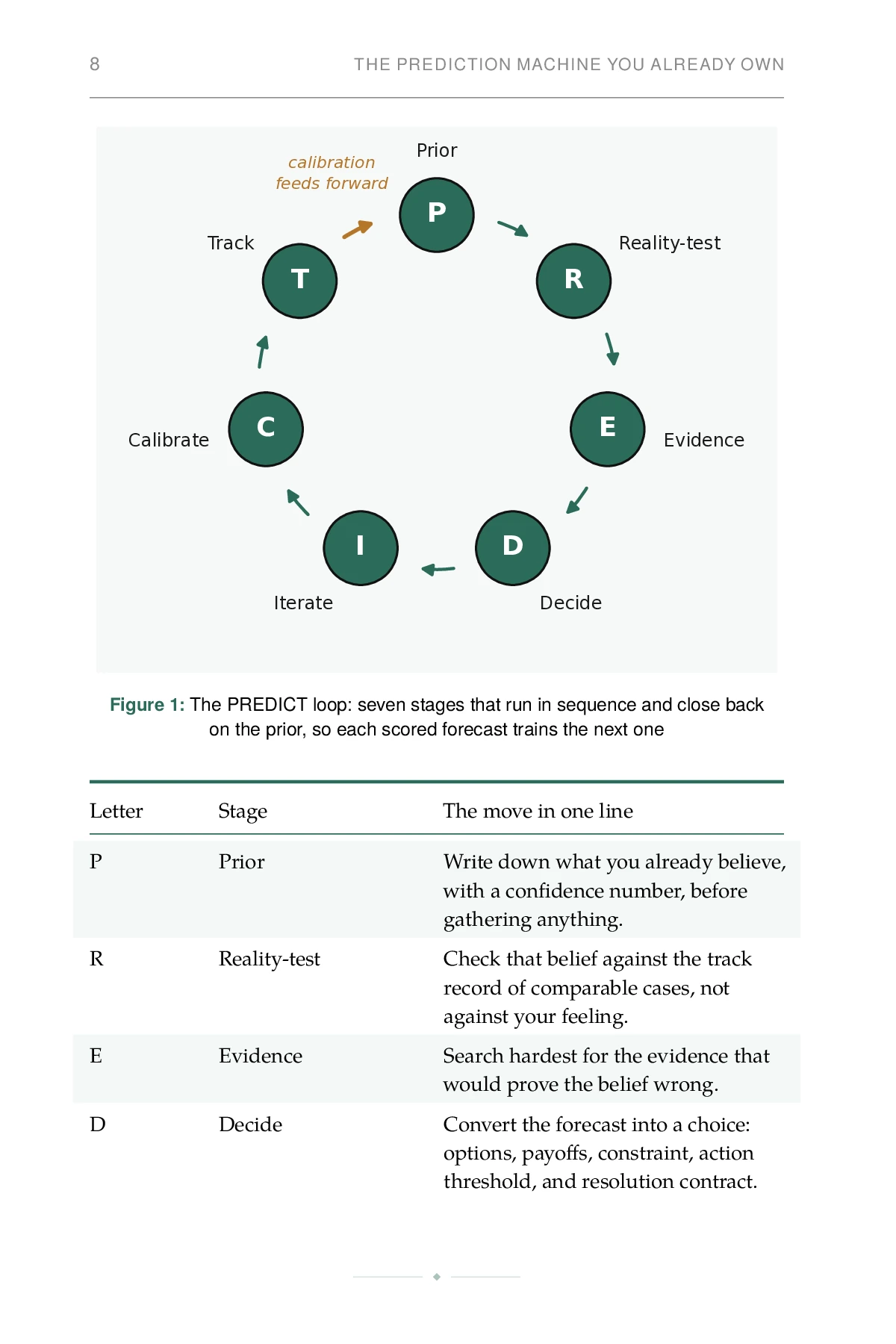
From the book
The PREDICT loop: seven stages that run in sequence and close back on the prior, so each scored forecast trains the next one
The Predictive Founder, printed page: The PREDICT loop: seven stages that run in sequence and close back on the prior, so each scored forecast trains the next one
Inspect more pagesLook inside
Pages from the print edition.
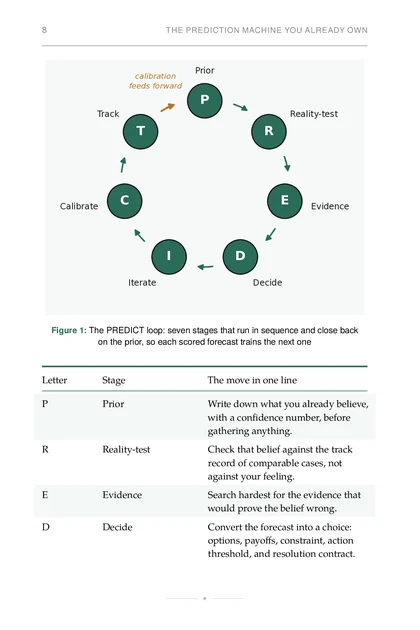 The PREDICT loop: seven stages that run in sequence and close back on the prior, so each scored forecast trains the next one
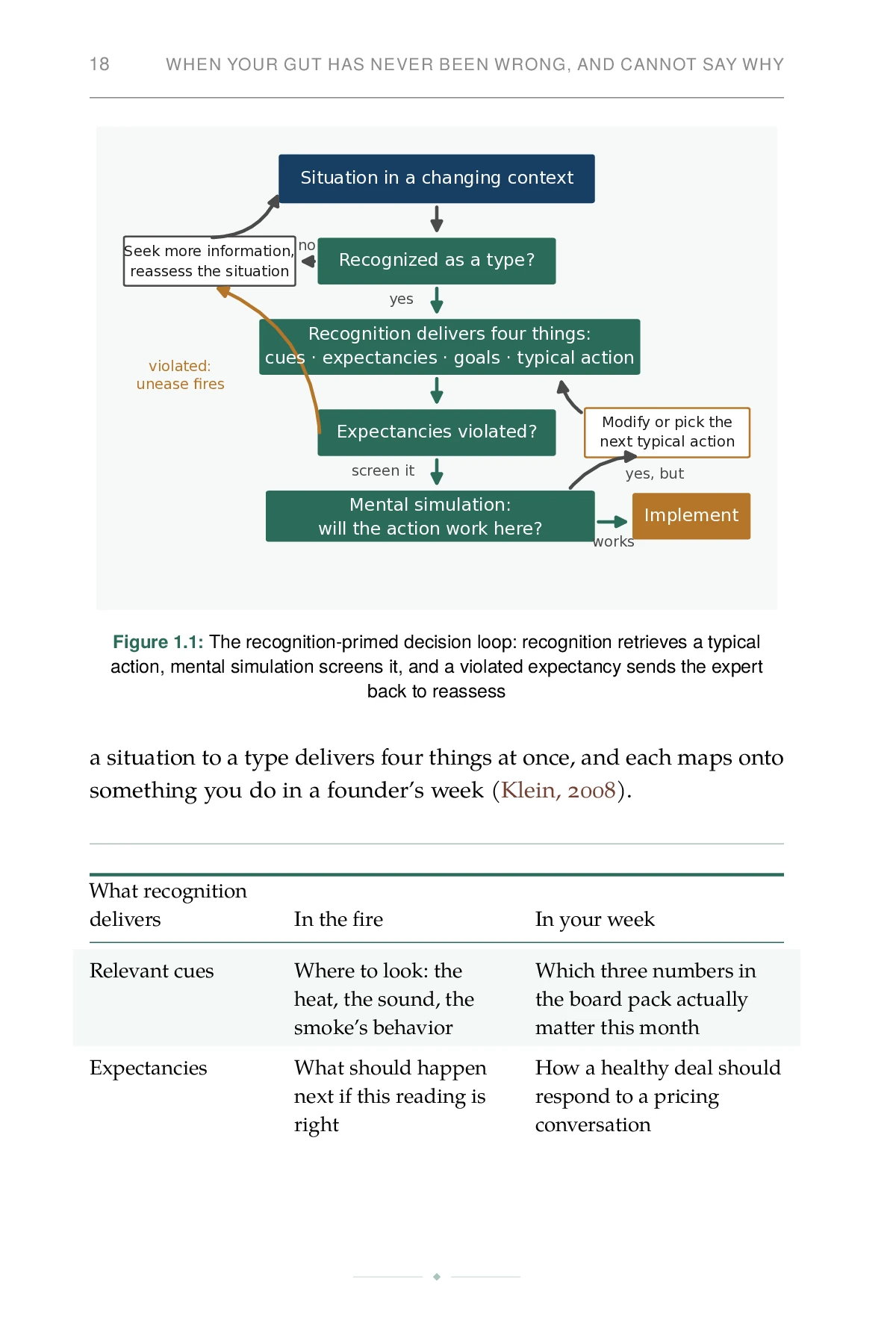
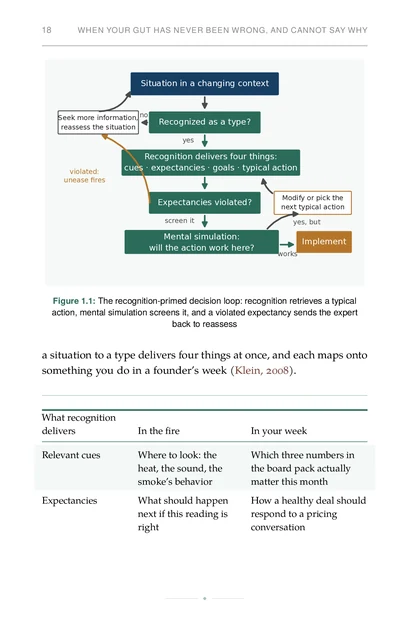 The recognition-primed decision loop: recognition retrieves a typical action, mental simulation screens it, and a violated expectancy sends the e…
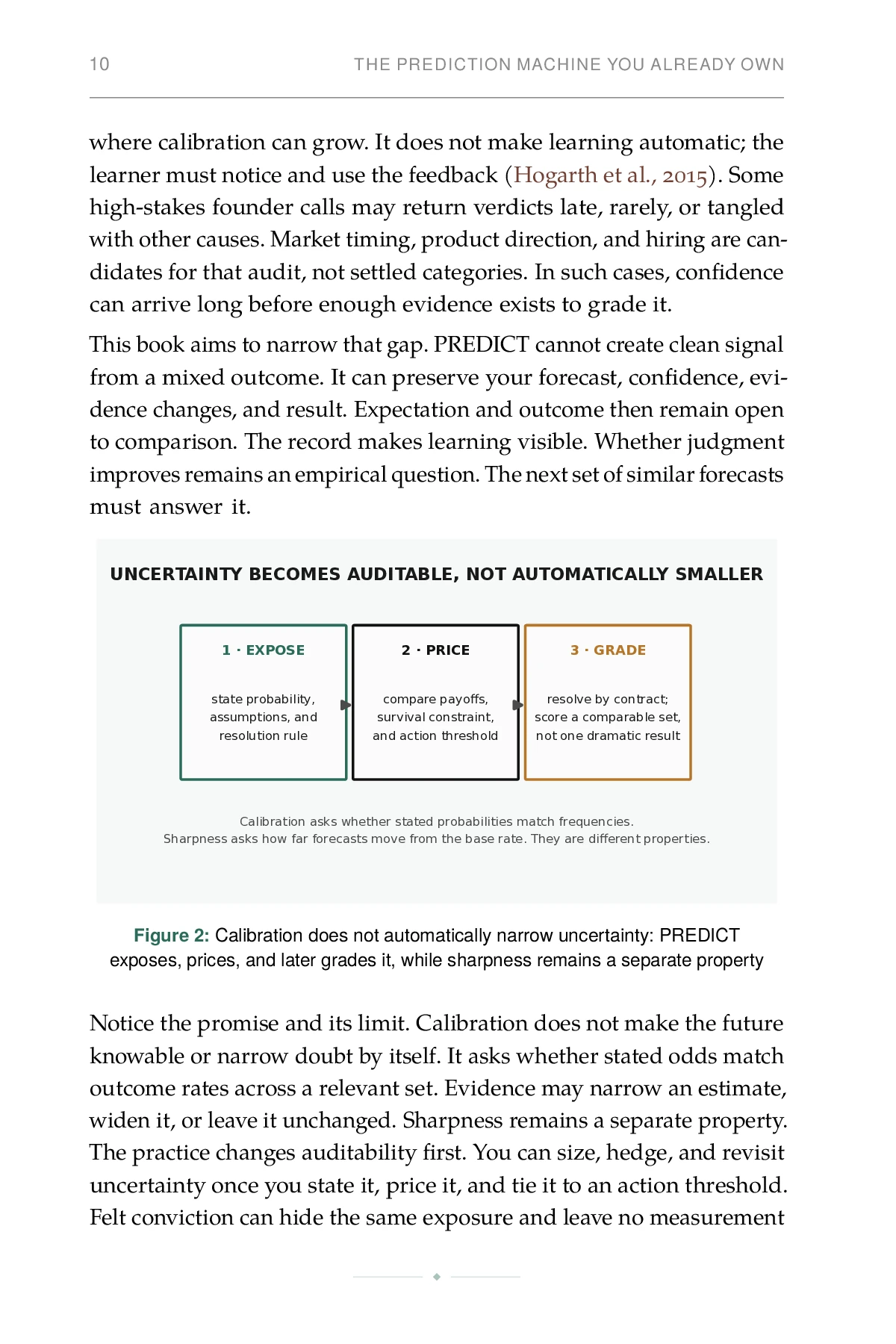
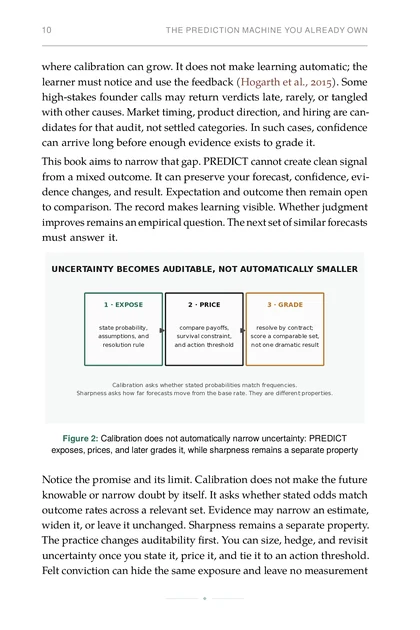 Calibration does not automatically narrow uncertainty: PREDICT exposes, prices, and later grades it, while sharpness remains a separate property
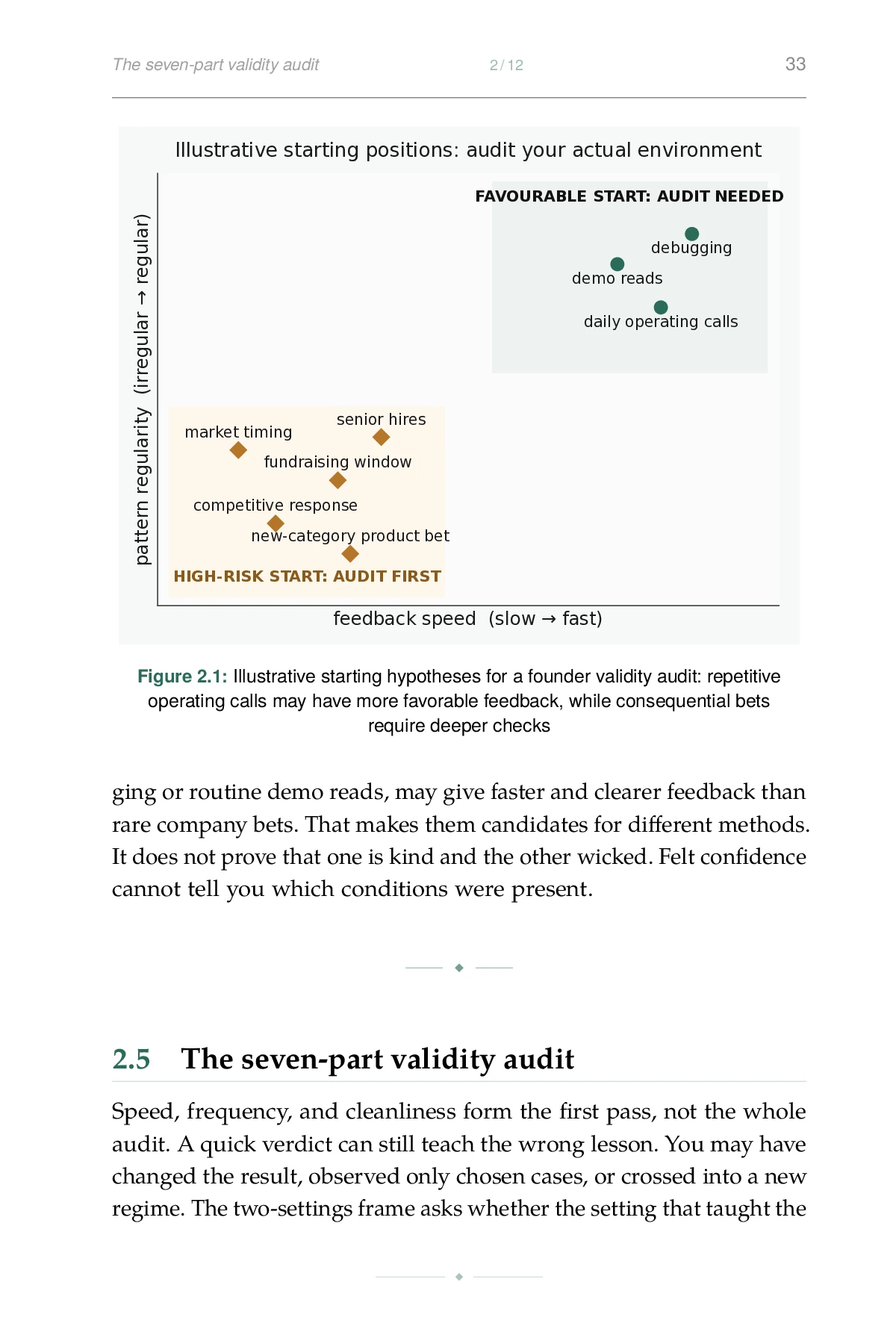
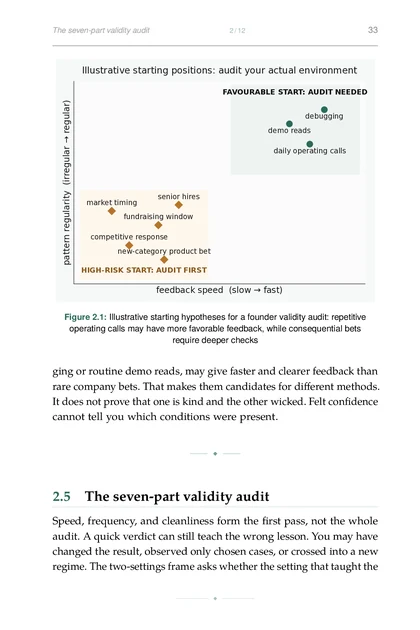 Illustrative starting hypotheses for a founder validity audit: repetitive operating calls may have more favorable feedback, while consequential bets
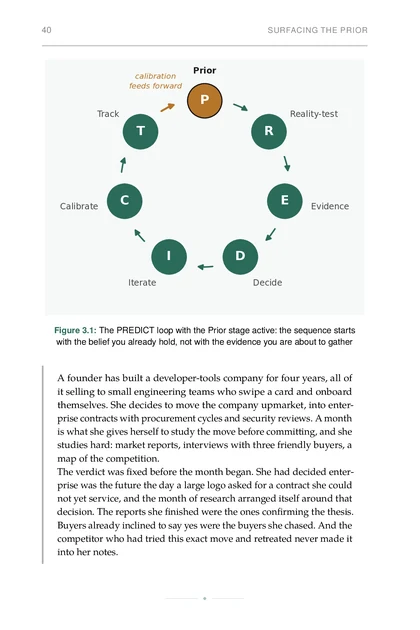 The PREDICT loop with the Prior stage active: the sequence starts with the belief you already hold, not with the evidence you are about to gather
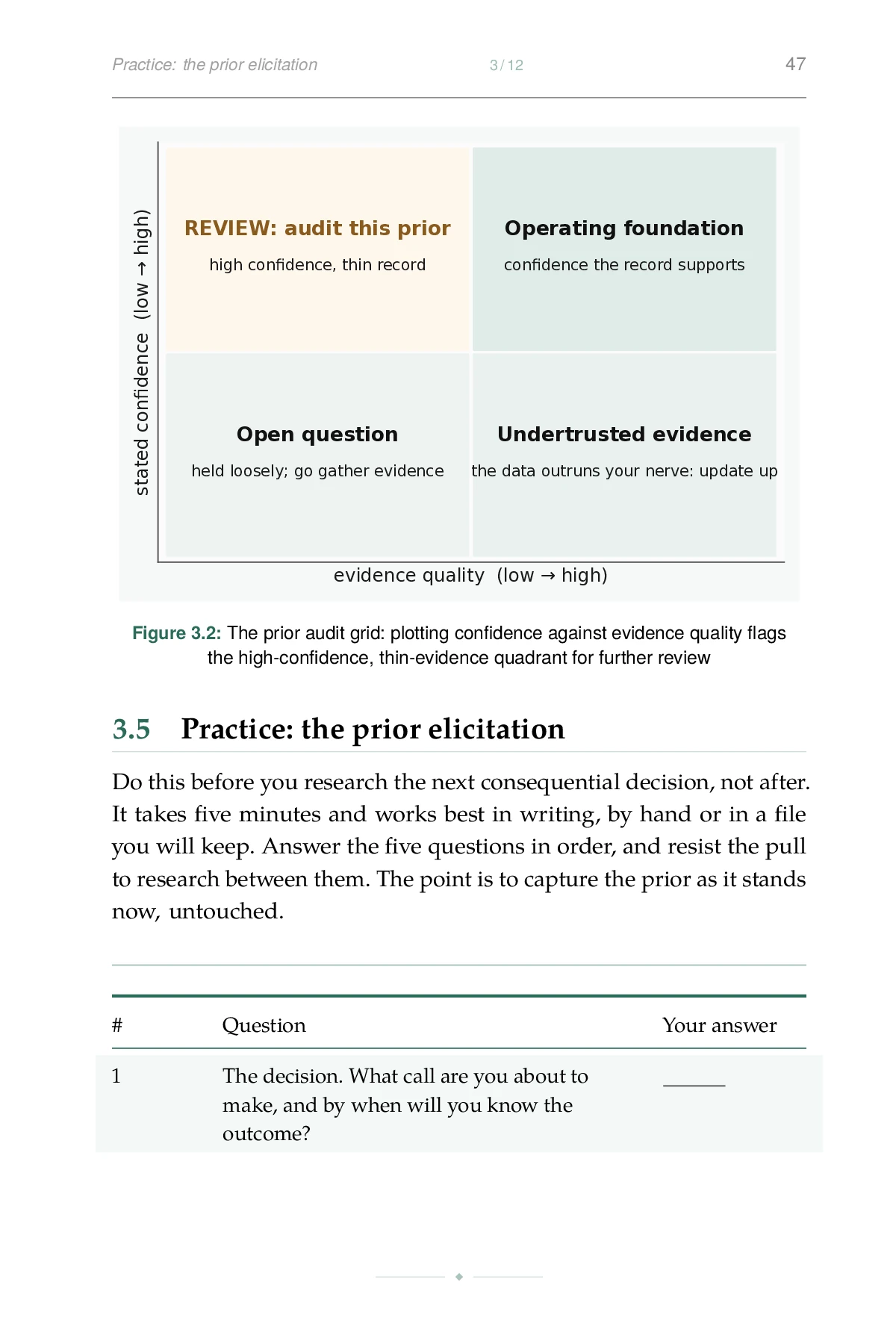
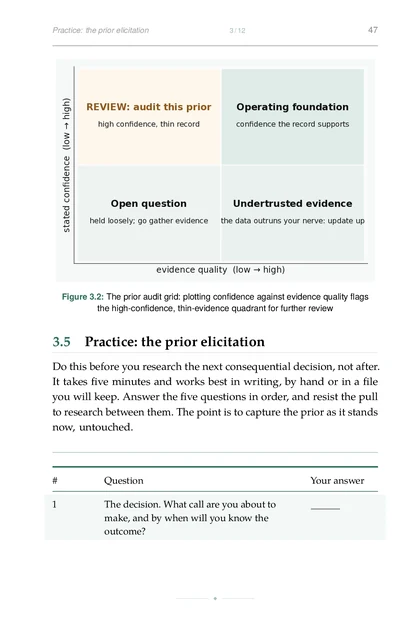 The prior audit grid: plotting confidence against evidence quality flags the high-confidence, thin-evidence quadrant for further review
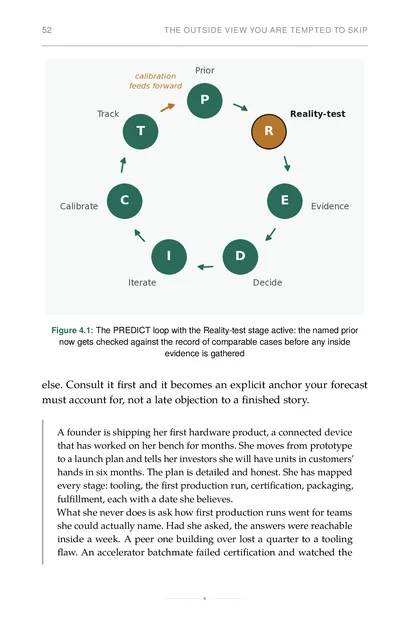 The PREDICT loop with the Reality-test stage active: the named prior now gets checked against the record of comparable cases before any inside
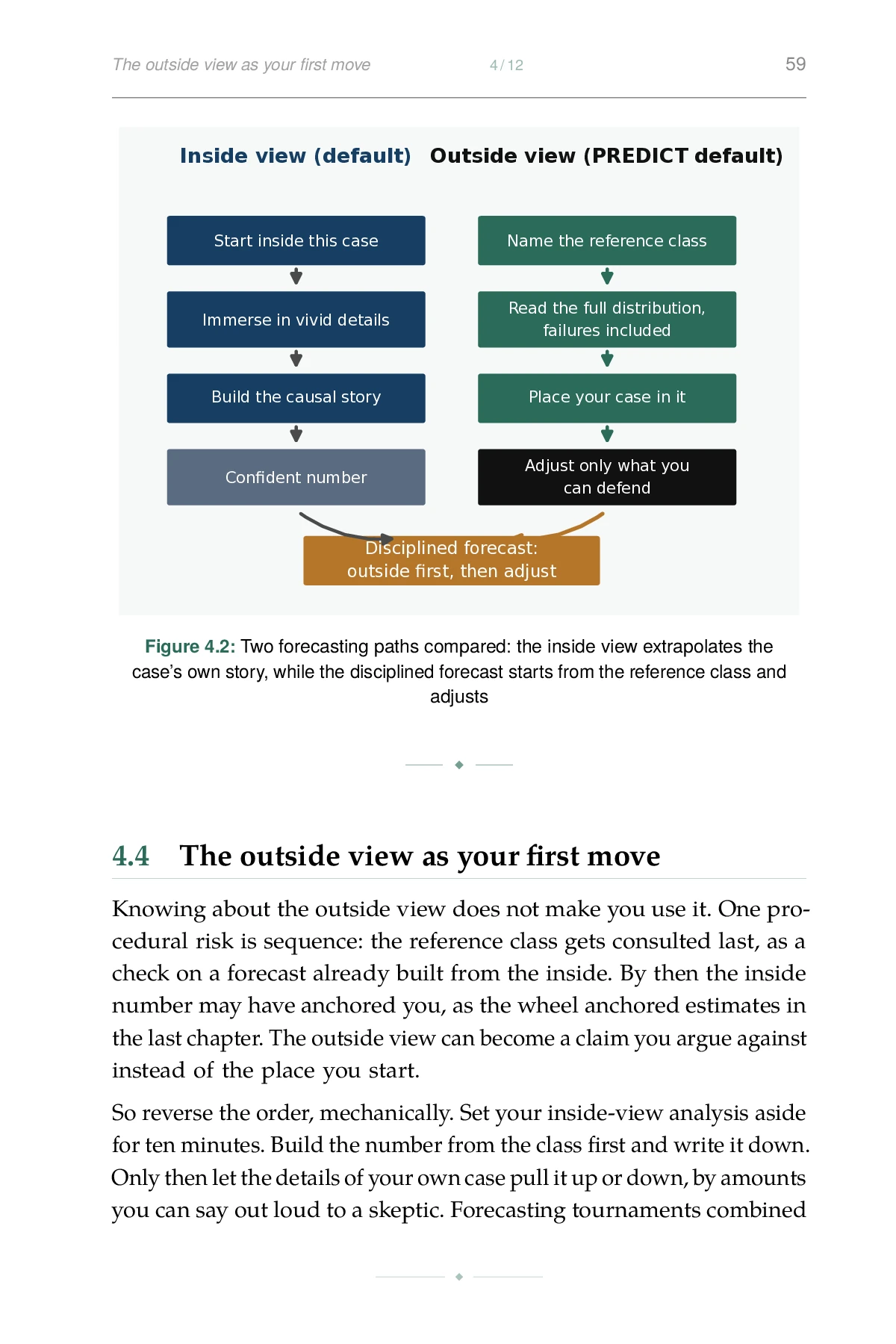
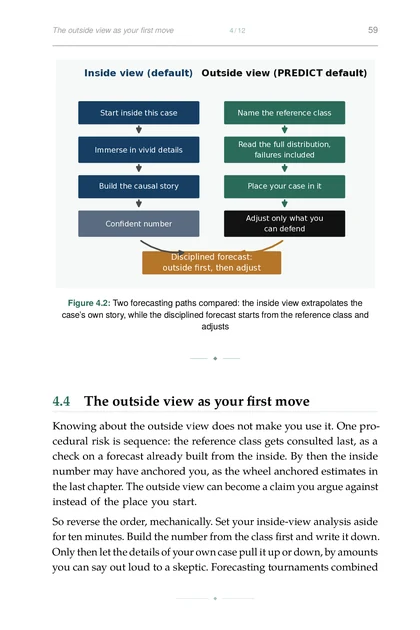 Two forecasting paths compared: the inside view extrapolates the case’s own story, while the disciplined forecast starts from the reference class…
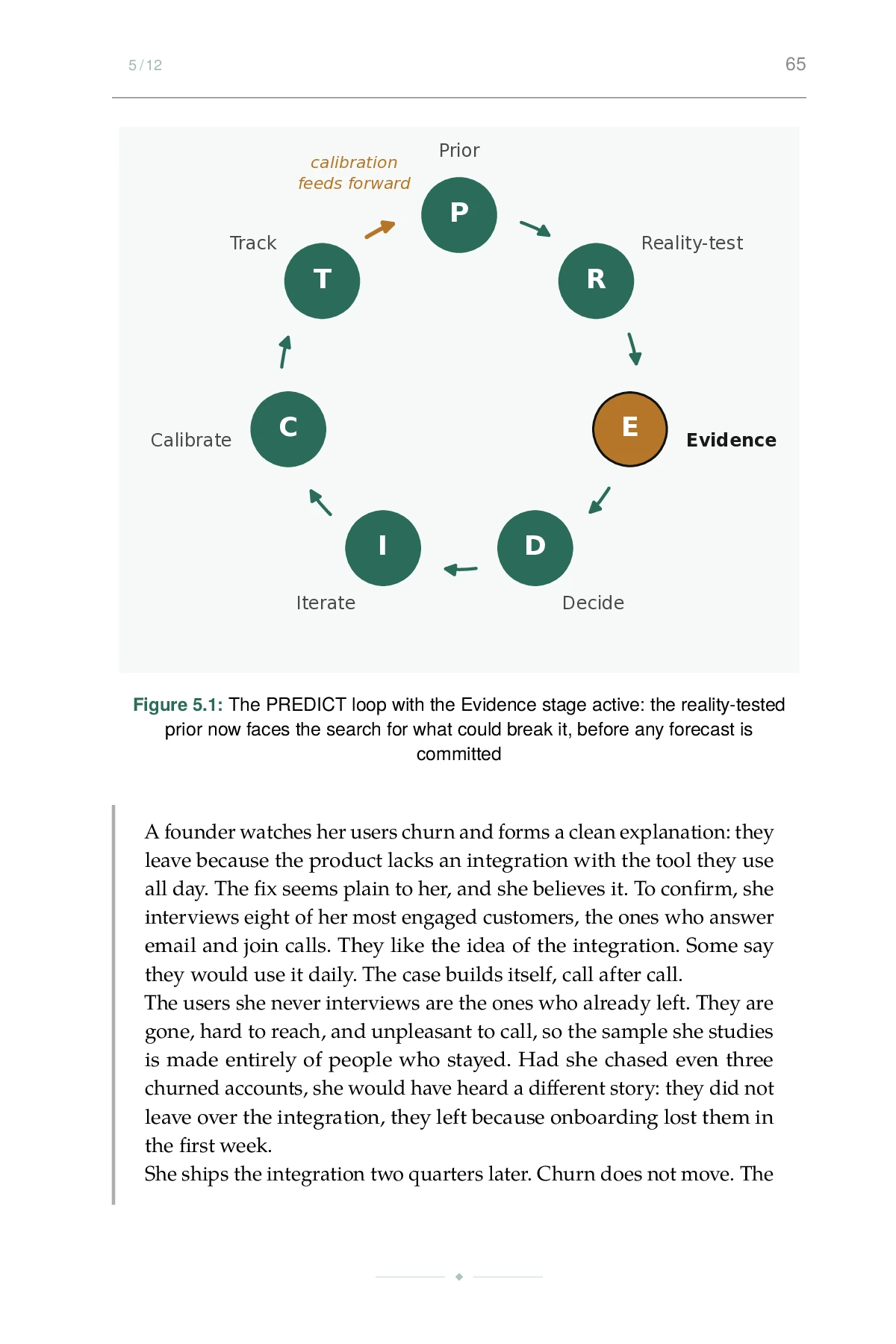
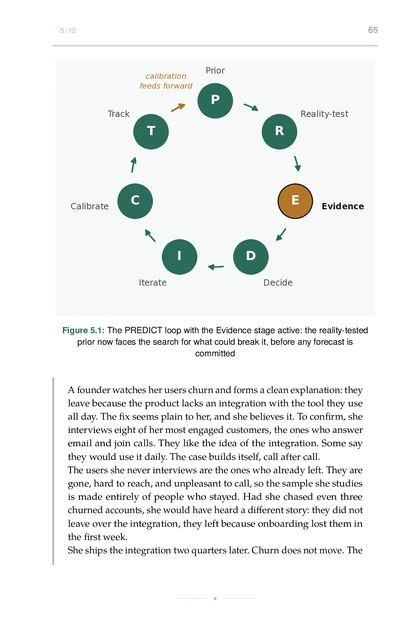 The PREDICT loop with the Evidence stage active: the reality-tested prior now faces the search for what could break it, before any forecast is
The contents
Chapter by chapter
Every chapter of The Predictive Founder with its printed epigraph, what you can do afterwards, and the moment it is built for.
Introduction
The prediction machine you already own
Predictive-processing theories model the brain as forecasting sensory input rather than recording it passively. This book borrows that lens for founder judgment, then tests only the forecasts and outcomes a decision record can expose.
What you can do afterwards
You will stop treating intuition as a fixed trait you either have or lack, and start auditing the conditions under which a fast judgment may deserve weight.
Use this chapter when
A high-stakes call feels obvious and you cannot say why, or you are arguing with a co-founder over whether to trust instinct or the data.
Chapter 1
When your gut has never been wrong, and cannot say why
Your gut is not a separate sense. Often it is fast pattern recognition whose evidence no longer arrives with the verdict.
What you can do afterwards
A precise account of how recognition-primed decision making describes experienced practitioners, which conditions may let it earn weight, and why the feeling cannot certify its own reliability.
Use this chapter when
You have made a high-confidence call that proved right and cannot reconstruct the reasoning, and a structurally similar call that proved wrong at the same confidence.
Chapter 2
The environment that trains you, and the one that tricks you
Intuition is not trained by years alone. It needs usable feedback, and many decisions that define a company return little of it.
What you can do afterwards
A seven-part audit that records evidence about conditions in which reliable intuition could develop; it flags process risk but does not certify intuition.
Use this chapter when
You are about to lean on experience for a high-stakes call and want to know whether the experience that feels relevant was ever graded.
Chapter 3
Surfacing the prior
Most inquiries begin with a starting estimate. Write it down before you learn whether it was a useful cue or an anchor.
What you can do afterwards
A method for bringing your starting estimate into the open as a stated forecast, before new evidence can move it or entrench it.
Use this chapter when
A consequential decision is open and you are about to start researching it, or you notice you are collecting facts that all point the same direction.
Chapter 4
The outside view you are tempted to skip
Your plan knows everything about your case and nothing about its kind.
What you can do afterwards
A way to test your prediction against a source your own case analysis omits: the track record of people who attempted something comparable before you.
Use this chapter when
You have a stated prior on a consequential outcome and are about to forecast how long it will take, what it will cost, or how likely it is to work.
Chapter 5
Stress-testing the model
Evidence gathered to confirm a prediction is often cheap. Evidence that could break it may carry far more diagnostic value.
What you can do afterwards
A method for turning evidence gathering from a case you build for your own prediction into a search for the facts that could break it.
Use this chapter when
You hold a stated prior, you have reality-tested it, and you are about to collect evidence about your specific case before you commit to a forecast.
Chapter 6
Making the forecast explicit
You cannot grade a prediction you can always explain away. A forecast that can lose leaves a record you can inspect.
What you can do afterwards
A method for turning a tested belief into an action choice and a forecast you can score, so you can review the decision separately from its result.
Use this chapter when
You hold a prior you have reality-tested and stress-tested, and you are about to act on it, before you let the decision pass without a recorded forecast.
Chapter 7
The update discipline
A useful signal may arrive before the deadline and look like noise. Without a declared review rule, you may let it pass.
What you can do afterwards
A method for updating a committed forecast by testing how strongly new evidence distinguishes true from false, while preserving every earlier probability.
Use this chapter when
You hold a committed forecast with a number and a resolution date, and time still remains before the deadline to respond to what the world reveals.
Chapter 8
Measuring what your gut has actually been doing
A single outcome invites a story. A coverage-controlled record can challenge the story, but only to the extent that its questions, references, and dependencies deserve.
What you can do afterwards
A method for scoring a forecasting history, comparing it with a declared reference, and separating provisional calibration signals from conclusions the record cannot yet support.
Use this chapter when
You hold a resolved set of committed forecasts and want to learn the scoring mechanics, compare them with a declared reference, and decide what the record can support without asking a thin sample for a verdict.
Chapter 9
The log that compounds
A record tells you what you did. An instrument can change what you do next. The prediction log can serve that second role, but only while it is running and reviewed.
What you can do afterwards
A two-speed prediction log: fast enough to capture a forecast under pressure, complete enough to audit its resolution, updates, dependencies, and decision effects later.
Use this chapter when
You have run PREDICT on at least one real decision and want a standing place to keep the next hundred, so the scoring in the previous chapter has something to score.
Chapter 10
Where founder forecasts are most exposed
Forecast risk is not a personality trait. It can concentrate where feedback is slow, samples are selected, payoffs are asymmetric, and the environment keeps changing.
What you can do afterwards
A map of founder decisions that may carry high forecast exposure. It gives you evidence-graded safeguards to test before your own log has enough entries.
Use this chapter when
You face a market-timing, competitive-entry, hiring, or product call in a domain where your log is still thin. You want a more disciplined starting audit than raw confidence provides.
Conclusion
The prediction machine, tuned
The machine was always running. What you hold now, and did not hold on page one, is a way to keep score while it runs.
What you can do afterwards
PREDICT compressed to one page, a twelve-week commitment you can start this week, and your first ten forecasts written in before you set the book down.
Use this chapter when
You have read the book and want to put it to work without losing the thread between the method and the next real decision.
Who it is for
Who this book was written for
The result is a two-speed prediction log, decision and experiment cards for exposed calls, and a twelve-week installation plan that fits the operating cadence of a real company.
This is for founders who want something harder than confidence and more useful than self-doubt: a judgment system that can show its work, learn from outcomes, and improve without rewriting history.
The reader it was written for
A founder or founding-team operator must make a consequential call before the evidence is complete. Experience produces a fast judgment, but felt confidence cannot show whether the relevant environment offered learnable regularities, representative practice, or usable feedback.
Editions
Editions and specifications
| Edition | Formats | Chapters | Pages | Reading time | ISBN (paperback) |
|---|---|---|---|---|---|
| English The Predictive Founder | In production | 12 | 184 | ± 2 hours | — |
| Dutch De voorspellende ondernemer | In production | 12 | 200 | ± 2 hours | — |
Both editions are written natively. The Dutch text is not a machine translation of the English. · Trim size: 6x9″
Frequently asked
What readers usually want to know
What is The Predictive Founder about?
PREDICT turns judgment into an inspectable practice: prior, reality-test, evidence, decide, iterate, calibrate, track. It shows when experience deserves weight and when a consequential call needs an explicit test. The subtitle is: When to Trust Your Gut, When to Override It, and How to Keep Score.
What is the PREDICT framework?
PREDICT: Prior, Reality-test, Evidence, Decide, Iterate, Calibrate and Track.
Is there a Dutch edition?
Yes. The Dutch edition is De voorspellende ondernemer, written as a native edition rather than a machine translation. It moves through the same production line.
How long is The Predictive Founder?
This edition runs 12 chapters, 184 pages in print and roughly 2 hours of reading.
Who is The Predictive Founder for?
This is for founders who want something harder than confidence and more useful than self-doubt: a judgment system that can show its work, learn from outcomes, and improve without rewriting history.
The production system
How this book was made
Every title moves through the same gated production line: sourced research, a claim-level evidence ledger, structural review, fact-checking, red-team critique, and a bilingual final edit. AI agents do specialist work inside those gates; judgment, voice, and accountability stay human.
- Claims enter an evidence ledger with a source and a confidence grade before they reach the page
- English and Dutch are two native editions, not a translation of one another
- Every chapter clears readability, rhythm, and style gates before it is typeset


