Available now · worldwide on Amazon
The Evidence-Aware Life
How to Think in Levels Instead of Opinions
Stop borrowing other people's certainty. Start weighing the evidence yourself.
The Evidence Ladder and LEVEL check help readers grade claims before changing a belief, a health habit, a roadmap, or a company decision.
Get the book
Reading from another country?Pick your own Amazon marketplace — same edition, your store.
Amazon links may include affiliate tags. That does not change the price you pay. Bol.com listings are third-party.
English & Dutch editions · Kindle, Paperback, Hardcover · free on Kindle Unlimited · Nederlandse editie →
- pages
- 238
- chapters
- 13
- hours of reading
- ± 3
- editions
- EN · NL


The editions
Choose your format
Same book, your format. You buy on Amazon, not on this site.
-
Kindle
Read now. Kindle Unlimited members get it at no extra cost.
Buy on Amazon -
Paperback
The working copy. Mark it up. Take it into the meeting.
Buy on Amazon -
Hardcover
The shelf edition. Dark full-art jacket, built to stay in the room.
Buy on Amazon


Available now
How to Think in Levels Instead of Opinions
You read the study, the thread, the founder's post, the doctor's offhand remark, and you believe the one that sounded most certain. Weeks later it turns out to be a single anecdote in a good suit, and you have already changed your diet, your roadmap, or your mind on the strength of it. The problem was never too little information. It was that you could not feel the difference between a claim worth betting on and one worth ignoring.
The usual fix (read more, follow smarter people, trust the experts) fails, because a confident-sounding claim is now the cheapest thing in the world to manufacture, and volume does nothing to grade it.
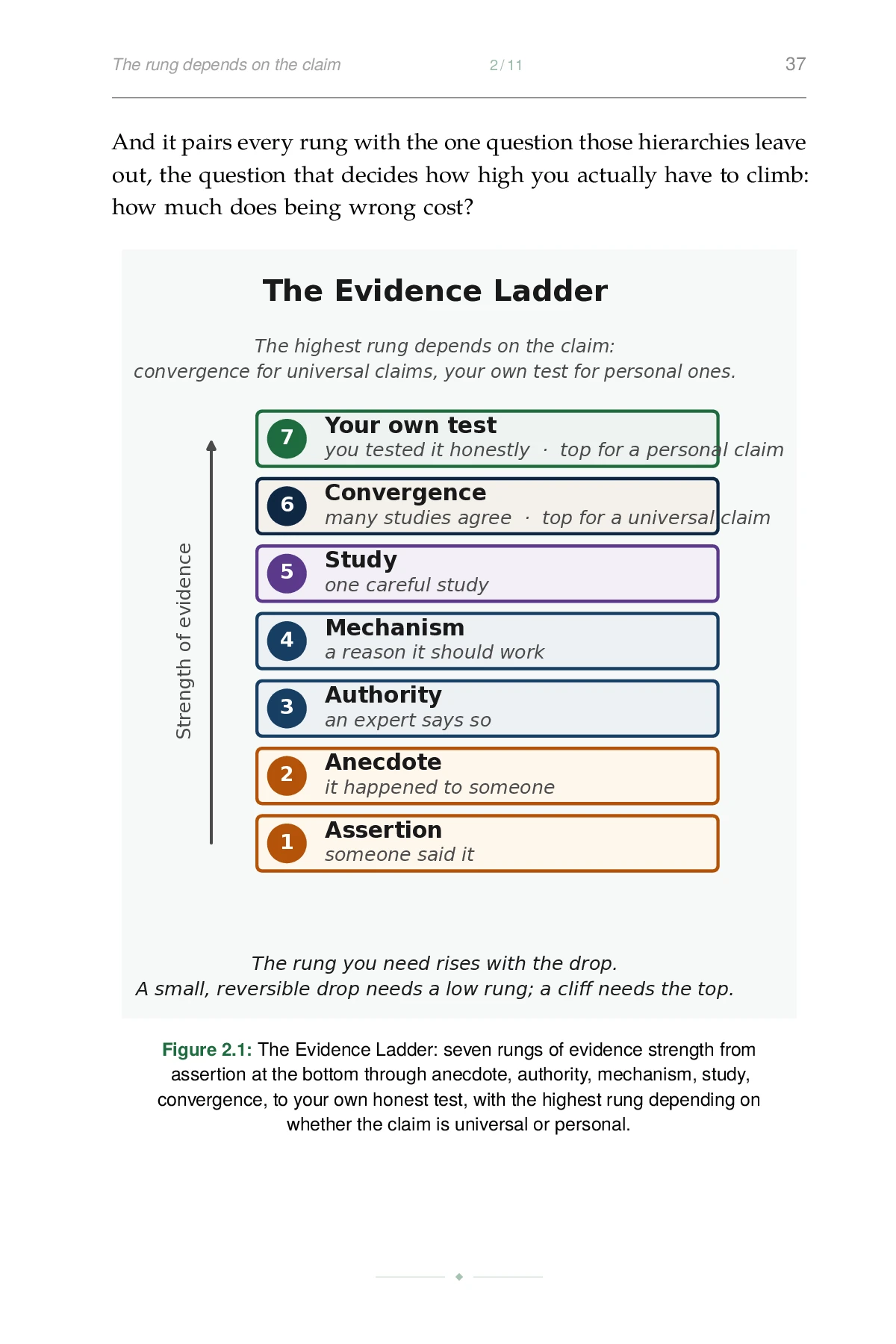
The Evidence-Aware Life replaces faith in packaging with one trained move you run before you believe or bet. It is built on the Evidence Ladder (seven rungs from bare assertion up to a test you ran yourself) and the LEVEL check, the five-step pass that makes the ladder a habit you can run for the rest of your life.
What you can do
What this book puts in your hands
You will learn to:
- State any claim plainly enough to grade it, and name its type.
- Set the bar by the stakes, not by how badly you want the claim to be true.
- Place evidence on the rung it is actually on, not the rung it was dressed up as.
- Run a cheap personal experiment when one beats waiting for proof.
- Lean hard where the evidence earns it, lightly where it does not, and on purpose either way.
The framework
LEVEL: the system behind the book
rank any claim on seven rungs, from confident stranger to your own N=1 test
-
Locate
Name the claim in one sentence. If you cannot, you are grading packaging.
-
Estimate
Set the bar by what being wrong costs, not by how badly you want the claim true.
-
Value
Place the evidence on the rung it actually stands on.
-
Expose
State the strongest case against the claim before you lean.
-
Lean
Act only as hard as the rung and the stakes allow, and on purpose.
From the book
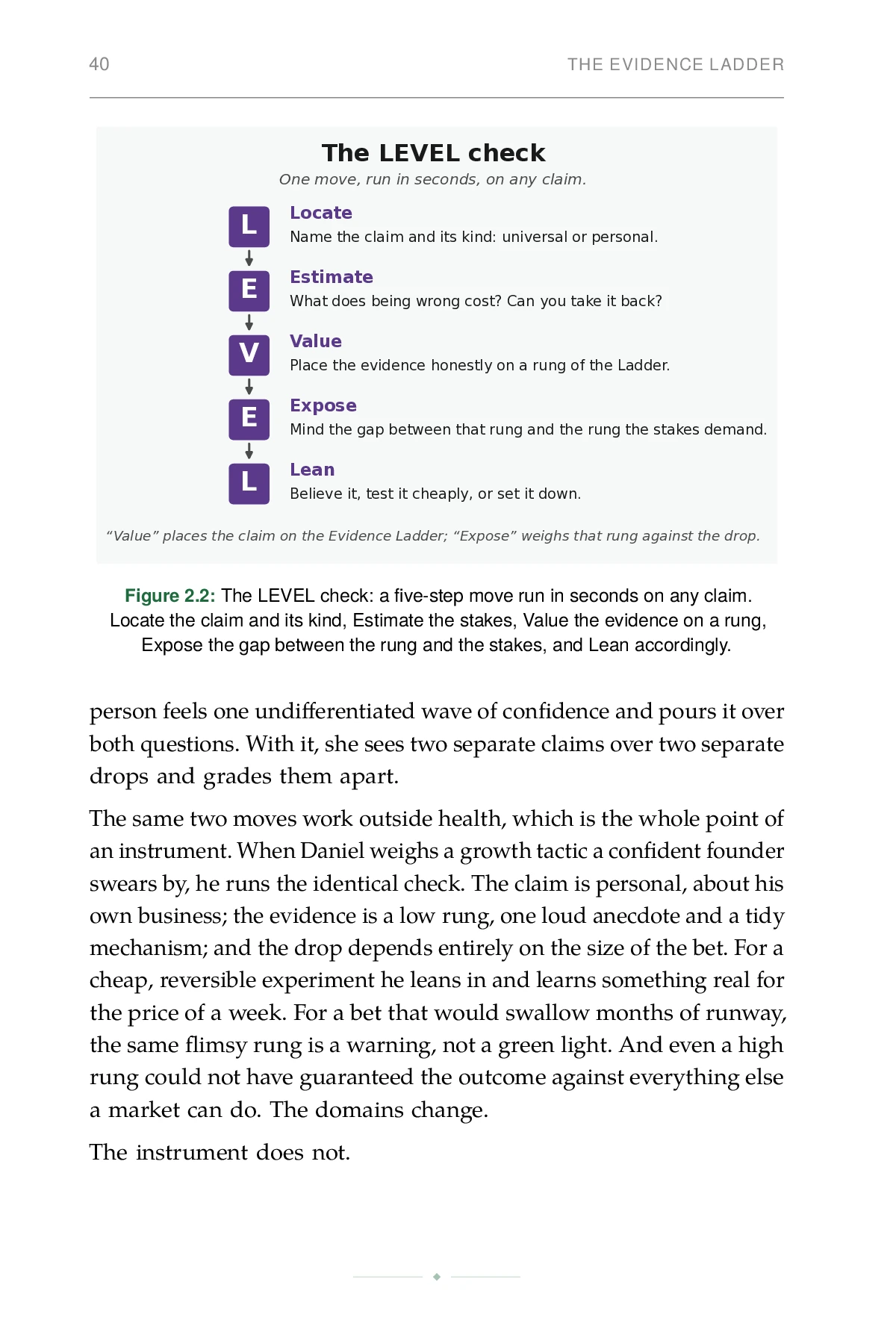
The LEVEL check: a five-step move run in seconds on any claim. Locate the claim and its kind, Estimate the stakes, Value the evidence on a rung,
The Evidence-Aware Life, printed page: The LEVEL check: a five-step move run in seconds on any claim. Locate the claim and its kind, Estimate the stakes, Value the evidence on a rung,
Inspect more pagesLook inside
Pages from the print edition.
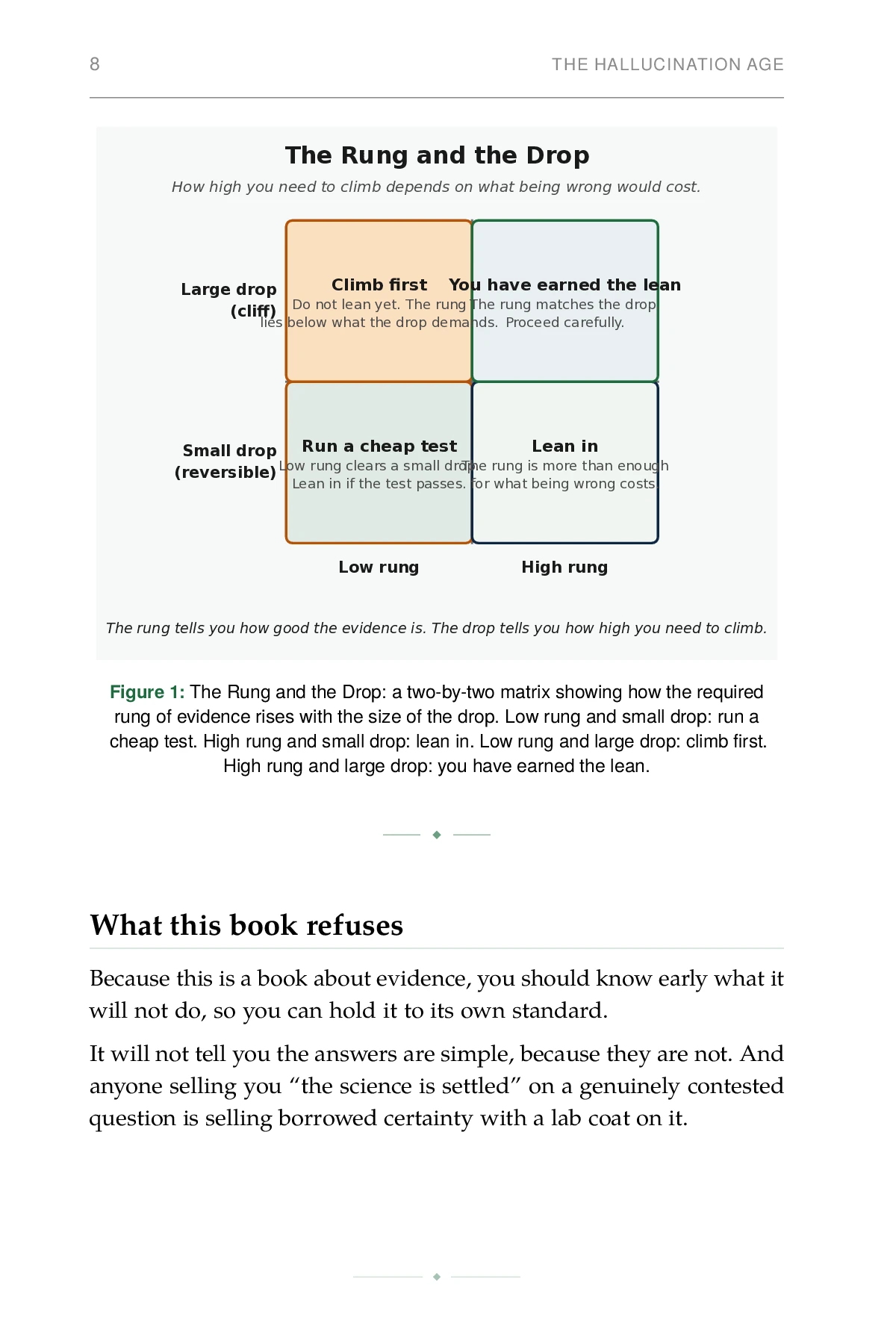
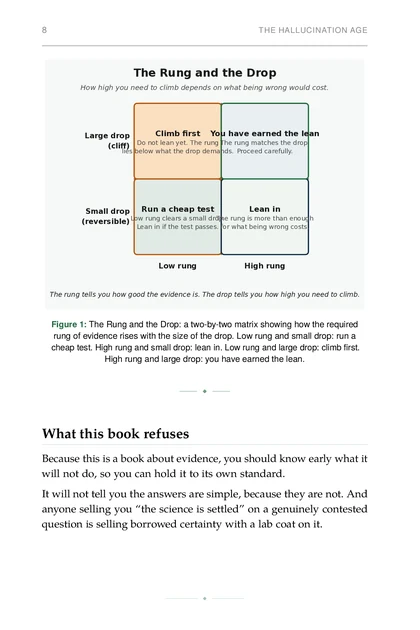 The Rung and the Drop: a two-by-two matrix showing how the required rung of evidence rises with the size of the drop. Low rung and small drop: run a
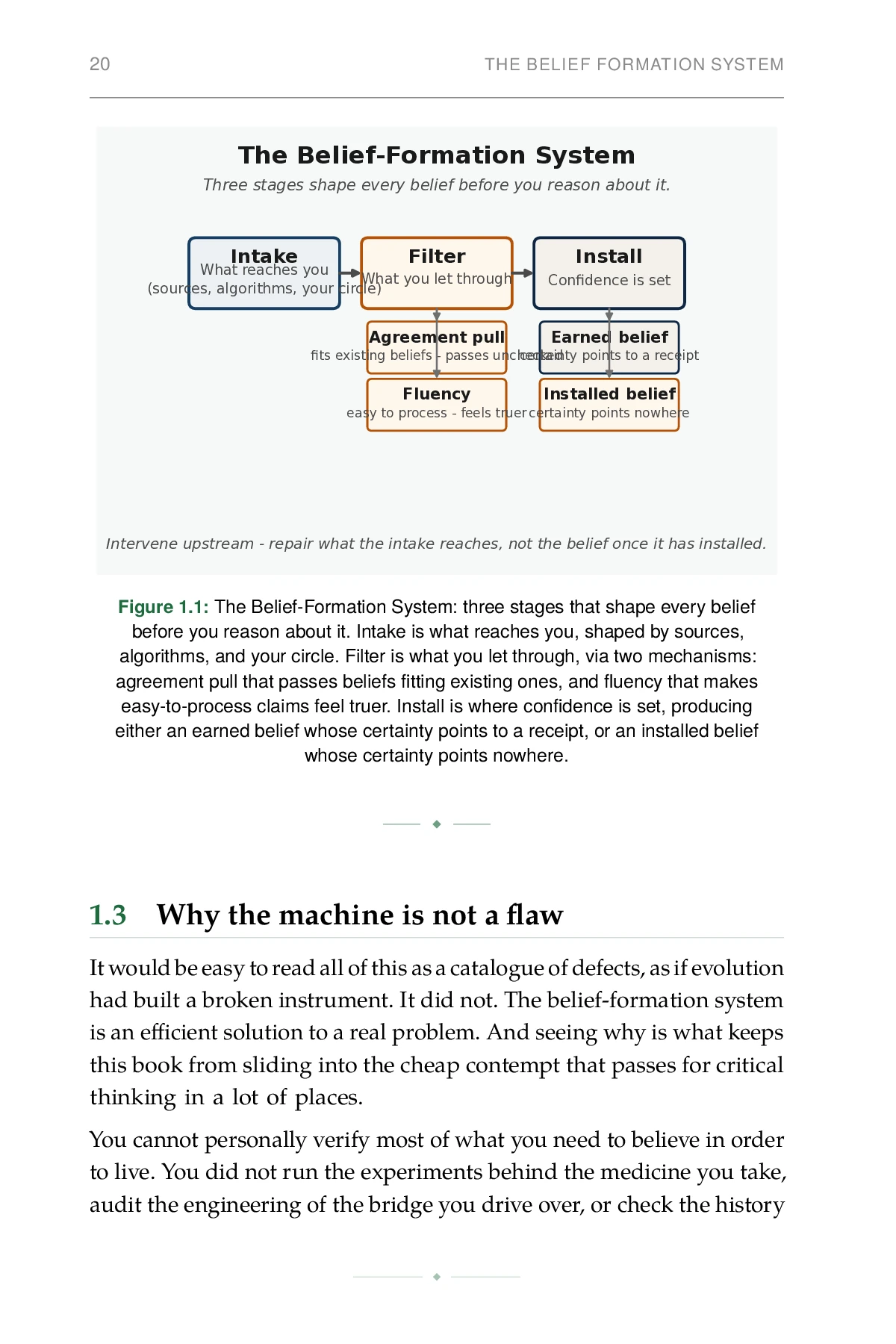
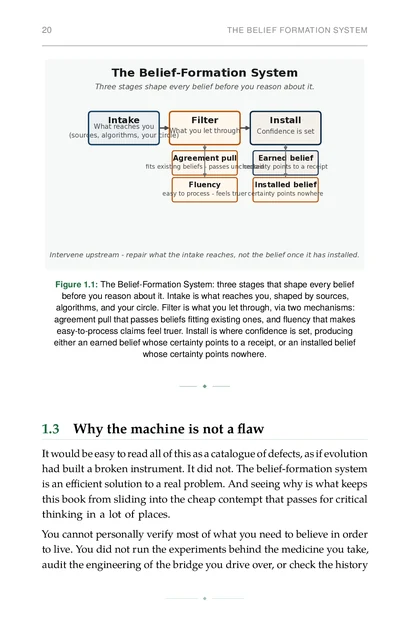 The Belief-Formation System: three stages that shape every belief before you reason about it. Intake is what reaches you, shaped by sources,
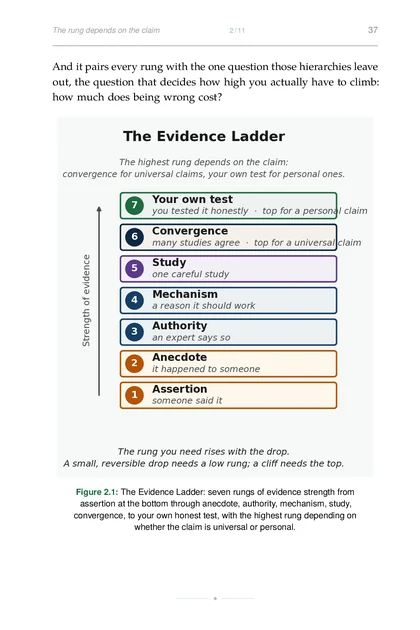 The Evidence Ladder: seven rungs of evidence strength from assertion at the bottom through anecdote, authority, mechanism, study,
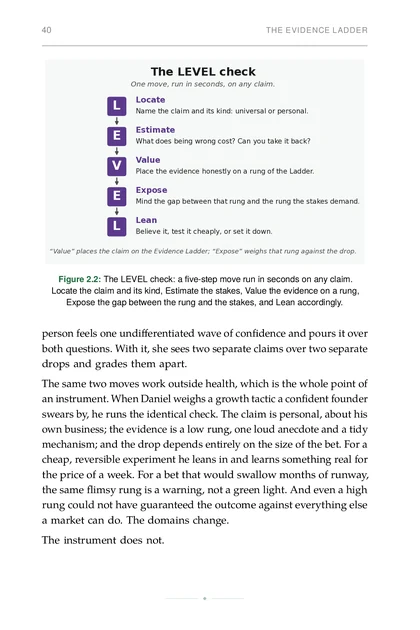 The LEVEL check: a five-step move run in seconds on any claim. Locate the claim and its kind, Estimate the stakes, Value the evidence on a rung,
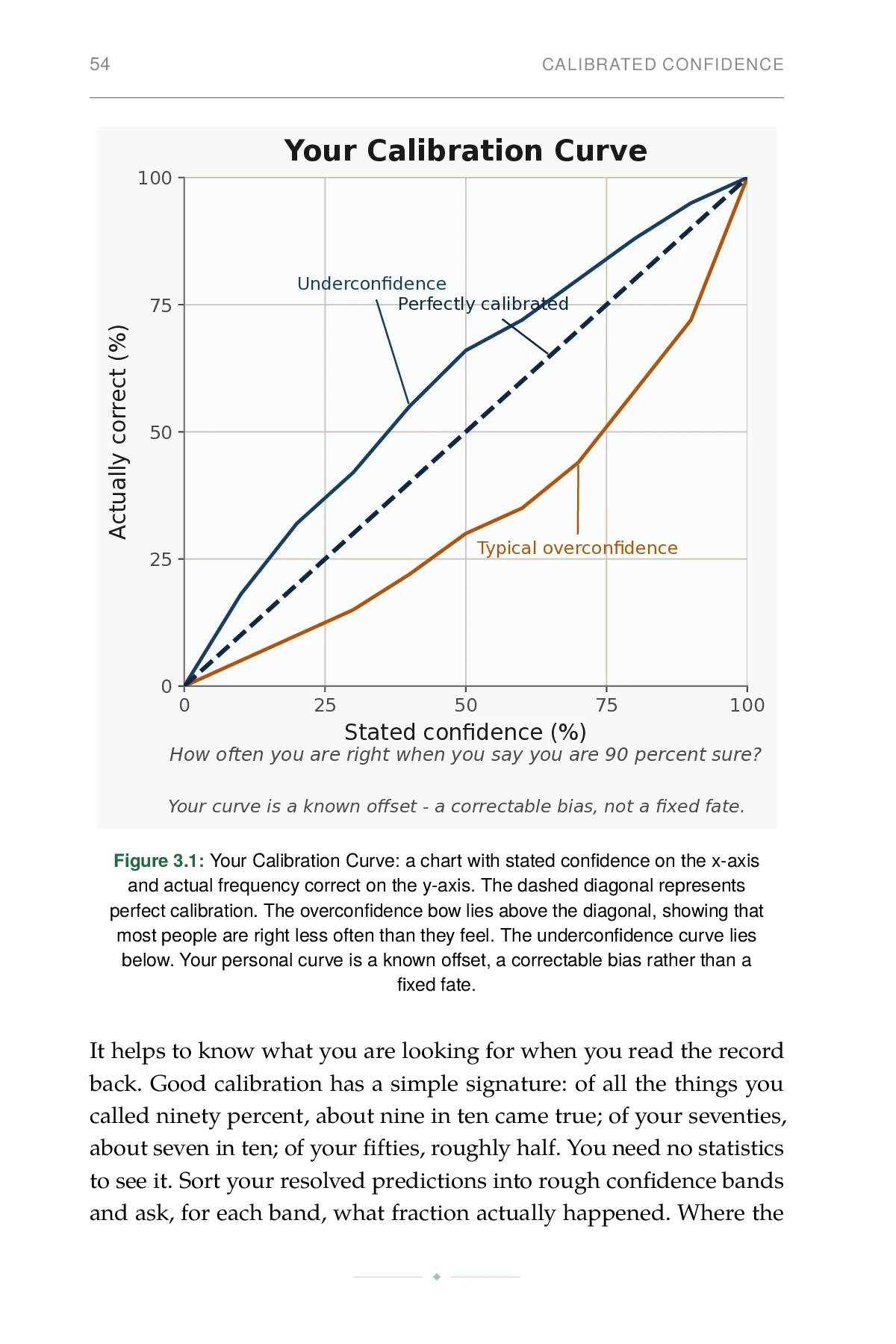
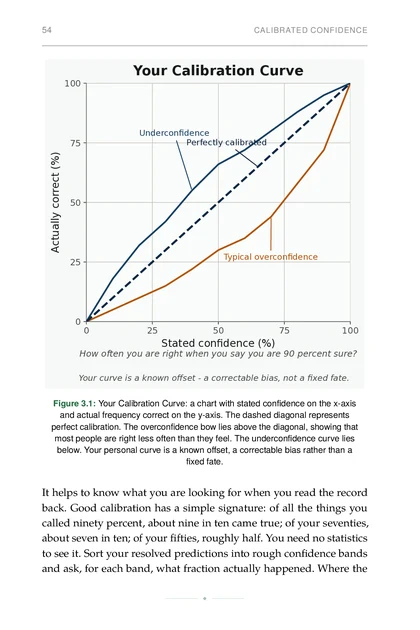 Your Calibration Curve: a chart with stated confidence on the x-axis and actual frequency correct on the y-axis. The dashed diagonal represents
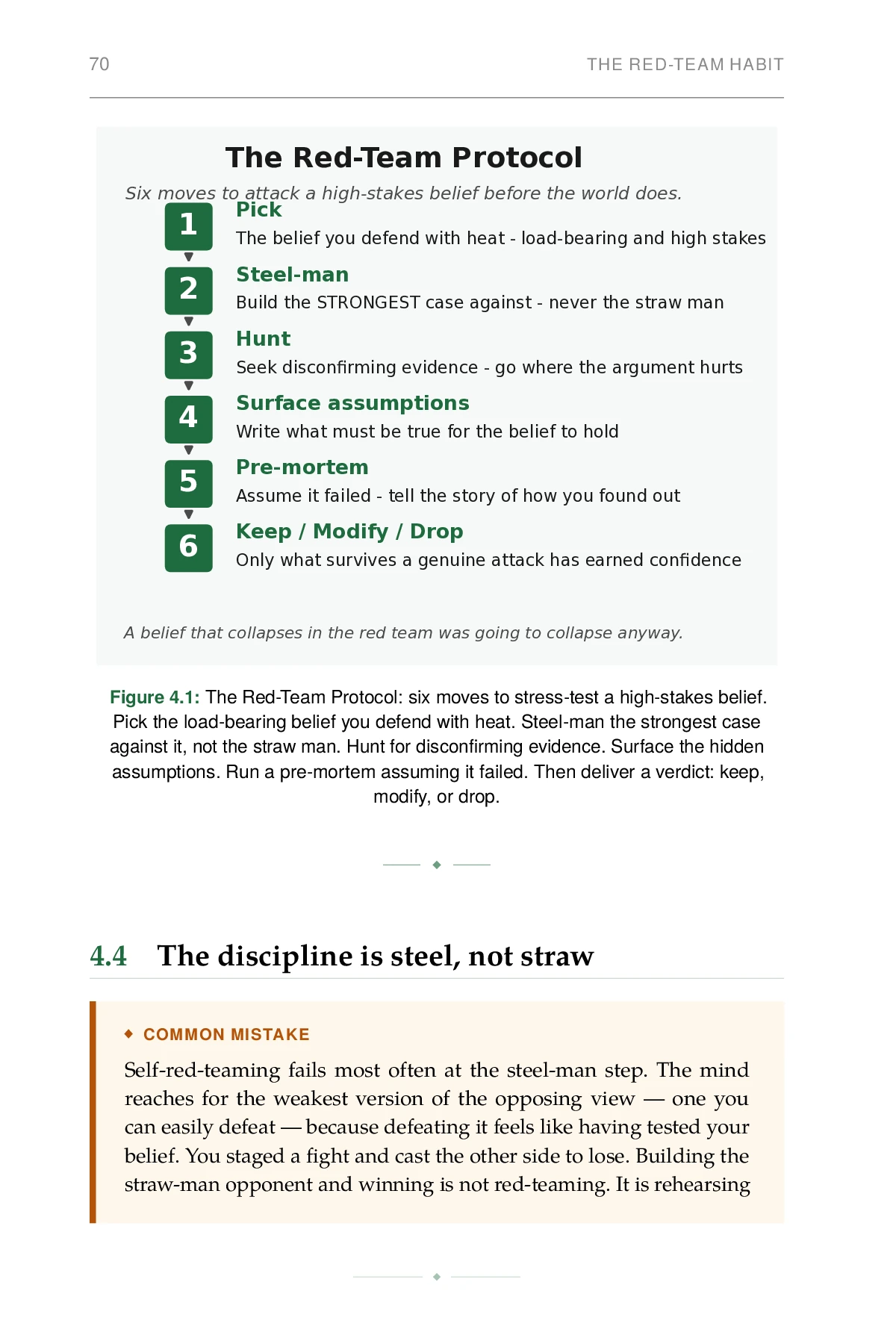
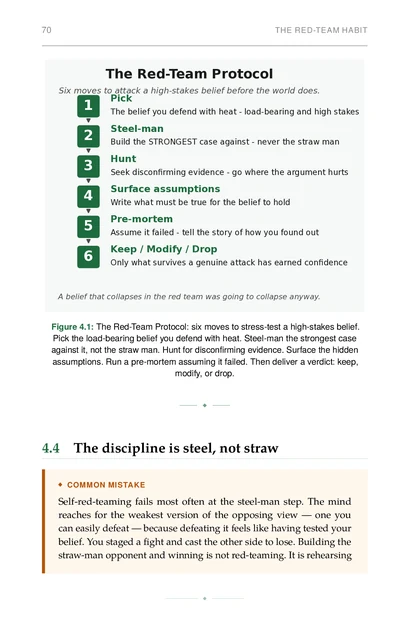 The Red-Team Protocol: six moves to stress-test a high-stakes belief. Pick the load-bearing belief you defend with heat. Steel-man the strongest…
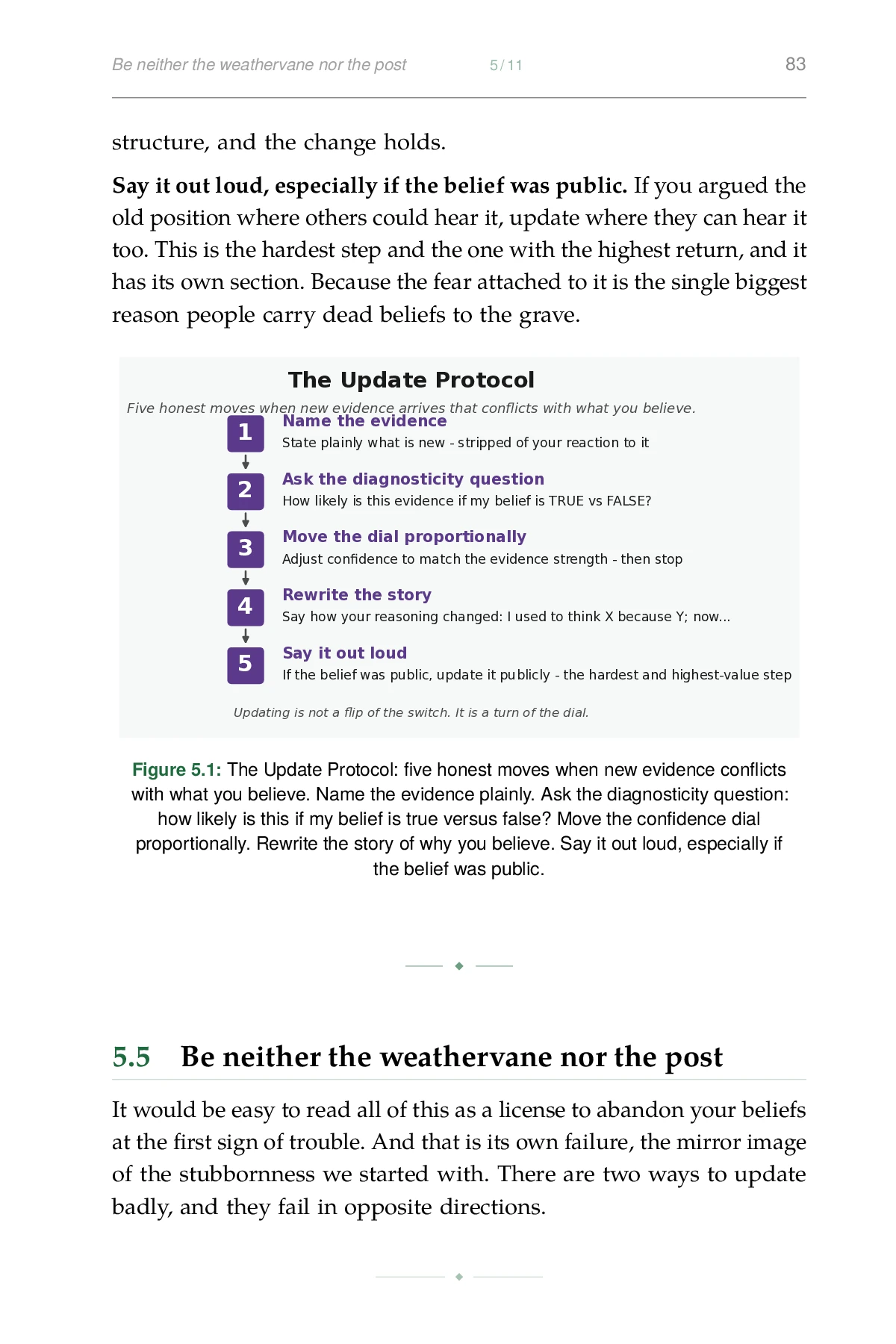
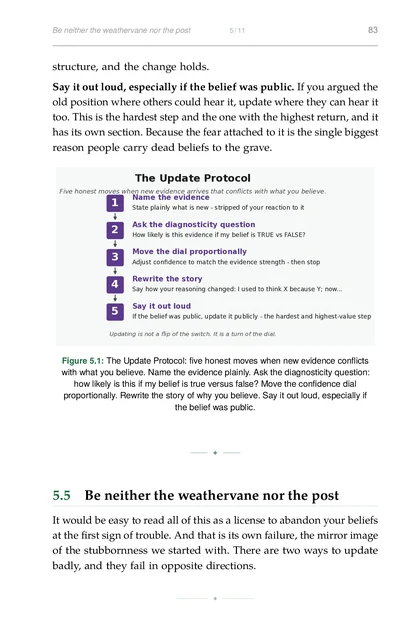 The Update Protocol: five honest moves when new evidence conflicts with what you believe. Name the evidence plainly. Ask the diagnosticity question:
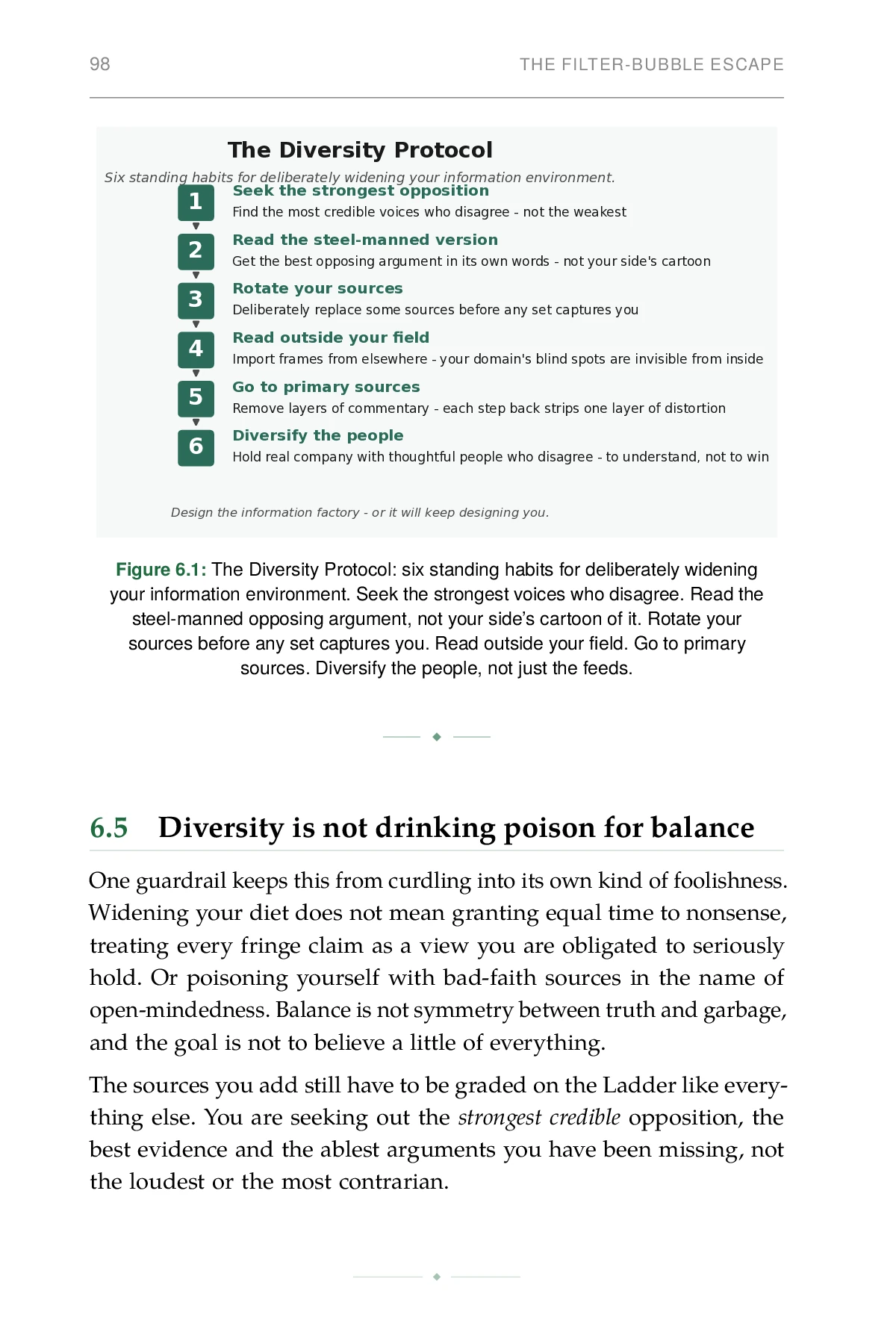
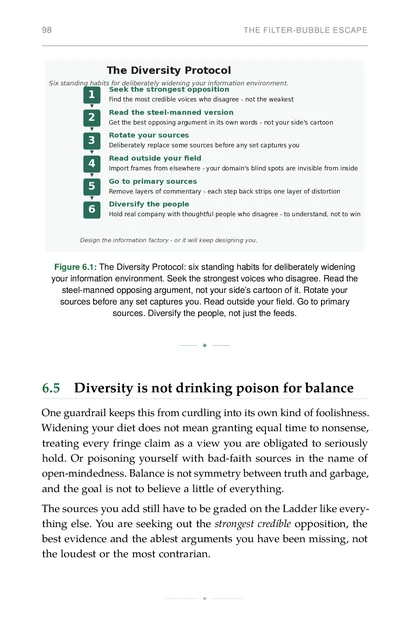 The Diversity Protocol: six standing habits for deliberately widening your information environment. Seek the strongest voices who disagree. Read the
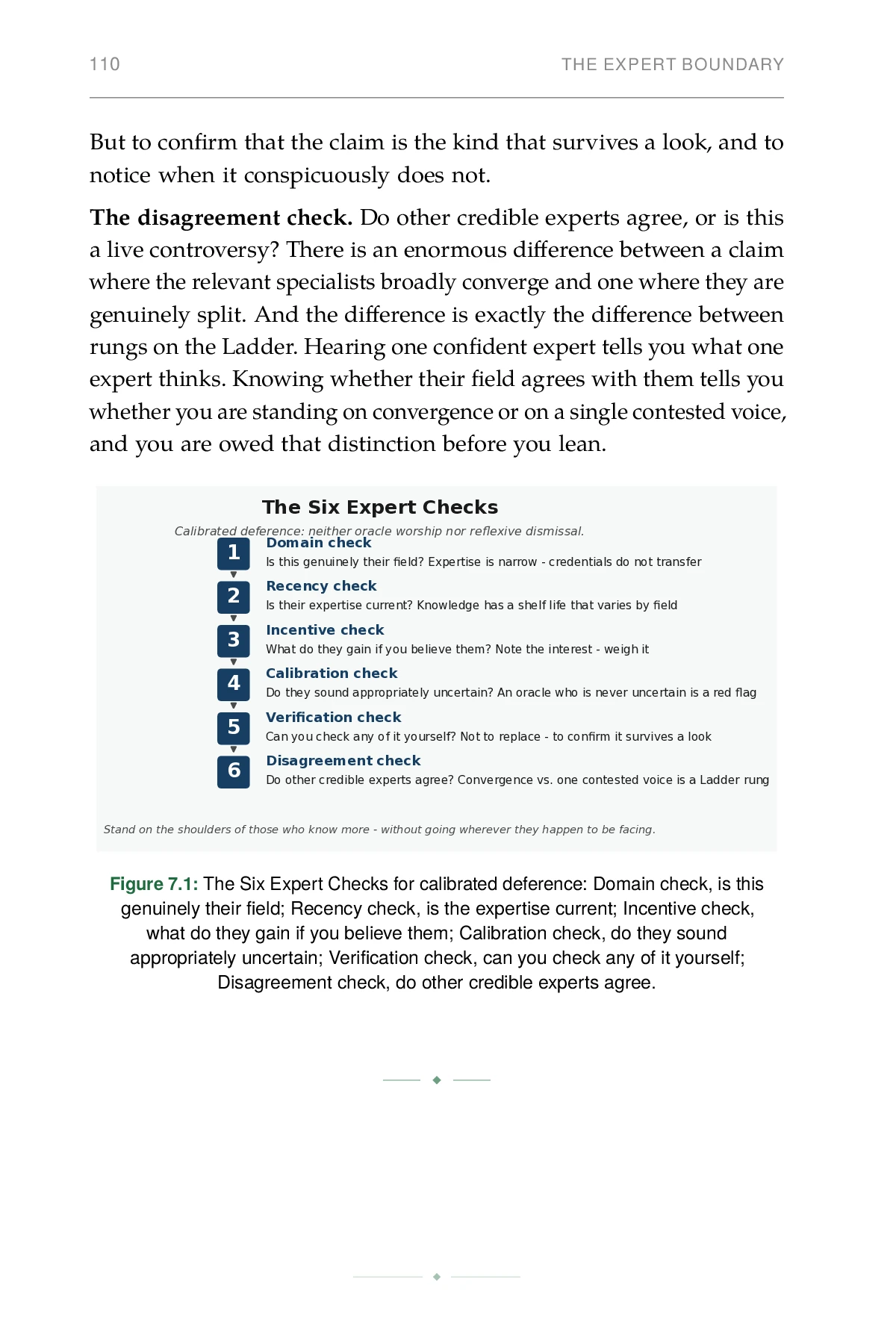
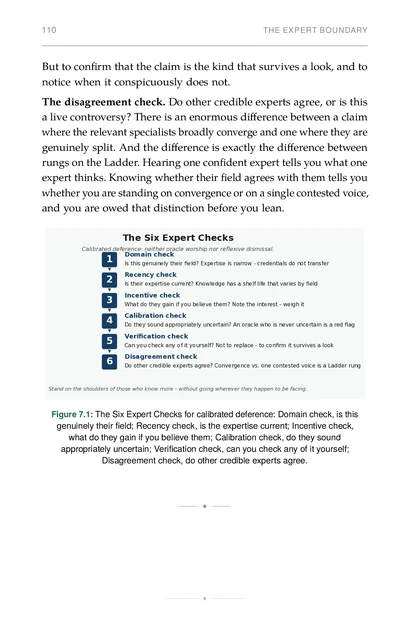 The Six Expert Checks for calibrated deference: Domain check, is this genuinely their field; Recency check, is the expertise current; Incentive c…
Purchase takes place on Amazon, not on this website.
Buy the paperback on AmazonFrom the book
Read a page
Introduction
The Hallucination Age
You are not short on information. You are short on a way to grade it. This book hands you the instrument, and the first thing it grades is the confidence you are already carrying.
What you can do afterwards
You will see how confident-sounding falsehood gets installed in you, and audit your ten strongest beliefs for the ones you never actually checked.
Use this chapter when
You notice you are certain about something you cannot remember verifying.
What you get
What you get
- The Evidence Ladder: rank any claim on seven rungs, from confident stranger to your own N=1 test
- The LEVEL check: a five-step move (Locate, Estimate, Value, Expose, Lean) you can run in seconds
- Calibration over certainty and cynicism: lean hard only where the evidence has earned it
- Applied across health, business, marketing, AI, and productivity through one recurring cast
- A reusable thinking tool you can still run a year after you finish the book
Who it's for
- Grade one claim before you change a belief, a habit, or a roadmap
- Set the bar by the cost of being wrong, not by how badly you want it true
- Place evidence on the rung it stands on, not the rung it was dressed as
- Run a cheap personal test when that beats waiting for proof
- Lean hard only where the evidence has earned it
Who it's for
Who this book was written for
You stop mistaking confidence for accuracy. You hold things at their true strength, bet with reversibility matched to what you actually know, and carry fewer false certainties across health, money, work, and judgment.
This is not skepticism, and it is not certainty. It is calibration: a quieter, more accurate way to decide when the stakes are yours.
If you have ever acted on the loudest claim in the room and paid for it later, this book was written for you.
The reader it was written for
The operator whose diet, hire, spend, or mind just moved on a confident study, thread, or pitch, and who cannot name the rung under the claim.
Also a fit for
The founder or professional who already distrusts packaging and wants a five-move check they can run in seconds, not a skepticism lecture.
What you will use it on
- Grade one claim before you change a belief, a habit, or a roadmap
- Set the bar by the cost of being wrong, not by how badly you want it true
- Place evidence on the rung it stands on, not the rung it was dressed as
- Run a cheap personal test when that beats waiting for proof
- Lean hard only where the evidence has earned it
Probably not for you if
- Readers who want certainty instead of calibration
- People looking for a clinical instrument or medical advice
The contents
Chapter by chapter
Every chapter of The Evidence-Aware Life with its printed epigraph, what you can do afterwards, and the moment it is built for.
Introduction
The Hallucination Age
You are not short on information. You are short on a way to grade it. This book hands you the instrument, and the first thing it grades is the confidence you are already carrying.
What you can do afterwards
You will see how confident-sounding falsehood gets installed in you, and audit your ten strongest beliefs for the ones you never actually checked.
Use this chapter when
You notice you are certain about something you cannot remember verifying.
Chapter 1
The Belief Formation System
You did not weigh the evidence and decide. The belief arrived, your mind built reasons for it on the way in, and now it feels like yours. If you can see the machine that installs beliefs, you can stop arguing with the output and start filtering the input.
What you can do afterwards
You will see the machine that installs your beliefs, and trace how one belief you are sure of actually got into you.
Use this chapter when
You catch yourself defending a position you cannot remember choosing.
Chapter 2
The Evidence Ladder
A claim is never simply true or false to you until you know one thing: how good the evidence under it actually is. Evidence is not a verdict you accept or reject. It comes in grades, on a ladder of rungs, and the whole skill is learning to see which rung a claim is really standing on, rather than which rung its packaging implied.
What you can do afterwards
You will hold the book's central instrument, the Evidence Ladder, and be able to place any claim, in any domain, on a rung you can actually see.
Use this chapter when
A claim sounds compelling and you cannot tell whether that is the evidence talking or the packaging.
Chapter 3
Calibrated Confidence
The feeling of being sure is manufactured upstream of the evidence, which means it can be strong and wrong at the same time. Calibration is the slow work of making how sure you feel match how good your evidence actually is, so that your confidence finally carries information instead of just heat.
What you can do afterwards
You will stop trusting the feeling of certainty as a readout of truth, and start matching your confidence to the rung beneath it and the drop in front of it.
Use this chapter when
You feel completely sure and need to know whether that feeling has earned its size.
Chapter 4
The Red-Team Habit
Left alone, a belief never meets its strongest opponent until reality introduces them, at the worst possible moment. The red-team habit is the discipline of arranging that meeting yourself, early, in private, by becoming the most capable adversary your own belief will ever face.
What you can do afterwards
You will learn to attack your own beliefs on purpose, so their weak points surface on your schedule instead of the world's.
Use this chapter when
You notice everyone around you agrees with you, or you feel the urge to defend a belief rather than test it.
Chapter 5
The Update Protocol
What you can do afterwards
You will be able to change your mind in proportion to the evidence, on the record, without it costing you your sense of self or your standing with others.
Use this chapter when
New evidence has arrived that cuts against something you believe, and you can feel yourself reaching for reasons to dismiss it.
Chapter 6
The Filter-Bubble Escape
You do not absorb your beliefs one at a time from a neutral world. You absorb them from an environment that has already decided which beliefs get to reach you. And that environment is built more by your own habits and company than you would like to think. Design it on purpose, or it will keep designing you.
What you can do afterwards
You will see your information environment as a thing you build rather than a thing you are given. And learn to widen it on purpose so the evidence that should reach you actually does.
Use this chapter when
Everyone you read and everyone you know seems to agree, and that agreement is starting to feel like proof.
Chapter 7
The Expert Boundary
An expert is neither an oracle to obey nor a fraud to dismiss, and treating them as either is a way of avoiding the harder work of thinking. The skill is calibrated deference: knowing exactly where someone's real knowledge ends, and meeting it there with both respect and a few good questions.
What you can do afterwards
You will stop swinging between worshipping experts and dismissing them, and learn to place a calibrated amount of trust in a specific claim from a specific expert.
Use this chapter when
An authority has told you something that matters, and you can feel yourself about to either swallow it whole or reject it on principle.
Chapter 8
The Narrative Defense
A story is the most persuasive thing a human being can receive and the least gradable, because it works by a channel your instruments do not cover. The goal is not to stop loving stories, which is impossible and would be a loss. It is to feel their full pull and keep the grading running underneath, so you can be moved by a tale without being recruited by it.
What you can do afterwards
You will be able to enjoy a story at full strength while still seeing the evidence underneath it. So a well-told tale can no longer smuggle a false claim past you.
Use this chapter when
Something you have read or heard feels deeply, satisfyingly true, and the feeling arrived as a story rather than as evidence.
Chapter 9
The Practice of Not Knowing
The honest answer, more often than our culture will admit, is that you do not know yet. And the mark of a clear mind is not how fast it can escape that state but how well it can live and act inside it. Comfort with not knowing is not resignation. It is the discipline that keeps you from buying a false certainty just to end the discomfort of an open question.
What you can do afterwards
You will be able to sit inside an honest "I do not know yet" without panic and without paralysis. And act well from there instead of grabbing a false answer to escape it.
Use this chapter when
A question genuinely is not settled, and you can feel the pull to decide now just to be rid of the discomfort.
Chapter 10
The Evidence-Aware Team
A group does not automatically think better than the people in it; left to its instincts it often thinks worse, manufacturing a shared confidence none of its members privately hold. Whether a team becomes smarter than its smartest person or dumber than its average one is decided almost entirely by its culture, and culture is something you can build on purpose.
What you can do afterwards
You will see why teams so often amplify error instead of averaging it out. And learn the few cultural moves that turn a group into something that thinks better than any member alone.
Use this chapter when
You are part of a team, family, or organization that keeps reaching confident agreement and you suspect the agreement is manufactured.
Chapter 11
The Lifelong Practice
The most dangerous moment in an evidence-aware life is the one where you believe you have arrived at it. Because the conviction that you have become a clear thinker is exactly what stops you from doing the things that made you one. This was never a credential to earn. It is a practice to keep, and the keeping is the whole of it.
What you can do afterwards
You will leave with a sustainable, lifelong way of keeping these skills alive, and an understanding of why the practice deepens into something close to instinct if you do.
Use this chapter when
You have finished learning the method and are about to make the quiet mistake of thinking you now simply possess it.
Conclusion
The Clearer View
You were never going to reach certainty, and it was never the point. The view this book offers is clearer, not complete: a world still mostly hidden, met with beliefs held at the size the evidence warrants and a quiet refusal to be sure of more than you have earned.
What you can do afterwards
You will leave with the whole method gathered into a single habit, an honest sense of what it does and does not give you, and a direction to keep walking.
Use this chapter when
You have finished the book and want to hold, in one piece, what all of it was for.
Editions
Editions and specifications
| Edition | Formats | Chapters | Pages | Reading time | ISBN (paperback) |
|---|---|---|---|---|---|
| English The Evidence-Aware Life | Kindle, Paperback, Hardcover | 13 | 238 | ± 3 hours | — |
| Dutch Het bewijsbewuste leven | Kindle, Paperback, Hardcover | 13 | 262 | ± 3 hours | — |
Both editions are written natively. The Dutch text is not a machine translation of the English. · Trim size: 6x9″
Get the book
One title, every Amazon marketplace. Pick your format and your store.
Get the book
Reading from another country?Pick your own Amazon marketplace — same edition, your store.
Amazon links may include affiliate tags. That does not change the price you pay. Bol.com listings are third-party.
Frequently asked
What readers usually want to know
What is The Evidence-Aware Life about?
The Evidence Ladder and LEVEL check help readers grade claims before changing a belief, a health habit, a roadmap, or a company decision. The subtitle is: How to Think in Levels Instead of Opinions.
What is the LEVEL framework?
LEVEL: Locate, Estimate, Value, Expose and Lean. rank any claim on seven rungs, from confident stranger to your own N=1 test
In which formats is The Evidence-Aware Life available?
The Evidence-Aware Life ships as Kindle, Paperback and Hardcover, on every Amazon marketplace worldwide. The Kindle edition is enrolled in Kindle Unlimited, so KU members read it free.
Is there a Dutch edition?
Yes. The Dutch edition is Het bewijsbewuste leven, written as a native edition rather than a machine translation. It is available on Amazon too.
How long is The Evidence-Aware Life?
This edition runs 13 chapters, 238 pages in print and roughly 3 hours of reading.
Who is The Evidence-Aware Life for?
If you have ever acted on the loudest claim in the room and paid for it later, this book was written for you.
I already know not to believe everything.
Knowing that is not a grade. LEVEL is the five-move check that names the claim, the stakes, the rung, the counter-case, and how hard you may lean.
I do not have time to evaluate every claim.
You already evaluate them, by volume and confidence. One sentence and a rung is faster than acting on packaging and unwinding it later.
This is just common sense.
Common sense does not name the rung. The Evidence Ladder and LEVEL do. Paperback, hardcover, and Kindle are live in English and Dutch.
Is this CALIBRATE?
No. CALIBRATE is the longer confidence practice in The Calibrated Mind. LEVEL grades one claim before you lean. They sit next to each other; they are not the same book.
The production system
How this book was made
Every title moves through the same gated production line: sourced research, a claim-level evidence ledger, structural review, fact-checking, red-team critique, and a bilingual final edit. AI agents do specialist work inside those gates; judgment, voice, and accountability stay human.
- Claims enter an evidence ledger with a source and a confidence grade before they reach the page
- English and Dutch are two native editions, not a translation of one another
- Every chapter clears readability, rhythm, and style gates before it is typeset


