Available now · worldwide on Amazon
The Verified Research Loop
Deep Online Research for Entrepreneurs Using AI Without Trusting It Blindly
Fluent is not the same as researched.
TRACE turns AI-assisted research into target-setting, retrieval, assessment, cross-checking, and export so decisions rest on verified claims.
Get the book
Reading from another country?Pick your own Amazon marketplace — same edition, your store.
Amazon links may include affiliate tags. That does not change the price you pay. Bol.com listings are third-party.
English & Dutch editions · Kindle, Paperback, Hardcover · free on Kindle Unlimited · Nederlandse editie →
- pages
- 330
- chapters
- 13
- hours of reading
- ± 4
- editions
- EN · NL


The editions
Choose your format
Same book, your format. You buy on Amazon, not on this site.
-
Kindle
Read now. Kindle Unlimited members get it at no extra cost.
Buy on Amazon -
Paperback
The working copy. Mark it up. Take it into the meeting.
Buy on Amazon -
Hardcover
The shelf edition. Dark full-art jacket, built to stay in the room.
Buy on Amazon


Available now
Deep Online Research for Entrepreneurs Using AI Without Trusting It Blindly
You ask the model to size the market, scan the competitor, or check the regulation, and back comes a clean, confident, well-formatted answer. You paste it into the deck. Three weeks later a number turns out to be invented, a "leading study" was one blog post, and a deal moved on evidence that was never there. The output was not researched. It was fluent, and fluency is now the cheapest thing an AI produces.
The standard reflex is to prompt better and trust the summary, or to abandon the tools and do it all by hand. The first ships fabrications into decisions; the second throws away the one thing AI is genuinely good at.
The Verified Research Loop keeps the speed and adds the part that was missing: structure. It introduces the TRACE framework (Target, Retrieve, Assess, Cross-check, Export), a repeatable run that turns a vague question into a decision-ready memo with every claim graded at the row level. AI accelerates collection; the loop is what turns collection into conviction.
What you can do
What this book puts in your hands
You will learn to:
- Target the question with stakes, scope, and output format set before a single search runs.
- Retrieve across independent sources instead of trusting one confident pass.
- Assess each source by tier (primary, secondary, advocacy, anonymous) so weight follows credibility.
- Cross-check every load-bearing claim against a second source before it earns a place in your thinking.
- Export a claim ledger and a memo a co-founder or investor can act on without re-doing the work.
The framework
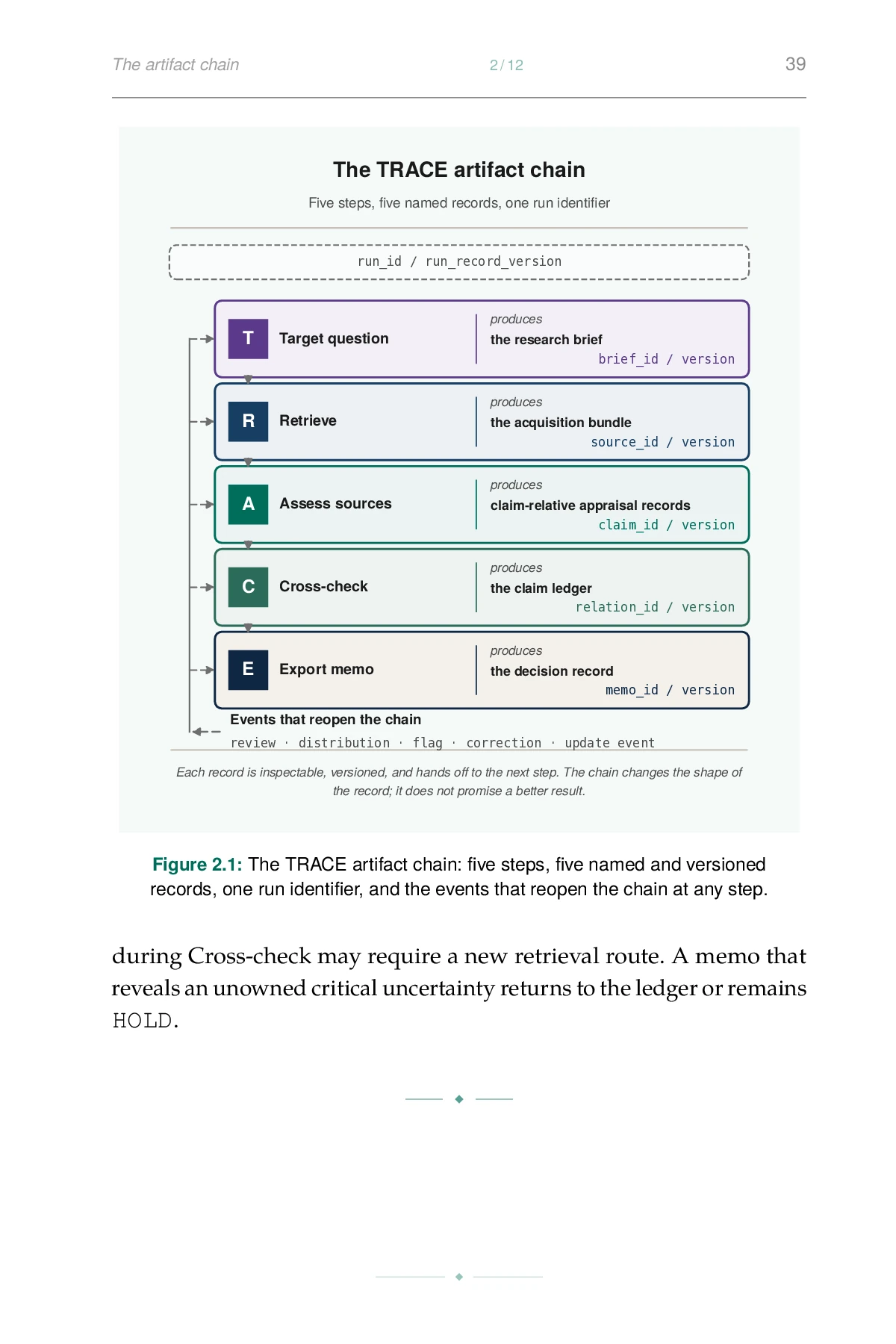
TRACE: the system behind the book
Target, Retrieve, Assess, Cross-check, Export
-
Target
Lock stakes, scope, and output format before a single search runs.
-
Retrieve
Gather independent sources instead of trusting one confident pass.
-
Assess
Tier each source (primary, secondary, advocacy, anonymous) so weight follows credibility.
-
Cross-check
Require a second source before a load-bearing claim earns a place in the memo.
-
Export
Ship a claim ledger and a memo a co-founder or investor can act on without redoing the work.
From the book
The TRACE artifact chain: five steps, five named and versioned
The Verified Research Loop, printed page: The TRACE artifact chain: five steps, five named and versioned
Inspect more pagesLook inside
Pages from the print edition.
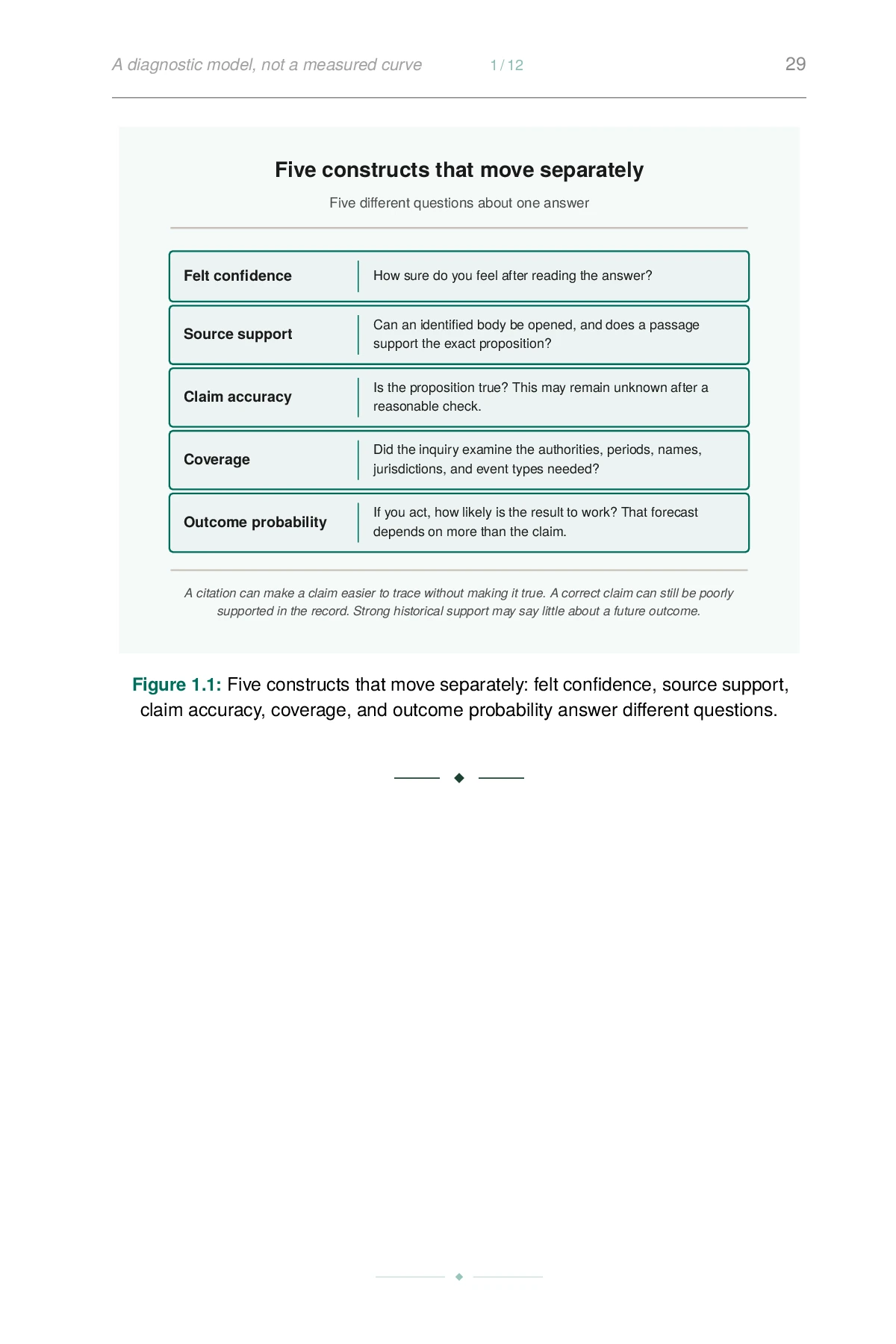
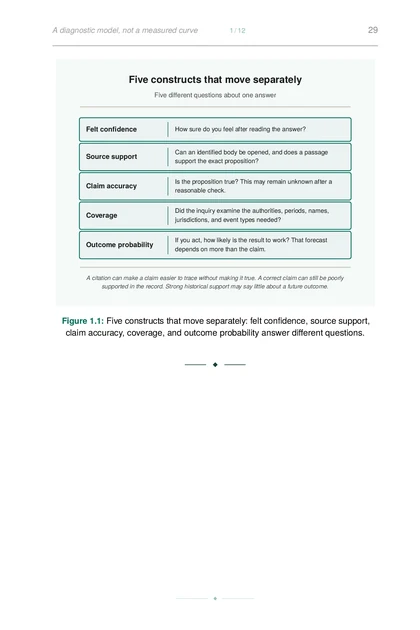 Five constructs that move separately: felt confidence, source support,
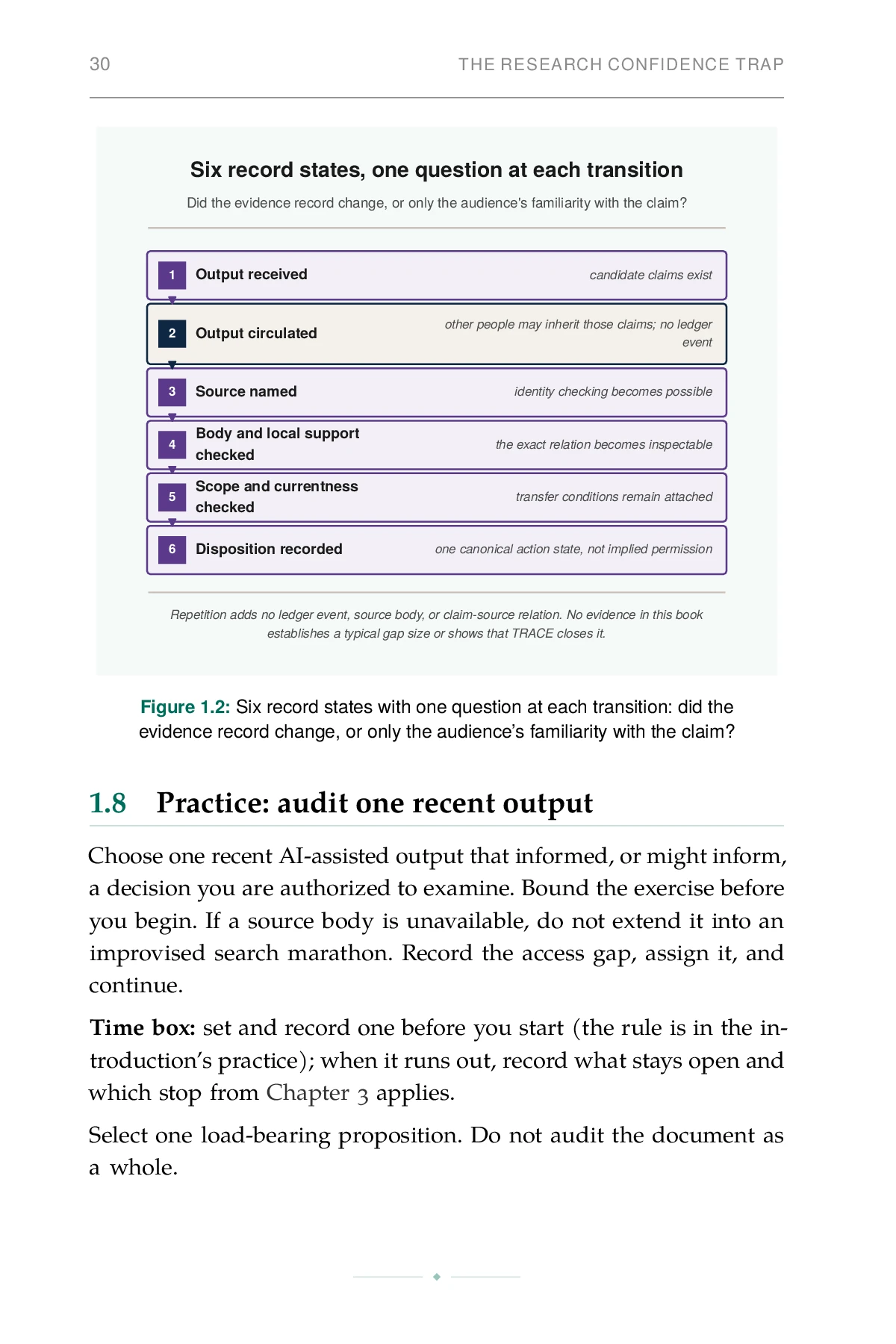
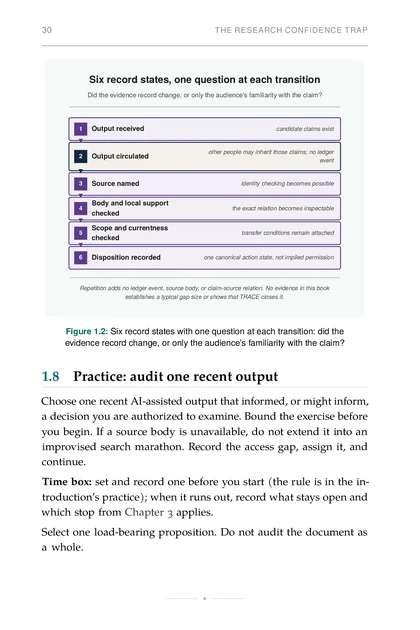 Six record states with one question at each transition: did the evidence record change, or only the audience’s familiarity with the claim?
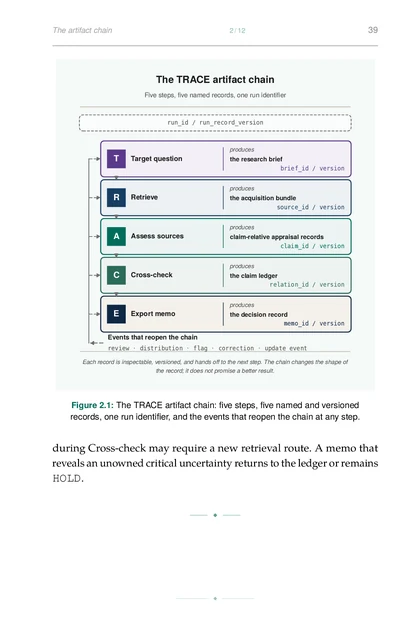 The TRACE artifact chain: five steps, five named and versioned
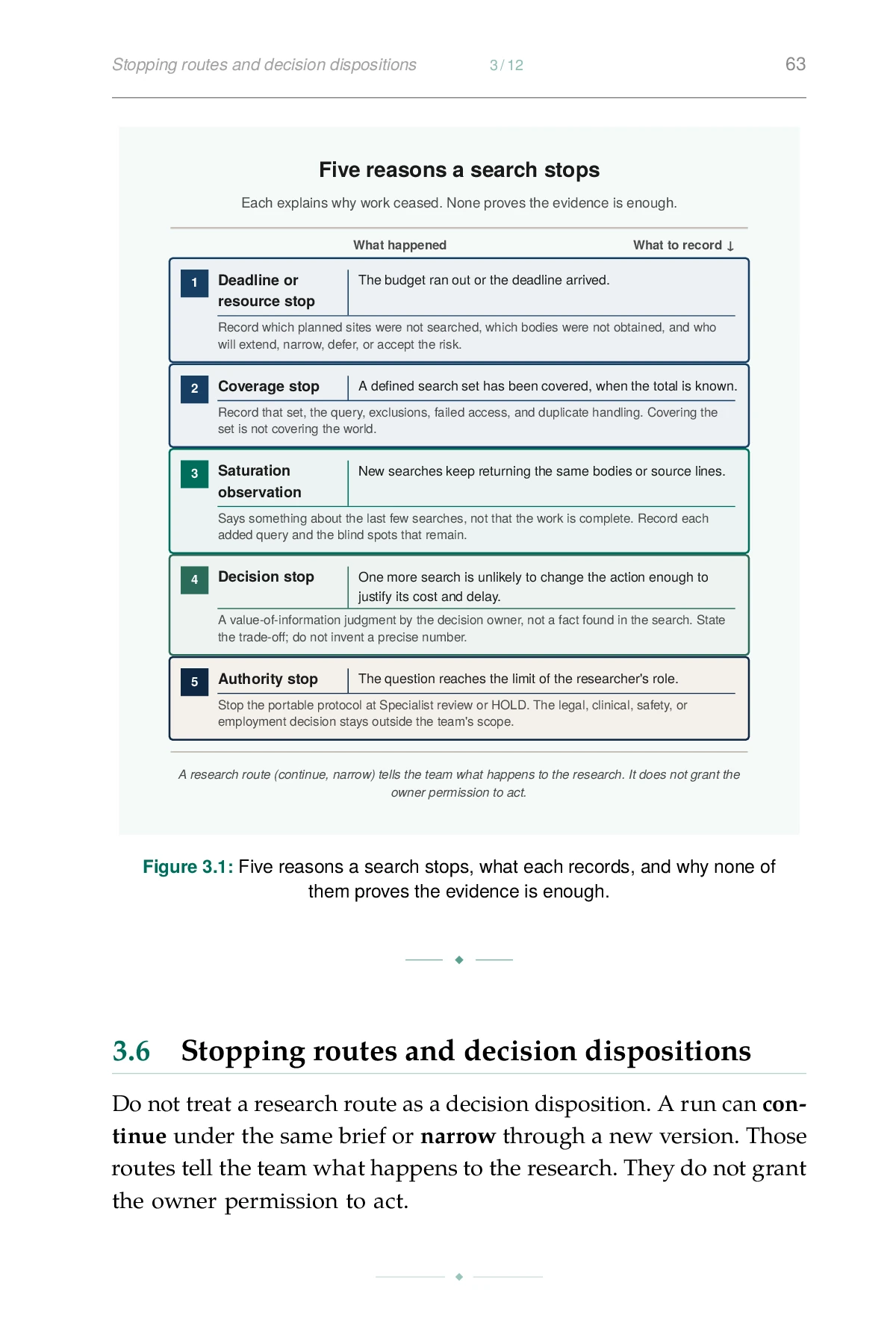
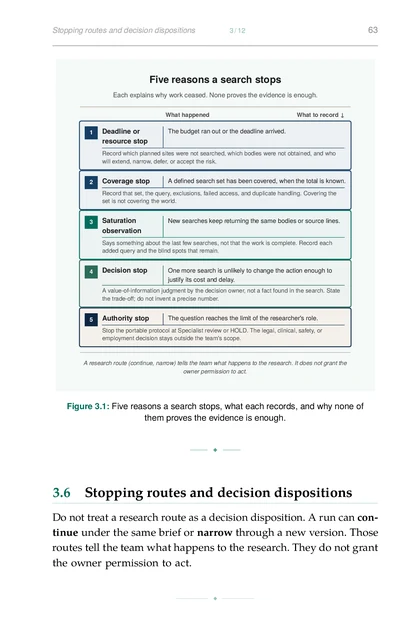 Five reasons a search stops, what each records, and why none of
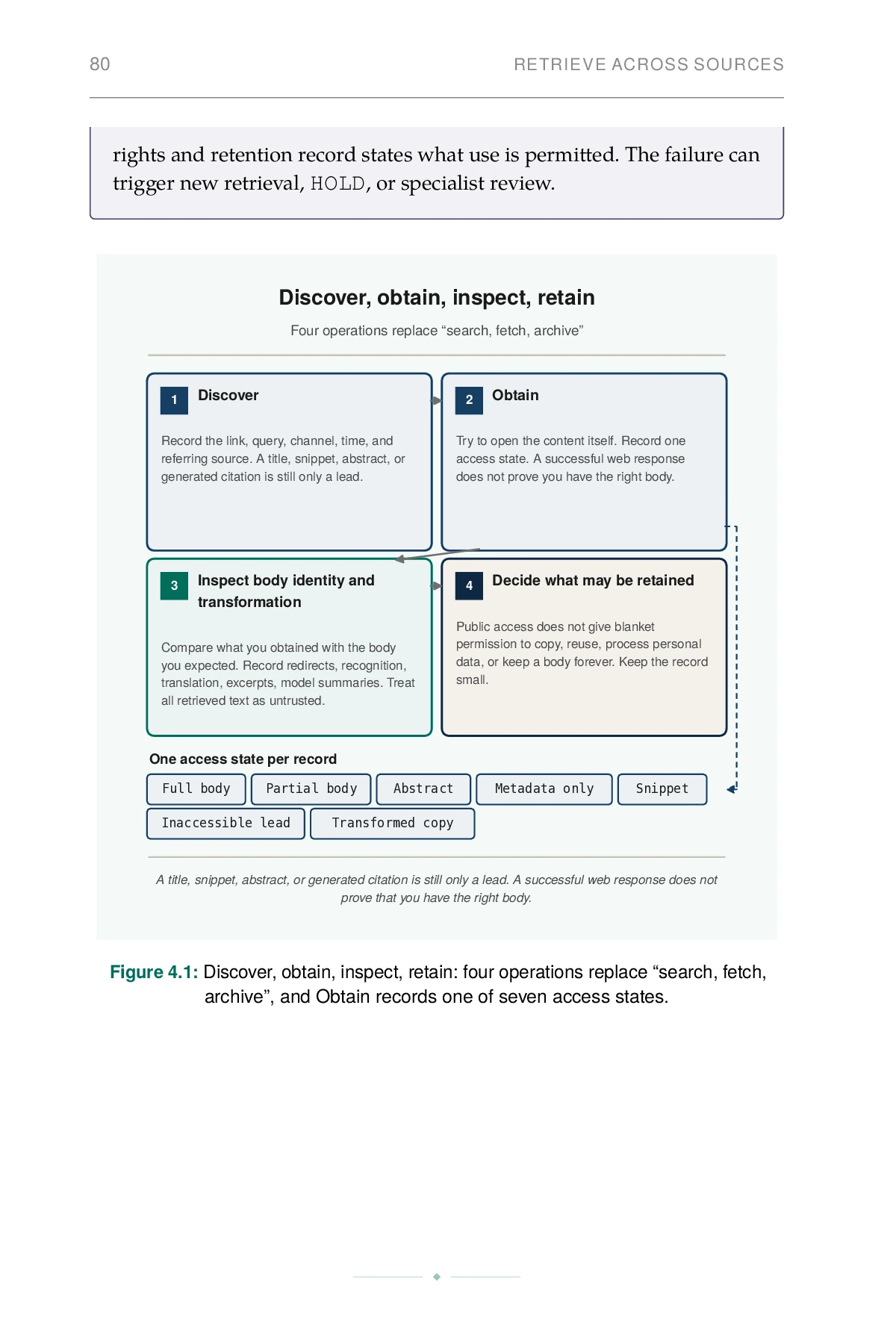
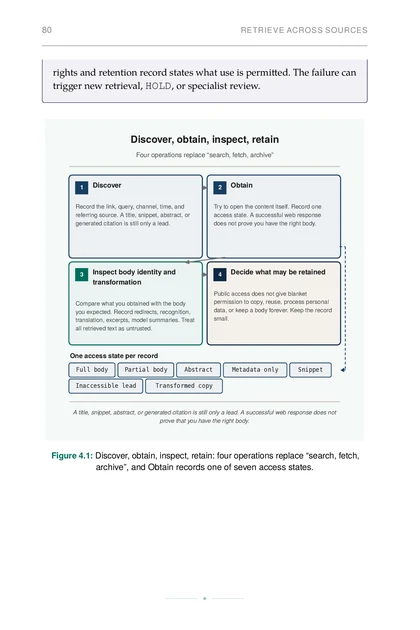 Discover, obtain, inspect, retain: four operations replace “search, fetch,
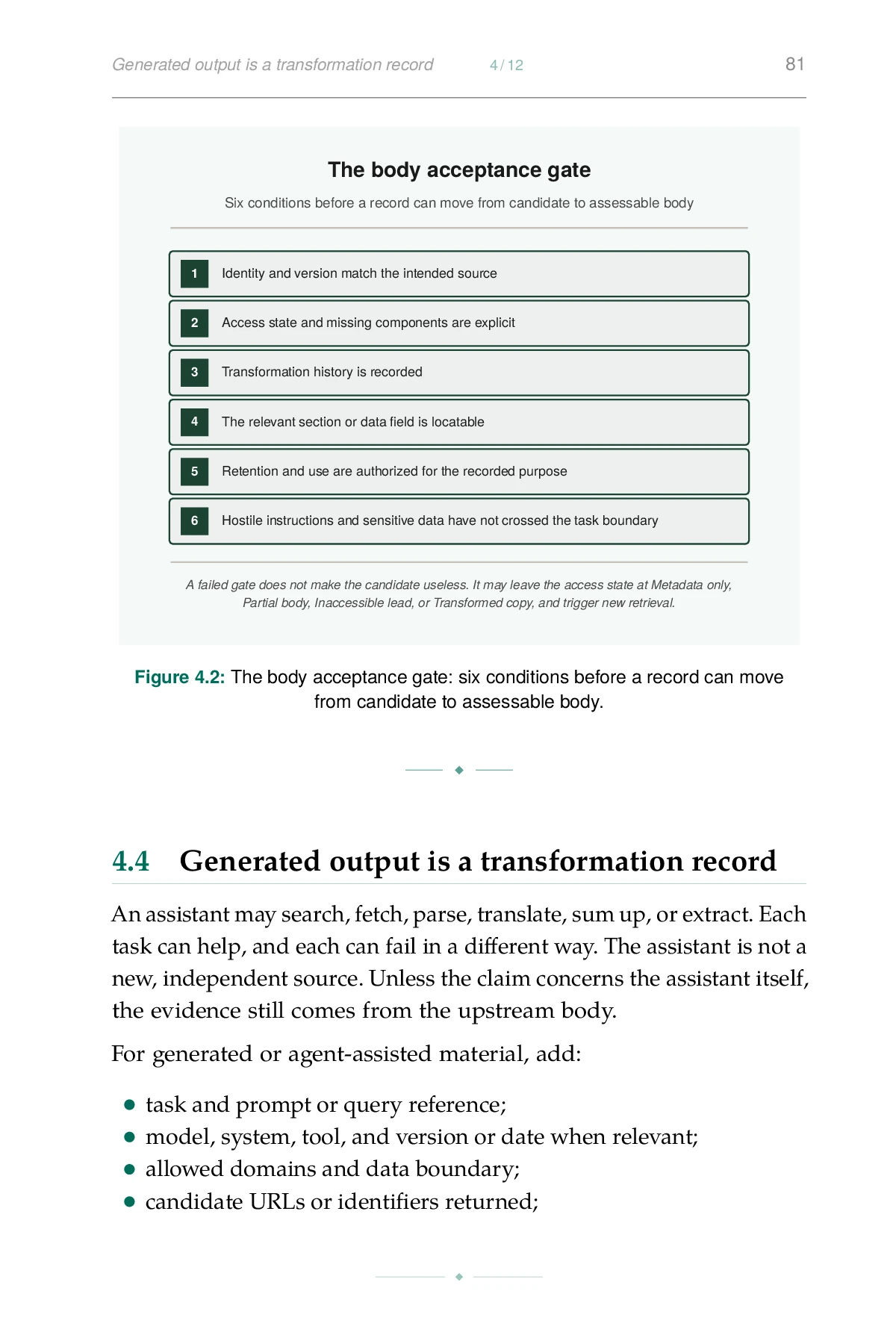
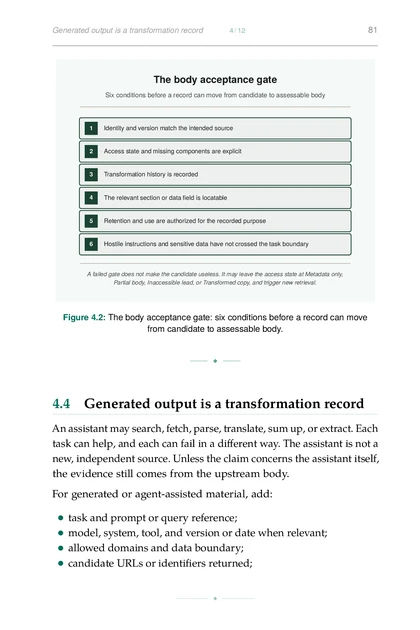 The body acceptance gate: six conditions before a record can move
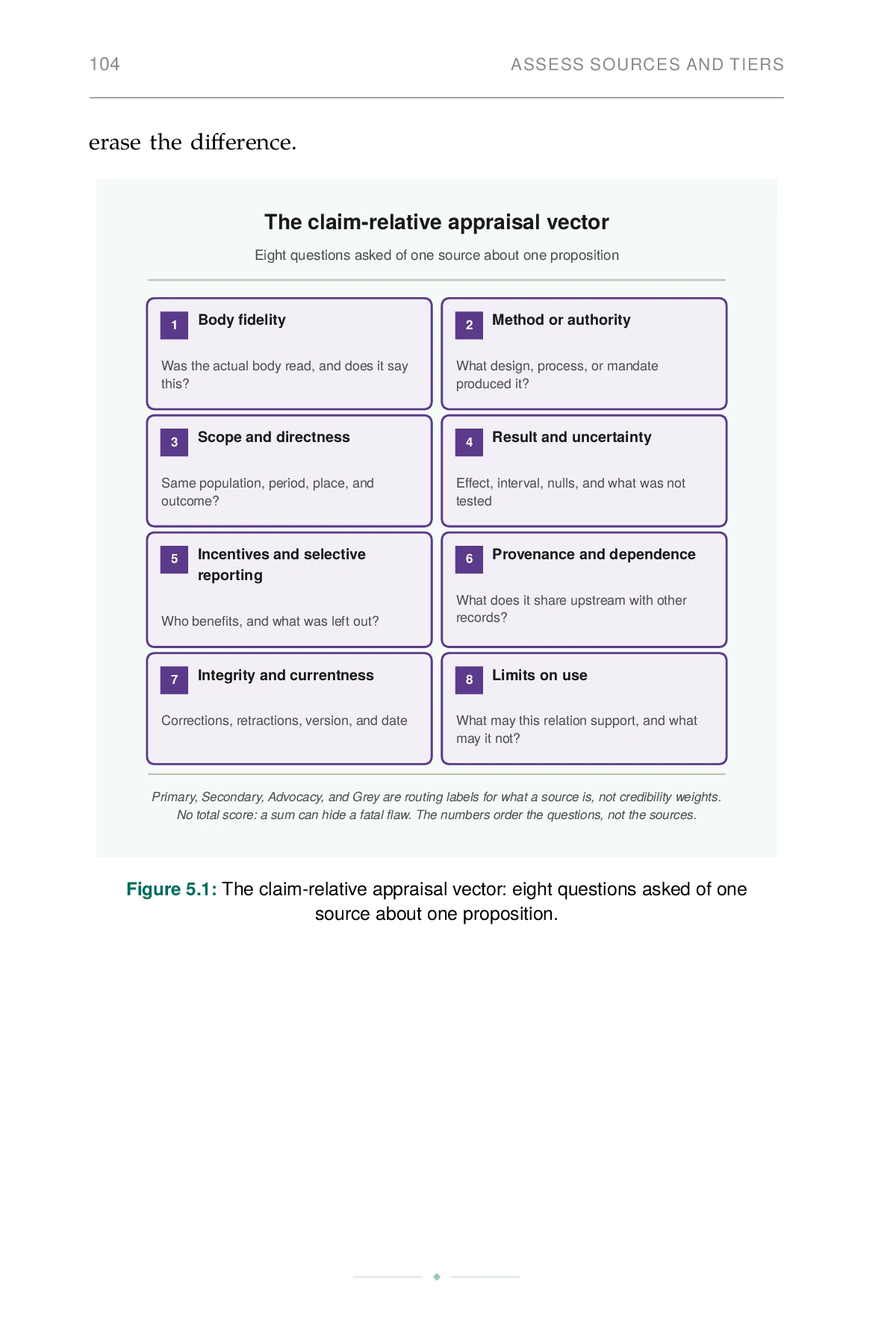
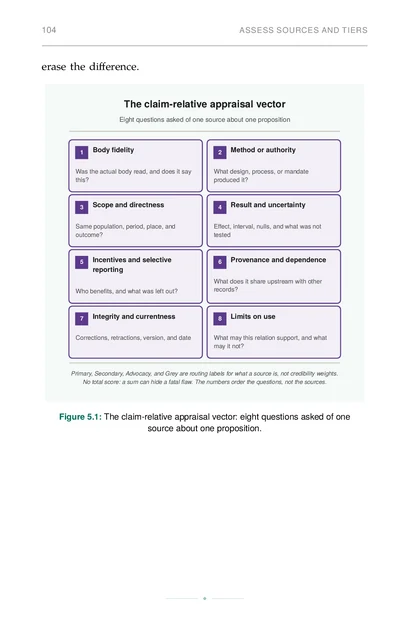 The claim-relative appraisal vector: eight questions asked of one
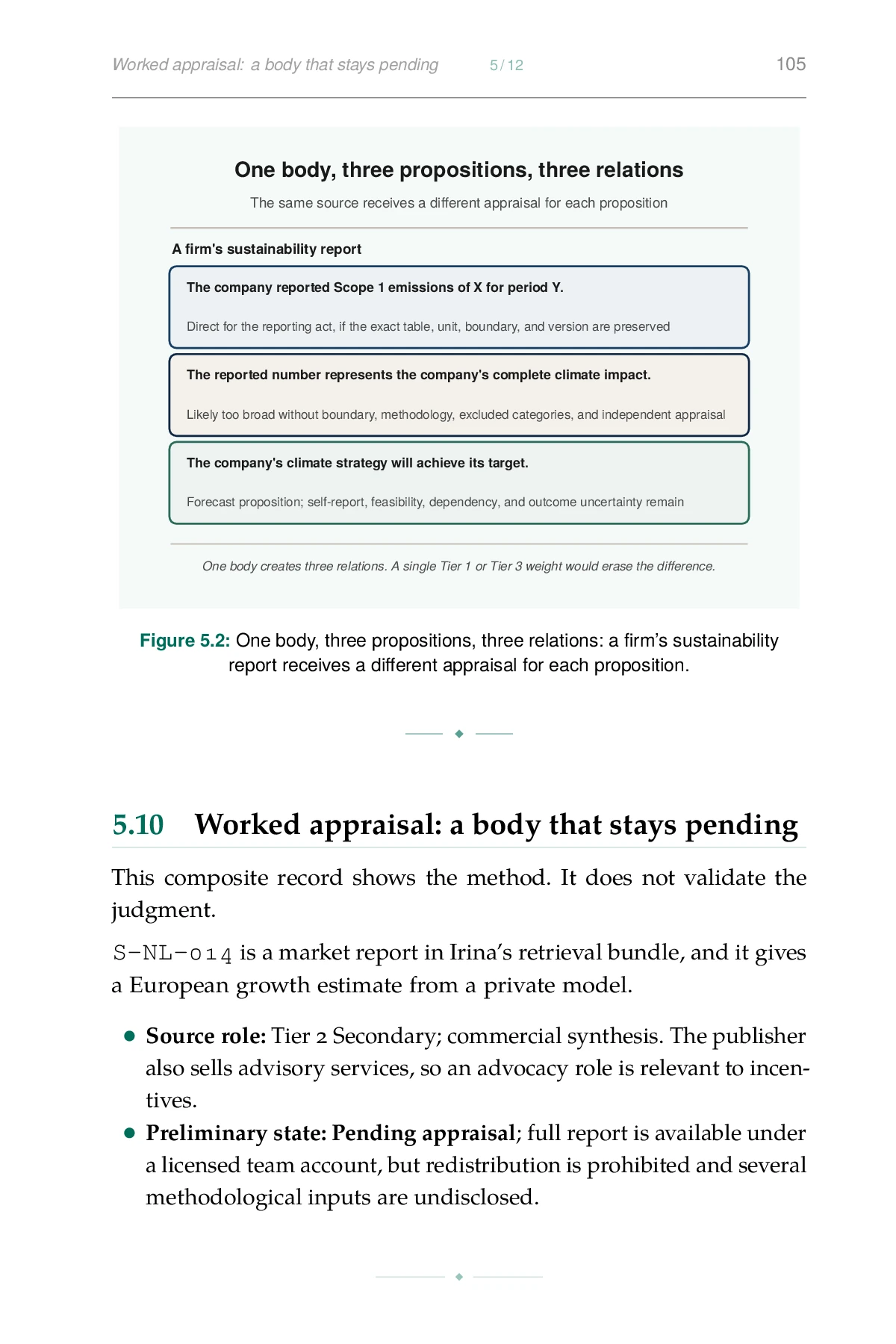
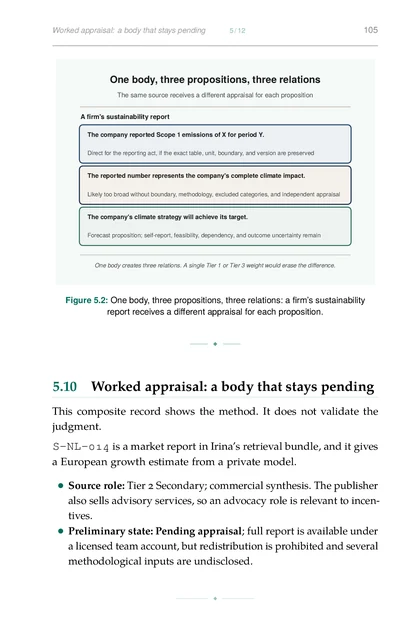 One body, three propositions, three relations: a firm’s sustainability
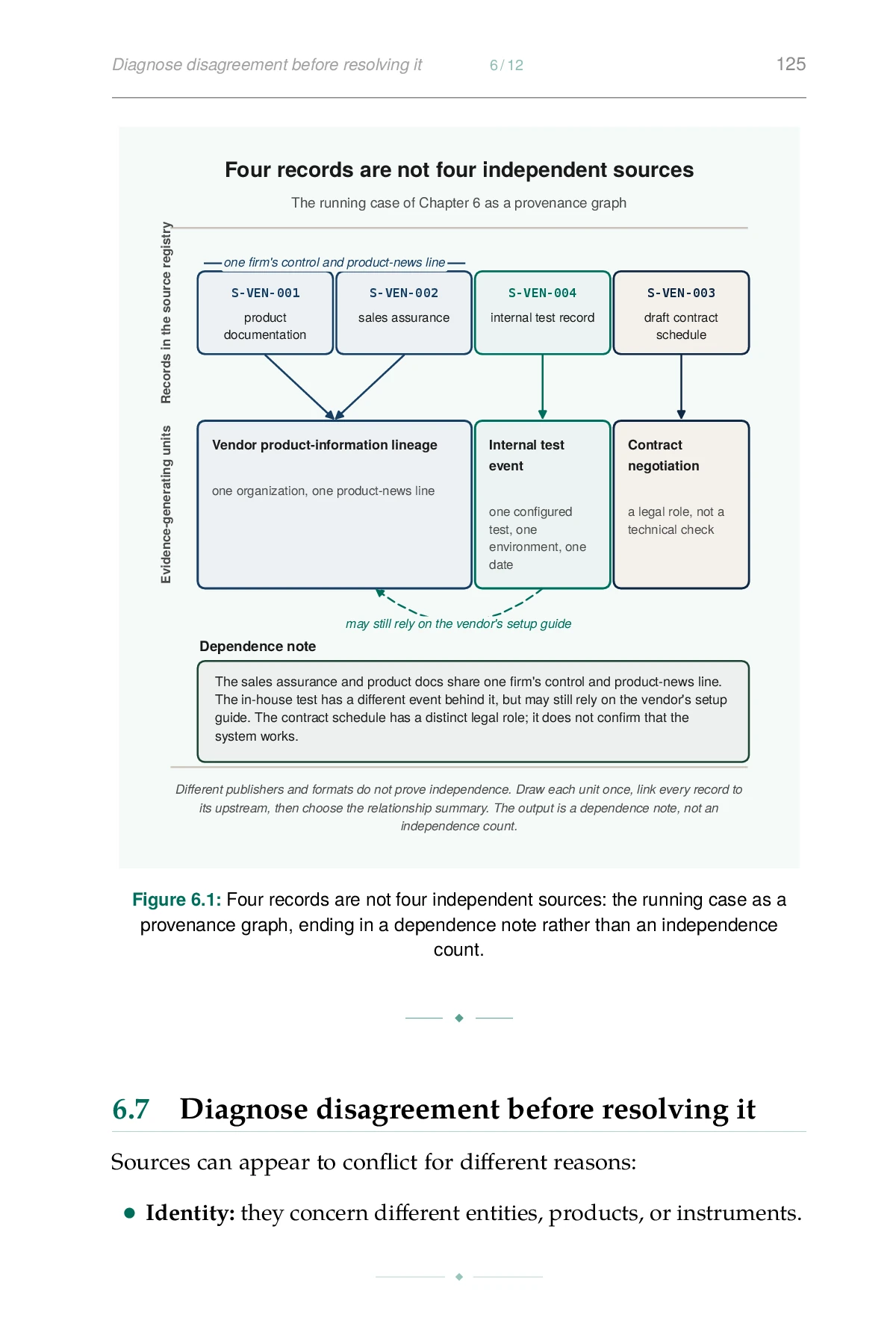
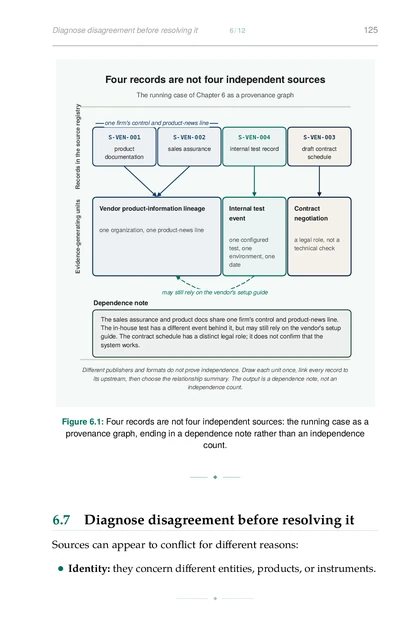 Four records are not four independent sources: the running case as a provenance graph, ending in a dependence note rather than an independence
Purchase takes place on Amazon, not on this website.
Buy the paperback on AmazonFrom the book
Read a page
Introduction
Fluency Is Not Evidence
The most dangerous research output is the one that sounds finished.
What you get
What you get
- The TRACE protocol: Target, Retrieve, Assess, Cross-check, Export
- Turn AI collection into verified claims with source tiers
- Decision-ready memos, not chat walls
Who it's for
- Scope a research question before opening tabs
- Retrieve from multiple independent source types
- Tier sources and flag bias before trusting claims
- Cross-check critical claims with a second source
- Export a decision-ready memo the team can act on
Who it's for
Who this book was written for
You stop shipping ChatGPT summaries and start producing research you can defend. Decisions rest on claims with known sources and known confidence, and the work survives the moment someone asks where the number came from.
This is not faith in the tool, and it is not doing without it. It is verification structure laid over fast collection: research you can move money on.
If you make real decisions on open-web research and refuse to bet on a claim you cannot trace, this was written for you.
The reader it was written for
The decision-bound founder-researcher running market sizing, competitor scans, regulatory checks, hiring diligence, or investment memos this week on the open web, under time pressure, with AI available but trust low.
Also a fit for
The operator-strategist: a product or GTM lead who must brief the founder with sourced memos, not ChatGPT paste.
What you will use it on
- Scope a research question before opening tabs
- Retrieve from multiple independent source types
- Tier sources and flag bias before trusting claims
- Cross-check critical claims with a second source
- Export a decision-ready memo the team can act on
Probably not for you if
- Academic systematic review authors following PRISMA
- Passive news consumers without decision stakes
- Classified or intelligence-only research contexts
The contents
Chapter by chapter
Every chapter of The Verified Research Loop with its printed epigraph, what you can do afterwards, and the moment it is built for.
Introduction
Fluency Is Not Evidence
The most dangerous research output is the one that sounds finished.
Chapter 1
The Research Confidence Trap
Feeling informed is not the same as being informed. The gap between the two is exactly where decisions go wrong.
Chapter 2
TRACE Overview
Five steps stand between a question and a trustworthy decision memo. The goal is speed with conviction, not speed in place of it.
Chapter 3
Target the Question
A bad question is not a starting point but a trap: it consumes retrieval time and returns information you cannot use.
Chapter 4
Retrieve: Multi-Source (R)
A scoped question is only as good as the diversity of the evidence you bring back to answer it. One search engine is a starting suggestion, not a research run.
Chapter 5
Assess Sources and Tiers
A collection of sources without a hierarchy is a pile, not research. The pile can still mislead you, and it will do so with impressive volume.
Chapter 6
Cross-Check Claims
A claim ledger is not a sign of slow research but a record of exactly where your conviction is solid and where it is thin. It is the one document that lets you walk into a decision room without being ambushed by a question you thought you had answered.
Chapter 7
Export the Decision Memo
The memo is the deliverable, and everything else was preparation.
Chapter 8
Research Types
Same loop, different terrain. The TRACE steps do not change when you switch from market sizing to people diligence. The sources that matter shift by type. So do the failure modes and the confidence ceiling you can honestly reach. Know where you are standing before you start retrieving.
Chapter 9
Agents and MCP for Research
Speed is not the variable you are optimizing. Accuracy of retrieval is, and agents are fast. Human judgment, applied at the right gate, is accurate. The trick is to assign each task to the layer that is good at it.
Chapter 10
Triangulation and ReasonKit-think
A single source that confirms what you already believe is not a verification. It is a mirror.
Chapter 11
Failure Modes and Red Flags
The loop is not a guarantee but a structure that makes the recurring research collapses visible before they become decisions. Recognizing the pattern is the protection.
Conclusion
Conviction at Speed
The loop is small, and it fits on a calendar. That is the whole point.
Editions
Editions and specifications
| Edition | Formats | Chapters | Pages | Reading time | ISBN (paperback) |
|---|---|---|---|---|---|
| English The Verified Research Loop | Kindle, Paperback, Hardcover | 13 | 330 | ± 4 hours | — |
| Dutch De geverifieerde research-loop | Kindle, Paperback, Hardcover | 13 | 362 | ± 4 hours | — |
Both editions are written natively. The Dutch text is not a machine translation of the English. · Trim size: 6x9″
Get the book
One title, every Amazon marketplace. Pick your format and your store.
Get the book
Reading from another country?Pick your own Amazon marketplace — same edition, your store.
Amazon links may include affiliate tags. That does not change the price you pay. Bol.com listings are third-party.
Frequently asked
What readers usually want to know
What is The Verified Research Loop about?
TRACE turns AI-assisted research into target-setting, retrieval, assessment, cross-checking, and export so decisions rest on verified claims. The subtitle is: Deep Online Research for Entrepreneurs Using AI Without Trusting It Blindly.
What is the TRACE framework?
TRACE: Target, Retrieve, Assess, Cross-check and Export. Target, Retrieve, Assess, Cross-check, Export
In which formats is The Verified Research Loop available?
The Verified Research Loop ships as Kindle, Paperback and Hardcover, on every Amazon marketplace worldwide. The Kindle edition is enrolled in Kindle Unlimited, so KU members read it free.
Is there a Dutch edition?
Yes. The Dutch edition is De geverifieerde research-loop, written as a native edition rather than a machine translation. It is available on Amazon too.
How long is The Verified Research Loop?
This edition runs 13 chapters, 330 pages in print and roughly 4 hours of reading.
Who is The Verified Research Loop for?
If you make real decisions on open-web research and refuse to bet on a claim you cannot trace, this was written for you.
TRACE will slow me down versus one ChatGPT thread.
The loop is small, and it fits on a calendar. You keep the speed of collection and add the structure that turns a fluent answer into a memo you can defend when someone asks where the number came from.
My topic does not have citable sources.
Then the ledger says so. TRACE grades claims at the row, including what is unknown. A thin source stays thin. It does not become a “leading study” because the prose is clean.
I am not a researcher.
You are making a decision on open-web material. That is already research. TRACE is the verification structure over fast collection, not a career change.
Agents will hallucinate the ledger anyway.
Speed is not the variable you are optimizing. Accuracy of retrieval is, and agents are fast. Human judgment sits at the gate. The ledger is the document that makes a fabrication visible before it ships into the deck.
Is this just another prompt pack?
No. It is five named steps, a claim ledger, and a memo a co-founder can act on without redoing the work. Paperback, hardcover, and Kindle are live in English and Dutch.
The production system
How this book was made
Every title moves through the same gated production line: sourced research, a claim-level evidence ledger, structural review, fact-checking, red-team critique, and a bilingual final edit. AI agents do specialist work inside those gates; judgment, voice, and accountability stay human.
- Claims enter an evidence ledger with a source and a confidence grade before they reach the page
- English and Dutch are two native editions, not a translation of one another
- Every chapter clears readability, rhythm, and style gates before it is typeset


