You are not losing to a better product first.
You are losing to a faster read of the field.
Monday arrives. A competitor ships what you did not see. A regulator moves while your notes still say “monitor.” A segment quietly churns while the data already sat in your warehouse.
The bottleneck is no longer effort.
It is sensing speed and synthesis quality.
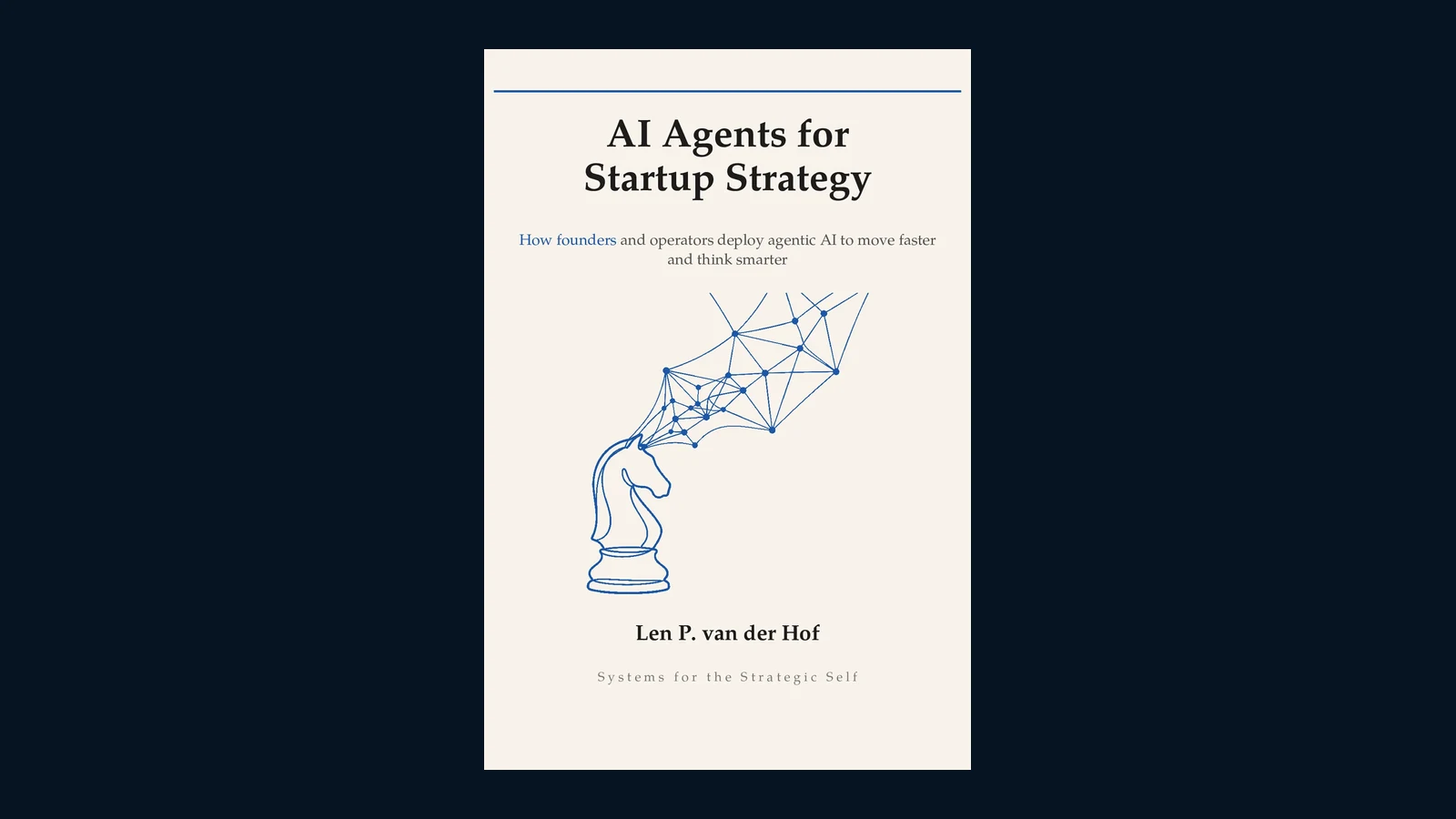
AI Agents for Startup Strategy is for founders done renting strategic awareness from luck, Slack noise, and meetings that land eleven days late.
The real gap is not “using AI”
Most founders already use AI.
They draft faster. They summarize notes. They generate options.
Almost none of them run a strategic intelligence layer: named agent systems, a decision cadence, evidence rules, and kill criteria.
That layer is the difference between a demo and an operating advantage.
The promise, in one breath
Stop treating agents as toys.
Design them as infrastructure.
This book gives you:
- the SENSE design grammar
- five strategic agent systems you can actually stand up
- a written delegation boundary (delegate / augment / reserve)
- versioned claims with expiry discipline
- a 90-day deployment plan that lands in real meetings, not slideware
Not hype. Not code cosplay. Operator doctrine.
SENSE: the grammar that prevents pretty failures
Most agent projects fail for boring reasons.
They scan poorly. They evaluate sloppily. They navigate without owners. They simulate nothing. They execute into a void.
SENSE forces the sequence:
- Scan — what must be sensed continuously?
- Evaluate — what evidence counts, and what is noise?
- Navigate — who decides, and on what cadence?
- Simulate — what breaks before it hits production?
- Execute — what action lands with an owner?
When a system collapses, you can name the phase.
Named failure is fixable. Vague disappointment is not.
Five systems, one portfolio
The book does not hand you one magical agent.
It builds a portfolio posture across competitive, market, scenario, customer, and investor intelligence — then wires output into the decision rituals you already run.
If an agent cannot feed a real owner and a real cadence, it is orphaned theater.
This book kills orphaned theater early.
Governance is the product
Speed without judgment is panic with better latency.
So the book is blunt about:
- versioned claims — date it, source it, expire it
- kill criteria — retire weak systems on purpose
- override doctrine — the founder keeps the hard calls
- team fluency — tools do not compound; practiced judgment does
That is why serious operators finish this book and actually deploy.
Who should buy this now
Buy it if you are:
- a founder tired of tactical AI while strategy still runs on memory
- an operator who owns the Monday decision stack
- a platform or studio lead standardizing agent practice across teams
- a builder who wants doctrine that outlasts this month’s model names
Skip it if you want a prompt pack and a dopamine hit.
Get the book. Then run the ninety days.
English editions (Amazon.com)
| Format | Link |
|---|---|
| Kindle | Buy English Kindle |
| Paperback | Buy English paperback |
| Hardcover | Buy English hardcover |
Dutch editions (Amazon.nl)
| Format | Link |
|---|---|
| Kindle | Koop Nederlandse Kindle |
| Paperback | Koop Nederlandse paperback |
| Hardcover | Koop Nederlandse hardcover |
Need instruments immediately? Use the worksheets.
Dutch catalogue page: boeken/ai-agents-for-startup-strategy.
Final push
Your market is already generating signal.
The only question is whether your company can hear it before the meeting that is already too late.
Build the layer. Govern the claims. Ship the ninety days.