Available now · worldwide on Amazon
The Multi-Agent Organization
How Humans and AI Agents Share Work Without Losing the Plot
Your org chart still describes humans only. Your work doesn't.
CHORUS defines the operating layer between having AI tools and running an AI-powered team: role charters, handoffs, orchestration, review gates, update loops, and shared context.
Get the book
Reading from another country?Pick your own Amazon marketplace — same edition, your store.
Amazon links may include affiliate tags. That does not change the price you pay. Bol.com listings are third-party.
English & Dutch editions · Kindle, Paperback, Hardcover · free on Kindle Unlimited · Nederlandse editie →
- pages
- 276
- chapters
- 13
- hours of reading
- ± 4
- editions
- EN · NL


The editions
Choose your format
Same book, your format. You buy on Amazon, not on this site.
-
Kindle
Read now. Kindle Unlimited members get it at no extra cost.
Buy on Amazon -
Paperback
The working copy. Mark it up. Take it into the meeting.
Buy on Amazon -
Hardcover
The shelf edition. Dark full-art jacket, built to stay in the room.
Buy on Amazon


Available now
How Humans and AI Agents Share Work Without Losing the Plot
You hire to scale, and the org chart fights you. Headcount goes up; clarity goes down. You bolt agents onto a few workflows, a human still reviews everything by hand, and the seams between people and machines become the place work goes to wait. You spend more on coordination and get less of the intelligence you paid for.
The usual advice is to "add AI to the team": buy seats, automate a task, write a policy. It fails because it treats agents as faster headcount instead of a different element of the system. So the org you already struggle to run acquires a second nervous system that no one designed.
This book gives you something you can build instead: a hybrid organization, designed on purpose. Its operating grammar is MULTI (Map, Unitize, Link, Trust, Iterate): the five moves that turn a pile of people and agents into one system that thinks. MULTI is the structure; the model you use this quarter is weather. When the tools change, the organization still holds.
What you can do
What this book puts in your hands
You will learn to:
- Map the work into decisions, then place each one with the agent or the human who should own it.
- Unitize the org into small human-agent cells with a clear interface, so capability composes instead of colliding.
- Link those cells with explicit handoffs, escalation paths, and a shared memory that lives outside one person's head.
- Set the trust boundary deliberately: what an agent decides alone, what it drafts for review, what stays human by law, risk, or judgment.
- Iterate the organization like a product (instrumented, measured, rebuilt) instead of freezing a chart and hoping.
The framework
CHORUS: the system behind the book
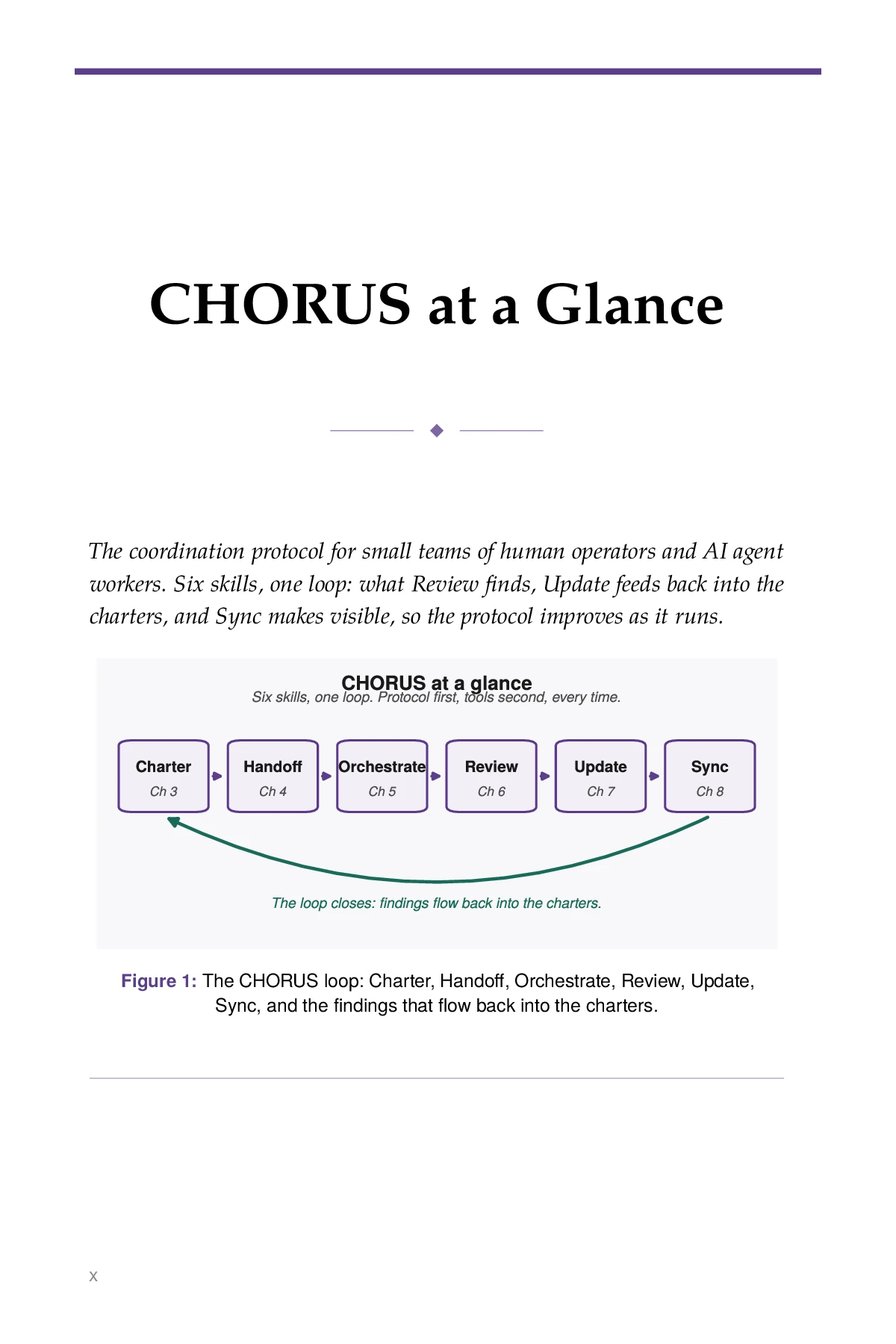
six coordination skills for mixed human-and-agent teams
-
Charter
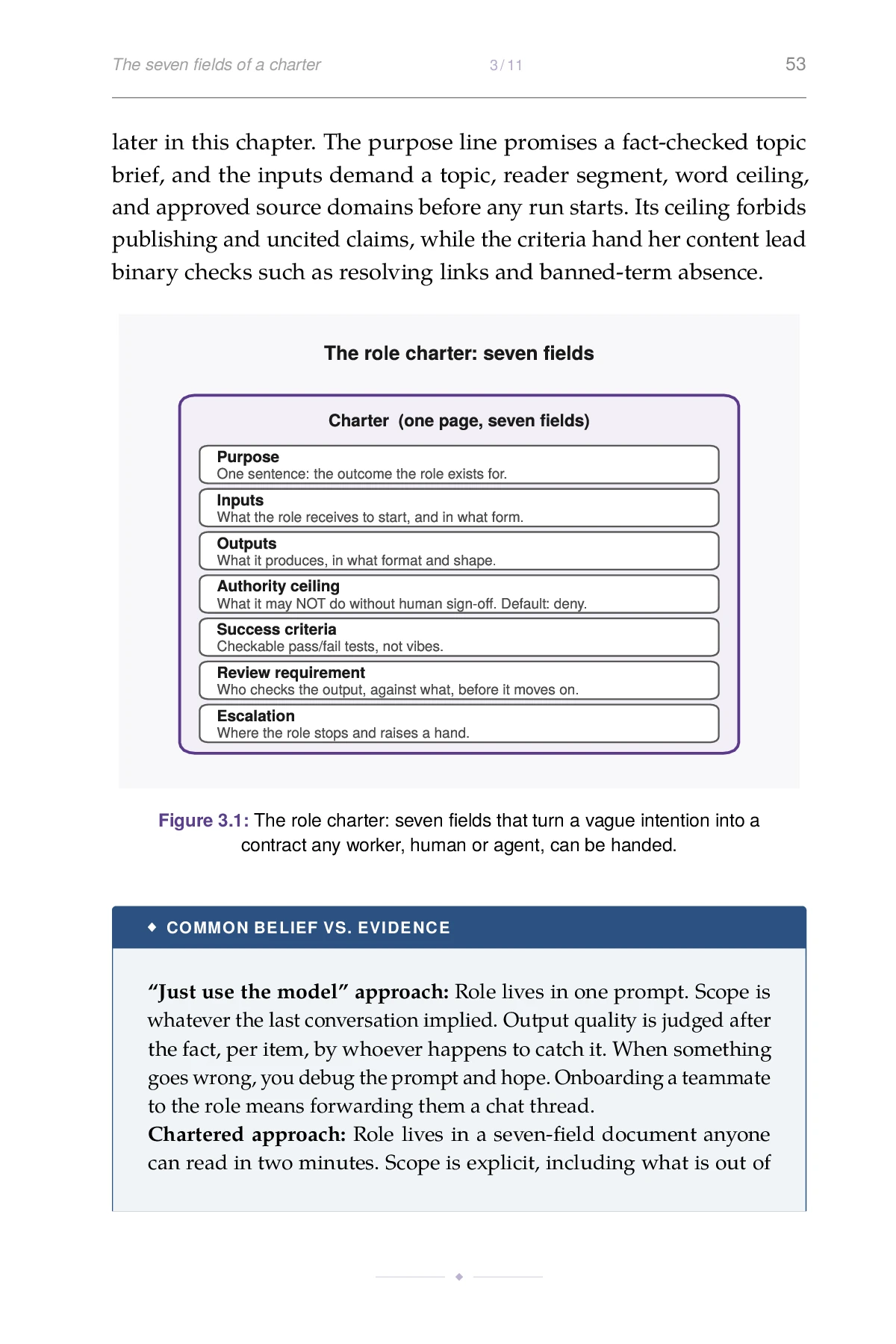
Seven fields that turn a vague intention into a contract any worker, human or agent, can be handed.
-
Handoff
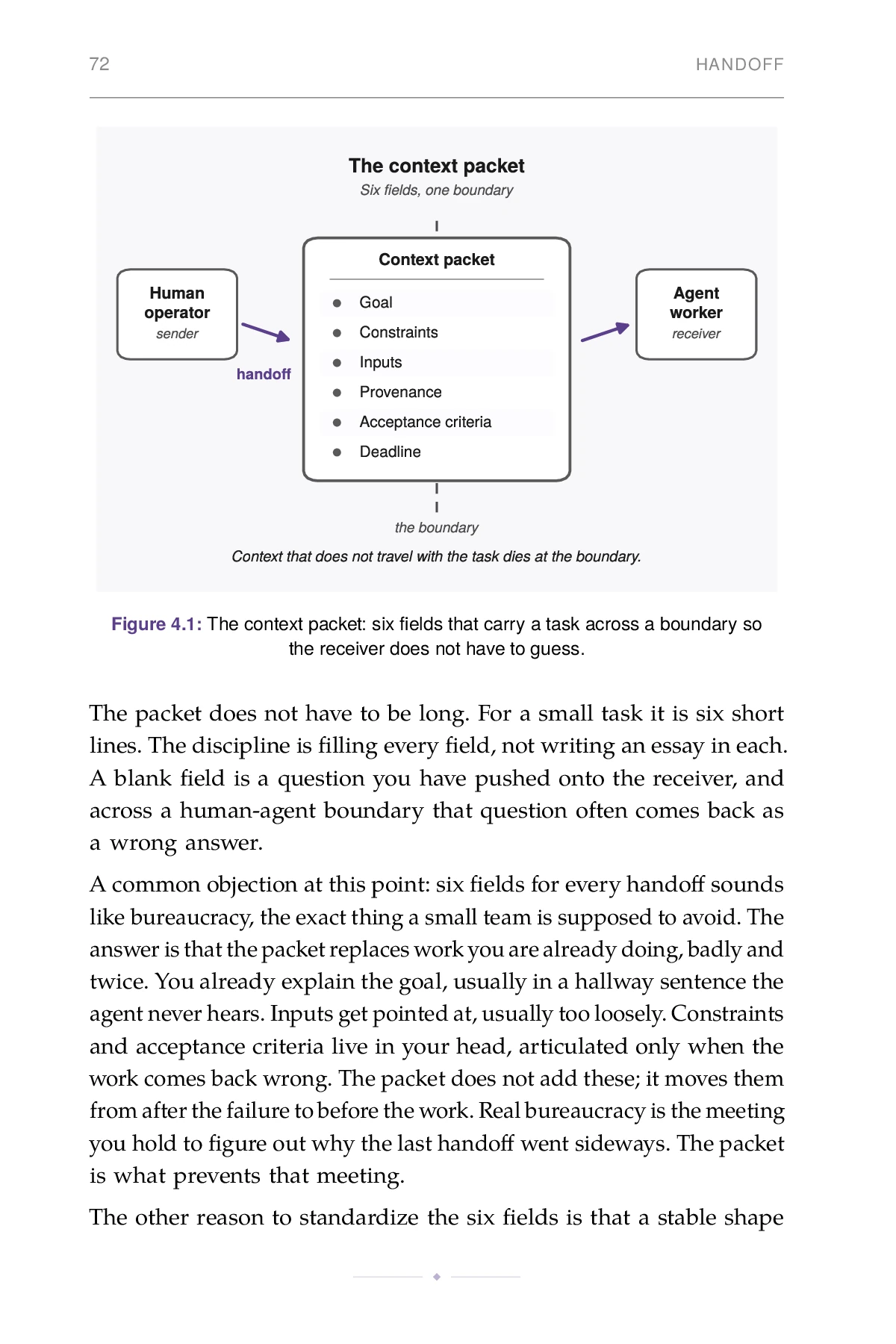
A context packet with six fields that carries a task across a boundary so the receiver never guesses.
-
Orchestrate
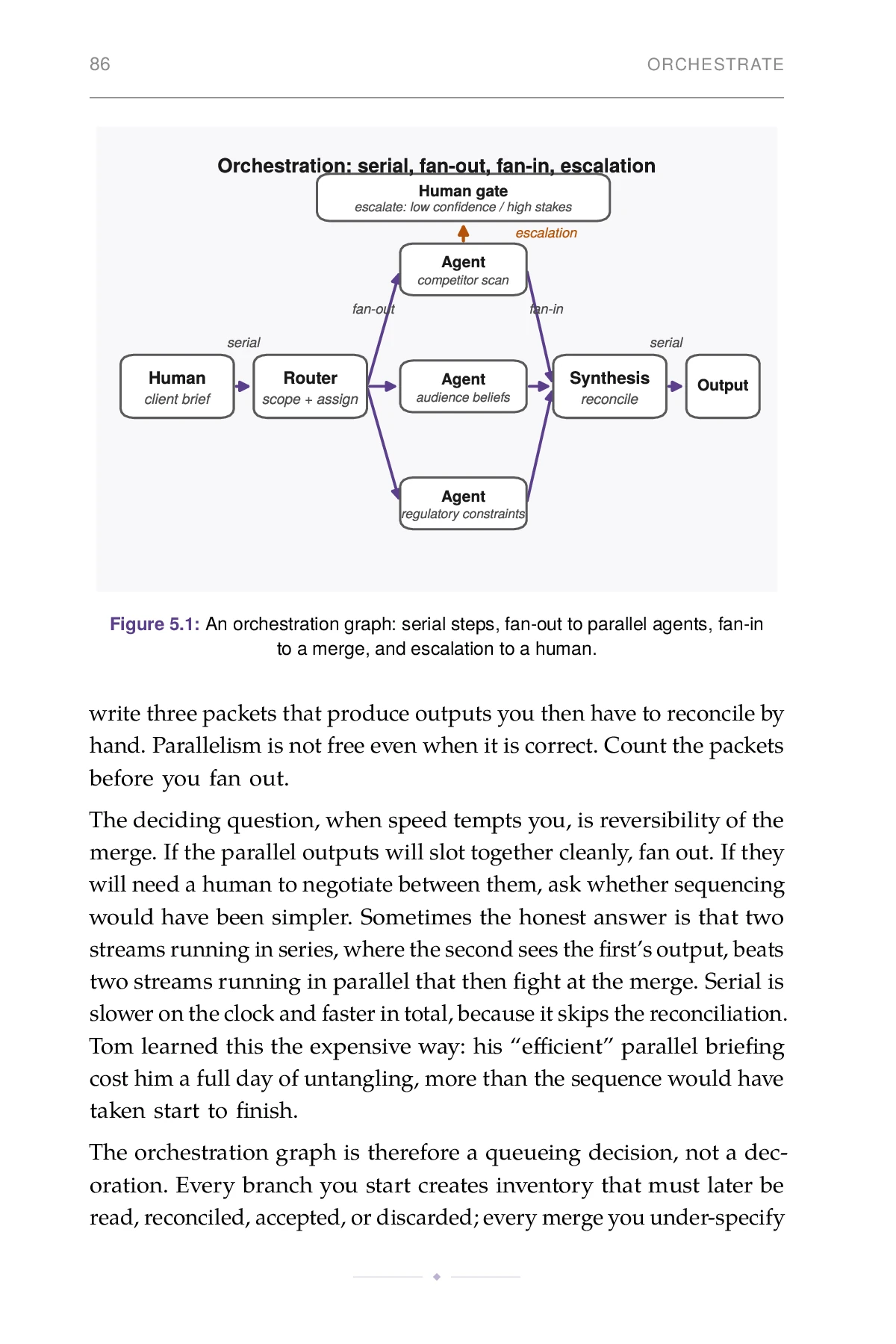
Serial steps, fan-out to parallel agents, fan-in to a merge, and a named escalation to a human.
-
Review
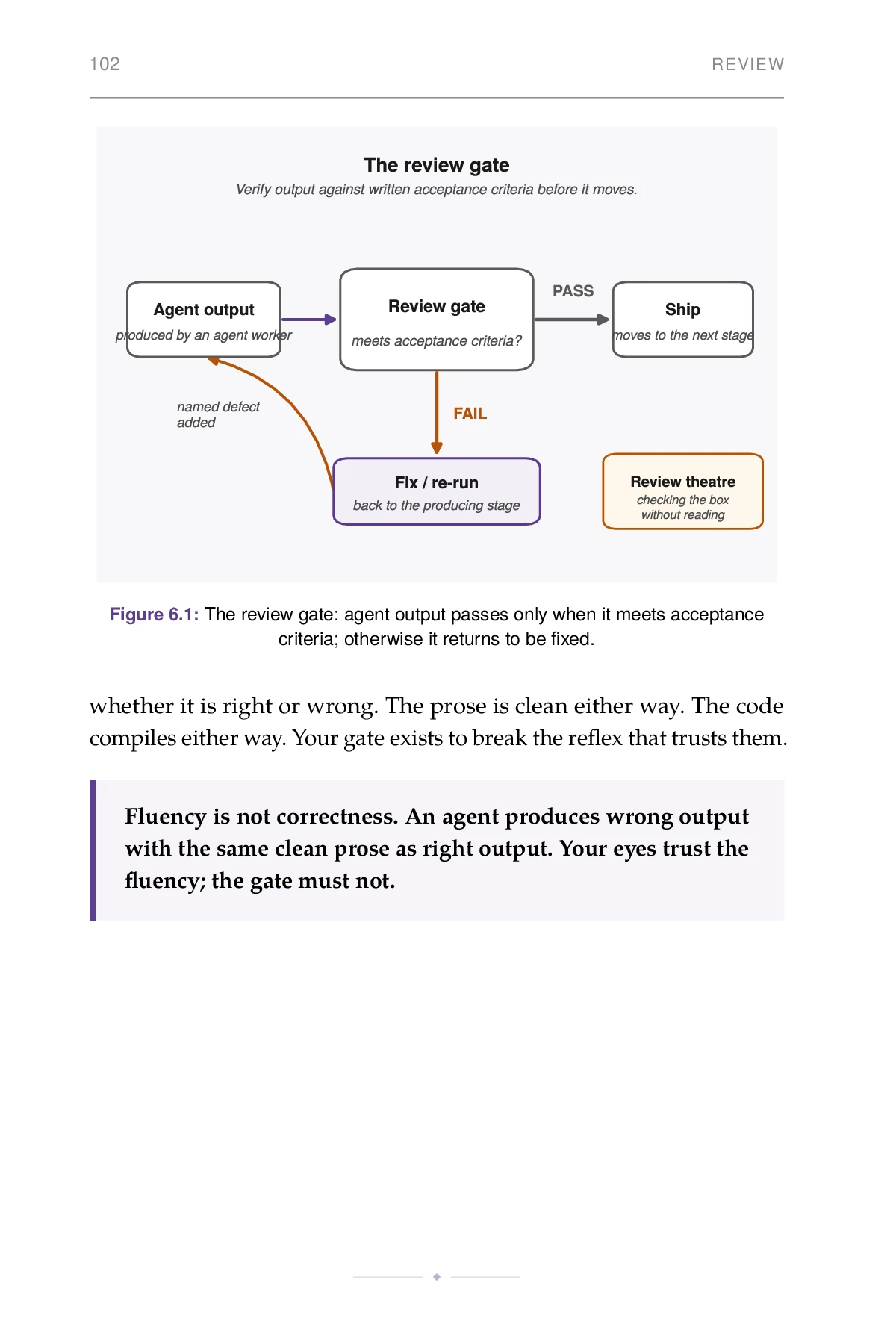
A gate where output passes only when it meets acceptance criteria, instead of being vibe-checked.
-
Update
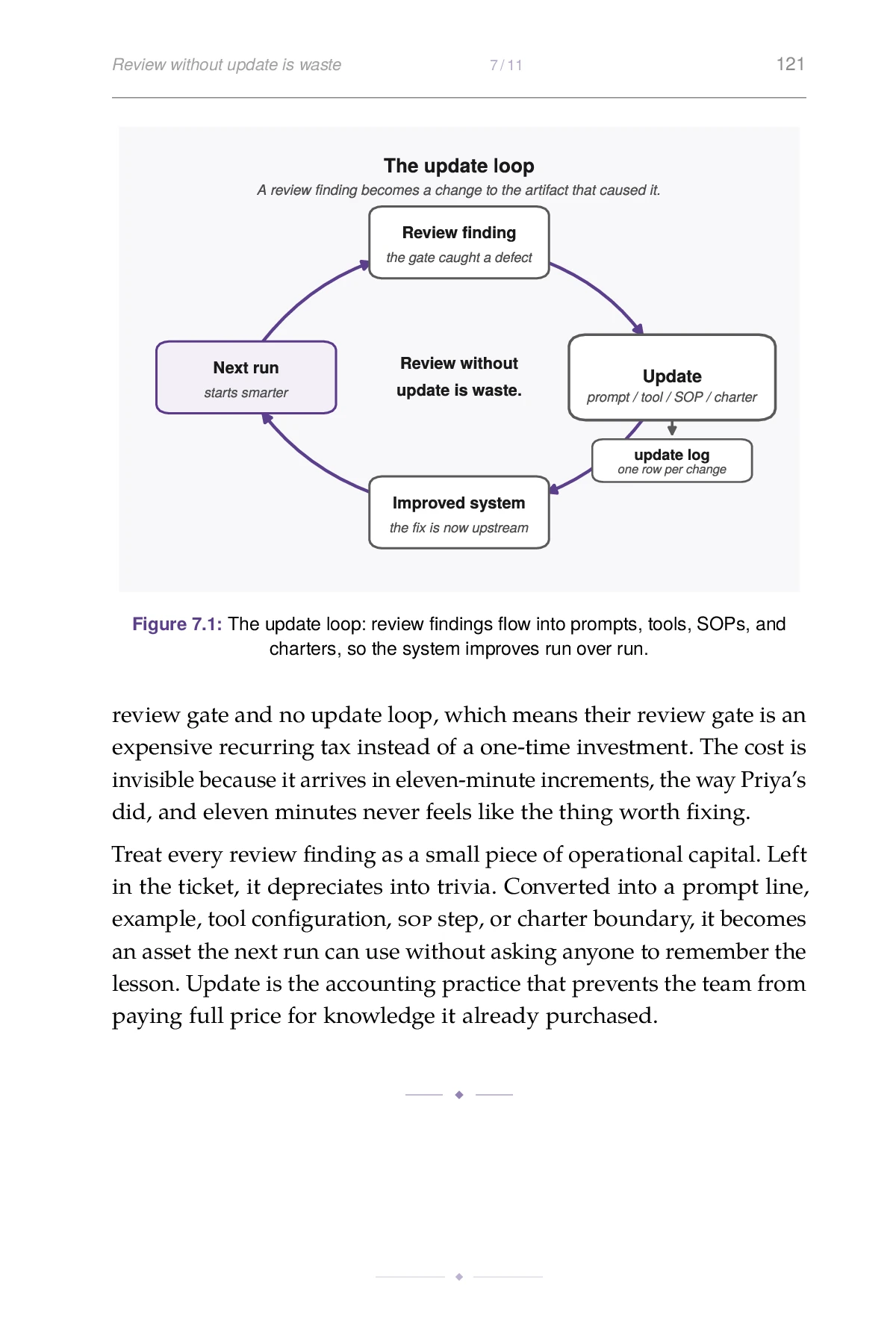
Review findings flow back into prompts, tools, SOPs, and charters, so the system improves run over run.
-
Sync
One surface showing who owns what and what is blocked, read in a short weekly ritual.
From the book
The CHORUS loop: Charter, Handoff, Orchestrate, Review, Update,
The Multi-Agent Organization, printed page: The CHORUS loop: Charter, Handoff, Orchestrate, Review, Update,
Inspect more pagesLook inside
Pages from the print edition.
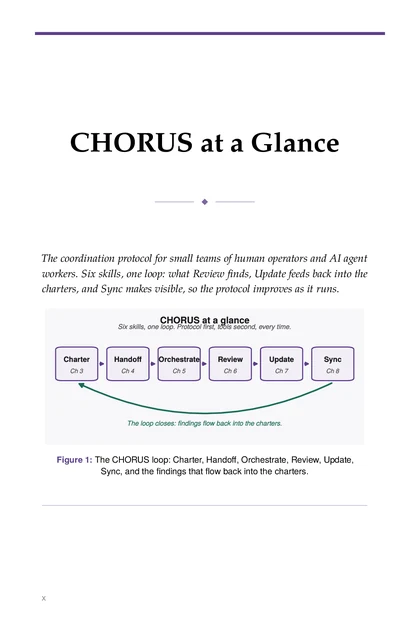 The CHORUS loop: Charter, Handoff, Orchestrate, Review, Update,
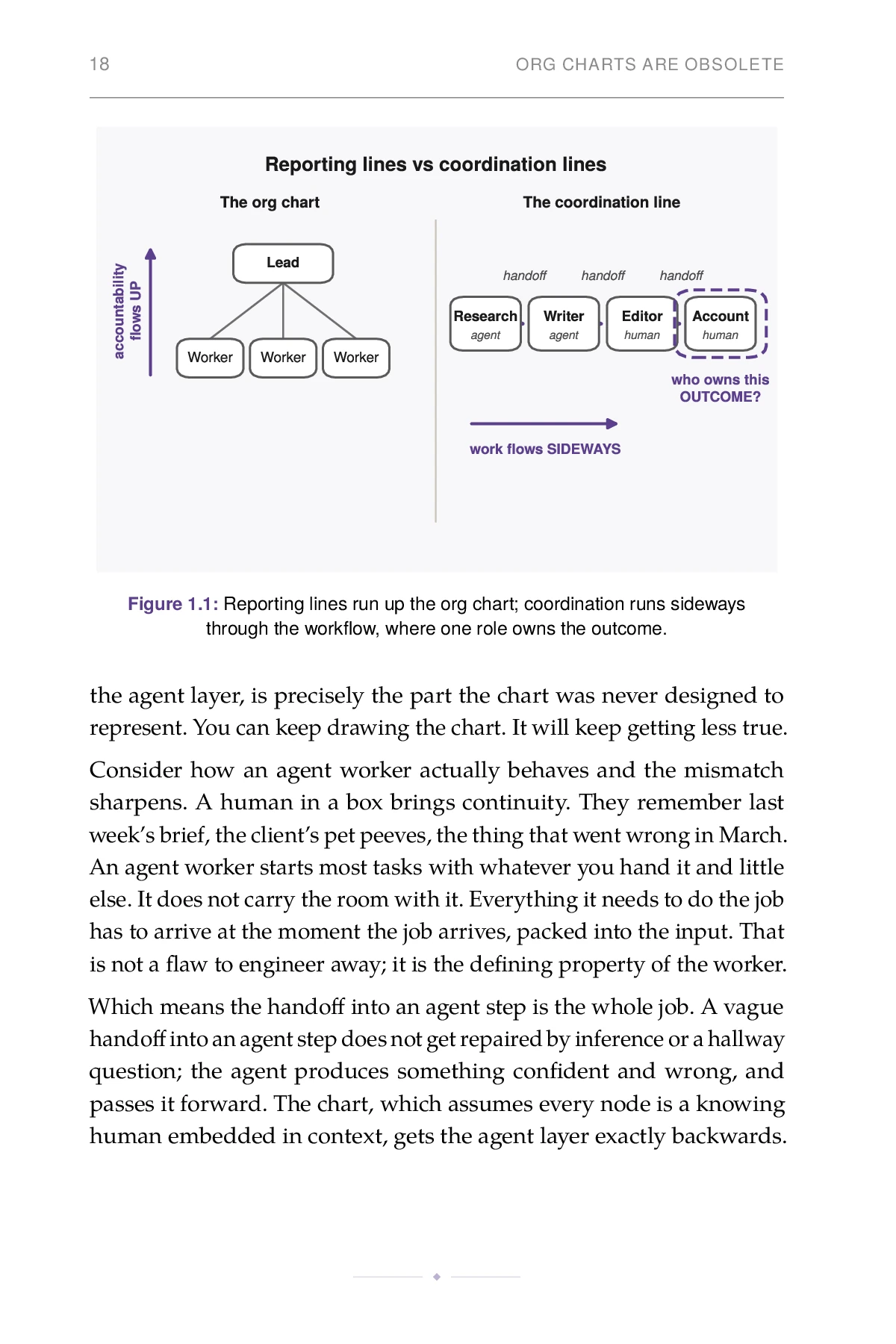
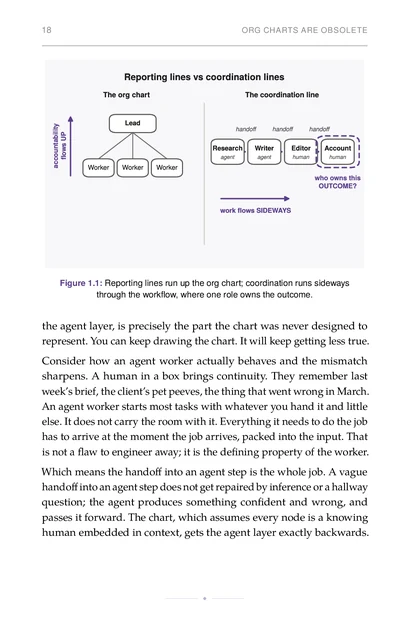 Reporting lines run up the org chart; coordination runs sideways
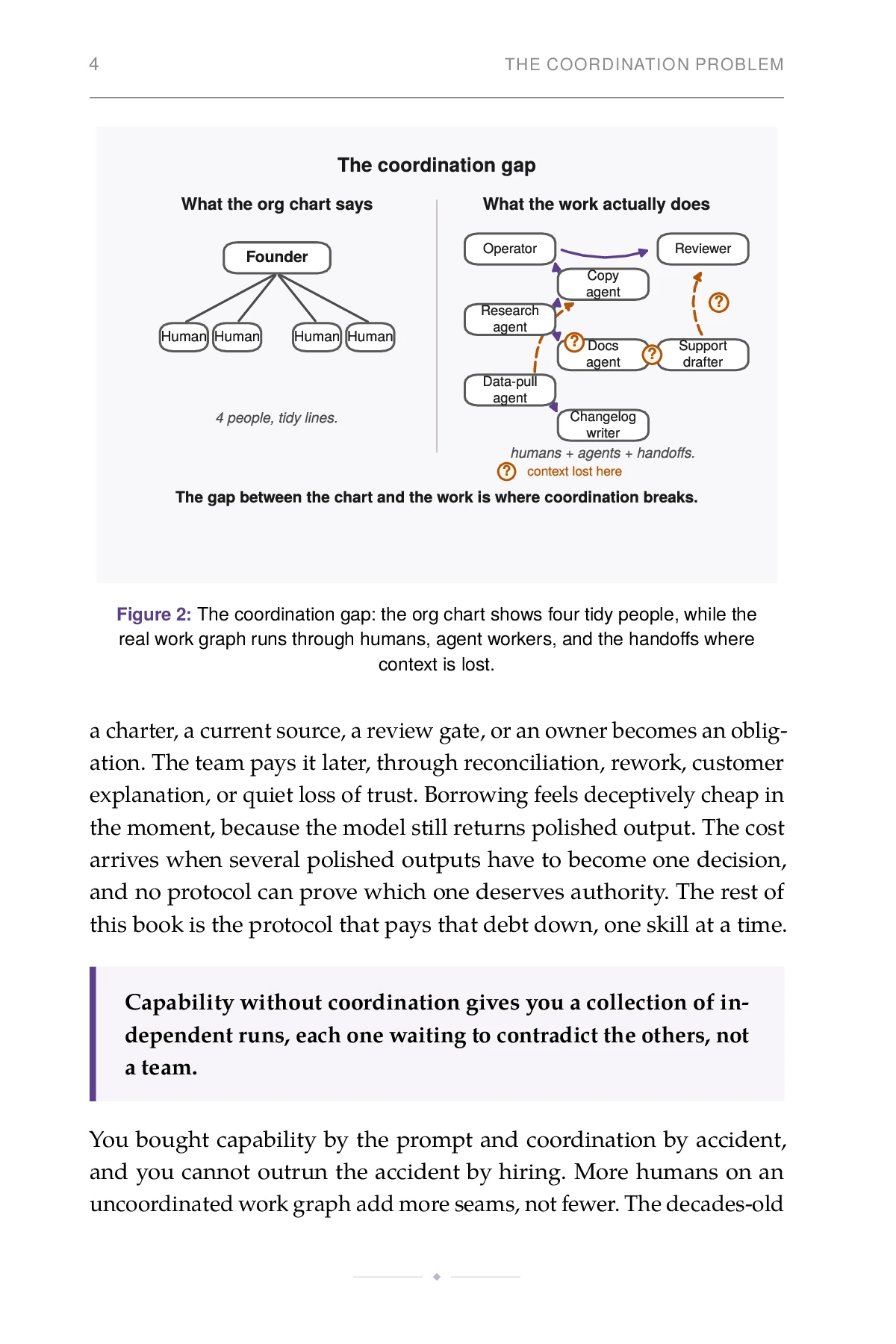
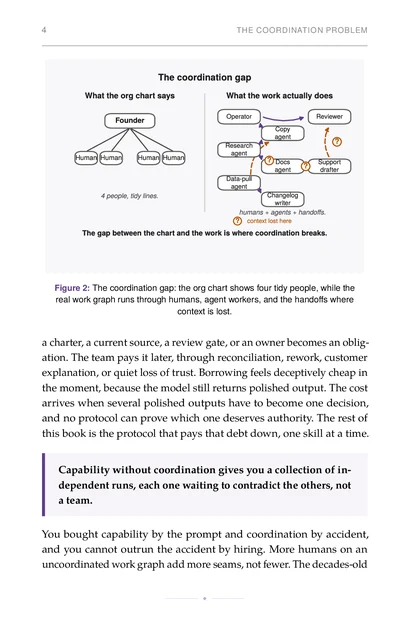 The coordination gap: the org chart shows four tidy people, while the real work graph runs through humans, agent workers, and the handoffs where
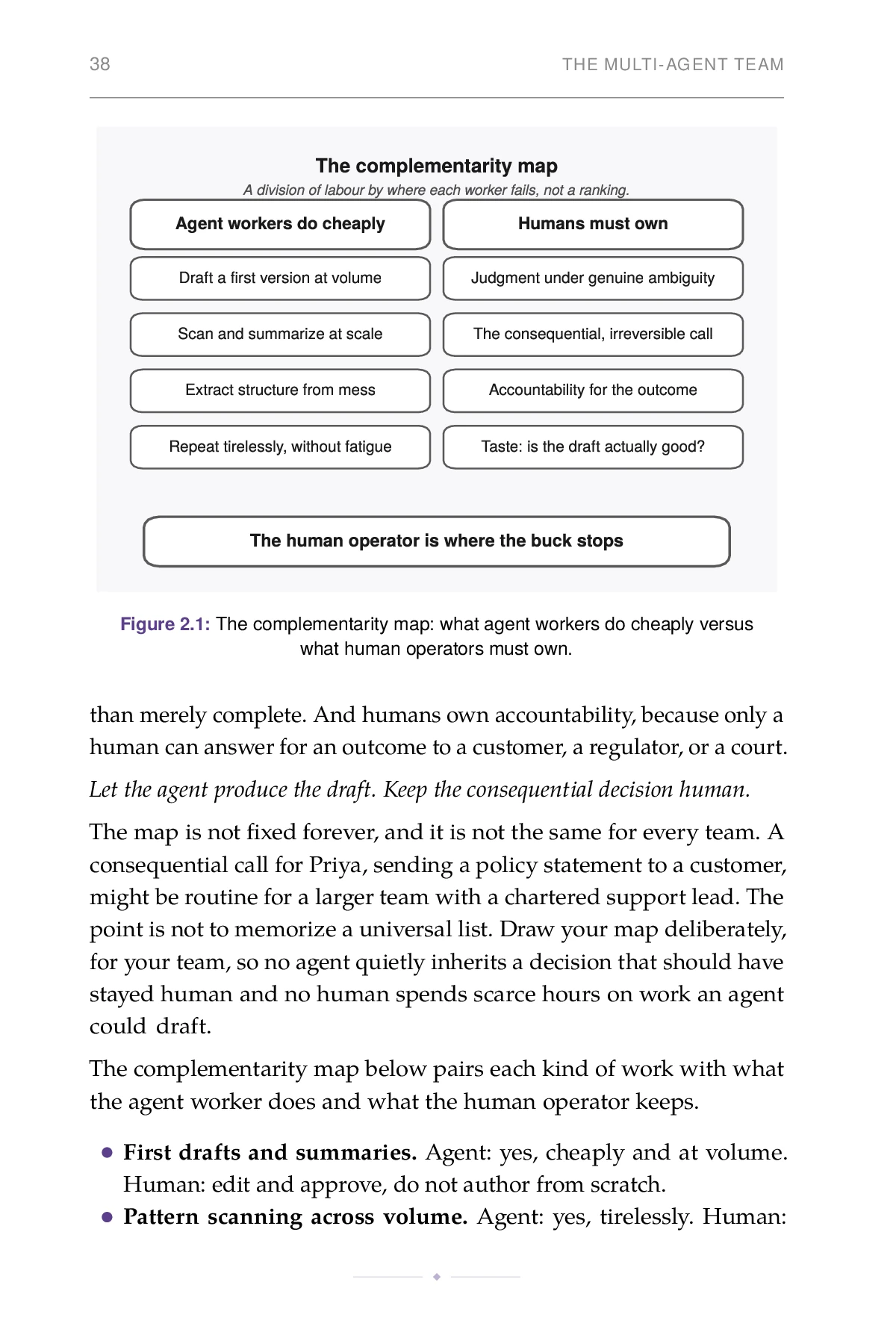
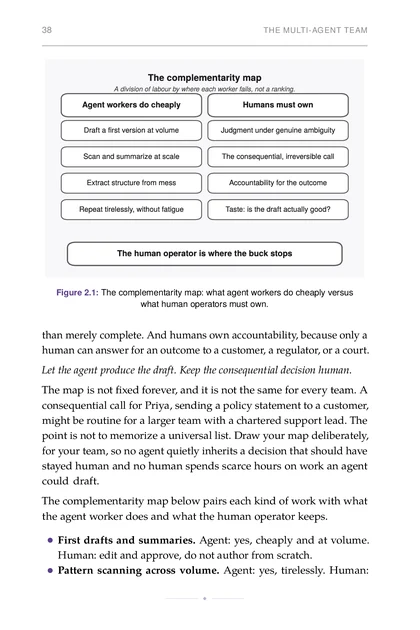 The complementarity map: what agent workers do cheaply versus
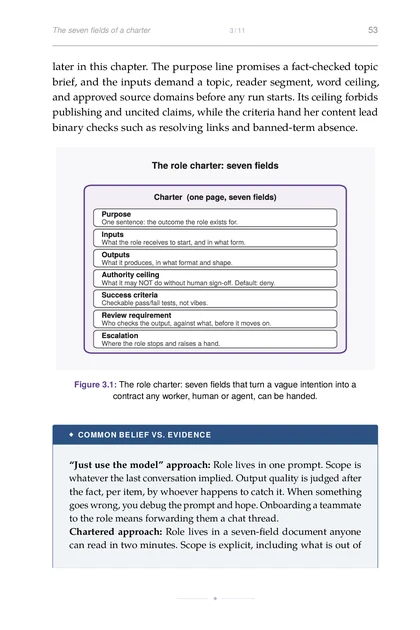 The role charter: seven fields that turn a vague intention into a
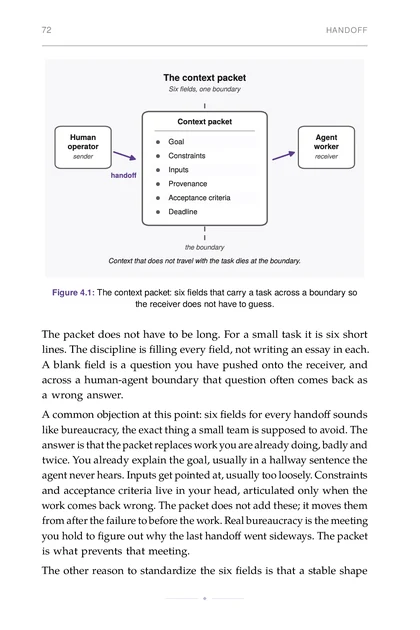 The context packet: six fields that carry a task across a boundary so
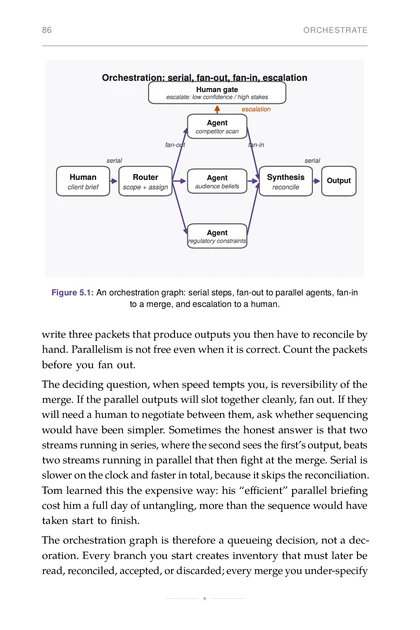 An orchestration graph: serial steps, fan-out to parallel agents, fan-in
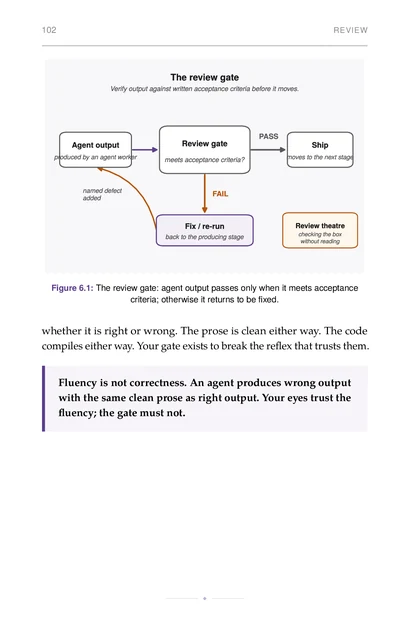 The review gate: agent output passes only when it meets acceptance
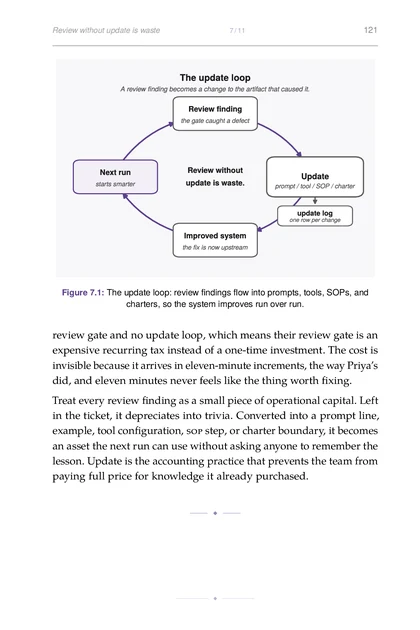 The update loop: review findings flow into prompts, tools, SOPs, and
Purchase takes place on Amazon, not on this website.
Buy the paperback on AmazonFrom the book
Read a page
Introduction
The Coordination Problem
You added agent workers faster than you added the protocol to coordinate them, and the bill is now due.
What you can do afterwards
You will name the coordination gap in your own team and see why protocol, not headcount, is your next lever.
Use this chapter when
Your agent workers piled up quietly and now the output contradicts itself.
What you get
What you get
- The CHORUS system: six coordination skills for mixed human-and-agent teams
- Explicit charters with authority boundaries for every human and agent role
- Clean handoffs: context packets, acceptance criteria, and provenance per transition
- Orchestration patterns plus review gates that verify agent output instead of vibe-checking it
- Update loops and sync rituals built for 2-15 person teams already running agents
Who it's for
- Charter agent roles and human operators with explicit authority
- Stop context dying when work crosses a person, a cofounder, or an agent
- Parallelize agent work without turning the week into chaos
- Install review gates that do not kill velocity
- Sync a mixed team without adding a useless meeting
Who it's for
Who this book was written for
The result is precise: intelligence stops being something you hire one head at a time and becomes something the system produces. The company scales its thinking, not just its payroll, and stays legible to the people accountable for it.
If you are done bolting AI onto an org you already cannot see, and ready to design one that holds, start here.
The reader it was written for
Founders and leads running a team of 2–15 people who already use agents daily and now lose context at every handoff.
Also a fit for
High-output individual contributors treating agents as a personal team who need charter and review discipline before they scale to humans.
What you will use it on
- Charter agent roles and human operators with explicit authority
- Stop context dying when work crosses a person, a cofounder, or an agent
- Parallelize agent work without turning the week into chaos
- Install review gates that do not kill velocity
- Sync a mixed team without adding a useless meeting
Probably not for you if
- CIOs rolling out company-wide AI governance
- Readers who have not yet used an agent in a real workflow
- Teams chasing autonomous swarms with zero human review
The contents
Chapter by chapter
Every chapter of The Multi-Agent Organization with its printed epigraph, what you can do afterwards, and the moment it is built for.
Introduction
The Coordination Problem
You added agent workers faster than you added the protocol to coordinate them, and the bill is now due.
What you can do afterwards
You will name the coordination gap in your own team and see why protocol, not headcount, is your next lever.
Use this chapter when
Your agent workers piled up quietly and now the output contradicts itself.
Chapter 1
Org Charts Are Obsolete
The chart tells you who answers for the work; it never tells you who moves it.
What you can do afterwards
You will stop expecting the org chart to fix coordination, and start reading your work as a flow of handoffs instead of a tree of reporting lines.
Use this chapter when
A workflow keeps stalling between people or agent workers, and no one can name the outcome's owner even though everyone can name their own box on the chart.
Chapter 2
The Multi-Agent Team
A team is a set of named roles, each with one job, one output, and one person who answers for it, not a pile of capabilities.
What you can do afterwards
You will stop thinking of agents as one fuzzy "AI helper" and start treating them as specialized workers alongside the humans they support. Each worker gets a name, an output, and a known failure mode.
Use this chapter when
You have agent runs scattered across chat threads and shared docs, nobody can say exactly which jobs the agents own, and you cannot tell where a human must stay in the loop.
Chapter 3
Charter
A worker without a charter is not a worker; it is a guess you keep paying for.
What you can do afterwards
You will write one complete charter for a real role on your team, human or agent, that another person could hand work to without a meeting.
Use this chapter when
You are about to put an agent worker into production, onboard a human operator, or you keep getting output that is almost right but never shippable.
Chapter 4
Handoff
The work does not break at the desks; it breaks in the space between them.
What you can do afterwards
You will build a context packet template and run one real handoff with it, so the next worker (human or agent) never has to guess what you meant.
Use this chapter when
Work crosses a boundary: human to agent, agent to human, or one person to the next on a chartered task.
Chapter 5
Orchestrate
Orchestration is deciding, on purpose, what runs in sequence, what runs in parallel, what merges, and what stops for a human, not getting everyone to work at once.
What you can do afterwards
You can take one multi-step workflow you run today and draw it as an orchestration graph. Serial links go where order matters, fan-out where work can split, fan-in where it must merge, and escalation gates where a human steps in.
Use this chapter when
A workflow involves more than two handoffs, more than one agent worker, or any step where parallel work would save time but risks producing conflicting outputs.
Chapter 6
Review
A charter that promises quality without a gate that verifies it is a wish, not a system.
What you can do afterwards
You will build one review gate that checks agent output against written acceptance criteria, so quality stops depending on whoever happens to be paying attention.
Use this chapter when
An agent worker produces something that leaves your team (a client deliverable, a customer reply, a code change, a published post) and a mistake costs money, trust, or a rework loop.
Chapter 7
Update
A review that changes nothing is a review you ran for the file, not for the work.
What you can do afterwards
You will turn a single failed review into a permanent improvement by changing one upstream artifact and logging the change.
Use this chapter when
A review gate catches a defect, and you find yourself fixing the same defect more than once.
Chapter 8
Sync
A team stays aligned by reading the same surface, not by sitting in the same meeting.
What you can do afterwards
You will replace status meetings with a sync surface anyone can read in thirty seconds and a ritual that takes fifteen minutes.
Use this chapter when
Your team (human operators and agent workers) runs enough parallel work that nobody can hold the full state in their head, and you keep discovering surprises late.
Chapter 9
The Small-Team Operating Model
A coordination protocol you do not run on a rhythm is just a document; CHORUS becomes an operating model only when charter, handoff, review, and sync each land on a predictable beat.
What you can do afterwards
You will compose the six CHORUS skills into one lightweight weekly rhythm and capture it on a single page your whole team can read in two minutes.
Use this chapter when
You have learned the skills one at a time and now run them ad hoc. Charters drift, reviews get skipped under deadline, and nobody is sure what the agent workers shipped last week.
Chapter 10
Failure Modes
Multi-agent teams rarely fail from a missing tool; they fail from a missing protocol, and the failures arrive in a small, predictable set.
What you can do afterwards
You will recognise the five failure modes that quietly degrade multi-agent teams and match each to the CHORUS skill that fixes it.
Use this chapter when
Output quality is slipping, work is being redone, or you sense the team is busy without being aligned, and you cannot name why.
Chapter 11
Build Your CHORUS Stack
The protocol is the asset; the tools are rented, and you should treat them that way.
What you can do afterwards
You will leave with a tool mapped to each CHORUS skill, a traceability check that proves your agent runs are auditable, and a clear rule for when a spreadsheet beats a platform.
Use this chapter when
You are about to buy coordination software, or you already bought it and the coordination problem stayed.
Conclusion
Conclusion: The Protocol Organization
Your competitors can copy your tools by Friday; the thing they cannot copy is how cleanly your team hands work between humans and agent workers.
What you can do afterwards
You will leave with CHORUS as a shared vocabulary your team actually uses, and a ninety-day plan to install it without a reorg, a new platform, or a single extra meeting.
Use this chapter when
You have read the skills, you believe the protocol, and you are standing in the gap between knowing CHORUS and running it on Monday.
Editions
Editions and specifications
| Edition | Formats | Chapters | Pages | Reading time | ISBN (paperback) |
|---|---|---|---|---|---|
| English The Multi-Agent Organization | Kindle, Paperback, Hardcover | 13 | 276 | ± 4 hours | — |
| Dutch De multi-agent organisatie | Kindle, Paperback, Hardcover | 13 | 296 | ± 4 hours | 9798188531270 |
Both editions are written natively. The Dutch text is not a machine translation of the English.
Get the book
One title, every Amazon marketplace. Pick your format and your store.
Get the book
Reading from another country?Pick your own Amazon marketplace — same edition, your store.
Amazon links may include affiliate tags. That does not change the price you pay. Bol.com listings are third-party.
Frequently asked
What readers usually want to know
What is The Multi-Agent Organization about?
CHORUS defines the operating layer between having AI tools and running an AI-powered team: role charters, handoffs, orchestration, review gates, update loops, and shared context. The subtitle is: How Humans and AI Agents Share Work Without Losing the Plot.
What is the CHORUS framework?
CHORUS: Charter, Handoff, Orchestrate, Review, Update and Sync. six coordination skills for mixed human-and-agent teams
In which formats is The Multi-Agent Organization available?
The Multi-Agent Organization ships as Kindle, Paperback and Hardcover, on every Amazon marketplace worldwide. The Kindle edition is enrolled in Kindle Unlimited, so KU members read it free.
Is there a Dutch edition?
Yes. The Dutch edition is De multi-agent organisatie, written as a native edition rather than a machine translation. It is available on Amazon too.
How long is The Multi-Agent Organization?
This edition runs 13 chapters, 276 pages in print and roughly 4 hours of reading.
Who is The Multi-Agent Organization for?
If you are done bolting AI onto an org you already cannot see, and ready to design one that holds, start here.
We are too small for process.
CHORUS is built for teams of 2–15 already running agents. The cost of a missing handoff shows up faster in a small team, not slower.
This will bureaucratize a nimble team.
A charter and a context packet are smaller than the Slack thread that replaces them. The book is allergic to process theatre.
Our tools already have workflows built in.
Tools have features. They do not have a shared memory, an authority boundary, or a review gate that the next agent can inherit.
Agents change too fast for a book.
CHORUS names coordination skills, not vendors. Charter, handoff, orchestrate, review, update, sync survive the next model.
Is this just project management with AI branding?
Project management assumes human workers. CHORUS is the operating layer for mixed human-and-agent work: provenance, acceptance criteria, and a named escalation to a human.
The production system
How this book was made
Every title moves through the same gated production line: sourced research, a claim-level evidence ledger, structural review, fact-checking, red-team critique, and a bilingual final edit. AI agents do specialist work inside those gates; judgment, voice, and accountability stay human.
- Claims enter an evidence ledger with a source and a confidence grade before they reach the page
- English and Dutch are two native editions, not a translation of one another
- Every chapter clears readability, rhythm, and style gates before it is typeset


