Calibration is a crowded word. Photographers mean a colour profile. Lab techs mean a scale. Machine-learning decks mean a reliability diagram. People searching it on this site usually want the judgment meaning, and they bounce when the first screen is a camera.
What calibration means here: matching the strength of a judgment to the strength of the evidence, then updating when the facts move. Confidence is a report, not a personality trait. A loud claim with a thin source is a calibration failure, not conviction.
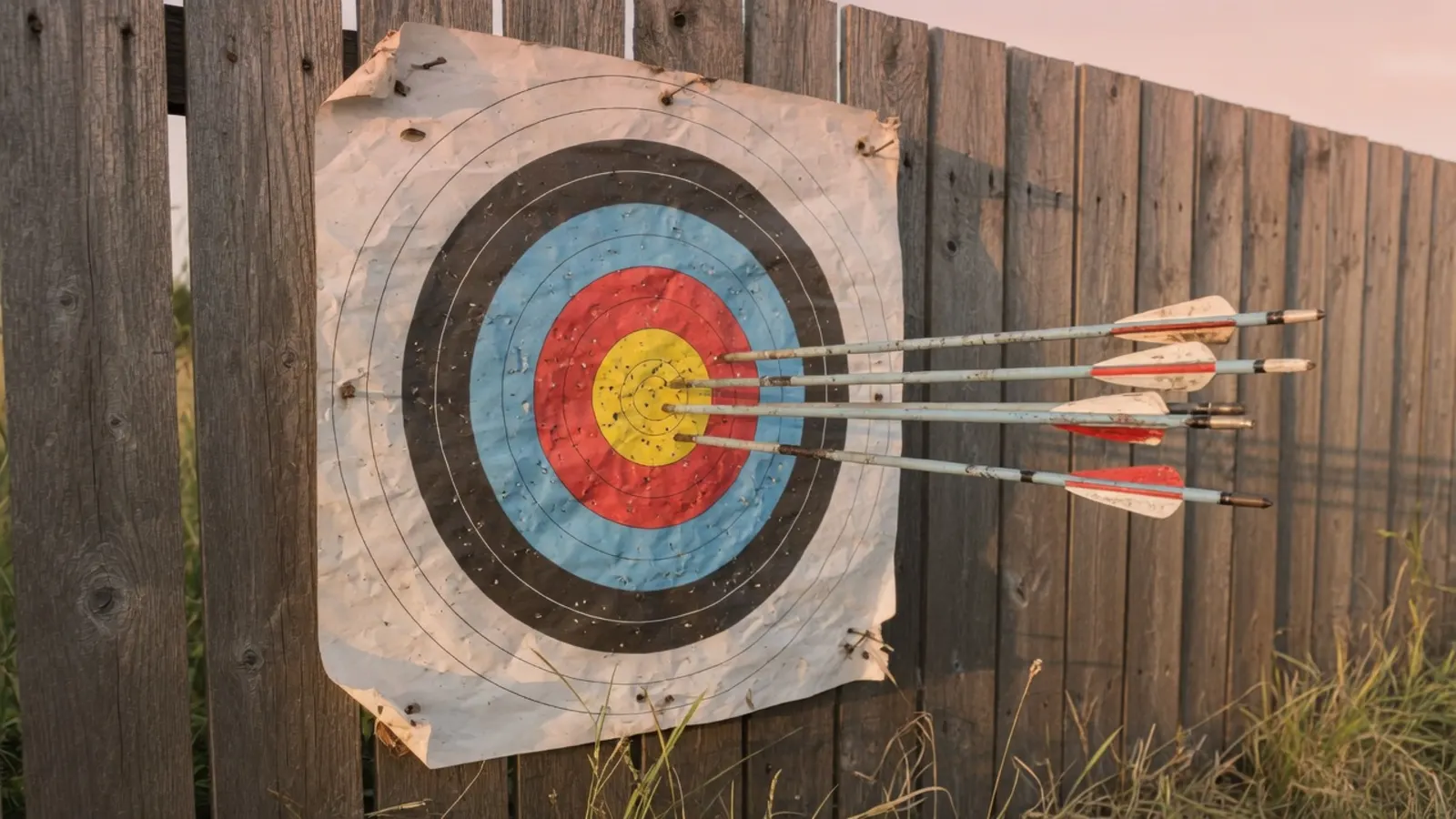
Tight and wrong is still uncalibrated. A cluster of arrows in the same ring proves consistency. It does not prove the ring was the target. Founders confuse those two. A team that always sounds sure is not a calibrated team. It is a team with a rendering style.
Not a feeling
You cannot tell, from the inside, whether your certainty matches reality. That is a structural problem, not a character flaw. The feeling of being sure is cheap. It arrives with a tidy sentence. It is the same feeling whether the second line has a source or a blank.
The repair is not a better adjective. Write three lines.
- The claim.
- The evidence.
- A percentage you would actually bet.
If line two is empty, line one is not a judgment. It is a mood. That is the live CALIBRATE capsule, applied to a paste, a hire, or a forecast.
“Would actually bet” is the load-bearing phrase. A number you would not put on a calendar invite is theatre. 70% that you would not defend in the Monday meeting is 70% of nothing. Write the number you would still own if the other side asked how you got it.
Update is the other half. A score that never moves is a slogan. When the evidence moves, the percentage moves, or you are collecting souvenirs.
Three claims, three reports
A hire. “They will raise the bar on the engineering team.” Evidence: two interviews, one take-home, a reference who worked with them three years ago. A percentage you would bet on “still here and net-positive at six months.” If you cannot name the six-month test, you are buying a feeling. The report might read 55%, with the missing evidence being a working session on this codebase. That is allowed. Silent 90% is not.
A forecast. “We will close this quarter.” Evidence: three verbal yeses, no paper, one champion who has not booked procurement. The percentage belongs on the forecast, not in the all-hands adjective. If paper would move you 25 points, write that down before the paper arrives. After it arrives, memory will say you knew.
A model paste. The paragraph is fluent. Fluency is a rendering choice. Evaluate the reasoning, not the fluency is the adjacent operator test. Calibration is whether you were entitled to believe the claim inside the paragraph. Line two is the citation, the log, or the run that would fail. Empty line two means you are about to ship a mood with a typesetting budget.
No Brier tables on this page. No training-effect size. Those belong in a methods appendix. The operator object is the three-line report.
Not a psychometric product
CALIBRATE is the named system in The Calibrated Mind. It is not a test you administer. It is not a personality inventory. The collision is in the glossary on purpose. English and Dutch editions are available now as paperback and hardcover. This page does not teach the nine skills. The book owns that longer practice.
It is also not camera calibration, not a colour profile, and not “the model is calibrated” as a product claim about temperature. Those are different machines that borrowed the same English word. If you landed here with a lens in your hand, leave. This is judgment under uncertainty.
The five-line decision journal is the scorecard that does not lie about a human call. Memory will defend the feeling. The journal will not. Use it when the call is yours. Use the three-line report when the call is a claim you are about to ship.
A ten-minute check
Take the last claim you shipped.
- What would move you 20 points?
- What evidence would retire it?
- Did anyone write that down before the result landed?
If those lines are blank, you are not uncalibrated as a person. You are running without a report. Start the report.
A second pass, same ten minutes: pick one claim that is still live. Rewrite it as claim / evidence / percentage. If the percentage is 80 and the evidence is one conversation, cut the number until you would bet it. Then write the observation that would move it 20 points. Put that observation on a calendar, not in your head.
The hardcover can wait. The next loud sentence cannot.
Cite this:What calibration means: matching confidence to evidence.Len P. van der Hof. https://lenvanderhof.com/en/blog/what-calibration-means/ ·