

No. 56 · Manuscript complete · AI & agents · TALENT
The Talent System
Build a Talent Operating System That Compounds in the Agent Era
The Talent System: Build a Talent Operating System That Compounds in the Agent Era.
TALENT turns hiring, onboarding, learning, feedback, AI augmentation, and retention into a compounding system rather than episodic HR work. Build a Talent Operating System That Compounds in the Agent Era. The framework: TALENT.
- pages
- 200
- chapters
- 14
- hours of reading
- ± 3
- editions
- EN · NL
- Design
- Drafting
- Manuscript
- Production
- Launched
The editions
Kindle and Paperback
Production shots of the editions. Not for sale yet — this page is the public working version.
-
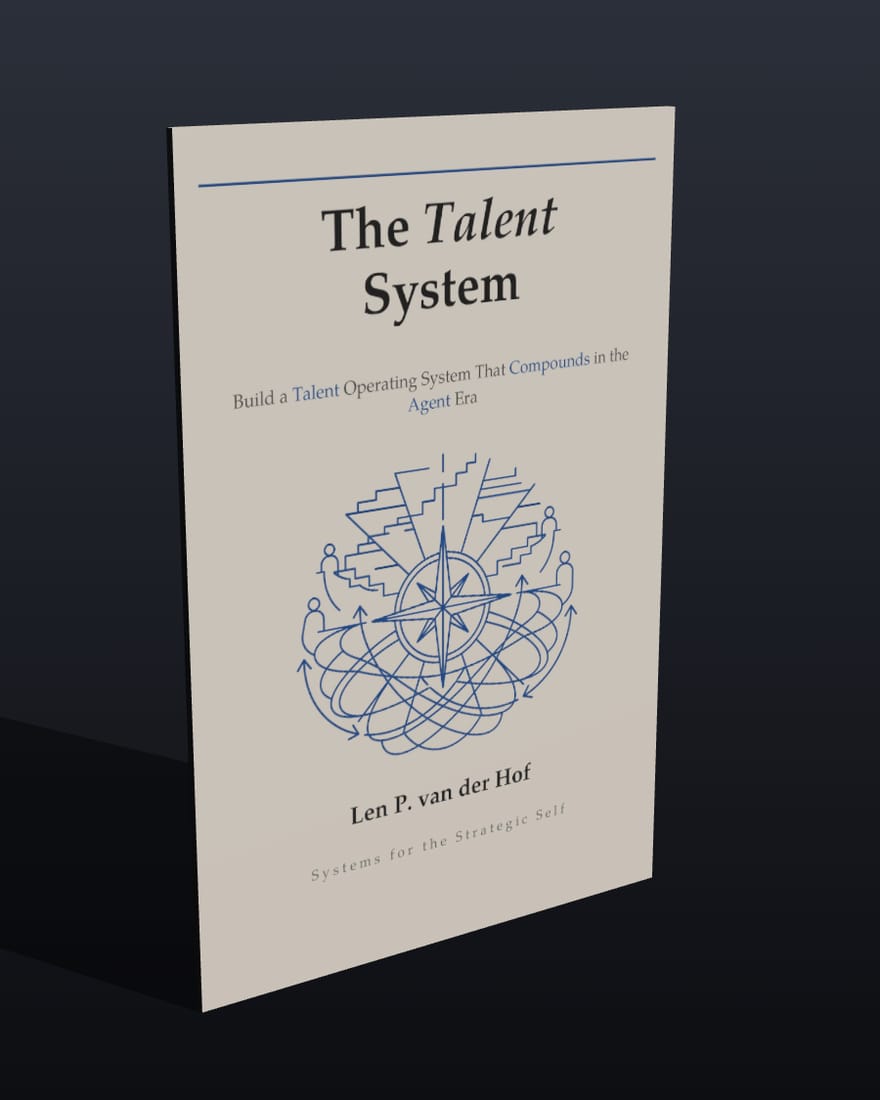
Kindle
The digital edition, ready in any Kindle app.
-
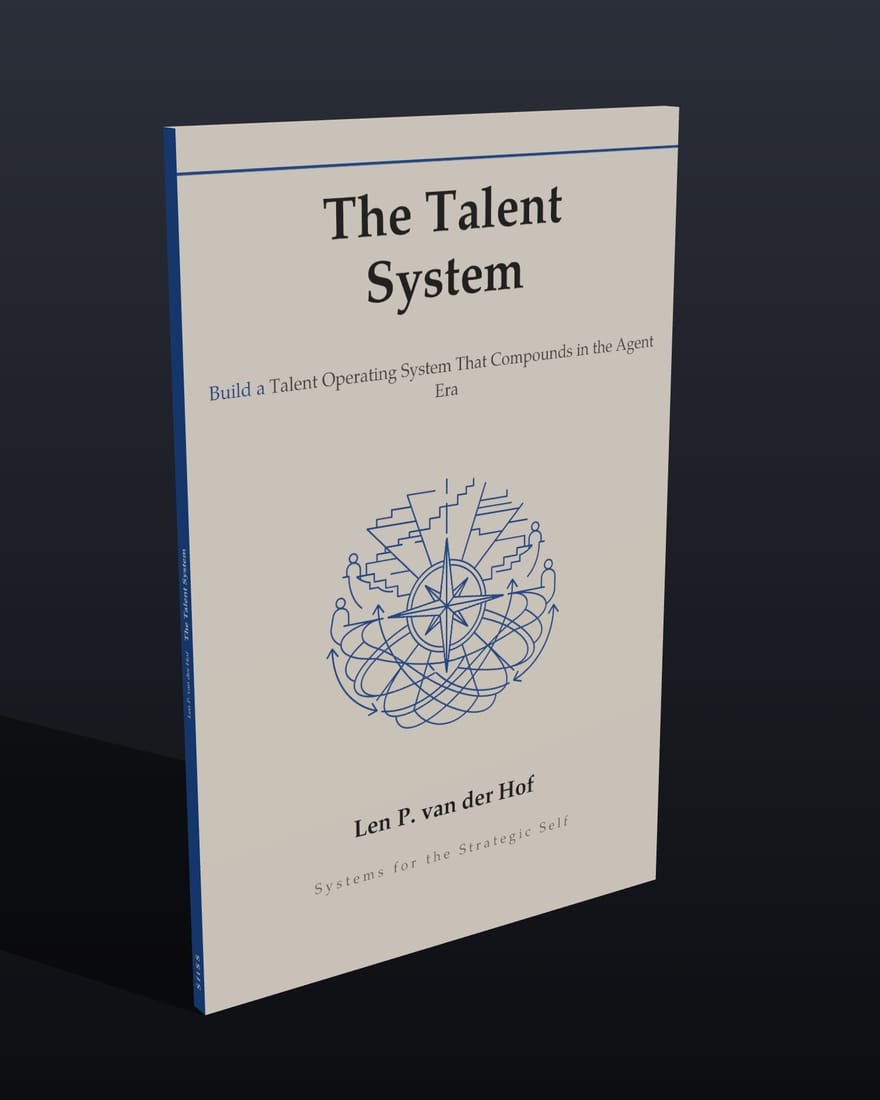
Paperback
The working copy. Mark it up. Take it into the meeting.


The book
Build a Talent Operating System That Compounds in the Agent Era
You hired the early team on instinct, and it worked. Then the company crossed fifty people and agents changed the job. The "culture fit" lead you loved cannot tell when an agent output is wrong. The "high potential" you promoted on "I know it when I see it" is shipping slower and burning out. Your team now spends more time managing around talent decisions than doing the work.
The reflex is to add headcount and tighten the interview. That scales the problem, not the work: a sharper interview still selects for the pre-agent role, and judgment that was right at fifteen becomes politics at fifty.
The Talent System is the opposite of a hiring hack: talent as a designed operating system. Its TALENT framework (Track signals, Attract the right humans, Level explicitly, Engage through ownership, Nurture what compounds, Transition cleanly) replaces founder taste with auditable structure.
What you learn
What this book puts in your hands
- Retire "culture fit" and gut feel for observable signals that predict success once agents change the job.
- Level explicitly with rubrics instead of taste, and engage people through ownership, not retention theater.
- Nurture the skills that compound with agents, and reward the new success, not the old.
- Read your calendar and talent debt as signals, then transition people cleanly before a mis-hire taxes everyone around it.
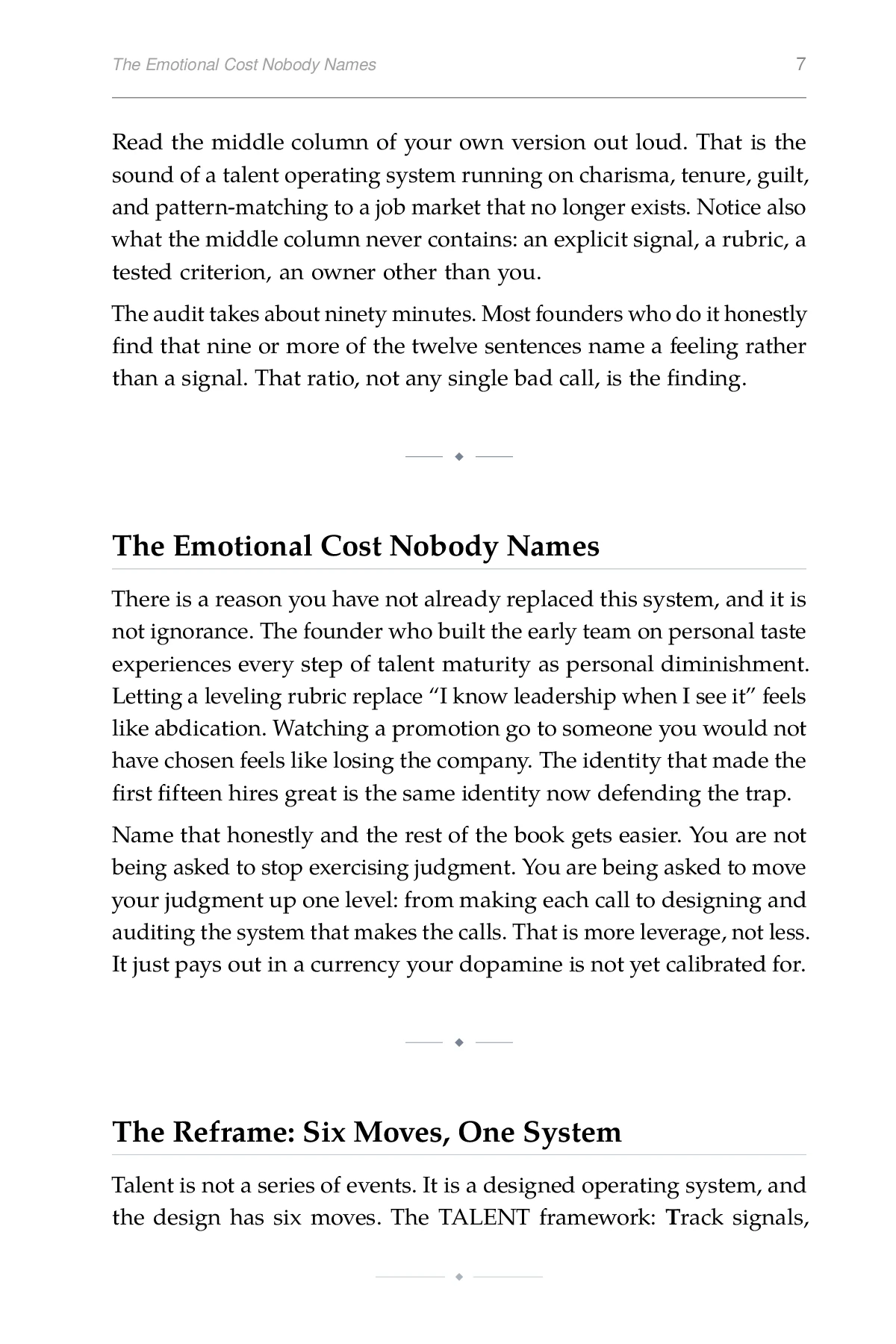
From the book
The Emotional Cost Nobody Names
The Talent System, printed page: The Emotional Cost Nobody Names
Inspect more pagesLook inside
Pages from the print edition.
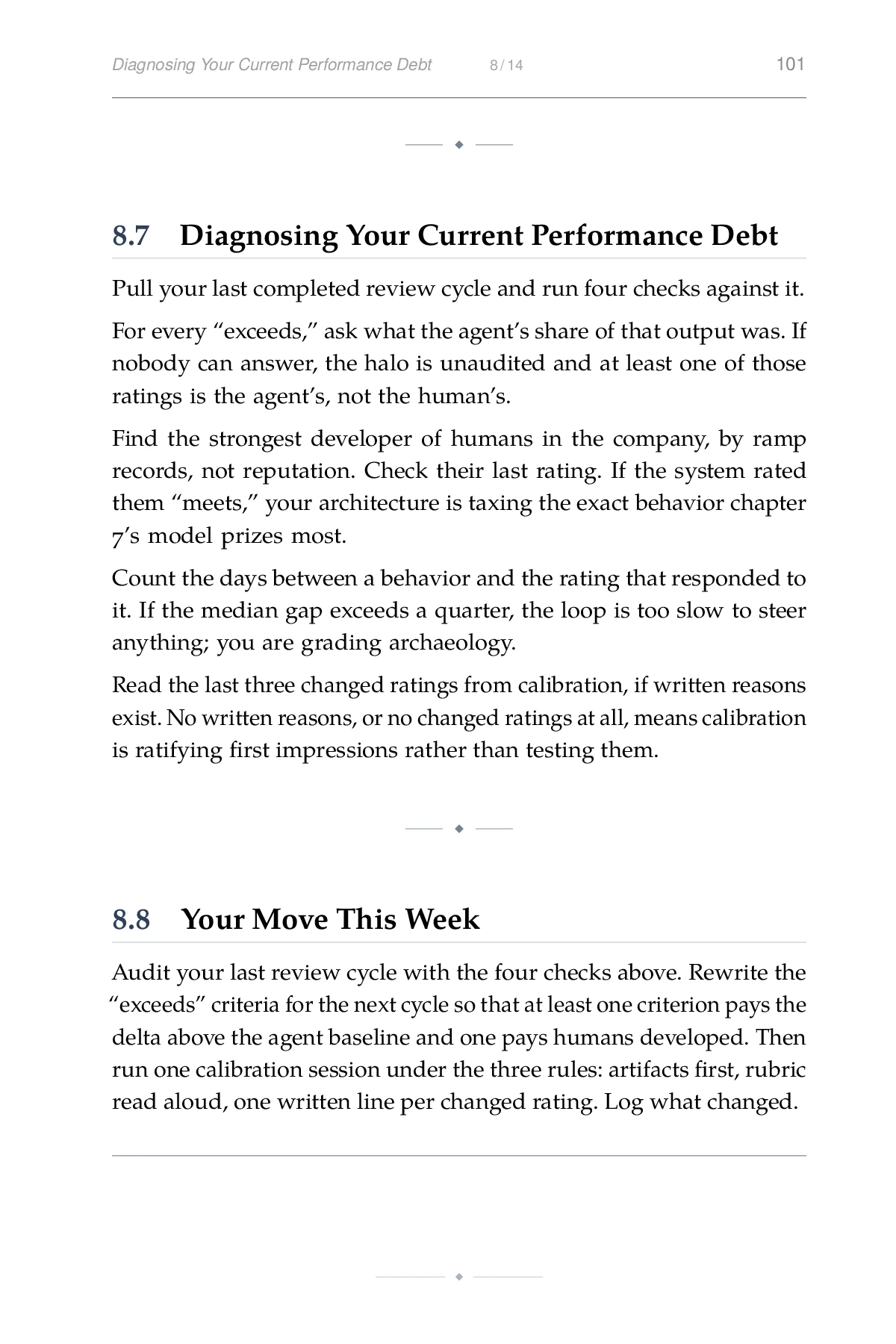
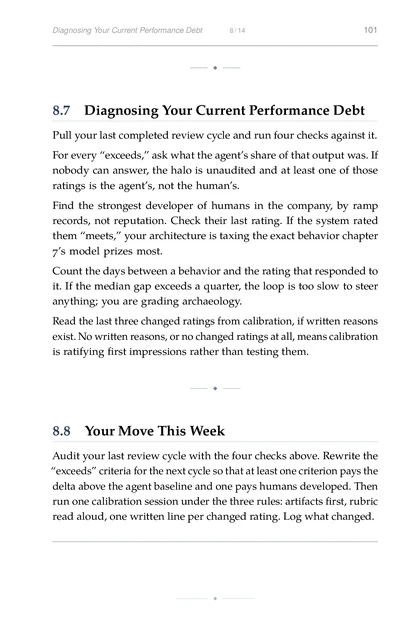 Find the strongest developer of humans in the company, by ramp
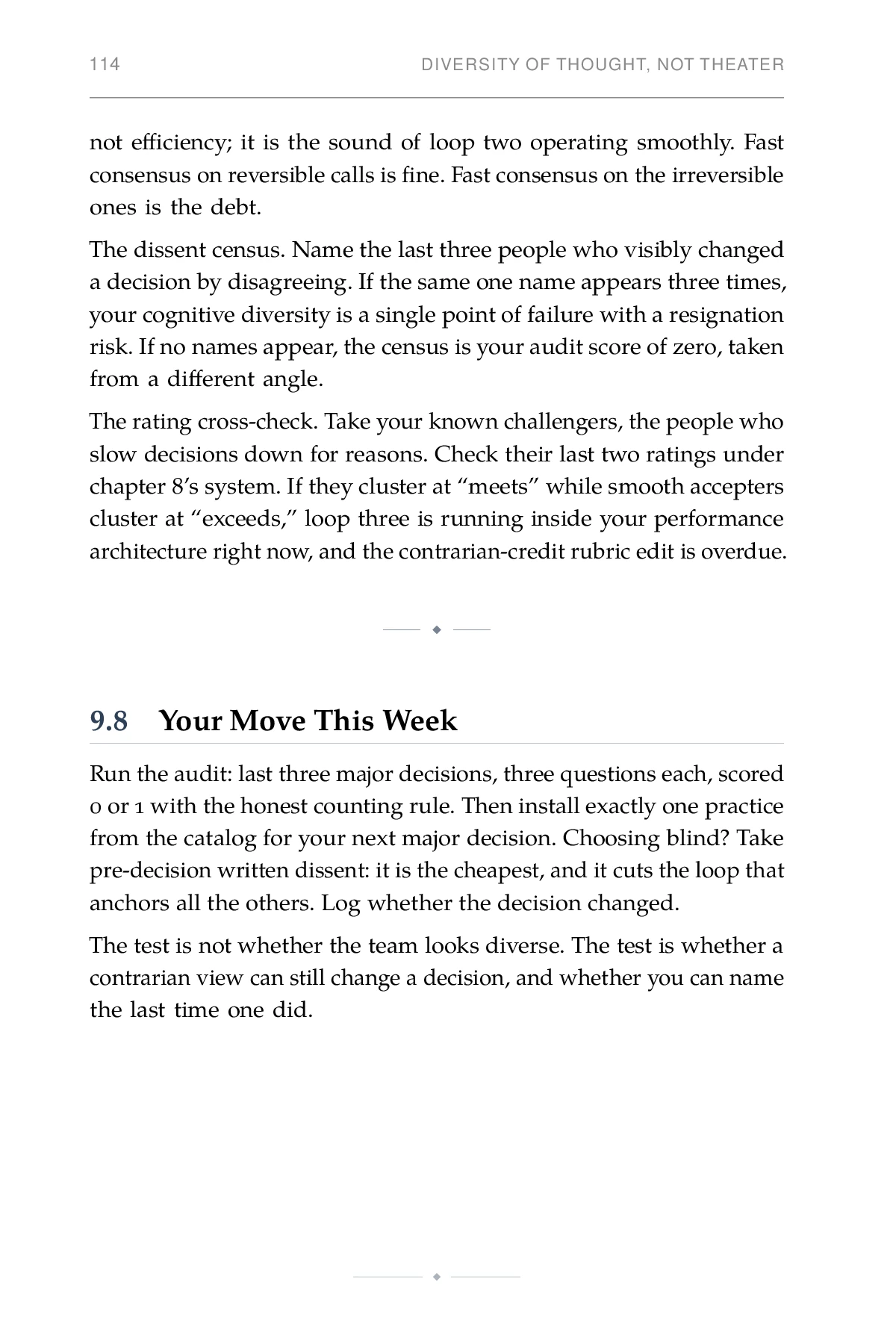
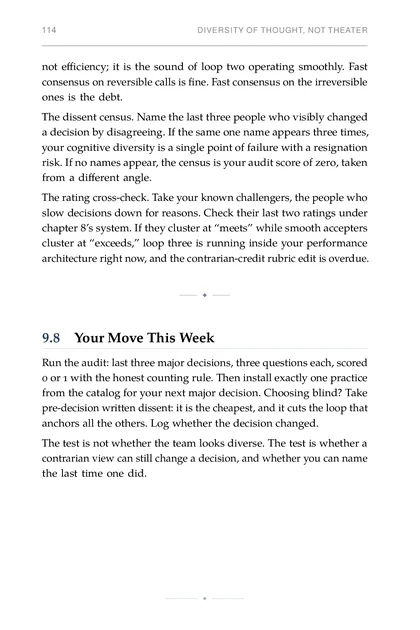 The dissent census. Name the last three people who visibly changed
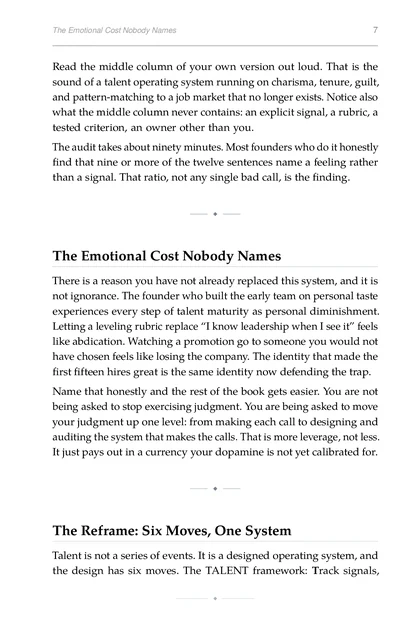 The Emotional Cost Nobody Names
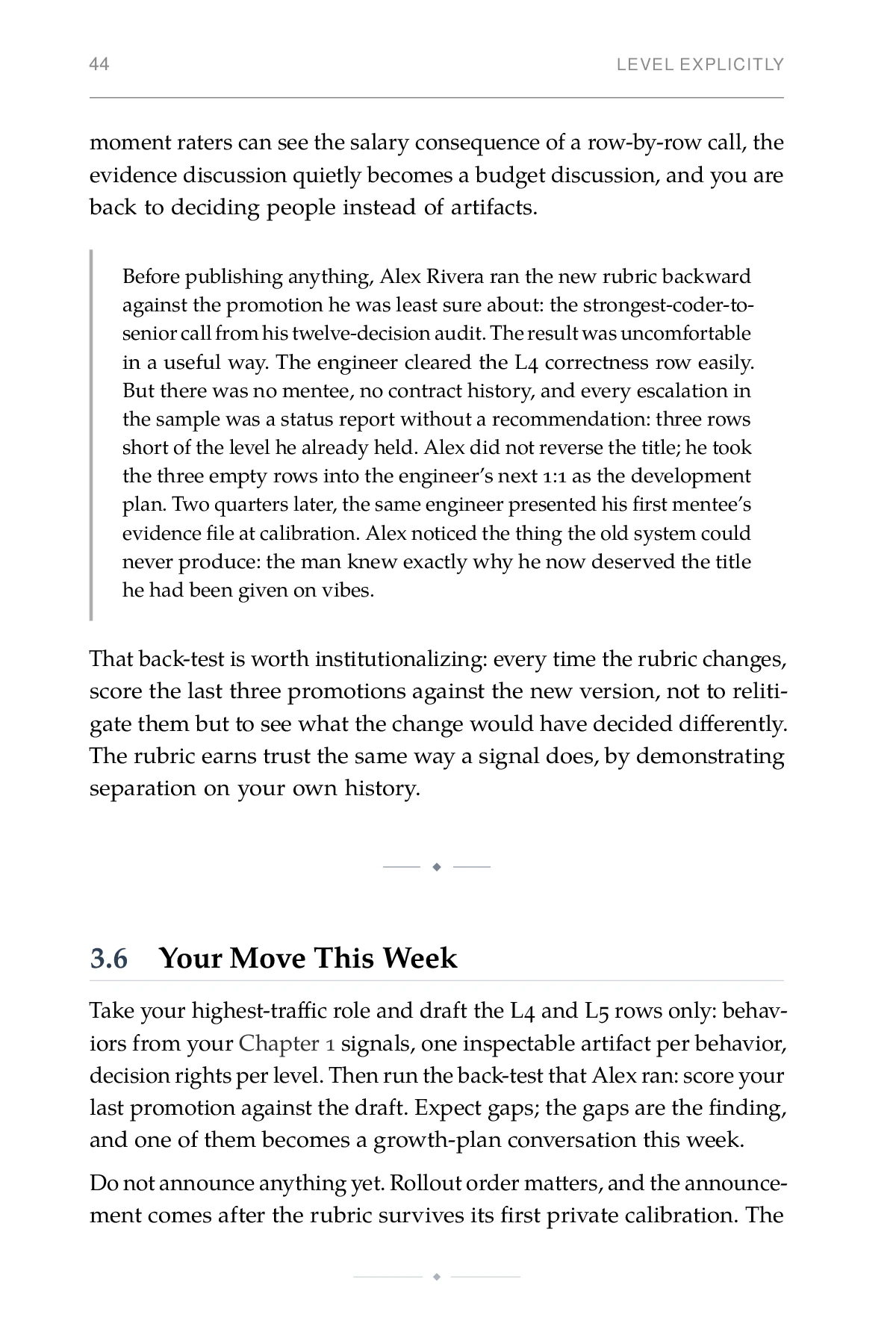
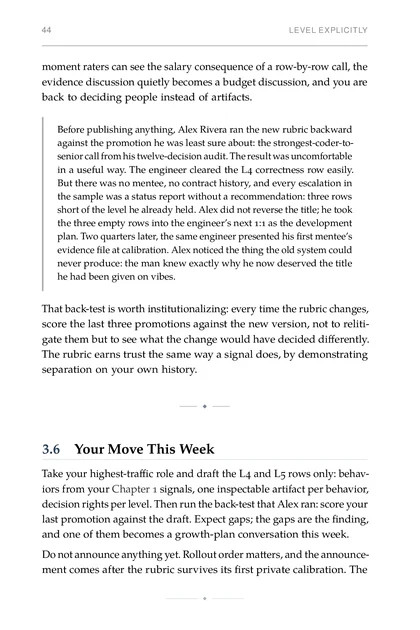 Before publishing anything, Alex Rivera ran the new rubric backward
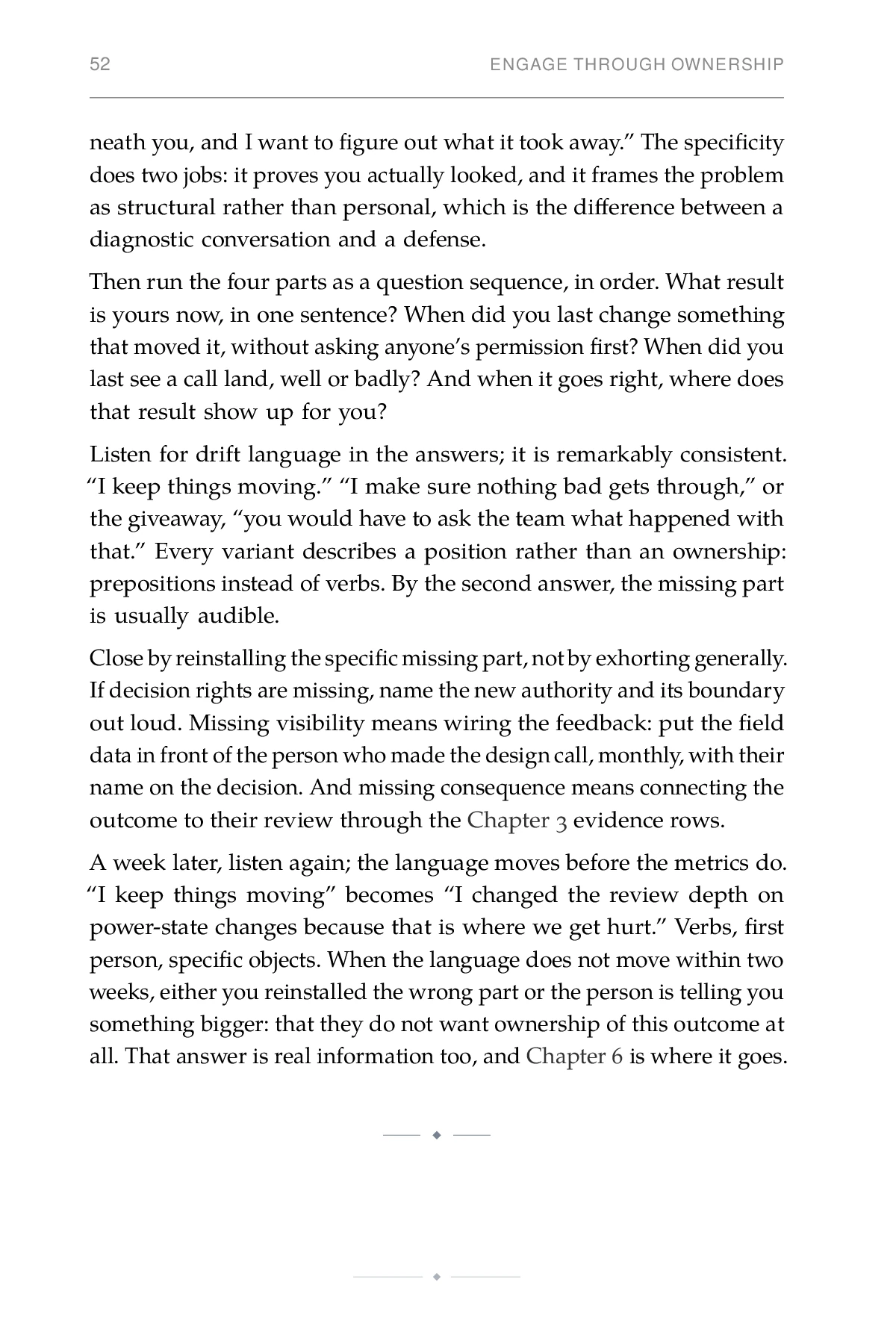
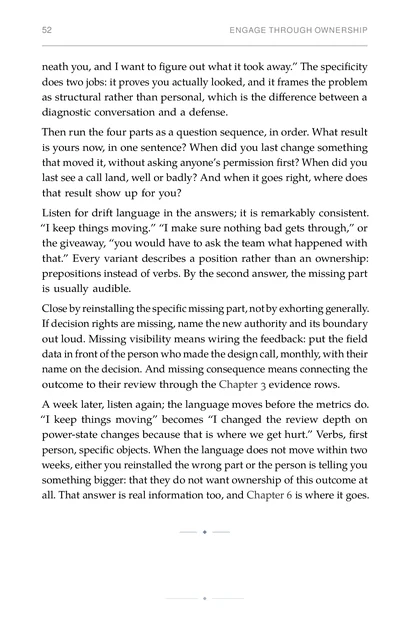 Then run the four parts as a question sequence, in order. What result
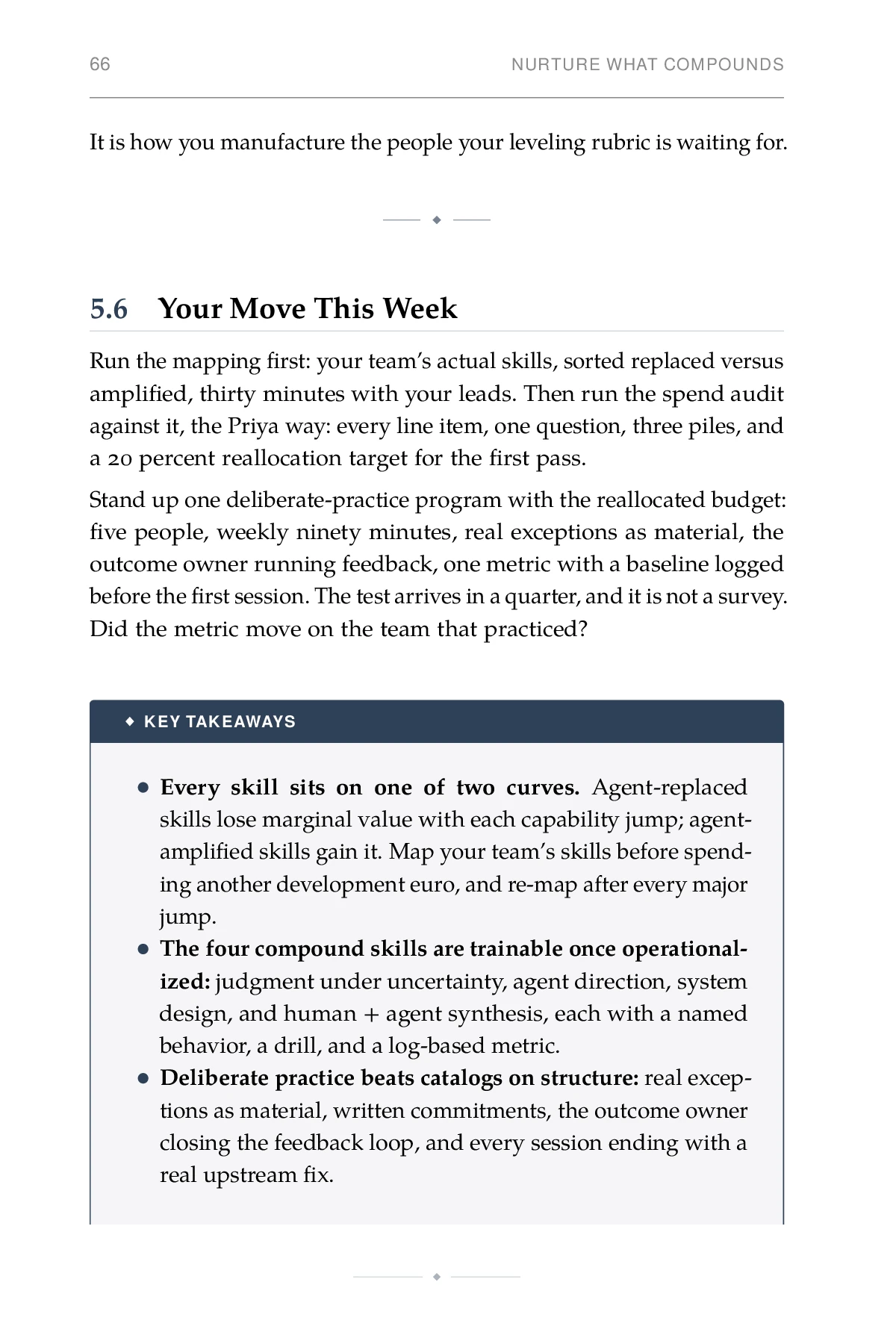
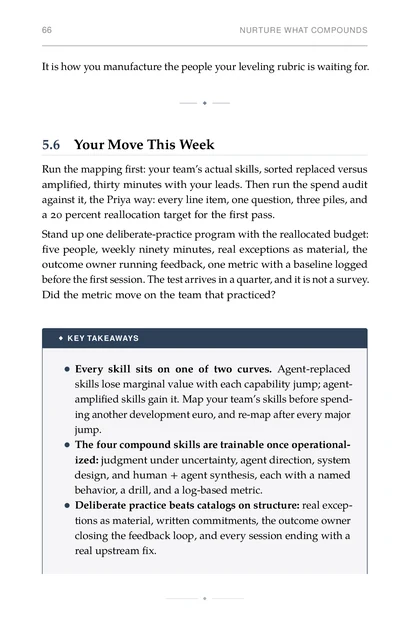 Did the metric move on the team that practiced?
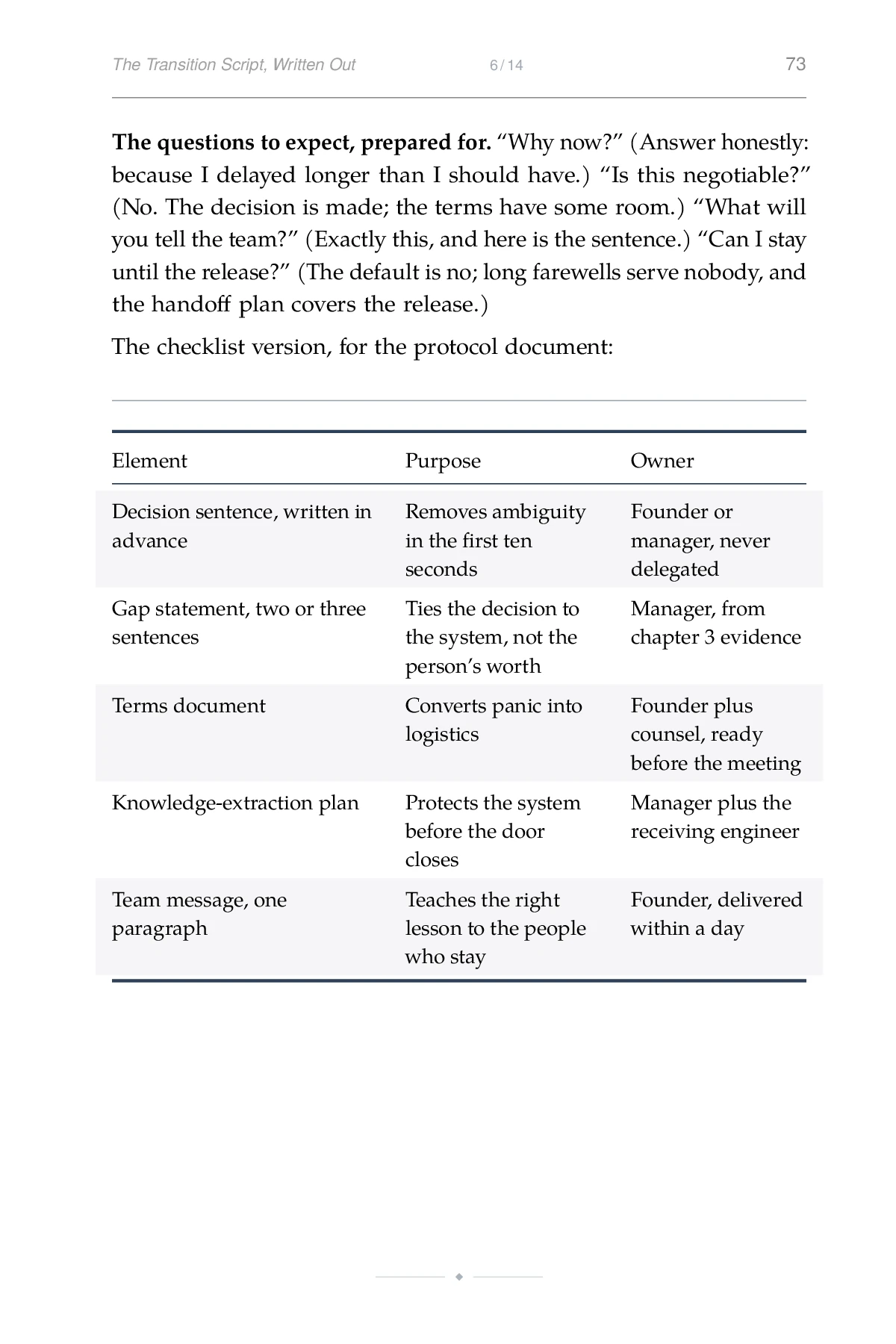
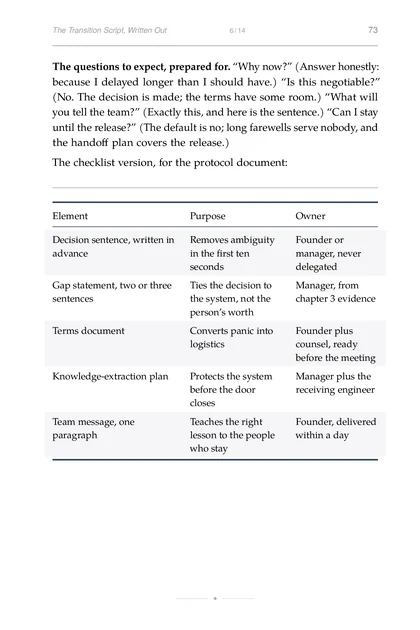 Element Purpose Owner
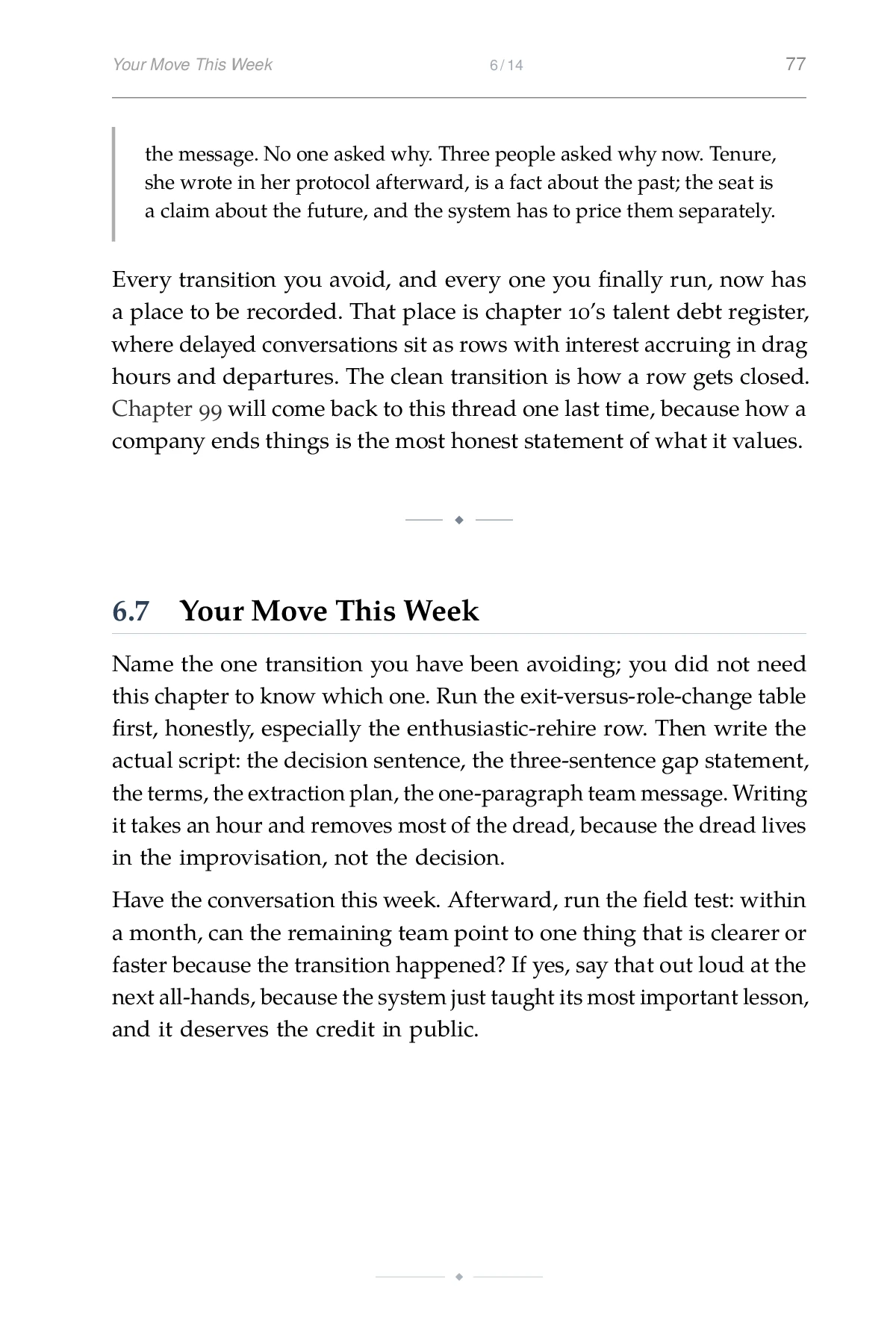
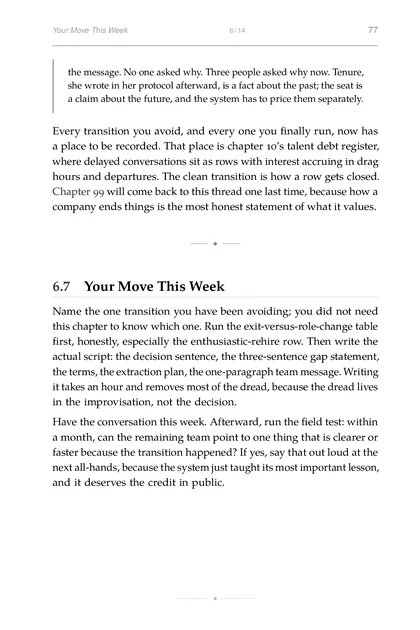 Your Move This Week 6 14 77
The contents
Chapter by chapter
Every chapter of The Talent System with its printed epigraph, what you can do afterwards, and the moment it is built for.
Introduction
The Heroic Talent Trap
Hiring and promotion by charisma, gut, and heroic founder judgment does not scale when agents change what "good" looks like, what skills compound, and what roles are durable. The first move is to see that the old talent operating system is now the liability.
What you can do afterwards
You will audit your last twelve talent decisions, name the single heroic pattern creating the most drag, and see the six TALENT moves that replace it.
Use this chapter when
You still feel like "I know good people when I see them" and the team is spending more time managing around talent decisions than shipping.
Chapter 1
Track Signals, Not Vibes
"Culture fit" and gut feel are not signals; explicit, measurable, context-specific signals that predict success in an agent-augmented reality are required. Vibes are the fastest way to politics and regret.
What you can do afterwards
You will build a signal taxonomy for your team, write three observable signals for your highest-volume role using the three-part template, and back-test them against your last six people.
Use this chapter when
You are still hiring or promoting on "I know good when I see it" and the outcomes are inconsistent or political.
Chapter 2
Attract the Right Humans
Job descriptions written for pre-agent roles attract the wrong humans; sourcing, selection, and offer design must be rebuilt around the signals that matter now. The humans who can evaluate and direct agents are not the ones who reply to the old ads.
What you can do afterwards
You will rewrite one job description from your chapter 1 signals, and design a rubric-scored work sample that tests agent judgment. Before opening the role at all, you will apply the hire-versus-redesign decision rule.
Use this chapter when
Your open roles are attracting excellent pre-agent talent who then struggle or leave when the actual work involves agents.
Chapter 3
Level Explicitly
Ambiguous levels and promotion criteria are the fastest way to politics, resentment, and loss of high performers; explicit, observable leveling is required when agents change what "senior" means. The ladder must be legible or it becomes a political game.
What you can do afterwards
You will build a worked L3-L6 rubric for one role with behaviors, evidence, and decision rights per level, install a promotion case protocol around it, and roll both out without demoting anyone.
Use this chapter when
Promotions feel political, high performers are leaving because they cannot see the path, or the same title means three different things to three different people.
Chapter 4
Engage Through Ownership
Perks, ping-pong, and "we're a family" are theater; engagement comes from visible ownership of outcomes that matter and the ability to see the impact of your judgment. The humans who feel they own something real do not need to be entertained.
What you can do afterwards
You will decompose ownership into its four load-bearing parts, build an ownership map for your top five humans, and run one scripted ownership conversation with someone who is drifting.
Use this chapter when
Survey scores are high but the quality of judgment work is dropping, or your best humans now spend their days reviewing agent fragments instead of the work that made them sharp.
Chapter 5
Nurture What Compounds
Training the old skills while the job changes is the fastest way to create expensive, frustrated humans; nurture must target judgment, directed capacity, and agent collaboration or the investment is wasted. The skills that get better with agents are the ones worth investing in.
What you can do afterwards
You will map your team's skills into agent-replaced versus agent-amplified, and operationalize the four compound skills into drills and metrics. Then you will reallocate 20% of your training spend into one deliberate-practice program this quarter.
Use this chapter when
Your training budget is still buying the pre-agent leadership curriculum while the actual work has changed underneath it.
Chapter 6
Transition Cleanly
Sentimentality, guilt, and heroic retention efforts turn necessary transitions into slow poison; clean, designed exits and role changes are required for the talent system to stay healthy. The long goodbye is the most expensive decision you make.
What you can do afterwards
You will run the exit-versus-role-change decision, write the actual transition script with the knowledge-extraction plan, and have the conversation you have been avoiding this week.
Use this chapter when
You have a human who is no longer growing, is blocking others, or is in the wrong seat, and the conversation has been delayed for months.
Chapter 7
The Agent-Augmented Talent Model
The pre-agent mental model of roles, seniority, and potential is now a liability; the talent system must be rebuilt around the human + agent capability unit or every career conversation will be misaligned. The unit is no longer the individual. It is the human who directs the agent and develops the humans who direct the agent.
What you can do afterwards
You will build the agent-augmented role map for your top three roles: what each human + agent capability unit owns, what "senior" and "staff" mean when agents do 60% of the execution, and which titles lag the work.
Use this chapter when
Your org chart and your reality are two different things; titles no longer match contribution, and the high-potentials are confused about what "career" means here.
Chapter 8
Performance Architecture
Annual theater and "360 feedback" that no one reads are not performance architecture; reviews, calibration, and feedback that actually change what humans do with agents are required. The architecture must reward the behavior the new model requires.
What you can do afterwards
You will audit your last review cycle, rewrite the "exceeds" criteria for the next cycle, and run one calibration session with artifacts on the table instead of slide decks.
Use this chapter when
Your reviews still reward "individual impact" while the actual value is now human + agent output and the development of humans who direct agents.
Chapter 9
Diversity of Thought, Not Theater
Surface diversity metrics are easy to game; cognitive diversity that actually changes decisions and survives agent homogeneity is the only kind that compounds. Agents trained on the same data make teams think more alike even when the humans look different.
What you can do afterwards
You will run the cognitive diversity audit on your last three major decisions, score each against three questions, and install one practice that forces a contrarian view into the room before the next decision.
Use this chapter when
Your diversity numbers look excellent but every major decision is unanimous within 20 minutes and the agent outputs are being accepted without challenge.
Chapter 10
Talent Debt and Technical Debt
Bad talent decisions create drag that compounds faster than technical debt and is harder to see; a talent debt register is required to make the cost visible before it becomes existential. The invisible tax is the one that bankrupts the system.
What you can do afterwards
You will build a talent debt register with your five worst open entries, quantify each one's drag in hours, blocked people, and exits, and pick the payoff move for the most expensive row.
Use this chapter when
Mis-hires or bad promotions are still on the payroll, the cost is invisible in the P&L, but the team is slower, the high-potentials are leaving, and founder time goes to managing around a person.
Chapter 11
Your Calendar as Talent Signal
The founder who says "talent is our most important asset" while spending 3% of their calendar on it is not sending a mixed message; they are sending a clear one. Time is the only truth the organization believes.
What you can do afterwards
You will audit your last 90 days of calendar with a five-category rubric and an honest counting rule, then redesign the next 30 days to hit at least 15% talent signal, protected like board prep.
Use this chapter when
You talk about talent as the strategy but your calendar shows that product, sales, and fundraising are what you actually spend time on.
Chapter 12
Building Your Talent Protocol
Every talent decision feels new and political until you have a living protocol that encodes signals, attraction, leveling, engagement, nurture, transition, the agent-augmented model, performance, diversity, debt, and founder time. The protocol is the team's talent memory and immune system.
What you can do afterwards
You will assemble version 1.0 of your TALENT protocol from the artifacts the earlier chapters built, one page per section, install the three rituals on the calendar, and schedule the handoff test that proves the document works.
Use this chapter when
Every talent decision still requires the founder to reinvent the map, and the only person who can explain the pattern is the founder.
Conclusion
The Machine That Makes the Right People Better
A talent system is the highest-yield work a founder does because it is the machine that makes every other system better over time; the protocol is what makes the machine run without you. The long game is the organization that compounds capability instead of regret.
What you can do afterwards
You will write your personal machine commitment (one sentence: "I will treat the TALENT protocol as the default for X decisions") and share it with your leadership team.
Use this chapter when
You have finished the book and are about to make or delegate the next talent decision.
Who it is for
Who this book was written for
This is not a faster way to fill one seat. It is a system that compounds: every signal you define makes the next decision better, and you stop being the sole quality control for who is good. TALENT is a heuristic to test on your team, not a proven instrument.
Start here: audit your last twelve talent decisions, name the pattern creating the most drag, and define the signal that would have changed it. If you refuse to let speed decide who is good, this is your operating system.
The reader it was written for
Founders and heads of people/ops at 20–150 person companies that have begun using agents in workflows and are experiencing the mismatch between old talent practices and new reality. They hire "good people" but the system does not compound. Psychographics:
Probably not for you if
- Large corporate HR with mature systems.
- Pre-agent or <15 person teams.
- Readers seeking only interview scripts.
Editions
Editions and specifications
| Edition | Formats | Chapters | Pages | Reading time | ISBN (paperback) |
|---|---|---|---|---|---|
| English The Talent System | In production | 14 | 200 | ± 3 hours | — |
| Dutch Het talentsysteem | In production | 14 | 88 | ± 2 hours | — |
Both editions are written natively. The Dutch text is not a machine translation of the English.
Frequently asked
What readers usually want to know
What is The Talent System about?
TALENT turns hiring, onboarding, learning, feedback, AI augmentation, and retention into a compounding system rather than episodic HR work. The subtitle is: Build a Talent Operating System That Compounds in the Agent Era.
Is there a Dutch edition?
Yes. The Dutch edition is Het talentsysteem, written as a native edition rather than a machine translation. It moves through the same production line.
How long is The Talent System?
This edition runs 14 chapters, 200 pages in print and roughly 3 hours of reading.
Who is The Talent System for?
Start here: audit your last twelve talent decisions, name the pattern creating the most drag, and define the signal that would have changed it. If you refuse to let speed decide who is good, this is your operating system.
The production system
How this book was made
Every title moves through the same gated production line: sourced research, a claim-level evidence ledger, structural review, fact-checking, red-team critique, and a bilingual final edit. AI agents do specialist work inside those gates; judgment, voice, and accountability stay human.
- Claims enter an evidence ledger with a source and a confidence grade before they reach the page
- English and Dutch are two native editions, not a translation of one another
- Every chapter clears readability, rhythm, and style gates before it is typeset
The series
More in this theme


