Available now · worldwide on Amazon
The Model Portfolio
How to Route, Mix, and Govern LLMs Like a Strategic Asset Allocator
Stop picking models off the leaderboard.
ROUTE turns model choice into portfolio management across cost, latency, privacy, reliability, capability, and governance.
Get the book
Reading from another country?Pick your own Amazon marketplace — same edition, your store.
Amazon links may include affiliate tags. That does not change the price you pay. Bol.com listings are third-party.
English & Dutch editions · Kindle, Paperback, Hardcover · free on Kindle Unlimited · Nederlandse editie →
- pages
- 490
- chapters
- 13
- hours of reading
- ± 8
- editions
- EN · NL


The editions
Choose your format
Same book, your format. You buy on Amazon, not on this site.
-
Kindle
Read now. Kindle Unlimited members get it at no extra cost.
Buy on Amazon -
Paperback
The working copy. Mark it up. Take it into the meeting.
Buy on Amazon -
Hardcover
The shelf edition. Dark full-art jacket, built to stay in the room.
Buy on Amazon


Available now
How to Route, Mix, and Govern LLMs Like a Strategic Asset Allocator
A new flagship ships, the benchmark chart looks decisive, and you migrate everything to it by Friday. Then latency creeps, the bill climbs on calls that never needed the smartest model, and a capability you relied on regresses in an update you cannot refuse. You run production on one vendor's roadmap and call it simplicity. It is exposure.
The standard move: pick the best model and standardize. That fails: there is no best model, only one best for a task, a budget, and a failure tolerance, and they stop agreeing once traffic is real.
The Model Portfolio treats your models as an investor treats capital: assets allocated on purpose, not one bet you keep doubling. It introduces ROUTE (Register, Objective typing, Utilize policy, Track, Evolve): five practices that turn a stack of API keys into a managed system. When the leaderboard turns over, your architecture holds.
Use the book to:
What you can do
What this book puts in your hands
- Register every model, with mandate, cost class, privacy class, and retirement date, so nothing runs unowned.
- Type each task by what it demands (reasoning depth, output format, latency, quality threshold, privacy class), not the loudest launch.
- Write a routing policy that sends work to the cheapest model clearing the bar, with cascades that escalate only when work earns it and fallbacks that hold when one fails.
- Track cost, latency, and quality per route, so a waste pattern surfaces before the invoice.
- Evolve the mix on a quarterly cadence, with promote, demote, and retire criteria, so a deprecation notice is a scheduled release, not a scramble.
The framework
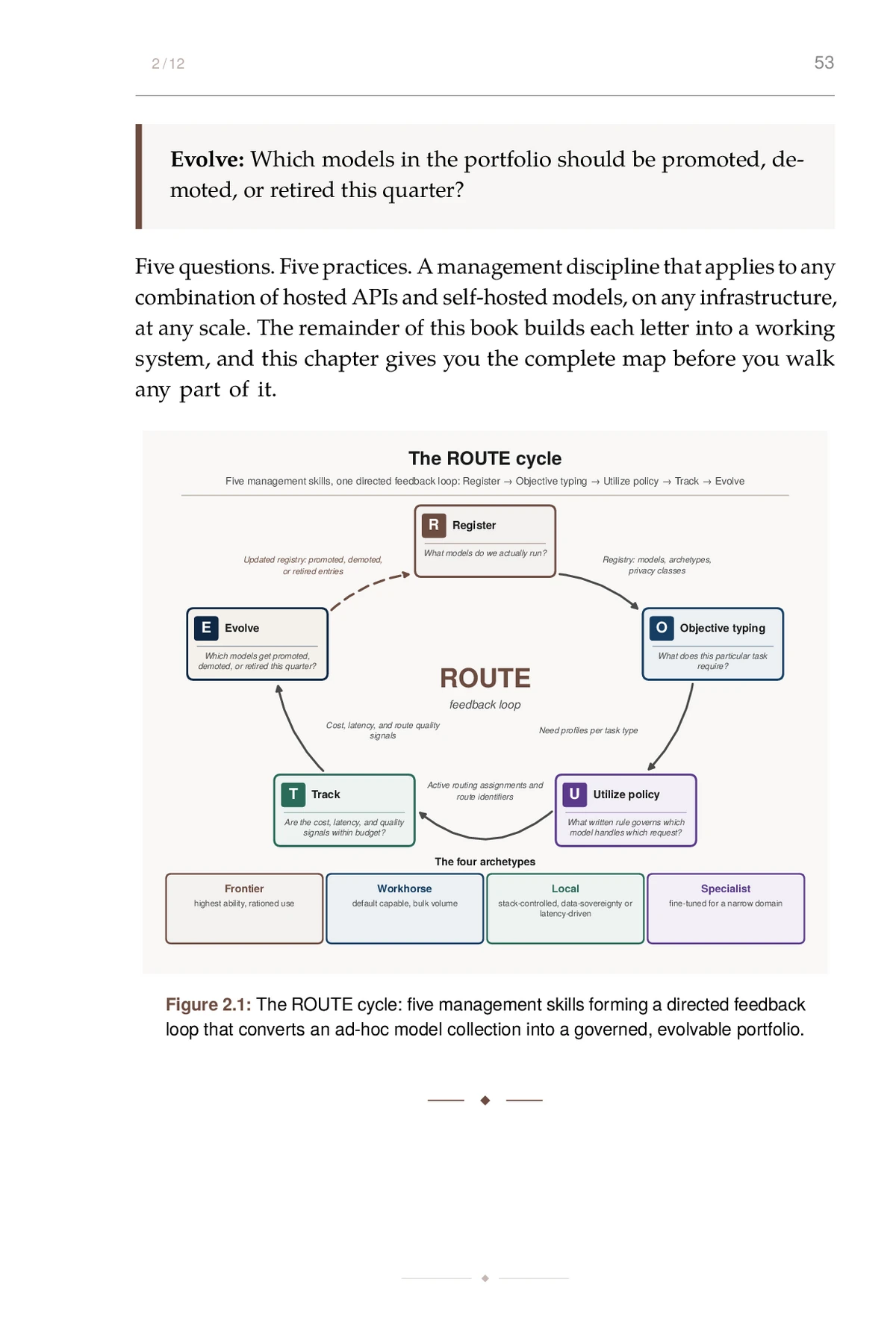
ROUTE: the system behind the book
govern a living mix of models, not one pick
-
Register
Catalog every model with mandate, cost class, privacy class, and retirement status so nothing runs unowned.
-
Objective typing
Name what the task requires (reasoning depth, format, latency, quality, privacy) before a model is chosen.
-
Utilize policy
Write the routing rules, cascades, and fallbacks that decide which model handles which request.
-
Track
Measure cost, latency, and quality per route so a waste pattern surfaces before the invoice.
-
Evolve
Promote, demote, and retire on a cadence so a deprecation is a scheduled release, not a scramble.
From the book
The ROUTE cycle: five management skills forming a directed feedback
The Model Portfolio, printed page: The ROUTE cycle: five management skills forming a directed feedback
Inspect more pagesLook inside
Pages from the print edition.
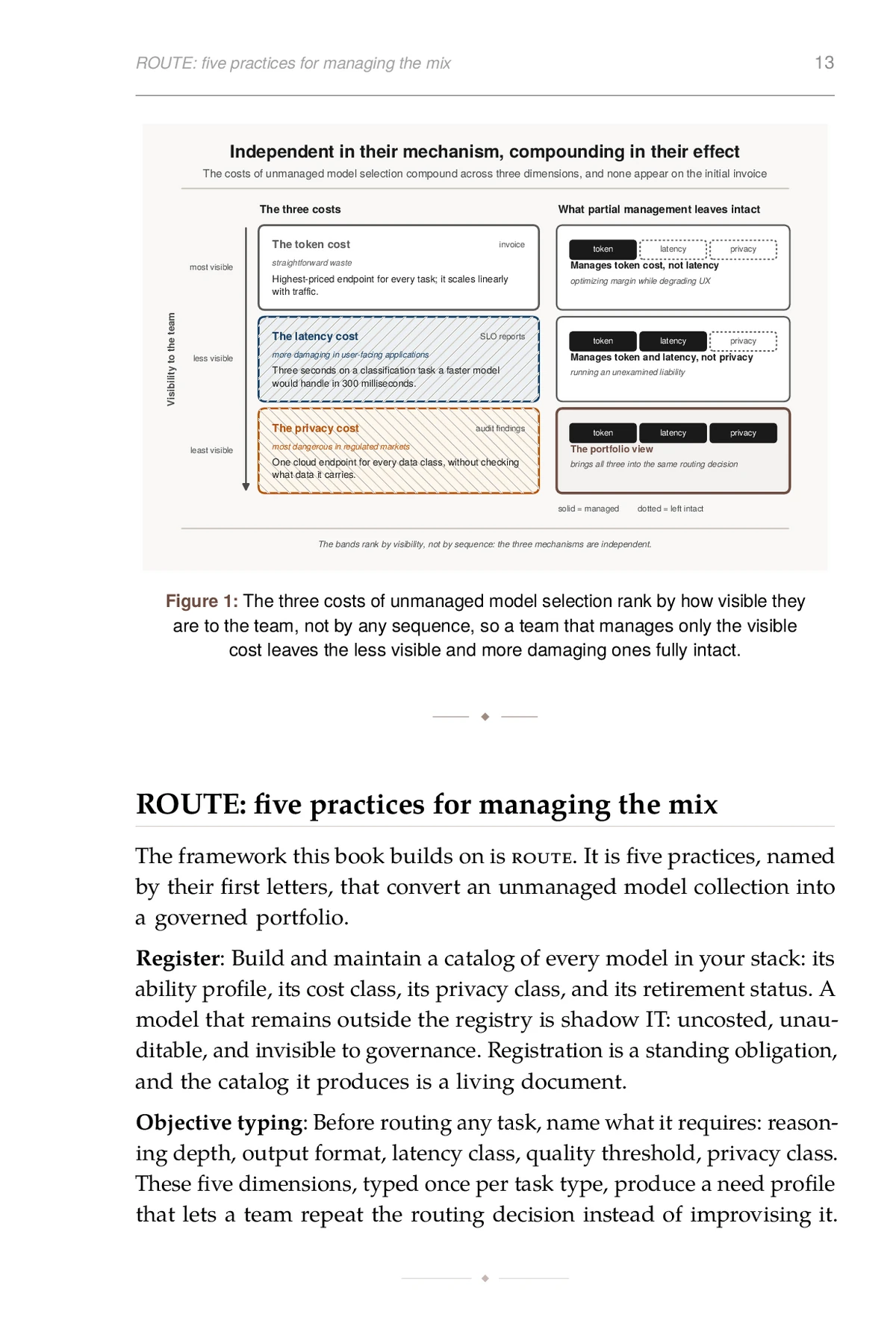
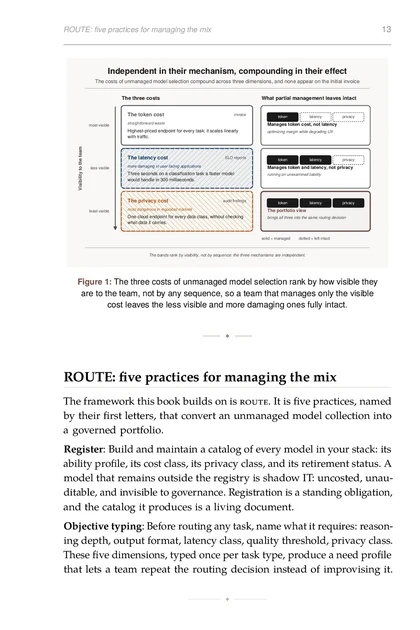 The three costs of unmanaged model selection rank by how visible they are to the team, not by any sequence, so a team that manages only the visible
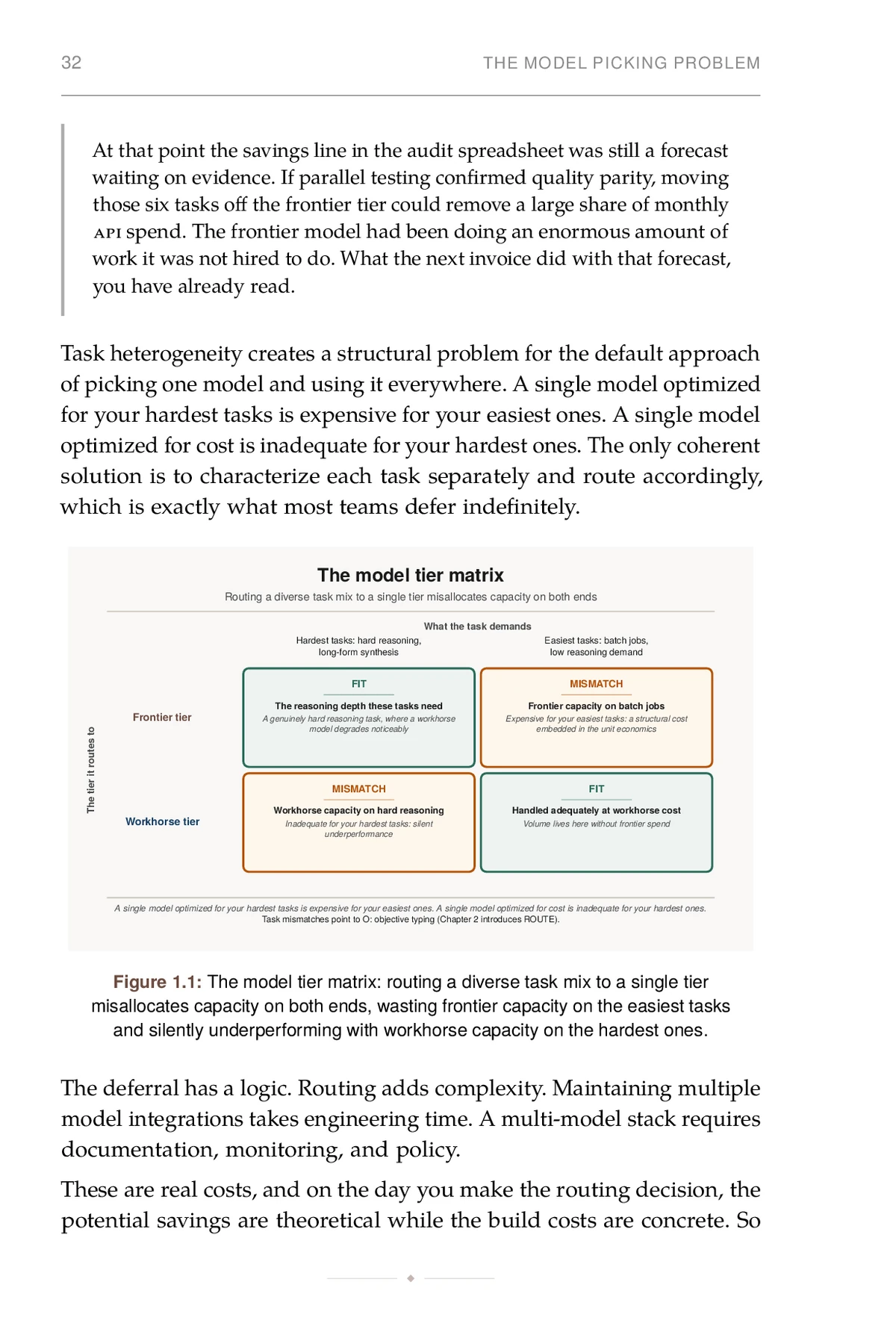
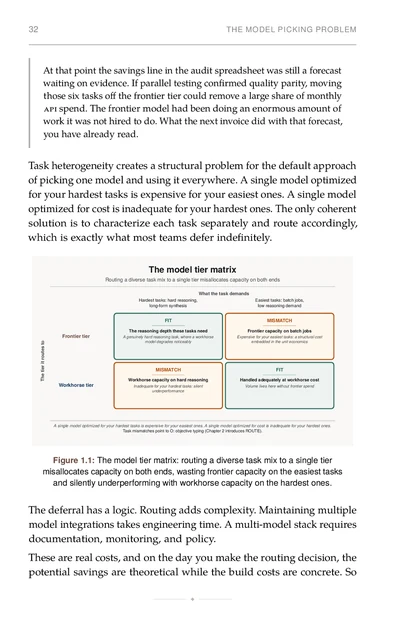 The model tier matrix: routing a diverse task mix to a single tier misallocates capacity on both ends, wasting frontier capacity on the easiest t…
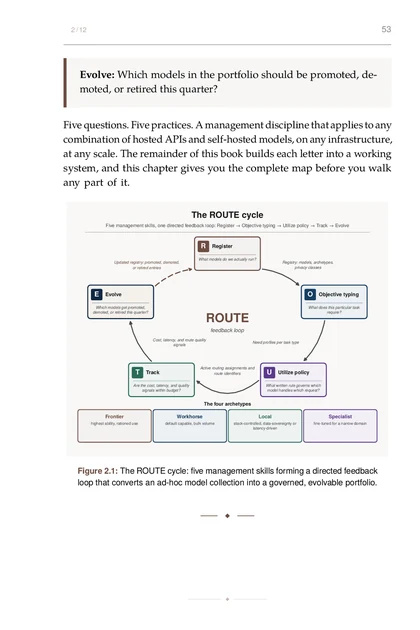 The ROUTE cycle: five management skills forming a directed feedback
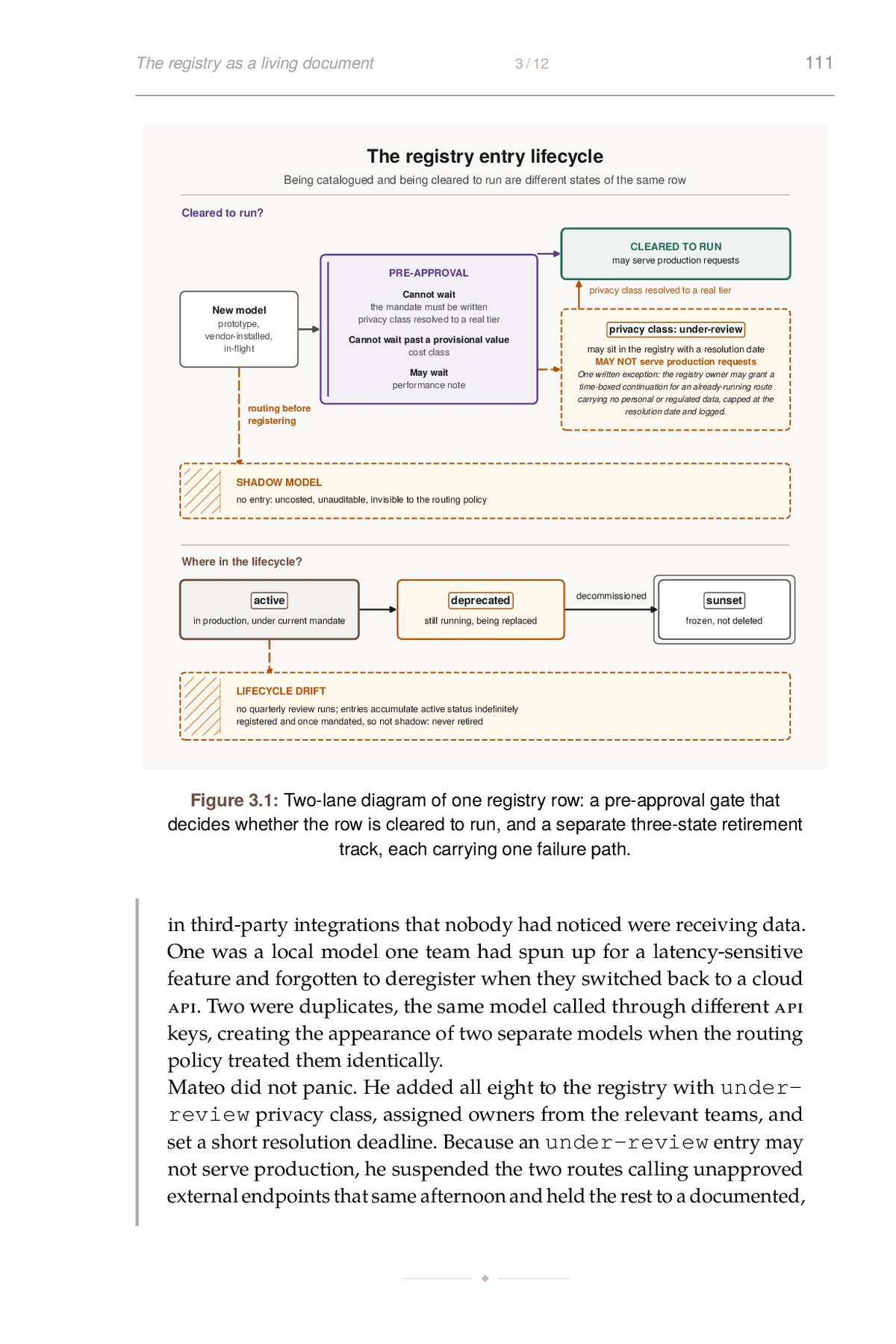
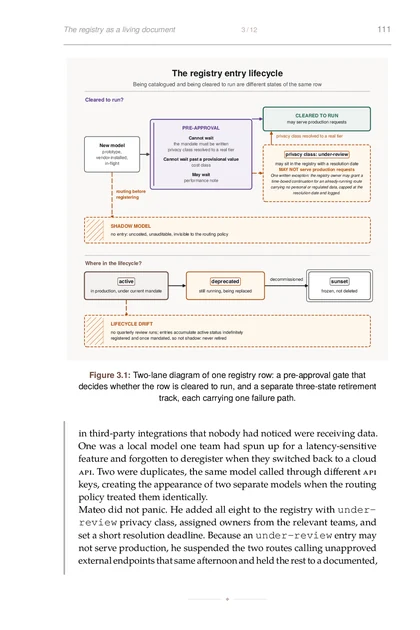 Two-lane diagram of one registry row: a pre-approval gate that decides whether the row is cleared to run, and a separate three-state retirement
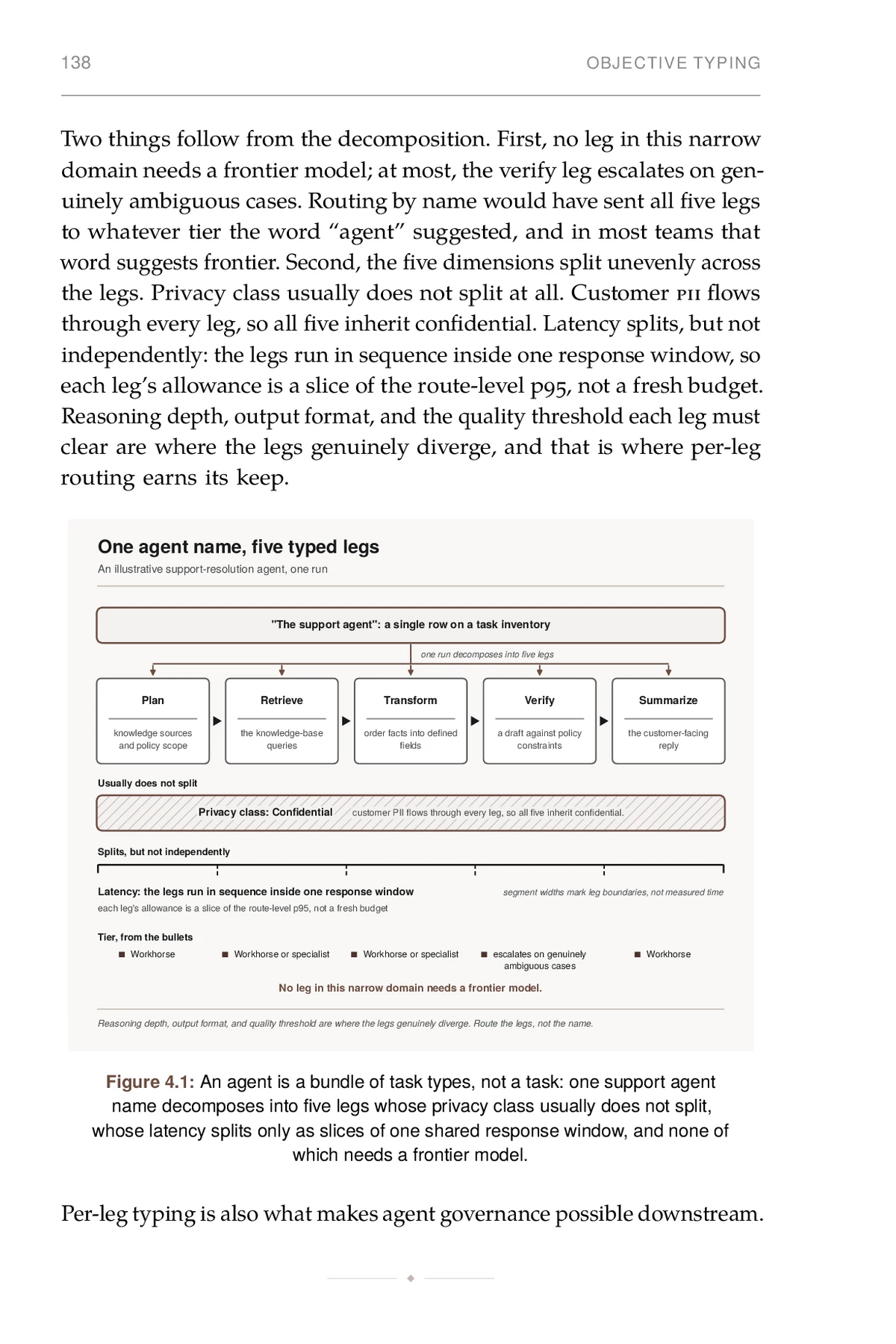
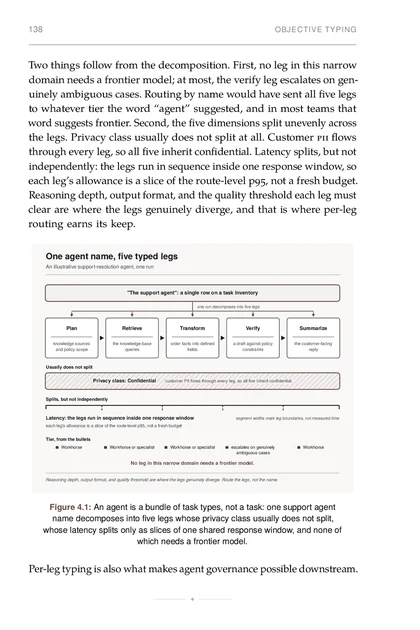 An agent is a bundle of task types, not a task: one support agent name decomposes into five legs whose privacy class usually does not split,
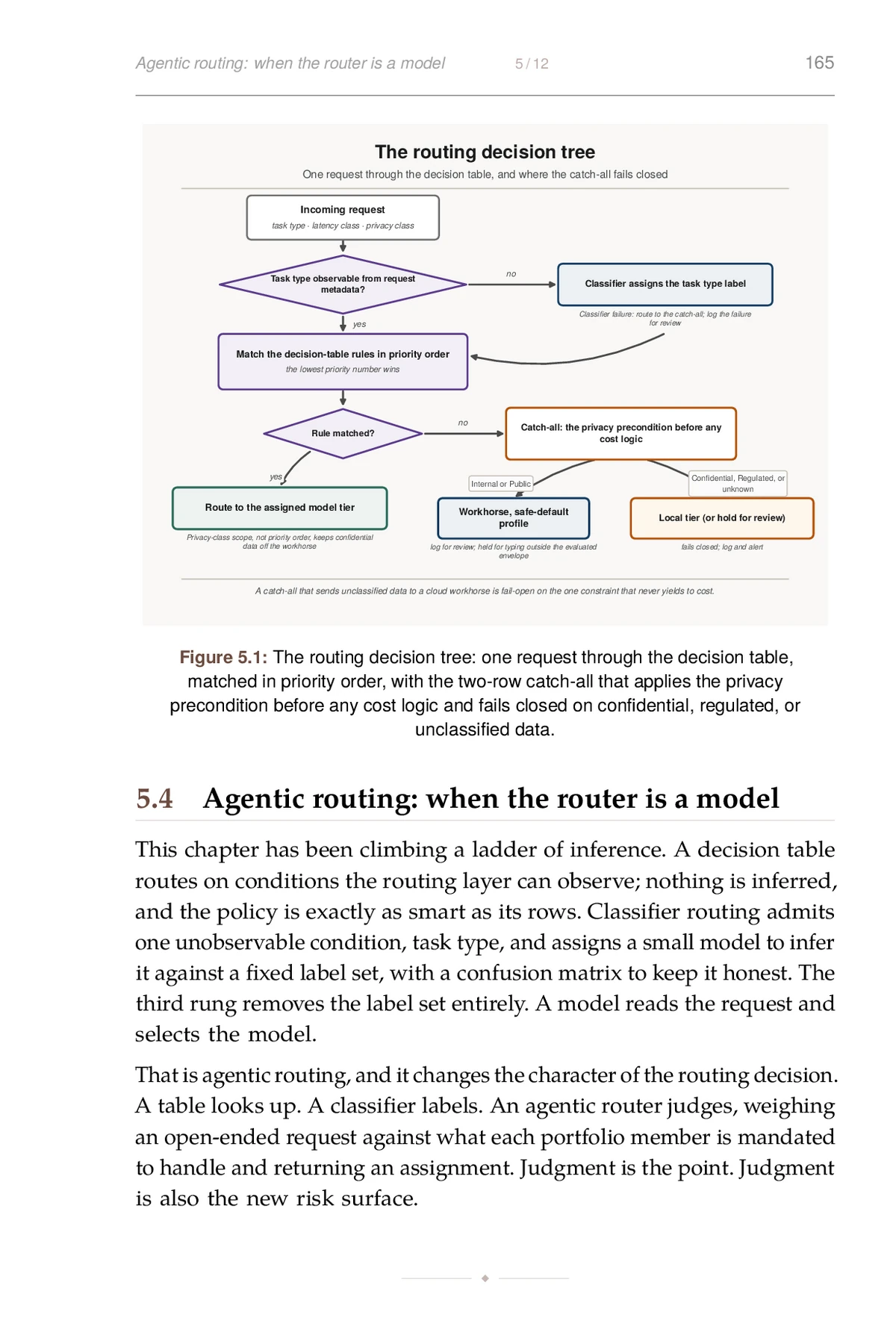
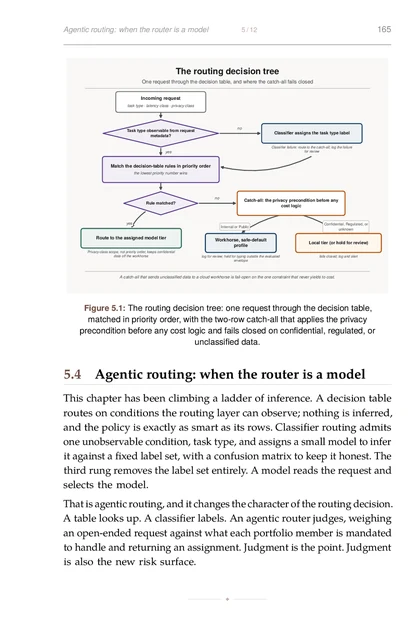 The routing decision tree: one request through the decision table, matched in priority order, with the two-row catch-all that applies the privacy
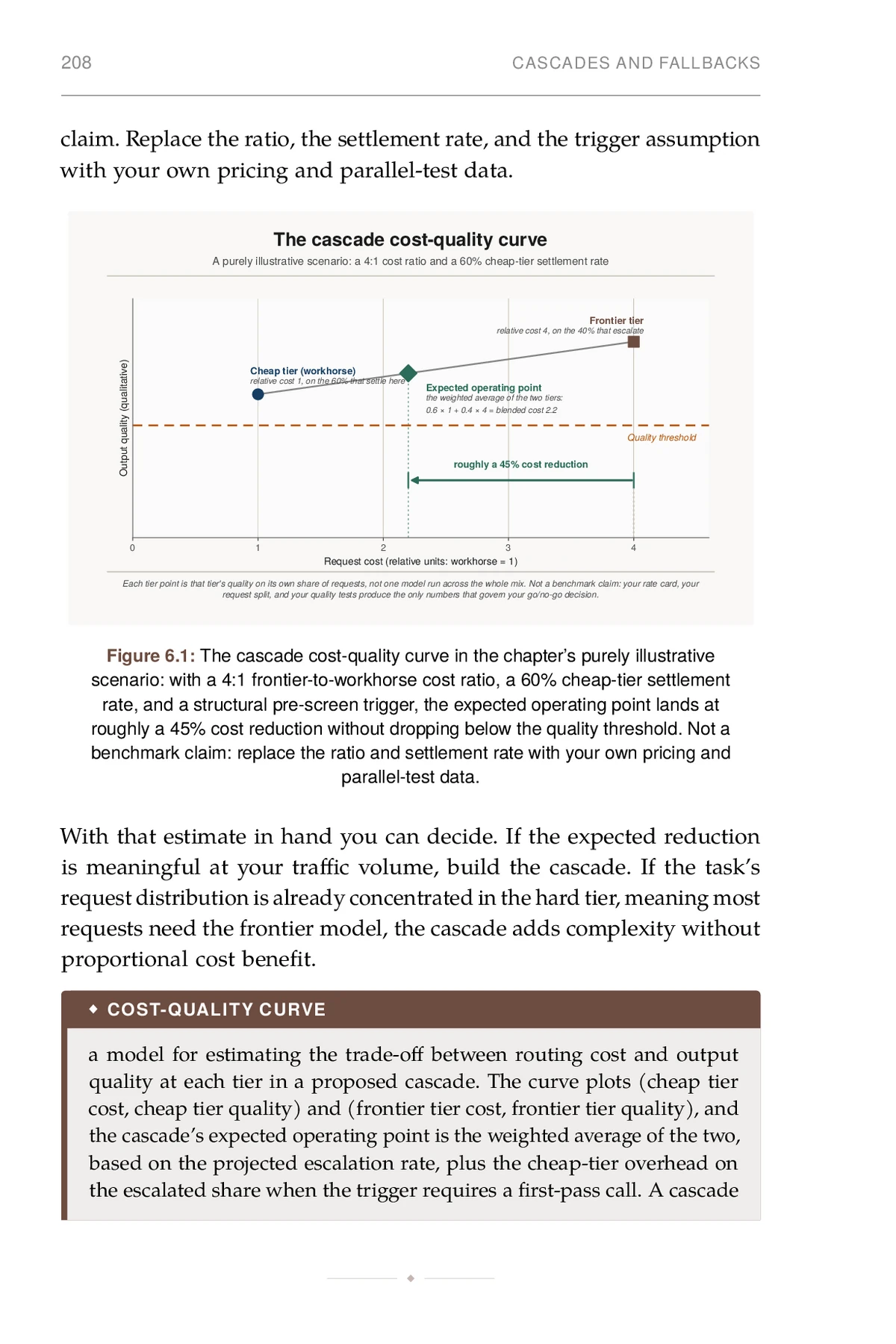
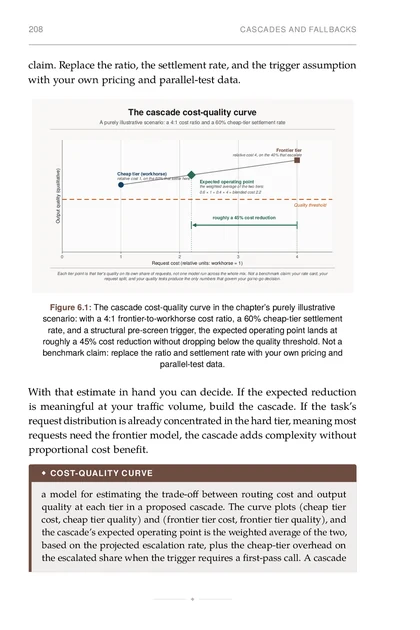 The cascade cost-quality curve in the chapter’s purely illustrative scenario: with a 4:1 frontier-to-workhorse cost ratio, a 60% cheap-tier settl…
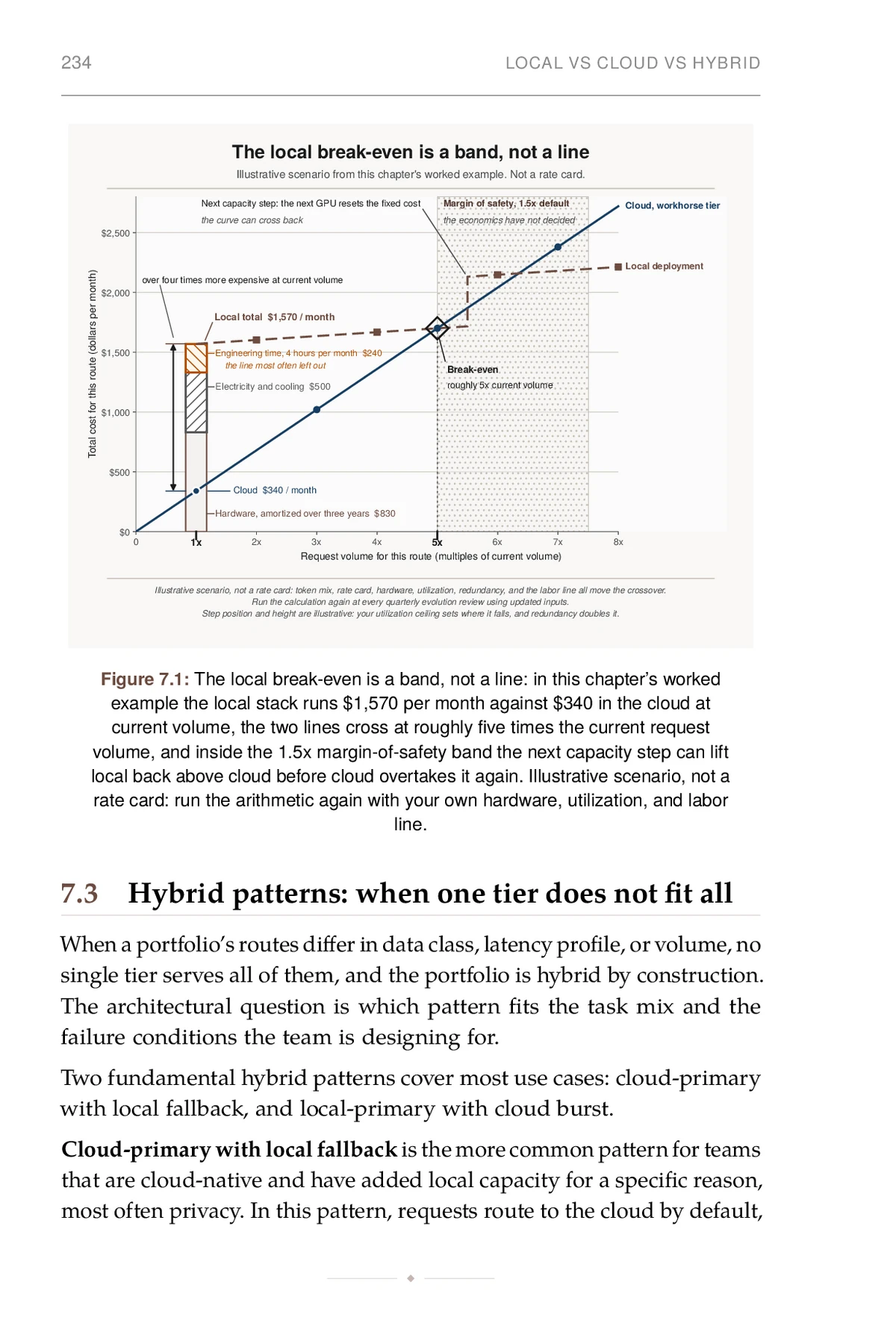
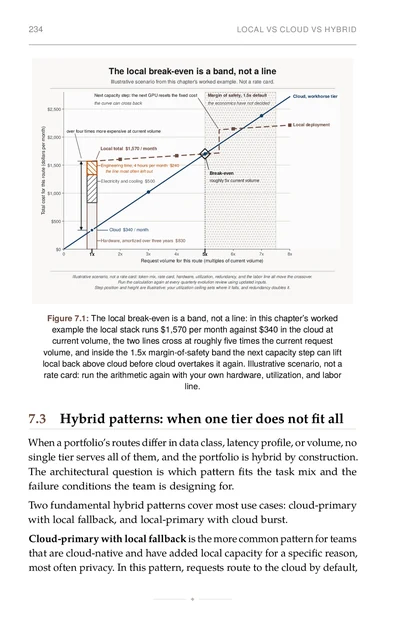 The local break-even is a band, not a line: in this chapter’s worked example the local stack runs $1,570 per month against $340 in the cloud at
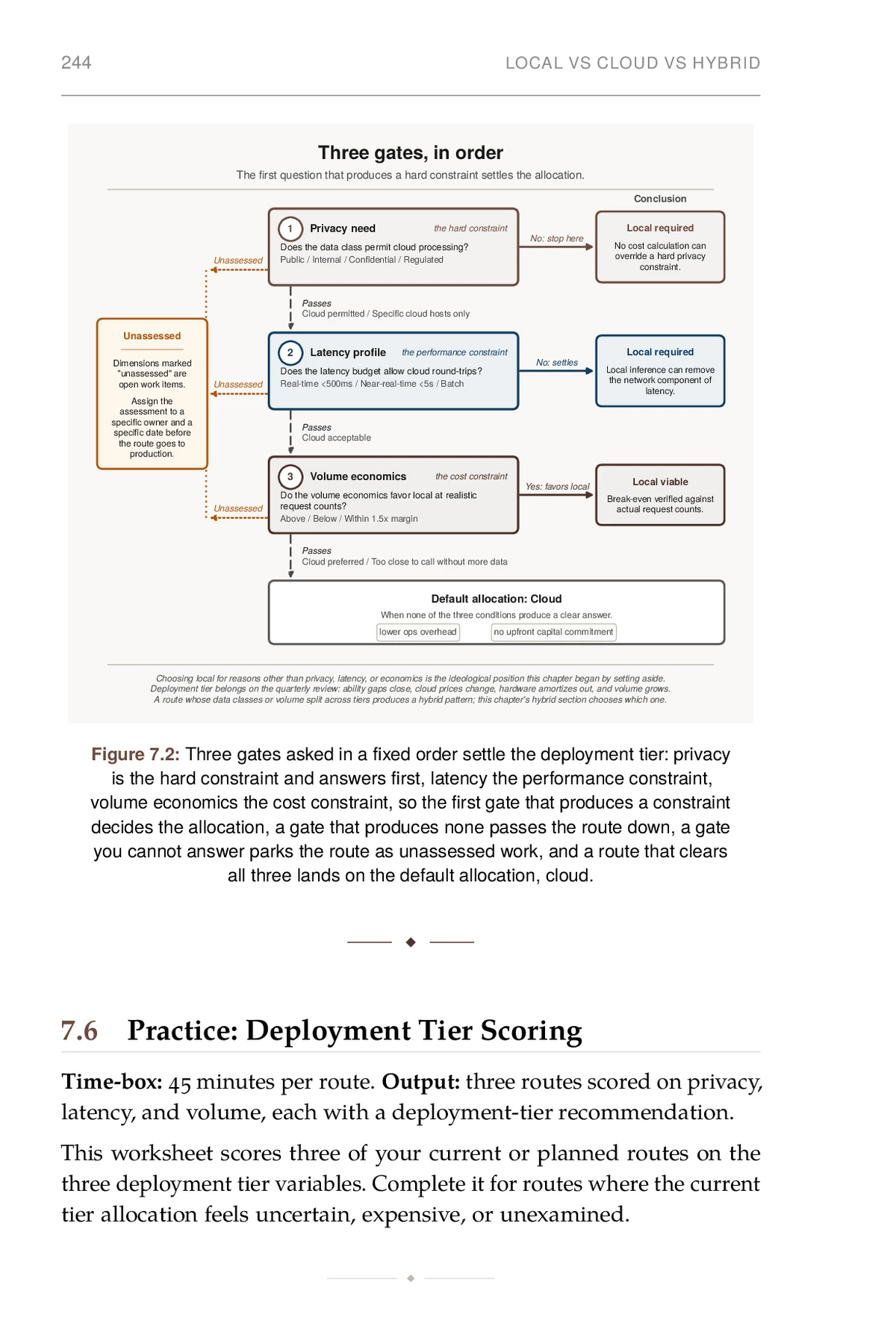
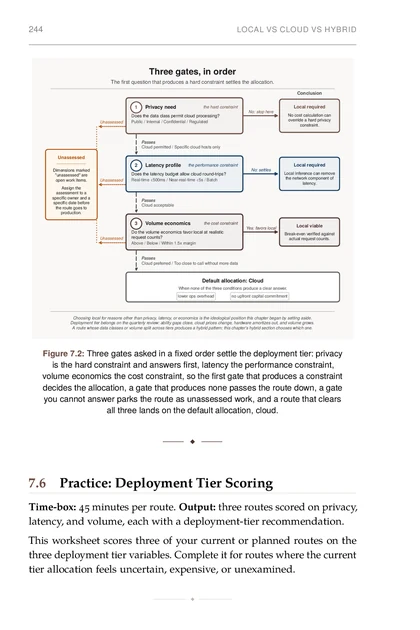 Three gates asked in a fixed order settle the deployment tier: privacy is the hard constraint and answers first, latency the performance constraint,
Purchase takes place on Amazon, not on this website.
Buy the paperback on AmazonFrom the book
Read a page
Introduction
Stop Worshipping the Leaderboard
The benchmark winner is always someone else's model on someone else's tasks, priced, measured, and celebrated in conditions that have nothing to do with your production environment.
What you can do afterwards
You will see that routing every request to the benchmark leader is a habit with compounding costs (money, latency, and data exposure) and that managing models as a portfolio makes all three visible, measurable, and manageable.
Use this chapter when
Your API bill just spiked without a corresponding spike in value, your team argues about model choices using Twitter consensus, or you cannot explain your current routing logic without saying "we just use the best one."
What you get
What you get
- The ROUTE protocol: govern a living mix of models, not one pick
- Manage by cost, latency, privacy and capability
- Route work to the right model on purpose
Who it's for
- Register every model with mandate, cost class, privacy class, and retirement status
- Type each task before a model is chosen
- Write routing policy, cascades, and fallbacks that can be tested
- Track cost, latency, and quality per route, not as one invoice total
- Evolve the mix on a cadence: promote, demote, retire
Who it's for
Who this book was written for
The method promises no savings from someone else's benchmark: cascade trade-offs are estimated from your own rate card, request split, and quality tests. Jurisdiction-specific legal interpretation stays outside the book's scope.
You finish with a model portfolio whose routes can be explained, tested, and changed.
If you run more than one model in production, something already routes the work. The only question is whether anyone chose it. The router is infrastructure; the routing policy is governance.
The reader it was written for
Founders and tech leads choosing among open, closed, local, and frontier models across an agent stack, tired of ad-hoc picks driven by a leaderboard screenshot.
Also a fit for
Operators who own the API bill and latency SLOs and need explicit trade-offs instead of “use the latest.”
What you will use it on
- Register every model with mandate, cost class, privacy class, and retirement status
- Type each task before a model is chosen
- Write routing policy, cascades, and fallbacks that can be tested
- Track cost, latency, and quality per route, not as one invoice total
- Evolve the mix on a cadence: promote, demote, retire
Probably not for you if
- Readers training models from scratch (see ML for Agent Builders)
- Readers implementing retrieval pipelines (see The RAG Engineer)
- Pure ML governance without a routing implementation (see ML for Strategic Founders)
- Teams running a single model with no second path and no bill to inspect
The contents
Chapter by chapter
Every chapter of The Model Portfolio with its printed epigraph, what you can do afterwards, and the moment it is built for.
Introduction
Stop Worshipping the Leaderboard
The benchmark winner is always someone else's model on someone else's tasks, priced, measured, and celebrated in conditions that have nothing to do with your production environment.
What you can do afterwards
You will see that routing every request to the benchmark leader is a habit with compounding costs (money, latency, and data exposure) and that managing models as a portfolio makes all three visible, measurable, and manageable.
Use this chapter when
Your API bill just spiked without a corresponding spike in value, your team argues about model choices using Twitter consensus, or you cannot explain your current routing logic without saying "we just use the best one."
Chapter 1
The Model Picking Problem
You can find a model selection process by its artifacts: a Slack message, a benchmark screenshot, and a decision that took four minutes. The evidence that it needs review often appears much later.
What you can do afterwards
You will be able to name the four failure modes of unmanaged model selection and run a picking audit that exposes the implicit rules driving your current stack.
Use this chapter when
You are about to choose a model for a new use case, or you have inherited a stack and cannot explain why half the models in it were chosen.
Chapter 2
ROUTE Overview
Five skills. One feedback loop. Two teams can hold the same models and run one of them as a collection and the other as a portfolio, and the discipline they apply to those models is what separates them.
What you can do afterwards
You will hold the complete ROUTE framework in one mental model, understand how the five skills connect in a feedback loop, and be able to place every model in your current stack into one of four archetypes (frontier, workhorse, local, specialist), each with an explicit mandate.
Use this chapter when
You have accepted that leaderboard-driven routing is a habit your team fell into rather than a strategy anyone chose, and you are ready to replace it with a framework you can actually operate. Read the chapter as the architecture session that comes before the build begins.
Chapter 3
Register the Portfolio
The moment a model touches your stack without an entry in the registry, you have not added a capability: you have added a liability with no owner.
What you can do afterwards
You will build a model registry that is specific enough to use (not a spreadsheet graveyard) so that every model your team operates carries an explicit mandate, cost class, privacy class, and retirement status.
Use this chapter when
You cannot answer, without looking at code, which models your team is currently running, what data each one may touch, or who is responsible for retiring them when they age out.
Chapter 4
Objective Typing
A task you cannot describe cannot be routed. A task you describe badly will be routed badly. The discipline of typing always comes before the discipline of routing.
What you can do afterwards
You will be able to characterize any agent task on five dimensions (reasoning depth, output format, latency class, quality threshold, and privacy class) and produce a need profile that makes every subsequent routing decision explicit and defensible.
Use this chapter when
You are building routing logic for a new use case, auditing an existing route that is producing unexpected cost or latency, or preparing a task inventory before writing a routing policy.
Chapter 5
Routing Policies
A policy written in prose can be debated. A policy written as a decision table can be tested. Only one of those options tells you whether your routing does what you intended.
What you can do afterwards
You will be able to write an explicit routing policy for a product surface (conditions, assignments, fallback chains, and override governance) and test whether it behaves as written before it goes anywhere near production.
Use this chapter when
Your routing decisions live in your team's shared mental model rather than in a document, or you are about to add a new product surface and want to route it correctly from the first call.
Chapter 6
Cascades and Fallbacks
The most expensive decision in a routing policy is the one you never made: to always use the most capable model available.
What you can do afterwards
You will be able to design a production-grade cascade for any high-volume task: naming the cheap-first tier, the escalation signal, the timeout policy, and the fallback chain; you will also be able to explain why a cascade without circuit-breaker logic is an incident waiting to happen.
Use this chapter when
A single task type is eating an outsized share of your model budget. You are routing every request through a frontier model when most of them are simple, or you have a fallback that is named in a comment but never tested.
Chapter 7
Local vs Cloud vs Hybrid
Where a model runs is a portfolio allocation decision, one with a cost, a latency consequence, and a data-sovereignty constraint. Like every allocation decision, it is answerable.
What you can do afterwards
You will be able to score any task on three dimensions: privacy need, latency profile, and volume, and decide the right deployment tier: local, cloud, or hybrid. You will also have a worked amortization model you can apply to your own hardware and a failover plan you can add to your routing policy today.
Use this chapter when
You are designing a new route and the cloud-default assumption feels unexamined. Or you have already deployed locally and are wondering whether the economics work. Or your privacy tier review has surfaced a constraint that cloud hosting cannot satisfy.
Chapter 8
Privacy and Compliance Tiers
A routing system that optimizes for cost and capability but ignores data sensitivity has a legal problem. Calling it a privacy problem misplaces it, and the distinction matters because the fix is different.
What you can do afterwards
You will define a four-tier privacy schema for your product context and map every active task type to a tier. You will also design the blocked-route handling that keeps your compliance posture clean when the preferred model cannot serve a sensitive request.
Use this chapter when
You are about to route a new task type through your stack and you have not yet established which tier of data it will carry. Or a compliance review has surfaced model hosts that your legal team cannot sanction for certain data categories.
Chapter 9
Track Cost and Latency
The invoice is not the dashboard. By the time a billing statement surfaces a cost problem, the routing decision that caused it has been running for weeks.
What you can do afterwards
You will have the metrics, the dashboard design, and the alert thresholds that give you per-route visibility into cost and latency, and you will be able to find a waste pattern before the invoice arrives.
Use this chapter when
You have a routing policy in place (Chapters 5 and 6) and you are now flying blind on whether it is behaving as intended. Alternatively, use this chapter whenever a cost spike arrives without warning and you have no data to explain which route caused it.
Chapter 10
Quality Signals and Eval
A model swap that improves the benchmark and breaks the product ships as a promotion and lands as a regression that nobody caught.
What you can do afterwards
You will be able to define an online quality signal for each route in your portfolio, one that runs in production without adding meaningful latency. You will also design a lightweight offline eval suite scoped to your actual task distribution, and set a regression gate that blocks model swaps that degrade performance before they reach users.
Use this chapter when
You are preparing to swap a model on a live route and need a gate that tells you whether to proceed. Or you have noticed that output quality on a route feels degraded but you have no instrumented signal to confirm it. Or you are running a cascade and want to know whether the workhorse tier's false-negative rate (requests it should escalate but does not) is within the threshold you designed for.
Chapter 11
Evolve the Mix
A portfolio managed on a calendar is managed. A portfolio that moves with the hype cycle is driven by it. The difference shows up on your invoice, in your regression logs, and in the confidence your team has in the next swap.
What you can do afterwards
You will leave this chapter with a quarterly portfolio evolution process that is ops from day one. It includes a review calendar, explicit promote and demote criteria, a vendor-risk checklist, the six-phase Model Deprecation Protocol, and a provider evaluation framework with its risk register. It also includes a 90-day portfolio plan template that treats model changes as managed releases rather than reactive swaps.
Use this chapter when
Your team swaps models after announcements, benchmark reports, or cost spikes, and you want to replace that reactive habit with a cadenced, evidence-driven process. Also use when you are about to swap a model into a high-traffic route and have no formal gate for that decision.
Conclusion
Conclusion: Allocate Models Like Capital
A portfolio that is not governed will still be managed: by whoever made the last ad-hoc decision. The only question is whether that management is deliberate.
What you can do afterwards
You leave with the five ROUTE disciplines consolidated into one operating protocol, a clear articulation of what the allocator mindset means in practice, and a concrete seven-day field test (one action per letter) that you can begin today.
Use this chapter when
You have worked through the framework, can recall its parts, and now need it consolidated into the way you actually run your model portfolio.
Editions
Editions and specifications
| Edition | Formats | Chapters | Pages | Reading time | ISBN (paperback) |
|---|---|---|---|---|---|
| English The Model Portfolio | Kindle, Paperback, Hardcover | 13 | 490 | ± 8 hours | 9798171745295 |
| Dutch Het model-portfolio | Kindle, Paperback, Hardcover | 13 | 538 | ± 8 hours | 9798171845735 |
Both editions are written natively. The Dutch text is not a machine translation of the English. · Trim size: 6.14x9.21″
Get the book
One title, every Amazon marketplace. Pick your format and your store.
Get the book
Reading from another country?Pick your own Amazon marketplace — same edition, your store.
Amazon links may include affiliate tags. That does not change the price you pay. Bol.com listings are third-party.
Frequently asked
What readers usually want to know
What is The Model Portfolio about?
ROUTE turns model choice into portfolio management across cost, latency, privacy, reliability, capability, and governance. The subtitle is: How to Route, Mix, and Govern LLMs Like a Strategic Asset Allocator.
What is the ROUTE framework?
ROUTE: Register, Objective typing, Utilize policy, Track and Evolve. govern a living mix of models, not one pick
In which formats is The Model Portfolio available?
The Model Portfolio ships as Kindle, Paperback and Hardcover, on every Amazon marketplace worldwide. The Kindle edition is enrolled in Kindle Unlimited, so KU members read it free.
Is there a Dutch edition?
Yes. The Dutch edition is Het model-portfolio, written as a native edition rather than a machine translation. It is available on Amazon too.
How long is The Model Portfolio?
This edition runs 13 chapters, 490 pages in print and roughly 8 hours of reading.
Who is The Model Portfolio for?
If you run more than one model in production, something already routes the work. The only question is whether anyone chose it. The router is infrastructure; the routing policy is governance.
Routing adds complexity we do not need yet.
If more than one model already answers production traffic, something already routes. The complexity is unnamed. ROUTE writes the policy so you can test it.
Benchmarks already tell us what to use.
A public Elo or SWE-bench score is someone else’s model on someone else’s tasks. Track answers a different question: what this route spent, at which latency, under your policy.
Local models are not good enough.
ROUTE does not require a local model. It requires a privacy class and a mandate. If a task may not leave the machine, the registry says so before the request is sent.
Compliance will sort itself out.
A model outside the register is shadow infrastructure: unbudgeted, unauditable, invisible to governance. Register is the first control, not a later paperwork pass.
Is this just another vendor AI-stack diagram?
No. It is five named skills, one feedback loop, and a routing policy you can open. Paperback, hardcover, and Kindle are live in English and Dutch.
The production system
How this book was made
Every title moves through the same gated production line: sourced research, a claim-level evidence ledger, structural review, fact-checking, red-team critique, and a bilingual final edit. AI agents do specialist work inside those gates; judgment, voice, and accountability stay human.
- Claims enter an evidence ledger with a source and a confidence grade before they reach the page
- English and Dutch are two native editions, not a translation of one another
- Every chapter clears readability, rhythm, and style gates before it is typeset
Terminology
Books


