Available now · worldwide on Amazon
The Agent Dream Team
Build Your Autonomous Specialist Roster for a One-Person Company
Stop prompting one chatbot. Coach a roster of specialists.
ROSTER shows solo operators how to create named specialist agents with charters, triggers, handoffs, and review gates instead of one overloaded chatbot.
Get the book
Reading from another country?Pick your own Amazon marketplace — same edition, your store.
Amazon links may include affiliate tags. That does not change the price you pay. Bol.com listings are third-party.
English & Dutch editions · Kindle, Paperback, Hardcover · free on Kindle Unlimited · Nederlandse editie →
- pages
- 484
- chapters
- 14
- hours of reading
- ± 5
- editions
- EN · NL


The editions
Choose your format
Same book, your format. You buy on Amazon, not on this site.
-
Kindle
Read now. Kindle Unlimited members get it at no extra cost.
Buy on Amazon -
Paperback
The working copy. Mark it up. Take it into the meeting.
Buy on Amazon -
Hardcover
The shelf edition. Dark full-art jacket, built to stay in the room.
Buy on Amazon


Available now
Build Your Autonomous Specialist Roster for a One-Person Company
A single chatbot mixes contexts and never hands off. Research, drafting, ops, and follow-up share one thread, one memory, and no charter. Quality swings because nothing owns the job.
The usual move is a sharper prompt or a bigger model. That still leaves you doing every role yourself.
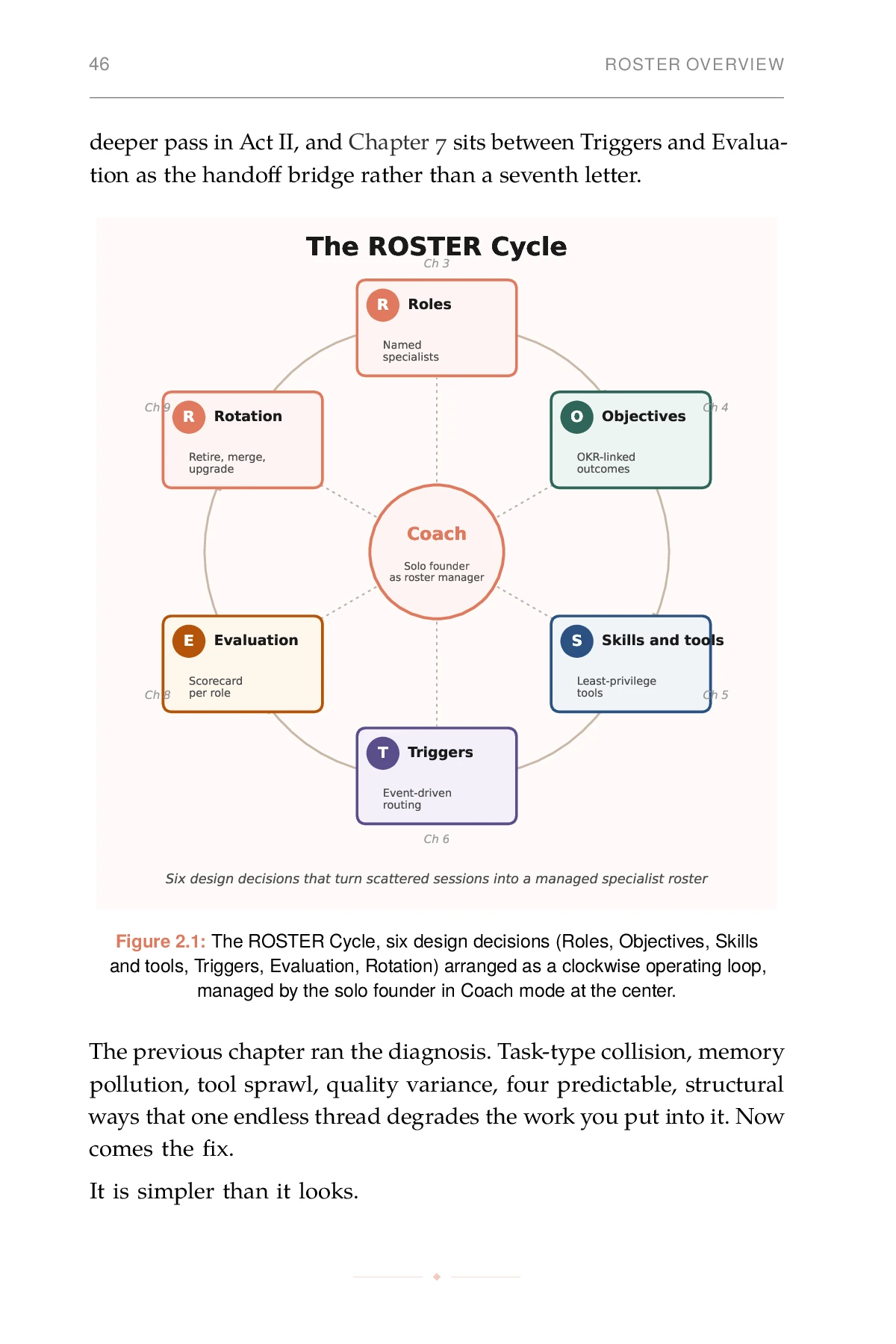
The Agent Dream Team installs ROSTER: Roles, Objectives, Skills and tools, Triggers, Evaluation, Rotation. Six skills that turn a company of one into a coached roster of named specialists, each with a charter, a trigger, and a review gate.
What you can do
What this book puts in your hands
You will learn to:
- Split one chatbot into a specialist roster with clear mandates.
- Wire triggers so the right agent runs at the right event.
- Bound tools and memory so an agent cannot wander into every job.
- Evaluate output with scorecards, not vibe.
- Rotate the agent built for last quarter's work before it fails this quarter's.
The framework
ROSTER: the system behind the book
Roles, Objectives, Skills, Triggers, Evaluation, Rotation
-
Roles
Give each agent a charter so one job has an owner instead of a shared thread.
-
Objectives
Make the charter measurable. A role without an objective is a job title.
-
Skills and tools
Bound what the agent may use, and cut the access it does not need.
-
Triggers
Decide once, at your clearest, which event starts which agent.
-
Evaluation
Score output with a scorecard. Judgment by vibe is hope, not management.
-
Rotation
Retire the agent built for last quarter's work before it quietly fails this quarter's.
From the book
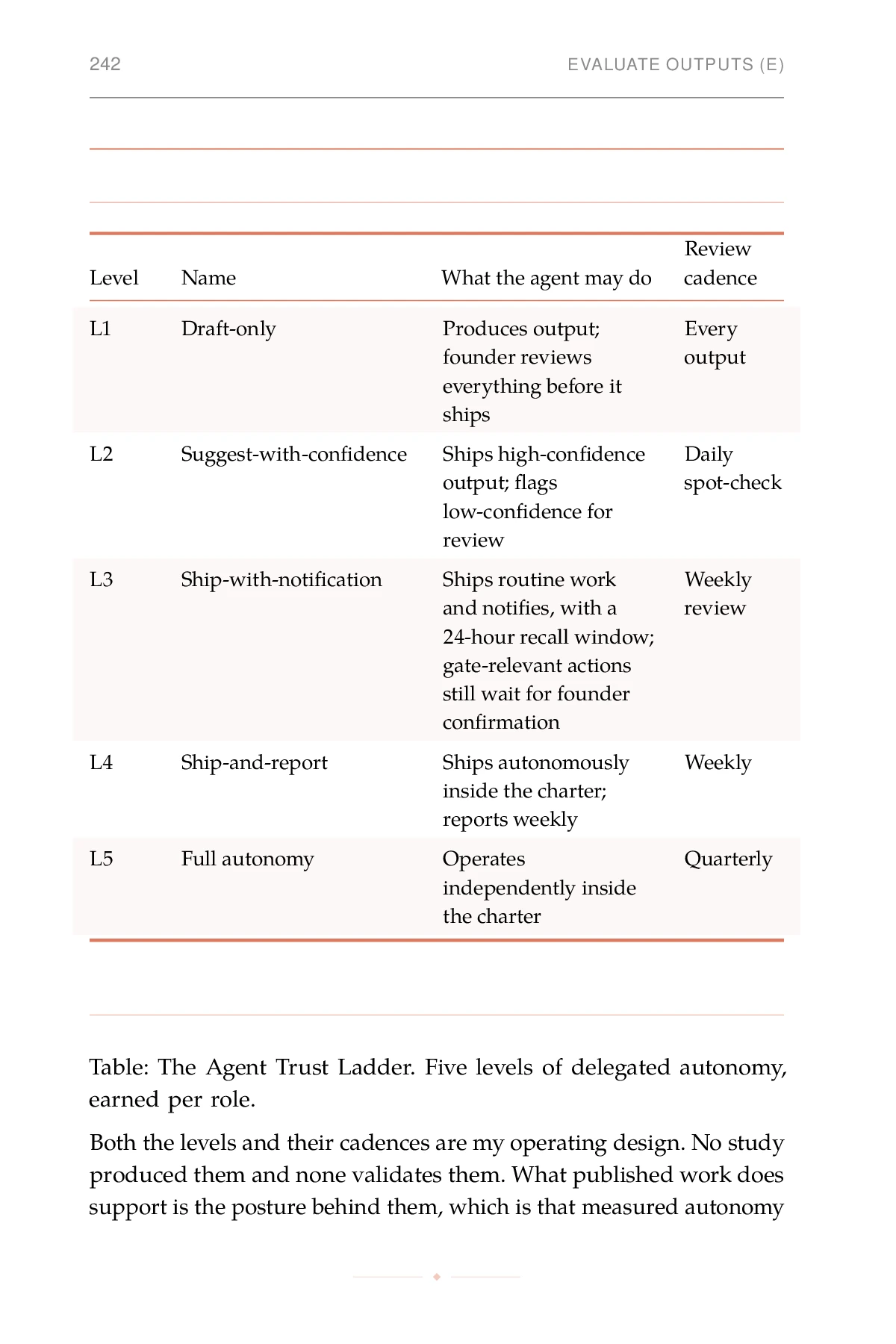
The ROSTER Cycle, six design decisions (Roles, Objectives, Skills and tools, Triggers, Evaluation, Rotation) arranged as a clockwise operating loop,
The Agent Dream Team, printed page: The ROSTER Cycle, six design decisions (Roles, Objectives, Skills and tools, Triggers, Evaluation, Rotation) arranged as a clockwise operating loop,
Inspect more pagesLook inside
Pages from the print edition.
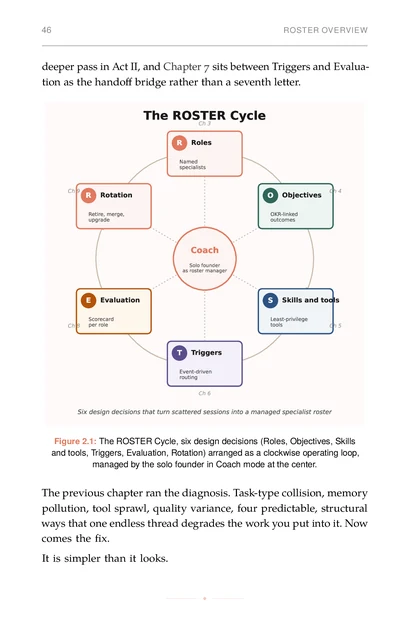 The ROSTER Cycle, six design decisions (Roles, Objectives, Skills and tools, Triggers, Evaluation, Rotation) arranged as a clockwise operating loop,
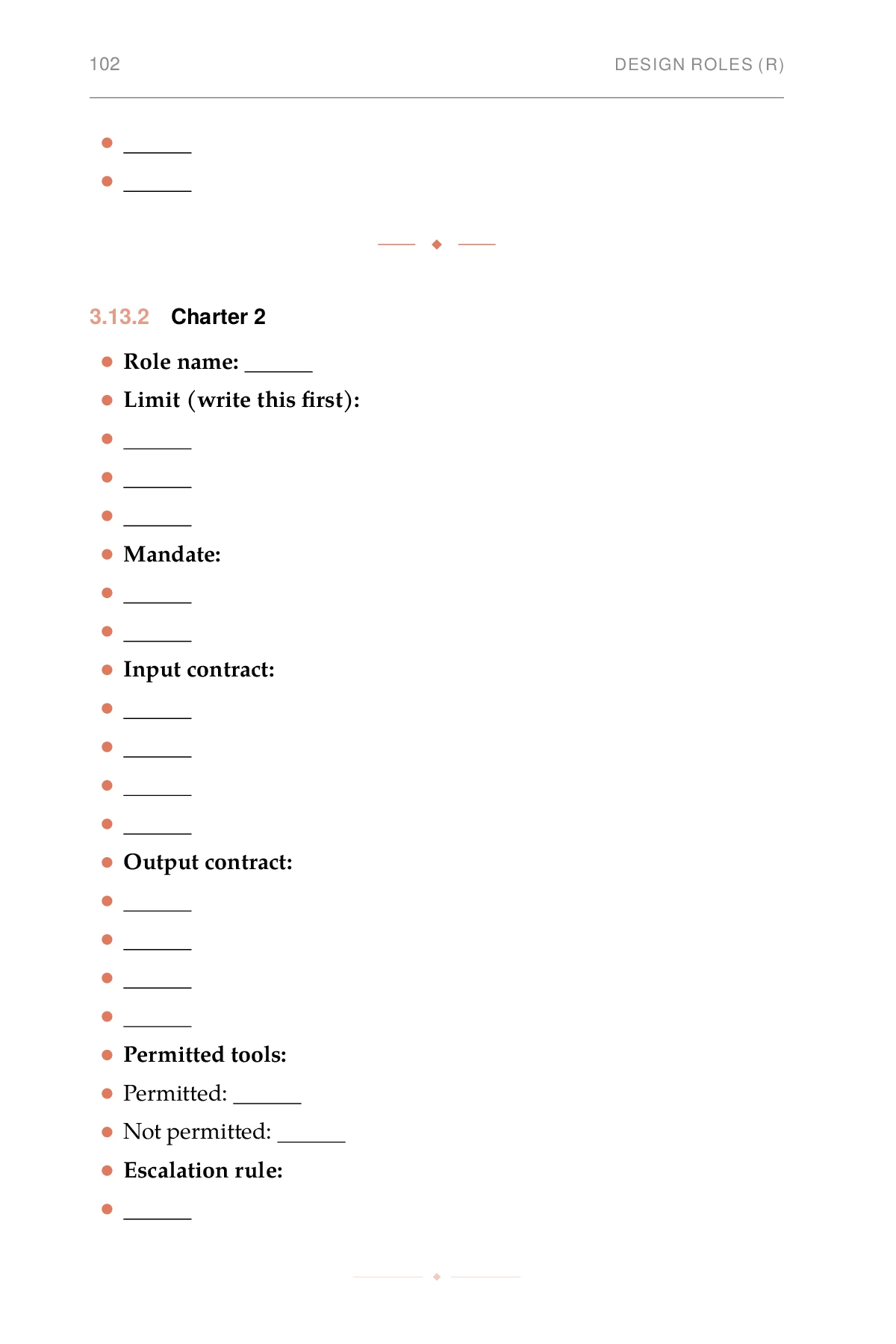
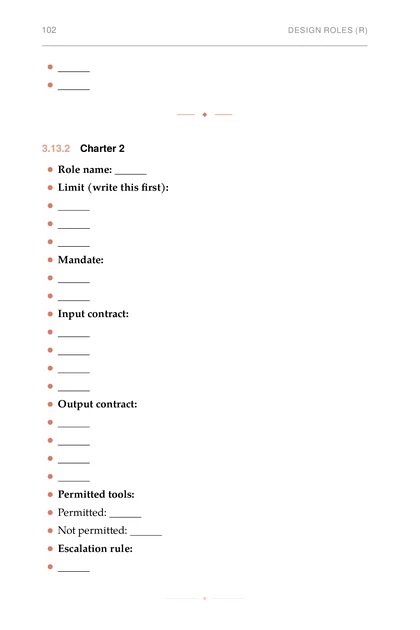 3.13.2 Charter 2
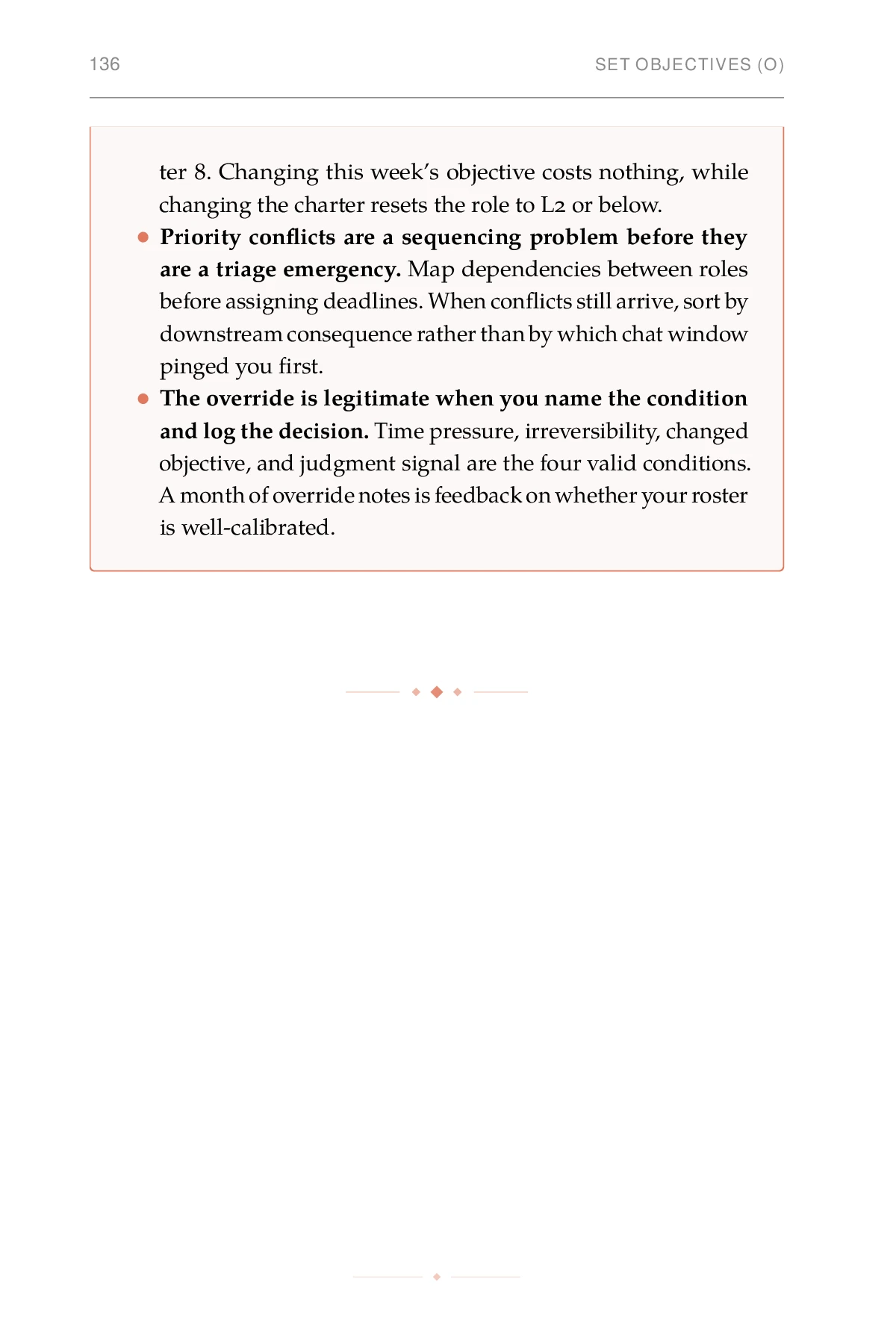
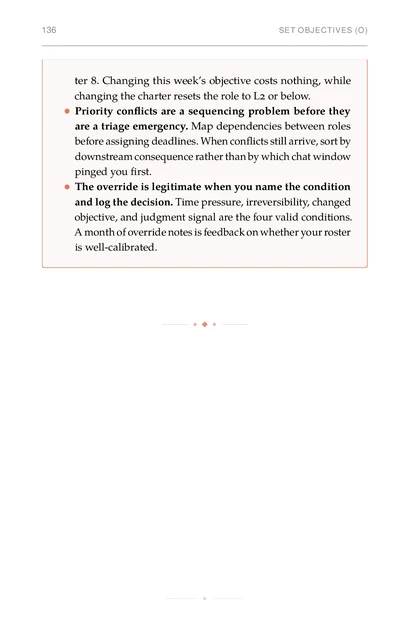 ter 8. Changing this week’s objective costs nothing, while
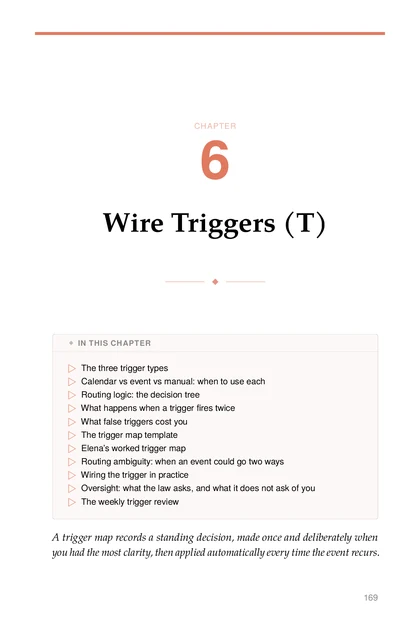 CHAPTER
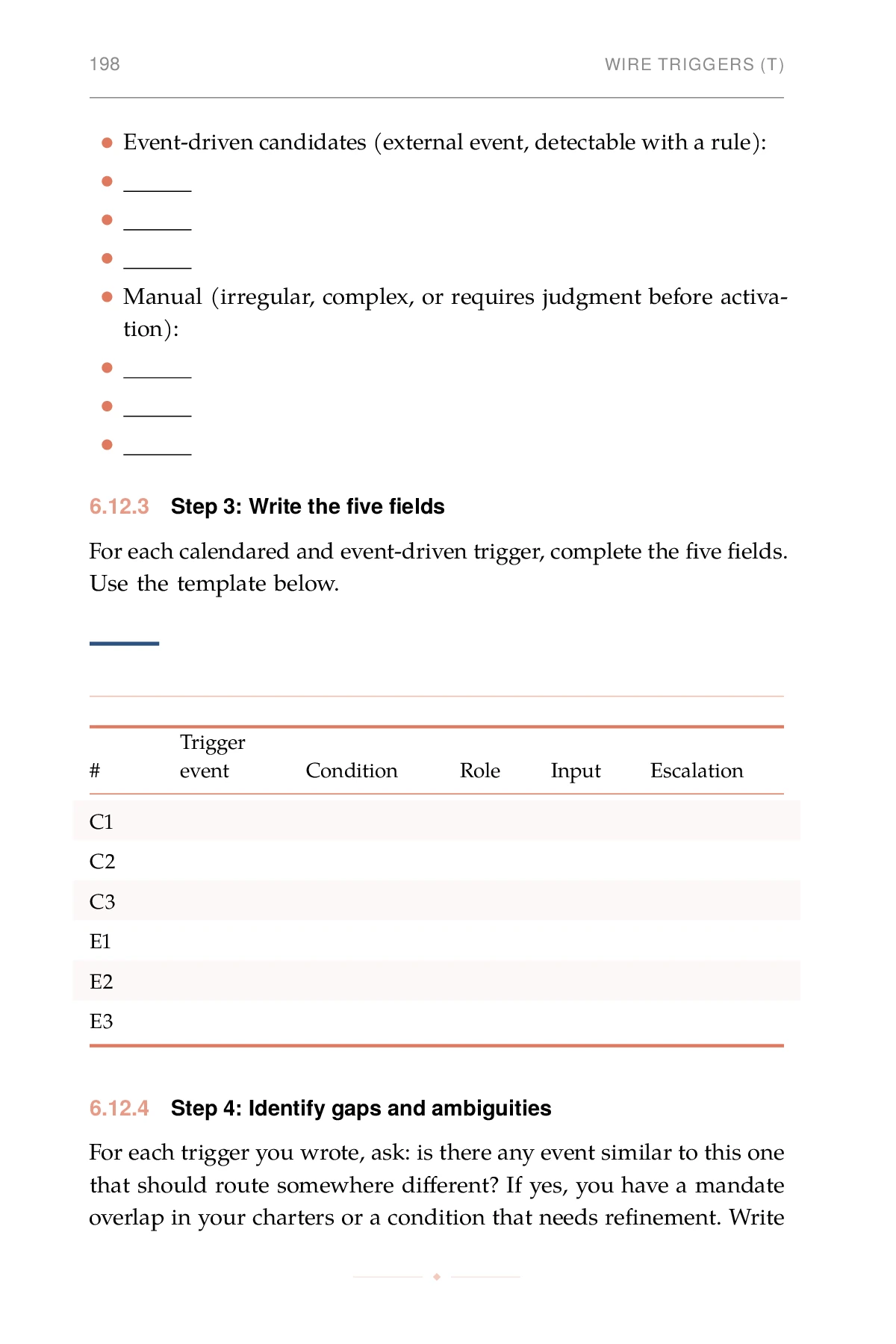
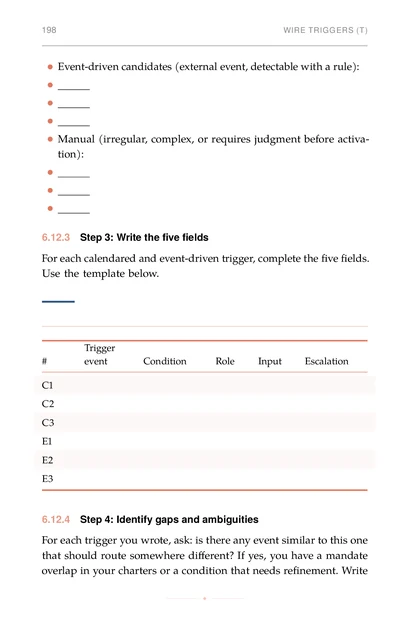 Event-driven candidates (external event, detectable with a rule):
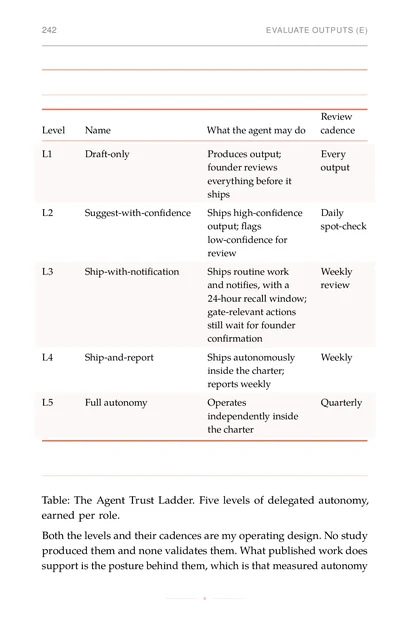 Review
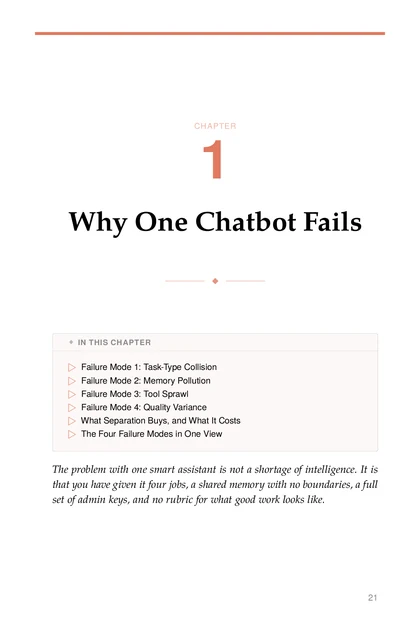 CHAPTER
 from recurring patterns, not transcripts of any one person.
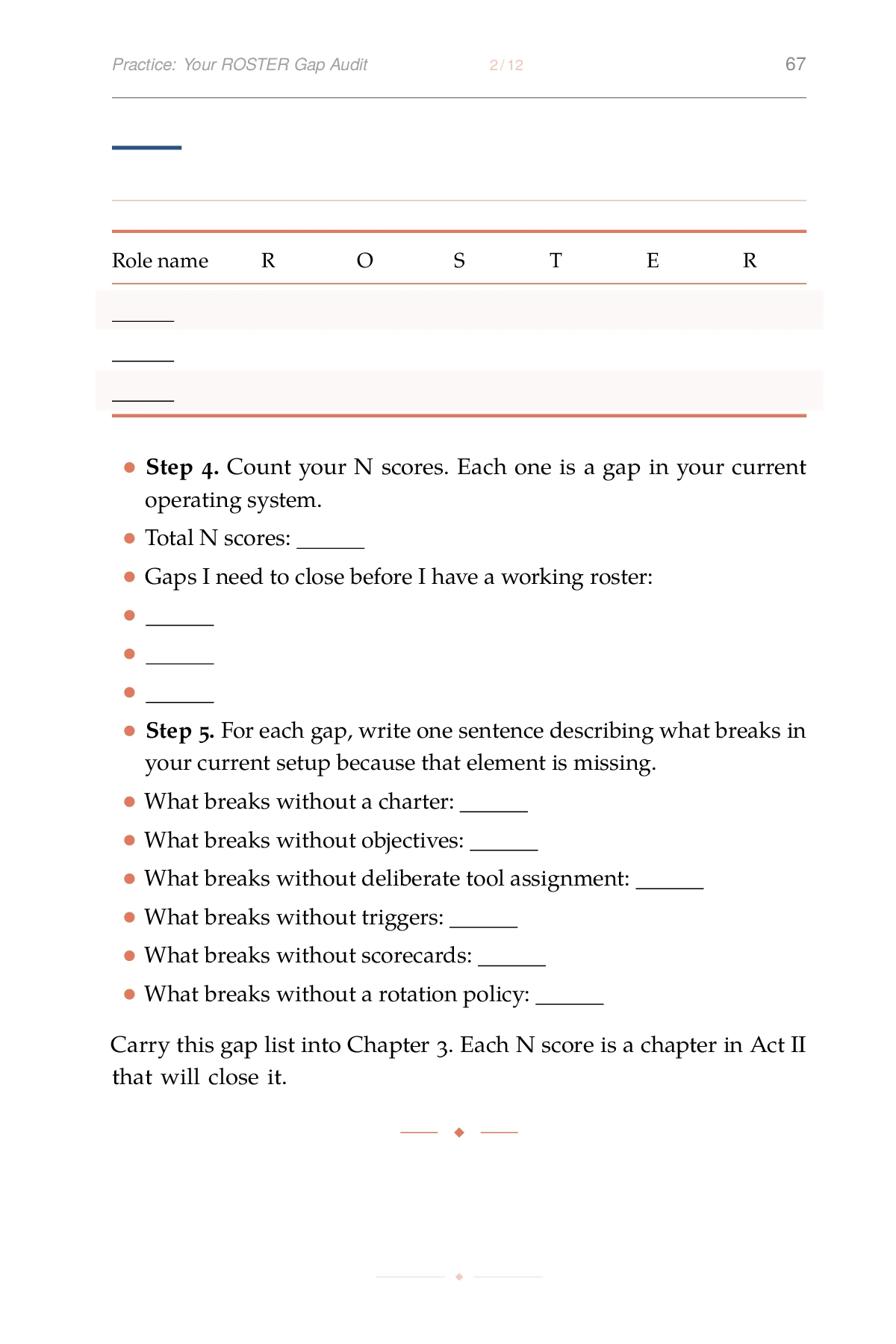
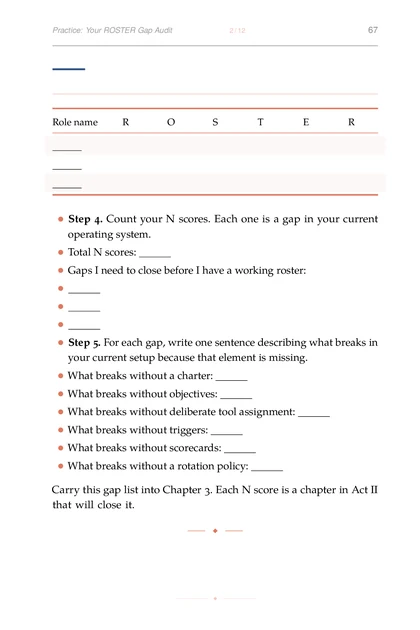 Role name R O S T E R

Purchase takes place on Amazon, not on this website.
Buy the paperback on AmazonFrom the book
Read a page
Introduction
Company of One, Team of Many
The solo founder's real problem has never been capability. It has been configuration.
What you get
What you get
- The ROSTER protocol: Roles, Objectives, Skills, Triggers, Evaluation, Rotation
- Named specialist agents with charters and review gates
- Run a company of one like a real team
Who it's for
- Split one chatbot into a specialist roster with clear mandates
- Wire triggers so the right agent runs at the right event
- Run a weekly operating ritual without team-sync overhead
- Evaluate agent output with scorecards, not vibes
- Adopt dream-team templates for GTM, research, or ops
Who it's for
Who this book was written for
You direct the team instead of doing every job in one chat.
If you run a company of one and refuse to confuse a fluent assistant with a roster, this was written for you.
The reader it was written for
The solo founder-operator, bootstrapped or early-stage, a company of one, using AI daily but stuck in one endless chat. Wants named specialist agents with charters, not a generic assistant.
Also a fit for
The creator-consultant scaling a newsletter, course, or advisory practice through agents while keeping quality and voice consistent across roles.
What you will use it on
- Split one chatbot into a specialist roster with clear mandates
- Wire triggers so the right agent runs at the right event
- Run a weekly operating ritual without team-sync overhead
- Evaluate agent output with scorecards, not vibes
- Adopt dream-team templates for GTM, research, or ops
Probably not for you if
- Teams of five or more humans needing org design (see The Multi-Agent Organization)
- Readers seeking repository architecture only (see The Agentic Codebase)
The contents
Chapter by chapter
Every chapter of The Agent Dream Team with its printed epigraph, what you can do afterwards, and the moment it is built for.
Introduction
Company of One, Team of Many
The solo founder's real problem has never been capability. It has been configuration.
Chapter 1
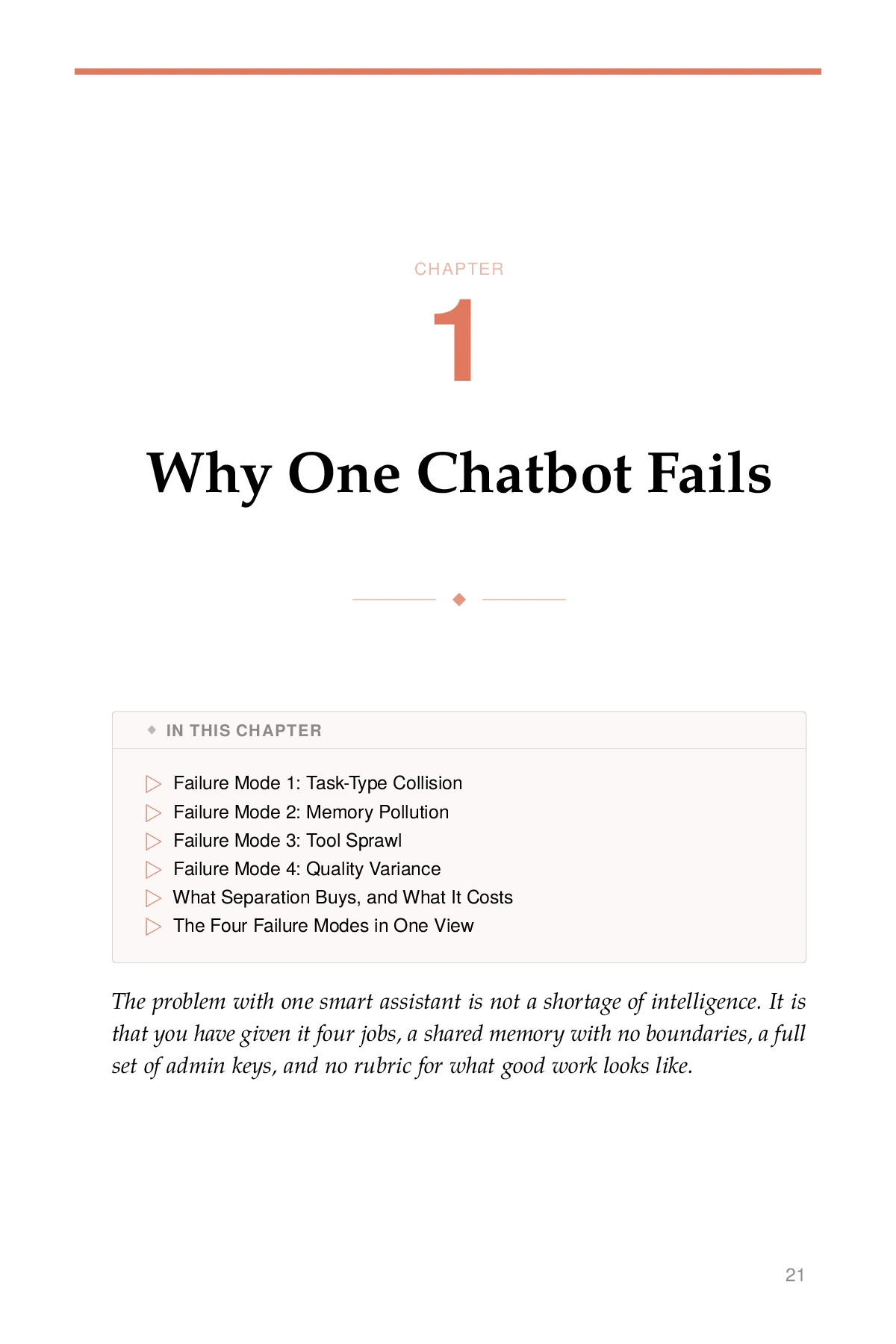
Why One Chatbot Fails
The problem with one smart assistant is not that it is dumb. It is that you have given it four jobs, a shared memory with no boundaries, a full set of admin keys, and no rubric for what good work looks like.
Chapter 2
ROSTER Overview
A company of one can run like a managed team. The six skills that make it possible fit on a single page.
Chapter 3
Design Roles (R)
A job description is not bureaucracy. It is the document that makes accountability possible.
Chapter 4
Set Objectives (O)
A role without a measurable objective is a title. The title collects no receipts.
Chapter 5
Assign Skills and Tools (S)
The question is never which tools your agents could use. It is which tools they should, and what breaks when you get it wrong.
Chapter 6
Wire Triggers
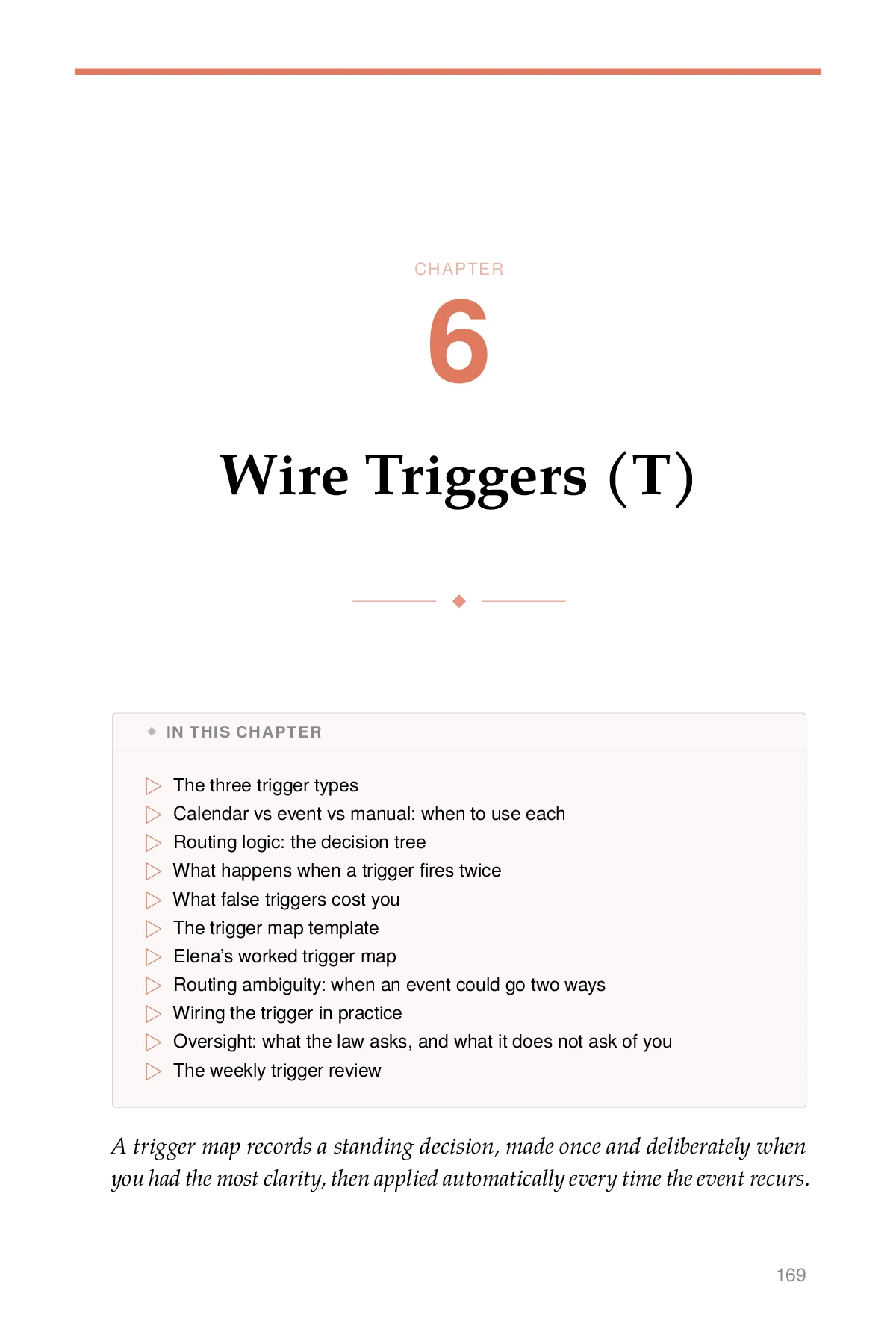
A trigger map records a standing decision, made once and deliberately when you had the most clarity, then applied automatically every time the event recurs.
Chapter 7
Handoffs and Memory
Work that is implicit in a thread stays trapped there. Work that is explicit in a packet can travel anywhere.
Chapter 8
Evaluate Outputs (E)
The founder who reviews by feel is not reviewing, they are hoping. A scorecard is not a bureaucratic imposition; it is the minimum equipment for a manager who wants to improve something.
Chapter 9
Rotate and Retire Agents
A roster that never changes is a roster that never improves. The agent you designed six months ago was built for the work you had then, and the work has changed.
Chapter 10
Dream Team Archetypes
The fastest way to build something usable is to start from a known pattern and then cut it down to your work.
Chapter 11
Weekly Operating Ritual
The founder who never pauses to look at the roster is not running a team, they are running a hope.
Chapter 12
Failure Modes
Every system designed by one person, for one person, contains the seeds of its own failure, usually planted in the moment of its greatest apparent success.
Conclusion
Coach Your Dream Team
The founder who builds the roster does not automate themselves out of a job. They automate themselves out of the bottleneck.
Editions
Editions and specifications
| Edition | Formats | Chapters | Pages | Reading time | ISBN (paperback) |
|---|---|---|---|---|---|
| English The Agent Dream Team | Kindle, Paperback, Hardcover | 14 | 484 | ± 5 hours | — |
| Dutch Het agent-droomteam | Kindle, Paperback, Hardcover | 14 | 522 | ± 5 hours | — |
Both editions are written natively. The Dutch text is not a machine translation of the English. · Trim size: 6.14x9.21″
Get the book
One title, every Amazon marketplace. Pick your format and your store.
Get the book
Reading from another country?Pick your own Amazon marketplace — same edition, your store.
Amazon links may include affiliate tags. That does not change the price you pay. Bol.com listings are third-party.
Frequently asked
What readers usually want to know
What is The Agent Dream Team about?
ROSTER shows solo operators how to create named specialist agents with charters, triggers, handoffs, and review gates instead of one overloaded chatbot. The subtitle is: Build Your Autonomous Specialist Roster for a One-Person Company.
What is the ROSTER framework?
ROSTER: Roles, Objectives, Skills and tools, Triggers, Evaluation and Rotation. Roles, Objectives, Skills, Triggers, Evaluation, Rotation
In which formats is The Agent Dream Team available?
The Agent Dream Team ships as Kindle, Paperback and Hardcover, on every Amazon marketplace worldwide. The Kindle edition is enrolled in Kindle Unlimited, so KU members read it free.
Is there a Dutch edition?
Yes. The Dutch edition is Het agent-droomteam, written as a native edition rather than a machine translation. It is available on Amazon too.
How long is The Agent Dream Team?
This edition runs 14 chapters, 484 pages in print and roughly 5 hours of reading.
Who is The Agent Dream Team for?
If you run a company of one and refuse to confuse a fluent assistant with a roster, this was written for you.
This is overkill for a solo founder.
One chatbot doing four jobs is already a team, just an unnamed one. ROSTER makes the charters explicit so you stop being the bottleneck in every thread.
Maintaining multiple agents sounds like more work.
You already maintain them: prompts, memory, and follow-ups, mixed in one window. Rotation and evaluation are how you stop rebuilding the same assistant every Monday.
My use case is too unique for templates.
The roster is unique. The six skills are not. Roles, objectives, tools, triggers, evaluation, and rotation are the same moves whether the specialist is research, ops, or GTM.
Isn't this just fancy prompting?
A prompt is not a charter, a trigger, or a scorecard. ROSTER is how a company of one coaches a roster instead of doing every job in one chat.
Is this the same as CHORUS?
No. CHORUS coordinates a human team of 2 to 15 with agents in the mix. ROSTER coaches named specialists for a one-person company. Paperback, hardcover, and Kindle are live in English and Dutch.
The production system
How this book was made
Every title moves through the same gated production line: sourced research, a claim-level evidence ledger, structural review, fact-checking, red-team critique, and a bilingual final edit. AI agents do specialist work inside those gates; judgment, voice, and accountability stay human.
- Claims enter an evidence ledger with a source and a confidence grade before they reach the page
- English and Dutch are two native editions, not a translation of one another
- Every chapter clears readability, rhythm, and style gates before it is typeset
Terminology
Books


