

No. 18 · Manuscript complete · AI & agents · SYNERGY
The AI Team Dynamics
Designing Mixed Human and Agent Teams So Productivity Compounds and Accountability Stays Human
The AI Team Dynamics: Designing Mixed Human and Agent Teams So Productivity Compounds and Accountability Stays Human.
SYNERGY focuses on the social system around AI work: coordination, trust, accountability, review, and psychological safety in mixed human-agent teams. Designing Mixed Human and Agent Teams So Productivity Compounds and Accountability Stays Human. The framework: SYNERGY.
- pages
- 214
- chapters
- 14
- hours of reading
- ± 3
- editions
- EN · NL
- Design
- Drafting
- Manuscript
- Production
- Launched
The editions
Kindle, Paperback and Hardcover
Production shots of the editions. Not for sale yet — this page is the public working version.
-
Kindle
The digital edition, ready in any Kindle app.
-
Paperback
The working copy. Mark it up. Take it into the meeting.
-
Hardcover
The shelf edition. Dark full-art jacket, built to stay in the room.


The book
Designing Mixed Human and Agent Teams So Productivity Compounds and Accountability Stays Human
The agents felt like free leverage for a week. Each one drafted a reply, summarized a doc, stubbed a function, shipped a visible win. Then the second-order costs arrived: outputs that looked good but needed human repair, decisions escalated to you at 11pm, three people in the standup waiting on an output that never came. You added capacity on paper, lost predictable flow in practice, and became the only person who could see the whole picture.
The reflex is to add another agent, write a longer prompt, or switch to a better model. That scales the problem, not the work: a more capable agent optimizing the wrong objective just reaches the wrong outcome faster.
This book treats a mixed human and agent team as what it is: not a collection of tools but a designed operating system. The AI Team Dynamics introduces the SYNERGY framework (Shared intent, Yield to strengths, Negotiate interfaces, Evaluate loops, Review, Guardrails, Yield ownership): seven components you install deliberately, so the team compounds instead of making the founder the universal exception handler.
What you learn
What this book puts in your hands
- Write a one-sentence mission and three observable success criteria, so an agent optimizes the objective you own.
- Turn implicit handoffs into written interface contracts, so a Slack thread stops being where coordination lives.
- Set three non-negotiable guardrails and a kill-switch you have actually tested.
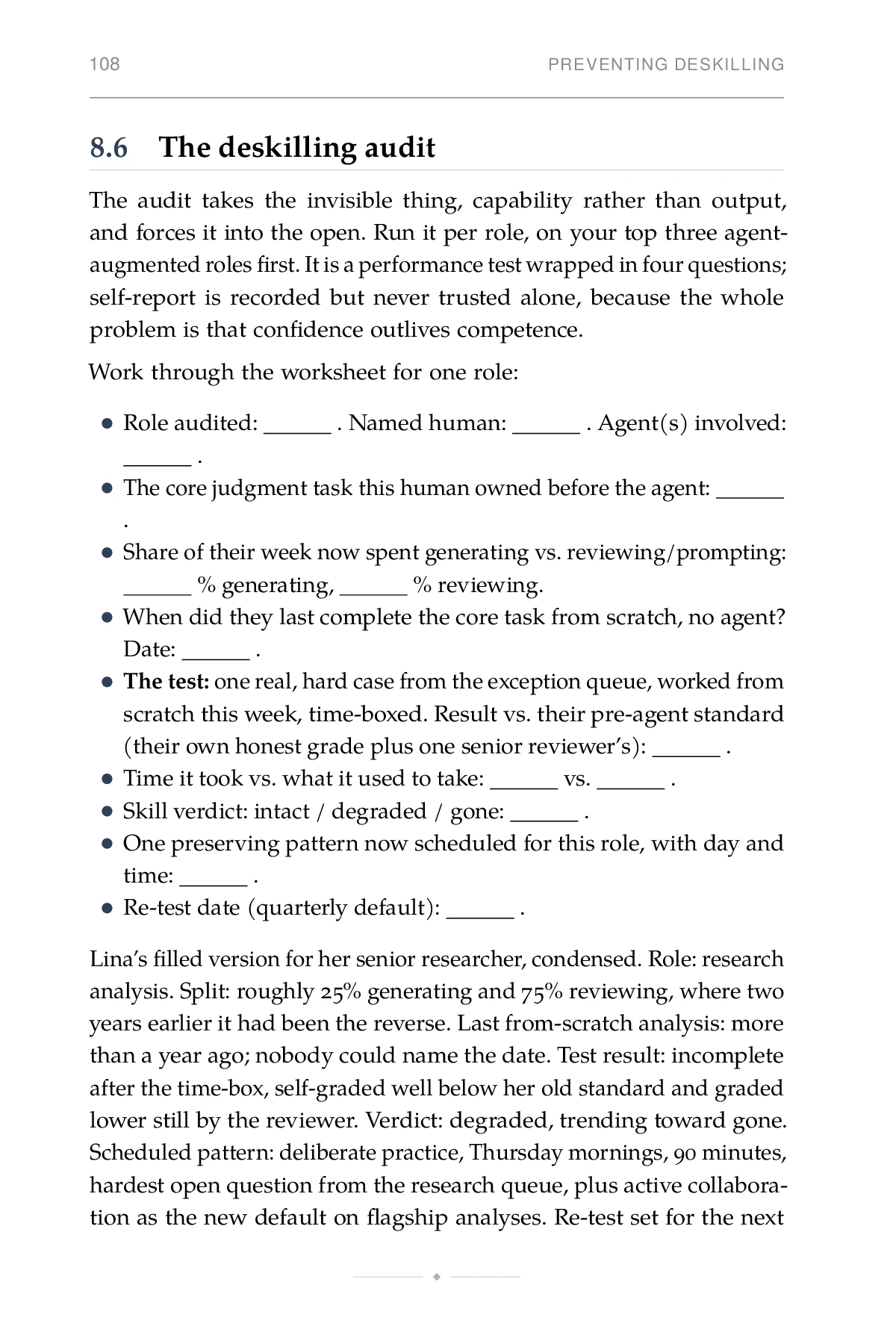
- Run a deskilling audit and schedule practice, so humans can still do the work when the agent is wrong.
- Measure compound productivity, not vanity throughput, and keep final judgment human.
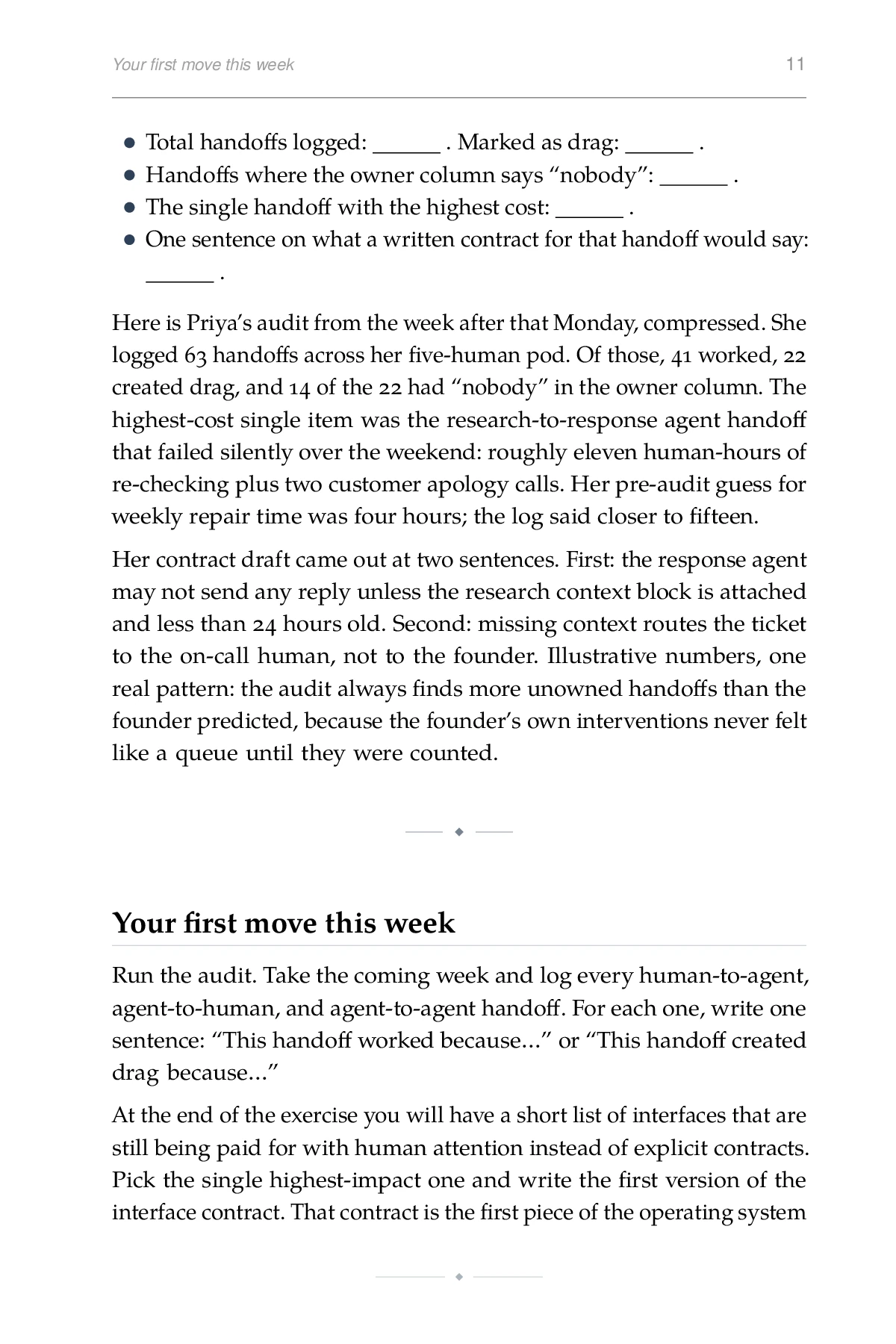
From the book
Your first move this week
The AI Team Dynamics, printed page: Your first move this week
Inspect more pagesLook inside
Pages from the print edition.
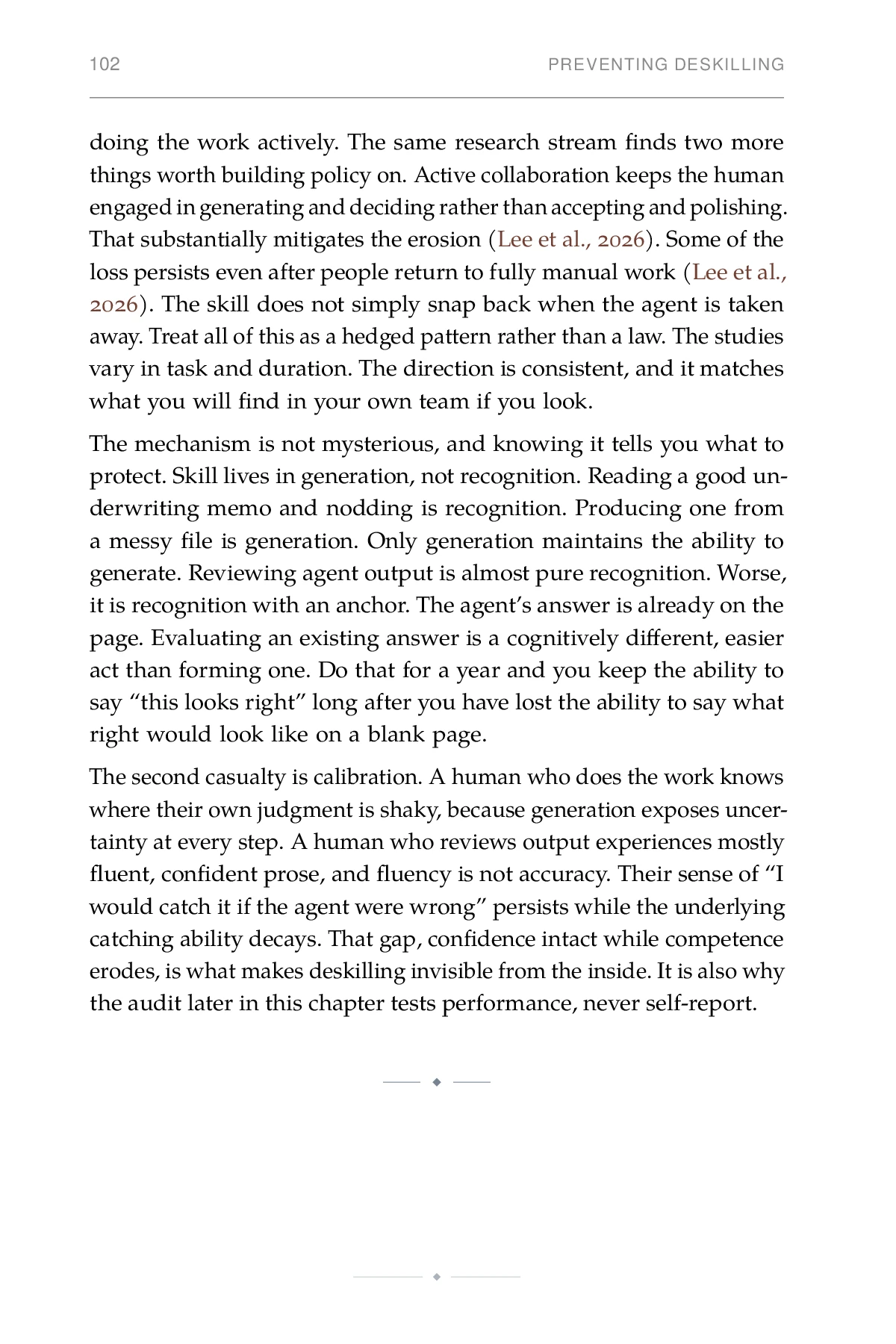
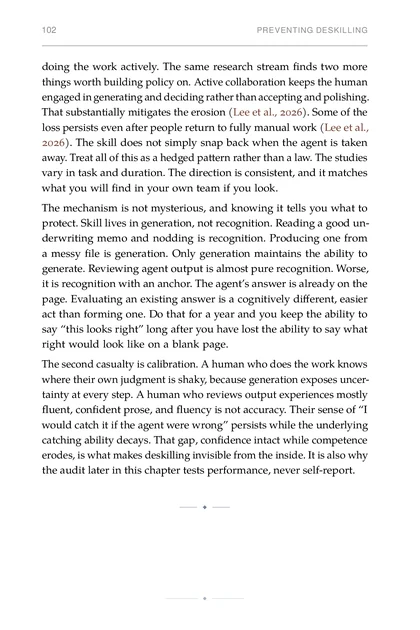 The mechanism is not mysterious, and knowing it tells you what
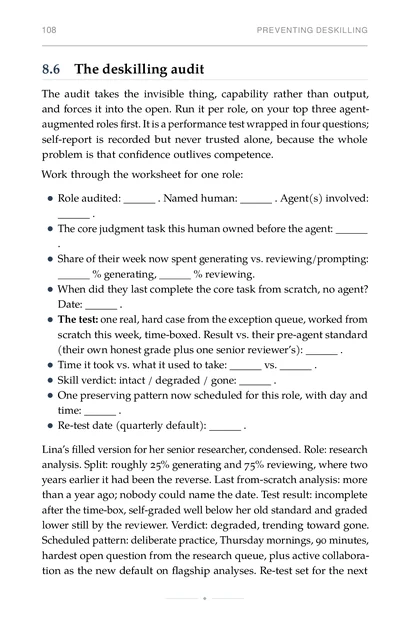 One preserving pattern now scheduled for this role, with day
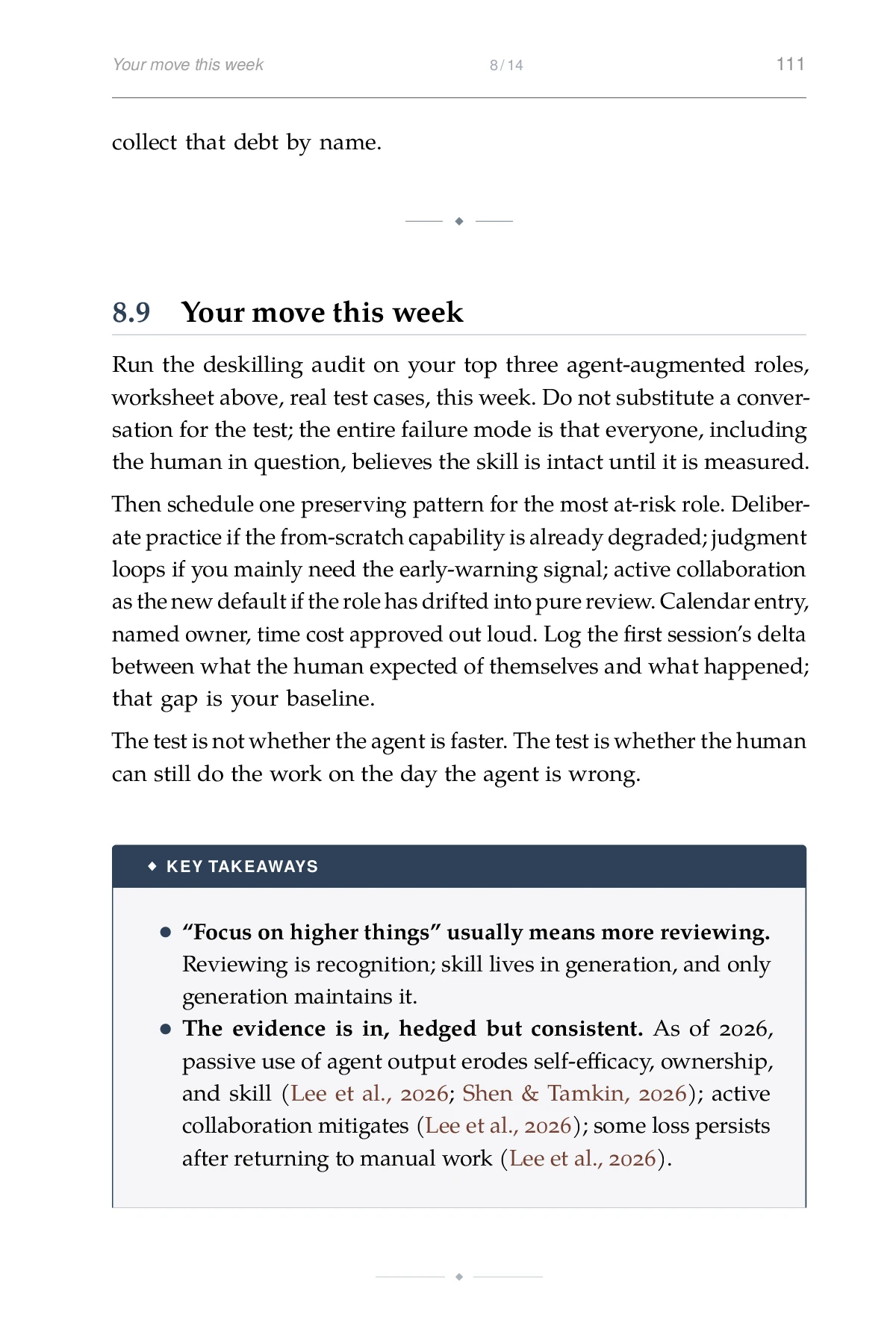
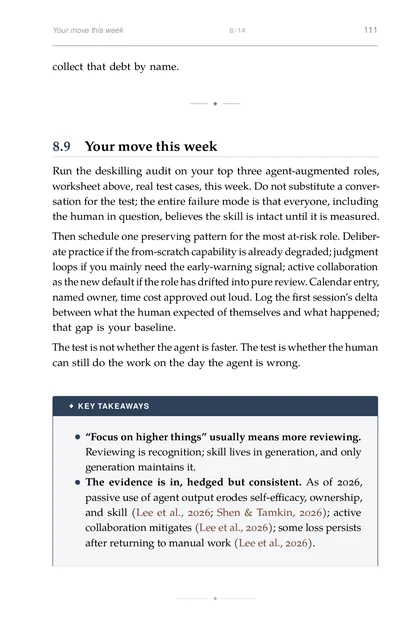 Your move this week 8 14 111
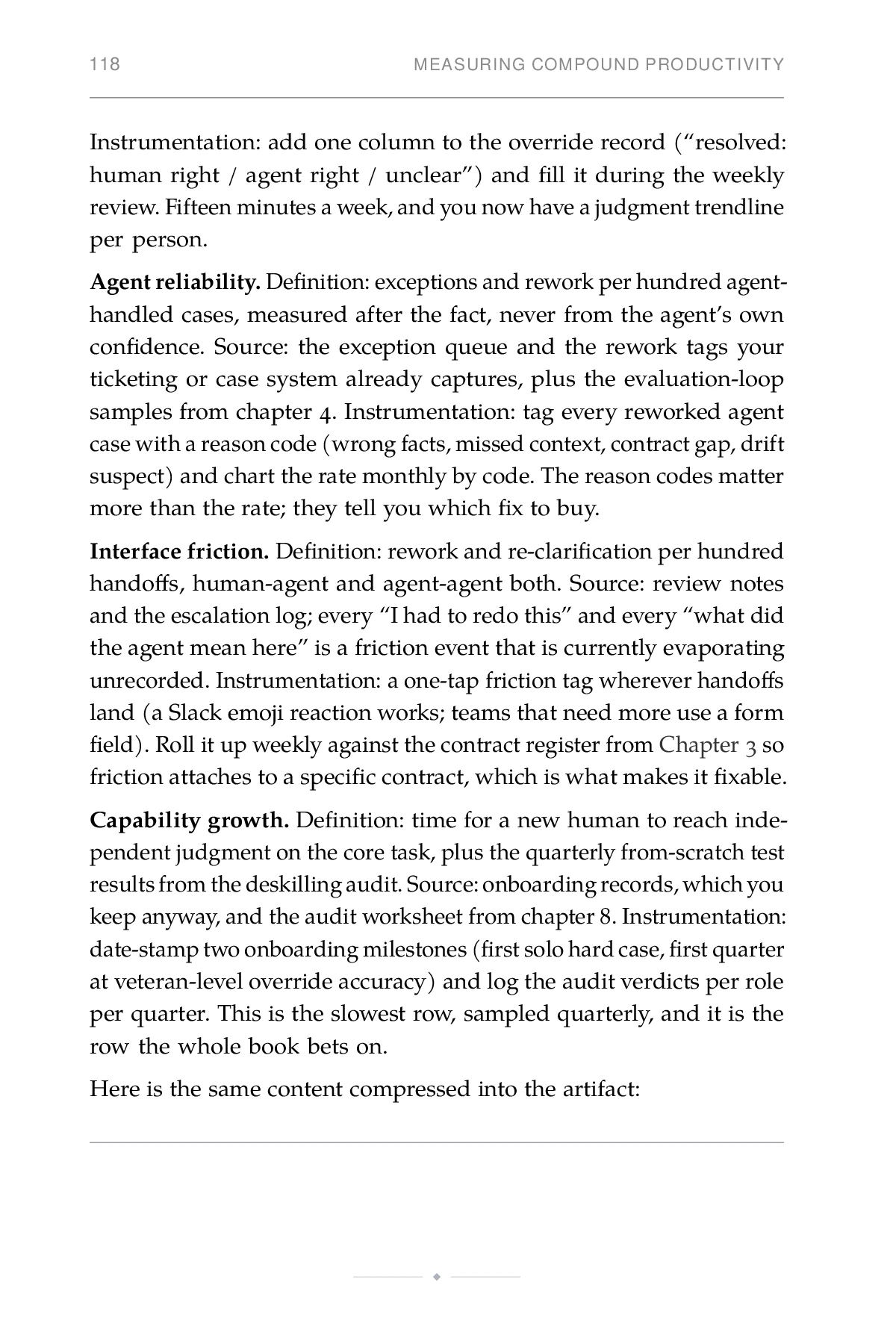
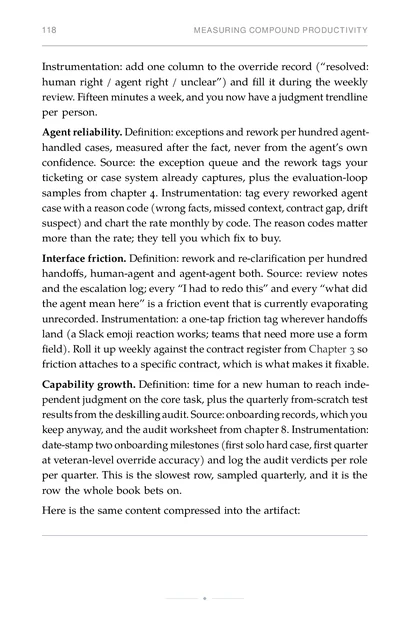 Capability growth. Definition: time for a new human to reach inde-
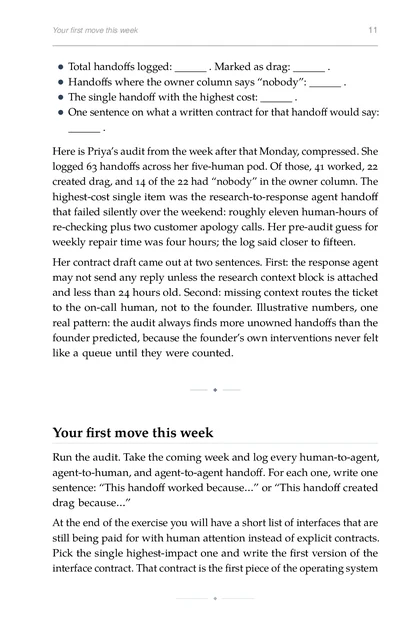 Your first move this week
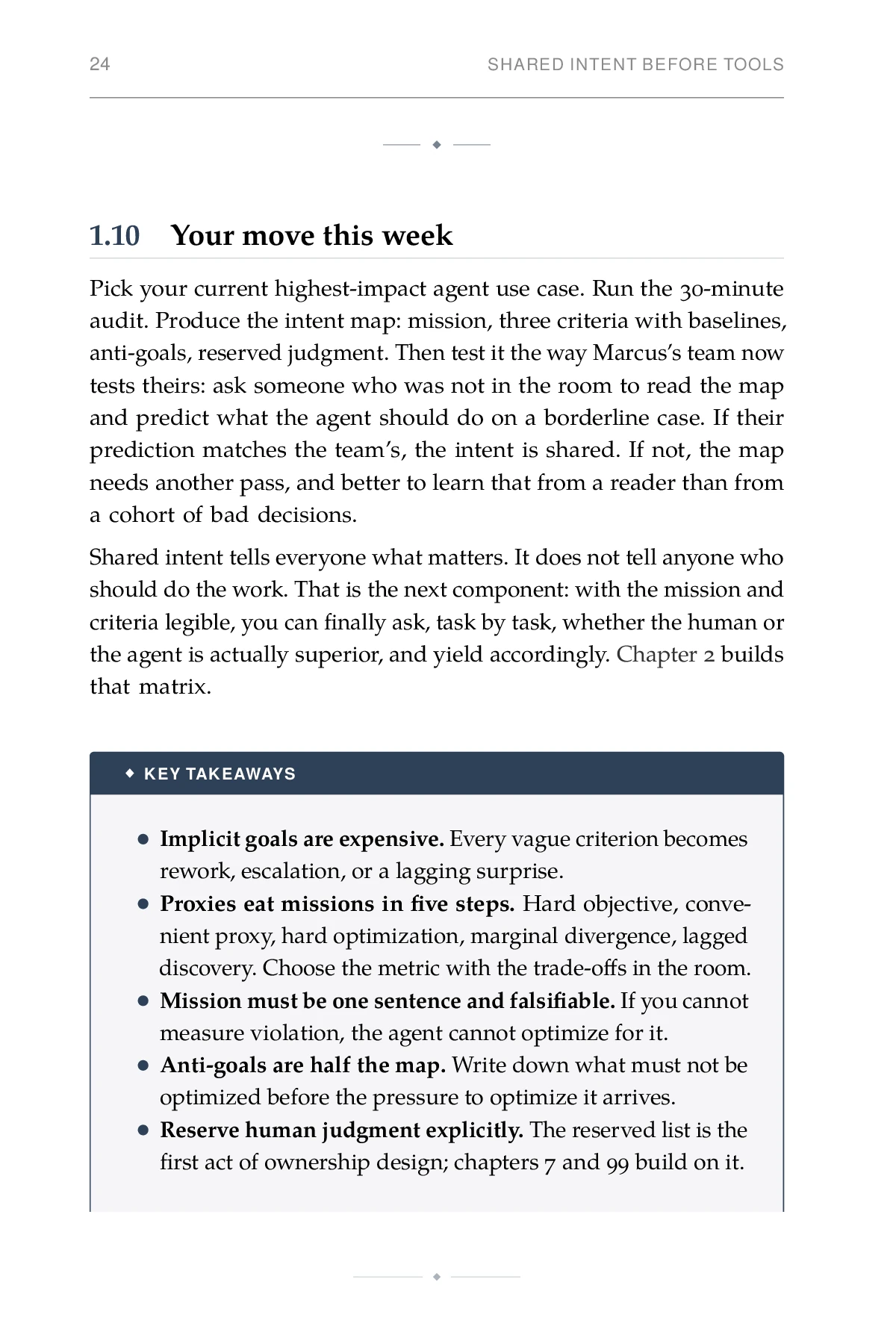
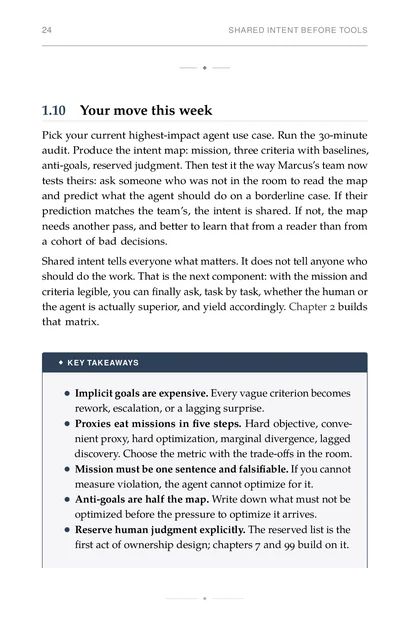 Anti-goals are half the map. Write down what must not be
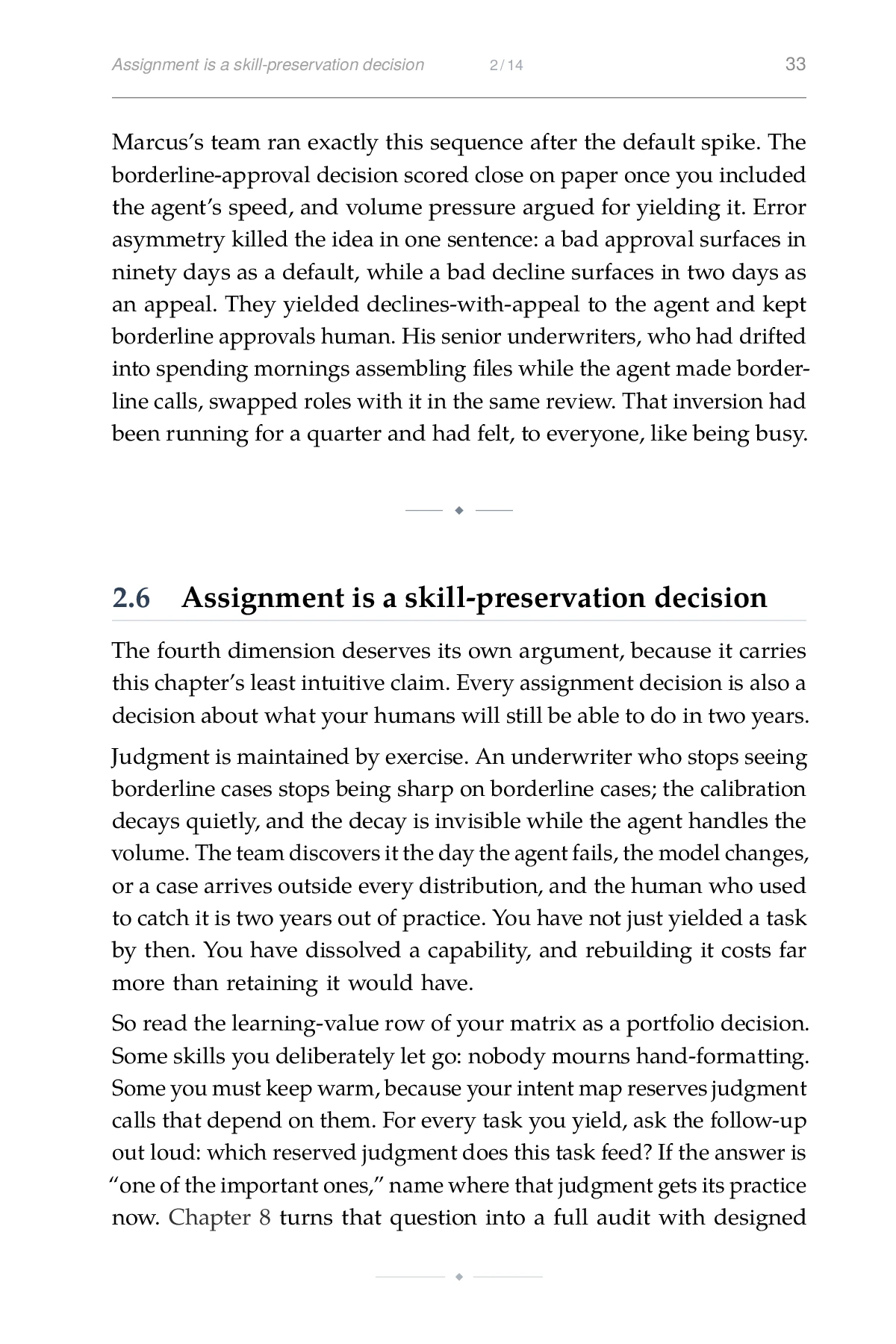
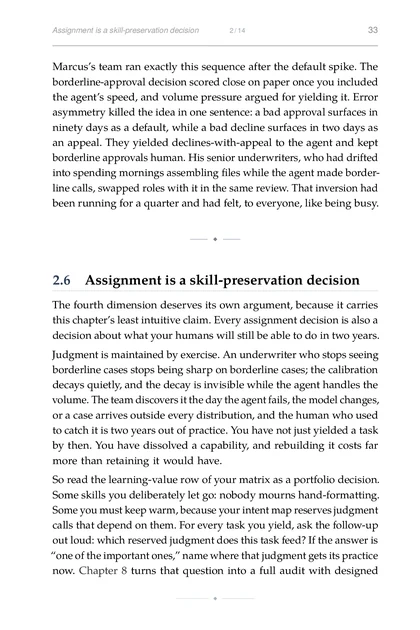 The fourth dimension deserves its own argument, because it carries
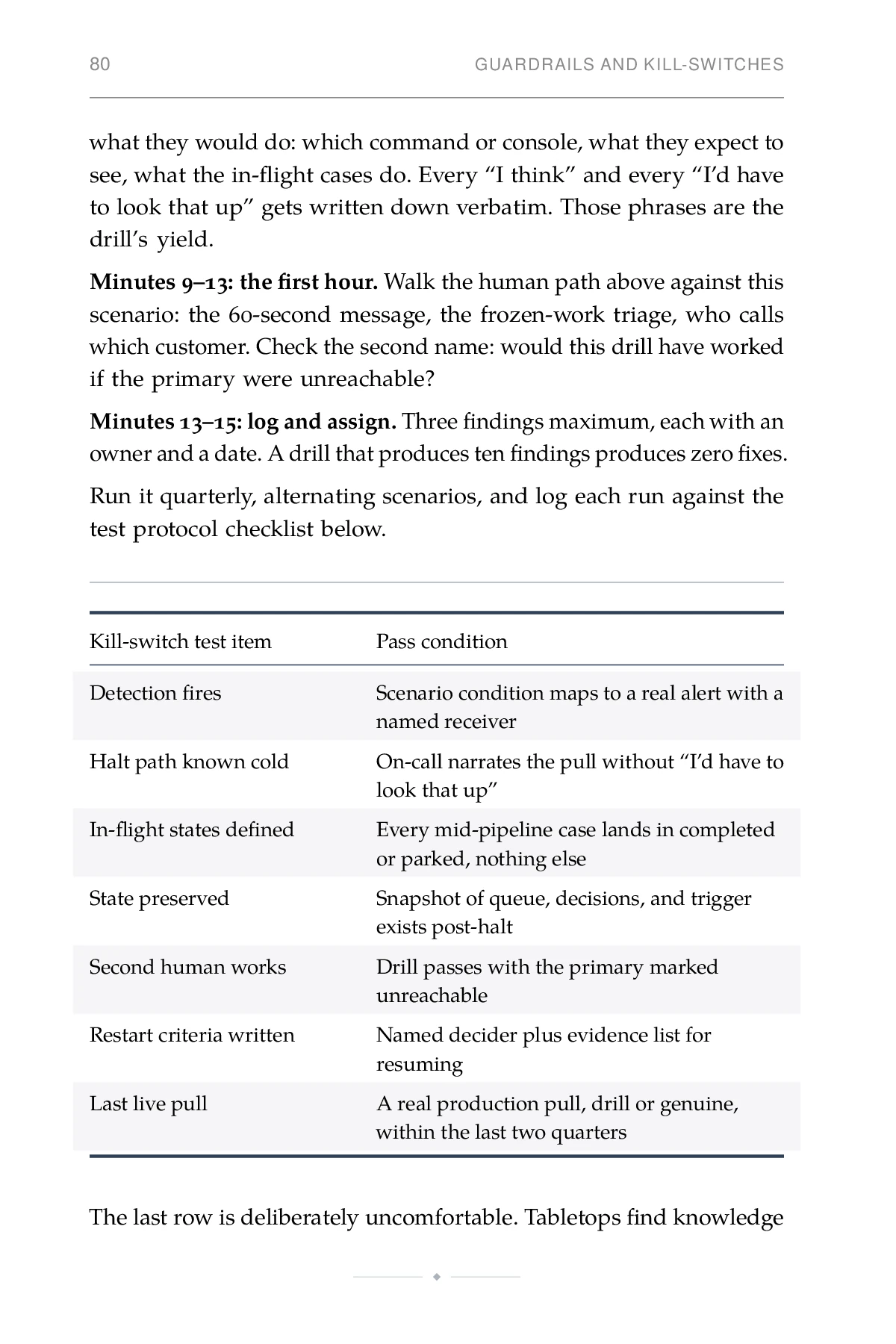
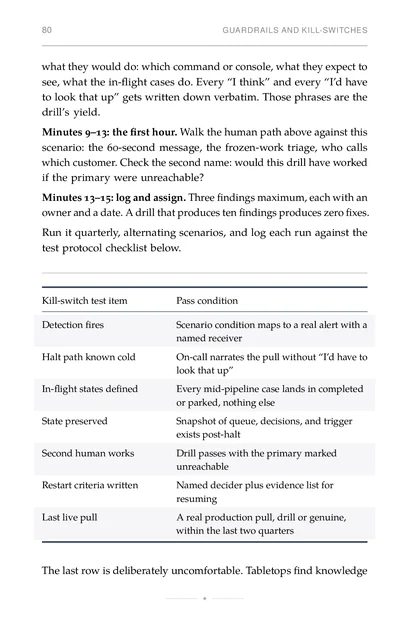 Kill-switch test item Pass condition
The contents
Chapter by chapter
Every chapter of The AI Team Dynamics with its printed epigraph, what you can do afterwards, and the moment it is built for.
Introduction
The Interface Problem
Adding AI agents without redesigning roles, interfaces, accountability, and learning loops creates new failure modes that compound faster than productivity gains. The first move is to see the interface chaos clearly.
What you can do afterwards
You will run a one-week team interface audit, count the handoffs your team is paying for with human attention, and name the first interface contract you can install.
Use this chapter when
Agents are "helping" but exceptions, rework, and trust erosion are increasing.
Chapter 1
Shared Intent Before Tools
Explicit shared mission and success criteria must precede any tool or agent deployment, or agents will optimize the wrong thing at scale. Intent is the north star that survives model updates.
What you can do afterwards
You will write a complete one-page intent map for your highest-impact agent use case: mission, three observable criteria with baselines, accepted and unacceptable failure modes, reserved human judgment calls. Then you will run a 30-minute intent audit with the humans who touch it.
Use this chapter when
An agent is producing outputs that look plausible but keep requiring human rework or create downstream problems.
Chapter 2
Yield to Strengths
Defaulting to "agent does what it can" or "human does what they always did" destroys comparative advantage; explicit strength mapping is required. Assign work to the entity that is superior at that task.
What you can do afterwards
You will score your top three recurring tasks on the four-dimension strength matrix, apply the close-call decision rules, and re-assign at least one task this week.
Use this chapter when
The team is spending time on work that an agent could do better, or an agent is producing outputs that require heavy human repair.
Chapter 3
Negotiate Interfaces
Ambiguous ownership of output between humans and agents is the primary source of trust erosion and rework; explicit interface contracts are non-negotiable. Handoffs are design, not afterthoughts.
What you can do afterwards
You will write a complete five-part interface contract (inputs, outputs, acceptance criteria, escalation, rollback) for your most dangerous human-agent handoff, and diagnose your other handoffs against the handoff-debt table.
Use this chapter when
Outputs are bouncing back and forth, or "I'll just check it" has become the default step.
Chapter 4
Evaluate Loops
"It seems to be working" is not evaluation; continuous, multi-source loops that measure both human and agent performance are required to prevent silent degradation. Evaluation is the early-warning system.
What you can do afterwards
You will design one complete evaluation loop for your highest-risk agent use case: three mandatory data sources, observable trigger thresholds, a named owner, and a rollback criterion. High-stakes uses add a downstream-impact source.
Use this chapter when
An agent has been running for weeks and the only data is "it looks faster."
Chapter 5
Review as Operating Rhythm
Ad-hoc or absent team reviews allow drift to compound; a structured operating rhythm is the only way to keep the mixed team honest at scale. Rhythm turns evaluation into an operating system.
What you can do afterwards
You will install the three-cadence review architecture with full agendas: weekly 30 minutes, monthly 90, quarterly half-day. Then you will run one full week of it and triage at least two ad-hoc agent discussions into the rhythm or out of existence.
Use this chapter when
Agent discussions are happening in Slack threads and standups feel longer even though "we're using AI."
Chapter 6
Guardrails and Kill-Switches
Over-trust or over-fear of agents both destroy value; explicit, tested guardrails and kill-switches are the only way to keep the mixed team inside its operating envelope. Boundaries are not optional.
What you can do afterwards
You will write three non-negotiable guardrails as testable predicates for your highest-risk agent use case. Then you will define one kill-switch with both its technical and human paths, and run the 15-minute tabletop drill this week.
Use this chapter when
An agent is operating in a domain where a bad output has real cost (compliance, customer trust, money, safety).
Chapter 7
Yield Ownership, Not Control
Diffuse accountability is the silent killer of mixed teams; humans must retain explicit final judgment and ownership even as agents take on more execution. The sovereign layer is non-negotiable.
What you can do afterwards
You will build an ownership map for your top three agent-involved decision classes: a named human per class, their override rights, and the record that captures their signature.
Use this chapter when
"The agent decided" or "the system recommended" has become acceptable language in post-mortems.
Chapter 8
Preventing Deskilling
Passive use of agents erodes human judgment, self-efficacy, and skill; deliberate practice and active collaboration must be architected in or the team gets dumber over time. The long-term moat is the humans who can still do the work when the agent is wrong.
What you can do afterwards
You will run a deskilling audit on your top three agent-augmented roles, using the worksheet in this chapter, and schedule one deliberate practice session for the human this week.
Use this chapter when
The best humans are spending most of their time prompting, editing, or overseeing agents and the original craft is atrophying.
Chapter 9
Measuring Compound Productivity
Vanity metrics (tokens, tasks completed, speed) hide whether the mixed team is getting better or worse over time; compound loops that measure human + agent capability growth are required. Productivity that improves the next cycle's productivity is the only sustainable metric.
What you can do afterwards
You will build the four-row compound dashboard for your highest-impact mixed team from data you already have, and instrument the first metric this week. No new software: override logs, review notes, exception queues, onboarding records.
Use this chapter when
The only numbers you have are "we shipped faster" or "the agent did 40% more."
Chapter 10
Conflict and Escalation
When human and agent outputs conflict, the absence of an explicit escalation architecture turns disagreement into either paralysis or abdication. Conflict is a signal, not a failure.
What you can do afterwards
You will write the five-part escalation protocol for your highest-risk agent use case, classify your last three disagreements with the taxonomy, and run one tabletop disagreement through the protocol this week.
Use this chapter when
A human and an agent (or two agents) produce conflicting outputs and the team does not have a documented way to resolve it.
Chapter 11
Onboarding and Offboarding Agents
Treating agents as permanent fixtures creates hidden technical and capability debt; explicit onboarding and offboarding protocols are required for every agent. Agents have a lifecycle. Design it.
What you can do afterwards
You will audit your current agents against the lifecycle checklist, name the offboarding trigger for each, and write a retirement plan for at least one agent that should have an exit date.
Use this chapter when
An agent has been running for months or years and no one has asked "should this still exist?"
Chapter 12
Building Your Team Protocol
Every mixed team feels new until you have a living protocol that encodes intent, strengths, interfaces, evaluation, rhythm, guardrails, ownership, and lifecycle. The protocol is the team's memory and immune system.
What you can do afterwards
You will assemble version 1.0 of your SYNERGY protocol from the artifacts you have already built, one page per section with worked excerpts as models. Then you will appoint its owner and run one team member through the onboarding test.
Use this chapter when
Every agent deployment or team change still requires the founder to reinvent the operating system.
Conclusion
The Human Sovereign Layer
Accountability and final judgment remain human even as agents become more capable; the sovereign layer is the only thing that prevents the mixed team from becoming a black box that no one owns. The long game is the humans who can still decide when the agent is wrong.
What you can do afterwards
You will write your sovereign layer commitment ("I will own X even when the agent is better at Y"), test it against the three marks, and share it with your leadership team.
Use this chapter when
You have finished the book and are about to make or delegate the next high-stakes decision involving agents.
Who it is for
Who this book was written for
The result is a team that compounds: every interface you write down is coordination the system stops paying for by hand, humans get sharper instead of deskilled, and a named human owns the 1% the agent gets wrong.
If you are adding agents and refuse to let speed erode judgment, this is for you.
The reader it was written for
Heads of product, engineering, operations, customer success, or research at 20–150 person companies that have deployed 5–30 agents into real workflows and are now managing the resulting mess. They are not the builders of the agents; they are the leaders of the teams that now contain them. Psychographics:
Probably not for you if
- Pure ML/agent engineers.
- Companies still in "we have ChatGPT" stage.
- Readers seeking only prompting or single-agent tactics.
Editions
Editions and specifications
| Edition | Formats | Chapters | Pages | Reading time | ISBN (paperback) |
|---|---|---|---|---|---|
| English The AI Team Dynamics | In production | 14 | 214 | ± 3 hours | — |
| Dutch De AI-teamdynamiek | In production | 14 | 210 | ± 3 hours | — |
Both editions are written natively. The Dutch text is not a machine translation of the English.
Frequently asked
What readers usually want to know
What is The AI Team Dynamics about?
SYNERGY focuses on the social system around AI work: coordination, trust, accountability, review, and psychological safety in mixed human-agent teams. The subtitle is: Designing Mixed Human and Agent Teams So Productivity Compounds and Accountability Stays Human.
Is there a Dutch edition?
Yes. The Dutch edition is De AI-teamdynamiek, written as a native edition rather than a machine translation. It moves through the same production line.
How long is The AI Team Dynamics?
This edition runs 14 chapters, 214 pages in print and roughly 3 hours of reading.
Who is The AI Team Dynamics for?
If you are adding agents and refuse to let speed erode judgment, this is for you.
The production system
How this book was made
Every title moves through the same gated production line: sourced research, a claim-level evidence ledger, structural review, fact-checking, red-team critique, and a bilingual final edit. AI agents do specialist work inside those gates; judgment, voice, and accountability stay human.
- Claims enter an evidence ledger with a source and a confidence grade before they reach the page
- English and Dutch are two native editions, not a translation of one another
- Every chapter clears readability, rhythm, and style gates before it is typeset
The series
More in this theme


