Most nonfiction authors are stuck between two bad exits.
Exit one: reject AI and drown for years.
Exit two: outsource judgment to AI and publish generic pages the market sniffs in three screens.
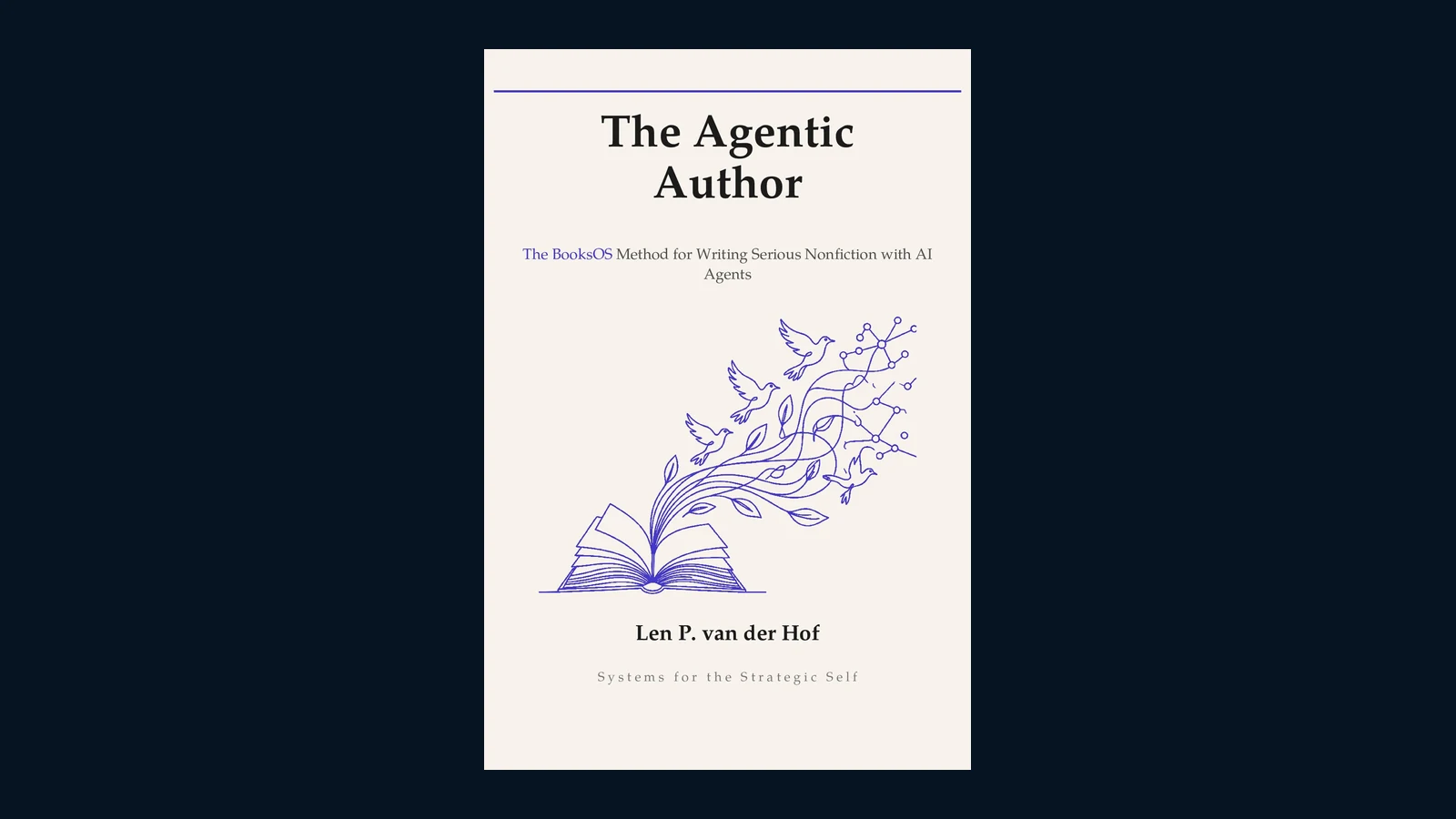
Neither path produces a serious book. A third path does, and The Agentic Author documents it. The book is live. This page is the operator intro, not the definition of the pipeline. What is BooksOS? owns the seven names.
The reframe that unsticks a draft
You are not “bad at writing.”
You are running authorship without architecture.
A stalled manuscript is often structural collapse wearing the costume of procrastination. The author reads the stall as a verdict on discipline. The cheaper diagnosis is a missing system: nothing was built to inspect, so the failure is invisible until 30,000 words disagree with each other.
The book opens with a hard sentence:
You are not writing a book. You are building a knowledge-production system that happens to output books.
Most books are written as events. You clear the calendar, summon discipline, and push. Momentum holds it together until life breaks the streak. The return is harder than the start, because nothing was built to inspect. The author decides they lack talent. Usually they lack a sequence: input, output, gate. Without those joints, research, structure, drafting, and editing happen in one head, and you cannot isolate the stage that failed.
The visible result is the book. The durable asset is the system. Books end. Systems keep producing. An author who treats each title as a heroic event begins every project from nothing. An author who treats authorship as a system keeps the brief, the bible, the map, and the ledger. The second book begins where the first stopped.
That reframe is not poetry. It is the operating-system upgrade. Speed does not repair a method. It amplifies one. An event run at machine speed is still an event. It mass-produces the flaw.
What the book installs
The Agentic Author is the operator manual for BooksOS, a seven-stage production pipeline for serious nonfiction written with AI agents: Brief, Bible, Map, Draft, Edit, Package, Launch. Agents run specialist work inside a stage. The author certifies the gate. Judgment, voice, and the byline stay human.
What is BooksOS? is the search-term page: the seven names, the tell when you skipped one, and the refusal that keeps a CMS or a speed course from stealing the word. This intro will not restage that table.
What the book adds, and the definition page does not, is the operating posture:
- Treat agents as specialists (research, structural critic, fact-checker, red-teamer, bilingual editor), never as a ghostwriter.
- Separate judgment from execution so a stage can be delegated without surrendering the book.
- Run an evidence ledger and a hallucination check that catch the confident sentence that is merely fluent.
- Hold one voice across a draft, and across two languages, by writing the standard down before you write the prose.
- Keep the method tool-agnostic, so a model change does not retire the gates.
The book was researched, drafted, edited, fact-checked, packaged, and adversarially reviewed by the method it teaches. That recursion is a proof posture, not a magic trick. Anyone can print “made with AI.” The unit of differentiation is the audit trail: named gates, a claim-level ledger, receipts in the book. This article does not reprint the bibliography.
Each stage leaves a named artifact. Each stage ends in a gate. Twelve working artifacts ship in the book, from a one-page brief to a ninety-day plan. You do not need a throughput number. You need one claim that cannot name its source, and a gate that can fail it.
Why gates beat prompt culture
Prompt culture optimizes for output volume.
Gate culture optimizes for defensible quality.
A prompt pack is not a production system. A folder of chapters in a drive is not a production system. A model that “writes 2,000 words an hour” is weather. When the tool changes, the gate still has to hold.
That is why the book folds the scarce work into the stages rather than into a chat window:
- claim-level evidence tracking, so a number cannot wander between chapters
- hallucination checks folded into review, so fluency is not treated as verification
- adversarial pressure before packaging, so a weak argument is attacked on purpose
- bilingual native editions as two products, not one clumsy translation
- tool-version isolation so the method outlives this month’s model
Fiction is a different craft. A “write a book in a weekend” shortcut is a different product. A reader who wants the model to keep the byline should leave the book on the shelf. The load-bearing asset in this method is the author’s judgment. Everything else is designed, delegated, and governed.
If you came looking for a named-model tutorial, a prompt library, or a marketing playbook that treats the book as a funnel asset and stops there, this is the wrong object. The method will make a credibility asset, but only as the output of a gated line. It will not teach you buttons. Tool surfaces change. The gate is what you keep.
Who feels the click immediately
- the author with 30,000 words and no spine
- the founder who needs a book as a credibility asset, not a vanity PDF
- the consultant who cannot risk soft claims
- the creator graduating from posts to a body of work
- the coach who wants a system clients can run with them
If you want magic buttons, leave it on the shelf.
If you want judgment to stay load-bearing, buy it. Kindle, paperback, and hardcover are live in English and Dutch. The book page owns the full grid. ASINs below match that page. This intro does not invent editions.
Buy the format that matches your craft
English editions (Amazon.com)
| Format | Link |
|---|---|
| Kindle | Buy English Kindle |
| Paperback | Buy English paperback |
| Hardcover | Buy English hardcover |
Dutch editions (Amazon.nl)
| Format | Link |
|---|---|
| Kindle | Koop Nederlandse Kindle |
| Paperback | Koop Nederlandse paperback |
| Hardcover | Koop Nederlandse hardcover |
Dutch page: boeken/the-agentic-author.
The line to keep
An event run at machine speed is still an event.
Method turns speed into a body of work that compounds. The tenth book begins with a decade of decisions already made.
Install the system. Certify the gates. Keep the byline honest.