

No. 13 · Active development · AI & agents · SIGNAL
ML for Strategic Founders
Read Models, Not Math - Decision-Grade Machine Learning for Operators
Govern the models that touch your revenue without writing a line of code
Founders drowning in ML hype need decision literacy, not a data science degree. This book hands you the SIGNAL loop to scope, evaluate, and govern every model that touches revenue, risk, or reputation. It takes you from "I don't know what to ask my ML team" to running governance protocols that keep models honest and decisions defensible. A strategic lens, not a coding manual.
- pages
- 172
- chapters
- 14
- hours of reading
- ± 2
- editions
- EN · NL
- Design
- Drafting
- Manuscript
- Production
- Launched
The editions
Kindle, Paperback and Hardcover
Production shots of the editions. Not for sale yet — this page is the public working version.
-
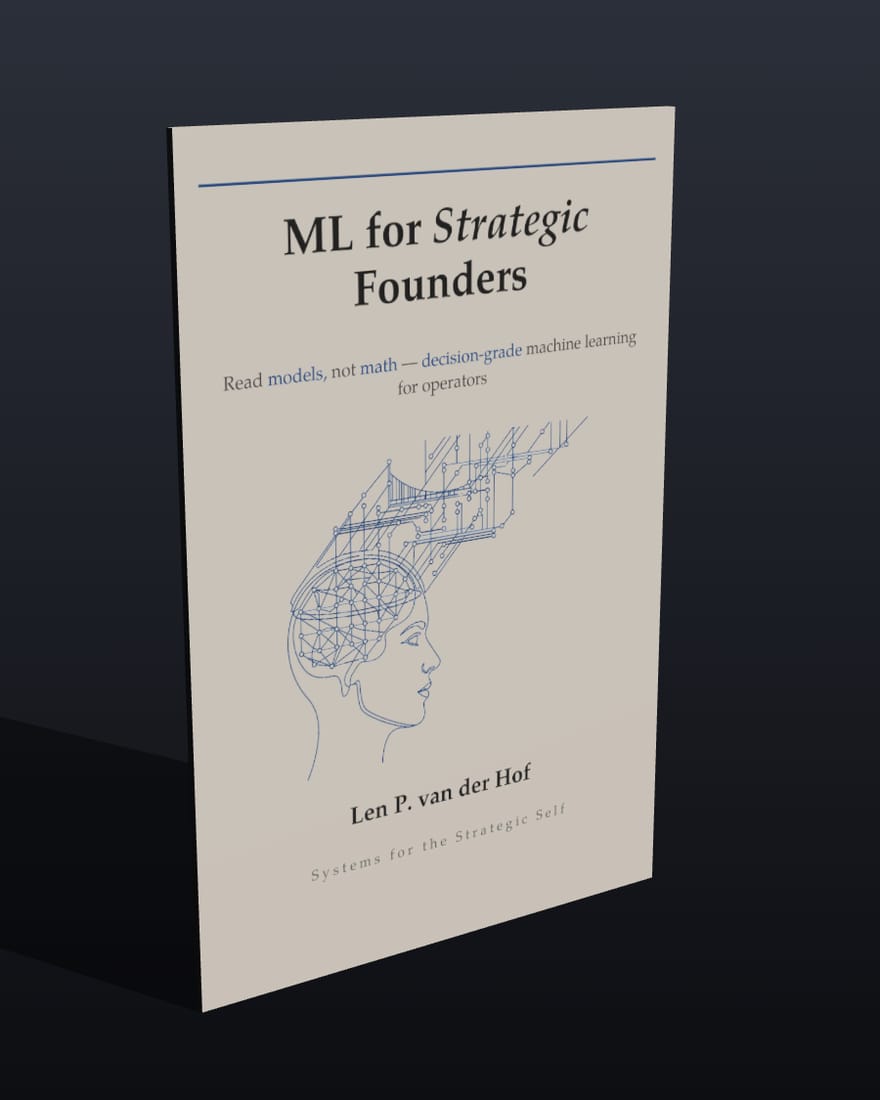
Kindle
The digital edition, ready in any Kindle app.
-
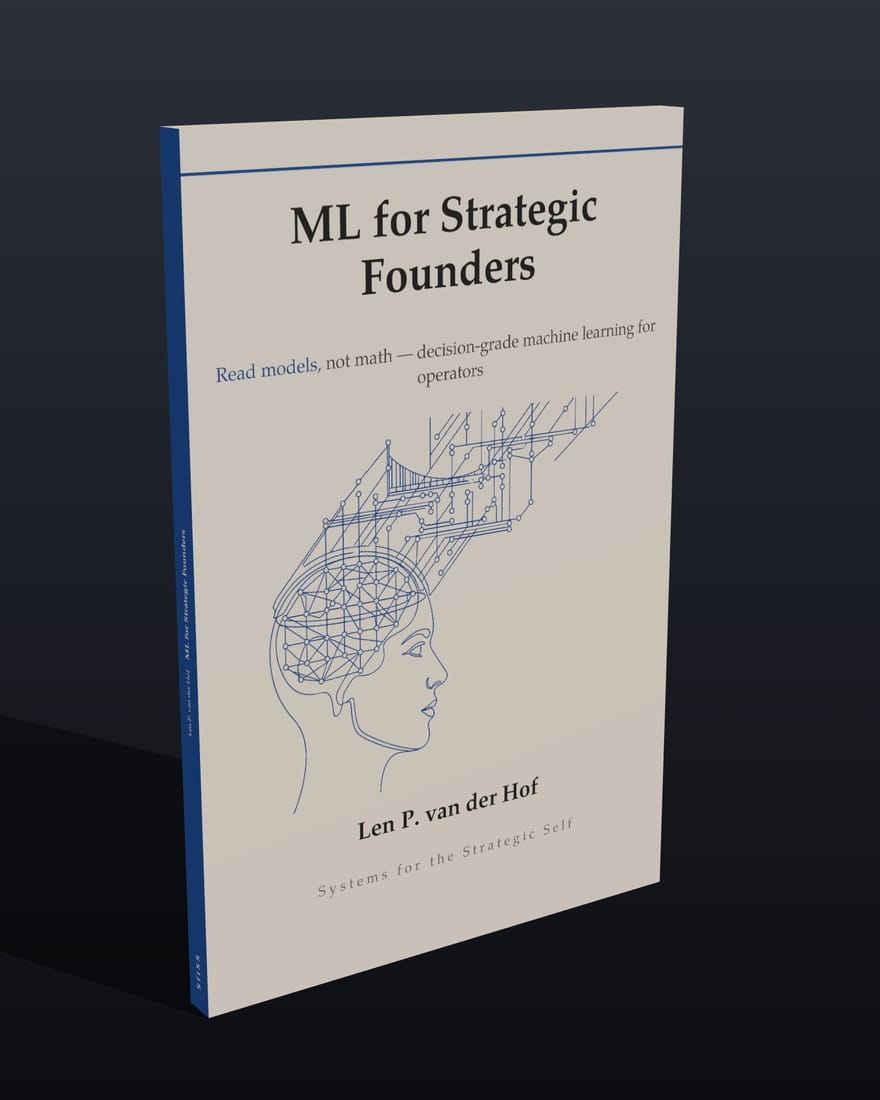
Paperback
The working copy. Mark it up. Take it into the meeting.
-
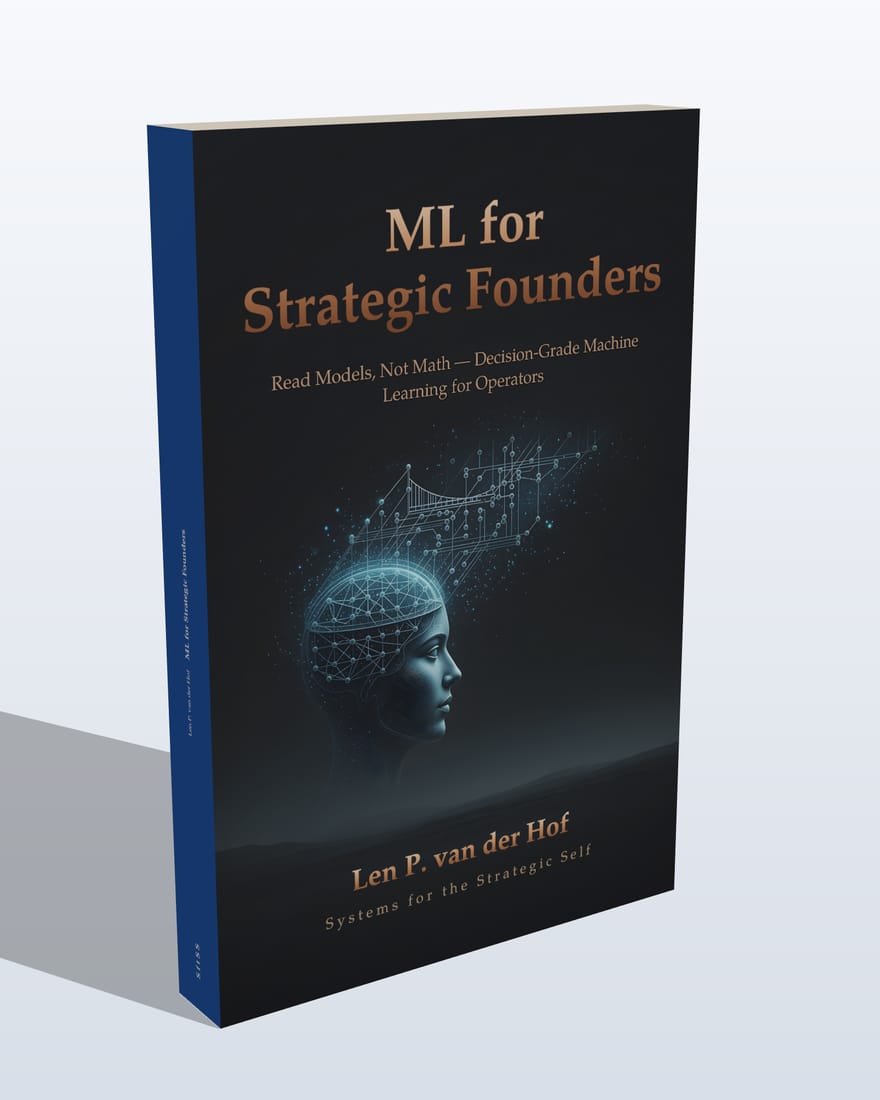
Hardcover
The shelf edition. Dark full-art jacket, built to stay in the room.


The book
Read Models, Not Math - Decision-Grade Machine Learning for Operators
A model tells you the lead will convert, the churn risk is high, the forecast says hire. You act on the number because the dashboard looks confident and arguing with it feels like admitting you do not understand the math. So you defer (to the tool, to the data team, to whoever built the thing) and quietly stop being the person who decides.
The usual advice is to "learn the fundamentals": take the course, study the algorithms, come back when you can do the linear algebra. It fails because you do not need to build the model. You need to interrogate its output before you bet the quarter on it.
ML for Strategic Founders is written for that moment. You will not derive a gradient or train a network. Instead it gives you SIGNAL (Scope, Inputs, Generalization, Noise, Accountability, Limits), six questions you run against any model output to learn whether it has earned a place in your decision. SIGNAL is the read; the algorithm underneath is weather. Change the tooling, and the questions still hold.
What you learn
What this book puts in your hands
- The SIGNAL loop: Scoping, Inputs, Ground truth, Noise, Audit, Learn for every model
- A strategic lens on what ML can and cannot do, no Python or TensorFlow required
- How to read vendor demos and benchmark claims and separate signal from noise
- How to scope ML projects that actually ship, and why most never do
- How to audit models for bias, drift, and failure before they cost you customers
The framework
SIGNAL, step by step
Scoping, Inputs, Ground truth, Noise, Audit, Learn for every model
-
Scoping
-
Inputs
-
Ground truth
-
Noise
-
Audit
-
Learn for every model
From the book
License & Disclaimer . . . . . . . . . . . . . . . . . . . . . . . . 162
ML for Strategic Founders, printed page: License & Disclaimer . . . . . . . . . . . . . . . . . . . . . . . . 162
Inspect more pagesLook inside
Pages from the print edition.
The contents
Chapter by chapter
Every chapter of ML for Strategic Founders with its printed epigraph, what you can do afterwards, and the moment it is built for.
Introduction
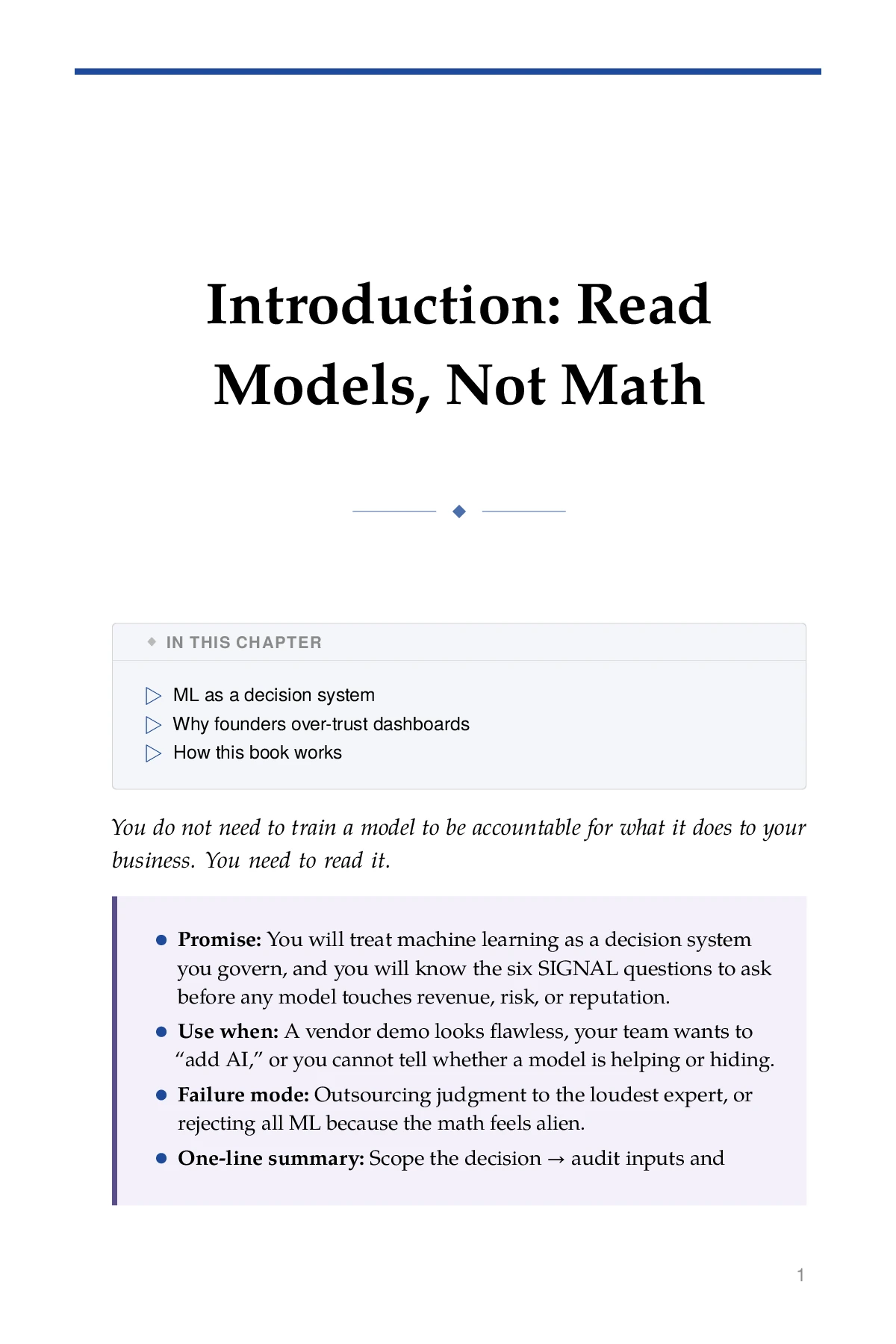
Introduction: Read Models, Not Math
You do not need to train a model to be accountable for what it does to your business. You need to read it.
Chapter 1
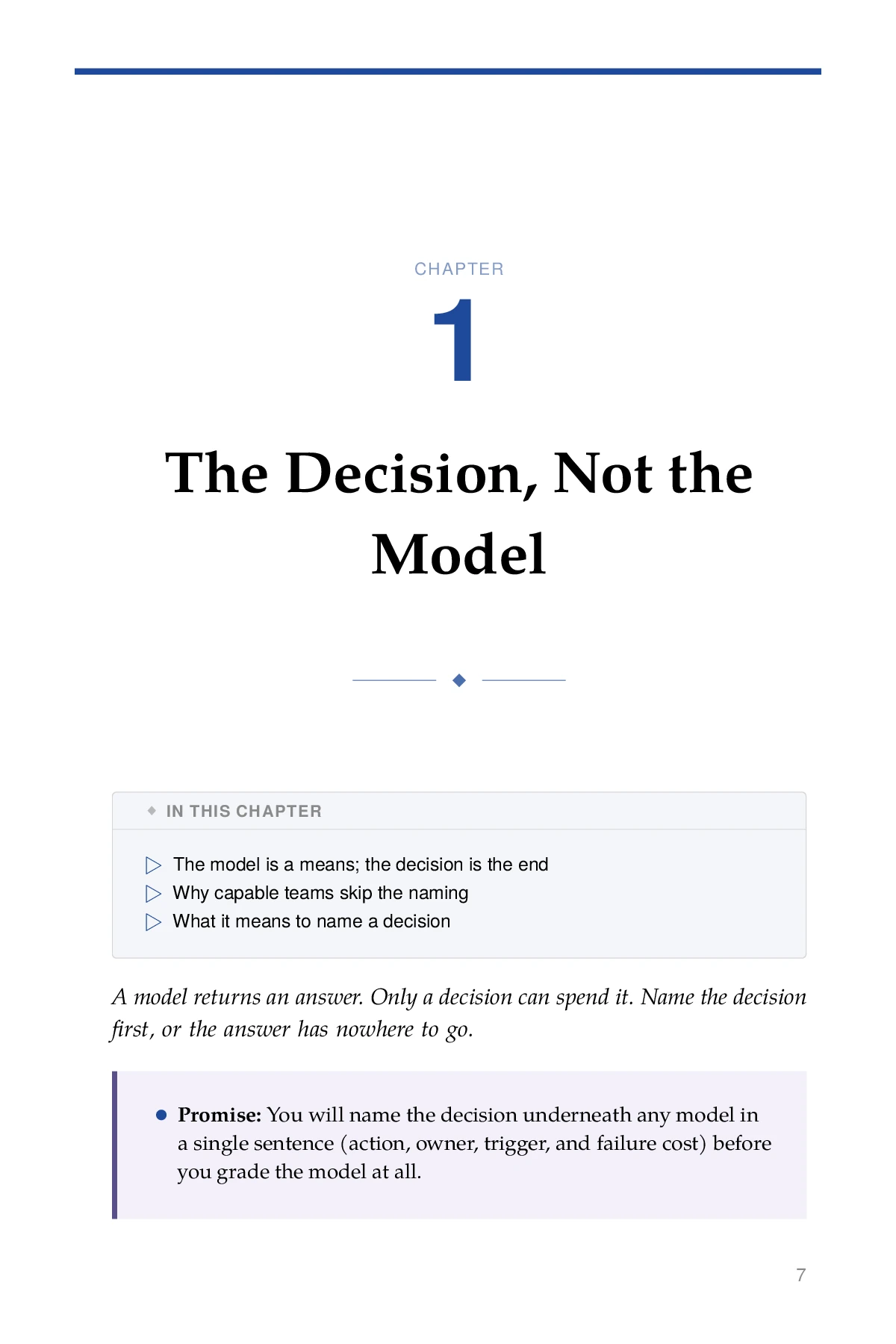
The Decision, Not the Model
A model returns an answer. Only a decision can spend it. Name the decision first, or the answer has nowhere to go.
Chapter 2
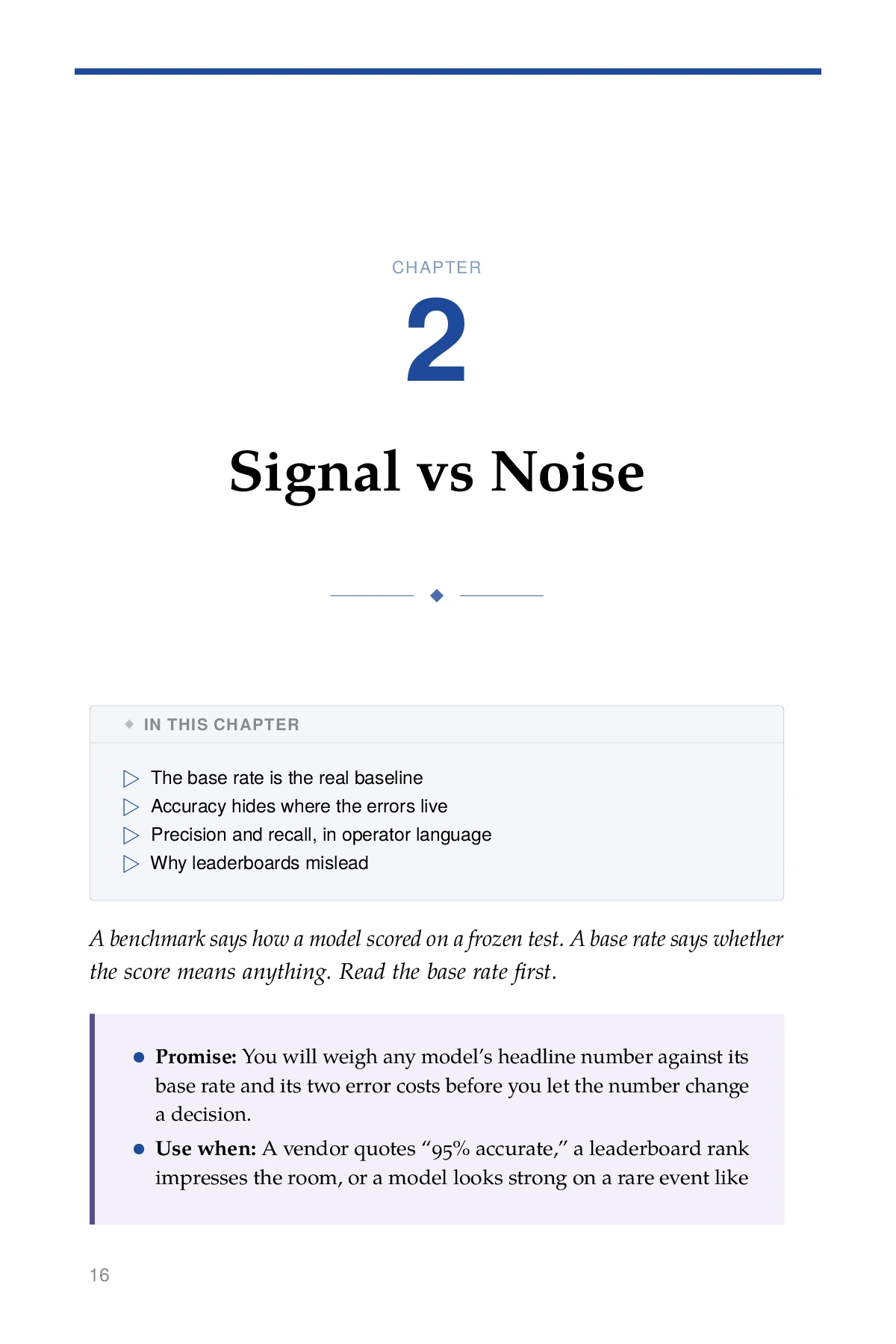
Signal vs Noise
A benchmark says how a model scored on a frozen test. A base rate says whether the score means anything. Read the base rate first.
Chapter 3
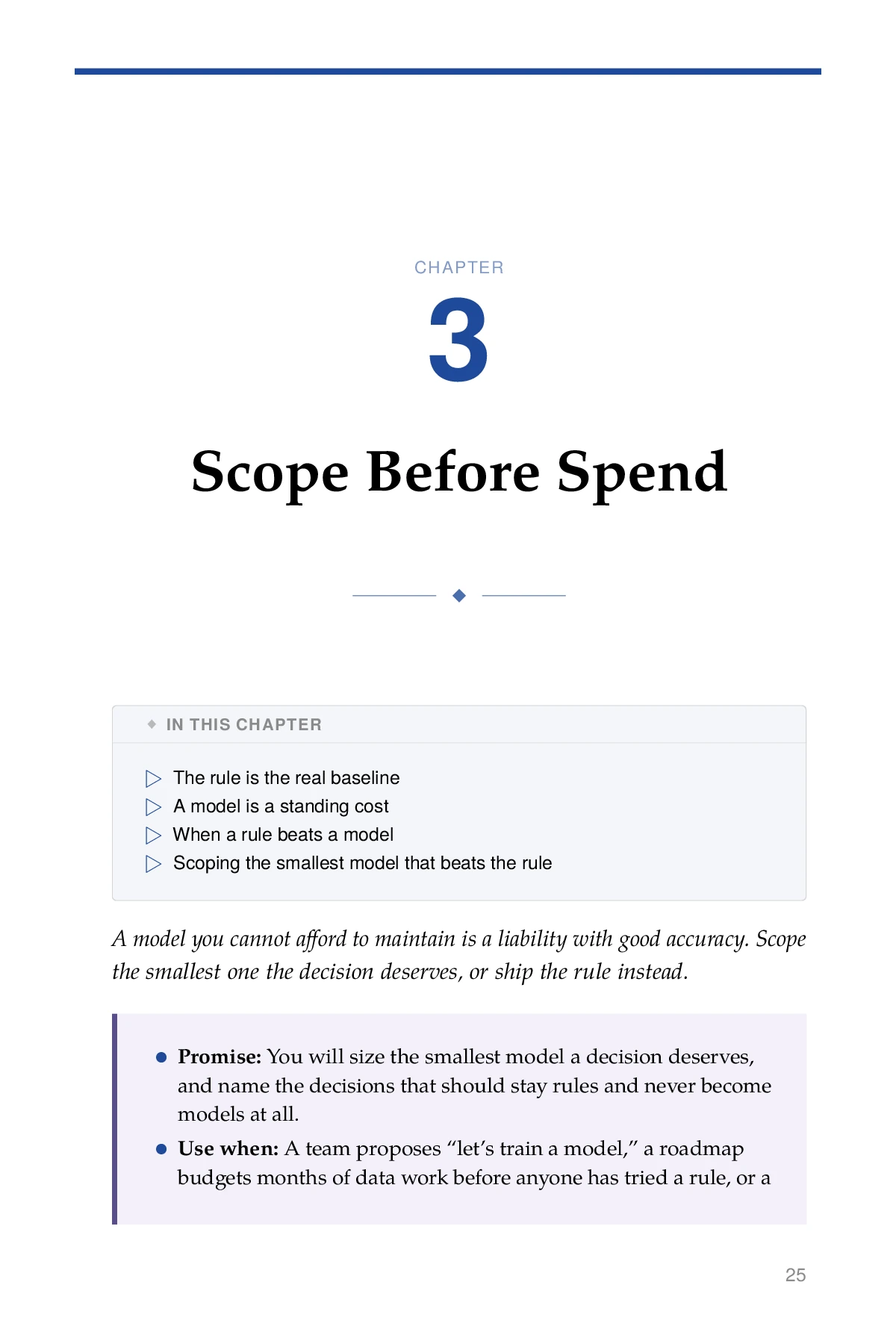
Scope Before Spend
A model you cannot afford to maintain is a liability with good accuracy. Scope the smallest one the decision deserves, or ship the rule instead.
Chapter 4
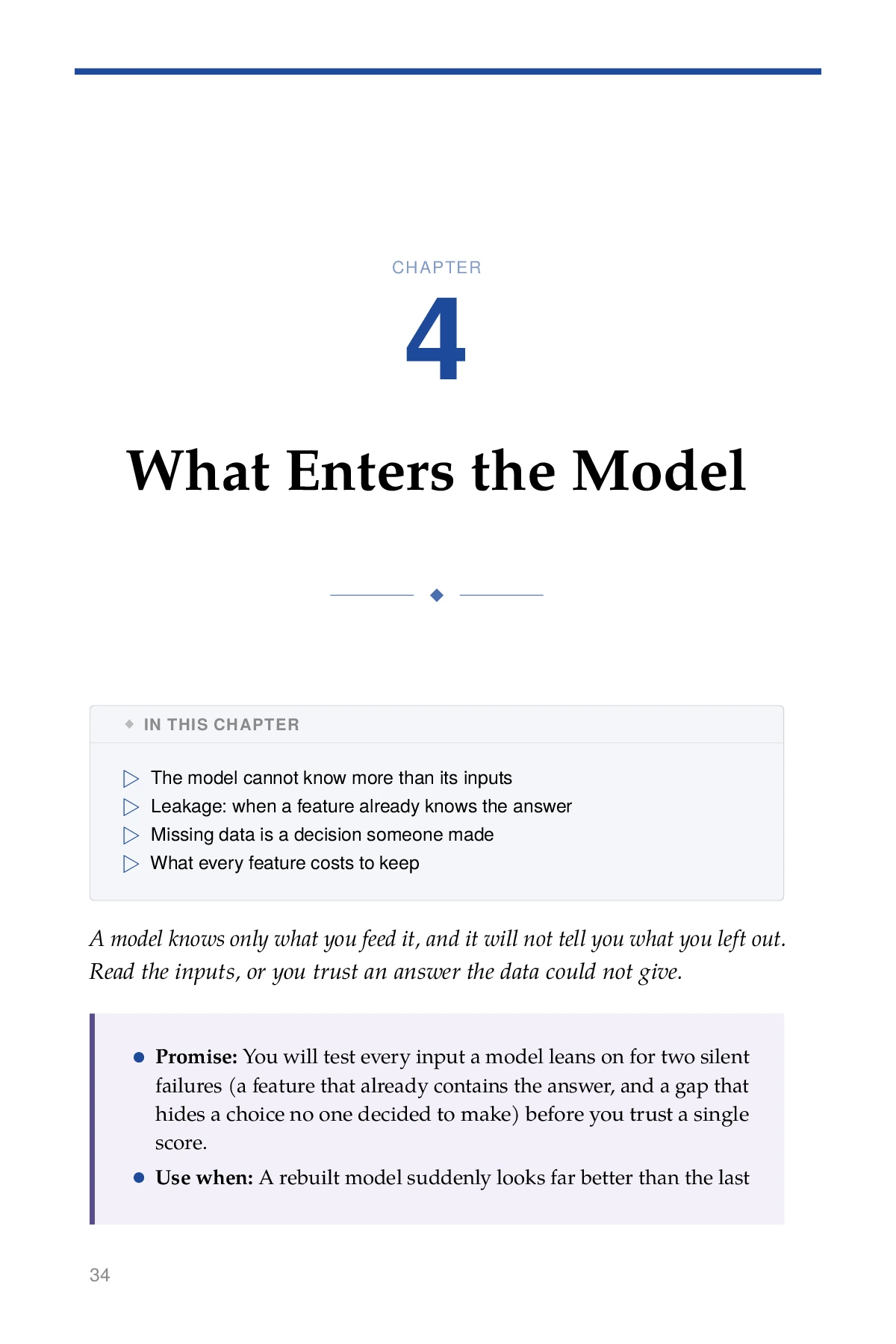
What Enters the Model
A model knows only what you feed it, and it will not tell you what you left out. Read the inputs, or you trust an answer the data could not give.
Chapter 5
What the Model Calls Right
A model learns the answer you marked, not the outcome you meant by it. Audit the answer key before you trust the grade.
Chapter 6
When the World Moves
A model learns the world as it was, then the world keeps moving. Accuracy is a reading that expires, not a property the model keeps. Check the date on every score.
Chapter 7
What Would Prove It Wrong
A model you cannot prove wrong is a model you cannot govern. Build the test that tries to kill it, and run that test while the model still looks fine.
Chapter 8
The Update Is a Decision
The audit tells you a model has turned. It does not tell you what to do, and the same failing score can call for three different answers. Teach the model again, trade it for another, or hand the decision back to the rule it never beat.
Chapter 9
The Demo Is the Ad
A demo is a model's advertisement: the inputs are clean, the baseline is flattering, and every number peaks inside a thirty-minute window the vendor chose. The six questions you learned to ask your own models are how you read past the ad to the model underneath.
Chapter 10
The Model Needs an Owner
A model is a standing position inside the company, not a deliverable that ships and goes quiet. Someone has to hold it: the decision it serves, the inputs it eats, the day it turns. Name that person on purpose, or the name defaults to no one.
Chapter 11
The Average Hides the Harm
A model earns the word helpful on the average and owes the word harmless to the person. The average is what the metric reports. The person is what arrives in a complaint, a lost account, or a regulator's letter. A model can be right about the many and wrong about the few, and the few are where the cost lives.
Chapter 12
A Framework Is What You Repeat
Conclusion
Conclusion: The Founder Who Reads Models
You opened this book accountable for models you could not read. You close it able to read any of them. What changed was never the math. It was the founder holding it.
Who it is for
Who this book was written for
This is not data science for spectators or a glossary you forget by Friday. It is operator-grade literacy: a protocol you run on a live model output, with a decision due and the cost of misreading it already on the table.
The result is precise. You stop outsourcing judgment to whoever owns the dashboard and read models the way you read a P&L: fluently, skeptically, on your own authority.
If your decisions carry real stakes and you are done deferring to numbers you cannot question, start here.
What you will use it on
- Evaluate an ML vendor without being fooled by demo data
- Ask the right questions in model review meetings
- Know when to kill a model project early
- Communicate model limits to sales and legal
Editions
Editions and specifications
| Edition | Formats | Chapters | Pages | Reading time | ISBN (paperback) |
|---|---|---|---|---|---|
| English ML for Strategic Founders | In production | 14 | 172 | ± 2 hours | — |
| Dutch ML voor strategische oprichters | In production | 14 | 192 | ± 2 hours | — |
Both editions are written natively. The Dutch text is not a machine translation of the English.
Frequently asked
What readers usually want to know
What is ML for Strategic Founders about?
The SIGNAL loop gives founders enough machine-learning literacy to scope, evaluate, audit, and govern models that touch revenue, risk, or reputation without becoming data scientists. The subtitle is: Read Models, Not Math - Decision-Grade Machine Learning for Operators.
What is the SIGNAL framework?
SIGNAL: Scoping, Inputs, Ground truth, Noise, Audit and Learn for every model. Scoping, Inputs, Ground truth, Noise, Audit, Learn for every model
Is there a Dutch edition?
Yes. The Dutch edition is ML voor strategische oprichters, written as a native edition rather than a machine translation. It moves through the same production line.
How long is ML for Strategic Founders?
This edition runs 14 chapters, 172 pages in print and roughly 2 hours of reading.
Who is ML for Strategic Founders for?
If your decisions carry real stakes and you are done deferring to numbers you cannot question, start here.
The production system
How this book was made
Every title moves through the same gated production line: sourced research, a claim-level evidence ledger, structural review, fact-checking, red-team critique, and a bilingual final edit. AI agents do specialist work inside those gates; judgment, voice, and accountability stay human.
- Claims enter an evidence ledger with a source and a confidence grade before they reach the page
- English and Dutch are two native editions, not a translation of one another
- Every chapter clears readability, rhythm, and style gates before it is typeset
The series
More in this theme


