

No. 33 · Manuscript complete · AI & agents · AGENT
AI Agents for Personal Health
Deploy Intelligent Systems to Monitor, Analyze, and Optimize Your Biology
Your wearables already collect the data. Now build the system that reads it.
Health data is abundant but fragmented. You wear an Oura Ring, track workouts in TrainingPeaks, log meals in Cronometer, yet nothing connects these streams. This book introduces the AGENT framework, a five-phase architecture for assembling health data, correlating it, and alerting you on meaningful changes. The same agentic thinking you apply at work, turned on your own biology. Not medical advice. Data architecture.
- pages
- 376
- chapters
- 13
- hours of reading
- ± 5
- editions
- EN · NL
- Design
- Drafting
- Manuscript
- Production
- Launched
The editions
Kindle and Paperback
Production shots of the editions. Not for sale yet — this page is the public working version.
-
Kindle
The digital edition, ready in any Kindle app.
-
Paperback
The working copy. Mark it up. Take it into the meeting.


The book
Deploy Intelligent Systems to Monitor, Analyze, and Optimize Your Biology
You wear the ring, sync the scale, and pay for the lab panel. The data lands in six apps that do not talk to each other, and once a quarter you skim a dashboard, nod at a number you cannot interpret, and close it. Your resting heart rate drifted up for eleven days before you noticed, in a chart, after the fact, when whatever caused it had already passed. You instrument your body better than ever and understand it no better than before.
The usual answer is another device, as if the problem were missing data. It is not. Nothing watches the data the way you would if you had the time, and you do not.
AI Agents for Personal Health gives you the layer that does the watching. It introduces the AGENT framework (Aggregate, Govern, Establish, Notice, Tune), five stages that turn a drawer of trackers into one intelligent system that monitors your biology, flags what matters, and tells you why. It does not replace your judgment or your physician. It builds the standing infrastructure that earns both better questions.
What you learn
What this book puts in your hands
- The AGENT framework: a five-phase architecture for assembling, correlating, and alerting on health data
- Connect fragmented streams from Oura, TrainingPeaks, Cronometer, and AutoSleep into one coherent system
- Agent design patterns: the daily briefing, the anomaly detector, the experiment tracker
- A privacy-first approach: run agents locally, with GDPR and data-sovereignty built in
- A clear scope boundary: data architecture for health, never medical advice or diagnosis
The framework
AGENT, step by step
a five-phase architecture for assembling, correlating, and alerting on health data
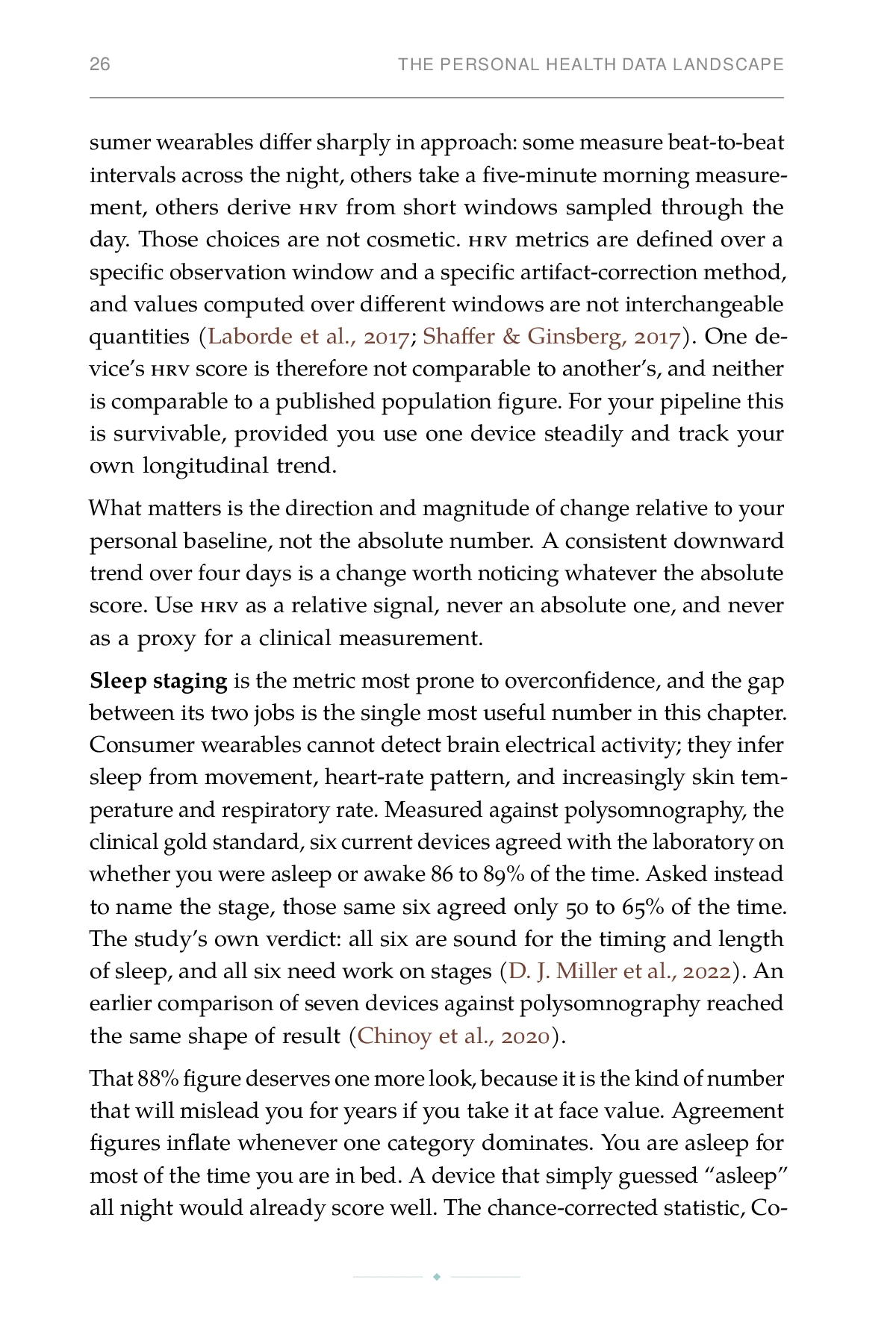
From the book
The study’s own verdict: all six are sound for the timing and length
AI Agents for Personal Health, printed page: The study’s own verdict: all six are sound for the timing and length
Inspect more pagesLook inside
Pages from the print edition.
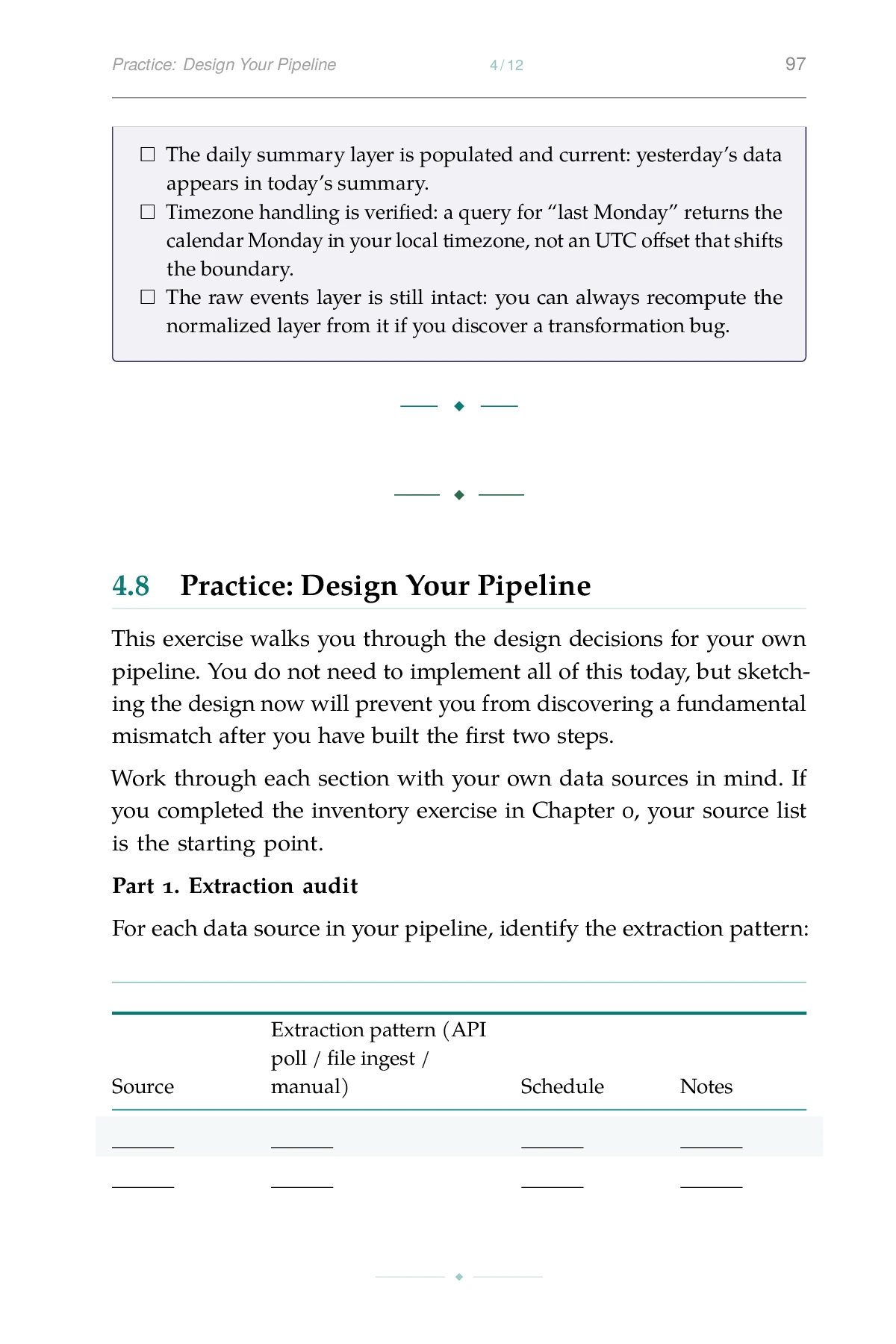
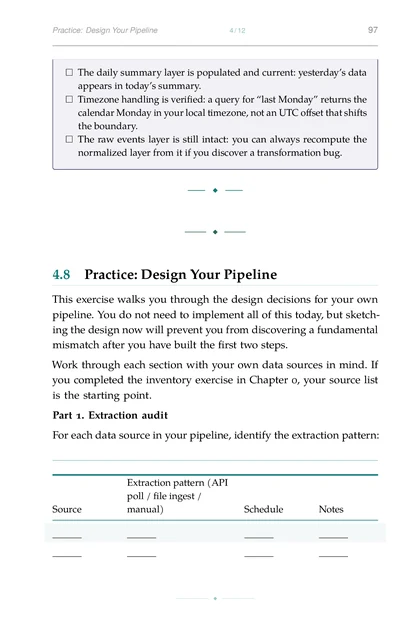 Practice: Design Your Pipeline 4 12 97
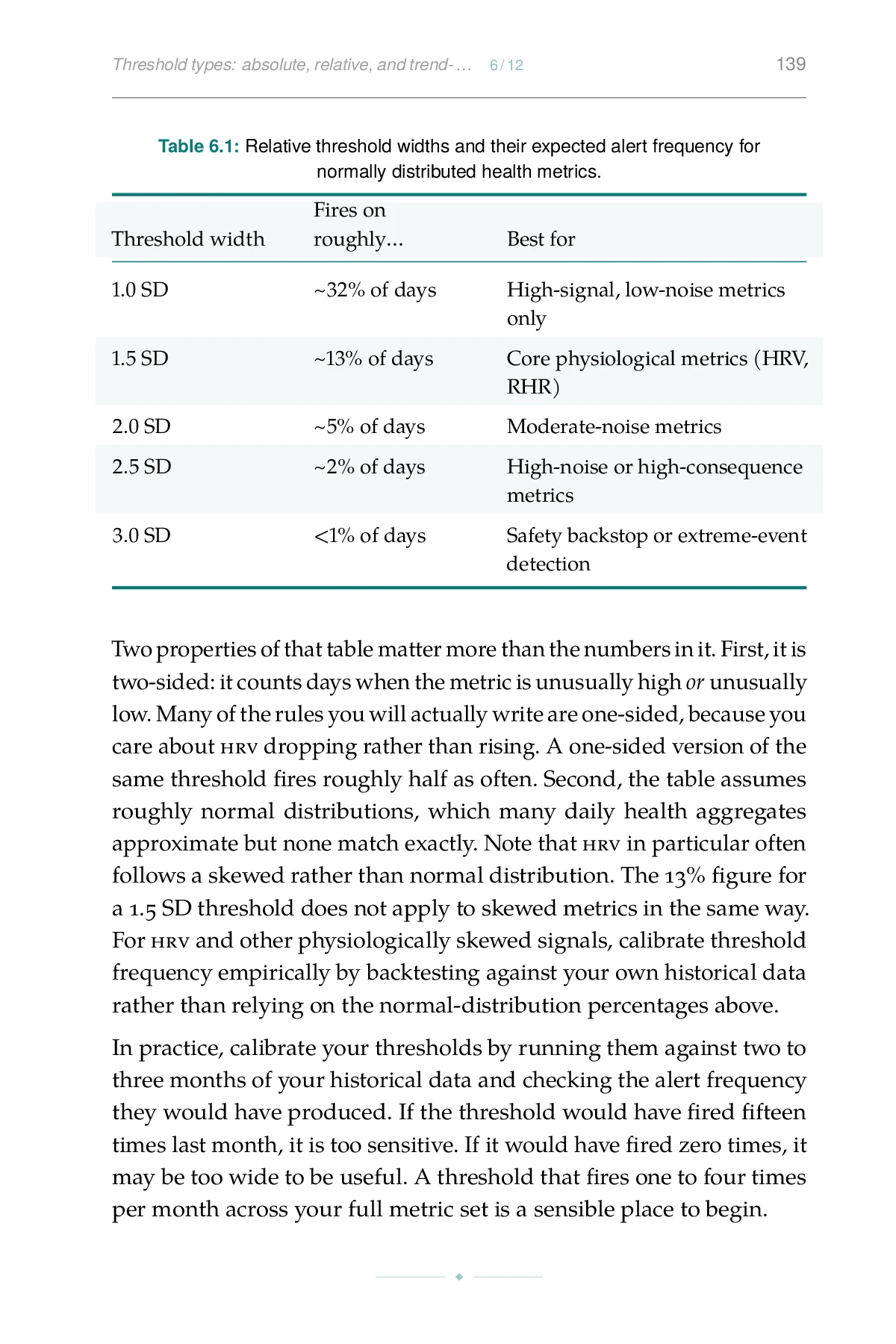
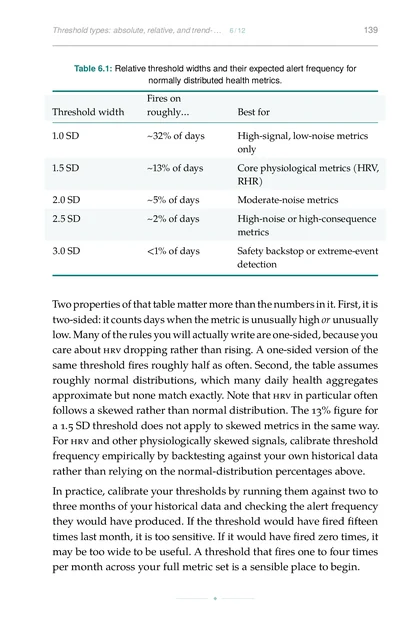 Threshold width roughly… Best
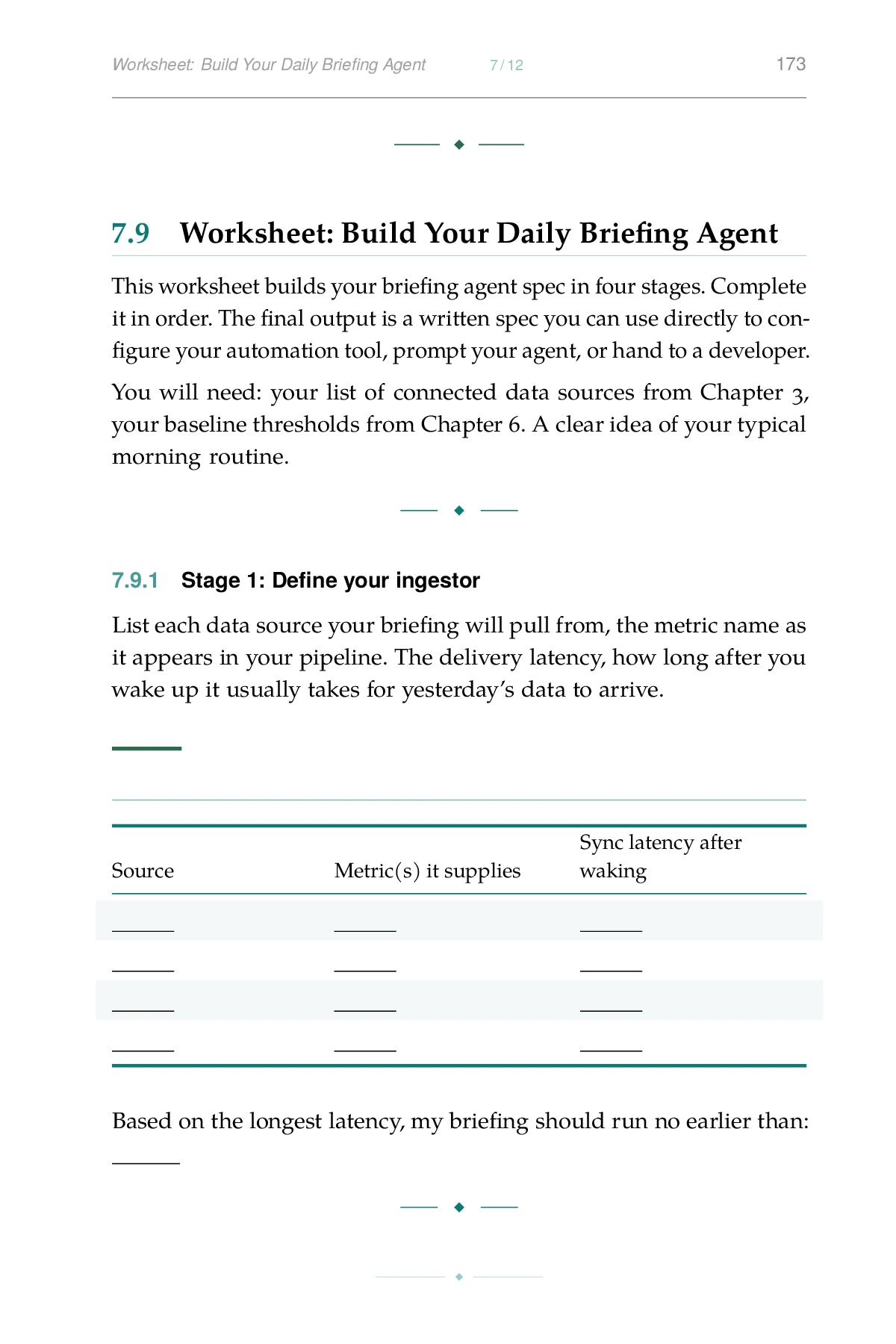
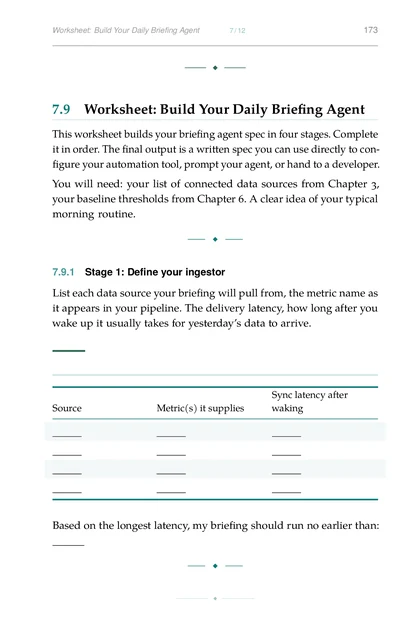 Worksheet: Build Your Daily Briefing Agent 7 12 173
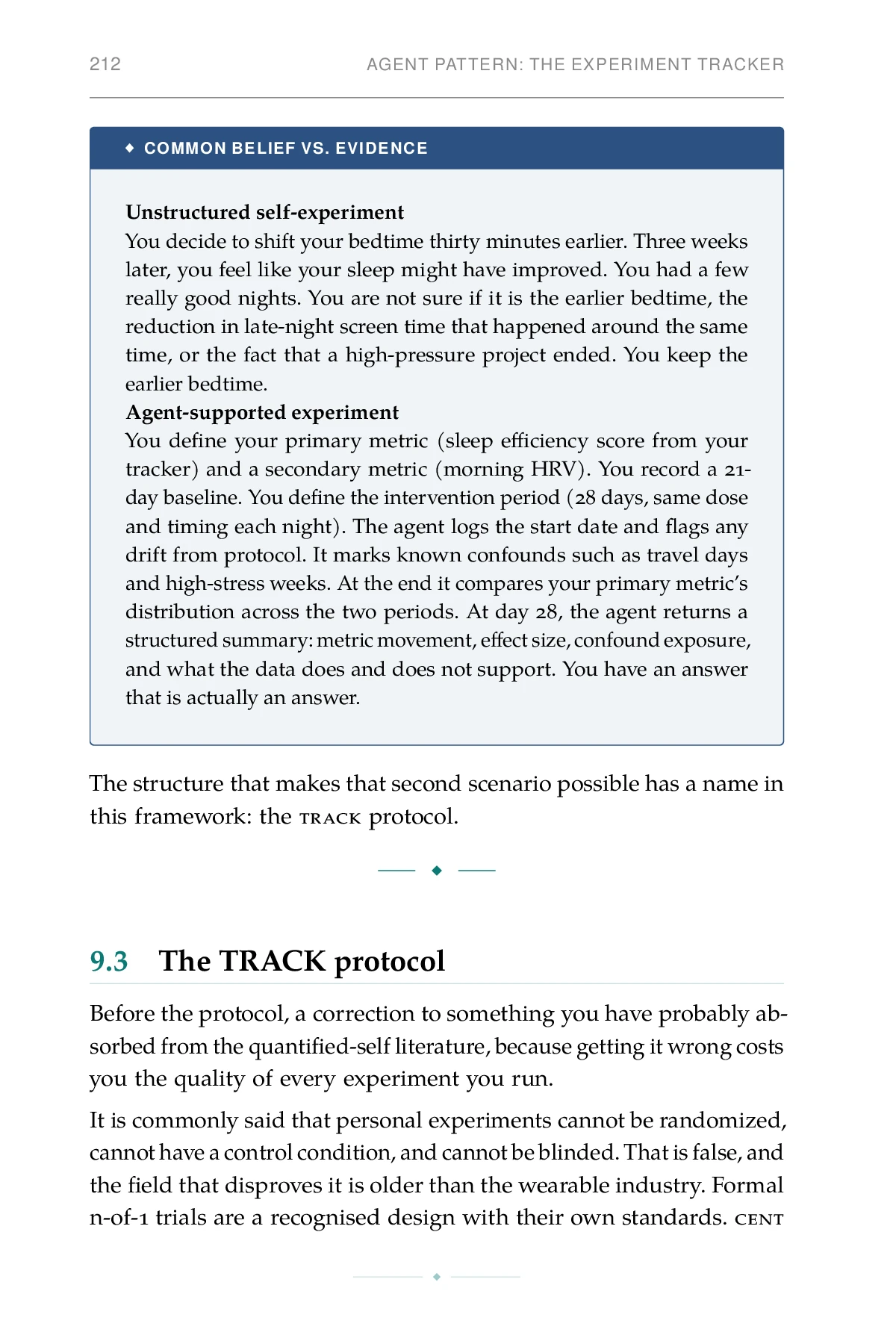
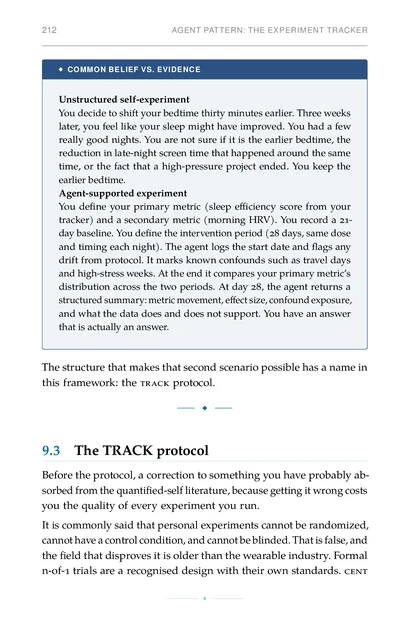 Agent-supported experiment
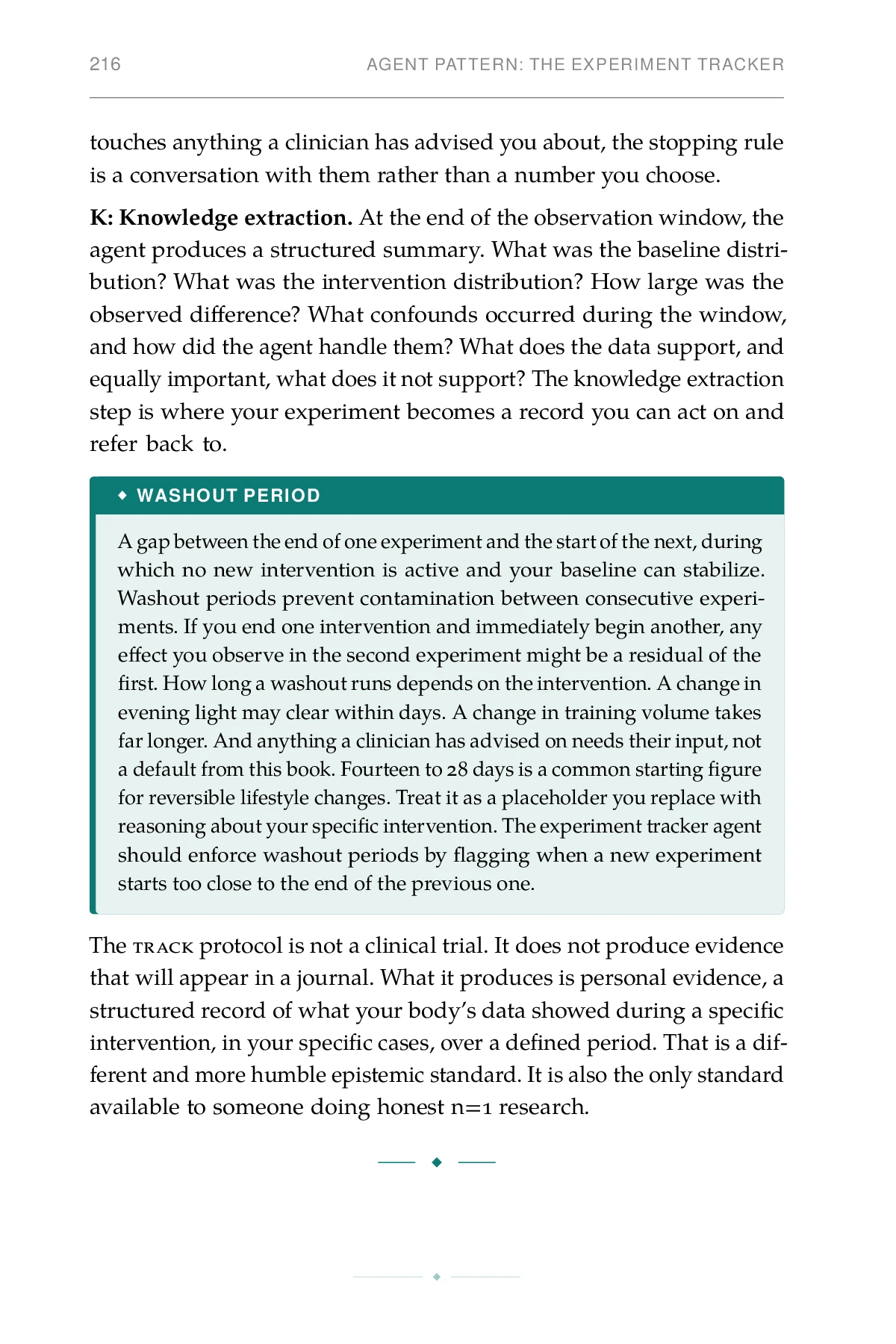
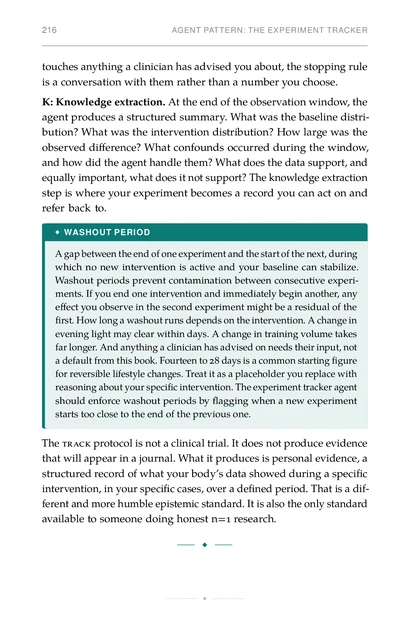 step is where your experiment becomes a record you can act
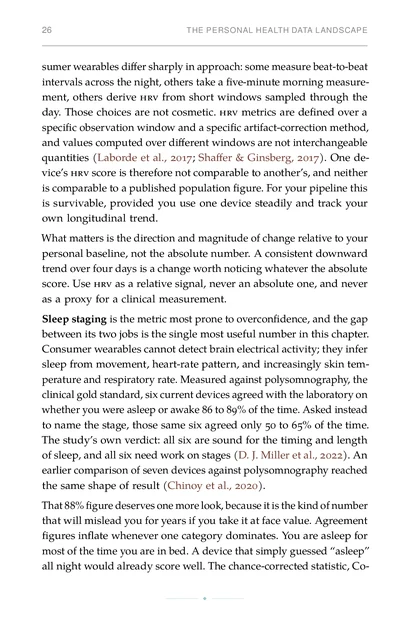 The study’s own verdict: all six are sound for the timing and length
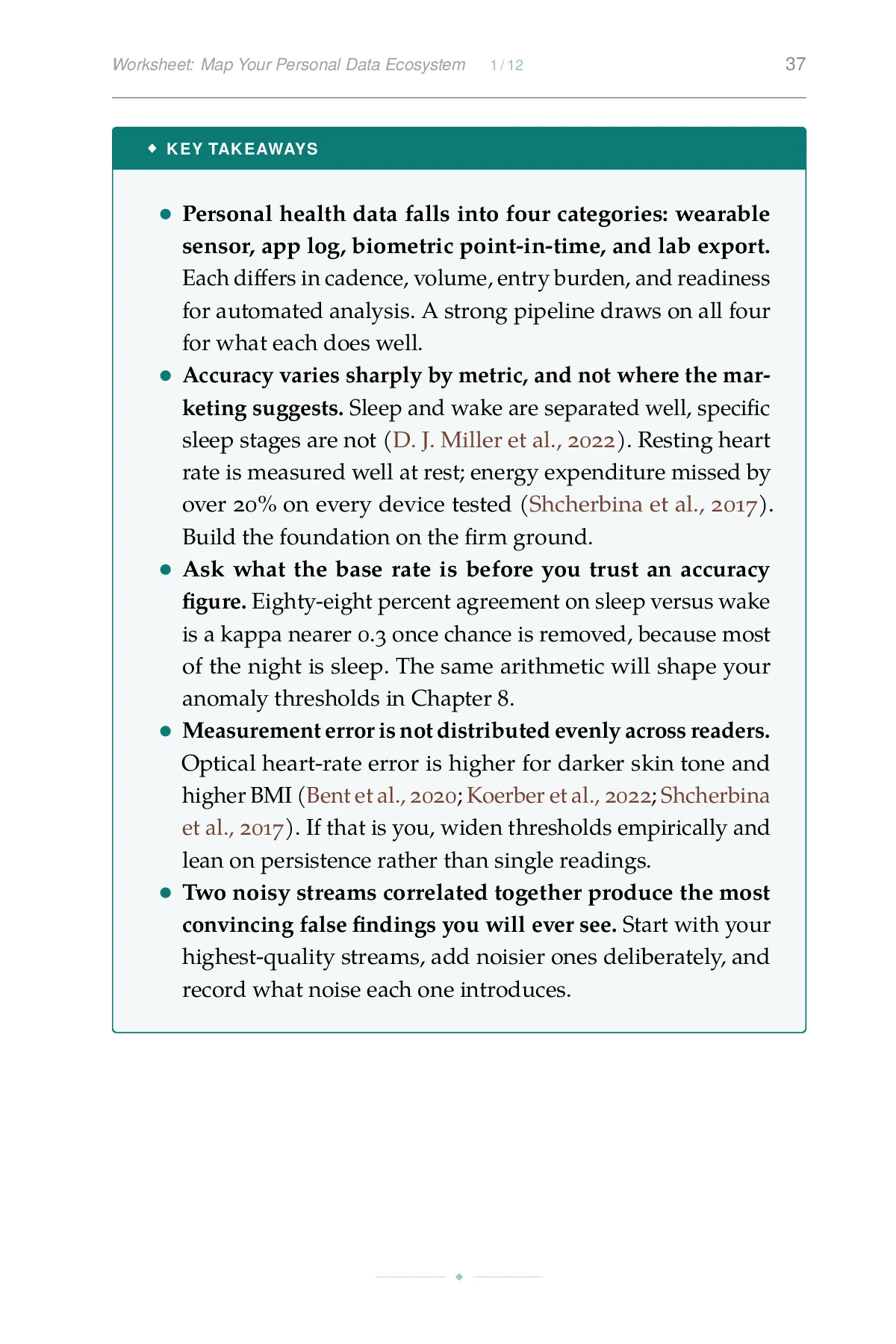
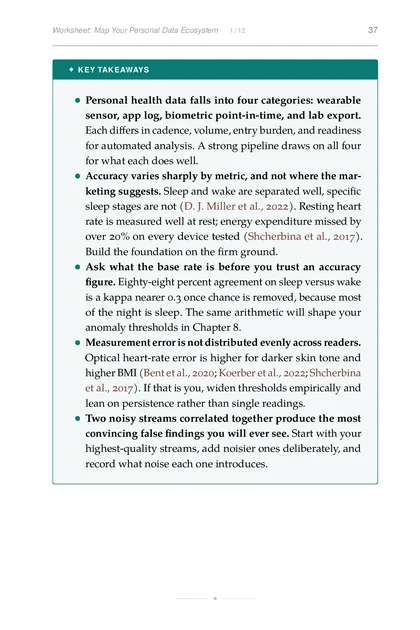 Worksheet: Map Your Personal Data Ecosystem 1 12 37
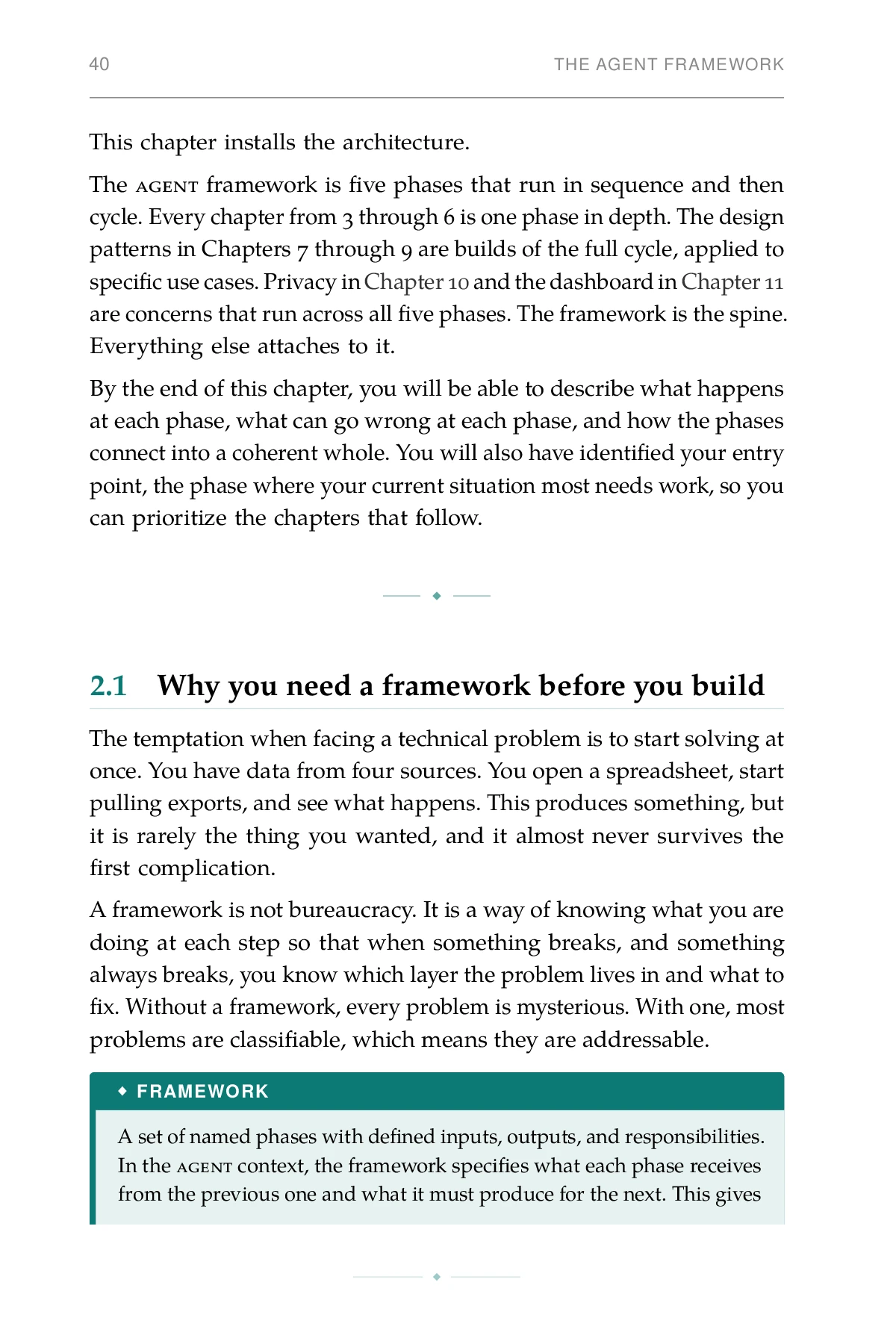
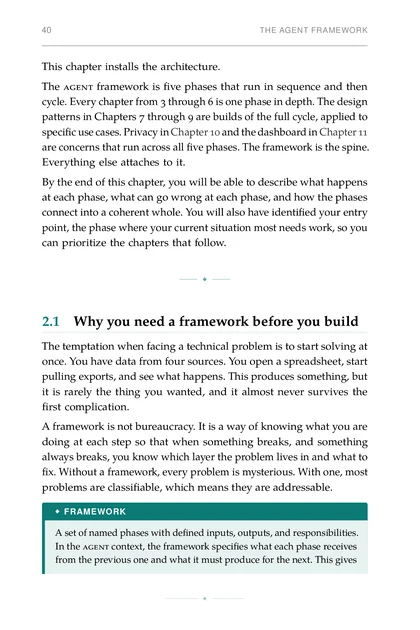 The agent framework is five phases that run in sequence and then
The contents
Chapter by chapter
Every chapter of AI Agents for Personal Health with its printed epigraph, what you can do afterwards, and the moment it is built for.
Introduction
Why Your Health Data Doesn't Talk to Each Other
The data about your body is richer than it has ever been. The problem is that it lives in five different apps that have never been introduced to each other.
What you can do afterwards
You will gain a clear understanding of why your health data feels useless despite being abundant, and a concrete path to connecting it.
Use this chapter when
You wear a tracker, log food or workouts, and still feel like you have no coherent picture of your health.
Chapter 1
The Personal Health Data Landscape
Knowing that you have health data is the beginning. Knowing what your data actually measures, and where it quietly fails, is where useful analysis starts.
What you can do afterwards
You will have an honest map of your health data streams. You will know what each one can and cannot tell a system. You will be able to judge your own data quality before you build on it.
Use this chapter when
You have wearables, apps or logs and want to know which signals are solid enough to build on, and which will add noise you cannot explain later.
Chapter 2
The AGENT Framework
Architecture is the difference between a system you can reason about and a pile of parts that now and then cooperate.
What you can do afterwards
You will have a complete mental model of the AGENT framework, Assemble, Generate, Evaluate, Notify, Tune, and understand what each phase takes in, produces, and hands to the next.
Use this chapter when
You are ready to move from recognizing the fragmentation problem to designing the solution. You want a shared vocabulary before you start building.
Chapter 3
Assemble: Connecting Your Data Sources
Data integration is not a technical luxury. It is the prerequisite for everything else in this book. And it is more achievable than most founders assume.
What you can do afterwards
You will understand every practical method for pulling your health data out of its silos and into a unified pipeline, including what to do when a source has no API at all.
Use this chapter when
You have identified your data sources in the Chapter 1 inventory and are ready to move from knowing what data you have to actually connecting it.
Chapter 4
Generate — Building the Agent Pipeline
Raw data is not insight. It is the raw material for insight, the same way ore is the raw material for steel. The pipeline is the smelter.
What you can do afterwards
You will understand how to design a pipeline that takes the raw, messy exports from your data sources and turns them into clean, structured, queryable health signals, the form your agents actually need.
Use this chapter when
You have connected at least one data source (Chapter 3) and your data is sitting in a folder or a database but still feels unusable. The timestamps are inconsistent, the units disagree, the gaps are unexplained, and you are not sure how to query any of it.
Chapter 5
Evaluate — Correlation and Analysis
Clean data is the beginning of honesty. What you do with it afterwards determines whether your analysis produces knowledge or convincing noise.
What you can do afterwards
You will be able to search your data for cross-domain relationships without fooling yourself. You will know how to handle the timing mismatches that make health data hard to correlate. And you will know how to say plainly what a correlation does not prove.
Use this chapter when
Your pipeline from Chapter 4 is running and producing clean, normalized signals. You have data from at least two different streams and want to know whether they are related.
Chapter 6
Notify — Alerting on What Matters
A good alert system does most of its work by staying silent. The alerts you never send are as important as the ones you do.
What you can do afterwards
You will understand how to design an alert layer that alerts on really meaningful changes in your health data, and stays quiet the rest of the time. The result is a system you learn to trust rather than tune out.
Use this chapter when
You have a functioning data pipeline (Chapter 4) and correlation findings (Chapter 5) and you are ready to operationalize your monitoring. You want alerts that catch important signals without turning into background noise you start ignoring.
Chapter 7
Agent Pattern — The Daily Briefing
Most health data is reviewed too late, too infrequently, or not at all. The daily briefing agent changes that by making review automatic, timed exactly right, and limited to what actually warrants your attention.
What you can do afterwards
You will understand how to design, configure, and use a daily briefing agent, a lightweight agent that runs each morning, summarizes the health signals from the previous 24 hours, and surfaces the one or two things most worth your attention today. By the end of the chapter you will have a working spec for your own briefing agent.
Use this chapter when
You have a functioning pipeline (Chapter 4) producing clean daily signals, and you have set at least one personal baseline (Chapter 6). You want a routine, low-friction touchpoint with your health data that does not require opening five apps or keeping a manual dashboard.
Chapter 8
Agent Pattern: The Anomaly Detector
The most useful alert is the one you did not know you were waiting for. Every other alert is the system rehearsing for that moment.
What you can do afterwards
You will be able to design a detector that watches several metrics against your own baselines at once. It alerts when something moves across your data, rather than when one metric briefly crosses a line someone else drew.
Use this chapter when
You have a working data pipeline (Chapter 4) and a configured alert layer (Chapter 6) and you want to move from per-metric alert to pattern-level detection. The anomaly detector is the right next step when you find your individual metric alerts are firing in isolation without telling a coherent story.
Chapter 9
Agent Pattern: The Experiment Tracker
The difference between trying something and running an experiment is not intent. It is infrastructure.
What you can do afterwards
You will understand how to design an experiment tracker agent that turns your n=1 self-experiments into interpretable data rather than anecdote. By the end of this chapter you will have a working design for a tracker that manages baseline, intervention, and washout periods, and surfaces what the data actually shows when the experiment ends.
Use this chapter when
Your pipeline runs (Chapter 4), a detector stands watch (Chapter 8), and you want to test one specific change and know whether it worked.
Chapter 10
Privacy and Data Sovereignty
Health data is not like other data. Knowing what you slept last night, how your heart responded to stress last week, and where your glucose sits after meals is knowing something about you that no public record contains. Keeping that knowledge yours is not paranoia. It is basic architecture.
What you can do afterwards
You will see why health data demands more of your architecture than any other personal dataset. You will leave with concrete decisions: local-first processing, encryption, where the law reaches, and which models you can run yourself.
Use this chapter when
Your pipeline works, and you are now asking what should have been asked first. Where does my data go, who can reach it, and what law applies to a system I built for myself?
Chapter 11
Your Personal Health Dashboard
A dashboard that shows you everything shows you nothing. The final act of building a personal health agent system is deciding what deserves a panel, and having the discipline to leave the rest out.
What you can do afterwards
You will learn to design a personal health dashboard that makes your entire agent system visible and actionable without demanding your attention. By the end of the chapter you will have a clear design spec: which metrics earn a daily panel, which earn a weekly review, and which are fully delegated to your agents.
Use this chapter when
You have at least one working agent, ideally a daily briefing agent (Chapter 7) and an alerting layer (Chapter 6). You want a deliberate interface for the whole system rather than a collection of disconnected app screens. You feel the pull toward adding more panels and want a principled way to resist it.
Conclusion
The AI-Augmented Body
You built something that did not exist before: a layer of intelligence between your data and your attention. The question now is what you do with it.
What you can do afterwards
You will see the full system, not as a collection of parts you assembled chapter by chapter, but as a closed feedback loop that learns your patterns and improves as you do. You will also understand what the system should never attempt, how to share it responsibly, and how to write a short personal manifesto that makes your design choices explicit and yours.
Use this chapter when
You have worked through the AGENT framework and have at least a partial build running. You are ready to shift from builder mode to owner mode, from constructing the system to living inside it.
Who it is for
Who this book was written for
The result is precise: health monitoring stops being a quarterly chore and becomes ambient. You stop reacting to numbers after the fact and start running a system that catches drift early, on the only physiology that governs your output: yours.
If you are done collecting data you never read and ready to build something that reads it, start here.
The reader it was written for
Founder or operator who already uses AI tools for work but has not applied them to health. Technical or semi-technical. Already wears a wearable or tracks something. Comfortable with APIs, agents, and the idea of data pipelines. Has read AI Agents for Startup Strategy (or at minimum is familiar with AI agent concepts).
Also a fit for
1. Quantified-self early adopter with data but no synthesis. Has multiple data streams but no way to connect them. Technically literate but not a professional developer. 2. Health-optimization enthusiast who wants to add AI to their practice. Has read Outlive, Boundless, or similar. Wants the next level: AI-powered personalization. 3.
What you will use it on
- **Consolidate health data** — "I have data in 5 apps and I want one view
- **Find hidden correlations** — "Does my sleep quality predict my productivity?
- **Get actionable alerts** — "Tell me when something is off, not when everything is normal
- **Track experiments** — "Help me run a clean n=1 experiment on a supplement
- **Save time** — "I want the insight without the dashboard maintenance
Probably not for you if
- People looking for medical advice or clinical treatment (hard scope boundary)
- Non-technical readers uncomfortable with APIs, agents, or data pipelines
- Readers who want a "just tell me what to take" protocol book
- Pure wellness audience with no interest in AI or data
Editions
Editions and specifications
| Edition | Formats | Chapters | Pages | Reading time | ISBN (paperback) |
|---|---|---|---|---|---|
| English AI Agents for Personal Health | In production | 13 | 376 | ± 5 hours | — |
| Dutch AI-agenten voor persoonlijke gezondheid | In production | 13 | 396 | ± 5 hours | — |
Both editions are written natively. The Dutch text is not a machine translation of the English. · Trim size: 6x9″
Frequently asked
What readers usually want to know
What is AI Agents for Personal Health about?
A non-medical data architecture for founders who want personal AI agents to organize wearable signals, detect changes, and surface questions worth asking professionals. The subtitle is: Deploy Intelligent Systems to Monitor, Analyze, and Optimize Your Biology.
What is the AGENT framework?
a five-phase architecture for assembling, correlating, and alerting on health data
Is there a Dutch edition?
Yes. The Dutch edition is AI-agenten voor persoonlijke gezondheid, written as a native edition rather than a machine translation. It moves through the same production line.
How long is AI Agents for Personal Health?
This edition runs 13 chapters, 376 pages in print and roughly 5 hours of reading.
Who is AI Agents for Personal Health for?
If you are done collecting data you never read and ready to build something that reads it, start here.
The production system
How this book was made
Every title moves through the same gated production line: sourced research, a claim-level evidence ledger, structural review, fact-checking, red-team critique, and a bilingual final edit. AI agents do specialist work inside those gates; judgment, voice, and accountability stay human.
- Claims enter an evidence ledger with a source and a confidence grade before they reach the page
- English and Dutch are two native editions, not a translation of one another
- Every chapter clears readability, rhythm, and style gates before it is typeset
The series
More in this theme


